Showing posts with label poll workers. Show all posts

Sunday, August 24, 2008

Governor Notes Need for Election Officials

No matter which political party or presidential candidate one supports, it is impossible to ignore the likelihood that this November's election will have one of the highest voter turnouts in recent memory. Both Republicans and Democrats are registering new voters and, judging from the heavy interest in the Democratic primaries, many of these new voters will be coming to the polls this fall.

Across the country, election administrators are scrambling to recruit and train new poll workers to serve the voters on election day. The anticipated long queues of voters will move much faster if there are sufficient numbers of poll workers to process them, answer their questions, solve any problems that might arise, and count the votes at the end of the day.

In Virginia, the term of art we use for "poll worker" is "election officer," (or "EO"). Each precinct is required to have at least three EOs, including at least one from each of the two legally recognized political parties (Republicans and Democrats). Election officials work a long day, since polls open at 6:00 a.m. and close at 7:00 p.m. (Their tasks begin earlier than 6:00 o'clock and do not end at 7:00 o'clock, however, since there are detailed procedures for opening and closing the polls to assure that votes are accurately counted and all the various forms documenting the day's activities are fully and correctly filled out.)

Last week Governor Tim Kaine of Virginia (who will not, it turns out, be a candidate for vice president this year) acknowledged the need for additional election officials in Virginia in a news release. Here is the text of what he distributed to the press on August 20:

LOCALITIES STEADILY FILLING OFFICER OF ELECTION VACANCIES

~ Outreach efforts include partnering with businesses ~

RICHMOND - General Registrars and Electoral Boards around the Commonwealth are beginning to realize their goal of fully staffing their election precincts for the November presidential election. Localities are continuing to recruit people to serve as Officers of Election to help voters at the polling places on Election Day, November 4.

"In every election there is an opportunity for citizens to be part of the process," Governor Timothy M. Kaine said. "This year, we launched the 'Ensure the Vote' campaign to inform voters of the opportunity to help with elections in their communities. We are appreciative that employers throughout the Commonwealth are embracing this opportunity for community participation and encouraging their employees to get involved in their community on Election Day. State Farm Insurance, for example, has provided nearly 300 people ready to act as Officers of Election. "

Officers of Election assist the voter on Election Day. An individual must apply to become an Officer of Election and must be a qualified voter.

Virginia still needs more than 2,000 people to help on Election Day. Originally, 10,000 people were needed, but through community outreach efforts and business partnerships that number has been reduced. The increased need stemmed from the creation of 300 new precincts since 2004 and the projected increase in voter turnout for the November election.

In order to further focus the recruitment process, areas around the state have been designated as "hot spots" or places with substantial vacancies. These areas have recruited a large number of Officers of Election, but need more. These areas include: City of Fairfax, City of Richmond, Alexandria, Chesterfield County, Henrico County, Loudoun County, Virginia Beach, Frederick County, Norfolk and Pittsylvania County.

Earlier this spring, the Virginia State Board of Elections, in partnership with the Virginia Electoral Board Association (VEBA) and the Voter Registrars Association of Virginia(VRAV), launched a statewide campaign called "Ensure the Vote" to encourage individuals to become Officers of Election. The State Board of Elections has subsequently developed community partnerships with numerous businesses such as: State Farm, Bank of America, Erie Insurance, Federal Reserve Bank of Richmond, Virginia Automobile Dealers Association, Virginia Chamber of Commerce, Ukrops Grocery, League of Women Voters, US Investigation Services, Rockingham Group, LandAmerica, State Employees of Virginia and Phillip Morris: an Altria Company. These partnerships provide an opportunity for their employees to work the polls in their respective communities.

Applications to become an Officer of Election are available online and can be submitted through the web site. For more information on applying to become an Officer of Election visit the Virginia State Board of Elections web site at www.sbe.virginia.gov or contact your local registrar.

# # #
In the City of Charlottesville, we have about 150 election officers ready to go on November 4. Fifteen of them (or about 10 percent) work for State Farm in their daily lives. Others work for the University of Virginia, Martha Jefferson Hospital, SNL Financial, and various local businesses. Many are retirees. (The average age of pollworkers in the United States is 72.) We also have high-school student pages drawn from the ranks of future voters who are not yet eligible to vote by dint of their age.

One hundred and fifty election officers is sufficient for most elections, but we could easily use 50 or so more. We have scheduled several training sessions during the month of October, so nobody should be afraid to offer themselves for the job out of fear that they will not have time to learn how to do it right. Pollworkers are also paid for their time and provided with lunch on election day.

Any registered voter is qualified to work as an officer of election. There is no requirement that he work in his own precinct, or even in her own voting jurisdiction. (Some of the EOs in Charlottesville live in Albemarle, Fluvanna, and Greene counties; they choose to work in Charlottesville for convenience or other reasons.)

Those interested in working as an election officer in Charlottesville can get more information through the Office of Voter Registration and Elections on the city's web site.
Monday, October 23, 2006

Student Pollworkers Sworn In


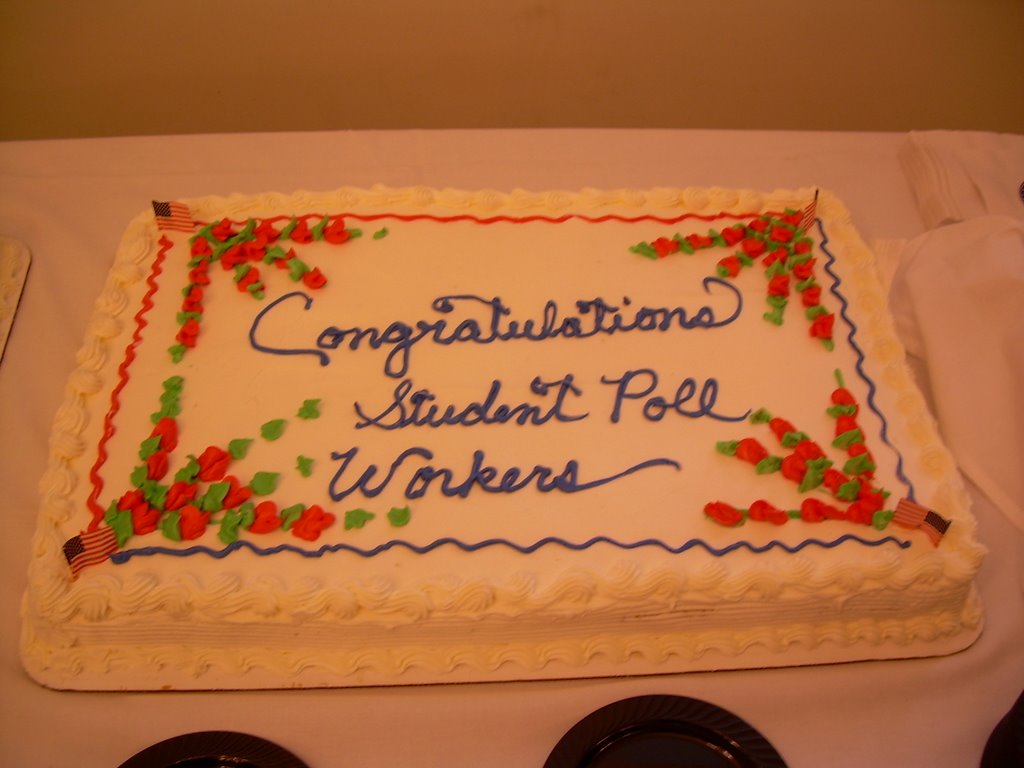
As previously announced, the UVa Center for Politics today sponsored a ceremony to swear in student pollworkers who were recruited by the Center and the Offices of Voter Registration and Elections in Charlottesville and Albemarle County.

The ceremony attracted VIPs from the local, state, and federal level, including Charlottesville Mayor David Brown, Secretary of the State Board of Elections Jean Jensen, and federal Election Assistance Commissioner Graciela Hillman. WCAV-TV has a report (including video) here.

Here are some snapshots from the event, which took place in the Dome Room of the Rotunda on the grounds of the University of Virginia.


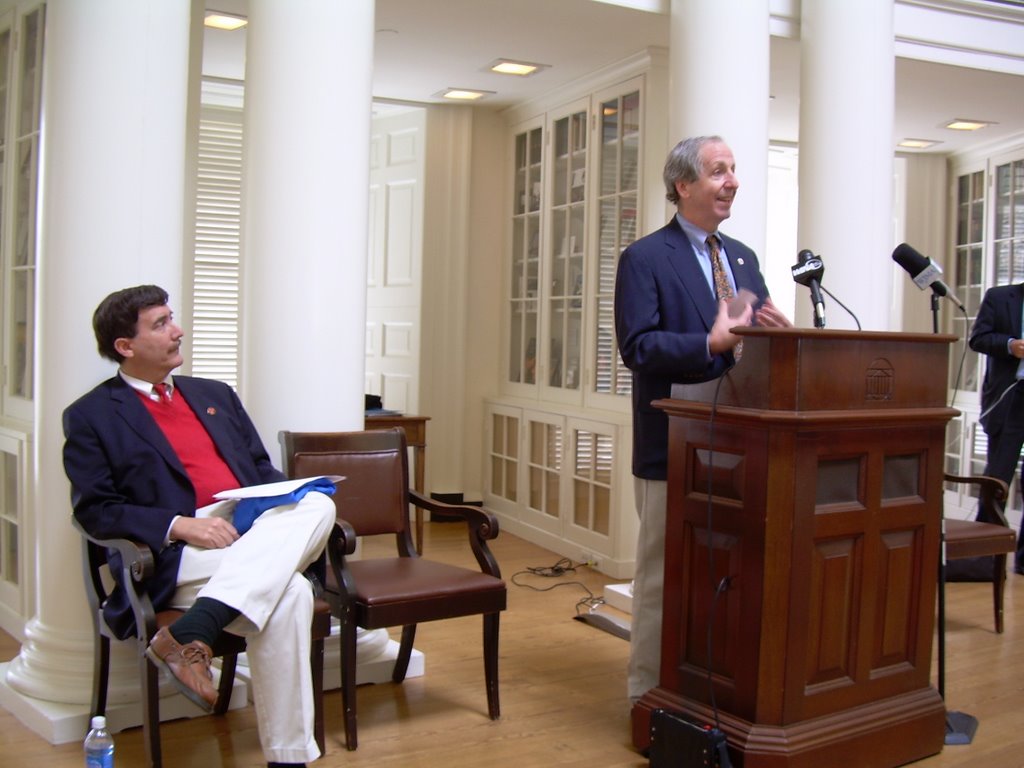
Larry Sabato of the UVa Center for Politics welcomes guests and student pollworkers to the Rotunda.


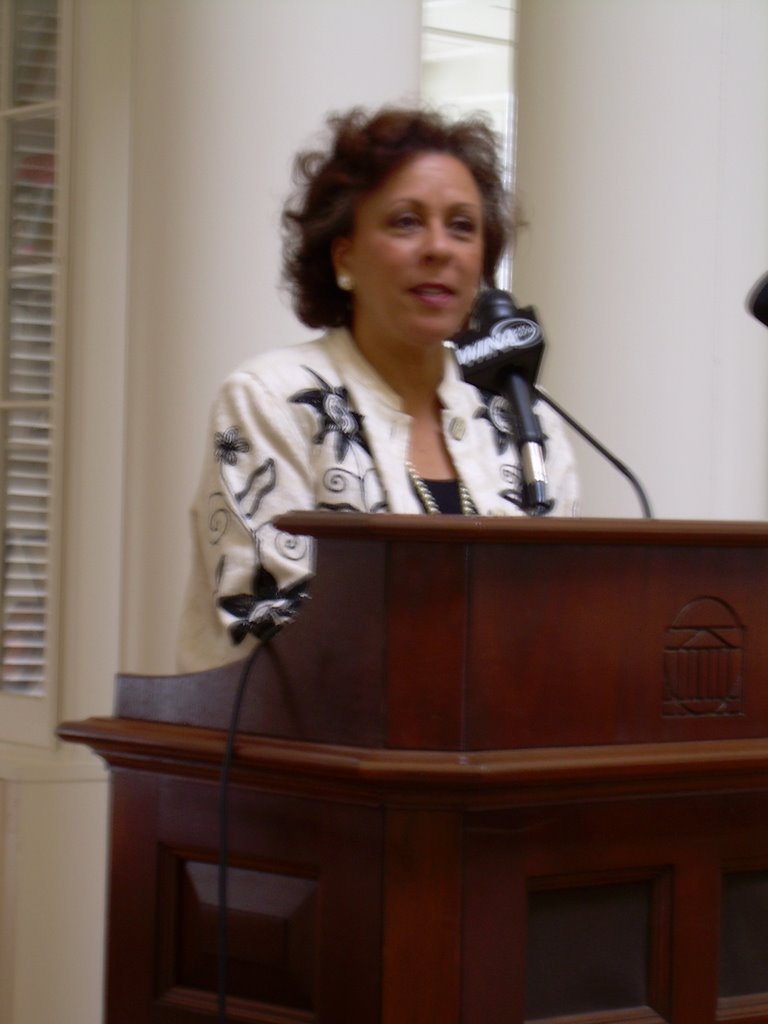
Graciela Hillman of the federal Elections Assistance Commission (EAC) traveled from Washington to attend the ceremony and commend the student pollworkers -- and to suggest Congress should allocate more money for programs to recruit younger pollworkers around the country.


Jean Jensen, secretary of the State Board of Elections, noted the comfort level of college-age people with electronic devices and asked that the new pollworkers convey any ideas they might have for improving the election process, based on their observations on the upcoming Election Day.


Larry Sabato looks on as Charlottesville Mayor David Brown expresses his appreciation for smoothly-run elections and speaks of his own experience in persuading young people to register to vote.


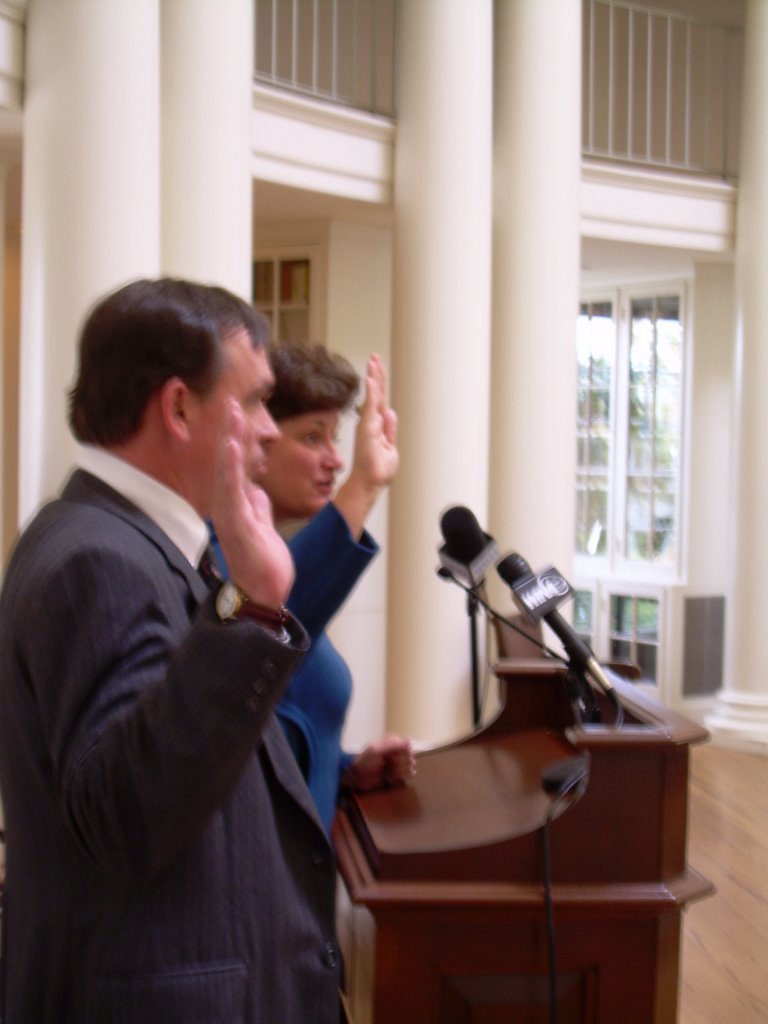
Albemarle County General Registrar Jake Washburn and Charlottesville General Registrar Sheri Iachetta swear in the new student pollworkers.


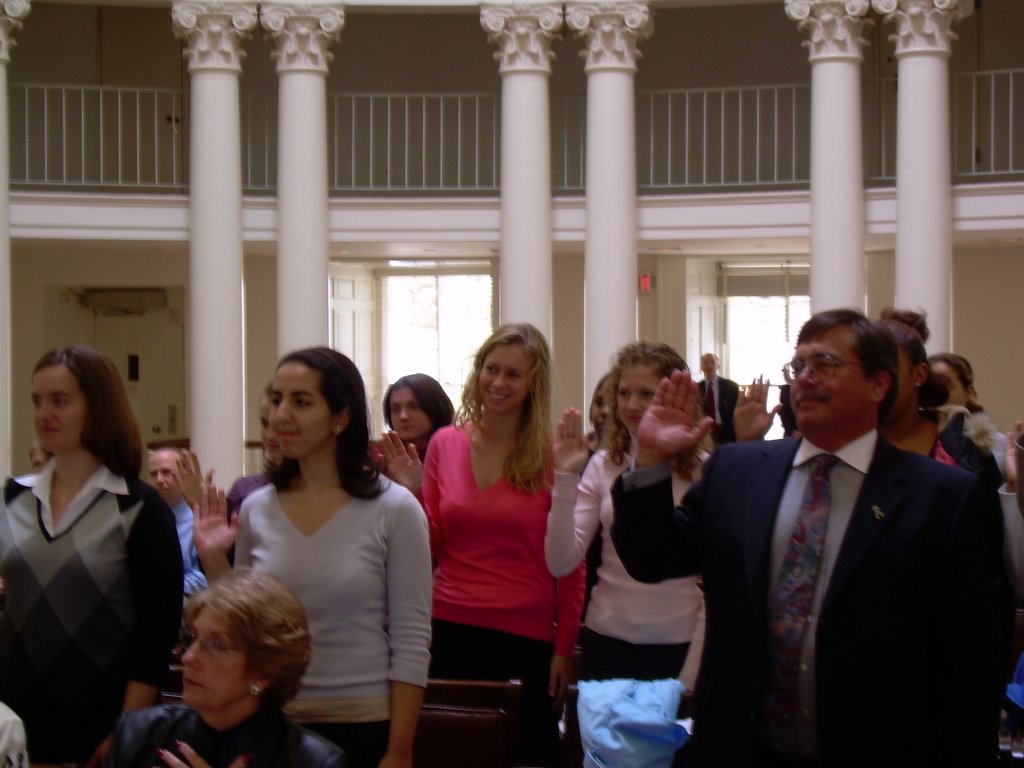
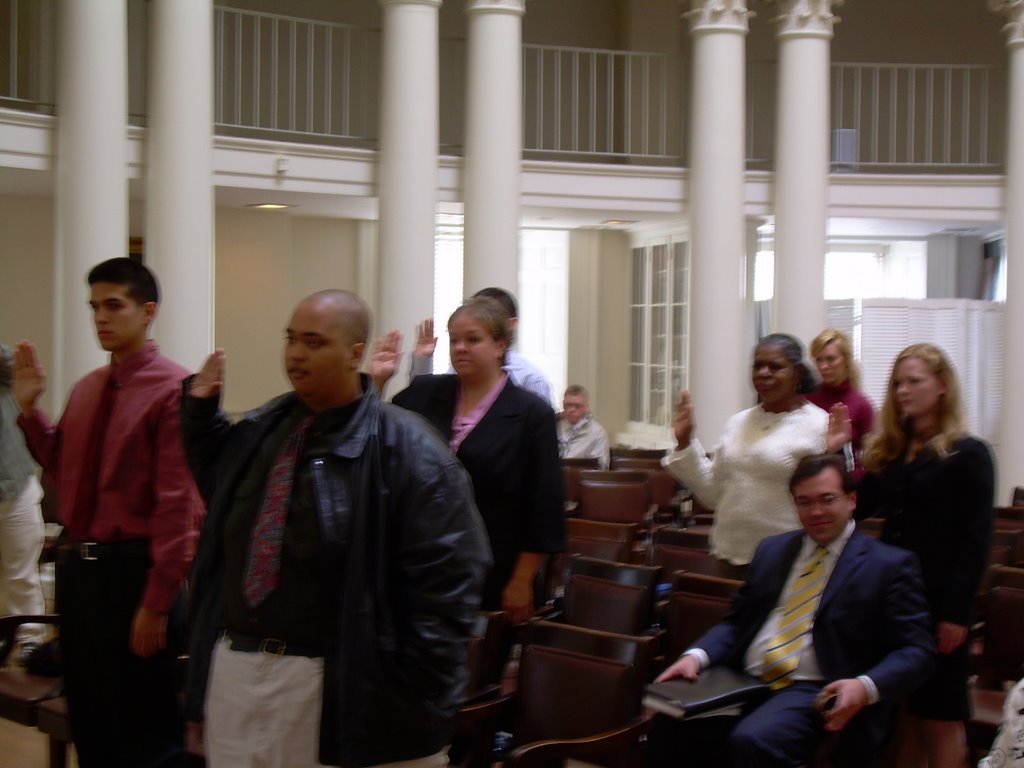
Student pollworkers take the oath.


More student pollworkers swear to uphold the Constitution and the Virginia Election Code.


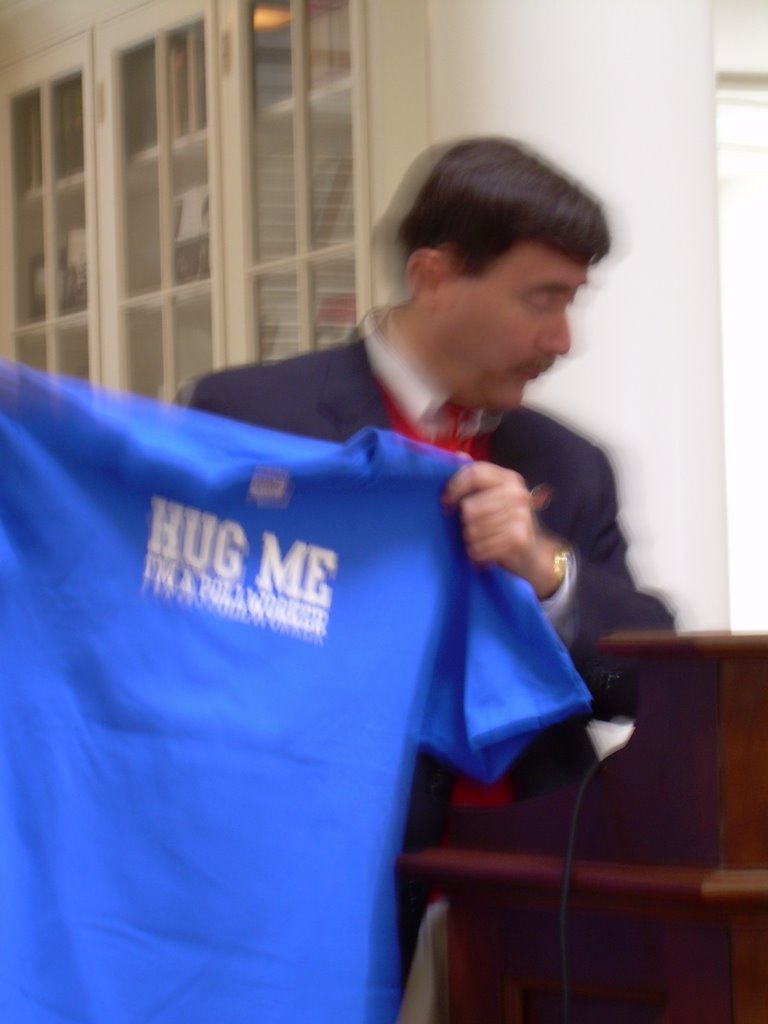
Larry Sabato unveils the student pollworker "uniform" for Election Day. (Sorry for the blurred image, but I thought Chad might like this for a future caption contest!)


Albemarle County Electoral Board Member Will Harvey with SBE Secretary Jean Jensen.

Thursday, October 19, 2006

Student Pollworkers To Be Sworn In

I knew about this earlier, since last month the City of Charlottesville Electoral Board approved the applications of some 75 University of Virginia and Piedmont Virginia Community College students to be election officials.

But now it looks so much more official, with this press release from the University's Center for Politics arriving in my email box:

Center for Politics Hosts Swearing-In Ceremony for Student Poll Workers from U.Va., PVCC --Center for Politics and Offices of Voter Registration Partner to Help Staff Midterm Elections--

CHARLOTTESVILLE – In a new effort to expand civic activity among young citizens, as well as to provide additional staffing at local polling places, the University of Virginia Center for Politics has partnered with the City of Charlottesville Office of Voter Registration and the Albemarle Country Department of Voter Registration & Elections to announce this fall’s Student Poll Worker Swearing-In Ceremony, to take place at 11:00 a.m. on Monday, October 23, at The Rotunda Dome Room on the grounds of the University of Virginia.

This event is hosted by University Professor Larry J. Sabato and the Center for Politics, with City of Charlottesville General Registrar Sheri Iachetta and Albemarle County Elections Manager Clarice Schermerhorn presiding over the ceremony. Several additional special guests will be on hand for the swearing-in ceremony. Members of the media are encouraged to attend.

Currently over 80 students from the University of Virginia and Piedmont Virginia Community College have registered to participate, with training to be completed in time for them to serve as poll workers in the City of Charlottesville and Albemarle County during the November 7 elections for U.S. Senate, House and the three statewide ballot issues.

In attendance at the Student Poll Worker Swearing-In Ceremony will be Federal Election Assistance Commissioner Gracia Hillman, Virginia State Board of Elections Secretary Jean Jensen and Charlottesville Mayor David Brown, along with Iachetta, Schermerhorn and Sabato.

* Event: Student Poll Worker Swearing-In Ceremony
* Location: The Rotunda Doom Room, University of Virginia
* Date: Monday, October 23, 2006
* Time: 11:00 a.m.

The Center for Politics and these Offices of Voter Registration have joined together to fight the alarming trend of civic apathy among the younger demographics. As a group, students and young adults are the least likely to turn out to the polls and vote. While this poses a challenge to programs aiming to increase youth participation, the program seeks to overcome this problem by offering students a unique perspective on democracy.

In August 2006, the Center for Politics was awarded a federal grant from the United States Election Assistance Commission (EAC), to develop programs to recruit and train college students as non-partisan poll workers on Election Day. The awards are part of the Help America Vote College Program which was established by the Help America Vote Act of 2002 (HAVA) to promote college student involvement. The fund will be used to encourage students enrolled at institutions of higher education (including community colleges) to assist in the administration of elections.

“Elections continue to require many more trained poll workers, and these grants will train the next generation,” said EAC Chairman Paul DeGregorio. “We encourage America’s college students to answer the call and provide the critical human resources needed to make democracy happen.”

This funding will allow for the continuation and expansion of the Student Poll Worker Program, begun in early 2006 as a partnership between the Center for Politics and the City of Charlottesville Office of Voter Registration. During the city elections on May 2, 2006, twenty-six University of Virginia students served as poll workers at voting precincts throughout the city, lowering the average age of poll workers in Charlottesville from 55 to 47 years.

According to Center for Politics Director Larry Sabato, “This is a remarkable opportunity for students to participate directly in the American electoral process and become more knowledgeable, engaged citizens. Polling places are the Roman Forums of American politics--they are invaluable opportunities for citizens to come together to support representative democracy, and these students will truly appreciate the uniqueness of our system once they have seen it for themselves.”
I have written before about the need for new and younger election officials. (The average age of pollworkers across the country is over 70.)

The presence of the college students will also be helpful because Charlottesville will be deploying electronic poll books this year for the first time. (As usual, Charlottesville is on the cutting edge in voting technology. We are testing the new e-pollbooks in the full expectation that this will become not just permitted, but required, statewide in the not-too-distant future.) We expect synergy: The student pollworkers will be paired with more experienced election officials, who know the mechanics of election day procedures, and the students can bring their familiarity with electronic devices to the table.

Williamsburg, another college town, has also tested electronic pollbooks, finding that the amount of time voters stand in line waiting their turn has been cut down considerably. As explained by John Yellig in Monday's Daily Progress,
The e-poll books contain the same voter information traditionally found in the heavy paper rosters used by poll workers. But while the paper rosters only contained information for an individual precinct, the e-poll books have information on all of the locality’s voters, which could come in handy for first-time voters who go to the wrong precinct.

In the past, poll workers could only tell voters to call the registrar to find out where to vote. With the e-book, the workers can look up voters and point them in the right direction.

“It has worked wonderfully,” said Dave Andrews, Williamsburg’s voter registrar. “The officers of the election, even folks who have no real computer experience, found it easy to use and were able to find the voters quicker.”
In November 2004, Delegate Robert Marshall (R-Manassas) was upset when the lines at his polling place were unusually long. (You'll remember that the 2004 presidential election had historically high turnout.) To remedy this, he introduced legislation the next year, HB 1808, which "requires the State Board of Elections to provide instructions for the division of pollbooks and voter lists into sections for the efficient processing of voter lines at the polls."

The proposal makes no sense, since local election officials are far more qualified to figure out how best to divide the pollbooks in their jurisdiction than bureaucrats in distant Richmond are. (Should it be A-K and L-Z or A-H, I-Q, and R-Z? A lot depends on local conditions, like the number of Shiffletts registered to vote in a single precinct.) But to my astonishment, the bill passed the General Assembly and is now part of Section 24.2-404 of the Virginia Code.

Having electronic pollbooks eliminates the need for splits. The electronic pollbook can hold the entire, statewide voter registration list, so if a voter from, say, Fluvanna County shows up to vote in Charlottesville, we'll be able to tell him or her where to go to find the appropriate precinct and polling place. (This will really solve problems regarding Alumni Hall Precinct, in the City of Charlottesville, and University Hall Precinct, in Albemarle County, both of which serve UVa populations.) Lines will move faster, and calls from chief election officers to the Office of Voter Registration and Elections will be reduced exponentially.

And having the college pollworkers there, too, beefing up the staff of election officials for the very long day (5:00 a.m. to past 7:00 p.m.), will help a lot in making the whole voting experience more efficient and fun.

Monday, October 02, 2006

Paper or Electronic?

Last week the Washington Times ran an article in the local news section that began:

New Mexico Gov. Bill Richardson visited Maryland yesterday to support Baltimore Mayor Martin O'Malley's bid for governor, but said he agrees with Gov. Robert L. Ehrlich Jr.'s views on paper balloting's superiority to electronic voting.

"I believe that the best way is paper ballots, with optical scanners," Mr. Richardson, a Democrat, said during an event in Silver Spring. "We did that in New Mexico, and it should become nationwide."
The article, by Jon Ward, noted:
Mr. Ehrlich has threatened to call a special session of the General Assembly to discard the entire electronic voting system in favor of paper ballots.
I thought the article cried out for a response, so I wrote one. It appeared in today's letters to the editor column in the Times. (Somehow the editor got the section wrong in the reference to the original article.)
The governors of Maryland and New Mexico may belong to different political parties, but they agree that "the best way" to avoid problematic or fraudulent elections "is paper ballots" rather than electronic voting machines ("Democratic governor backs Ehrlich on balloting," Commentary, Wednesday).

Govs. Bill Richardson and Bob Ehrlich may have confidence in paper ballots but they may be sorely disappointed if they count on them to prevent fraud.

In order to disrupt an election or change its results when electronic voting machines are used, a potential perpetrator must have a sophisticated knowledge, not just of computer hardware and software in general, but of particular hardware and software, plus he must gain physical access to the machinery by overcoming simple and widely-practiced security procedures.

In order to disrupt an election or change its results when paper ballots are used, a potential perpetrator must have: a pen. Or a pencil. And nothing more.

Marking a second (or third) candidate in a "vote for one" race invalidates a ballot for that race, with nobody receiving a vote.

Stray marks made on an optical-scan ballot render that ballot unreadable by a machine, and therefore it must be set aside for hand-counting, when it becomes subject to human error.

All it takes is a pen or pencil to make these marks on paper ballots to change the results of an election.

Paper ballots can also be torn, folded, spindled and mutilated, making them unreadable by either machine or human eyes.

In his 2004 book, "Stealing Elections," Wall Street Journal editorial writer John Fund documents dozens of cases of electoral fraud involving paper (either voter registration forms or paper ballots) over the past two decades. At the same time, he notes in regard to electronic voting machines, that "in the twenty-plus years that these machines have been used, in many counties all across the country, there has never been a verified case of tampering."

There are many other problems involving paper ballots, but one thing is clear: They will not stop perceived or actual election fraud.
In the print edition, my letter was placed at the head of the letters column, just below the editorial cartoon by Bill Garner. Sadly, though -- despite the prominent placement -- I don't think this will put an end to the debate.

Friday, September 22, 2006

Talking Sense

The Washington Post today has an atypically sensible editorial about the primary election fiasco last week in Maryland and how to address the problems as we approach the general election of November 7.

Echoing (modesty forces me to add "unconsciously") my comments of September 17, the Post says:

Most of the problems on Sept. 12 resulted from human error: officials forgetting to deliver cards to operate machines, judges not showing up, workers failing to remove memory cards. The one big equipment problem had to do with the electronic poll books (used by poll workers to check voters off as they come in) and not, as Mr. Ehrlich might have you believe, with the machines voters use to cast their ballots.
The Post also corrects the widely-held but mistaken belief that the human errors were attributable to the newness of the voting machines:
In fact, not only did the touch-screen voting machines work largely without incident across the state in the recent primary, but this was not the first time they have been employed. In the 2002 election, when Mr. Ehrlich became governor, four counties -- including the state's largest, Montgomery -- used these units. In the 2004 presidential election, every locality except Baltimore City used them. So why is this an issue now?
The fact that Montgomery County has been using these machines for at least four years makes the performance of its top election officials even more shameful.

Sunday, September 17, 2006

Chicken Little or Cassandra?

Last Tuesday's primary election mishaps in Maryland -- centered on Montgomery County but also including Prince Georges County and Baltimore -- have pricked up the ears of election watchers across the country, with increasing fears of disruptions in November because of faulty equipment and other factors.

The Washington Post reports today:

An overhaul in how states and localities record votes and administer elections since the Florida recount battle six years ago has created conditions that could trigger a repeat -- this time on a national scale -- of last week's Election Day debacle in the Maryland suburbs, election experts said.

In the Nov. 7 election, more than 80 percent of voters will use electronic voting machines, and a third of all precincts this year are using the technology for the first time. The changes are part of a national wave, prompted by the federal Help America Vote Act of 2002 and numerous revisions of state laws, that led to the replacement of outdated voting machines with computer-based electronic machines, along with centralized databases of registered voters and other steps to refine the administration of elections.
The Post goes on to cite the concerns of various people that these changes may result in problems and perhaps challenged or contested elections.

I take issue with what one former governor says, in the second paragraph below:
"It's hard to put a factor on how ill-prepared we are," said former Ohio governor Richard F. Celeste, a Democrat who recently co-chaired a study of new machines with Republican Richard L. Thornburgh, former governor of Pennsylvania, for the National Research Council. They advised local election officials to prepare backup plans for November.

"What we know is, these technologies require significant testing and debugging to make them work," added Celeste, now president of Colorado College. "Our concern -- particularly as we look to the November election, when there is a lot of pressure on -- is that election officials consider what kinds of fallbacks they can put in place."
Electronic voting machines, of various sorts, have been in use for more than 20 years. They are not only used in the United States, but in Latin America and other foreign lands.

These machines and their software and firmware have been tested and debugged and tested and debugged multiple times. New generations of voting machines are released every year, it seems, as improvements are implemented and defects are corrected. They are tested by independent testing labs, by state and local election officials, and by national standards boards.

In other words, by the time they are deployed, they are ready.

The only question is, are the people who use them ready?

There is a serious concern about the amount of training received by pollworkers across the country. An article in the August 2006 issue of Campaigns & Elections magazine (which is accessible online only by subscribers -- and I am not, though I should be) has an article entitled "The Neglected Threat," by Jeanne Zaino, which notes:
As we look toward midterms, the situation involving pollworkers remains problematic. Those working the more than 180,000 polling sites across the nation are aging; two years ago, the average poll worker in the United States was 72 years old. Most are temporary employees or volunteers who [are] asked to work long hours for little pay. In the 2004 election, poll workers in Indiana were paid $75 per day, while precinct leaders received $150. That same year poll workers in San Luis Obispo County received $97, plus $10 for attending a three-hour training course. Poll workers in New York City are paid more than most. In 2004, they got a $200 stipend that, after working the required shift of at least 16 hours, amounts to about $13 per hour after taxes.

In Washington state shifts run 15 hours or more with a one-hour break. As poll worker Genie Dickinson noted, "Most poll workers are seniors, and few are accustomed to even an eight-hour workday. When polls close, a portion of workers can't compute the arithmetic necessary to complete paperwork. Others feel too pooped to care."
I am pleased to report that in Charlottesville, we are and have been addressing these issues.

First, in concert with the University of Virginia's Center for Politics, the Office of Voter Registration and Elections is recruiting and training college students to perform the duties of election officials in Charlottesville, thereby lowering the average age of the pollworkers here. Last year's crop of college election officials was enthusiastic, hardworking, and almost uniformly said they would do the job again in coming years. In addition, Charlottesville has for several years -- from the time it became legal to do so -- recruited and deployed high school students, not yet eligible to vote and therefore not yet eligible to serve as an election officials, to be "pages" on election day, helping the precinct chiefs in whatever capacity they can, from running errands and making phone calls to handing out "I Voted!" stickers -- tasks that are not required to be done by properly appointed election officials.

In regard to long hours, Charlottesville was the first jurisdiction in Virginia to adopt "split shifts," in an effort to lessen the burden on senior citizens, parents, and others who want to contribute something to the community on election day but cannot devote a full 14, 15, or 16 hours to do so.

The way the split shift works is this: Some of our election officials work all day, including the chiefs and assistant chiefs in each precinct. Others work from 5:00 a.m. to 1:00 p.m. (the morning shift) and the rest work from 12:00 noon to the close of polls at 7:00 p.m. (the afternoon shift). Some workers have to remain behind after the polls close to perform closing operations after the last voter has cast her ballot and the doors are locked shut.

There is no legal reason, in Virginia at least, for other cities and counties not to adopt the split shift format. In other states, their election law codes may prohibit pollworkers from entering or leaving the polling place during the course of the voting day, so those laws would have to be modified to allow it.

In her article, Zaino quotes Thad Hall, a professor at the University of Utah, who notes:
A voter's experience with their poll worker plays a key role in determining how satisfied they are in the election process and whether they have confidence that their vote was counted accurately.
Charlottesville's Electoral Board receives very few complaints from voters about surly, unhelpful, incompetent, or otherwise unacceptable election officials. (I won't exaggerate and say we receive no such complaints, but at each election they can be counted on the fingers of one hand.) We attribute this both to the high quality of the persons who volunteer to work as election officials twice (or more) each year, but also to our insistence on training each worker in the weeks leading up to election day. (Virginia state law requires a certain amount of training before each election, but Charlottesville generally goes beyond the minimum requirement.)

Training is vital. As Jeanne Zaino says in her C&E article:
Poorly trained workers can rob citizens of their vote and change an election's outcome. Since 2006 and 2008 promise to include a number of close and hotly contested races, it is more critical than ever to have enough well-trained workers manning the nations' polling sites.
A first-person account of Tuesday's Maryland elections in this morning's Washington Post adds some flavor and insight to Zaino's broader point. Karen Yudelson Sandler writes:
None of us election officials had assembled as a team before Monday night, when we set up the polls and went through a flurry of checklists. There were eight of us: four Republicans and four Democrats. That night, we spent most of our time hunting for things. Finding the little printers that go with the electronic poll books required a call to the Montgomery County Board of Elections. And then there was the big bag that was not to be opened until the next morning -- where the voting access cards were supposed to be found....

The complaint I heard most often from would-be voters was that they didn't believe the provisional ballot was confidential. However, my main concern was a result of what I learned during our brief training: that a provisional ballot is the lowest of the low when it comes to the caste system of ballots. Our trainer more than implied that such ballots might end up on a shelf somewhere and never be looked at by anyone. And long before we were informed by the Board of Elections late in the afternoon, we heard an announcement on the radio that the closing time would be extended until 9 p.m.
That trainer was just plain wrong -- now because of HAVA (the Help America Vote Act of 2002), every state, and for many years before that, in Virginia, provisional ballots are treated both with utmost confidentiality and with respect. A provisional vote is a real vote. If the voter who casts the ballot is a qualified voter, it is counted just as every other ballot is counted. It is not discarded or ignored.

No wonder Montgomery County turned into such a royal mess.

When I meet election officials from across the country (registrars, election administrators, and others who are in charge of their local operations), I am always impressed at their attention to detail, insistence on discipline, and dedication to serving their "customers" (that is, voters and candidates) with professionalism and political neutrality.

Of course, most of those I meet from outside Virginia are those who use the Hart Intercivic eSlate and BallotNow systems, so perhaps that group of users constitutes a special breed. Yet I don't think that narrow interpretation is warranted. I think it applies across the board, with a few bad apples (think Montgomery County, Maryland) strewn here and there.

Still, if I want to leave any message here, it is that whatever problems are encountered on November 7, those problems will be human problems, not technological problems. Don't blame the machine.

Thursday, September 14, 2006

SNAFU, or Not SNAFU?

In a statement sure to rank alongside "Brownie, you're doing a heckuva job!" in the book of misunderestimated quotations, Nancy Dacek, president of the elections board in Montgomery County, Maryland, told the Washington Post: "It wasn't a screw-up. It was a mistake."

It was a screw-up. Such a big screw-up, in fact, that a synonym for "screw" beginning with the letter "F" should be used to describe it. It was a screw-up of major proportions.

I have been in Roanoke for annual training of local electoral board members by the State Board of Elections, so it is rather ironic that I learned late about the horrible performance by election officials in Maryland. (I simply wasn't watching the TV news as I normally do, not paying attention while preoccupied elsewhere.)

For others coming late to the story, here it is in a nutshell:

Polling places in Montgomery County opened up for the primary election on Tuesday with all the equipment in place except for one vital item -- the access cards (sort of like ATM cards) that voters use to activate the voting machines. The access cards also include information about which ballot the voter sees on the machine. (If there are two party primaries on the same day, for instance, a Republican voter gets a card to activate a Republican ballot, while a Democratic voter gets a card that activates the Democratic ballot.)

The person in charge of packing the bags with equipment that precinct officials need to run their polls simply forgot to pack the cards. As David Montgomery reported in the Post Style section:

Here's what happened: Elections workers assembling packages for the polls somehow forgot to include the plastic ATM-like cards needed for each voter to use the electronic voting system. Workers had a checklist that was supposed to include the vital cards, so no one would forget: A low-tech redundancy against a botched election.

Instead, the cards remained at election headquarters, locked securely in a big blue cage on wheels, hiding in plain sight.

Nobody noticed until the morning of the election when election judges opened their poll packages.

Drivers rushed the cards to the precincts, but meanwhile 10,000 to 12,000 voters had to use paper provisional ballots over the course of the day. Many others reportedly left in frustration without voting, and the whole mess now is attached to that election hangover phrase, "under investigation."

This was a screw-up, plain and simple. It wasn't a mistake, it was malfeasance.

So it's no wonder that politicians and voters are asking for the county's top election officials' heads on a platter:

Montgomery County Executive Douglas M. Duncan called yesterday for the county's top two elections officials to be fired, saying they were responsible for the widespread voting problems that marred Tuesday's primary election.

Duncan's demand, joined by County Council President George L. Leventhal (D-At Large), came on a day of intense activity with the same basic intent: to find out what went wrong and who was to blame.

"I cannot recall a failure of local government like this," Leventhal said, adding that the county's Elections Board needs to be overhauled. "It is absolutely unacceptable and unconscionable."

Even though Dacek is an appointee of Maryland's Republican Governor, Bob Ehrlich, this should not be seen as a partisan issue. While election officials in Maryland and Virginia (and elsewhere in the country) are technically political appointees, in practice they take off their political hats for the running of elections and are essentially non-partisan. Their job is to serve the voters and candidates in as neutral and even-handed a fashion as possible. That is their mission and it should be their principle, too.

It is important to note that the electronic voting machines in Montgomery County did not fail. People failed. People failed to do the jobs they were charged with doing. As one expert told the Washington Post:
"The thing that gets lost in many current discussions of election reform is the degree to which elections are an intensely human affair," says Doug Chapin, director of Electiononline.org in Washington, a nonpartisan clearing house for election reform information. "In an election you've got millions of voters encountering thousands of poll workers at hundreds of polling locations, which creates an almost exponential opportunity for error."
The problems extended beyond just one county, too, and the problems were essentially human ones. In some jurisdictions, for instance, some polling places opened late because the precinct officials ("election judges," in Maryland's parlance) showed up late. In Baltimore there were reports that some of the election judges appeared to be "intoxicated."

Because of the delays and inability to use the voting equipment, paper ballots were issued, to be used provisionally after a judge ordered polls to be open for an extra hour. But some of the paper ballots were marked for the wrong precinct, and in other precincts, there were too few ballots, so voters were using scraps of paper to mark their choices. Some were using pencils to mark their ballots! (Pencil marks can be erased and rewritten; unless one is using an optical scan system that specifically calls for using a No. 2 Ticonderoga, a ballot should be marked in blue or black ink.)

Widespread use of paper ballots, especially in chaotic circumstances like this, is an invitation to fraud. Paper is easily lost, torn, marred, or re-marked. It lacks the surety and control that electronic balloting does (or, for that matter, that lever machines and, under most circumstances, punchcard machines, did). That is why paper ballots have to be kept even more secure than electronic machines are -- and, as I have written before (on more than one occasion), electronic voting equipment is, or should be, kept highly secure.

So the prize for gross incompetency again goes to Nancy Dacek. From David Montgomery's article in the Washington Post:

Andrea LaRue, a lawyer volunteering on behalf of U.S. Senate candidate Ben Cardin, steps up to the counter with a question for Dacek.

"Do you have a chain-of-custody plan for the provisional ballots?" LaRue asks.

"A who?" Dacek replies.

Who, indeed! And "who" should resign, rather than whine, is Nancy Dacek. Any election official with integrity who presides over an election as badly executed as the one in Maryland was on September 12 would do so, even before receiving a request from voters or elected officials. Taking responsibility is the right thing to do; passing the buck is not.