Showing posts with label Daily Progress. Show all posts

Wednesday, April 18, 2018

Guest Post: Is Ryan Kelly's Pulitzer Prize-winning photograph an American 'Guernica'?

Jennifer Wenzel, Columbia University

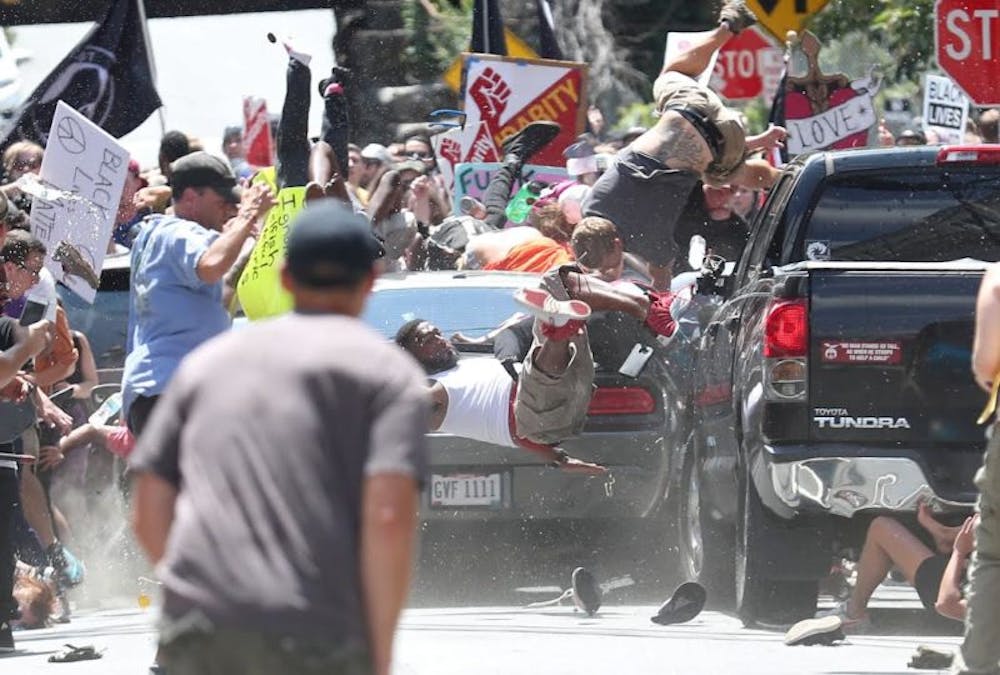
On Aug. 12, 2017, Charlottesville Daily Progress photographer Ryan M. Kelly captured the moment that Nazi sympathizer James Alex Fields, Jr. drove his Dodge Challenger into a crowd of counterprotesters, injuring 19 and killing 32-year-old Heather Heyer. It’s probably the most enduring image to emerge from the weekend of “Unite the Right” rallies in Charlottesville, Va.

Eight months later, Kelly’s iconic photograph from that tragic day has earned him the Pulitzer Prize for Breaking News Photography.

At first glance, the photograph is nearly impossible to make sense of visually or politically. Cars are not supposed to drive into pedestrians; fellow citizens are not supposed to kill each other over political differences. And there’s so much in the frame of the image – so many figures and forms crowded together, most only partially visible – that you can’t take it in all at once.

Pablo Picasso’s 1937 iconic mural “Guernica” might teach us how to interpret this image more closely, and why it is important to do so. Like Kelly’s photograph, “Guernica” conveys a moment of terror through a jumble of forms and fragments that seem to make no sense.

In April 1937, a different sort of “Unite the Right” moment took place in fascist Europe during the destruction of Guernica. At the request of General Franco, the leader of nationalist insurgents in the Spanish Civil War, German and Italian warplanes bombarded the Basque town in northern Spain. Terror rained from the sky: Hundreds of civilians were killed, while military targets were left unscathed.

Days later, as May Day protesters filled the streets of Paris, Pablo Picasso began what would become an anti-war masterpiece.


Pablo Picasso Guernica

Pablo Picasso, ‘Guernica’ (1937).
Reina Sofia


There are uncanny echoes of Picasso’s “Guernica” in Kelly’s photograph. Picasso used the Cubist techniques of fragmentation and collage to create a visual cry of anguish at the destruction wrought by men at the controls of war machines.

To make sense of the painting, you must do the work of reassembling what has been rendered apart. Yet you will never make sense of such destruction. You cannot merely glance at this massive painting or take it in all at once; you must stand and look and witness. There is nothing beautiful about it. It refuses to console. However, in the painting’s abstraction – its matte shades of gray, its distorted figures that stand in for the wounded and the dead – there is a kind of mercy toward its viewers and these victims.

If there is any mercy of abstraction in Kelly’s photograph, it is that of time. The image captures the moment in medias res – when the bodies of the men near its center still evoke the beauty of the human form in its wholeness.


Pulitzer Prize photograph Charlottesville


Ryan M. Kelly/The Daily Progress


Yet we know the victims are not whole; that is why it hurts to look. The contorted positions of the man in red and white sneakers and the man somersaulting above him make sense only in the realm of sports photography. But this is not a game.

Elsewhere the photograph captures only fragments: arms and hands, legs and feet, heads and faces. Empty shoes on the ground. Sunglasses. A cellphone in midair.

You will never make sense of this image because it makes no sense. (Or, rather, it makes as much sense as racism itself.) Yet to look away risks turning away from the truths it tells. A heavy aspect of our national tragedy is that we seem to lack a president – such as Abraham Lincoln – whose heart might break to see such carnage.

As he kept reworking “Guernica,” Picasso painted over a raised fist he had initially drawn near the center of the canvas. Then – as now – the raised fist is a symbol of solidarity against fascism. It makes an eerie reappearance on two posters in the top third of Kelly’s photograph.

“Guernica” includes small lines resembling newsprint. The Charlottesville photojournalist’s image is also crowded with text; some of it implicates the driver, while other words are a call to action.

Clear as day, there’s the incriminating license plate. No one can deny that this car drove into this crowd, as the colluding European fascists did when they claimed that Guernica had been bombed by Spanish Republican forces.

Then there’s the collage of protest signs and street signs that the neo-Nazi at the wheel didn’t heed: Peace/Black Lives Matter. Solidarity. STOP. LOVE. BLACK LIVES. STOP.

Kelly’s photograph redirects these injunctions to the viewer, who’s left to wonder whether this is what our democracy – or the state of our union – looks like.

The ConversationThis is an updated version of an article originally published on Aug. 17, 2017.

Jennifer Wenzel, Associate Professor of English and Comparative Literature and Middle Eastern, South Asian, and African Studies, Columbia University

This article was originally published on The Conversation. Read the original article.


Wednesday, July 13, 2016

From the Archives: Chinese hackers attack University of Virginia email, cause IT shutdown

Publisher's note: This article was originally published on Examiner.com on August 14, 2015. The Examiner.com publishing platform was discontinued July 1, 2016, and its web site is scheduled to go dark on or about July 10, 2016.  I am republishing this piece in an effort to preserve it and all my other contributions to Examiner.com since April 6, 2010. It is reposted here without most of the internal links that were in the original.

Chinese hackers attack University of Virginia email, cause IT shutdown

Late breaking news from the University of Virginia arrived just as the Charlottesville Libertarian Examiner joined radio host Coy Barefoot on WCHV-FM to discuss current affairs on Friday afternoon, August 14.

A message to the University community from executive vice president and chief operating officer Patrick D. Hogan said: "The University of Virginia has confirmed that sophisticated attackers originating from China illegally accessed portions of the University's information technology systems. Federal authorities had alerted the University of a possible cyber attack, and this was confirmed by the University on June 11. Upon becoming aware of the attack, the University engaged Mandiant, an internationally recognized cybersecurity firm, to immediately help the University identify the nature of the attack and take corrective action. This action included enhanced security measures to further fortify University data and systems."

Two targets
While no personal data like Social Security numbers or credit card accounts was accessed by the hackers, it appears the breach was intended to find emails from specific individuals within the University whose work focuses on China.

According to a report by Daily Progress correspondent Dean Seal, published nearly simultaneously with Hogan's University-wide announcement, "The attack specifically targeted the email accounts of two employees whose work is connected with China, university officials told The Daily Progress. However, the identities and departments of those employees have not been released. They remain employed at the university, officials said Friday."

Who did it?
Although it was not clear that the cyberattack had originated from the Chinese government, speculation aired on Coy Barefoot's "Inside Charlottesville" radio program suggested that the employees may be faculty members or researchers who work on democracy issues or human rights in China, or perhaps are involved in some business activities.

Chinese hackers have previously invaded U.S. businesses' computer systems in order to uncover trade secrets. They also recently harvested information from a decades-old database of U.S. government employees maintained by the Office of Personnel Management (OPM).

The cyberattack did not target the UVA hospital or health system. Those divisions' email, web sites, and databases remain operational.

University officials estimate that it will take approximately 48 hours to install the security fixes needed to protect the emails of faculty, staff, and students. They recommend that, once the system is running again, individuals should change their email and other passwords for additional protection.

SUGGESTED LINKS

UVA political scientist analyzes 2012 election, looks toward 2016 GOP nominee
Talking about 'liberaltarianism' at the University of Virginia
At UVA debate, Creigh Deeds calls libertarians ‘Republicans with guts’
UVA historian explains Ayn Rand's unusual popularity in 2010
WINA radio host Coy Barefoot assesses the Perriello-Clark congressional debate

Original URL: http://www.examiner.com/article/chinese-hackers-attack-university-of-virginia-email-cause-it-shutdown

Monday, October 13, 2014

Stating the obvious in a single newspaper headline

Charlottesville's Daily Progress wins the prize for stating the obvious in its banner headline on Sunday, October 12.

There, above the fold, was this shattering piece of news:


That's right:  "Not all churches open to same-sex marriage."

Next week we'll learn that "Not all halal butchers sell pork" and "Not all Unitarian-Universalists believe in god."

To be fair, the web version of the newspaper's article has a better, more explanatory headline -- but most readers of the Sunday Daily Progress read what's tossed on their lawns in the pre-dawn hours.


Tuesday, August 12, 2014

Fuzzy memories of elections past

An odd letter made its way into the Charlottesville Daily Progress today.

The letter, submitted by Albemarle County resident Hubert Hawkins, makes an argument about retaining Virginia's tradition of open primary elections, in which any voter, regardless of party affiliation, can participate in either the Democratic or Republican party's primaries for nominating candidates for the general election. (Virginia voters do not register by political party, so "party affiliation" is determined by the voter's own individual preference and observations of primary voting patterns and recorded financial contributions to candidates and party committees.)

Mr. Hawkins tries to undergird his point by reminiscing about the only time he crossed party lines to vote in a Republican primary:

Years ago when Oliver North opposed John Warner in the Republican primary, I was a Democrat who never sought to meddle in Republican elections. But I knew that my senator was going to be a Republican, no matter who won the party’s primary, because my party had no competitive candidate. So I voted in the Republican primary, fearful of what outcome might ensue from the victory of such a controversial character as North.

I have never regretted my vote, and I have always been grateful that Virginia law allows all voters to participate realistically in the future of the state and nation without restrictions on what party they may have belonged to.
The problem with that example? Oliver North never challenged John Warner for the Republican Party of Virginia's nomination for the U.S. Senate, in a primary or through any other method.

John Warner, Larry Sabato, and Mark Warner at UVA, June 2014
John Warner ran unopposed for the GOP nomination in 1990, and he had no Democratic opponent in the November election. Nancy Spannaus, a devotee of political cult leader Lyndon LaRouche, was the only other candidate on the ballot that year. Warner beat Spannaus by sweeping every county and city and earning 80.9 percent of the vote.  The absence of a Democratic general election candidate that year may be what Mr. Hawkins is trying to recall in his letter to the editor.

In 1994, Oliver North sought the Republican nomination for the U.S. Senate and winning it in a convention against former Reagan administration official James C. Miller III. There was no primary election that year, and John Warner was not on the ballot. North went on to lose the general election to incumbent Democrat Chuck Robb in a three-way race that also included independent J. Marshall Coleman. That election was the subject of a popular documentary film, A Perfect Candidate.

In 1996, Jim Miller challenged John Warner for the nomination in a primary election but Warner won and went on to face Democrat Mark Warner in the general election.

After serving one term as Virginia''s governor, Mark Warner eventually won John Warner's U.S. Senate seat in 2008, after John Warner decided to retire.  The two of them remain on friendly terms (as seen in this video from earlier this year) and, in fact, John Warner has endorsed Mark Warner's re-election bid this year.

Regardless of what one thinks about the merits of Mr. Hawkins' argument about open primaries, it's important that the person making that argument have his facts straight. For that matter, it is the responsibility of the newspaper's editors to ensure that such factual errors do not make their way into print.


Thursday, July 24, 2014

Adventures in the Land of the Mathematically Challenged

A letter to the editor in today's Daily Progress tries to draw attention to the problem of expensive housing in the Charlottesville area.

The letter writers, however, display a sad sort of incompetence when it comes to their grasp of everyday mathematics.


They explain that

according to the U.S. Census, the median value of owner-occupied housing in Charlottesville from 2008-2012 was $286,400. With the median household income in Charlottesville at $44,535, a mortgage on the median home value is likely more than half of your monthly net income.
That may all be accurate but the howler follows in the next paragraph:
Homes under the median value are rare, and are often no more than 800 square feet and/or in complete disrepair.
The second part of that sentence may or may not be true, but the first part is demonstrably false.

It is not possible that homes "under the median value are rare," since, by definition, 50 percent of all homes are under the median value. (The other 50 percent are, by definition, above the median value.)

Perhaps the writers were trying to say that homes available for purchase that are also below the median value are rare, but that is not what they said.

Would this kind of innumeracy (mathematical illiteracy) be solved by adopting the Common Core, or made worse by it? Or would this demonstration of innumeracy be solved more simply by having a good copy editor?