Showing posts with label Fifth Congressional District. Show all posts

Sunday, February 11, 2018

Briefing with Congressman Tom Garrett and Afghan and Czech Ambassadors

Tom Garrett Hamdullah Mohib Hynek Kmonicek Monticello
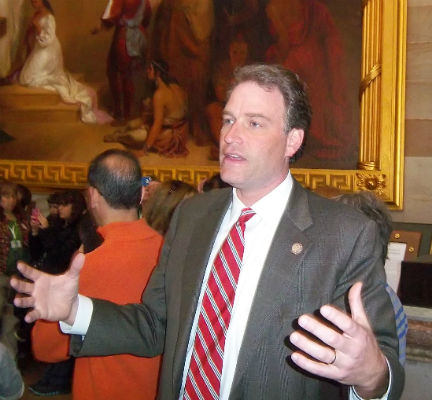
Fifth District Congressman Tom Garrett on Friday hosted several diplomats on a tour of Thomas Jefferson’s home at Monticello. After the tour, he and two of them – Ambassador Hamdullah Mohib from Afghanistan and Ambassador Hynek Kmonícek from the Czech Republic – answered questions from the local Charlottesville news media.

Garrett explained that even though, as a slaveholder, Thomas Jefferson was a flawed individual, the Declaration of Independence that he drafted was a “brilliant” document that led to freedom not only in the United States but around the world. Both Ambassador Mohib and Ambassador Kmonícek acknowledged that they learned things about U.S. history and Jefferson himself by taking the tour of Monticello, and that there are lessons they could convey to their compatriots back home.

(Ambassador Kmonícek joked that, where he comes from, a 200-year-old house is considered new.)

You can see the entire press conference here:

Congressman Garrett also answered questions about current domestic policy. Tyler Hawn of the Charlottesville Newsplex asked him about the budget bill that was passed late in the night and signed Friday morning by President Trump, and whether the process was frustrating. Garrett replied (starting at the 9:28 minute mark in the video):
It’s ironic that we stand at the home of Thomas Jefferson, who drafted the Declaration of Independence, which was signed by people who knew when they put their name on that paper that if they were captured they would be killed. We’ve devolved into a political class with the inability to say “no.”

I voted against the National Defense Authorization Act even though people would describe me as a hawk, because thirty-plus years ago department of defense agreed with other federal agencies to be audited – it’s never been audited.

To continue to spend and spend and spend is a symptom of a political class without the courage to do what they think is right when it’s too difficult and standing for reelection having done what you said, even when it was difficult or uncomfortable, is the hallmark of who we are supposed to be as a people.

I voted against that. I think President Trump was wrong to capitulate on heightened spending. He can spin it however he likes. We need to draw lines and assure that taxpayer dollars are being spent efficiently and on the core functions of government. We’re not doing that. It wasn’t OK when President Obama spent profligately. It’s not OK when President Trump does it. So, yes, I’m frustrated.
Garrett also answered a question (about 10:40 in the video) about pending immigration legislation and how it will affect participants in DACA (Deferred Action for Childhood Arrivals).
That’s going to start in the Senate, for sure, because that’s the chamber where I think they can get something out. I’ve spoken with dozens of DACA recipients – dozens may be low – they can prove it because they’ve filmed me. I’d love to have a solution for DACA. I don’t think deferred action is the proper long-term solution but I’m not going to vote for anything until we secure our southern border.

To do the same thing again and again and expect a different result is the definition of insanity. And I’ve said this to these people with whom I’ve spoken: I think border security should be this AND that, not a this THEN that. We tried this in ’86 with a this-then-that and it failed. And I haven’t had any of the people with whom I’ve spoken who are DACA recipients have a problem with that.

So, I think if we set aside some of the hyperbolic rhetoric that we can get something done but right now people need to step back from the rhetorical edge, acknowledge the existential reality to the young people who are DACA recipients, and also acknowledge that it makes no sense not to take action to secure our southern border.
There are plenty of other gems in the conversation, from both the ambassadors and from Congressman Garrett, who said he would like to do more programs like this, perhaps three or four times each year, bringing ambassadors from Washington to Charlottesville to visit both the University of Virginia and Monticello.

In addition to Tyler Hawn of the Newsplex, Pete DeLuca of NBC29 covered the press event in the Robert H. and Clarice Smith Gallery at Monticello's David M. Rubenstein Visitor Center.

This article was previously published, in slightly different form, on Bearing Drift.


Sunday, August 13, 2017

From the Archives: Fifth District congressional candidate Jeffrey Clark endorses idea of liquor sale privatization

Fifth District congressional candidate Jeffrey Clark endorses idea of liquor sale privatization
August 13, 2010 7:07 PM MST

Jeffrey Clark Tom Perriello Bob McDonnell Charlottesville ABC privatization liquor regulation
Just prior to his debate with incumbent Representative Tom Perriello (D-Ivy) at Charlottesville’s Senior Center on August 11, independent congressional candidate Jeffrey Clark gave his opinion on a current statewide issue.

When asked by the Charlottesville Libertarian Examiner what he thinks of Governor Bob McDonnell’s proposals to privatize the state’s monopoly on wholesale and retail sales of distilled spirits, Clark readily replied, “I like it.” It is, he said, “a win for everybody.”

‘A great model’
Pointing out that in “many places” elsewhere in the United States, liquor is sold through private outlets, Clark asked, “If it’s working effectively in other areas of the country and it’s a great model, why not move in that direction here as well?”

Clark explained that he doesn’t see “any reason that would prevent us from” privatizing ABC sales.

“We can get away from the bureaucracy,” he added, noting that “small businesses like restaurants and things like that would welcome the idea of the privatization of the ABC stores.”

Drawing on his own business experience, Clark remarked: “Trust me, I’ve been in restaurant-hotel management for a very long time, and I understand the red tape that can go along with that.

End the red tape
“Listen,” he continued, “just trying to get an opportunity to be able to have the privilege of selling alcohol in your business can be a huge issue of red tape and then you’ve got to go deal with this government bureaucracy that is the ABC stores of Virginia.”

McDonnell’s idea is “a way overdue proposal,” Clark said, wondering “why so long here?” when 32 other states have had private systems for decades.

Like the governor, Clark suggested that ABC privatization is part of a broad-based approach to government reform.

“We really need to look at every program, no matter what it is, even if it seems small, even if it seems like” people are dismissing the idea by saying things like “Oh, the ABC stores, it’s just alcohol, no big deal, we’ll leave it” the way it is, Clark argued.

‘Save a dollar, save a billion’
“Any area where we can look, where we can focus on the small things” the state should consider a change. “If it’s saving [just] a dollar, who cares? If we look to save a dollar, we can eventually save a million, two million, a billion.”

By looking for savings and efficiencies, Clark asserted, “we can start to bring these things back into some type of financial control and better serve the people.”

Clark, who lives in Danville in Southside Virginia, where it is believed much of the opposition to McDonnell’s proposals originates, does not see a downside.

“I don’t think anybody believes that somehow the ABC stores won’t be able to serve the public as well if they’re somehow not under government control,” he said.

“As a matter of fact, I think that most independent businesspeople probably act more responsible in their day to day lives than do government bureaucracies.”

Add Jeffrey Clark’s name to the list of supporters of Bob McDonnell’s ABC privatization efforts.

Publisher's note: This article was originally published on Examiner.com on August 13, 2010. The Examiner.com publishing platform was discontinued July 1, 2016, and its web site went dark on or about July 10, 2016.  I am republishing this piece in an effort to preserve it and all my other contributions to Examiner.com since April 6, 2010. It is reposted here without most of the internal links that were in the original.

Wednesday, April 05, 2017

Video Proof: Congressman Tom Garrett's Charlottesville Town Hall

Over at Bearing Drift, I have a brief report on U.S. Representative Tom Garrett's town hall meeting, which was held last week at the Frank Batten School of Leadership and Public Policy at the University of Virginia. (Coincidentally, the meeting took place in a classroom in the Batten School's Garrett Hall.) The town hall was scheduled for 90 minutes but extended to two hours. It was moderated by Dean Allan Stam, who noted that the previous week he had hosted a similar discussion by one of Garrett's predecessors as the representative for the Fifth Congressional District of Virginia, Tom Perriello, who this year is running for governor. (Other predecessors include James Madison, Virgil Goode, and Robert Hurt.)

I noted some of the issues covered in the wide-ranging conversation:

There were many other topics discussed during the town hall: health care, immigration, energy, climate change, presidential tax returns, rescheduling marijuana, gas pipelines and eminent domain, the federal budget and its impact on the University of Virginia. Originally scheduled to last 90 minutes, Garrett agreed to extend it another half hour and promised to seek a larger venue the next time he holds a town hall meeting in Charlottesville. (According to another news release from his office, dated April 3, “Garrett’s next radio town hall is scheduled for April 13 from 7-9 pm with Joe Thomas on WCHV 107.5 and in person on May 9 in Moneta, Virginia.”)

I also was able to capture the entire discussion on video, now posted to YouTube, in four easily digestible segments of unequal length. Watch them below.

Part 1:

Part 2:

Part 3:


Part 4:

For a special bonus, here is an excerpt of the interruption early in the town hall, staged by protesters who chanted: "Hey hey, ho ho, white supremacy's got to go!" (To which Garrett replied, "We agree.")

After the forum, I had an exclusive interview with Congressman Garrett about foreign policy issues, particularly those that concern him as a member of the House Foreign Affairs Committee's subcommittee on Africa, Global Health, Global Human Rights, and International Organization. You can read an article based on that interview at Sub-Saharan Monitor.


Thursday, August 04, 2016

From the Archives: Virginia Congressman Robert Hurt discusses U.S. policy in Syria and Iraq

Publisher's note: This article was originally published on Examiner.com on October 8, 2014. The Examiner.com publishing platform was discontinued July 1, 2016, and its web site was scheduled to go dark on or about July 10, 2016.  I am republishing this piece in an effort to preserve it and all my other contributions to Examiner.com since April 6, 2010. It is reposted here without most of the internal links that were in the original.

Virginia Congressman Robert Hurt discusses U.S. policy in Syria and Iraq

Just before a campaign rally at Republican party headquarters in Albemarle Square on October 8, U.S. Representative Robert Hurt (R-VA5) spoke to Charlottesville area news media about a range of issues, from health care and education to job growth and presidential usurpation of congressional authority.

In an exclusive interview with the Charlottesville Libertarian Examiner, Congressman Hurt answered questions about foreign policy issues, starting with the use of military force in Iraq and Syria.

Last month, Hurt voted against an amendment to authorize the Secretary of Defense to provide arms to certain Syrian rebel groups, as part of the Obama administration's strategy to fight the so-called Islamic State (also known as ISIS or ISIL). Hurt was in the minority, as the amendment passed on a vote of 273-156.

'Grotesque organization'
Hurt explained that he thinks that “the President has made the case – and I'm convinced based on all the briefings that I've attended – that we really do face an existential threat from ISIL, certainly as it relates to our allies in the Middle East, as it relates to our American interests in the Middle East, and then, finally, ultimately, here, if this grotesque organization is not destroyed.”

The Fifth District congressman added for emphasis: “We need to destroy them.”

The reason he voted against the so-called McKeon amendment, he said, was “in large measure due to the fact that the President has not asked for congressional authorization to use military force in Iraq and Syria.”

President Obama, he explained, “claims that he has the power to do it under the 2002 and 2001 military authorizations; I just simply disagree: Different time, different conflict, different parties.”

The President, Hurt said, “needs to recognize that he has a constitutional obligation to come” to Congress, where “we'd have an honest and candid debate about what is going to be required of the American taxpayer [and] most of all, what's going to be required of the American men and women in uniform.”

Moreover, he added, the President has to explain what victory will look like.

Hurt said he does not believe that the President has “laid out that case, so I think it's something that needs to be debated in Congress.”

Asked whether the U.S. military can effectively end a conflict in the Middle East that has been going on for 1,300 years, Hurt replied: “It's a very hard question.”

'Secure in our homes'
He said that “it's unlikely that we can solve these problems. The best that we can do is destroy the immediate threat [ISIL] and degrade the long-term threat and, hopefully, get to a place where we can at least be secure in our homes here on our soil and certainly provide for safe passage for those Americans who are traveling across the world in different countries, [and for] business that's being done internationally. Those are all important things.”

Admitting some uncertainty, Hurt added: “I don't know that we'll ever be able to solve those problems. Like you said, it's been going on a pretty long time, and I think it's unlikely that we can do that but I do think that we need to destroy the immediate threat as soon as we can.”

Robert Hurt is running for re-election to a third term in the House of Representatives. He has three opponents: Democrat Lawrence Gaughan, Independent Green Kenneth Hildebrandt, and Libertarian Paul Jones. The election takes place on November 4.

SUGGESTED LINKS

Congressman Robert Hurt expresses 'grave concerns' over potential Syria war
Congressman Bob Goodlatte 'skeptical' about U.S. military intervention in Syria
GOP congressional nominee Robert Hurt discusses constitutional principles
Virginia Congressman Robert Hurt reacts to federal unemployment report
U.S. Representative Robert Hurt discusses eminent domain and redistricting

Original URL:  http://www.examiner.com/article/virginia-congressman-robert-hurt-discusses-u-s-policy-syria-and-iraq


Wednesday, August 03, 2016

From the Archives: Virginia Congressman Robert Hurt discusses Africa policy, Ebola threat, and AGOA

Publisher's note: This article was originally published on Examiner.com on October 10, 2014. The Examiner.com publishing platform was discontinued July 1, 2016, and its web site was scheduled to go dark on or about July 10, 2016.  I am republishing this piece in an effort to preserve it and all my other contributions to Examiner.com since April 6, 2010. It is reposted here without most of the internal links that were in the original.

Virginia Congressman Robert Hurt discusses Africa policy, Ebola threat, and AGOA

At a campaign stop in Charlottesville on October 8, U.S. Representative Robert Hurt talked to reporters about a wide range of political topics and policy issues.

He answered questions posed by the Charlottesville Libertarian Examiner about foreign policy matters. In an exclusive interview, he explained his position on U.S. military assistance to Syrian rebel groups and the Obama administration's strategy to defeat the Islamic State (also known as ISIL or ISIS).

In reply to other questions, Hurt talked about U.S. policy toward Africa, with reference to the threat of Ebola and also with regard to trade and investment under the umbrella of AGOA (the African Growth and Opportunity Act), which comes up for reauthorization by Congress in 2015.

'Public health threat'
“The Ebola epidemic definitely poses a public health threat to the United States,” Hurt said, noting the death of Liberian Ebola patient Thomas Eric Duncan in Dallas a few hours earlier that day.

“We need to be able to know exactly who's coming into this country,” he explained, adding that the Ebola problem “highlights the need for border security, not just for terrorism but obviously for public health issues.”

With regard to the U.S. government's decision to send several hundred American troops to Guinea, Liberia, and Sierra Leone to help manage the Ebola epidemic in those West African countries, Hurt warned that “we have to be very careful in deploying our military for humanitarian reasons. I know we do it from time to time but I think there has to be a demonstrable, justifiable use of our military for that purpose.”

The reasons for caution, he said, include that “it's a huge risk to the members of the military but” also that “the United States can't be the world policeman. We can't be all things to all people.”

Asked whether he planned to vote to reauthorize AGOA next year, Hurt said, “I need to look at it. We'll obviously have some time to look at that.”

AGOA and free trade
He explained that, “whenever you're talking about any kind of trade agreements, I think that we have to look for what's in the best interests of the United States.”

Hurt said that “we've seen instances where trade agreements have hurt us, and they've hurt very deeply people in places like Virginia's Fifth District, where you look at what's happened in the southern part of our district, in Martinsville and Danville and those sorts of places.”

Each trade agreement “is different,” he explained, so “you have to take it on a case by case basis and try to figure out what's the best deal.”

Congressman Hurt added, however, that he views free trade in a positive light. “Free trade – generally speaking – I'm all in favor of it.”

He favors free trade, he said, “because it does open up markets for our producers and for our manufacturers, so we want to open those markets – but we have to do so in a careful way.”

Referring to the situation on the ground in his own congressional district, Hurt illustrated his point by describing what Central Virginia farmers grow on their land.

“We were just coming down Route 29 and looking at the soybeans. A lot of the soybeans that are going to be harvested in Virginia [will] go down to Hampton Roads, [and] get on a ship” carrying them to China.

That, he concluded, is “a good thing for our producers, so where we can find those advantages, we want to pursue them” in appropriate trade agreements.

SUGGESTED LINKS

Virginia Congressman Robert Hurt discusses U.S. policy in Syria and Iraq
Omidyar Network's Karol Boudreaux offers optimistic view of African economies
Scholar reflects on why Africa was absent from final presidential debate
South African author Greg Mills offers solutions to African poverty
Virginia political leaders react to Supreme Court marriage decision

Original URL: http://www.examiner.com/article/virginia-congressman-robert-hurt-discusses-africa-policy-ebola-threat-and-agoa


Saturday, July 16, 2016

From the Archives: Virginia Congressman Robert Hurt speaks out for free trade in Charlottesville

Publisher's note: This article was originally published on Examiner.com on June 13, 2015. The Examiner.com publishing platform was discontinued July 1, 2016, and its web site was scheduled to go dark on or about July 10, 2016.  I am republishing this piece in an effort to preserve it and all my other contributions to Examiner.com since April 6, 2010. It is reposted here without most of the internal links that were in the original.

Virginia Congressman Robert Hurt speaks out for free trade in Charlottesville

Appearing at the monthly Albemarle County Republican breakfast on June 13, Congressman Robert Hurt (R-VA5) vigorously defended his vote in favor of the Trade Promotion Authority (TPA) in the House of Representatives on June 12.

Noting that opposition to the TPA and related bills (Trade Adjustment Assistance, or TAA, and the Trans-Pacific Partnership, or TPP) comes largely from labor unions and left-leaning liberals like Senators Bernie Sanders (I-VT) and Elizabeth Warren (D-MA), Hurt said that support for free trade is a conservative principle that “would make Ronald Reagan proud.”

In an interview with the Charlottesville Libertarian Examiner immediately after his breakfast remarks, Hurt explained what the TPA does and what it does not do, and emphasized that there is not yet an agreement for the Trans Pacific Partnership – that the TPP is still being negotiated.

“What we voted on yesterday was the Trade Promotion Authority, also known as TPA,” Hurt said. The bill “passed with a large Republican majority in support.”

Framework and authorization
He explained that TPA sets up a framework and gives authorization to the President “to finish negotiating trade agreements” that have been under consideration for years. The Trans-Pacific Partnership, he noted, “was begun under George Bush, so this is not like this is Obama's idea. This was initiated under a previous president.”

Hurt pointed out that “in order for us to even consider a free trade agreement – which was not on the floor – in order for us just to consider it, we had to pass a Trade Promotion Authority to give the president the ability to finalize the negotiations with the other 11 countries (in the case of TPP) and, not only that, but it gives Congress and the American people a tremendous amount of transparency” that would not be available without the TPA in place.

The congressman said that “as it is now [the President] doesn't have to share anything with Congress. That's why the negotiating text of a free trade agreement that does not exist is classified. That's because the Administration has the power to control that negotiating text and doesn't have to do anything with Congress.”

Under TPA, he said, “the President not only has to give us access to it currently and in the future, [he] also has to make it publicly available before anybody votes on anything for at least two months prior to it is even considered by Congress so that our constituents can hear and can look at every single word and see what the agreement does and what it doesn't do.”

Hurt explained that since he has been in Congress, he has voted for two free trade agreements (with Colombia and Panama) and voted against another (with South Korea).

“The devil's always in the details,” he said. “For people who are getting so upset about this bill, I think there's some misunderstanding that somehow what we voted on Friday was a free trade agreement. It was not a free trade agreement.”

Asked whether a trade agreement like this would get pushback from conservatives if it were promoted by President Romney rather than President Obama, Hurt demurred.

“Great question,” he said, adding “I don't know. It's hard to say. It's hard to attribute motive.”

That question makes the point, he suggested, that “this President has so soured any reasonable relationship with Congress and he is so distrusted among so many of the American people because of his abuse of the rule of law in this country that people push back for that reason – but this vote yesterday had nothing to do with President Obama.”

Hurt stated that he does not “trust President Obama to follow the rule of law. He's demonstrated again and again that he cannot.”

Setting that aside, he said, the TPA does not give the President “any authority to do anything that he cannot already do. It gives him restrictions in negotiating objectives that are in TPA but it doesn't give him any additional power to make any law.”

'Hogwash'
Hurt cited Internet rumors like “'this means we're going to give the president the authority to change immigration law!'” Those, he said, are “just totally, 100 percent false. It does not.”

He explained that, contrary to those rumors, “in order for any law of the United States to change, it has to come through Congress.”

Moreover, he said, “if it's pursuant to a free trade agreement, it has to come through Congress twice, because it has to be adopted as a free trade agreement and, secondly, the actual change of the law has to be adopted through implementing legislation, which would be a second shot at the apple.”

Taking aim at the Internet rumor mill, Hurt asserted that “the idea that this President can affect any of our laws unilaterally or that we're going to submit to some international tribunal is just hogwash.”

Hurt also emphasized how free trade will benefit his constituents in Virginia's Fifth Congressional District.

As a legislator, he said, “I have to look at the economy of the Fifth District the way it is in 2015, not the way it was in 1980 or 1990 or 2000. Our economy has changed a tremendous amount” over the past thirty years.

He pointed out that “agriculture is huge,” the largest sector in Virginia's economy, with $75 billion in output each year. The Fifth District has 23 counties and cities and “with the exception of Charlottesville and Danville, it is mostly rural, mostly agricultural.”

'Opportunities for growth'
“There are huge opportunities” in agriculture, he said, “but let me tell you this: There are opportunities for growth. There are opportunities for our manufacturers to access these foreign markets and sell our products that we make here there and we get their cash.”

If the Trans-Pacific Partnership is finalized – a prospect that Hurt says is a year or more in the future “I will look very carefully and make my best judgment as to whether or not this is good on balance for the people I represent.”

If, by his consideration, the agreement is not good on balance for the Fifth District, “I'll vote against it and work for its defeat. If it is good, on balance, for the people I represent, [if it] creates jobs and opportunity and growth and it projects American strength in a very sensitive area geopolitically, in the shadow of China,” he said, he will vote for it.

As to free trade in general, Hurt concluded, “I think it's consistent with Republican principles, consistent with conservative principles. It would make Ronald Reagan proud.”

Note: the full audio of this interview with Congressman Robert Hurt is available as a podcast from Bearing Drift.

SUGGESTED LINKS

'Open-minded, pragmatic' Republican Anson Parker enters race for City Council
Presidential candidate Bernie Sanders stumps for support in Charlottesville
Poultry industry is trade-talk pawn of South African government, says analyst
Think-tank head Jason Grumet reacts to Obama's mandatory voting idea
Former Senator Rick Santorum says homosexuals deserve protection

Original URL:  http://www.examiner.com/article/virginia-congressman-robert-hurt-speaks-out-for-free-trade-charlottesville

Monday, May 26, 2014

Virginia's 'Sprawling' Eighth District?

Get well wishes are due Delegate Patrick Hope (D-Arlington), who injured himself -- breaking a rib and fracturing other bones -- while campaigning for the Democratic party's congressional nomination in Virginia's Eighth District.

Or should I say Virginia's "sprawling" Eighth District, as that is the unlikely adjective used by the Washington Post's Patricia Sullivan in a squib appearing in Monday's print edition.

Sullivan writes
:
Hope has been trying to visit every precinct in the sprawling district, which covers Alexandria, Falls Church, Arlington County and part of Fairfax County. He will have to abandon that effort, Tribbett said, and will now have to wear a rib belt, take painkillers and rest. Hope is one of seven Democrats vying to win the June 10 primary in a bid to succeed U.S. Rep. James P. Moran (D).
"Sprawling" is an odd word to use to describe this congressional district, which is geographically the smallest and arguably the most compact of Virginia's eleven districts. "Sprawling" more accurately describes the Fifth District, represented by Robert Hurt (R-Chatham). The Fifth stretches from the North Carolina border to the outer Northern Virginia suburbs of Fauquier County. It is often noted that the Fifth District is about the size of New Jersey.

As to the Eighth? It's no wonder that Delegate Hope has been doing door-to-door retail campaigning. He's running in just about the only congressional district in Virginia where that makes sense to do.

It's no wonder that Sullivan (or her editors) has omitted the word "sprawling" from a longer version of the story on the Post's web site.


Saturday, April 19, 2014

Will Fifth District Democrats refuse to challenge Robert Hurt in 2014?

Hurt-Rotunda
Robert Hurt in the U.S. Capitol Rotunda
It appears there is a good chance that Fifth District U.S. Representative Robert Hurt will not face a Democratic challenger in the 2014 general election.

About two months ago, Bearing Drift broke the news that Ben Hudson of Fluvanna County, a retired U.S. Army officer, was seeking the Democratic nomination to challenge Hurt. Hudson had run for the same office in 2012 as a write-in candidate, getting 388 scattered votes.

Subsequently, another candidate emerged. Last month, the Daily Progress reported that television and film actor Lawrence Gaughan of Albemarle County had thrown his hat in the ring.

Both candidates submitted their candidacy papers properly by the April 1st filing deadline. They will both be on the ballot at a convention of Fifth District Democrats to be held at Fluvanna County High School on Saturday, May 31.

A funny thing happened on the way to the nomination, however.

Fifth District Democratic leaders are unimpressed, and in some cases displeased, by the choices they have before them.

Hudson, for instance, despite the tepid results of his write-in candidacy in 2012, had actively opposed Democratic nominee John Douglass. One local Democratic activist told me that he was puzzled over the fact that Hudson had expressed views at odds with Democratic policy positions on about five key issues, positions that he has now reversed without explanation.

For his part, Gaughan -- who has lived outside the district for about five years, until recently -- tried to run against incumbent Virgil Goode and challenger and future congressman Tom Perriello in 2008 as a candidate for the Green Party, but the party's central committee refused to nominate him.

Neither Gaughan nor Hudson has reported any campaign receipts or expenditures to the Federal Election Commission. (During the reporting period ending March 31, Congressman Hurt's campaign received $643,625 in contributions with $378,679 cash on hand and no debts.)

It appears Fifth District Democrats are looking for a way to avoid fielding a weak candidate against Hurt, in the belief that no candidate is better than one who may bring disrepute upon the party.

In fact, "no candidate" is one of the choices that will be on the ballot at the May 31 convention in Fluvanna.

During the delegate selection process, which will take place in the form of "assembled caucuses" in each of the district's cities and counties, according to the convention call,
After caucus participants have been certified as eligible to participate, all participants will be asked to assemble into caucuses, with one caucus for each filed Congressional candidate, a “No Candidate” caucus, and an “uncommitted” caucus.
and this:
A delegate candidate or alternate candidate may indicate a preference for a filed Congressional candidate on his or her filing form, or he or she may file as a “No Candidate” delegate or alternate or as an “Uncommitted” delegate or alternate. If a delegate or alternate candidate fails to indicate a preference on the filing form, the committee shall list such persons as “uncommitted”.
Most pertinent, the convention call exercises an option offered in Section 12.5 of the Democratic Party Plan implemented in September 2013 -- essentially "none of the above" as an alternative to selecting a candidate:
The Temporary Rules Committee shall prepare the pre-printed ballot, which shall be on white paper and which shall contain the names of all filed candidates for Congress as well as the option of selecting "No Candidate".
While Fifth District Democratic party leaders cannot prudently advocate in the open for the "no candidate" option, they are hoping that its prominent inclusion will nudge delegates in that direction. Like their counterparts in the Seventh Congressional District, who are running nobody against House Majority Leader Eric Cantor, they are calculating that having no candidate to run against an incumbent Republican is better for Fifth District Democrats in the long run than having a candidate who will embarrass the party.

The question that remains is this: Will the Libertarian Party or the Independent Green or Green parties take advantage of this potential vacuum to run a challenge against Hurt, who is seeking his third term? Stay tuned -- there may be more news to come.

This article has been cross-posted from Bearing Drift.