Showing posts with label alt-right. Show all posts

Saturday, December 30, 2017

Guest Post: The myth that the English have a common Anglo-Saxon origin

Duncan Sayer, University of Central Lancashire

The idea that there is a common Anglo-Saxon ancestry based on biology is gaining currency among some right-wing and religious groups in the UK and US.

In the UK, the new leader of the UK Independence Party, Henry Bolton, suggested in a radio interview in October that “in certain communities the indigenous Anglo-Saxon population is nowhere to be seen.”
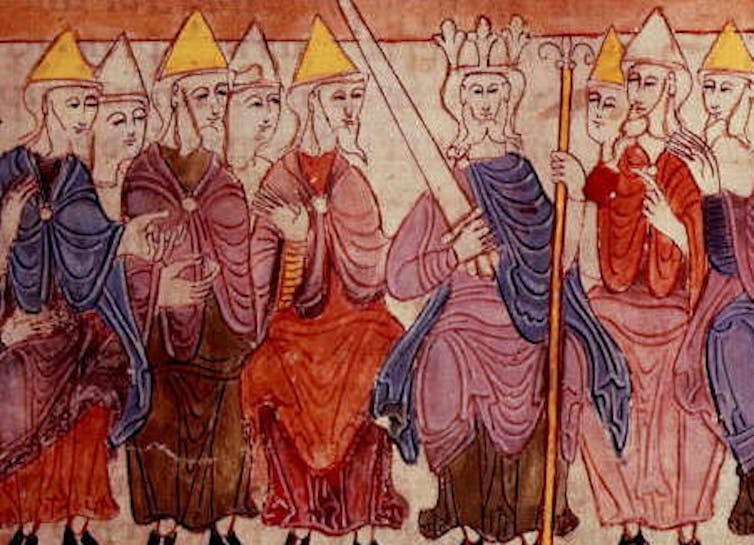


Witan hexateuch via Wikimedia Commons

A diverse history.
Witan hexateuch via Wikimedia Commons


In August, a religious group called the Odinist Fellowship wrote to the Church of England demanding two churches as reparations for a “spiritual genocide” which it claims began in the seventh century AD.

The Odinists use old Icelandic texts to reconstruct the “indigenous” religion of the Anglo-Saxons which they claim was oppressed with the arrival of Christianity. The Anglo-Saxons are commonly believed to have migrated into Briton in the fifth and sixth century AD. Iceland by contrast was inhabited in the ninth century by Viking settlers. In the US, this mixed up medievalism is associated with the white supremacist alt-right who use Anglo-Saxon and Viking motifs.

But archaeological research, which examines ancient DNA and artefacts to explore who these “indigenous” Anglo-Saxons were, shows that the people of fifth and sixth century England had a mixed heritage and did not base their identity on a biological legacy. The very idea of the Anglo-Saxon ancestor is a more recent invention linked closely with the English establishment.


Listen: The Anthill podcast episode on myths includes a segment on myths about race


The Anthill 20: Myths.
CC BY-ND38,2 Mo (download)


What DNA evidence shows


For decades, archaeologists and geneticists have sought to identify Anglo-Saxons in England. An early attempt in 2002 relied on modern DNA with a study of the male Y chromosome suggesting there had been a 95% population replacement of Britons by the Anglo-Saxons, comprised of different people from Northern Europe. But another study, based on mitochondrial DNA which is inherited from the mother, found no evidence of significant post-Roman migration into England. A third paper suggested that the genetic contribution of the Anglo-Saxons in south-eastern England was under 50%.

The discrepancies between the findings are because these three papers used modern DNA and worked backwards. Work my colleagues and I have undertaken looked at the question from the other direction – by working with ancient DNA.

The results from our recent study were published in Nature Communications and included evidence from an Anglo-Saxon site I excavated in Oakington, Cambridgeshire. In total ten skeletons were investigated. These included seven early medieval graves dating to between the fifth and eighth century – four from Oakington and three from Hinxton – and three earlier Iron Age graves from Cambridgeshire, dating to between the second century BC and the first century AD, to provide the genome of the antecedent inhabitants of Briton.

We used a novel method called “rarecoal” to look at ancestry based on the sharing of rare alleles, which are the building blocks of genes. Our research concluded that migrants during what’s now thought of as the Anglo-Saxon period were most closely related to the modern Dutch and Danish – and that the modern East English population derived 38% of its ancestry from these incomers. The rest of Britain, including today’s Scottish and Welsh, share 30% of their DNA with these migrants.
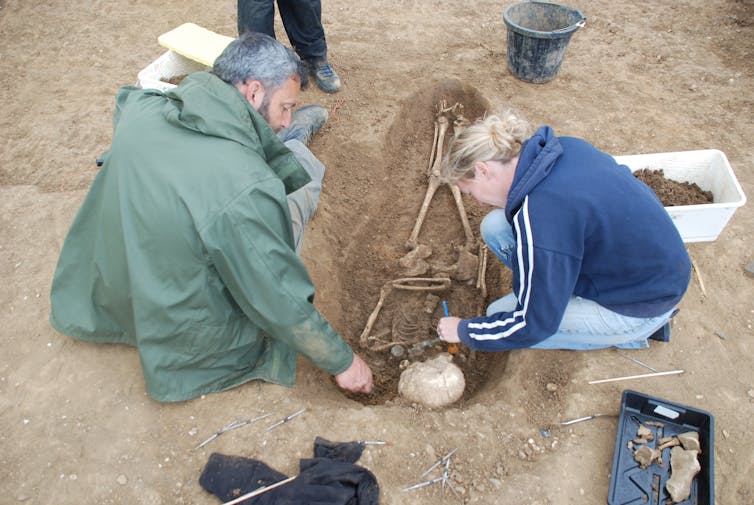


Excavating at Oakington. Duncan Sayer

Excavating at Oakington.
Duncan Sayer, Author provided


The analysis of DNA of four individuals from the Oakington Anglo-Saxon cemetery identified that one of them was a match with the Iron Age genome, two were closest to modern Dutch genomes, and one was a hybrid of the two. Each of these burials was culturally Anglo-Saxon because they were buried in the same way, in the same cemetery. In fact, the richest assemblage of Anglo-Saxon artefacts came from the individual with the match for Iron Age genetic ancestry, and so was not a migrant at all.

It shows that these ancient people did not distinguish biological heritage from cultural association. In other words, someone who lived and died in the fifth or sixth century Anglo-Saxon village of Oakington could have been biologically related to an earlier inhabitant of England, a recent migrant from continental Europe or a descendent of either or both – they were all treated the same in death.

Writing Anglo-Saxons into history


Biologically then these people were a mixed group who shared what we consider Anglo-Saxon culture. But they did not think of themselves as Anglo-Saxons.

The idea of the Anglo-Saxon is a romanticised and heavily politicised notion. When Gildas, a sixth century Monk wrote De Excidio et Conquestu Britanniae (On the Ruin and Conquest of Britain) he referred only to Saxons. Writing 200 years later, the Venerable Bede used the word “Anglorum” in his ecclesiastical history to describe a people unified under the church. In the ninth century, Alfred the Great used the term Anglo-Saxon to describe the extent of his realm – but this description did not persist.

It was not until the 16th century that pre-Norman people were consistently described as Anglo-Saxons. Previously, stories like the 1485 Le Morte d'Arthur, by Thomas Malory, romanticised Arthurian antagonists who defended Britain from invading Saxons. This origin story was important enough to late medieval Englishness that Henry VIII installed a round table in Winchester castle.
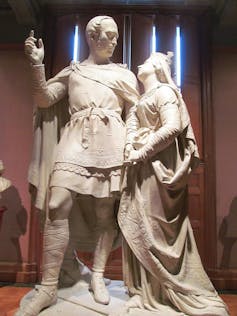


 Victoria and Albert: Anglo-Saxon style.

Victoria and Albert: Anglo-Saxon style.
David Holt London/flickr, CC BY


It was not until the 19th century that Anglo-Saxon poems such as Beowulf, the Seafarer and the Wanderer were translated into English as interest in Anglo-Saxons grew. In London’s National Portrait Gallery, there is a statue of Queen Victoria and Prince Albert of Saxe-Coburg and Gotha dressed as Anglo-Saxon monarchy – a commission that equated their Germanic descent with that of their subjects. This Anglo-Saxon origin story has its roots in politics, downplayed when anti-German sentiment during World War I prompted the royals to change their name from Saxe-Coburg-Gotha to Windsor in 1917.

A convenient, but inaccurate label


The people of the fifth, sixth and seventh century certainly did not think of themselves as Anglo-Saxons and would not have understood the description. Migration into the UK took place in deep prehistory, throughout the Roman and post-Roman periods – a fact which the Classicist Mary Beard was lambasted for defending on Twitter in August.

Migration then continued with Viking settlement in the ninth and eleventh centuries. Dutch and European migration into England was present throughout the middle ages and particularly pronounced in the 16th and 17th century as Flemish weavers fled religious persecution.

Today, the term Anglo-Saxon is a convenient label for those opposed to future immigration. While it collectively describes some post-Roman and early medieval culture, it has never accurately described a biological ethnicity nor an indigenous people. The DNA evidence points to an integrated people of mixed ancestry who lived side by side.

Anglo-Saxon ancestry is a modern English myth – the English are not descended from one group of people, but from many and that persists in our culture and in our genes.


The ConversationTo hear more on myths about race, listen to the December episode of The Anthill podcast on myths, featuring an interview with Duncan Sayer.

Duncan Sayer, Reader in Archaeology, University of Central Lancashire

La version originale de cet article a été publiée sur The Conversation.

Tuesday, August 15, 2017

Updated: Gary Johnson and Cliff Hyra React to #Charlottesville

Gary Johnson Charlottesville City Hall Jefferson Madison Monroe
Gary Johnson
Former New Mexico Governor Gary Johnson, who was the Libertarian Party's nominee for President in 2012 and 2016, issued a statement on the afternoon of August 14 in reaction to the events this past weekend in Charlottesville, Virginia.

Johnson posted his remarks on Facebook:

Racism killed people in Charlottesville this weekend. That is as un-American as it gets.

In the nation our Founders created, even a tiny minority of vile and repugnant 'demonstrators' enjoys the right to express racist white-supremacist evil.

BUT, the rest of us -- the overwhelming majority -- have the right, and I believe, the obligation, to condemn racism of every form. And when racist hate becomes violence and murder, we must respond with nothing less than the full force of the law.

Late Saturday night, Cliff Hyra, the Libertarian Party's 2017 nominee for Governor of Virginia, issued a similar statement, also on Facebook, reacting with shock and disbelief to the carnage precipitated by the presence of neo-Nazis, unabashed racists, and Confederate sympathizers in Charlottesville:
Cliff Hyra Libertarian Party Virginia Governor Charlottesville
Virginia gubernatorial candidate Cliff Hyra
Horrific and tragic events in Charlottesville today. White nationalists and neo-Nazis threaten the liberty of us all, and as Virginians we must stand united against them. My heart goes out to the victims of the brutal terrorist attack and their families. I wish a swift and full recovery to those hospitalized, and offer my deepest condolences to the families and friends of those who lost their lives.

It is shocking and unbelievable to me that a political disagreement over statues could serve as an excuse for violent combat and heinous murder. I am heartbroken today, and also fearful for the future of our country and our commonwealth. We must act now to root out and extirpate all support for political violence. Peaceful discussion and political action are the only way forward.

Update, August 15: Gary Johnson expanded on his thoughts about last weekend's events and their aftermath in an article for The Jack News headlined "In the Wake of Charlottesville, Let’s Look for Solutions and Not Blame."

Saturday, August 12, 2017

Guest Post: The Violence in Charlottesville

by Jeffrey A. Tucker

Robert E Lee Statue Emancipation Park Charlottesville Virginia
Robert E. Lee statue in Charlottesville
The vast majority of people in the United States have no interest whatsoever in street battles between the alt-right (better described today in more poignant terms) and the counter-protesters. Most people have normal problems like paying bills, dealing with kids, getting health care, keeping life together under all the usual strains, and mostly want these weird people to go away. So, of course, people are shocked at scenes of young people in the streets of this picturesque town with a university founded by Thomas Jefferson screaming, “Jews will not replace us.”

It’s hard to see, hard to hear. But they are not going away. For some people with heads full of violent ideology, what's happened so far is not enough. They imagine that with their marches, flags, uniforms, slogans, chants, screams, and guns, they will cause history to erupt and dramatically turn to favor them over the people they hate. Indeed, what is unfolding right now, with real loss of property and life, has gone beyond politics as usual and presages something truly terrible from the past, something most of us had previously believed was unrepeatable.

What in the world causes such a thing? It’s not about bad people as such. Many of the young men and women involved in this movement were raised in good homes and, under normal conditions, would never hurt anyone. What this is about is bad ideas. They crawl into the brain and cause people to imagine things that do not exist. It can be like a disease that a person doesn’t even know that he or she has. It causes people to seethe with hatred for no apparent reason, to long for the extermination of people who have never done anything wrong, to imagine insane outcomes of social struggles that have zero chance of succeeding.

The Group
The implausibility of their ideas is disguised by group psychology. They hang around people who think these same things and egg each other on in shared resentments and dreams of new powers they can acquire if they act boldly, bravely, and with determination. They conjure up scapegoats (blacks, Jews, women, Antifa, gays, and a government that is supposedly giving them all privileges at their expense) and begin to believe that the only way forward is to destroy them all in some grand uprising, after which they will seize power and rule forever.

Yes, I know it sounds insane. But one thing you learn from history is that no idea is too insane to be off limits to a group infected with a longing to rule. Any means to the end will do, with the end deeply embedded in the fevered imagination of the group member who finds mission, meaning, and significance from some struggle.

The Statue Myth
Much of the media coverage about the violence in Charlottesville, Virginia report that this all began with a dispute over the fate of a statue of the Civil War Confederate general Robert Lee that sits downtown. The city council voted to take it down; the protesters want it to remain as a symbol of white pride and rule (which is absurd because General Lee would have been thoroughly repulsed by the ideology these people represent). In actual fact, the dispute over this statue is a complete distraction from the real motivation here.

What this really is: an explosive expression of an idea that has been brewing in a malevolent movement that has been gaining steam for very a long time. After the Second World War, most people imagined that Nazi ideology was gone from the earth and that the only real totalitarian view that remained to threaten liberty was Communism. That might have been true for a few decades, but matters began to change in the 1990s, as new violent strains of statism begin to arise.

The Deep History
For the last two years, I’ve written about the deep history of this violent strain, which can be described variously as Nazism, fascism, alt-right, white supremacy, white nationalism, neo-reaction, or, my preferred and more technical moniker (borrowed from Ludwig von Mises), right-Hegelianism. People have variously wondered why I’ve spent so much time and energy digging through the works of people like Johann Fichte, Houston Stewart Chamberlain, Thomas Carlyle, John Ruskin, Charles Davenport, Oswald Spengler, Carl Schmitt, Julius Evola, Giovanni Gentile, and so on (many of my writings on these people are here). All of these ideas existed long before Hitler and the Nazis – and caused enormous damage in the world long before the Holocaust – and they persist after them.

It’s true that probably not even one of the protesters in Charlottesville have read these thinkers, much less the traditional liberal response to these rightist strain of anti-liberalism. How can they possibly be responsible?

Ideas are strangely magical, like time-traveling spiritual DNA, moving from brain to brain like a genetic mutation and just as unpredictably. Keynes was right to observe that most politicians are slaves to some defunct economist; in the same way these violent thugs are slaves to some defunct philosopher who loathed the emergence of universal freedom in the world during the 19th century and were determined to set it back.

Propagandists for Evil
At the same time, there must be some mode of transmission for ideas. The leaders of this movement serve the purpose well, but there is a deeper root. I’ve been very reluctant to mention what might be the most influential tract among the rise of the hard statist right in the last few decades, but given where we are with all of this, it is time. The book is The Turner Diaries, written by “Andrew McDonald” who was really William Pierce, a brilliant physicist whose mind was taken over by Nazi ideology, precisely because he was steeped in the literature above.

I do not recommend reading this book. You can’t unread it. It is their roadmap. I can recall the first time I read it. I was shaken to my very core, and it was the beginning of a new realization of the task before us, to combat this horror with every bit of intellectual energy.

It is the story of a small junta of whites who set out to reverse history with a series of killings, starting with Jews, then blacks, then communists, and then, inevitably, apologists for the merchant class and libertarians (they hate us deeply too). What you learn early on here is that this movement is absolutely socialist, just in a different way from the more-famous left-wing socialists. They are not red shirts but brown shirts, so they have a different agenda. It’s not about class struggle. It’s about race struggle, religious struggle, gender identity struggle, national struggle. 

So what happens? They rally the masses to their side with a growing amount of bloodshed, gain control of the government, set up a centrally planned socialist state, get hold of the nuclear stockpile and slaughter all non-whites in the world. Sorry for the spoiler.


The Genetic Code
Why would anyone rally behind such a ghastly book? Again, the human mind is capable of imagining terrible things, and that which we imagine to be true influences actions. Ideas, as they say, have consequences. Hence, anyone who has followed the transmission of these ideas over the last decades could see where this is heading.

What happens now? The tragedy is compounded, with a burgeoning leftist movement to counter the emerging threat from the opposite side, and a government ready to exploit the conflict between the two to crack down further on human rights and freedoms. It’s the perfect storm.


Our Task
The question is: what to do now? The answer lies in the source of the problem. The huge mess began with bad ideas. The only means available – and it is the most powerful – is to fight bad ideas with good ideas. We all need to throw ourselves into the intellectual battle most of all and as never before. What are those good ideas?

The progress of the last 500 years shows us precisely what the good ideas are: social harmony, human rights, the aspiration of universal dignity, the conviction that we can work together in mutual advantage, the market economy as a means of peace and prosperity, and, above all else, the beauty and magnificence of the idea of liberty itself.

Let us all – those who love peace, prosperity, and human flourishing for all – not despair but rather rededicate ourselves to the mission of replacing bad ideas with good ones. Our predecessors in this mission faced far worse odds and they prevailed, and they were far fewer than us. We can too, provided we think, speak, and act with courage and conviction in favor of all that is beautiful and true. This is how the left/right cycle of violence will be replaced by the highest longings of the human heart.


Jeffrey A. Tucker is Director of Content for the Foundation for Economic Education. He is also Chief Liberty Officer and founder of Liberty.me, Distinguished Honorary Member of Mises Brazil, research fellow at the Acton Institute, policy adviser of the Heartland Institute, founder of the CryptoCurrency Conference, member of the editorial board of the Molinari Review, an advisor to the blockchain application builder Factom, and author of five books. He has written 150 introductions to books and many thousands of articles appearing in the scholarly and popular press.


This article was originally published on FEE.org. Read the original article.


Friday, May 20, 2016

I endorse Governor Gary Johnson for President in 2016

I have been publishing this and other blogs for more than eleven years, in addition to contributing to Examiner.com, Bearing Drift, and the Richmond Times-Dispatch op-ed page over that period.  I've spent countless hours discussing politics as a guest commentator (and guest host) on local radio and TV programs.

Throughout that time, I have refrained from endorsing candidates for public office at any level.  To be fair, I have written nice things about candidates I like and snarky things about candidates I dislike, but I have never issued an explicit endorsement.

This year, that changes.  This year, the stakes are too high.

In 2016, with Hillary Clinton on the left and Donald Trump on the alt-right, I am morally bound to oppose them both.  Yet I am not content to vote for the least of three (or four) evils.  Instead, I can enthusiastically endorse the most qualified of any of the candidates for president who will appear on the ballots of all 50 states plus the District of Columbia.

The letter below was released earlier today on Facebook.  I felt compelled to write it because of the risk that my fellow Libertarians may grasp defeat and despair from the jaws of opportunity and success.

Governor Gary Johnson represents the best hope for a Libertarian ascendancy in the 45-year history of the party.  Gary Johnson will have my vote in Orlando on May 29, and my vote in Virginia on November 8.

I urge my compatriots in the LPVA to do the same at the convention next weekend, and my fellow citizens to do the same in the general election.

May 20, 2016

To my fellow delegates to the 2016 Libertarian National Convention
and to all American voters:

I am firm in my support of Governor Gary Johnson and endorse him for the Libertarian Party’s presidential nomination without reservation.

To be honest, I have known Governor Johnson for six years and he is the warmest, most unassuming politician I've ever met - - and I've met many, including every Virginia governor since Chuck Robb and nearly every candidate for Virginia statewide office since at least 2001. He is also among the most intelligent and thoughtful people I know.


You can't ignore the unprecedented flood of positive media attention that Gary has induced. Polls show him winning vote percentages in the double digits, on the cusp of an invitation to the debates this fall, with the minimum potential of doubling or tripling the LP's record-high totals of 2012. If any other candidate wins the nomination on May 29, all of that will be dust in the wind, and the party's presidential vote totals will descend to Michael Badnarik - - or worse, Dave Bergland - - levels. The added advantages of drawing new and energetic members into the party, bringing libertarian ideas to a wider audience, and changing the terms of the country’s policy discussions are incalculable.

Disaffected Republicans who vow #NeverTrump will not cast their votes for another erratic businessman with no political foundation, nor for a never-elected neophyte with a thin résumé. They are looking for someone with solid credentials and a proven track record. Similarly, disaffected Democrats who prefer Bernie Sanders’ misdirected idealism to a Clinton dynasty will find Gary’s clear vision of fiscal prudence and social progress compelling.

Gary Johnson is a credible, pragmatic, experienced chief executive with a libertarian core. I can't imagine a better combination as the LP's standard bearer or as President of the United States.

-- Rick Sincere
   Chairman, Libertarian Party of Virginia, 1991-1996
   Cofounder and President, Gays and Lesbians for Individual Liberty
   Former Chairman, City of Charlottesville Electoral Board

I hope to see many of my readers in Orlando and I look forward to a vigorous, civil debate about the nominations and the issues.