Showing posts with label gas prices. Show all posts

Sunday, September 10, 2017

From the Archives: Higher gas prices won’t change American car culture, says transportation expert

Editor's note: One of the repercussions of Hurricane Harvey (and, to a lesser extent, Hurricane Irma) has been a spike in gasoline prices, by about 50 cents per gallon across the country (30 to 45 cents higher in the Charlottesville area). This seems like a good time to revisit the topic of fuel's price elasticity. This article from 2011 sheds light on the issue.

Higher gas prices won’t change American car culture, says transportation expert
May 25, 2011 4:42 PM MST

Higher gasoline prices will not fundamentally affect the travel habits of Americans, asserts transportation expert Alan E. Pisarski, author of the “Commuting in America” series for the National Academy of Sciences.

Pisarski spoke to the Charlottesville Libertarian Examiner immediately after giving a presentation on livability and transportation issues at the Heritage Foundation in Washington on May 20.

$4 a gallon ‘sounds scary’

While four dollars a gallon “sounds scary,” Pisarski explained, that “is actually about the same as we were paying in 1980 -- even less if you take into [account] things like wealth and fuel efficiency.”

Even if gas prices move higher than that, “the benefits that people gain from the automobile are not really going to change,” he said. People will make minor accommodations to account for the higher prices, “but the fundamental change in the society will be trivial.”

As an example, Pisarski pointed out that the “last time we almost doubled the price of gasoline, in 2009, we had a three-and-a-half percent decline in travel.”

Virginia commutes

In his presentation, Pisarski had noted that Virginians commute to work outside of their home counties at a rate double that of the national average – about 52.1 percent travel outside their counties, compared to 27.4 percent nationwide. What accounts for that?

gas prices transportation Alan Pisarski
“One of the things that really matters,” he said, “is the fact that because of government, there’s a tremendous integration of activity, so people traverse long distances from their homes to their work sites. You see much more interaction between counties, in an economic sense, than you do in most other areas of the country.”

Arlington County, for instance, "exports" 80,000 workers each day and "imports" 130,000. In other words, only 33 percent of its workers stay in the county even though Arlington has 1.4 jobs per worker. In Fairfax County, to give another example, 50 percent of workers stay in the county for their jobs while 50 percent leave.

While it may seem like Northern Virginia – the suburbs around Washington, D.C. – skew the rate upward, the phenomenon is statewide. There are only two or three counties in the whole state, Pisarski explained, “that don’t send the majority of their people to another county to work.”

In fact, he added, “it’s more extensive in the rural counties” and exurban counties that are “two and three counties out from the metropolitan area,” and from those places, Virginians commute to metropolitan Richmond or metropolitan Washington.

Pisarski noted that the state that comes in second in this category is Maryland, which is also affected by the government jobs and economic activity generated by Washington, followed closely by Pennsylvania.


Livability and local budgets

Alan Pisarski transportation gasoline prices
Alan Pisarski
The theme of Pisarski’s presentation at the Heritage Foundation was the new emphasis on “livability” in the housing and transportation policies of the Obama administration. He said that “livability” is a “nonce word,” which has different meanings – and sometimes no meaning at all – depending upon who is using it and in what context.

“Those words come in and out of favor,” he explained, but the emphasis on livability comes from “the pressure on local governments to come up with money. This is another way for them to argue for what they see is their share, whether its of state money or federal money” to supplement their budgets to pay for community concerns, whether to solve traffic problems, improve neighborhoods, or build bike paths.

“These things” that local governments desire, Pisarski said, “are not unattractive or undesirable or even inappropriate.”

The problem, he explained, is that they do not “belong in discussions at the federal level,” because they are local concerns that should be dealt with on the local or state level.


Publisher's note: This article was originally published on Examiner.com on May 25, 2011. The Examiner.com publishing platform was discontinued July 1, 2016, and its web site went dark on or about July 10, 2016.  I am republishing this piece in an effort to preserve it and all my other contributions to Examiner.com since April 6, 2010. It is reposted here without most of the internal links that were in the original.


Monday, September 04, 2017

Guest Post: Price Gougers Actually Help Solve the Problem of Scarcity

by Tom Mullen

Whenever there is a natural disaster, we see two things: the best in human generosity, courage and resilience and the worst in economic ignorance.

The former includes individuals rescuing stranded neighbors, volunteers lining up to join charity relief efforts, and corporations marshaling their vast resources to pour needed items such as food, bottled water and clothing into devastated areas. The latter includes “economists” repeating the age old broken window fallacy and politicians denouncing and threatening so-called “price gougers.”

Emotions run high during disasters, which is a double-edged sword. The outpouring of sympathy for the victims leads to extraordinary efforts in assistance. But it also leads to irrational resentment of those whose actions are often vital to human survival, but whose motives are judged inferior. These are, of course, the aforementioned price gougers.

One of the weaknesses in rational responses to the accusation of price gouging is just that: they appeal to reason when the accusation is born of emotion. And that disconnect is an irrevocable one until the accuser can be persuaded to look at the situation reasonably. But once so persuaded, the accuser often voices the understandable objection that economic arguments rooted in supply and demand charts and theory are too removed from what the accuser considers “the real world.”

Real World Behavior
Here, then, is a “real world” scenario in which the actors respond to incentives just as anyone in similar situations have countless times in the past:

There is a hurricane and flooding. Drinkable water is in short supply. A man has $100. He needs a case of water to get his family of three through the week. He walks into the store, where water is $25/case. There are 4 cases left on the shelf. He needs one, but can afford 4 and he doesn’t know how long the emergency will last. So, he buys all 4 cases.

Immediately afterwards, a family of five walks into the store with $100. There is no water to buy at any price. This family is now in desperate straits and must look elsewhere to procure what they need to survive.

Can anyone dispute the actors in this little parable have acted rationally and precisely as they would in the real world? No. Neither have any acted in a malicious or overly selfish manner. All have made the best choices among the alternatives presented them.
Now, change the price of a case of water in the above scenario to $100/case. What would be different? Of course, the man with a family of three would now only be able to buy one case of water, giving him what his family needs, but not necessarily as much insurance against future uncertainty as he would like. He gives up a little, but the family of five whose survival was in grave danger in the $25/case scenario is now able to purchase at least one case of water.

In the latter scenario, both families have enough to survive and a strong incentive to conserve water, thereby reducing demand and lowering its price, all other things being equal.

The so-called “price gougers” may have acted in their own interests, but they have not only benefited society economically, they have saved the lives of the family of five. Thus, Adam Smith’s 241-year-old “invisible hand” is confirmed by the real world yet again.

Incentivizing Other Entrepreneurs
But there are still those who claim that, while the price gougers have acted rationally and within their rights and may even have inadvertently benefited others, they have still acted immorally. In the case of the recent hurricane in Texas, many say,
“No, you don’t understand. Many of these people aren’t even from Houston. They knew the hurricane was coming and bought up a bunch of water at regular prices, with the express intent of coming to Houston and selling it for huge profits, while others were giving water away for free. That’s immoral!”

First, anyone selling water at any price is obviously serving people who don’t have access to the free water. If the buyers had access to free water, they wouldn’t pay for it, at inflated prices or not. Second, this sanctimonious moralizing begs the question, “Why didn’t you buy up a bunch of water and go to Houston and sell it at regular prices?”

The answers to the latter question are many, but they can be summarized as follows: most people do not have the time, capital or expertise to do what the price gougers did.

Who can afford to take off from their own job or cease running their own business to start a whole new one on a few days notice, much less donate their time? Some can, but not most, which is why after all those who can be by charitable work are served, there is still a market for those seeking profits.

We Need Price Gougers
Lost in all the moralizing is the reality that the so-called price gougers face all the same challenges as anyone else, having to forego whatever income they otherwise would have earned if not for their disaster-relief project, and face the risk of losing future income because they took off from their jobs or put their own regular businesses on hold. These losses and risks must be compensated, which is another reason they sell products at a premium price, in addition to supply/demand realities.

Thus, in the real world, even with as many people as are able acting as charitably as possible, there is a need for those seeking profits from higher-than-normal margins, whose self-interested actions save lives and mitigate the devastating effects of disasters. Yet, the rest of the world condemn them and governments seek to punish them, threatening not only the price gougers, but those whose lives they may save or whose suffering they may lessen during the next disaster.

Reprinted from Tom Mullen.

Tom Mullen price gouging economics supply and demand


Tom MullenTom Mullen is the author of Where Do Conservatives and Liberals Come From? And What Ever Happened to Life, Liberty and the Pursuit of Happiness? and A Return to Common  Sense: Reawakening Liberty in the Inhabitants of America. For more information and more of Tom's writing, visit www.tommullen.net.


This article was originally published on FEE.org. Read the original article.


Wednesday, May 09, 2007

Orwellian Regulation in Wisconsin

Citing the ironically-titled Unfair Sales Act, the government of the state of Wisconsin has ordered the immigrant entrepreneur of a small gas station to stop offering discounts to his customers.

That's right: According to the state of Wisconsin, it is "unfair" to take a couple of cents off a gasoline purchase, currently costing as much as $3.14 per gallon locally.

According to the Wausau Daily Herald and reported internationally by the Associated Press:

A service station that offered discounted gas to senior citizens and people supporting youth sports has been ordered by the state to raise its prices.

Center City BP owner Raj Bhandari has been offering senior citizens a 2 cent per gallon price break and discount cards that let sports boosters pay 3 cents less per gallon.

But the state Department of Agriculture, Trade and Consumer Protection says those deals are too good: They violate Wisconsin’s Unfair Sales Act, which requires stations to sell gas for about 9.2 percent more than the wholesale price.
Offering the discount no doubt brings Mr. Bhandari goodwill among his customers, but it is unlikely to help his bottom line. Gas-station owners operate on a notoriously narrow margin, and they are unlikely to reap many profits -- if any -- from the sale of gasoline alone.

Rather, they rely on the sale of peripheral items, such as the odd candy bar, soda pop, or beef jerky, to fill their cash register drawers. Unfortunately, as gas prices rise, customers are less likely to spend their spare change on a snack or a drink -- and so the mom-and-pop gas station suffers a decline in revenues.

Given this situation, it is remarkable that the same newspaper that broke this story -- the Wausau Daily Herald -- has an editorial today that cruelly suggests that the state should regulate gasoline prices in such a manner that the small-time entrepreneur would suffer even more losses. In so doing, it completely misreads why the "Unfair Sales Act" -- a name George Orwell would relish -- is itself unfair to consumers and business owners alike:
Wisconsin requires all retailers to mark up the price of fuel at least 9.2 percent above its wholesale price.

The rule is intended to prevent retailers from undercutting competitors to drive them out of business.

But as gas prices rise, so do profits; at $1 a gallon, retailers make 9.2 cents on every gallon sold. At $3, they make 27.6 cents.

The formula needs to be changed. Make it a dime a gallon, no matter what the wholesale cost, to protect competition and consumers.
It is not the government's role to set prices for any product. If the state or federal government told supermarkets that the shelf price of cornflakes, for instance, must be 9.2 percent more than the wholesale price, there would be an uproar. If the government told furniture retailers to stop advertising "North Carolina prices" and to jack up the numbers on the price tags of sofas and coffee tables, consumers and store owners alike would be furious.

Somehow, the economically illiterate seem to think that the laws of supply and demand cease to have relevance when it comes to gasoline and that the government should play a role for which it is singularly unsuited.

Hat tip to Bart Hinkle for bringing my attention to this item.

Wednesday, July 26, 2006

Gas Prices: How Much Is Too Much?


Waldo Jaquith posts a chart on his blog that suggests the minimum wage (per hour) is converging with the price of a gallon of gasoline and asks, "What happens when the minimum wage exceeds the cost of a gallon of gasoline?" (meaning, as one of his commenters notes, "when the cost of a gallon of gasoline exceeds the minimum wage").

Waldo does not find this scenario hopeful.

For me, he provides an opportunity to discuss gasoline prices, something I've wanted to do for some time now but just haven't got around to it. I think he frets too much.

The fact is, gasoline prices are not as much of a hardship as one might think, even for those few people who both earn the minimum wage and own a car to use for their personal transportation.

Nobel laureate economist Gary Becker notes on the blog he writes jointly with federal judge Richard Posner:

Gasoline prices have risen by about $1 during the past year to almost $3 a gallon. This is a very large increase over a short period of time, but it should be put in perspective. Spending on gasoline by the average household has risen from about 2% of its total consumer spending to a still low 3%-it reached over 4-1/2% of personal consumption spending in 1981. The real cost of gasoline, adjusted for changes in the price level, is less than in 1981. Since a typical family has a higher real income than it did 25 years ago, the burden of high gas prices is easier to bear now than at that earlier time. The higher price will pinch for families who commute long distances to work in their SUV's, but the price of gasoline does not have a major effect on the many poor families who take public transportation to work.
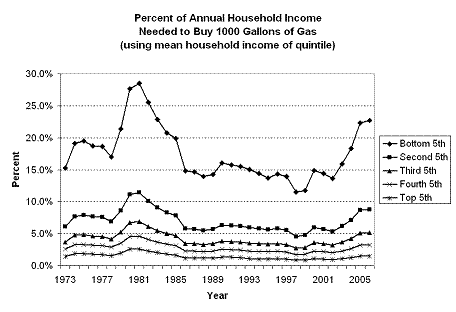
Meanwhile, Glen Whitman, who worked under me as an intern at the International Freedom Foundation (when he was a Koch Fellow and an undergraduate at American University in D.C.) and is now an associate professor of economics at California State University-Northridge, posts this graph on his own blog, Agoraphilia:


Glen explains:
So what can we see? Even looking at the poorest fifth of the population, the fraction of income required to buy gasoline is still lower than it was in the early '80s. Not surprisingly, the fraction has risen a great deal over the last few years, but it still has not surpassed its historical peak. The same holds true for every other income quintile, but the effect is more muted, since higher income means any given price difference will correspond to a smaller fraction of income. (If gas prices stay at their current price of about $2.90/gallon, however, then we could pass that early-80s high-water mark this year.)

How is it possible that the same qualitative pattern holds for both rich and poor, given the rising disparity in income? It’s true that the income gap has increased since the 1970s. But that’s not the same as saying the poor have gotten poorer, because in fact real incomes have risen for every income group over this period. The gap has grown because the rich have gotten a lot richer, while the poor have gotten a little richer.
Glen's explanation goes a long way to answering an unspoken question I have had on my mind: Why does demand for gasoline seem inelastic even in the face of what appear to be dramatic price increases? The reason is that, no matter what income bracket an American might be in, the price is not hitting the pocketbook as hard as it seems to do so on the surface.

Another aspect of the situation is this: As prices rise, despite short-run inelasticity of demand, consumption will decline (due to the substitution effect), and prices will follow. Here is Richard Posner replying to Gary Becker:
In fact the cause of the price spike is primarily, as I said, the increase in crude oil prices, and that increase is in turn primarily the result of rapid growth in demand for oil by China (now the world's second-largest consumer of oil) and India, a growth that has outpaced supply. The notion that this represents a crisis--that the world is running out of oil--is ridiculous. In the short run, with demand rising faster than supply, price rises steeply, producing "obscene" profits since roughly the same quantity is being sold at higher prices. In the longer run, consumption falls as consumers search out substitutes; supply rises as previously uneconomical sources of oil become economical; and so profits fall back to a normal level. . . .

From the broad national standpoint, we should welcome high gasoline prices because it is in the national interest to reduce our consumption of gasoline, and high prices will do that, dramatically so in the long run when more substitution is possible.
We'll leave the question of the minimum wage for another day, unless you'd like to visit my previous posts on it, here and here.