Showing posts with label marketing. Show all posts

Thursday, November 22, 2018

Guest Post: How advertising shaped Thanksgiving as we know it

Samantha N. N. Cross, Iowa State University

I have always been intrigued by Thanksgiving – the traditions, the meal, the idea of a holiday that is simply about being thankful.

For my family, Thanksgiving is all about the food. Some foods, like turkey and mashed potatoes, may be familiar. But there are a few twists. Since I grew up in the Caribbean, I’m allowed a Caribbean dish or two. The reliability of the menu – with a little flexibility sprinkled in – seems to unite us as a family while acknowledging our different cultural backgrounds.
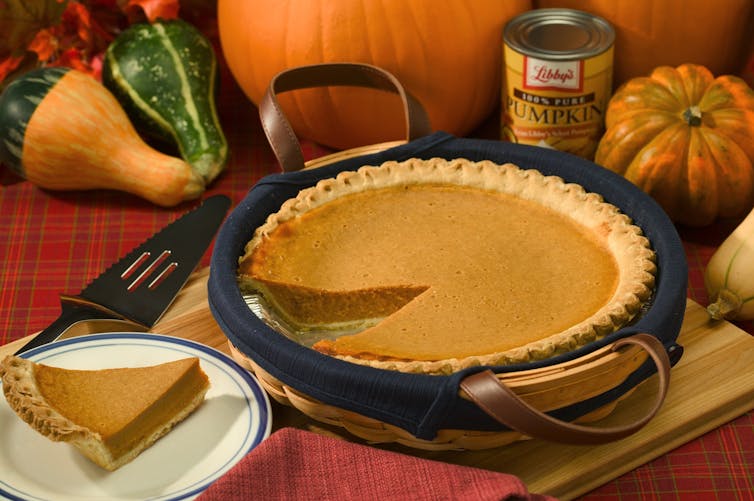


Pumpkin pie Thanksgiving

Libby’s continues to fiercely compete with pumpkin pie peddlers Borden’s, Snowdrift and Mrs. Smith’s for a place on the Thanksgiving table.
Jean Beaufort


Chances are you and your family have similar traditions. Filipino-American families might include pancit. Russian-American families might serve a side dish of borscht. That’s what makes Thanksgiving unique. It’s a holiday embraced by people regardless of their religion or ethnicity.

Yet despite this adaptability, there’s a core part of the meal that almost everyone embraces. How did this come to be? Although few appreciate it, advertisers have shaped the meal as much as family tradition.

A uniquely broad appeal


When Sarah Josepha Hale, the editor of Godey’s Lady’s Book, first advocated for Thanksgiving as a national holiday in 1846, she argued that it would unify the country. In our research, my colleagues and I have been able to show that Hale’s vision for the holiday has been largely fulfilled: Inclusivity of people and traditions has been Thanksgiving’s hallmark quality.

A reason for its broad appeal is that it lacks any association with an institutionalized religion. As one interviewee told us, “There is no other purpose than to sit down with your family and be thankful.” And after interviewing a range of people – from those born in the U.S. to immigrants from countries like South Africa, Australia and China – it became obvious that the principles and rituals they embraced during the holiday were universal no matter the culture: family, food and gratitude.

But as a relatively new holiday – one not tied to a religious or patriotic tradition – a shared understanding of the celebration and the meal is crucial to ensure its long-term survival.

While there might be subtle variations, the Thanksgiving meal is the lodestone of the holiday, the magnet that brings people together. Today, familiar items constitute the meal: turkey, cranberry sauce, stuffing, gravy, alcohol, salad, apple pie and pumpkin pie. Many of our interviewees tended to serve some version of this list.

But why these items and not others? What makes turkey, cranberry sauce and pumpkin pie so special? My colleagues and I studied 99 years of Thanksgiving ads in Good Housekeeping magazine to find out.

Marketing a ritual


Starting with Thanksgiving’s early champion, Sarah Josepha Hale, the history of Thanksgiving is rooted in marketing. Marketers not only helped create many of the rituals and cultural myths associated with the Thanksgiving meal, but they also legitimized and maintained them.
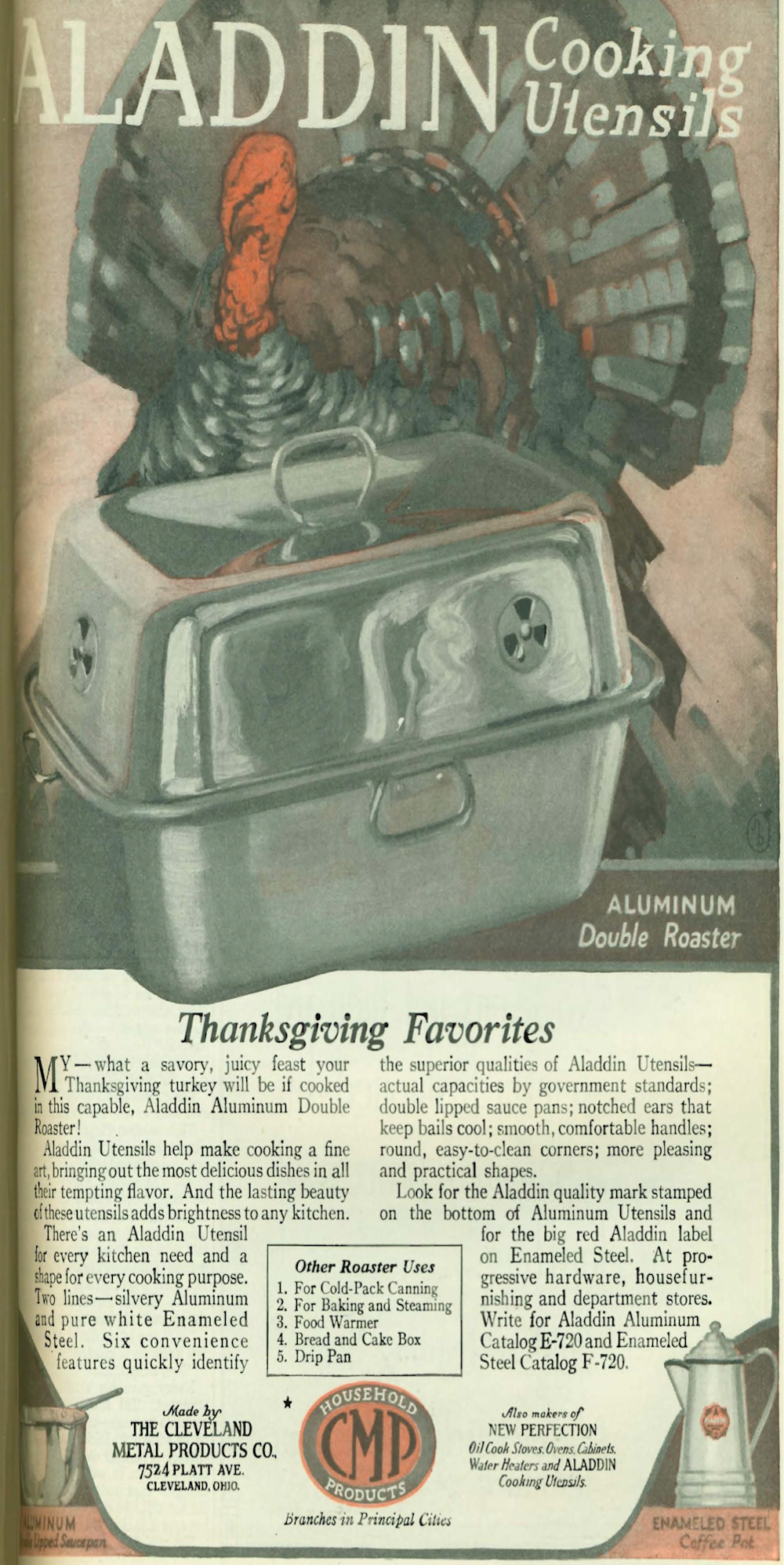


Aladdin Cooking Utensils advertises its double roaster in a 1920 issue of Good Housekeeping.

Aladdin Cooking Utensils advertises its double roaster in a 1920 issue of Good Housekeeping.
Good Housekeeping


Initially, the Thanksgiving turkey competed with other meats, like duck, chicken and goose, for centerpiece at the Thanksgiving table.

But by the 1920s, turkey had become the only meat advertised. Early ads would focus on how to prepare and present the perfect bird, promoting branded tools like roasters, ranges, pop-up thermometers and oven-cooking bags.

Iconic Swift’s Premium turkey ads focused on the sacredness of the meal by featuring families at prayer, giving thanks before the meal begins. The importance of the turkey to the Thanksgiving celebration dominates, helping to perpetuate the Thanksgiving turkey tradition.

Meanwhile, early ads for the Eatmor Cranberry Company positioned their whole cranberries as a perfect complement to any and all Thanksgiving meat dishes. This brand dominated until the 1930s when another brand, Ocean Spray, entered with its canned gelatin cranberry sauce.
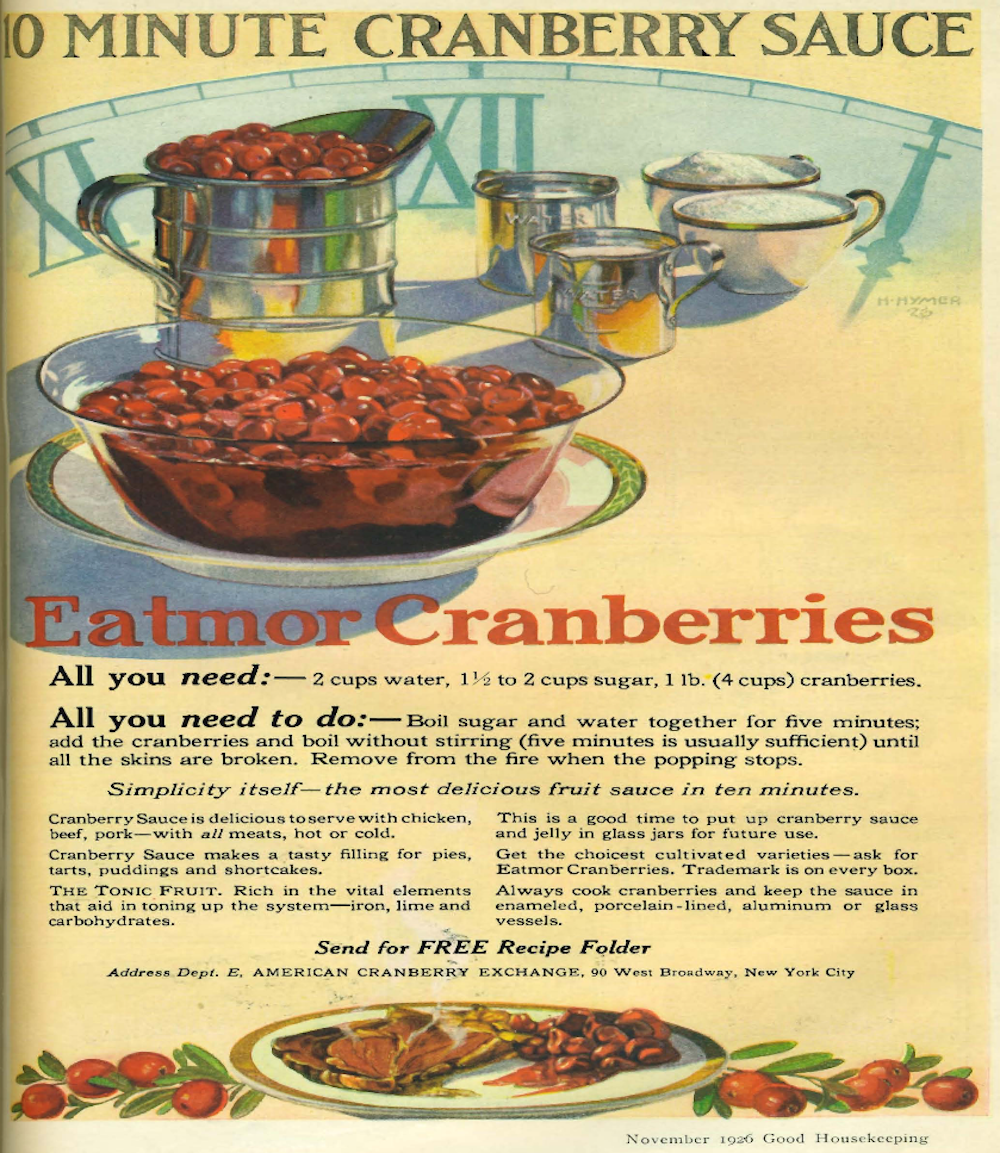


Eatmor Cranberries Thanksgiving advertising

Eatmor Cranberries – which used to be the king of Thanksgiving cranberry sauce – advertises in a November 1926 issue of Good Housekeeping.
Good Housekeeping


Ads for both brands implied that cranberry sauce has been around since the first Thanksgiving dinner, which was highly unlikely. However, the brand positioning war successfully promoted cranberry sauce as the natural condiment for the Thanksgiving turkey. Ocean Spray would triumph and, to this day, promotes whole cranberries and canned gelatin.

Considered by many to be the quintessential Thanksgiving dessert, pumpkin pie also wasn’t present at the first Thanksgiving meal. (The Pilgrims lacked the butter, wheat flour and sugar to make the pastry.) Nonetheless, beginning as early as 1925, a range of brands – for example, Borden’s, Snowdrift, Mrs. Smith’s and Libby’s – have competed fiercely to connect pumpkin pie to the season, the holiday and the meal. It’s a rivalry that continues to this day.

The role of the consumer


Not every product category or brand succeeded in becoming a core part of the Thanksgiving meal.
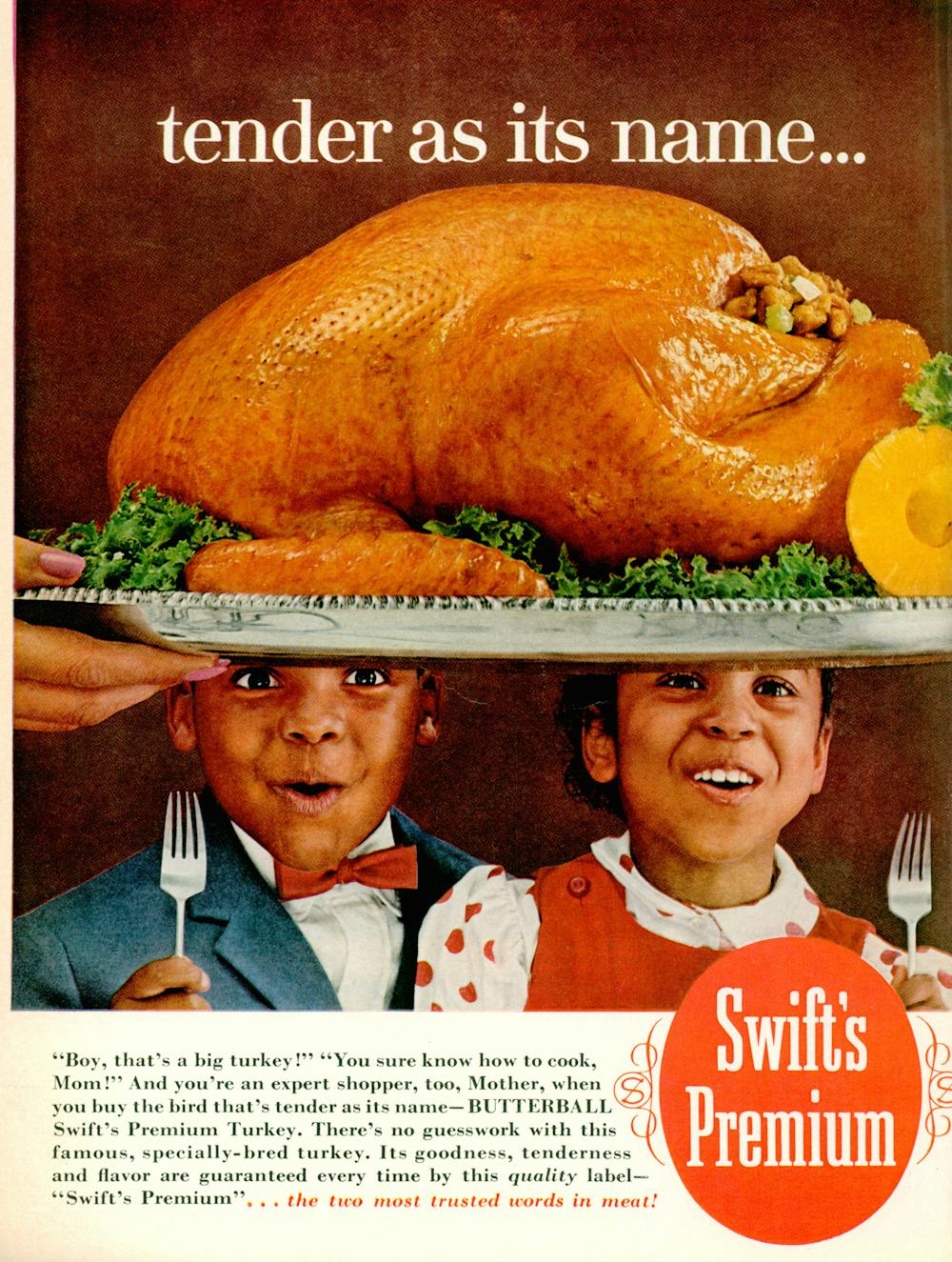


A Swift’s Premium Turkey ad from 1964.

A Swift’s Premium Turkey ad from 1964.
Wishbook


A Welch’s ad from the 1960s implies that the first Thanksgiving meal included juice made from grapes. In 1928, Diamond marketed their walnuts as an accessory to dress up Thanksgiving dishes. Despite vociferous ad campaigns, few associate Welch’s grape juice or Diamond walnuts with Thanksgiving today.

But those early 20th-century ads for turkey clearly resonated: Today, nearly 88 percent of U.S. households have turkey on Thanksgiving, and approximately 20 percent of the turkeys consumed in any given year are consumed at Thanksgiving. This is a testament to the enduring influence of marketing on the holiday. For brands like Butterball (formerly Swift’s Premium), Thanksgiving is big business.

Whether you’re a turkey fan or not, prefer apple pie to pumpkin pie, enjoy canned gelatin over whole cranberry sauce, by celebrating Thanksgiving, you play a role as well. Marketers may have shaped many of the rituals of the holiday. But all Americans – from all backgrounds – certainly do their part to maintain them.

The ConversationAfter all, brands need customers to survive.

Samantha N. N. Cross, Associate Professor of Marketing, Iowa State University

This article was originally published on The Conversation. Read the original article.
Saturday, December 16, 2017

Guest Post: The secret behind the success of the new 'Star Wars' films

Subimal Chatterjee, Binghamton University, State University of New York

In the 40 years since the original “Star Wars” film premiered, the franchise has been a pop culture powerhouse.

“The Last Jedi” – the latest edition in the series – looks to continue the trend, with huge box office returns expected.

It also looks poised to join “The Force Awakens” (93 percent on Rotten Tomatoes) and “Rogue One” (85 percent) as “Star Wars” films that are both commercially and critically successful.


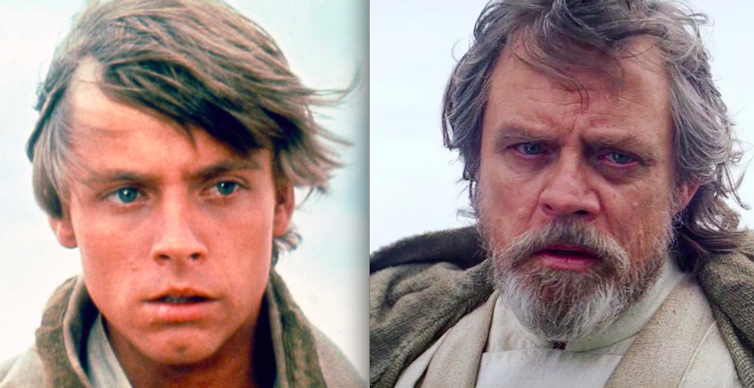
Actor Mark Hammill reemerged in ‘The Force Awakens’ and ‘The Last Jedi.’

Actor Mark Hammill reemerged in ‘The Force Awakens’ and ‘The Last Jedi.’
Nick Lehr/The Conversation via Lucasfilm , CC BY-NC-ND


Not all “Star Wars” films have hit that sweet spot. It’s sometimes easy to forget the prequel trilogy – “The Phantom Menace” (1999), “Attack of the Clones” (2002) and “Revenge of the Sith” (2005) – wasn’t met with the same enthusiastic response from critics and fans, and hasn’t been looked upon kindly since.

What made the prequel trilogy such a (relative) dud? Why are the more recent films being so much better received?

If it isn’t broke, don’t fix it


Research I helped conduct on what makes for a good extension (sequel or prequel) may provide some insight.

My colleagues and I tracked audience reactions to sequels and prequels over the course of nearly a hundred franchises, from “Psycho” to “X-Men.”

Our results show that the successful franchises make smaller, gradual updates – rather than sweeping changes – in each successive film. And it fits well with what we know about audience behavior: They seek a balance between the familiar and the new; while they aren’t looking for a carbon copy of the originals, they’re hoping to relive some of the most vivid, nostalgic moments from the first films.

With these findings in mind, let’s reexamine prequel series of “Star Wars.” When “The Phantom Menace,” the first of the prequels, was released in 1999, it had been 16 years since audiences had seen a new “Star Wars” film. (The original trilogy had just finished up a successful theatrical re-release.)

But fans hoping to relive the magic of the originals were in for a surprise.

The beloved trio of Mark Hamill (Luke Skywalker), Harrison Ford (Han Solo) and Carrie Fisher (Princess Leia) gave way to new faces: Liam Neeson, Ewan McGregor and Natalie Portman. Instead of relying on real sets, miniatures and models to pull off the breathtaking special effects in the originals, director George Lucas opted mostly for computer-generated and digital effects. There were also changes to the rules of the “Star Wars” world. The Force was no longer being described as an all-encompassing life force that bound everyone together; it was now being explained as the result of special biological cells called “midichlorians.” (And I won’t even go into the widely loathed Jar Jar Binks.)

Out with the new, in with the old


In contrast the newest film, “The Last Jedi,” includes many of the original cast members. Mark Hamill and Carrie Fisher return to portray Luke Skywalker and Princess Leia, respectively. And it features the popular “hero’s journey” plot device of the original films, in which an ordinary person’s life is unexpectedly upended, and he is thrust into the role of the hero.

We see this phenomenon in other film series and even product lines. Though the lead actor will occasionally change, the James Bond series never strays from its action-film formula. Apple has a similar approach when releasing new iPhones; before taking the leap to a radically new version, it will release an incremental “S” version of the previous model as a bridge.

That isn’t to say the new “Star Wars” films aren’t making any changes: There are more female protagonists, in addition to a host of new characters. But this isn’t exactly shattering fans’ expectations.

Our research also found that the deeper into a franchise you get, the more major changes audiences are willing to accept. The next “Star Wars” trilogy will expand the boundaries of the “Star Wars” world, exploring planets and featuring characters not yet seen on film.

With this move, the studio is willing to bet that audiences are finally ready to accept some major changes in the franchise – something they weren’t quite ready for yet when the prequels were released.

The ConversationHowever, in order to ensure the Force remains strong over the franchise’s lifetime, these future films would be wise to continue including at least a handful of nods to the original trilogy.

Subimal Chatterjee, Professor of Marketing, Binghamton University, State University of New York

This article was originally published on The Conversation. Read the original article.

Thursday, November 27, 2014

'How Many Shopping Days Until Christmas?'

If you landed here because you asked your search engine, "How many shopping days until Christmas?," the answer as this went to press was "27."  If you've landed here after November 27, you can check out this handy countdown clock to find out the accurate answer.

The reason for the headline is more to explore the origin of the phrase "only x shopping days until Christmas."

The conventional story of the origin of "shopping days until Christmas" is that the phrase was coined by Wisconsin-born retailer Harry Gordon Selfridge, founder of Selfridge and Company in Oxford Street (London).  There is renewed interest in Selfridge's life and work due to a popular British TV series about him, starring Jeremy Piven, that has also been broadcast on public television in the United States.

It is clear from both factual and fictionalized portrayals of Selfridge that he was an innovative merchant, but research I have done suggests that he is unlikely to have been the coiner of the now-ubiquitous countdown phrase.

According to Selfridge's Wikipedia entry, which lacks a citation for the point,

While at Marshall Field, Selfridge was the first to promote Christmas sales with the phrase "Only _____ Shopping Days Until Christmas", a catchphrase that was quickly picked up by retailers in other markets. Either he or Marshall Field is also credited with popularizing the phrase "The customer is always right."
The UK-based web site "The Phrase Finder," citing the Encyclopedia of Word and Phrase Origins, repeats the same information:
American retailer H. Gordon Selfridge (1856-1947) coined this expression - " __ shopping days until Christmas" while working for Marshall Field & Co. in Chicago. Later he coined the slogan "the customer is always right" when he opened Selfridge's in London.
An Australian web site, WordBooks.com.au, acknowledges that Selfridge may have heard the phrase somewhere else before he used it in marketing his own store's products. Writer Michelle Holland cites another book (Who Said That First?, by Max Cryer) as her source:
The idea of reminding people how much shopping time is left before Christmas is not new. On 19 December 1900 the Los Angeles Times displayed a reminder: ‘There are only (counting today) five more shopping days till Christmas.’ Four days later the Washington Post took up the cry: ‘Only one more shopping day until Christmas.’

At the time Gordon Selfridge was working with Marshall Field and Company in Chicago. He may have picked up the idea from the newspapers mentioned, but certainly he soon instructed his staff to drive the same slogan, which put a real sense of urgency into the shopping lead-up to Christmas. Before long it was used worldwide.
A careful search on NewspaperArchive.com turns up several uses of the phrase several years before the 1900 citations from the Los Angeles Times and Washington Post. The earliest usage I can find was in 1891 but it was frequently used in the 1890s in locations as various as Boston and Cedar Rapids and in various small towns in the Midwest (Oshkosh, Wisconsin, and Mansfield, Ohio, for instance).

The earliest example I can find from Gordon Selfridge himself comes from 1909, the first Christmas season that Selfridges was open:

London Standard, December 16, 1909
Yet I was not able to find any uses of the phrase in Chicago newspapers during the time that Selfridge worked for Marshall Field. The earliest instance appears to be from the front page of the Chicago Heights Star on December 17, 1908 -- about two years after Selfridge had moved to London to build his own department store.
Chicago Heights Star, December 17, 1908
One Illinois newspaper used the phrase in 1897 -- but that was in Jacksonville, a central Illinois city some 235 miles southwest of Chicago and unlikely to be familiar to Selfridge.

Jacksonville (Ill.) Daily Journal, December 8, 1897
Four years earlier, a Massachusetts merchant, Hollander Bradshaw Folsom, used the phrase in a large advertisement for a variety of products it had on offer:

Boston Sunday Post, December 10, 1893
That Boston Sunday Post advertisement may be the first time the phrase "only __ shopping days before Christmas" appeared in print.

Two years before that, the same retailer posted this reminder in the Boston Globe: "NOTICE--Please bear in mind that only 16 SHOPPING DAYS now intervene to Christmas, and that during the last ten days all of our floors are jammed."

Boston Sunday Globe, December 6, 1891
I believe that Boston Sunday Globe ad is the earliest use in print of anything close to "shopping days until Christmas," although it is expressed in more flowery language.

In 1894, the Herms Dry Goods Company advertised in the Portsmouth (Ohio) Daily Times, admonishing readers to "Do Your Xmas Shopping Now" because there were "Only 18 Shopping Days Before Christmas."
The Daily Times (Portsmouth, Ohio), December 4, 1894
On the same page in that same newspaper was the beginning of the serialization of Stephen Crane's novel, The Red Badge of Courage, up to chapter III. The Daily Times was one of 200 small town dailies that serialized Crane's story that month and helped establish his fame as a writer. Now a high-school lit-class staple, The Red Badge of Courage wasn't published in book form until the following year. (Charlottesville connection: Crane's handwritten manuscript is preserved in the Albert and Shirley Small Special Collections Library at the University of Virginia.)

Advertising in the Boston Sunday Globe in 1895, Jordan, Marsh, & Co. claimed to have "the Grandest Aggregation of Holiday Goods in New England" and reminded readers there were "Only 8 More Shopping Days Before Christmas":

Boston Sunday Globe, December 15, 1895
By the turn of the century, the phrase was ubiquitous. Here are some examples:

The Daily Northwestern (Oshkosh, Wisc.), December 11, 1899

Mansfield (Ohio) News, December 12, 1899

Cedar Rapids (Iowa) Republican, December 23, 1900


Washington Post, November 27, 1904
That last example, published exactly 110 years ago today, is puzzling in that it warns about "only 24 shopping days until Christmas," when it should be 27 days.  The advertiser, Galt & Bro. Jewelers, was at one time the oldest continuously operating business in Washington, D.C.  It closed in March 2001 after nearly two centuries of operation.  It was once managed by Edith Galt, who became the second Mrs. Woodrow Wilson and effectively president after her husband's debilitating stroke.

To summarize:  The claim that Harry Gordon Selfridge coined the phrase "___ shopping days until Christmas" rests on flimsy ground.  Knowing that Selfridge was a notorious self-promoter, the assertion that he first used it while he was at Marshall Field & Co. in Chicago in the late 19th century may originate with him in one of his expansive chats with journalists (like this 1932 interview with The Milwaukee Journal, in which he lays claim to "the customer is always right").

The earliest near-usage I was able to find was in the Boston Globe in 1891.  (I searched as far back as 1860.)  The earliest precise phrasing I found was two years later, in the Boston Sunday Post. The phrase became common in the 1890s in New England and the Midwest but I found no evidence of Selfridge using it before 1909, even in Chicago newspapers that would have published ads for Marshall Field. That doesn't mean no evidence exists -- just that I could not find it.  If anyone can find an earlier usage attributed to Selfridge, I welcome feedback.


Saturday, April 17, 2010

Remembering 'New Coke' 25 Years Later

Next week marks the 25th anniversary of one of history's most infamously boneheaded marketing strategems.

On April 23, 1985, Coca-Cola introduced "New Coke" to -- not acclaim, as its top executives expected --  near universal disdain.  So poorly received was the new flavor formula that within months, "Coke Classic" appeared on store shelves alongside the New Coke, eventually replacing New Coke entirely.

Within days of the product's introduction, I wrote an article decrying the decision, assuming, as did most people at the time, that the original Coke formula would disappear forever.

This article appeared originally in the New York City Tribune on Monday, May 6, 1985, about two weeks after “New Coke” was introduced.

RICHARD SINCERE
Coca-Cola, where is thy sting? Tradition, where is thy victory?

American culture has some perennial certainties. Just as sure as the sun will rise there will be firecrackers on the Fourth of July, there will be heavy beach traffic on summer weekends — and the flavor of Coke will always be the same.

coca-cola coke recipes flavor cookbookThe flavor of Coke? I misspeak. Tuesday on the plaza in front of the National Theatre here in Washington several thousand people were treated to free samples of the “new” Coca-Cola, a bland, wimpy version of the venerable old Coke. Lacking the snap and vigor of the original 99-year-old recipe, this “new” Coke is unworthy of the name. It does not live up to the slogan “The Real Thing?” The preferred beverage of presidents and kings is no more.

Words can barely express the deep pain I felt when I heard the Coca-Cola Company’s announcement that it is changing the formula for Coke for the first time in nearly a century. Their decision shakes the timbers of American society.

In a bold move designed to offset a creeping approach by Pepsi-Cola in the national soft drink market, Coke has used the results of the research that produced Diet Coke and has introduced a drink described by company chairman Roberto Goizueta as “smoother, rounder, yet bolder. It’s a more harmonious flavor.”

A journalist interviewed on NBC News the day of the announcement used a different description: “flat” She said, “It tastes like the can was left open in the refrigerator all night.” A bold move, indeed.

For nearly 100 years, nothing has been quite so certain in American consumer society as the basic flavor of Coca-Cola. Some have argued that there are regional variations due to different sources of water, Coke’s major ingredient, but these variations have been minimal, if indeed they have ever existed. The closest consumer good, in terms of uniformity, familiarity, and certainty has been the recognizable friendliness and responsible service at McDonald’s -- which, of course, serves Coke in all 5,500 of its restaurants nationwide.


Little old lady from Appalachia
E.J. Kahn, in his “biography” of Coca-Cola written about 2 decades ago, The Big Drink, noted that of 100 people tested for their familiarity with consumer products at the New York World’s Fair, only one — an elderly lady from Appalachia on her first trip to a city — could not recognize Coke’s logo or bottle. No other product — including Bic pens, Crest toothpaste, and, yes, Pepsi — came close to that near-universal familiarity.

Similarly, within 24 hours after Coke’s announcement of the new formula, two-thirds of all Americans knew about the change — a level of recognition most politicians spend a lifetime seeking.

Kahn also tells of the importance of Coke to “our boys overseas.” In the days before aluminum cans became the preferred vessel for soft drinks, local Coca-Cola bottlers around the country imprinted their towns’ names on the bottom of the bottle.

coca-cola new coke Like coins, Coke bottles would circulate far from their place of minting. Several bases in Europe and the Pacific during World War II would display empty Coke bottles, bottoms-up in a rack, never failing to bring nostalgic tears to the eyes of American servicemen looking through the bottles for a familiar place.

After the war, Coke became known as an agent of American imperialism, because no sooner would U.S. troops liberate Nazi- or Japanese-held territory than a Coke truck would arrive. Coca-Cola bottling plants, at least in the 1950s and ‘60s, were erected in more Third World countries than any other American industry.

To millions of people around the globe, Coke is synonymous with free enterprise and human liberty — at least to those who look upon the American flag with as much favor as they view Coke. Coca-Cola’s corporate system of decentralization, granting substantial autonomy to local bottlers while providing the secret-formula syrup from corporate headquarters in Atlanta, has been a model for multinational industrial development. Coke is a source of pride for the American spirit of enterprise — and it is thus scorned by the Kremlin and its dupes around the world.

Pepsi’s new television commercial gives us a teenage girl who asks, “Why is Coke doing this?” Indeed, why? What is Coke’s goal in changing the flavor of the world’s best-known carbonated beverage (if not the world’s favorite beverage, period)?

Coca-Cola products predominate in the U.S market — 35 percent of all soft drinks sold are made by Coke. Twenty-two percent of sales are for regular Coke, 5 percent for Diet Coke, about 1 percent each for Sprite and Tab. Basically, Diet Coke’s astounding popularity in the 2 years it has been on the market has narrowed the gap between non-diet Coca-Cola and Pepsi’s 18 percent market share.

Coca-Cola risks losing many loyal customers if they perceive its sweeter flavor as too different. Coke drinkers [drink] Coke qua Coke; if they wanted Pepsi, they would buy Pepsi. Already, the Wall Street Journal reports, loyalists are stockpiling bottles and cans from the last batch made with the secret formula, Merchandise 7X, kept in an Atlanta bank vault since 1886. (I confess to be one of the hoarders.)

Tradition, loyalty, steadfastness, pride in work, and good taste seem to matter not a whit to Coca-Cola Co. executives. Reducing American values to their most materialistic and mocking our spirit of enterprise, Coke’s President Donald Keough said: “The American way is to want more, and we want more,” meaning profits, not good will.

And so a tradition fades, like family squabbles about Milton Berle vs. Bishop Sheen, like barn-raisings, like knickers giving way to long pants, and like Saturday matinees with neighborhood pals — sharing popcorn, a Coke and a smile.


Richard Sincere writes from Washington on national affairs.


Monday, February 11, 2008

Innovation to Circumvent Injustice

As we tread steadily toward a nationwide ban on smoking in public, a resort owner in Minnesota has come up with an innovative way to circumvent that state's law that prohibits indoor smoking.

Noting that the smoking ban had reduced its business, Barnacle's resort in Lake Mille Lacs found a loophole in the law: it permits smoking by actors in a theatrical performance.

The AP reports:

Barnacle's Resort in Lake Mille Lacs turned its normal Saturday night business into a play, testing a loophole in Minnesota's smoking ban. The production included programs and buttons that said "Act Now!"

"You are looking at a stage. You are looking at a playhouse," said Mark Benjamin, a nonsmoking lawyer who worked the bar dressed in Shakespearian garb. "Those are not cigarettes -- those are props."

The law allows actors and actresses to light up in theatrical performances -- but it doesn't define what that means. The idea of stretching the definition came to Benjamin at the Renaissance Festival, an annual event where people dress up in costumes.

Barnacle's usual winter boom went missing this winter, after smoking was outlawed in bars, restaurants and other indoor workplaces in October. Resort co-owner Sheila Kromer said she tried to stop the ban by testifying against it at the Capitol, but that didn't work.

So she was interested in Benjamin's idea, and said local police told her they won't step in unless someone complains.

"Several of the legislators said, 'You know, you've got to be innovative. Come up with something to get the people in your bar.' Right? OK. What's wrong with a theater night? Is that not being creative?" Kromer said.
The proprietors at Barnacle's plan to continue the Saturday night performances weekly for as long as they bring in customers -- or until somebody complains to the authorities and shuts them down.

To paraphrase an old saying, When the legislature closes a door, good ol' American ingenuity opens a window.

Thursday, August 02, 2007

Return to Kwik-E-Mart

After posting a few photographs and comments about my visit to the Kwik-E-Mart in Maryland last month, I was able to talk about it with Coy Barefoot on his WINA-AM radio program.

One of the ideas that emerged from that conversation was what a brilliant marketing concept this was for 7-Eleven. It took what was, in essence, a negative image of itself from The Simpsons TV show and adapted that kritik into a positive, linking 7-Eleven to the opening of a popular animated film and generating loads of free media from the MSM and bloggers alike.

During my recent visit to Southern California (part of a two-week, five-state vacation), I was able to seek out another of the dozen Kwik-E-Marts in North America (one of two in the Los Angeles area). On the day after The Simpsons Movie opened, I trekked to the transfigured 7-Eleven at the corner of Olive and Verdugo in Burbank, California, where a queue of customers had formed. I was able to take some midday video footage -- an improvement over the still photos I took just past midnight in Bladensburg.


Of course, I took a few photographs of Kwik-E-Mart as well. There was no long line of waiting customers in Bladensburg, but there was one in Burbank, along with a security guard controlling the front entrance like a bouncer at Studio 54.


I didn't venture inside the store this time, leaving that to my traveling companion, Richard Morrison, who bought a couple of cloyingly sweet Squishies, a dozen Sprinklicious donuts, and a six-pack of Buzz Cola. (The store had run out of Krusty-O's.)

Watch this blog for more posts about my continent-wide travels between July 18 and August 1. You'll see photos and videos from Milwaukee, Madison, Wausau, and Hurley in Wisconsin; Ironwood and Copper Peak in Michigan; Interstate 35 in Minnesota; the Reagan Library, Hollywood, and Santa Monica in California; and my nephew's first birthday party, with a Cookie Monster theme, in Encino.

For those of you who now, having seen the excitement, wish to visit a Kwik-E-Mart near your homes, I am afraid it's too late. As the trade publication Convenience Store Decisions put it on Tuesday, the curtain has closed on Kwik-E-Mart. I wonder, however, if blogger Doug Mataconis was able to visit more than one with his family?