Saturday, November 04, 2006

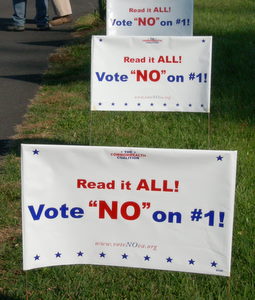
Lynchburg Paper Advises Readers: "Vote No"

The newspaper with a circulation area that includes Thomas Road Baptist Church and Liberty University -- that is, Jerry Falwell's backyard -- advises its readers in a lead editorial on Sunday to reject Ballot Question No. 1, the proposed Marshall/Newman amendment, because "it goes far beyond prohibiting same-sex marriages." The editorial in the Lynchburg News & Advance says the amendment is "overkill."

On the same page, the newspaper endorses Senator George F. Allen for re-election, saying that as a "self-described 'common sense Jeffersonian Conservative,' Allen will work for the people of the commonwealth to secure their dreams: free enterprise and free people."

In its lead editorial in its November 5 editions, the News & Advance explains that it understands the motivation behind lawmakers' desire to put the amendment on the ballot, and praises them for doing so:

... while we applaud the effort of the amendment, proposed by Lynchburg’s state Sen. Steve Newman and co-sponsored by Campbell County Del. Kathy Byron for having their fingers on the pulse of the majority of voters, the amendment is simply overkill.
The paper also explains why the proposed amendment is unnecessary, since it incorporates law that already exists even while going too far. It also points out that a "no" votes is not a vote in favor of same-sex marriage:
While the idea of the amendment resonates with many, its core is already law.

Voting “no” on the proposed amendment - as it’s worded - is not voting against traditional marriages; if voters consider how judges throughout the country have been ruling during the past year, they will see that time and time again, the legal definition of marriage remains a contract between one man and one woman.

While the intent is laudable - to translate the majority’s morality into a code of laws - the amendment’s language misses the mark.

Because it goes far beyond prohibiting same-sex marriages, we should be the first state in the country to defeat a same-sex marriage amendment. Not because we don’t adhere to a strict moral code, but because amending the constitution just isn’t necessary.
The News & Advance also reinforces a message of core conservative values -- personal and family responsibility for moral decisionmaking as opposed to the liberal view of government as nanny and nursemaid:
What is necessary is parents sharing their moral values with their children, having open and honest discussions about how they feel and why.

What is necessary is families taking responsibilities - and the consequences, good or bad - for their lifestyles decisions.

The proper role of government is not that of parent - or big brother.
So that is why the Reverend Jerry Falwell's hometown newspaper joins the vast majority of other Virginia dailies in urging its readers to vote "no" on Ballot Question No. 1 on November 7.

Update: I note, belatedly, that Charlottesville-area writer Dahlia Lithwick, who covers legal affairs for the on-line magazine Slate, has an incisive op-ed in the Outlook section of Sunday's Washington Post. I recommend it highly, especially this amusing passage:
Why the terrific urgency to gild the state's anti-gay-marriage lily? The measure's supporters advance a single argument: It's an insurance policy against "activist judges" who might someday strike down the many state laws banning same- sex marriage. Last week, Lt. Gov. Bill Bolling announced that the "amendment is necessary to protect traditional marriage from possible judicial assault." Judicial assault from whom? The hemp-wearing, incense-burning vegetarians who dominate the Virginia bench? The state's judges are extremely conservative, having been selected by the extremely conservative legislature. A Web site is carrying out an enthusiastic search for Virginia's unhinged liberal activist judges. They're proving tough to find.
Read the whole article, "Please Say 'I Don't'," in tomorrow morning's Post. (It is also available on Slate as "Yes, Virginia, This Is a Terrible Amendment: Why the Gay Marriage Ban Is Bad for All Virginians.")

'Useful Idiots' or 'Principled Conservatives'?

James Young, the always amusing and always petulant proprietor of Skeptical Observor, has called the prominent Republicans who participated in Friday morning's "vote no on 1" news conference "useful idiots." He also said we were "pathetic."

Well, everyone's entitled to his own opinion, no matter how demeaning.

So let's set those views aside for a moment and look instead at a far longer list of Republican activists and VIPs who have signed on to a pledge that explains why they are voting no on Ballot Question No. 1 on Election Day.

Here is the text of their pledge:

As a strong supporter of the traditional Republican principles of limited government and individual rights, I oppose adding the text of the proposed Marshall/Newman amendment to Article I of Virginia's Bill of Rights. It would be wrong to officially write discrimination into our Commonwealth's constitution and open our courts to so many legal questions and ambiguities caused by the amendment's language. I further believe that such confusing language would cause significant and largely unpredictable legal consequences, as has happened in other states with such amendments, and that such consequences would threaten the basic rights of both individuals and businesses in Virginia.
I won't list the names of every person who signed the pledge (that can be found by visiting the Commonwealth Coalition's web site) but I want to point out a few of the "useful idiots" and the roles they have played in building the Republican Party in Virginia (and elsewhere) and promoting conservative values over the years:
Former Governor A. Linwood Holton, Jr. (the first Republican elected to that high-ranking post since Reconstruction), and former First Lady of Virginia Jinks Holton;

Former Members of the U.S. House of Representatives Bob Barr, M. Caldwell Butler, and Steve Gunderson;

GOP candidate for state Attorney General and for Governor, Wyatt Durrette;

Former Treasurer of the Commonwealth (under Governor Jim Gilmore), Mary G. Morris;

Former member of the Chesterfield County Board of Supervisors Joan Girone;

Former member of the Arlington County Board and former 8th Congressional District Chairman Mike Lane;

Tom O'Donoghue, the only GOP congressional candidate this year (8th CD) who is a veteran of both the Iraq and Afghanistan wars;

Former State Senator and state Cabinet member Jane Woods;

Former members of the House of Delegates James Dillard and Panny Rhodes;

Former candidate for the State Senate and Arlington County Board Scott Tate;

Mike McMenamin, current candidate for Arlington County Board;

Former candidate for the House of Delegates Steve Sass;

Former Alexandria Young Republicans Vice Chair Peter Atherton;

Beth Wolffe, former candidate for Arlington County School Board;

and

Mary Cheney, author, activist, business executive, and daughter of Vice President Dick Cheney.
I have not included the names of the grassroots Republicans, who work largely behind the scenes on campaigns, manning phone banks, raising money, writing issue briefs, and badgering Democratic officeholders, and who also signed the pledge. Their work far too often goes unmentioned and unappreciated but that does not subtract from its value. Their contribution to the "vote no" campaign is similarly important.

Friday, November 03, 2006

Nietzsche Meets Keane

In his Richmond Times-Dispatch blog this morning, Bart Hinkle has a link to "The Nietzsche Family Circus," which "pairs a randomized Family Circus cartoon with a randomized Friedrich Nietzsche quote."

My favorite (so far) is this one. (The randomization makes for a near-bottomless well of possible combinations.) Try to find your own favorites; feel free to share your discoveries.

It's quite funny, in a nihilistic sort of way.

Prominent Republicans to "Vote No on No. 1"

A news conference via telephone at 10:30 this morning brought together prominent Republicans from around Virginia, urging their fellow party members and other voters to cast a ballot against Ballot Question No. 1 (the Marshall/Newman amendment) on Election Day.

Participants in the teleconference included former sixth district Congressman M. Caldwell Butler; former Delegates James Dillard and Anne G. "Panny" Rhodes; former Arlington County Board Member Mike Lane; Mac Pence, owner of the Pence Auto Group; David Lampo, vice president of the Log Cabin Republicans of Virginia; John Sherman, former CEO and chair, Scott & Stringfellow, and myself.

Mike Lane introduced himself to the group on the line and then said, to my embarrasment, that he would like to "thank Rick Sincere for working so hard on my campaign when he used to be an Arlingtonian."

Former Congressman Butler said that his "own perception of this is that it is not a partisan issue at all, it's just common sense. What is basically wrong with it is that it is poorly conceived. It is even mean-spirited. It is poorly drafted, as well." He added that the second sentence about "approximating marriage" doesn't belong in the Constitution. "The Constitution," he said, "sets up the fundamentals of the law, then you let the legislature work out the details."

Former Delegate Dillard laughed and said, "Can I just put my quotes around Caldwell's comments?" Then he added: "This will be a major embarrassment to Virginia to have this in our Bill of Rights and Constitution."

Mac Pence said that, "from the perspective of a businessman and a lifetime Republican, I would like to see our government and elected officials getting back to the basics. I believe in a limited government that keeps out of the lives of citizens."

Drawing on his experience as a business executive and community leader -- including as chairman of the Chamber of Commerce -- John Sherman commented that "the Statute for Religious Rreedom made Virginia a model of tolerance for not only the country but the world. This amendment will undermine tolerance. It's time to draw a line in the sand and stand up for the rights of all individuals and for tolerance."

Mike Lane said that he would like to "shift gears a little." From his perspective, he said, defeating the amendment would be "good for the [Republican] party. Since the Republicans took over the majority in the General Assembly, we've been on a march toward turning that majority back to the other side." He identified the danger of losing control of the legislature to a worsening rupture between Northern Virginia and the rest of the state. "If we don't understand the values of NoVA," Lane said, "we hasten the day when we lose the majority." What are those values? "Limited government and a smaller footprint on the backs of the citizens of the Commonwealth."

I commented that the amendment is not in tune with the values of Republicans who cut their teeth on the campaigns of Barry Goldwater and Ronald Reagan, that it is intrusive and an expansion of government, and that -- because its terms are not otherwise defined in the Code of Virginia -- it will lead to mischief and litigation for decades to come.

David Lampo said that the amendment "represents a repudiation of limited government. It is social engineering run amok. By denying legal rights to couples and relationships [the amendment's drafters] do not approve of, if you follow their rules you have rights, if you don't follow their rules, you don't." He concluded by saying, "That they want to write this into the Bill of Rights section is obscene."

Congressman Butler responded to Lampo by saying that he was "understating the outrage." He continued: "This is an ultimate indignity to try to put this in the Bill of Rights." Pointing out that the Declaration of Rights was written by George Mason in 1776, he said the proposed amendment "is unVirginian."

Former Delegate Panny Rhodes added: "Republicans have always stood for individual rights. This goes against everything we stand for."

The consensus within the group was remarkable, considering that it included conservative, libertarian, moderate, and liberal Republicans, and it also included grassroots activists, former elected officials, business leaders, and at least one blogger.

Later today, the Commonwealth Coalition -- which made arrangements for the news conference -- will be distributing a news release based on the official transcript. I will provide an update if there is any new information available.

Other posts on Republicans and conservatives who oppose the Marshall/Newman amendment, which pretends to ban gay marriage in Virginia but does much more to interfere in the relationships of both same-sex and opposite-sex unmarried couples, can be found here, here, here, here, and here.

Thursday, November 02, 2006

Wow! Thanks, Andrew!

I was a guest on Coy Barefoot's radio program from 5:30 to 6:00 this evening. I was preceded by fellow Virginia bloggers Chad Dotson and Kenton Ngo. (A podcast of the program will be available soon at the Charlottesville Podcasting Network.) We discussed the Virginia Senate race, the integrity of electronic voting systems, and the so-called marriage amendment -- it was a very fast half-hour.

After the show, I ran some errands and grabbed some dinner. When I got home, I decided to check my traffic reports to see if an appearance on Charlottesville ... Right Now might bring in any new visitors. (The last time I did a radio program wearing my blogger's hat, two or three people visited during the course of the show. I figured that Coy's afternoon drive-time listenership might bring in more than that.)

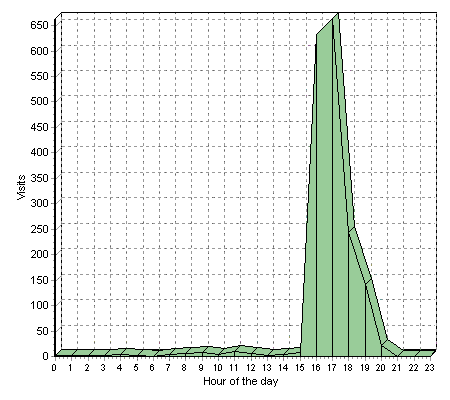
Boy, was I surprised! I had to give my computer screen a double-take. (If I had been drinking, the screen would have been drenched by a spit-take.) The numbers had gone through the roof:


Thanks to a link from Andrew Sullivan, this blog has received more visitors in the past five hours than it usually receives in a month.

Apparently, Andrew's readers are particularly interested in the statement by nearly 300 Virginia religious leaders who have announced their principled opposition to the Marshall/Newman amendment.

Welcome, new readers -- I hope you'll come back for more! And don't forget to patronize our advertisers or leave a gratuity in the tip jar.

Update: Sean Tubbs has posted my interview segment from "Charlottesville .... Right Now" right here. Coy's interview with Kenton is here, and his interview with Chad is here. This is how he summarizes my half-hour on the program:

Coy Barefoot continues his series on Virginia bloggers with a conversation with Rick Sincere, a libertarian blogger from Charlottesville. Sincere wonders why the Republicans in government have strayed so far away from their core values while in power.

“When the Republicans gained control of Congress in 1994, there was a lot of hope they would roll back the federal monstrosity,” says Sincere. “It hasn’t happened.”

Sincere also says dire predictions about electronic voting machines are not warranted. He also explains why he’s voting no on the Marshall-Newman amendment.
Thanks, Sean! And thanks, Coy, too!


Christian, Jewish Leaders Say "Vote No"

An article by Bob Gibson in this morning's Daily Progress begins:

Rabbi Dan Alexander sports a bumper sticker on his car that reads: “My Faith Says Vote ‘No’ on #1.”

He is one of about 20 Charlottesville area Christian and Jewish leaders who gathered Wednesday to discuss why they plan to vote against Question No. 1, a proposed amendment to the Virginia Constitution to add a definition of legal marriage to the Bill of Rights.

“I almost never put bumper stickers on my automobile,” said Alexander, rabbi at Congregation Beth Israel on East Jefferson Street.

In the upcoming election on this question, however, he said he believes strongly that the amendment runs counter to “the core American ideal whereby government is meant to ensure and protect the rights of individuals rather than to impose itself on them.”

Ministers from Westminster Presbyterian Church and Thomas Jefferson Unitarian Universalist Church on Rugby Road, Wesley United Methodist Church on Thomson Road and several other churches applauded Alexander and offered their own objections to the amendment.

“There is no need for this amendment to the Virginia Constitution,” said the Rev. Jim Baker of Westminster Presbyterian. “Obviously, marriage is in trouble, and yet the greatest threat to marriage comes not from homosexuals. It comes from heterosexuals who find it difficult to remain married to one another.”
Those twenty Charlottesville-area clergy are not alone in their concerns. As I indicated earlier today, at a press conference in Richmond this morning, Christian and Jewish religious leaders gathered to announce their opposition to Ballot Question No. 1, the Marshall/Newman amendment.

A statement explaining their reasons for opposing the proposed amendment was signed by 280 priests, ministers, and rabbis from all corners of Virginia.

The statement begins with an epigraph from the prophet Micah (chapter 6, verse 8):
God has told you, O mortal, what is good.
And what does the Lord require of you but to do justice, to love kindness,
and to walk humbly with your God?
The text continues:
As Clergy from across Virginia, we oppose Ballot Question #1 and encourage people of faith in this Commonwealth to vote "no" on this amendment on November 7.

We come from many different traditions, faiths and denominations, yet we all agree that Ballot Question #1 violates the call to justice and fairness that is a moral imperative shared by our faith traditions. Ballot Question #1, though called "the marriage amendmnent" by some, will not protect any marriages. It will cause undue hardship and harm to the families of unmarried couples in Virginia.

As religious leaders, we affirm the dignity of all persons and value the welfare of all loving and committed families regardless of their legal status. This amendment undermines those principles. Even those of us who believe that the state should reserve legally sanctioned marriage for unions between a man and a woman agree that this amendment goes too far.

Ballot Question #1 would create two categories of families: one headed by married couples enjoying expansive rights and legal protections and one headed by unmarried individuals banned from any legal recognition. For the latter, the discrimination is severe. Family courts may not be able to protect victims abused by unmarried partners under domestic violence laws. Child custody and visitation agreements between unmarried people may not be enforceable. Medical directives naming a loving partner to make critical healthcare decisions may not be recognized. State agencies, universities, and hospitals may not be able to grant an employee bereavement leave after a life partner dies or offer health benefits to an employee's domestic partner or the partner's children. Family courts may not be able to act in the best interest of a child if her parents are not married. Families in crisis will face the threat of years of legal quagmire while judges sort out their legal rights.

As Clergy, we pray with, counsel, and support families in times of crisis. We know the pain that such crises inflict, and we know that such pain does not discriminate based on whether or not the state has granted a marriage license. Married or not, the anguish of losing a lifelong partner is the same. Married or not, children and loved ones get sick and need medical care. Married or not, the crushing physical and emotional blows from an abusive partner require protection.

Our faith traditions teach us that God desires justice, kindness, and mercy. There is no place within our faith communities or within our Commonwealth for an amendment that punishes unmarried couples and their children. Ballot Question #1 will not protect marriage, but it will harm families. As religious leaders, we urge Virginians to vote "no" on Ballot Question #1. It is the moral choice.
The signatories include members of the clergy from the Baptist, Congregationalist, Episcopalian, Lutheran, Methodist, Mennonite, and Presbyterian traditions, as well as from Jewish and Unitarian Universalist congregations.

I suspect more news will appear on TV and radio today and at the Commonwealth Coalition web site and Blogging the Amendment.

Update: Andrew Sullivan has linked to this article from his well-read blog, The Daily Dish, leading to a tremendous traffic increase.

Fantasy vs. Reality?

In my brief report on the new documentary film, Jesus Camp, which was screened at the Virginia Film Festival, I pointed out how the pastor in the film warns against imaginary "warlocks" and states that if Harry Potter had been around in Old Testament times, he would have been "put to death."

I saw that movie on Sunday morning, not finding out until later in the day that Parade magazine, the Sunday supplement carried by many U.S. newspapers, reported on efforts to ban Harry Potter books from school libraries:

Now there’s an effort to pull the world’s most popular wizard, Harry Potter, from school libraries in Gwinnett County, Ga. Why? Some parents say kids can’t tell fantasy from reality and will try casting spells on classmates.
"Casting spells on classmates"? Who's having difficulty telling fantasy from reality here? (Hint: It's the parents who believe in magic spells, not the kids who like reading adventure stories.)

Those parents must be the product of government schools, where critical thinking is in short supply.

Letters on the Amendment

Wednesday's Charlottesville Daily Progress carries two letters to the editor that offer reasons to oppose the Marshall/Newman amendment (Ballot Question No. 1), but from very different perspectives.

Nelson County writer Doug Hornig -- author of a terrific book about the 1975 Boston Red Sox, The Boys of October -- says in the first letter:

In all of the conflict over Virginia’s proposed constitutional amendment, a key fact is often getting lost in the shuffle.

This proposal is not about gay marriage.

If it were, it would only be one paragraph long, and would simply prohibit gay marriage and stop there. Unnecessarily, as its supporters well know, because gay marriage is already illegal, and amending the constitution will not make it more illegal.

No, the devil here is in the details, specifically paragraph two, which is a profound anti-conservative, anti-family-values piece of work designed solely to give the state a constitutional right to intrude into a broad range of our personal relationships.

Read it before you vote. If you are a real conservative, you will be shocked and appalled.
Why would a real conservative be appalled? Hornig explains:
Paragraph two gives the state blanket authority to meddle in any and all of our non-marital relationships, whether they be with friends or other family members, and our experience with the government should by now have taught us that once you grant government a power, it will use that power. Probably in ways you won’t like.

Prominent Virginia conservatives are lining up in opposition. Here are comments from just two of them:

John Whitehead, president of the Rutherford Institute, writes that "amending a state or federal constitution to ban same-sex marriage not only fails to address the real problems facing America’s families - it also fails the family" (Rutherford.org, Oct. 20).
As an aside, let me point out that, despite his personal opposition to the proposed amendment, Whitehead (a civil rights attorney who often takes on freedom-of-religion issues) took up the case of a Cargill human resources employee who lost his job after he refused to remove a large pro-amendment sign from his truck, which was parked on company property. (Cargill later reinstated the man.)

I disagree that the man's First Amendment rights were violated, since the First Amendment does not extend to private action by employers or other individuals and organizations, but it demonstrates that Whitehead is not hidebound by his political beliefs; neither is the Rutherford Institute itself, which often takes on surprising cases, which means that Rutherford defies easy labeling as "liberal" or "conservative" or "libertarian."

But I digress. Hornig continues in his letter to the Daily Progress:
And former Congressman M. Caldwell Butler, R-Roanoke, writes, "Simply stated, the proposed language (which is mean-spirited, unwarranted, poorly drafted and already in the code itself) does not belong in the constitution of Virginia, and certainly nowhere in our Bill of Rights" (Roanoke.com, Oct. 14).

To enact this naked governmental grab for yet more power would be foolish in the extreme.

I urge all our true fellow conservatives to join us and to support family values in Virginia by voting no on Ballot Question One on Nov. 7.
The second letter comes from the leaders of the congregation at Charlottesville's Sojourners United Church of Christ, which as a body has agreed to oppose Ballot Question No. 1. The writers -- co-moderators Marie Baker and Jim Gibson, and pastor Jim Bundy -- quote the congregation's resolution on the matter:
"Sojourners United Church of Christ seeks to be a place where all God’s children may come together in a safe and loving Christian community. We also believe that we are called to work to make the world around us a safer and more loving place for everyone. Because of that, we believe we must speak out in opposition to the Marshall-Newman Amendment, Virginia’s Ballot Question No. 1.

"We believe everyone who chooses to live in loving, committed relationships should be supported in doing so, and that all such relationships should be honored and celebrated. The Marshall-Newman amendment does much more than define the nature of marriage. It seeks to prevent people who live in loving relationships, but who are not married, from enjoying any rights or privileges that might be associated with marriage. It is harsh and discriminatory and has no place in the Virginia constitution....

"Passage of the Marshall-Newman Amendment will not resolve the debate or ease the pain. It will only add to the pain and be hurtful to individuals. We recognize the need for compassionate conversation and prayerful reflection on the many issues that confront us. In the meantime, we strongly advocate a ‘no’ vote on Ballot Question No. 1 on Nov. 7."
The letter from Sojourners United Church of Christ is particularly timely, in that this morning in Richmond, religious leaders from around the state will gather for a news conference at St. Mark's Episcopal Church to announce their unified opposition to Ballot Question No. 1. These Christian and Jewish leaders (mostly clergy, but some laity among them) call themselves People of Faith for Equality in Virginia, and they plan to release a statement signed by hundreds of clergy from various denominations, all in opposition to the Marshall/Newman amendment.

Watch your local TV stations for reports on the news conference. I'm sure prominent Virginia bloggers will be covering the event as well.

Wednesday, November 01, 2006

Turn Your Radio On -- Again

At the invitation of local chat-show host Coy Barefoot, I will be a guest on his program, Charlottesville ... Right Now, on WINA-AM (1070 on the dial), on Thursday, November 2, during the 5:30 to 6:00 p.m. segment.

I'm not sure what we'll be talking about -- there is so much in the headlines these days -- but I suggested that one topic of conversation could be electronic voting machines and election security. Since I am invited to appear on the program as a local blogger, however, almost anything you see here could be fair game for discussion.

Tune in on Thursday afternoon and feel free to call in with questions or comments at 434-977-1070.

Tuesday, October 31, 2006

DOMA Author Supports "Vote No" Effort in Virginia


Former U.S. Representative Bob Barr of Georgia, the principal sponsor of the 1996 federal Defense of Marriage Act, has contributed $1,000 to the Commonwealth Coalition, the grassroots organization that has been leading the charge to defeat the proposed Marshall/Newman amendment, which will appears on the November election ballot in Virginia as "Ballot Question No. 1."

Barr's contribution was reported in this morning's Norfolk Virginian-Pilot and I confirmed the accuracy of the news report in an email exchange with the Commonwealth Coalition's executive director, Claire Guthrie Gastañaga.

Barr's support for the "vote no" effort is significant because he is on the record as an opponent of both same-sex marriage and the proposed (and twice-failed) Federal Marriage Amendment.

In a widely quoted opinion piece he contributed to the Washington Post and Atlanta Journal-Constitution in 2003, Congressman Barr wrote:

The political right and left in America share one unfortunate habit. When they don't get their way in courts of law or state legislatures they immediately seek to undercut all opposition by proposing an amendment to the Constitution....

Make no mistake, I do not support same-sex marriages. But I also am a firm believer that the Constitution is no place for forcing social policies on states, especially in this case, where states must have the latitude to do as their citizens see fit.

No less a leftist radical than Vice President Dick Cheney recognized this when he publicly said, "The fact of the matter is we live in a free society, and freedom means freedom for everybody. . . . And I think that means that people should be free to enter into any kind of relationship they want to enter into. It's really no one else's business in terms of trying to regulate or prohibit behavior in that regard. . . . I think different states are likely to come to different conclusions, and that's appropriate. I don't think there should necessarily be a federal policy in this area."

The vice president is right. There shouldn't be a constitutional definition of marriage. As an institution, and as a word, marriage has very specific meanings, which must be left up to states and churches to decide. The federal government can set down a baseline -- already in place with the Defense of Marriage Act -- but states' rights demand that the specific boundaries of marriage, in terms of who can participate in it, be left up to the states.
I hate to attribute views to Congressman Barr that he has not stated explicitly, but it is easy to infer a conclusion from his publicly expressed opinions combined with his support for the Commonwealth Coalition's efforts.

The inference I make is that, since Bob Barr believes that states have the authority to define marriage, his objection to the Marshall/Newman amendment is the same as that of distinguished conservatives like federal Judge J. Harvie Wilkinson, former Congressman M. Caldwell Butler, former Governor Linwood Holton, and others, who believe that the second and third sentences of the amendment are too expansive. Those sentences carry the amendment much further than simply "defining marriage" and in fact create a recipe for litigious mischief.

In October 2001, I was at a national convention of the Republican Liberty Caucus in Las Vegas. At the business meeting, a motion was made that we endorse a candidate in an upcoming Republican primary that pitted two incumbents against each other: Bob Barr and John Linder (sponsor of the Fair Tax in Congress).

It was a hard decision to make. Both candidates were solid, liberty-loving conservatives. Both were effective representatives for their constituents. The discussion went on for several minutes when a prominent conservative activist who was attending the meeting spoke up. (I won't give his name but just mention that he runs a weekly Wednesday morning meeting in Washington.) He said that "John Linder is a good friend, but Bob Barr is a hero."

And he was right. Bob Barr, in retirement from Congress, has been an outspoken proponent of personal liberties and privacy. Like his former colleague, Dick Armey of Texas, Barr has argued, using conservative principles, against the government's encroachment of civil liberties through ill-advised legislation like the USA PATRIOT Act. Working with groups like the American Conservative Union, Bob Barr has been an authentic hero, relentlessly striving to preserve the principles found in the Declaration of Independence, the U.S. Constitution, and the Bill of Rights.

Virginians owe Bob Barr strong thanks for his principled, conservative opposition to the Marshall/Newman Amendment. Not only does he talk about what he believes, he literally puts his money where his mouth is. The best way to thank him for his consistent philosophy of liberty and human autonomy is to vote "no" on Ballot Question No. 1 on November 7.

Still More Say: 'Vote No on No. 1'

Every day more and more newspapers and community leaders are joining the opposition to Ballot Question #1, the Marshall/Newman Amendment.

Even the Richmond Times-Dispatch, which arguably has one of the most conservative editorial pages of any big-city newspaper in the country, is urging its readers across Virginia to cast a "no" vote on November 7. In its edition for Sunday, October 29, the RTD concluded a well-reasoned editorial by saying:

Constitutions are in essence rhetorical covenants. In democracies, practically all else is politics.

Jefferson noted that societal change "may require occasional and corresponding modifications" in constitutions. But he and Madison (see The Federalist) and Marshall (see McCullough v. Maryland) stressed the "occasional" -- believing constitutions should be relatively spare documents, and amendments to them few. Legislatures were designed to be the most powerful branch. Because they are closest to the people, they also are the most reflective of citizen opinion, and the most responsive to it.

Virginia's judges live largely apart -- insulated and removed. If they begin knocking down the Commonwealth's statutory bulwarks protecting marriage, then let the Assembly send to the citizenry a proposed amendment consisting of a simple statement confining marriage in Virginia to a man and a woman.

And let it be a measure lacking this amendment's aggressive add-ons that could empower judges to engage -- practically unchecked -- in blue-sky interpretation of what its language means, while simultaneously denying the legislature the flexibility it ought to have to reconstruct the bulwarks.

On this amendment, as written, we incline against.

In The Examiner on Monday, the Cato Institute's David Boaz explains why the hoary argument about "activist judges" imposing same-sex marriage against an unwilling citizenry holds no water:
There’s never been a same-sex marriage in Virginia, and they’ve been outlawed by statute for more than 30 years. So why are Virginia voters being asked to vote on a constitutional amendment to ban gay marriage?

Mostly because it’s a bait-and-switch game. The proposed Ballot Question No. 1 is far broader than a simple ban on gay marriage.

Supporters say the amendment is needed in order to prevent activist judges from unilaterally changing the definition of marriage. But no liberal activists have yet been sighted in the Virginia judiciary. And that’s no surprise because judges in Virginia are selected by the same legislature that has repeatedly passed bans on gay marriage, civil unions and domestic partnerships, including this proposed amendment.

In fact, Virginia is one of only two states where the legislature directly appoints judges to the state courts, including the state Supreme Court. It is inconceivable that Virginia judges, including four members of the Supreme Court, are going to impose gay marriage on the state. Virginia is not Massachusetts nor Vermont or New Jersey, and our judges are certainly more conservative than those in New York, where the high court recently upheld the state’s ban on gay marriage.

The irony in Virginia is that conservatives fearful of an out-of-control judiciary are in fact inviting the judiciary to get involved in micro-managing family law.
Boaz's article reminded me of a recent blogpost by conservative lawyer Steve Minor, who writes the South West Virginia Law Blog. Referring to the recent New Jersey Supreme Court ruling that explicitly rejected the idea of same-sex marriage in that state, Minor writes:
The opinion is written in such a way that it could never be followed in Virginia. The Court cites all the protections against discrimination based on sexual orientation written into the law of New Jersey. None of this background exists in Virginia law. I doubt that the analysis in this case would make it any more likely that some day the Virginia Supreme Court will find that the statutory ban on same-sex marriage violates the Virginia Constitution.
The Roanoke Times also examined the New Jersey ruling and found it has little relevance to the situation in Virginia. An editorial in Monday's paper notes:
Despite the tolerance of New Jersey voters, however, the court specifically passed the question of marriage back to state lawmakers and the democratic process: Legislators can provide for nondiscriminatory civil unions or sanction "marriage."

The distinction is important to those religious Americans who regard homosexuality as sinful and argue that, while they do not condone discrimination against anyone, they regard marriage as a sacred institution that would be sullied by gay unions."The great engine for social change in this country has always been the democratic process," the New Jersey ruling acknowledges. "Although courts can ensure equal treatment, they cannot guarantee social acceptance, which must come through the evolving ethos of a maturing society. Plaintiffs' quest does not end here. They must now appeal to their fellow citizens whose voices are heard through their popularly elected representatives."

The ruling flies in the face of fear-mongering conservatives who insist that constitutions -- state or federal -- must be amended to "protect" marriage from judicial overreach.

Virginia voters have many valid reasons to go to the polls Nov. 7: to affect the war in Iraq, the erosion of constitutional guarantees such as habeas corpus, the growing gap between the very rich and everyone else that will change the future of people's children and grandchildren, a national debt that will burden them their entire lives.

The sanctity of marriage in Virginia, however, is not in any danger.
From Southwest Virginia itself, a guest writer in the Bristol Herald-Courier also finds good reasons to reject the Marshall/Newman amendment. An opinion piece in its Sunday editions by Dr. Teresa Keller of Emory and Henry College stated:

Voters have an opportunity to move Virginia backward by passing an amendment to the state Constitution on Nov. 7.

Changing the Constitution is a powerfully broad action that will prevent future generations from establishing policy for themselves. The proposal claims to "protect marriage," but fails. Homosexual relationships will not be affected, but others could be affected by unintended consequences. Most serious of all, the amendment blurs the line between the government and religion.

* * *

THE TRUTH IS that under our existing system, changing our laws or our state Constitution in regard to marriage should not affect religious belief or practice. Churches will marry or not marry whomever they choose. Furthermore, those who want homosexual relationships will continue to have them, state sanctioned or not.

The American Association of University Women, the League of Women Voters, the Virginia Legal Review Committee and many high-profile officials have announced their opposition to the proposal. Even Gov. Tim Kaine, who opposes gay marriage, has announced that he will vote against the amendment.

Virginia voters have a powerful decision to make on Nov. 7. Those who want to maintain the state Constitution as a document that protects rights rather than restricts them will vote "no."
Across the mountain, the editorial board of the Staunton News-Leader has also decided that Virginians should vote "no" on the amendment. Monday's lead editorial says:
Before we dissect the proposed amendment to our state constitution, we would be remiss if we did not state for the record that we do not believe that marriage between homosexual men or lesbian women ought to be the object of a constitutional amendment. We believe any decision about religious blessing (or censure) of unions between same-sex couples ought to be made by religious authorities. We also believe that businesses and corporations who deem it appropriate to recognize same-sex partners as bona fide beneficiaries of health or other benefits ought to be free to make those decisions without interference from state or federal government.

That stated, we are pragmatic enough to realize that marriage — whether it is viewed as a holy sacrament or merely a cold legal contract — is as regulated as voter registration or records held by the Department of Motor Vehicles. Under current state law, it is illegal for same-sex individuals to become married and any such unions undertaken elsewhere are not recognized by the state of Virginia. We are comfortable with those legal bans and we believe they are adequate, despite the bogeyman of "activist judges" the amendment's supporters love to cite. We do not fear that state judges will suddenly give their blessing to either same-sex civil union or marriage. If a sea-change sweeps the land such as that which occurred concerning what used to be called miscegenation — marriage between white and non-white citizens — we may either live with the change or our lawmakers may engage in another round of "massive resistance" similar to what followed the Supreme Court order to integrate public schools. We hope it never comes to that, but we have faith in our legislative, judicial and executive branches that it will not. Should that faith fail, we have our personal faiths to fall back upon — and they will rule as they shall.

* * *

Please — vote "no" on Tuesday, Nov. 7 when you are faced with the specter of this overzealous and potentially dangerous amendment to our state constitution.
Across the state, in Hampton Roads, the Virginian-Pilot urges its readers, too, to cast a "no" vote on Election Day. Its Sunday editorial argued:
You don't have to delve deeply into Virginia's constitution to find these words, penned by George Mason and adopted on June 12, 1776:

"That all men are by nature equally free and independent and have certain inherent rights, of which, when they enter into a state of society, they cannot, by any compact, deprive or divest their posterity; namely, the enjoyment of life and liberty, with the means of acquiring and possessing property, and pursuing and obtaining happiness and safety."

Neither will you have to look beyond the ballot on Nov. 7 to find these words:

"That only a union between one man and one woman may be a marriage valid in or recognized by this Commonwealth and its political subdivisions.

"This Commonwealth and its political subdivisions shall not create or recognize a legal status for relationships of unmarried individuals that intends to approximate the design, qualities, significance, or effects of marriage. Nor shall this Commonwealth or its political subdivisions create or recognize another union, partnership, or other legal status to which is assigned the rights, benefits, obligations, qualities, or effects of marriage."

Parse them anyway you like, but those 87 words seek no less than to undo what Mason wrought in Virginia's first days, sentiments that have stood the test of 230 years.

The contrast in language is itself stark, between Mason's soaring elegance and the clumsiness of what is commonly referred to as the marriage amendment, penned by Del. Bob Marshall and Sen. Steve Newman.

The mere possibility that such gracelessness might find its way into Virginia's high-minded Bill of Rights - among protections for religious liberties, assembly and free elections - is insult enough to the commonwealth's founding sentiments.

But the marriage amendment's intent - to deprive unmarried people of basic legal rights otherwise guaranteed by Virginia's constitution and by common law - makes a mockery of Mason's hope of protecting the inherent rights of all men to be equally free and independent.
The fact is, the conservative position -- that is, the position skeptical of change and of legislative solutions to social problems -- is to vote "no" on the Marshall/Newman amendment. Those who support this proposal and claim to be conservatives are liberal social engineers masquerading as conservatives. They are wolves in sheep's clothing.

The Answer Is in the Appendix

Today -- Halloween -- is the eightieth anniversary of the death of Harry Houdini, who was perhaps the world's most famous entertainer during the early 20th century. Houdini was a magician and escapologist, a significant enough figure that he plays a major role in Ragtime (the novel, the 1981 movie, and the 1998 musical play) along with Emma Goldman, Booker T. Washington, and Evelyn Nesbit. (Isn't historical fiction a wonderful thing?)

Houdini and I share one thing in common: We both lived in Appleton, Wisconsin, during our early childhoods. Small world, isn't it? (And, contrary to rumor, we were not living there at the same time.)

There is a widely believed report that Houdini died from blows to his stomach that caused peritonitis. The way the story goes, some college students visiting him backstage in Montreal asked if it was true that he could tighten his stomach muscles in such a fashion that he could not be hurt by even the strongest blows. When he responded that it was true, one of the McGill University students hit him four times just to the right of his navel. Houdini asked that he stop and said he was not really prepared. When Houdini died a few days later complaining about stomach pains, word quickly spread that the indirect cause was the incident in his dressing room.

Snopes.com debunks this story in an article updated as recently as yesterday:

In the aftermath of Houdini's death, the assumption was made that the blows to his stomach and his ruptured appendix were related. It seemed a logical conclusion at the time, even to some of his doctors, and so the legend began. With the advantage of several decades of hindsight, however, we now know this explanation to be dubious. Most modern medical experts assert that appendicitis caused by blunt trauma is impossible and/or unknown in medical history, and while the blows to Houdini's stomach may indeed have hastened the magician's death, that result came about in a way different than commonly believed. Houdini was likely already suffering from appendicitis at the time Whitehead punched him, and he may have written off his subsequent discomfort merely as residual pain caused by those blows, thereby delaying his seeking medical treatment until it was too late. Had the dressing room incident not occurred, Houdini might have realized the pain was actually a symptom of a serious medical condition and not delayed so long in consulting doctors.
The article goes into greater detail than this, and makes for an interesting read. The coincidence of Houdini dying on Halloween has always been a bit spooky. This helps make it a bit more grounded in reality and divorced from the supernatural.

Monday, October 30, 2006

'I Want to Believe It'

Virginia Film Festival, 2006 -- Day Four:

The fourth (and final) day of the Virginia Film Festival was, for me, heavy on filmgoing and light on picture-taking.

The morning started out with Jesus Camp, a new documentary that is already getting some commercial distribution around the country. (It was playing at the Landmark E Street Cinema in D.C. a couple of weeks ago, when Tim Hulsey saw it.)

The film looks at a Pentecostal church that sponsors a summer camp for children. It focuses largely at the camp's director, youth minister Becky Fischer, and juxtaposes some political and theological points of view.

Before the film began, one of the discussants, English professor Mark Edmondson, asked how many people were "skipping church" to see this movie. I was one of three people who raised their hands, which might give you some sense of who was in the audience. (Sociologist Brad Wilcox also served on the panel, offering some perspicacious comments.)

I'll be writing more about Jesus Camp later, as I prepare my full report on the festival for The Metro Herald, but I want to note a couple of choice quotations from the film. Pastor Becky says that

Warlocks are the enemy of God. If [he had been around during] the Old Testament, Harry Potter would have been put to death.
Here's a message for Pastor Becky: Warlocks are imaginary. Harry Potter is fiction. In fact, Harry Potter is part of a sub-category of fiction called fantasy.

In another part of the film, 12-year-old Levi has a conversation with his mother in their home-school classroom, after viewing a video asserting the earth is just 6,000 years old:
Levi's Mom: "Science doesn't prove anything."
Levi: "I believe personally that Galileo made the right choice by giving up science for Christ."
E pur si muove!

The next two films on the schedule were on a double-bill at the Paramount: West Bank Story, which is a student film from the University of Southern California, and His People, a 1925 silent film about Jewish immigrants on the Lower East Side of Manhattan.

West Bank Story
is a 20-minute parody of West Side Story, a 1957 musical retelling of Shakespeare's Romeo and Juliet created by four gay Jews. In this version, the rival gangs work for two competing fast food restaurants, Kosher King and Hummus Hut. The music is mediocre and the lyrics are cheap, but the end result is a very funny send-up not just of West Side Story itself, but of musicals in general. Let me put it this way: As a parody of musicals, it's not at the level of South Park: Bigger, Longer, and Uncut, but for a student film, it has real merit.

His People is a more conventional story. Its focus is on the Cominsky family -- father David, who had been a scholar in Russia but now sells clothing from a pushcart; mother Rose, who sews the clothes he sells; elder son Morris, who is studious and becomes a lawyer; and younger son Sammy, who becomes a boxer.

The whole tale comes alive through vivid imagery -- I was surprised at the sophistication of the production design, given the era -- and the intertitles, which convey a sense of Yiddish (and Irish) dialect without becoming cloying or patronizing. It occurred to me that filmgoers of the 1920s would have been familiar with the syntax and rhythms of Yiddish dialect from vaudeville comics, so they could -- as I did -- hear that while reading the title cards.

His People featured live musical accompaniment by Donald Sosin and Joanna Seaton.

Moving over to Newcomb Hall, a packed house came to see the Volvo Adrenaline Film Project. Once again, I sat next to Waldo Jaquith (sans Amber, this time). It was his first time at the Adrenaline Film Project, in which ten teams of three people compete to win an Audience Award, Jury Prize, and Mentors' Award. Beau Bauman and Jeff Wadlow supervised the competition, as they have in the previous two years.

Each team had to make a film in a specific genre, such as film noir or Japanese horror, and each had to make sure to use a line of dialogue ("I want to believe it") and a prop (a squeeze bottle of Miracle Whip), both of which were related to the Virginia film festival theme of Revelations: Finding God at the Movies.

Jeff Wadlow said of the prop:
I got some weird looks when I bought 12 bottles of Miracle Whip at Giant. When I said it was for making a movie, I got even weirder looks.
The Mentors' Award, bestowed by Wadlow and Bauman to the team that has to overcome the most obstacles to deliver its film to the competition, went to "The Enchanted," a fantasy by Bernard Hankins, Jon Sharp, and Kevin Finnegan.

The Audience Award and Jury Prize both went to "Taste of Evil," a film noir by Ben Haslup, Brian Wimer, and Ruth Monton. (The jury was made up of Rita McClenny of the Virginia Film Office, film producer Ron Yerxa [Little Miss Sunshine], and NYU film historian Harry Chotiner.)

The final screening of the 2006 Virginia Film Festival was a film from Bhutan called Travellers and Magicians, which was remarkable in many ways -- not least of which is the Himalayan landscape that dominates the screen.

I'm still exhausted, and I didn't even have to hitchhike down a Himalayan road to get to where I am.

Sunday photos to be posted later. (Blogger is being temperamental.)

'What Were You All Doing in the Wardrobe?'

Virginia Film Festival, 2006 -- Day Three:

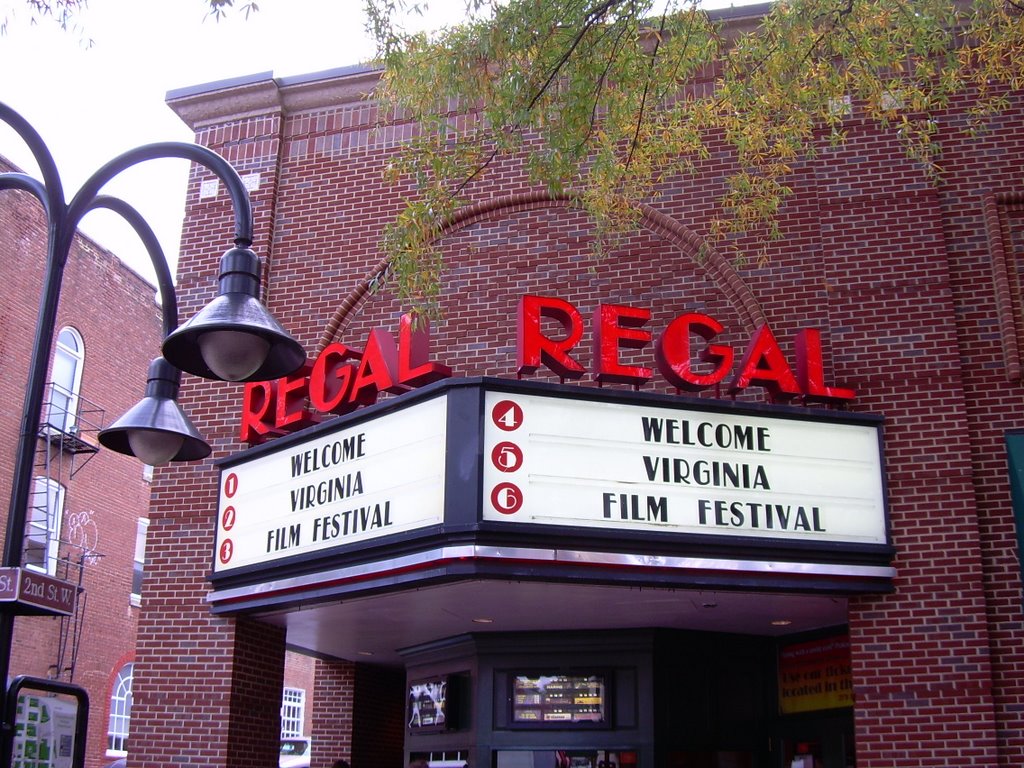
The morning began sunnily but inside the Regal Cinema it was winter, with a screening of The Chronicles of Narnia: The Lion, the Witch, and the Wardrobe, Disney's 2005 blockbuster. The movie was followed by a panel discussion moderated by the ubiquitous David Edelstein and featuring the film's producer, Mark Johnson, and its star, Peter Pevensie himself, young British actor William Moseley:


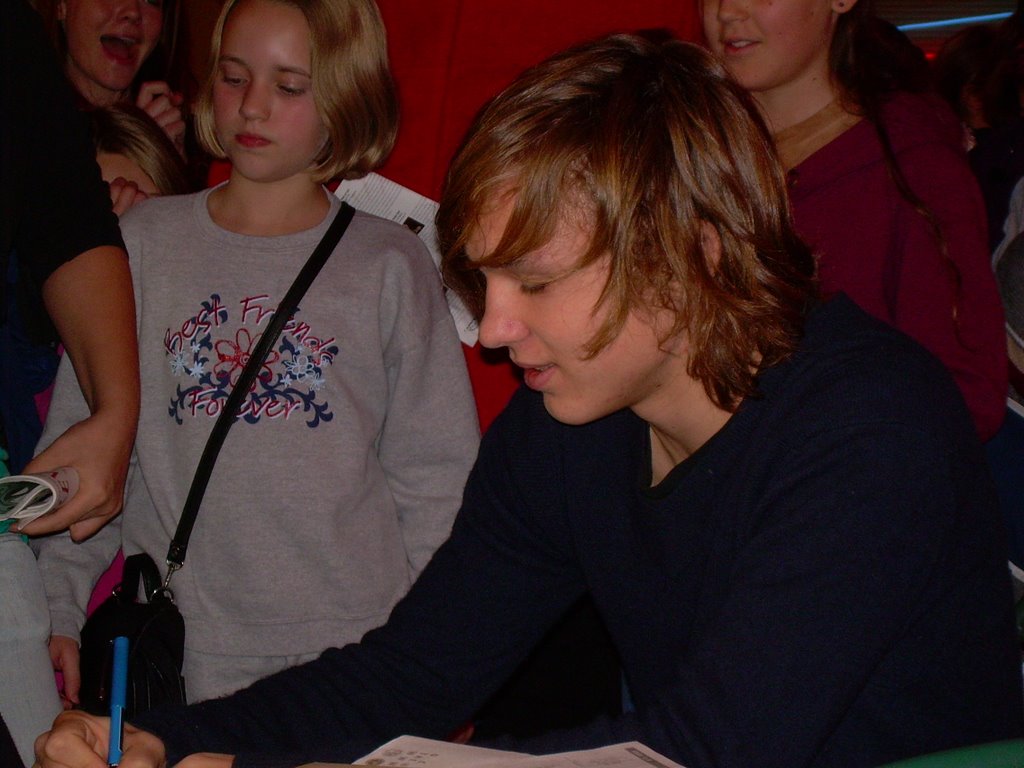
After an informative give-and-take with the audience, Mr. Moseley yielded to the desires of his (mostly female) teenage fans by signing some autographs in the lobby:


I left Narnia to see Cecil B. DeMille's silent version of King of Kings at the Paramount, but the toll of too many films on too little sleep began to affect me, so I ducked out after 20 minutes -- I stayed for the conversion of Mary Magdalene -- and took a break at home. Missing the live musical accompaniment by Donald Sosin and Joanna Seaton was a disappointment, but I needed some time to breathe.
Returning to downtown Charlottesville, I caught Michael Tolkin's The Rapture. The discussion with the director/screenwriter that followed this silly and pretentious movie was far better than the film itself.

Rushing to Newcomb Hall on the grounds of the University of Virginia, I saw last year's Everything Is Illuminated, based on the novel by Jonathan Safran Foer, which was followed by a Q&A with the film's director and screenwriter, Tony-winning actor Liev Schreiber. I don't want to give away too much of the plot, but let me just suggest this as a something to send to U.S. Senator George Allen as a Chanukah present this year.

I raised one question, which seemed to embarrass Mr. Schreiber, though he shrugged it off with aplomb.

I noticed that, in the movie, the Ukrainian tour company (and the family that runs it) is based in Odessa. But the character of Jonathan (played by Elijah Wood, in an understated yet neurotic performance) arrives at and departs from a railroad station in Lviv, some 388 miles northwest of Odessa. (Odessa is on the Black Sea; Lviv was once the Polish town of Lvov.) This wasn't something obscure that I caught: the name of Lviv is splashed in letters at least 12 feet high on the front of the railway station building.

In reply, Liev Schreiber tried to weasel out of this gaffe by saying that Odessa is an expensive city to live in, so even though the family owns a business there, they live "on the outskirts, in Lviv."

All I can say is, that's quite a commute.

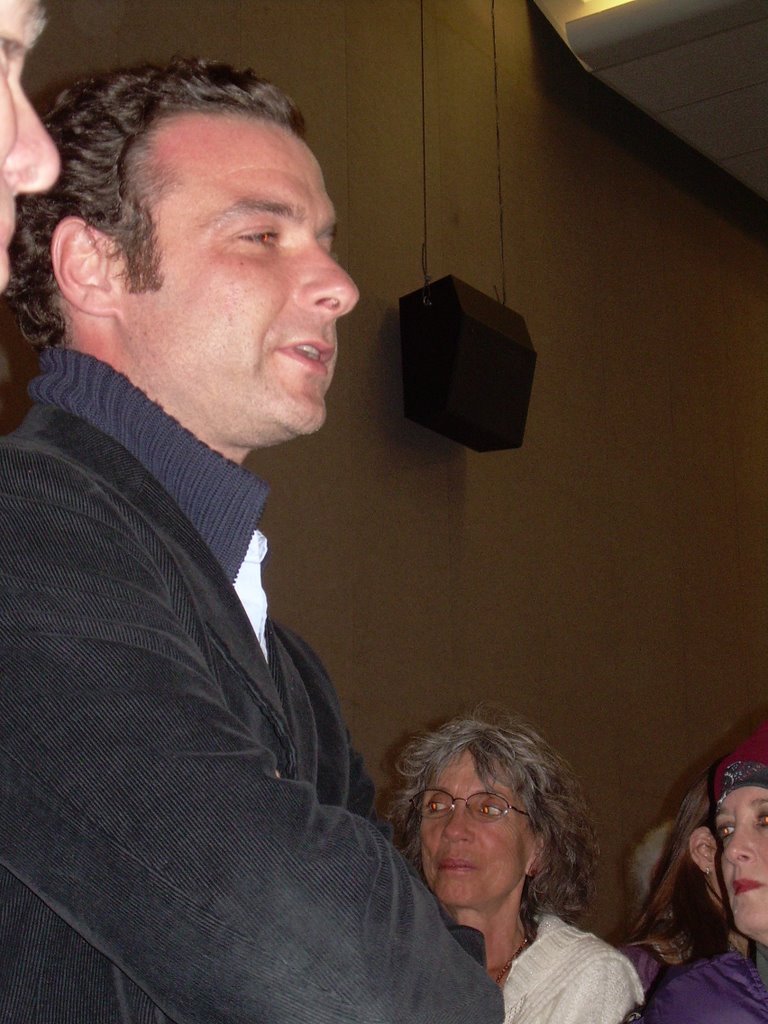
After the discussion, Liev Schreiber -- whose mother lives in metropolitan Charlottesville, he said -- enjoyed some informal banter with fans:


After Everything Is Illuminated, we were treated to the world premiere of the first trailer for Evan Almighty, the sequel to Bruce Almighty scheduled to be released next June. Evan Almighty was filmed in and around Charlottesville (most particularly in a new housing development near Crozet). Consequently, about three-quarters of the audience Saturday night to watch Bruce Almighty had been in the picture as extras. Director Tom Shadyac paid tribute to them and promised that Evan Almighty will have a big premiere in Charlottesville next year, in the form of a fundraiser for local charities.

Here are some photos from another busy day at the Virginia Film Festival:


Peter (William Moseley) defends his sisters in a scene from The Chronicles of Narnia: The Lion, the Witch, and the Wardrobe
(Photo courtesy the Virginia Film Festival)


William Moseley signs autographs for fans


Actor-director-screenwriter Liev Schreiber mingles with Virginia Film Festival participants


There's still one more day to chronicle, but I'm absolutely knackered right now. I discovered that, after four days of the Virginia Film Festival, I have 66 pages of notes to review before writing something more substantial than what you've seen here so far.

Saturday, October 28, 2006

'Reading Too Much Kierkegaard'

Virginia Film Festival, 2006 -- Day Two:

See Oscar winner Robert Duvall!


See Oscar winner Morgan Freeman!


See a Danish farmwife rise from the dead!


(Ordet photo courtesy Virginia Film Festival)

It was a busy day at the Virginia Film Festival. I began the morning with Carl Theodore Dreyer's 1955 film, Ordet ("The Word"), based on a play by Danish martyr Kai Munk. The film kept breaking during the screening, which was troublesome, but the Dreyer's meticulous composition makes it well worth seeing. (I also discovered that I can understand more spoken Danish than I ever expected.)
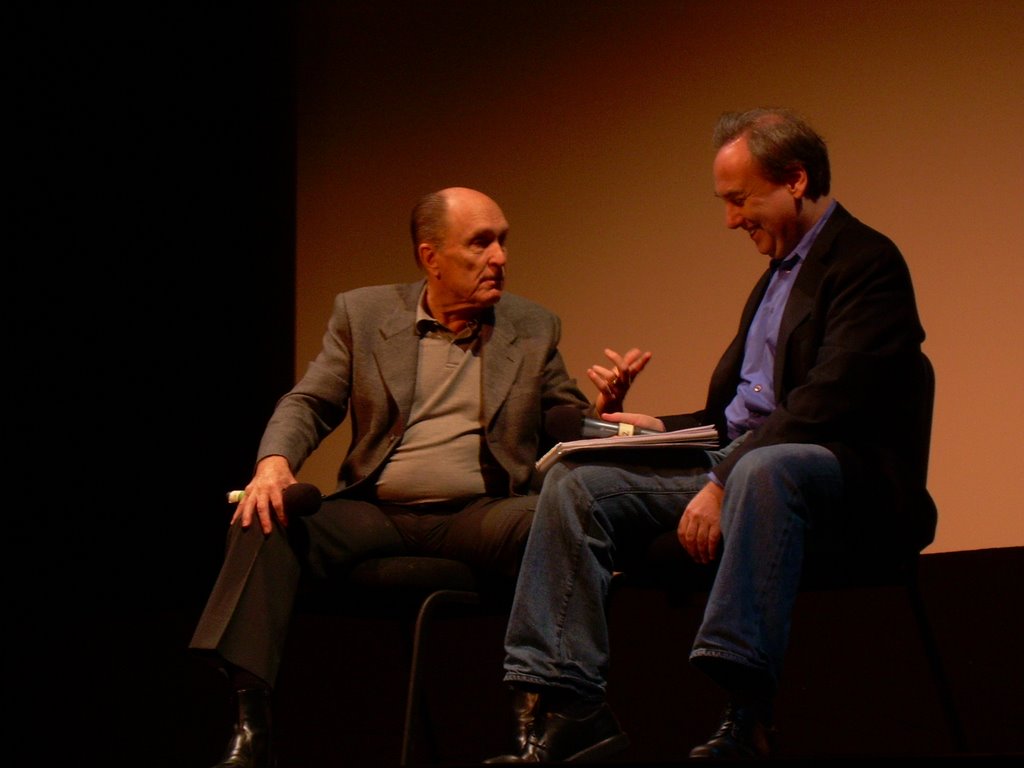
I then saw three gay-oriented (or, to use the preferred term in the third one, "GLBT-oriented") documentaries: Keep Not Silent, about Orthodox Jewish lesbians in present-day Jerusalem; In My Father's Church, a video diary of the months leading to a woman's wedding, with the question of whether her Methodist-minister father will be able to perform the ceremony; and Camp Out, featuring the first Bible camp for openly gay Christian teenagers.

Rushing out of Camp Out -- which has its own web site -- I missed the discussion with co-director Larry Grimaldi (but trust my Metro Herald colleague, Tim Hulsey, will report on that), so that I could cover the celebrity-studded evening at the Paramount.

Robert Duvall received the Virginia Film Award and discussed his career with New York magazine film critic David Edelstein. The interview followed a screening of Duvall's triple-threat 1998 film, The Apostle, which he wrote, directed, and starred in. I didn't measure precisely, but I estimate that in this 134-minute movie, no more than 5 minutes go by without Duvall on the screen. It is an impressive performance.

After a break, Morgan Freeman arrived to present his new film, 10 Items or Less, which is scheduled to be released in theatres on December 1 and available for (legal) download on December 15. The movie was followed by a panel discussion, moderated by film critic Josh Young and featuring Freeman, director Brad Silberling, and two of the film's producers. Freeman began by announcing that the Cardinals had just won the World Series, and it went on from there ...

Two more days to go. Here are some photos from today's fest:


Robert Duvall answers questions from the Charlottesville press corps


Robert Duvall answers questions from film critic David Edelstein


New York magazine and NPR's David Edelstein outside the Paramount


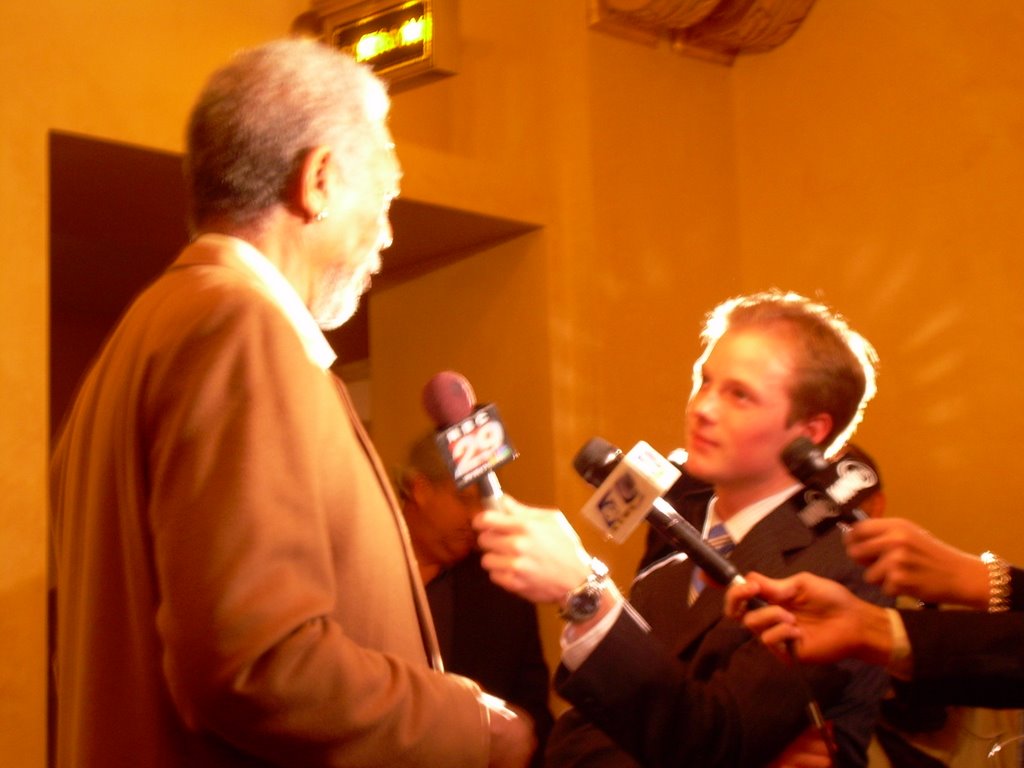
Morgan Freeman speaks to NBC29's David Douglas


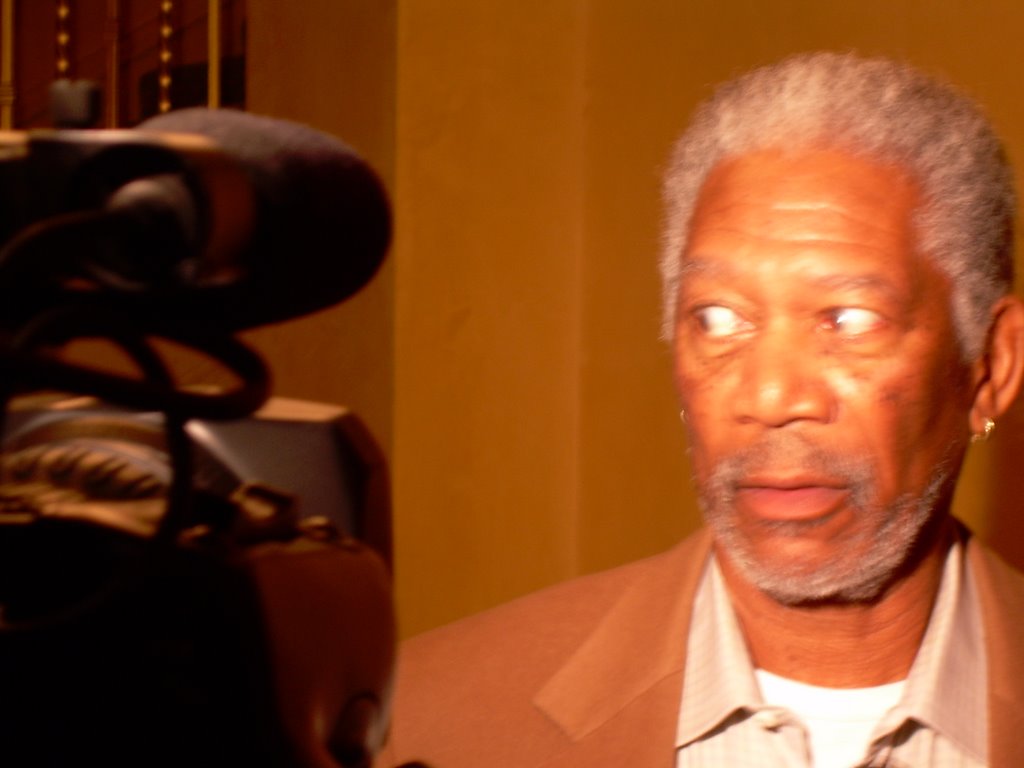
Morgan Freeman eyes a reporter suspiciously


Post-screening panel discussion of 10 Items or Less


Morgan Freeman and Lemony Snicket director Brad Silberling

Friday, October 27, 2006

'Blessed Are the Cheesemakers'

Virginia Film Festival, 2006 -- Day One:


The 19th Virginia Film Festival opened Thursday night. The first film to be screened was Swedish Auto, which was made last year in Charlottesville. It was directed by one of our native sons, Derek Sieg, and produced by University of Virginia graduate Tyler Davidson.

Swedish Auto was not only made in Charlottesville, it was set here, as well. The story does not take place in some unnamed town. Charlottesville is mentioned and is present throughout, as are many of our city's landmarks, including the Rotunda and Lawn at the University of Virginia, Chap's Ice Cream, the Downtown Mall, and, most prominently, Mel's Cafe on West Main Street.

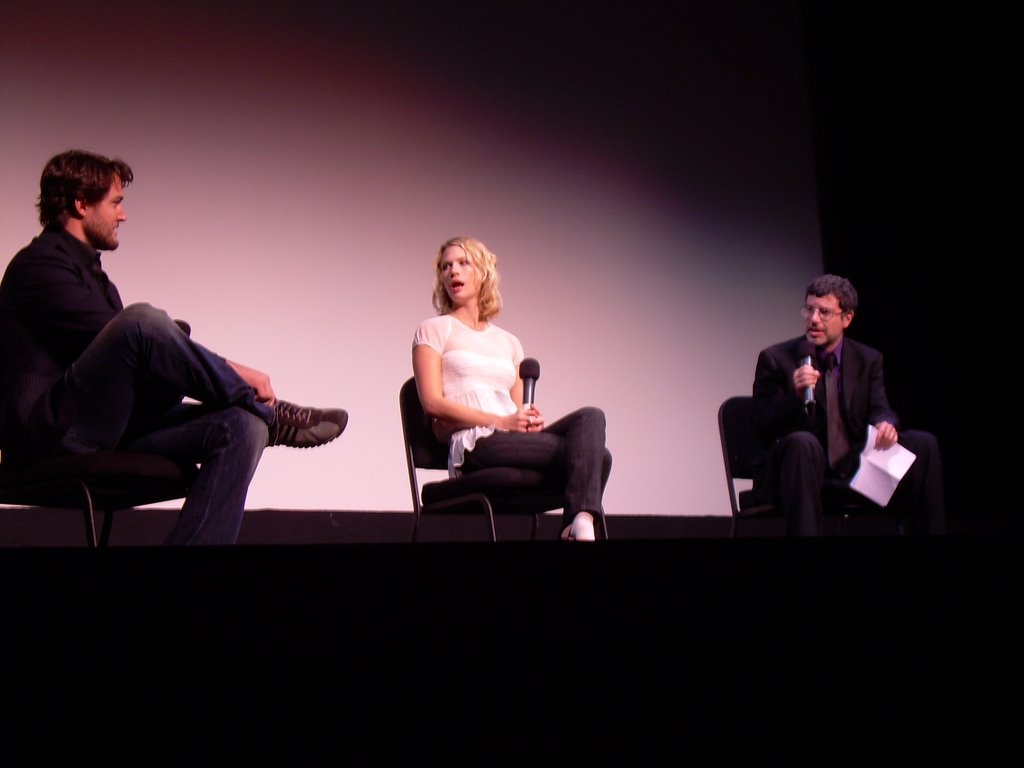
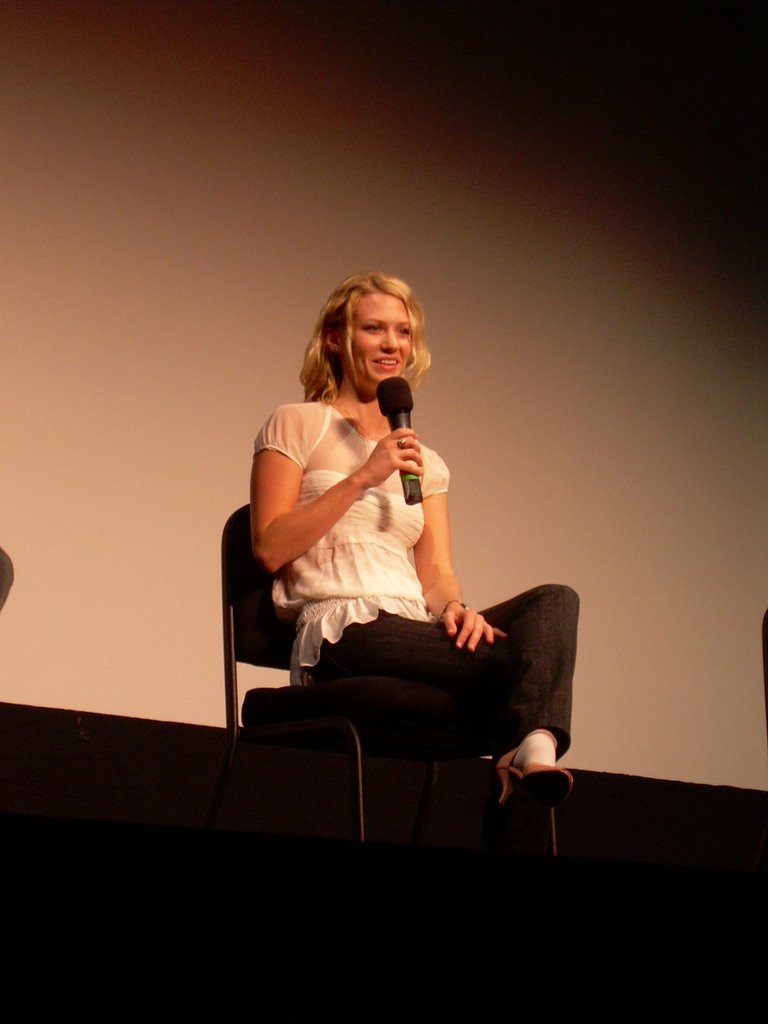
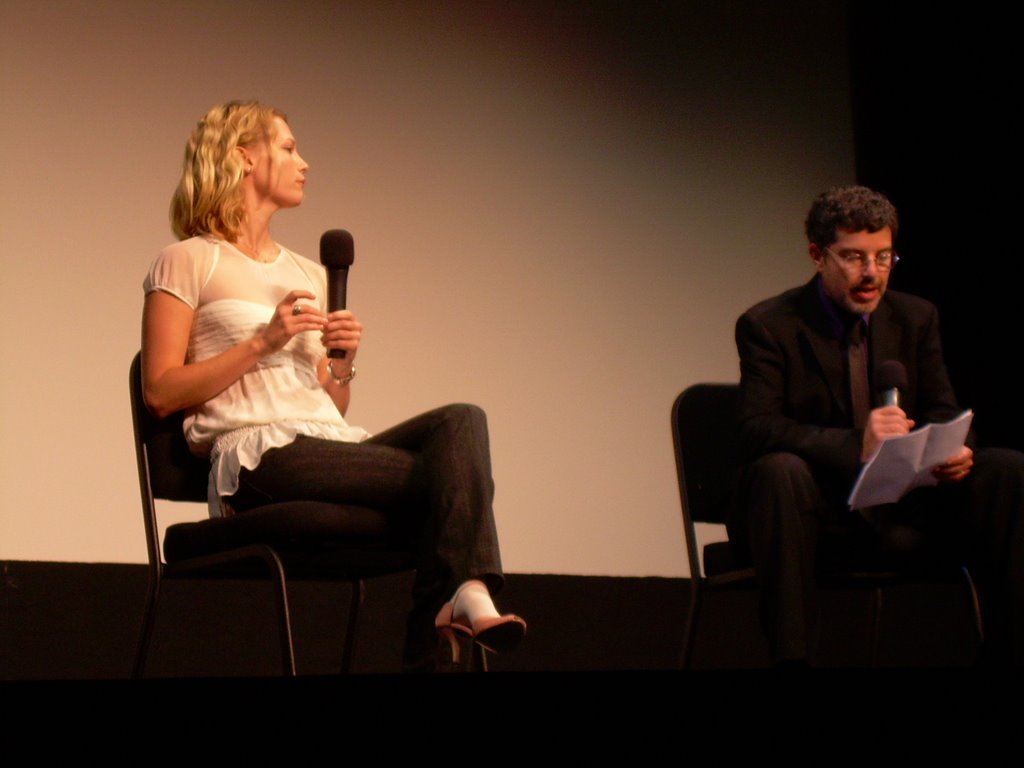
The screening of Swedish Auto -- which has not yet been released in theatres, but has had a good deal of success on the festival circuit -- featured a discussion with its director, Derek Sieg, and actress January Jones, on the stage of the Paramount Theatre. It was moderated by Virginia Film Festival Director Richard Herskowitz.


Derek Sieg, January Jones, and Richard Herskowitz


Derek Sieg and January Jones


January Jones


January Jones and Richard Herskowitz

* * *

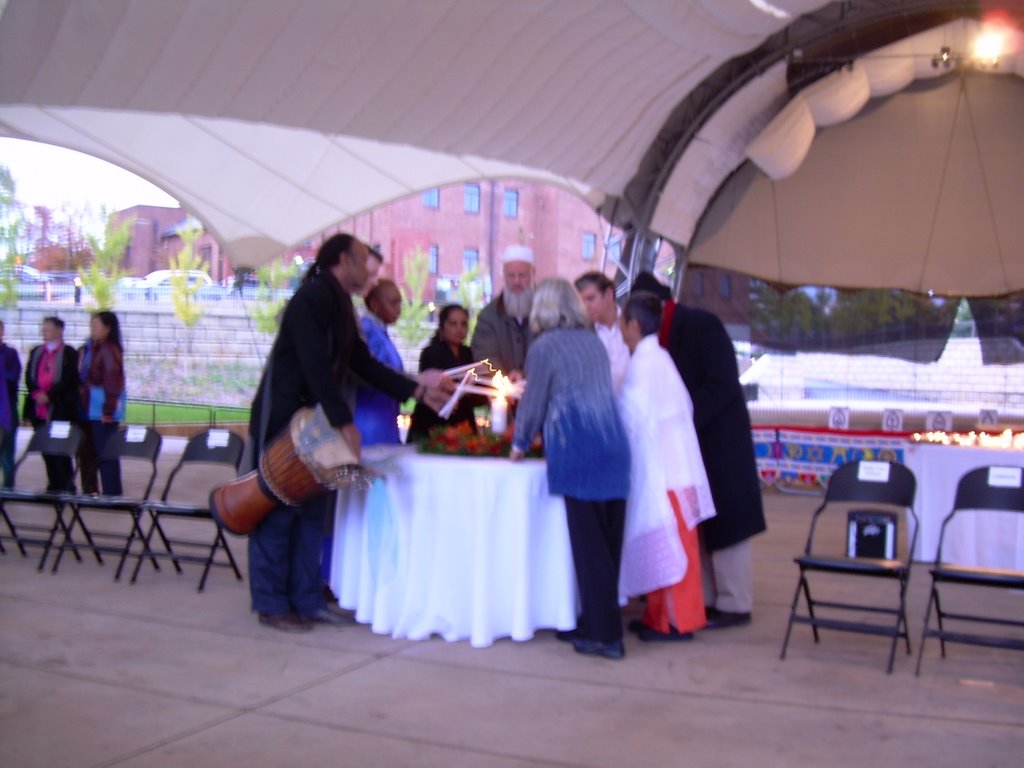
Earlier in the evening, at the Charlottesville Pavilion on the east end of the Downtown Mall, a small group gathered to celebrate various religious traditions and pray for peace. The multifaith ceremony was tied to the theme of the Virginia Film Festival, Revelations: Finding God at the Movies.


Charlottesville religious leaders light candles for peace

* * *

I closed the evening by attending a screening of Monty Python's Life of Brian. The venue was the Newcomb Hall Theatre on the grounds of the University of Virginia, so a large portion of the audience was made up of college students. (To my delight, I was joined for the show by Waldo Jaquith and his wife, Amber.)

Suffice it to say that this movie, which is almost 30 years old, is as relevant today as it was when it first came out. Its portrayal of Middle Eastern politics is more in tune with 2006 A.D. than it is with 33 A.D. Whose side are we on? The Peoples' Front of Judea or the Judean Peoples' Front? Or the Popular Front for Judea? And what should we call a man who wants to be a woman? (Answer: Loretta.) The more things change ...

But remember: "Always look on the bright side of life."

(Life of Brian photo courtesy Virginia Film Festival)

Wednesday, October 25, 2006

New Jersey Court Rejects Same-Sex Marriage Rights

The New Jersey Supreme Court today issued a long-awaited opinion in the case of seven gay and lesbian couples who had sued for the right to marry under the state constitution.

The court rejected the notion that the New Jersey Constitution demands equal marriage rights for same-sex and opposite-sex couples. As summarized in the court's syllabus of the opinion:

4. Times and attitudes have changed. There has been a developing understanding that discrimination against gays and lesbians is no longer acceptable in this State. On the federal level, the United States Supreme Court has struck down laws that have unconstitutionally targeted gays and lesbians for disparate treatment. Although plaintiffs rely on the federal cases to support the argument that they have a fundamental right to marry under our State Constitution, those cases fall far short of establishing a fundamental right to same-sex marriage "deeply rooted in the traditions, history, and conscience of the people of this State." Despite the rich diversity of this State, the tolerance and goodness of its people, and the many recent advances made by gays and lesbians toward achieving social acceptance and equality under the law, the Court cannot find that the right to same-sex marriage is a fundamental right under our constitution. (pp. 28-33)
The court did defer to the state legislature, saying it is up to elected lawmakers to create an institution other than marriage that treats same-sex couples equally. (It was probably looking to the Vermont and Connecticut examples, where same-sex couples are able to obtain civil unions as defined by legislation, not judicial opinion.)

More details will no doubt emerge as legal scholars and pundits have had a chance to read the whole opinion.

More "No" Votes Urged

Hot on the heels of the announcement by two Virginia governors -- one former, one current, one Republican, one Democrat -- that they are voting "no" on Ballot Question #1, two more Virginia newspapers are urging their readers to oppose the Marshall/Newman amendment.

The Roanoke Times says in today's editions:

The proposed constitutional amendment to ban same-sex marriage is not about protecting heterosexual marriage. Unions between a man and a woman are now legal and will remain so no matter what voters decide.

It also would not forbid any unions currently legal in the commonwealth. Virginia outlaws same-sex marriage and does not recognize unions from other states. . . .

Even if Virginia someday acknowledged same-sex unions and granted to them all the rights and responsibilities of heterosexual unions -- an extremely unlikely eventuality -- religious groups could still reject them.

Ballot Question No. 1 is an exercise in crass political maneuvering. The amendment appears on the ballot to give social conservatives a feeling that they are running the show, which some hope will turn out the base on Election Day.

Denying people the right to enter into civil arrangements should be unthinkable.

Under the headline, "A 'no' vote is the conservative stand," the Bristol Herald-Courier urges voters in both Virginia and Tennessee to reject similar ballot measures on Election Day:

Same-sex marriage is already illegal in both Virginia and Tennessee. So are civil unions. That’s been the law in Virginia for 30 years and in Tennessee for 10 years. No change is on the horizon.

Tampering with either state’s constitution in this manner is redundant. It reinforces an attitude of intolerance or hostility toward those who are different. It is a dangerous government foray into the realm of religion and a blow to individual rights.

In this nation’s history, most constitutional amendments have granted freedoms rather than taking them away – prohibition being the obvious exception. Virginia and Tennessee voters should think twice before altering these hallowed precepts to ban that which is already illegal.

A “no” vote is not a vote for same-sex unions. It is a vote to protect our constitutions and to respect freedom. We cannot think of a more traditionally conservative stand to take.
From Hampton Roads to Southwest Virginia, from Roanoke to the D.C. suburbs, from Richmond to Charlottesville, clear-thinking Virginians are voting "no" on Ballot Question #1.

Former GOP Governor Will Vote "No"


A. Linwood Holton, a former Republican governor of Virginia, announced on Tuesday that he plans to vote "no" on Ballot Question #1, the Marshall/Newman Amendment.

WRC-TV in Washington reported that Holton said:

The constitution shouldn’t include language taking away rights in vague or unnecessary ways.
The Washington Times quoted Governor Holton as saying:
We're talking in this amendment about fooling around with [the Virginia Constitution] in a way that will create confusion and unfortunately litigation for two or three generations. It just runs a serious risk of messing up our constitution.
The former Republican governor, who served from 1970 to 1974, was joined at a Richmond news conference by his wife, Jinks Holton, by his daughter, Anne Holton, and by the current governor, Tim Kaine, who became the 200th Virginia lawyer to add his signature to the statement of the Virginia Legal Review Committee, which expresses concern about the significant and largely unpredictable legal consequences of the proposed amendment. Anne Holton, a former family court judge, is the wife of Governor Tim Kaine and the current First Lady of Virginia.

Judge Holton, referring to the second and third sentences of the amendment, was quoted on WTVR-TV6 in Richmond as saying:
I can see all kinds of hay that lawyers can make with that ridiculous, vague language...what the heck does that mean?
WWBT-TV in Richmond added a bit to her soundbite:

... design, quality, significance, affects, that approximate the benefits of marriage. What the heck does that mean?

For her part, former First Lady Jinks Holton expressed concerns about senior citizens like herself. WWBT-TV reported that she said:

I worry for instance about older women, including friends of mine, who own a house together or an apartment…

Governor Kaine said, according to the Washington Times:
In states that have passed similar language, the ability of partners who are not married to obtain the social service and other protections of family courts have been thrown into jeopardy by this language, and I think that would be a very negative consequence.
Loretta Boniti reported on WVIR-TV in Charlottesville that Kaine said:
Read the whole thing. Ask yourselves if you understand what it means and if you don't, then that should be a pretty good indication you wouldn't want to put it in the bill of rights.
Another prominent Virginia political leader, State Senator R. Creigh Deeds (D-Bath County), who last year came within a hair's breadth of becoming the state's attorney general, has announced his opposition to the amendment, despite having voted for it as a member of the General Assembly. Upon reflection, Deeds says, the amendment does more than its original drafters claimed it does, and what it does is damaging.

In a statement released earlier this week, Deeds wrote:
I will be voting NO and here is why.

In the 2005 and 2006 General Assembly Sessions, I voted for the proposed constitutional amendment that is now Ballot Question #1, because I believe that marriage is between a man and a woman, and because I accepted at face value the arguments of proponents of the amendment that the language of the amendment was declarative of existing law. I also believed that issues of such magnitude ought to be determined by the voters.

Nothing has happened to change my belief that marriage is between one man and one woman, and nothing could. Nor has anything happened that would cause me to question the appropriateness of giving voters the opportunity to vote on this question.

It is clear to me now, however, that the language goes far beyond existing law and threatens real harm to many Virginians and their families, among them the unmarried victims of domestic violence.
Last week, several Richmond-area lawmakers who had earlier supported the amendment also announced their change of heart and their plans to vote "no" on November 7.

Deeds, Kaine, and the Holtons join a growing list of opinion leaders around the state who have announced their opposition to Ballot Question #1. Newspaper editorial boards are among the opponents.

For instance, the Free Lance-Star in Fredericksburg argued on Sunday:
The gauzy wording of the amendment is far from reassuring: It prohibits state or local recognition of "a legal status for relationships of unmarried individuals that intends to approximate the design, qualities, significance, or effects of marriage." What that would mean in the real lives of real Virginians--gay and straight--God knows. But He evidently hasn't told the amendment's authors, who dipped their pens in wells of fog, and judges will have to guess. In Ohio, which enacted a similar amendment, judges have ruled that cohabitating batterers cannot be prosecuted under Ohio's domestic-violence law because that law forbids harm to a "person living as a spouse." Such a person is now stripped of protection from a partner's flying fists because the state's "marriage amendment" denies the legal privileges of marriage to unwed couples.

But ambiguity is not the proposal's only sin. The General Assembly cannot come up with a plan to unclog the state's highways, but legislators think they know how to get the public's juices rapidly flowing--by throwing before it a bogus defense of a sacred institution allegedly threatened by skulking deviants. So lawmakers now invite us to junk up the Virginia Constitution's Bill of Rights--called by one scholar "the most influential constitutional document in American history"--with inflammatory redundancies designed wholly to curry favor for the passing parade of today's politicians who have little else to offer. "It is sad," writes conservative Virginia jurist J. Harvie Wilkinson of the 4th U.S. Circuit Court of Appeals, "that the state of James Madison and John Marshall will in all likelihood forsake their example of limited constitutionalism this fall."

The judge may be selling his fellow Virginians short. While voters in all 20 states that have placed "marriage amendments" on the ballot have approved them, a mid-October Washington Post poll found that only 53 percent of likely Virginia voters favored Question No. 1. When pollsters fairly stated arguments pro and con, respondents deadlocked. The more Virginians know about this amendment, the less they like it.
That paper is joined by the Newport News Daily Press, which said in its Sunday edition:
If we go to the polls on Nov. 7 and reject an effort to sully our state constitution with the words of a misguided effort to "protect" marriage, then we will have reminded Americans what constitutions are for. They are not for limiting human relationships. They are not for restricting freedom. They are not for muddling and meddling in the intimate questions of who may love whom and how that love is to be protected and nurtured.

The Marshall-Newman amendment - more typically referred to as the amendment to ban same-sex marriage - is a legislative train wreck waiting to happen. If allowed to leave the station on Election Day, it would amend the Bill of Rights of the Virginia Constitution with language that is, at best, ambiguous in terms of its legal effects and, at worst, mean-spirited and bigoted.
Even the student press is getting into the act. The editorial writers at the University of Virginia's Cavalier Daily offered this opinion on Monday:
It's not just same-sex marriage and civil unions that the amendment bans, but any agreement between two people that a court could deem to approximate the marriage. Unmarried straight couples could be affected, given that the amendment bans any agreement between unmarried people that looks like marriage. For unmarried people to share a bank account, a will or any sort of assets cold get a lot more complicated.

It is uncertain what effect the amendment will have on businesses, which could be constitutionally barred from offering benefits to employees on their own terms. Businesses who want to offer a benefits package to their employees may be barred from doing so as long as the amendment is in effect. If the amendment is interpreted that way, businesses that want to be competitive by offering domestic partner benefits may choose not to locate in Virginia, making the state less competitive.
Lest some readers dismiss the Cavalier Daily as a typical, soft-headed, left-leaning, student newspaper, let me point out that the very next day, the same editorial board endorsed Republican Congressman Virgil Goode for re-election.

One final point: Bob Gibson is reporting in today's Daily Progress that, according to the most recent Mason-Dixon poll, support for the Marshall/Newman amendment is steadily, if slowly, shrinking, with the percentage of those who say they plan to vote yes down to 52 percent, with six percent of voters still undecided.

As people become better informed about the amendment and its probable negative, unintended consequences, the more likely they are to vote "no" on Election Day. That's a credit to the level-headedness of Virginia voters.