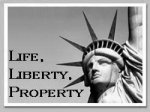
Showing posts with label eminent domain. Show all posts

Sunday, June 23, 2019

From the Archives: 5 years after Kelo v. New London: Are property rights safe?

5 years after Kelo v. New London: Are property rights safe?
June 23, 2010 7:54 PM MST

In its 1972 ruling in Lynch v. Household Finance Corporation, the U.S. Supreme Court explained:

“Property does not have rights. People have rights. The right to enjoy property without unlawful destruction, no less than the right to speak or the right to travel, is in truth a ‘personal’ right.” The court went on to declare that “a fundamental interdependence exists between the personal right to liberty and the personal right to property.”

Property rights – a shorthand term for the rights of people to own and use property – and human rights are indistinguishable. One cannot exist without the other. The right to a free press is impossible without the right to own ink or a photocopier or a typewriter. The right to free exercise of religion is not possible without the right to own churches and seminaries and cemeteries and Talmuds and schools.

Kelo v. New London
It is fitting today to remember these fundamentals because five years ago, on June 23, 2005, the Supreme Court undercut Americans’ property rights in the case of Kelo v. City of New London. In that case, the Court ruled that governments can take the property of one person, using the power of eminent domain, and hand it over to another person, who may be able to generate more tax revenues from the property than the original owner was able to do – or chose to do.

The U.S. Constitution guarantees the right to hold property and to make contracts using that property. The Fifth Amendment makes plain that “no person shall be deprived of life, liberty, or property without due process of law; nor shall private property be taken for public use without just compensation.”

Property Rights Under Attack
Still, property rights are under assault throughout the United States. Through taxation and regulation, state and federal governments are impeding our rights to do what we please with our property, even if we are not harming other people or their property.

Rick Sincere kelo new london examiner.com property rights scotus
Towns and cities across the country, for example, have begun to designate certain neighborhoods as “historic districts,” usually without the consent of homeowners in those neighborhoods. This designation is accompanied by hundreds of restrictions regarding what homeowners can do with their property, such as whether they can repaint their homes, put up aluminum siding, replace a roof, cut down a tree, and so forth.

This is not a trivial issue. It affects any person who owns property, whether a residence or a business. “Historic district” designations strike at the root of individual liberty and should not be dismissed lightly. Much is at stake. In fact, the Pennsylvania Supreme Court ruled a similar law unconstitutional because it took away the decision making capacity of homeowners in favor of a politically defined “public good,” thus taking private property for public use without just compensation.

Environmental regulations do much the same. Thousands of acres of farms, ranches, and residential areas have been declared “wetlands” that deserve government protection. The owners of the designated property are not permitted to plant crops, graze cattle, or build homes or factories on government-designated “wetlands” unless they can cut through miles of red tape.

Kelo’s Legacy
The Kelo decision states that it is permissible for the government to use eminent domain to seize one person's property and give it to another. The recipient is almost invariably wealthier and better connected politically than the victim of the seizure.

In the aftermath of Kelo, the good news is that the American people demanded that laws be made to reject the Court’s decision. Across the country, state legislatures have passed statutes or even constitutional amendments to protect people against eminent domain abuse. (In Virginia, the law is somewhat better than it was but still weaker than it should be.)

The bad news -- sadly ironic news -- is that the situation that started it all, Pfizer's demand that the city of New London, Connecticut, destroy a working-class neighborhood to create housing for its high-paid executives, turned out to be moot. Pfizer pulled out of the project, which was never built, and Suzette Kelo's former neighborhood is a desert, populated only by "feral cats," as one chronicler noted. New London took a vibrant cityscape and turned it into blight.

Kelo’s lesson is that nobody’s property is safe, even though property rights should be seen, properly, as one component the bundle of basic human rights that each individual possesses.

Publisher's note: This article was originally published on Examiner.com on June 23, 2010. The Examiner.com publishing platform was discontinued July 1, 2016, and its web site went dark on or about July 10, 2016.  I am republishing this piece in an effort to preserve it and all my other contributions to Examiner.com since April 6, 2010. It is reposted here without most of the internal links that were in the original.


Wednesday, October 16, 2013

Blog Action Day 2013: Property Rights Are Human Rights

Blog Action Day 2013
Today is Blog Action Day around the world, with the invitation issued to bloggers to discuss the theme of "human rights" in all its aspects.

In a somewhat obscure but important decision in 1972 (Lynch v. Household Finance Corporation), the U.S. Supreme Court explained: "Property does not have rights. People have rights. The right to enjoy property without unlawful destruction, no less than the right to speak or the right to travel, is in truth a 'personal' right." The court went on to declare that "a fundamental interdependence exists between the personal right to liberty and the personal right to property."

Property rights - a shorthand term for the rights of people to own and use property - and human rights are indistinguishable. One cannot exist without the other. The right to a free press is impossible without the right to own ink or a photocopier, a computer or a blog's domain name. The right to free exercise of religion is not possible without the right to own churches and seminaries and cemeteries and Talmuds and schools.

The U.S. Constitution guarantees the right to hold property and to make contracts using that property. The Fifth Amendment makes plain that "no person shall be deprived of life, liberty, or property without due process of law; nor shall private property be taken for public use without just compensation." The widespread negative reaction to the Supreme Court's 2005 Kelo decision -- and efforts to fix and overturn it legislatively -- demonstrates how deeply felt this right remains among Americans despite the encroachments of government. (See, for instance, "Richard Epstein notes how Kelo sparked more scrutiny of eminent domain.")

Even setting aside Kelo and eminent domain takings, property rights are under assault throughout the United States. Through taxation and regulation, state and federal governments are impeding our rights to do what we please with our property, even if we are not harming other people or their property.

Towns and cities across the country, for example, designate certain neighborhoods as "historic districts," usually without the consent of homeowners in those neighborhoods. This designation is accompanied by hundreds of restrictions regarding what homeowners can do with their property, such as whether they can repaint their homes, put up aluminum siding, replace a roof, cut down a tree, and so forth.

This is not a trivial issue. It affects any person who owns property, whether a residence or a business. "Historic district" designations strike at the root of individual liberty and should not be dismissed lightly. Much is at stake. In fact, the Pennsylvania Supreme Court ruled a similar law unconstitutional because it took away the decision making capacity of homeowners in favor of a politically defined "public good," thus taking private property for public use without just compensation.

Environmental regulations do much the same. Thousands of acres of farms, ranches, and residential areas have been declared "wetlands" that deserve government protection. The owners of the designated property are not permitted to plant crops, graze cattle, or build homes or factories on government-designated "wetlands" unless they can cut through miles of red tape.

Thinking about property rights as human rights reminds us of the fundamental importance of private property and the way it undergirds our civilization. Any protection of property rights protects all other rights and freedoms.


Sunday, January 23, 2011

Recent Interviews with Virginia Policymakers

Virginia State Capitol
My last post reported on the public appearance in Charlottesville of U.S. Senator Jim Webb, who answered my question about free trade issues during a press gaggle backstage at the Dickinson Auditorium on the campus of Piedmont Virginia Community College.

This was not my only recent encounter with elected officials.  In the past two weeks or so, I have had the opportunity to conduct interviews with several other Virginia policymakers, including Attorney General Ken Cuccinelli, State Senator Mark Obenshain, Delegate Harvey Morgan, and Delegate David Toscano.

My interview with Attorney General Cuccinelli resulted in at least four articles on Examiner.com.

The first addressed what, at the time, was Topic A in the national conversation, the shooting of Arizona Representative Gabrielle Giffords and several others in Tucson.  Six people were killed by alleged gunman Jared Lee Loughner in that incident.

In "Exclusive: Va. Attorney General Ken Cuccinelli reacts to tragedy in Tucson," published on January 12, the Attorney General identified some parallels that are close to home for Virginians:
Cuccinelli said that he has “been watching the information that’s rolled out about” Saturday’s events and that it is natural to ask, “What else could we have done?”

That question, he continued, “walks me right into a lot of the mental health work that I’ve done over the years. I’m still looking at Loughner’s history to see what sort of parallels there are to experiences we’ve had in Virginia, tragically” – referring to the Virginia Tech shootings of April 2007 – “and what sort of systems that, if in place, might have caught and treated this guy.”

In what turned out to be a supplement to an earlier interview I conducted with Maria Everett, executive director of the Virginia Freedom of Information Advisory Council, Cuccinelli spoke to me about his support for a strong FOIA statute and system in Virginia. He expressed concern about proposals to eliminate the FOIA Council.

In "Va. Attorney General Ken Cuccinelli talks about Freedom of Information," published on January 14, Cuccinelli responded to the recommendation of Governor Bob McDonnell's government reform commission that the FOIA Council -- which only has two staff members yet processes upwards of 1,800 inquiries each year -- be cut:
“Obviously,” he said, “I think that to have a robust FOIA you need some central clearinghouse, so if there’s going to be a substitute, which I don’t really see right now, I think their notion is that every agency will just handle its own.”

The commission suggested that the Office of the Attorney General could handle inquiries and disputes about FOIA matters, but Cuccinelli ruled that out as a realistic possibility.

“That’s a natural fallback,” he conceded, “because everybody would then turn to us and say, ‘Do I have to do a, b, or c?’ That’s got its problems.”
Cuccinelli also talked about government transparency more generally, and the need to provide access to budget information to citizens on a ready basis.

It turns out that state Senator Ralph Smith has proposed a rule to make the state budget available on line for scrutiny by both legislators and citizens for at least 72 hours before either chamber of the General Assembly may vote on it.

Cuccinelli pointed out some logistical hurdles that state agencies still face, in "State Senator Ralph Smith and Att'y Gen'l Ken Cuccinelli promote transparency," published on January 16:
“I learned doing the transparency work” in the General Assembly, Cuccinelli said, that “there’s a logistical hurdle to the kind of transparency I’d like to see, which is immediate, on-line, from your desk, in your office” access to government information.

“Half our state government,” the Attorney General explained, “is still not on what you and I would call anything approaching modern databases.”

As a consequence, he said, Virginia citizens “can’t plug into the databases and make available that information on the web, because -- I jokingly say -- they’re still using punch cards.”

Joking aside, he said, about half of state agencies are actually “just above that level. I’m sure they’re not happy about it either.”
In the final excerpt from our lengthy interview, "Va. Att'y Gen'l Ken Cuccinelli endorses curbs on eminent domain in constitution," published on January 20, Cuccinelli noted his support for an amendment that will enshrine protections for private property owners in the Virginia Constitution. (The constitutional amendment has been patroned by both Delegate Rob Bell [R-Albemarle] and Delegate Johnny Joannou [D-Portsmouth], with a bipartisan list of copatrons.)

The Virginia Attorney General addressed how the Bell-Joannou amendment -- which has to pass two sessions of the General Assembly with an intervening election before being put to the voters as a referendum for their approval -- strengthens protections against eminent domain abuse:
Cuccinelli went on to explain that he and his colleagues have “been working for months on good language that will address four different issues.”

The first issue is “proper damages to people whose property is taken.”

The second is “requiring the government entities taking property to prove that it’s going to be put to a public use.”

The third is limiting those entities “to take no more than is absolutely necessary for the achievement of the public use.”

The fourth issue is “not treating such things that we typically refer to as the ‘Kelo elements’” – such as “economic development, increasing tax base, those kinds of things" -- as rationale for a taking.

The proposed amendments, Cuccinelli said, “eliminate those constitutionally as possibilities for legitimate – by ‘legitimate.’ I mean legally allowable by a court – explanations for a taking for a public use."
Speaking of eminent domain abuse, I spoke to two members of the General Assembly about that issue: my own representative, Delegate David Toscano (D-57), and state Senator Mark Obenshain (R-Harrisonburg). Obenshain has his own proposal for a constitutional amendment, and Toscano opposes putting these protections in the constitution.

In "Delegate David Toscano discusses transparency and eminent domain reform," also published on January 20, the former Charlottesville mayor argues against putting too many things in the Commonwealth's constitution:
“We did a lot on eminent domain three or four years ago,” he said, when a bill “that ultimately I didn’t feel all that good about” was approved. Despite his own misgivings, he added, “it’s what the legislature wanted and so it got passed.”

This year, he noted, “we hear renewed efforts to make it a constitutional amendment. I’m very leery about that. I’m not going to support it.”

Not just the eminent domain proposals, he said, “I’m very leery about amending the constitution, anyway.”
In the same interview, Toscano spoke about his own efforts to improve government transparency through two bills that he has introduced.

For his part, Senator Obenshain -- whom I interviewed last year on the topic of ABC privatization -- talked about his strong support for including property rights in the Virginia Constitution.

In "State Senator Mark Obenshain discusses property rights and eminent domain reform," published on January 17 (the same day that I met with the senator with a delegation of Republican Liberty Caucus members), he argues for the inclusion:
Senator Obenshain went on the record with the Charlottesville Libertarian Examiner and spelled out what his constitutional amendment would do.

The resolution “basically codifies the statutory language that we adopted two years ago” in reaction to the U.S. Supreme Court’s ruling in Kelo v. City of New London (2005). “It prevents the economic development/employment-type of eminent domain exercises that have been subject to abuse across the commonwealth of Virginia. It gives us the opportunity to memorialize that [language] in the Constitution so that it can’t just be undermined by efforts of the General Assembly in years to come.”
Finally, I should note that last Monday I spoke to the criminal law subcommittee of the House Courts of Justice Committee in favor of HB 1443, Delegate Harvey Morgan's bill to decriminalize simple possession of marijuana. Nobody spoke against the bill but the subcommittee, chaired by Delegate Rob Bell, killed it on a voice vote without raising an argument one way or the other.

After the vote, I spoke with Delegate Morgan, an elfin octogenarian, conservative Republican, and retired pharmacist who last year endured ridicule over his marijuana-reform proposals, yet persevered this year. He told me, in "Disappointment as Va. House subcommittee votes to keep pot possession a crime," also published on January 17 (which happened to be Martin Luther King, Jr., Day, a federal and state holiday):
“The bill I introduced,” Morgan explained, “would have made the simple possession of marijuana [subject to] a civil penalty and not a criminal penalty.”

Saying he was not advocating marijuana usage “at all,” Morgan went on to say ruefully that today, if a person is arrested – “even if it’s set aside” under the first offender law in Virginia -- the arrest and conviction are “always on your record as an arrest for a drug offense.”

As a result, he said, “anyone who has that on a record finds that it is an absolute barrier to employment for a commercial driver’s license, to work in a health care profession, to be a teacher.” In many jobs that require security clearances, he added, “they do a background check and up pops a drug offense and they just cannot hire you.”
Weather permitting -- forecasters indicate there may be a big storm coming up the East Coast on Tuesday and Wednesday -- I will be in Richmond next week, with opportunities to speak to other legislators. Stay tuned.

Be sure to visit my CafePress store for gifts and novelty items!
Read my blog on Kindle!
Follow my tweets on Twitter! 

Wednesday, April 02, 2008

Paul Jacob: Putting Citizens in Charge


Paul Jacob, president of Citizens in Charge and a senior advisor at the Sam Adams Alliance, will be speaking at the University of Virginia tonight at the invitation of Students for Individual Liberty. According to the email announcement of the event:

On Wednesday, April 2, Students for Individual Liberty at the University of Virginia will sponsor an address by Paul Jacob. His address, entitled "Why Government Wants You to Shut Up and Pay Your Taxes: Attacks on Voters," will begin at 7:30 p.m. in Room 222 of Cabell Hall at U.Va. The event is free and open to the public.

Mr. Jacob is a senior advisor to the Sam Adams Institute in Chicago. He has recently been involved in a legal controversy with the state of Oklahoma concerning the rights of citizens to place an initiative on the ballot in Oklahoma. Information about this controversy is available at www.freepauljacob.com.
In anticipation of his speech tonight, Paul was a guest on Rob Schilling's afternoon radio program on WINA-AM in Charlottesville. I was there to get the interview on video.

In Part I, host Rob Schilling introduces his program, mentioning a "pizza and root beer" reception in the lobby of Lane Auditorium that will welcome Albemarle County citizens who will be attending the Board of Supervisors' hearing on the budget and taxes. He then introduces his guest, who begins his own remarks by talking about his experience in the term limits movement in the 1990s.


In Part II, Schilling and Jacob continue the discussion about term limits.


Part III opens up the discussion to other topics, such as eminent domain abuse and the Supreme Court's Kelo decision, as well as citizen initiatives to enact taxpayer bills of rights (TABORs):


In the final segment, Part IV, Jacob talks about the politically-motived prosecution of him and two colleagues who worked on a citizen initiative in Oklahoma. He describes how Oklahoma Attorney General Drew Edmondson brought felony charges against him and how the prosecution is designed to silence citizen activists who dare to oppose the interests of elected public officials:


One of the points that Paul makes in the last few minutes of the interview is that, unlike decades past, local political news can now become nationally prominent because, especially, bloggers write about it and draw attention to it. Public officials in Oklahoma can no longer misbehave and assume that citizen activists in Virginia won't hear about it -- or complain about it. So true.

Paul also explains, just before the end of the program, what Virginia voters can do to see that our laws are changed to allow citizen initiative in this state, a privilege enjoyed by voters in 24 other states but not in the Commonwealth. He says that voters should simply insist that politicians -- who hold all the cards now -- promise to pursue a constitutional amendment to permit citizens to initiate legislation that politicians refuse to consider because it adversely affects their (the politicians', not the voters') interests.

Thursday, October 19, 2006

Post-Kelo Property Rights


Law student Steve at Eminent Domain has a good synopsis of state initiatives aimed at overturning the most far-reaching aspects of the Supreme Court's 2005 decision in Kelo v. New London.

Citing Charlottesville writer Ron Bailey, he notes that a lot of proposals go farther than just restricting the use of eminent domain authority by state and municipal governments. They also attempt to change the way property owners are compensated (or not, as is mostly the case today) when regulations reduce the value of their property. "Regulatory takings" is still a muddled concept in the law, with no clear guidance from SCOTUS or other courts, so legislation -- especially voter-initiated legislation -- may finally clarify its meaning and circumscribe its use.

November 8 will bring a lot more news than just who controls Congress and whether Virginia marriage law becomes incontrovertibly confused.

On an unrelated topic, Steve also has an informative post about a Seventh Circuit oral argument about Indiana's requirement for voters to have a photo ID in order to vote. My own feeling on this subject is that it is not particularly burdensome, in the 21st century, to expect adults to have a photo ID. Perhaps requiring it for voting will provide an impetus for them to acquire the means to cash a check, travel by airplane, and get into an R-rated movie.

Wednesday, February 23, 2005

What the Bad Guys Say About Eminent Domain

The day after the U.S. Supreme Court heard oral arguments in Kelo v. New London, I received my copy of the Cato Policy Report in my postal mailbox. The back page of the January-February 2005 issue includes this nugget, attributed to Bond Buyer Online (October 4, 2004), a defense of indiscriminate use of eminent domain powers by the government:

"The way the opponents of eminent domain always want to portray it is, 'Oh, Old Mother Hubbard is getting kicked out of her cupboard by an evil government," said [District of Columbia mayor Anthony] Williams, a lawyer.

Much of the time, local governments try to expropriate the property of "some wealthy interest [who] doesn't want to get off their land for the benefit of the public," Williams said. Eminent domain authority constitutes "the exercise of the public realm for good productive purposes against selfish, private, parochial interests."...

"[Court restrictions on eminent domain] to me would be a veneration of propery rights at the expense of community interest, a federation of private interests at the expense of the public commonweal," he said. "The restrictions on when you can take property are becoming more and more severe."

If only Williams' last comment reflected reality! One can only hope that the Supreme Court makes his words true.

The kicker is Cato's headline on this little item: "Like small businesses getting expropriated for millionaire baseball owners?", a reference to Williams' steamrollering of a publicly-financed stadium in southeast Washington that will destroy dozens of small businesses and displace numerous homeowners. The taxpayer subsidy of the baseball teams' owners is bad enough; the destruction of a neighborhood is shameful.

Just more evidence of the inherent evil in those government officials who use eminent domain to transfer wealth from poor, politically powerless citizens to rich, politically powerful ones.