Friday, May 26, 2006

Stossel Meets Steigerwald


In last Saturday's edition of the Pittsburgh Tribune-Review, the paper's associate editor, Bill Steigerwald, interviews John Stossel of ABC News about Stossel's new book, Myths, Lies, and Downright Stupidity: Get Out the Shovel--Why Everything You Know is Wrong.

In the interview, Stossel confirms what I have long suspected -- despite disagreements on some issues, conservatives are closer to (and more comfortable with) libertarians than liberals are.

Steigerwald asks Stossel how he defines himself, politically speaking. Stossel replies:

I’d say I’m a libertarian. And I prefer the word “liberal” except that the liberals stole the word and have perverted it to mean “big government running your life.” So I’m stuck with “classical liberal” and no one knows what that means, so I call myself a libertarian.
The interviewer then points out that libertarians disagree with both liberals and conservatives -- with conservatives on issues like the drug war, with liberals on issues like the minimum wage. How, Steigerwald asks, do the two other groups treat libertarians like Stossel? The answer may surprise you:
I think homosexuality is all right. And yet the conservatives will pay me a $40,000 speaking fee -- which goes to charity, by the way – and invite me to their events and have me on their shows. But the liberals will have nothing to do with me.
This disdain extends to the mainstream media, Stossel says, with a complete lack of interest in his new book:
I've got no NPR, none of the big national NPR shows. No New York Times. No Washington Post. No Larry King....

The left only wants to talk to people they like. They view me as "icky." And these ideas are not even interesting enough to them to have them want to argue with me. They just don't want to think about it. ... I think a lot of journalists consider me somewhat of a pariah. I have betrayed the "objectivity" thing. There are some people at ABC who are furious at me who demand that I be fired for having a point of view. What's peculiar is that I have always had a point of view in my reporting. I won 19 Emmys doing consumer reporting where I had a point of view. I might say, "This company sucks" or "This product is better than that." I would do the research and say, "Here's my point of view" and "Here's what the other side says." What I do now is no different, but now I no longer win any Emmy awards and I'm criticized for not being objective.
I really like Stossel's answer to the question of how he became a libertarian. For Stossel, it was an important libertarian publication:
I watched government fail in the regulation I cheered on as a consumer reporter. And I kept reading, trying to find somebody who would explain to me what was going on. The New York Times and the Globe and the Post were all saying the same things, which didn’t make sense to me. And the National Review and American Spectator were all bashing Democrats and saying we should have soldiers more places. Then I finally found Reason magazine -- and that opened my eyes.
In my case, I like to say that it was because in the late 1980s, the Cato Institute served better food at its lunchtime seminars than the Heritage Foundation did. But that's just being glib -- the real story is more complex, and someday I might tell it here.

By the way, the interview with John Stossel also appears in that old war-horse of conservative publications, Human Events. I can't imagine seeing it reprinted in the Village Voice or Mother Jones.

Tuesday, May 23, 2006

New Carnival of Liberty

Left Brain Female ... in a Right Brain World ... is the host of the 46th weekly Carnival of Liberty.

The new carnival includes links to articles on issues ranging from U.S. policy toward Israel to the Canadian census. In between are pieces on the Beijing Olympic mascots, dispute resolution organizations, and the child soldiers of East Africa.

It's all well worth a look!

Monday, May 22, 2006

The Mark of the Beast

The newest Virginia Blog Carnival has been posted by James Martin over at The Virginia Progressive. As Waldo Jaquith observed, this week's carnival is post number 666 on that blog, which rounds up all the usual suspects ... and then some.

Someday I Will Rule You All

Don't worry -- I'm not making a proclamation of megalomaniac ambitions.

"SOMEDAYIWILLRULEYOUALL" is the solution to the tap-danced, Morse-Code puzzle in this past Sunday's "Foxtrot" comic strip, in the funny pages of many newspapers coast-to-coast -- more than 1,000 worldwide, according to a biosketch of creator Bill Amend. (I saw it in the May 21 Washington Post.)

If you don't believe me, check it out yourself at the CGI Morse Code Translator.

Sunday, May 21, 2006

Why No AAA for Homeowners?

About a week ago, I found myself in the ridiculously embarrassing predicament of locking my keys in my car -- not once, but on two successive days.

Consequently, for only the second and third times since I had become a member of the American Automobile Association, I called AAA for "roadside assistance" (although my car on both occasions was snugly in my driveway). AAA responded by dispatching Lethal Wrecker -- within an hour the first time, and within 100 minutes the second time. There was no charge for the unlocking of my car, as it is one of the benefits included in my AAA membership fee. The second time also required a battery jump, and that was also provided at no charge.

Yesterday I faced a plumbing emergency: A leak sprung from my hot water heater. (I won't go into the details of how it happened, but it turned into the most expensive "free" lawn-mowing my yard has ever had.)

With water flowing from the hole, I found that I could not turn off the spigot above the heater. Attempts to plug the hole with wine corks turned into comedy, as the water pressure increased and the corks flew 10 feet across my crawl space, with a spurt of water as if Moses tapped the rock with his staff.

I turned to the on-line Yellow Pages for help. I called up four plumbers -- this being about 7:00 p.m. on a Saturday -- and received four very different responses.

One, Virginia Plumbing, did not return my call at all. W. E. Brown called back and, without even surveying the situation, told me point-blank that I would need to buy a new water heater at a cost of $900 to $1,300. (I chose to pay my mortgage instead, and searched on.) Roto-Rooter said they could be here in three hours, and the basic fee would be $200, not including parts or labor.

My savior came in the form of AGS Services of Charlottesville. The plumber who returned my call said he could be at my house in 20 minutes, and the basic fee would be $75. (I called to cancel Roto-Rooter, who helpfully said if the other plumber doesn't turn up, he could still be there in three hours. Thanks, but no thanks.)

In the meantime, I called the City of Charlottesville to have the water turned off. To my surprise, the utilities office answered the phone immediately and a truck arrived within about 15 minutes to do the job.

As it turned out, the AGS Services plumber called back and said he did not have the necessary part for the repair in his truck, but he could pick it up first thing in the morning at Lowe's and be at my place between 9 and 11:00 a.m. I told him that was perfectly acceptable, and he did as he said, finishing the job within about 20 minutes after his arrival.

Last evening, during the calm behind the storm, I sat with my friends, David Brown and Richard Morrison, eating pizza and talking about the day's events.

"Why isn't there a Triple-A for homeowners?," I asked. In more than 6-1/2 years of owning and living in my house, this was the first time I had had to call a plumber. With no experience or knowledge of the market, I had to turn to the Yellow Pages and essentially pick out plumbers at random. I had no time to vet them or learn about their prices and reliability or their quality of workmanship.

David and Richard nodded in agreement with me. Wouldn't it make sense, we mused, for there to be a homeowners' version of AAA? With a large number of members, discounts could be arranged with contractors of all sorts -- plumbers, electricians, glaziers (for that baseball that crashes through a window), tree surgeons, pest exterminators -- who might be needed in an emergency.

This homeowners cooperative -- call it HAG: Homeowners Assistance Group -- could choose the contractors through a thorough vetting process, so that I (and other members) know that whomever is sent to deal with an emergency is trustworthy and economical.

Our conversation moved on to other topics, but the question stayed with me, which is why I am writing about it here.

If there is a homeowners' equivalent of the American Automobile Association, I would like to know. Is there? If there is, I'd like to join.

In the meantime, I would like to thank AGS Services for their prompt, courteous, high-quality, and budget-friendly service.

Saturday, May 20, 2006

Briefs, Briefly Noted

Leave it to a a reporter for a British newspaper to, ummm, uncover a major moment in American history:

For men, 19 January, 1935, was their equivalent of the day Mary Jacob patented the first bra in 1913 or the moment in 1959 when Glen Mills had the inspiration for tights - it was when Arthur Kneibler's Jockey briefs first went on sale at a department store.
Until reading this article, it had never occurred to me that briefs -- also known as "Jockey shorts" or, in the UK, the more descriptive "Y-fronts" -- had been invented. I figured they just evolved. I had no idea how revolutionary they were. Notes Terry Kirby in The Independent:
Mr Kneibler was an "apparel engineer" for a company called Coopers, originally set up to sell socks to lumberjacks, but which had been hit hard by the recession. While searching for an idea to help the company, he received a postcard from a friend on holiday in the south of France, which featured a picture of man wearing an abbreviated swim suit.

At this point, the only serious challenge to the hegemony of long johns had come from the boxer short, a cotton version of the trunks worn by boxers, and first designed in 1925 by a Joseph Golomb, founder of the Everlast company that still makes boxing equipment. But they were slow in finding customers because they did not provide much of what was termed "masculine support".

One thing that did was the "jock strap", a method of protection mostly worn by sportsmen and named after the bi-cycle "jockeys" or messengers who rode penny farthings for whom they were designed. Mr Kneibler's mission was clear - the Jockey brief was born.

They were so popular that the briefs sold out in every store almost immediately. Coopers sent its "Mascu-line" airplane to bring special deliveries of "masculine support" Jockey briefs to desperate retailers around the United States.
Of course, design did evolve, over a long period of time, but fashions come and go. The lowly briefs morphed into bikini briefs, boxer briefs, and thongs, among other styles. (The traditional boxer evolved along a different genetic line.) And things were interesting in the pre-modern era:
All of these, of course, are just contemporary versions of the lioncloth, which is as old as mankind, was worn by both sexes in Greek and Roman civilisations and still exists as a traditional form of undergarment in many Asian cultures, as well as among primitive peoples. Sometime during the Middle Ages, the loincloth was replaced by a loose, trouser-like garment, called braies, which were laced around the waist and calves; the flap at the front was called the codpiece and allowed men to urinate. It was Henry VIII who began the fashion for padded codpieces.

By the 18th century and the advent of widespread cotton fabrics, the dominant type of undergarment for both sexes was the close fitting union suit, which eventually became long johns.

While women's underclothing spiralled off into all manner of stays, corsets, drawers, chemises and so forth, men were stuck with various types of long johns until well into the 20th century, until Messrs Kneibler, Golomb et al came along.
So that's what codpieces were all about! I wonder if that topic is covered in costume design courses in university drama departments.

Is there any guy reading this who doesn't raise his eyes to Heaven in thanks when he learns about Arthur Kneibler?


Be sure to visit my CafePress store for gifts and novelty items!
Read my blog on Kindle!
Follow my tweets on Twitter!

Social Networking: Baby or Bathwater?

Kenton Ngo, as we have come to expect from him, has a perspicacious comment on proposed legislation to force schools and libraries to use filters to ban "social networking" sites from their computers.

As explained in the Allentown Morning Call, a Pennsylvania congressman is leading the effort, although so far he has found few followers:

Bucks County Republican Mike Fitzpatrick is at the fore of an election-year effort in Congress to limit access to popular ''social networking'' Web sites such as MySpace.

Just 15 House colleagues have signed on to Fitzpatrick's bill prohibiting anyone under 18 from accessing the sites on school or library computers.
(According to the "Power Rankings" derived by Knowledgis, Mike Fitzpatrick is the 266th most effective member of Congress, which -- aside from the lack of merit for this bill -- may explain the small number of cosponsors.)

As Kenton correctly points out, this bill is merely feel-good legislation that will not produce the desired effect:

This bill will do nothing to protect stupid teenagers, who are the only ones vulnerable (come on, smart teenagers don’t respond to sexual propositions and post slutty pictures of themselves). Only good parenting and brains will do that, and this legislation does neither. Their solution is to restrict access (which never works) in limited subsector of internet use.

Crazed efforts to parent America’s children from Congress’ election-year pandering will do nothing to protect children, give the illusion that action is being taken, and won’t dissuade the stupid from doing stupid things, such as putting up a pictures, like a Denver teenager who is now being slapped with felony charges, of yourself smoking a bong.

But, more than that, should the legislation pass, it could also have a deleterious effect, essentially throwing out the social networking baby with the putative predator bathwater.

An article by Brian Satterfield on the Digitial Divide Network points out that the numerous social networking sites -- they are not limited to MySpace, which has been getting a bad rap through tabloid TV these days -- are important tools for charities and other non-profit groups to do their good works.

Satterfield, a staff writer at TechSoup, notes:
Social networking platforms give nonprofits a forum for meeting like-minded organizations and potential supporters, and provide a medium for spreading their messages beyond the immediate community, says Alan Rosenblatt, Executive Director of the Internet Advocacy Center.
He explains what "social networking platforms" are:
Online social networking involves connecting and sharing information with other like-minded people via the Web. Internet message boards and Yahoo Groups fall under the general category of social networking, as do social bookmarking tools like del.icio.us and Technorati, applications that let users add their own keywords (or tags) to Web pages and blogs. (For more information on tagging and social bookmarking, read TechSoup's article What Is Web 2.0 Anyway?)

On the other hand, friend-of-a-friend (FOAF) social networking sites such as Care2, MySpace, and Friendster are specifically designed to connect individuals and groups directly with others who share common interests and goals.

A typical FOAF network will display a directory of people or topics. When you find someone with similar interests, you can send them a message asking to be added to their contact lists. This in turn allows you to meet other like-minded folks in that person's network, theoretically expanding your organization's contacts more efficiently and quickly than you could in the real world. Your network grows exponentially with each person you add, and you can interact with others using tools such as public and private messages and discussion forums.

There are hundreds of FOAF social networks on the Internet, each with its own user base and communication tools.
He then lists some of the most popular sites (some of which I have not previously encountered): Care2, Flickr, Friendster, Gather, LinkedIn, MySpace, Ryze, and Tribe. (He doesn't mention Facebook in this list, one of the most popular sites among college students.)

Satterfield then points out how these sites are useful to non-profits:
While many people regard social networking tools as a fun diversion, some nonprofits are leveraging them to accomplish serious goals, such as increasing their visibility, helping constituents find jobs, and raising awareness about time-sensitive issues.

For instance, Interplast, a nonprofit that provides free reconstructive surgeries to persons in developing countries, uses Flickr to help publicize its work. Interplast Communications and Technology Coordinator Seth Mazow initially began using Flickr in March 2005 when he was looking for an easy way to add images to Interplast's blog. Through Flickr, he quickly realized the benefits of sharing photos online. "Flickr is a very powerful tool," said Mazow, "one that Interplast uses to spread the message about our life-changing surgeries."

Eventually, Mazow began to experiment with Flickr's tagging feature, which has increased the visibility of Interplast's photos in Google search results. He points out that one of the top results for the search term "cleft baby" is a photo from Interplast's Flickr page. Mazow also started a Flickr group called International NGOs so that persons or organizations interested in international aid could share pictures, stories, and ideas.
I recommend reading all of Satterfield's article, which does not address political efforts to limit access to social networking sites. Given the information he provides, however, it is clear that, should Congressman Fitzpatrick succeed in getting his bill passed, a large number of people and organizations will suffer for it -- especially low-income people who use library computers to seek out assistance from non-profit groups that use social networking platforms to reach out to potential clients (as well as financial contributors).

Fitzpatrick's bill limits not only teenagers and so-called "predators" from access to these sites, but also the type of civil society organizations that make it possible to reduce the size and scope of government -- which, I would think, is Fitzpatrick's goal as a Republican Member of Congress.

But then, reducing the size and scope of government does not seem to have been on the radar screen of the Republican-led Congress in a long, long time.

Update: Vendetta Studios has produced a very funny video about the intersection of MySpace and life. It's called "My Space: The Movie." (You'll need Macromedia Flash to watch it.)

Language and Assimilation, Then and Now

The fuss over the Spanish-language version of the "Star Spangled Banner," which I wrote about earlier, continues and may even be picking up pace.

The Washington Post reported on Thursday:

After an emotional debate fraught with symbolism, the Senate yesterday voted to make English the "national language" of the United States, declaring that no one has a right to federal communications or services in a language other than English except for those already guaranteed by law.

The measure, approved 63 to 34, directs the government to "preserve and enhance" the role of English, without altering current laws that require some government documents and services be provided in other languages. Opponents, however, said it could negate executive orders, regulations, civil service guidances and other multilingual ordinances not officially sanctioned by acts of Congress.
According to a public-opinion survey released on March 30 by the Pew Research Center on the People and the Press,
One of the continuing sources of conflict over the assimilation of immigrants is language, as seen in recurring battles over English-only policies and statutes. A sizable majority of the survey's respondents (58%) said they believe that most recent immigrants do not learn English within a reasonable amount of time; slightly more than a third (35%) say that they do.

Within the case study communities, the belief that immigrants lag behind in the adoption of English ranged from a high of 66% in Phoenix and Las Vegas to 51% in the Washington metro area.
As linguist Geoff Nunberg said on "Fresh Air with Terry Gross" this week:
What's the Spanish for "poppycock"?

The fact is that the vast majority of Hispanics in America already speak English, and the rest are learning it much faster than the Germans, Italians, or those Norwegian bachelor farmers did a century ago.

Back then, after all, the economic incentives for learning English were nowhere near as great as they are now. Most immigrants lived in isolated rural areas or urban ethnic enclaves, and a lot of cities had separate public school systems for immigrants -- not like today's transitional bilingual programs, but schools where all the instruction was carried out in German or other languages.

According to demographers, the average immigrant family in 1900 took more than three generations to make the complete transition to English dominance. Now it takes just over two. By the third or fourth generation, in fact, most Hispanics are as depressingly monolingual in English as any other American group.
Nunberg's fact-based analysis seems to be reflected instinctively by the majority of respondents to the Pew poll, who think independently of those who are demagoguing the immigration debate:
Most people nationwide (61%) who say they have contact with immigrants who speak little or no English say it does not bother them; 38% say they are bothered by this experience. While people in Phoenix and Las Vegas report more contact with immigrants who do not speak English well, majorities in both cities say they are not bothered by this (58% in Phoenix, 56% in Las Vegas).
My own mother was one of those third-generation descendants of immigrants who became monolingual in English only after an early childhood that was monolingual in another language (in this case, Polish). She decided to speak English exclusively at the age of six when kids on the playground made fun of her accent; she spent the rest of her life able to understand spoken Polish, but unable to read it, write it, or speak it herself. (My grandparents, on the other hand, remained bilingual throughout their lives, while my great-grandparents lost the ability to speak or understand English toward the end of their very long lives -- likely more a consequence of senility than a lack of commitment toward American culture and values.)

Nunberg mentions in his "Fresh Air" commentary an article by Ann Powers in the Los Angeles Times, which reports that one of the most popular songs among the pro-immigrant demonstrators is Neil Diamond's tribute to his (East European, Jewish) grandparents, "(They're Coming to) America":
Amid the mariachi music, socially conscious corridos and civil rights hymns at last week's immigration-rights rallies, a surprising voice arose — a strong Jewish baritone usually favored by middle-aged women and retro-hip college kids. It was Neil Diamond, singing his own exodus anthem: "America," from the pop elder statesman's 1980 remake of America's first talkie, "The Jazz Singer."

The recording opened and closed the May 1 speakers' program at City Hall. It's made its way into reports of rallies in Dallas, Kansas City and Milwaukee. Although hardly the official anthem of La Raza, "America's" portrait of travelers "traveling light … in the eye of a storm" is outdoing more standard fare such as "If I Had a Hammer," giving Diamond something like the role Bob Dylan played during the civil rights era of the 1960s. . . .

"It's the immigrant anthem," said Angelica Salas, executive director of the Coalition for Humane Immigrant Rights of Los Angeles (CHIRLA). "Every time I've been at different activities over time, you'll have the Neil Diamond song. It speaks to the experience."

The song is built like a footpath up a monument, the melody swooping downward to rise up again, its key changes and call-and-response elements ("They're coming to America!" "Today!") forcing the tension. Rooted in the Yiddish music of Diamond's Brooklyn youth, the song moves on to Broadway and the Borscht Belt and lands on the edge of disco — a border-crossing trek unto itself. This intentional hugeness, this insistence on being an anthem, makes "America" easy to mock but also impossible to resist.
I find it intriguing, but not incredible, that today's Hispanic immigrants learn English at a faster rate than the immigrants who arrived at about the same time as Neil Diamond's grandparents and my great-grandparents. To learn it tells me that it is never a good idea to simply accept conventional wisdom, but better to explore the facts and use those as a basis for public policy.

Friday, May 19, 2006

A London Theatre Retrospective: February 2001

About two weeks ago, Washington Post Style section reporter Jacqueline Trescott wrote:

The bad news is that Signature Theatre is delaying its move into its new space in the Village at Shirlington almost five months, until early next year, because construction is behind schedule.

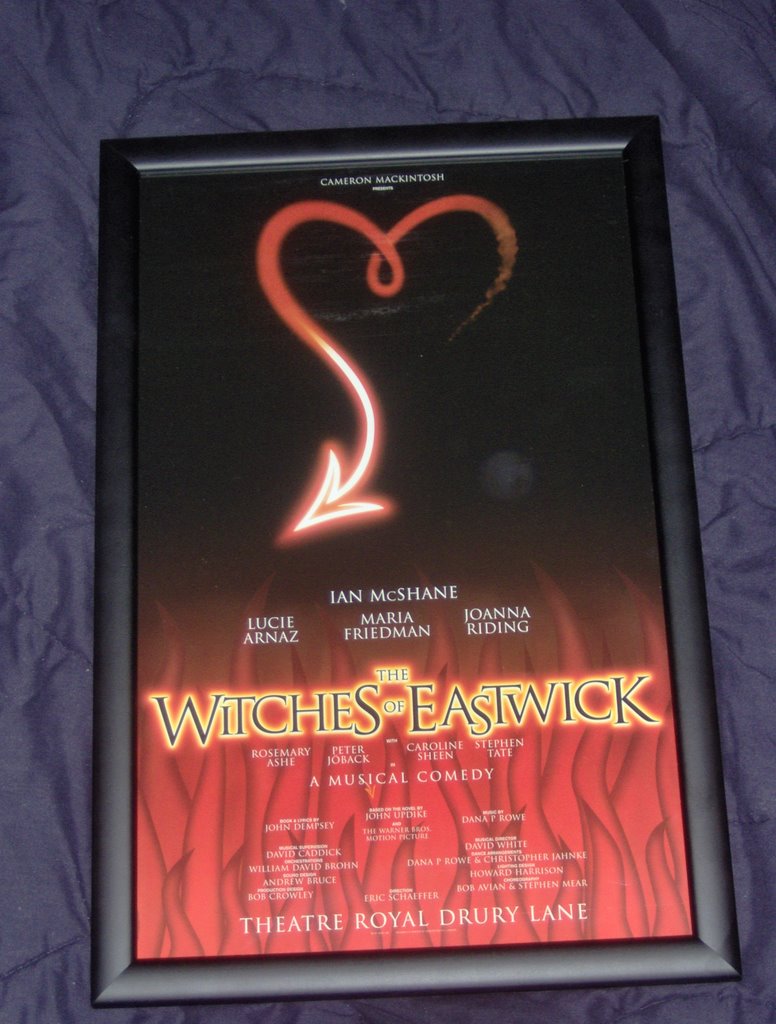
The good news is that because Signature has to juggle its lineup, it has added "The Witches of Eastwick," a musical from producer Cameron Mackintosh that was given a splashy production in London but is being reworked as a more intimate show for Signature.

This article -- and the subsequent news release I received from Signature -- reminded me that I had reviewed the original London production of The Witches of Eastwick just over five years ago, in February 2001. I had spent a couple of days in London in transit from Tel Aviv to Washington, and saw as many shows as I could in a short period of time. Witches was one of them.

The best way to sum up what I thought of Witches is this: Great production of mediocre material. We'll see whether Eric Schaeffer can get the material improved in time for the U.S. premiere next season.

For what it's worth, here is my review of the West End musical, The Witches of Eastwick, along with two other shows from that season, Merrily We Roll Along and Madame Melville, as it appeared in The Metro Herald on March 2, 2001. (There is a temptation, whenever I repost articles like this, to tweak them a bit, change some awkward language, rephrase a sentence or two, or reflect subsequent events. I avoid that temptation because I think it is important to archive these documents as they actually were rather than to alter history -- even though I doubt I could be caught at it.)

OUR MAN RICK CHECKS OUT THE LONDON THEATRE SCENE!

Rick Sincere, our Entertainment Editor, has just returned from across the pond where he checked out three productions currently being staged and presents is reviews for those of you headed for merry olde England. Enjoy, old chaps!

When Failure Rises to Perfection:
Merrily We Roll Along at the Donmar Warehouse


It can be said – though some will disagree – that even Stephen Sondheim’s failures as a composer and lyricist are superior to the best work of his contemporaries.

So what can we say about a flawless production of one of those failures? We have, perhaps, two options: one is to close our eyes and swallow, as if to take a mental picture of this impeccable moment; the other is to swallow poison, for after it is over, there is nothing left to live for.

Let’s hope we take the first option, because there’s always an opportunity for an encore, or perhaps a cast album that can later and forever act as a madeleine to bring back, to our minds, that perfect moment in time.

Such is the situation presented us at the Donmar Warehouse Theatre in London, where Merrily We Roll Along, Stephen Sondheim and George Furth’s 1980 flop, has been in performance since December 1 and, sadly, closes today, March 3.

Designer Christopher Oram has created the perfect set for this show. In contrast to the “big” musicals in the nearby West End, Merrily We Roll Along is the height of simplicity in its design, emphasizing the words and the music. The show is played on a plain, mostly flat stage of blond wood with white highlights – window frames, curtains. The lighting, designed by Tim Mitchell, is stark and mostly white – a potentially disastrous combination in so intimate a space. The actors perform within only a few feet of the audience, as the Donmar is a small theatre, only slightly larger than Arlington’s Signature Theatre.

In common with Signature is Donmar’s reputation for presenting Sondheim shows of the highest quality – the theatre’s first production was the British premiere of Assassins – as well as recent revivals of Company and Into the Woods. Donmar’s artistic director, Sam Mendes, has been honored for such productions as Cabaret and last year won an Academy Award™ for his film debut as a director, American Beauty.

For Merrily We Roll Along, director Michael Grandage has assembled a youthful cast that, in many ways, returns the show to its original concept, as envisioned by director Harold Prince, who was unable to make it work. The concept was this: A show cast entirely of teenagers and young 20-somethings, many with no previous experience on Broadway. The original production brought Jason Alexander his first major role, for instance.

For various reasons, Prince was unable to fulfill his vision, and the original production of Merrily We Roll Along lasted just 16 performances on Broadway. (At the Donmar, I sat in front of a man who told me he saw the original not once, but three times – a rarity, and a lucky one.)

Grandage seems to have overcome the problems Prince stumbled over. Subsequent productions – including the reworked, rewritten revival at Arena Stage in 1990 – have cast grown-ups in the major roles. (Arena’s Douglas Wager cast veterans Victor Garber as Franklin Shepard and David Garrison as Charley Kringas, to name two parts played by well-known “adult” actors.)

Donmar’s production largely goes back to the original work, reinstating the high-school graduation bookends that were eliminated at Arena, with the exception of two interpolated songs from Sondheim’s 1990 rewrite – “Growing Up,” which sounds like a trunk song left over from Sunday in the Park with George, and “The Blob,” which fits in better with the rest of the score.

Grandage’s cast is filled with youthful exuberance, something aided, no doubt, by Peter Darling’s exhilarating choreography. The dance numbers have the raw, fresh feel of Darling’s choreography for the hit movie Billy Elliot. It is happy and heartfelt.

And where to begin in describing this youthful cast? One place to start is Julian Ovenden, the Young Franklin Shepard. True to Hal Prince’s concept, Ovenden essentially has no résumé – just one professional credit before this one. An unknown in the lead? Yes, and what a find! Grandage has discovered a star, a young man with stage presence, musical ability (he sings and plays piano), personal charm, and movie-idol good looks. We will be hearing from him again.

As Frank’s collaborator, Charley Kringas, Daniel Evans has already been honored with an Olivier Award nomination for best actor in a musical. He certainly deserves it, if only for his stand-out number, “Franklin Shepard, Inc.,” in which he goes quite mad in the middle of a live television interview. Washington theatregoers who see Evans might be startled by his remarkable resemblance, in looks and demeanor, to local actor Jason Gilbert.

Also nominated for an Olivier (as best actress in a musical) is Samantha Spiro as Mary Flynn, Frank and Charley’s “old friend.” Spiro plays Mary’s transformation, from youthful-optimist-aspiring-writer to hard-bitten-cynical-film-critic with just about as much fine-tuning as can be imagined. And she plays this tranformation backwards, just like the others.

The rest of the cast is similarly gifted, and much credit must also go to dialect coach Jeanette Nelson, who has taught all these “kids” to speak with believable, authentic American accents.

There’s more: Sondheim’s longtime musical collaborator, Jonathan Tunick, has created new orchestrations for Merrily We Roll Along, fitting for a smaller ensemble in a smaller space. What genius it was for Donmar to go to the original orchestrator to adapt his own work. Brilliant, just brilliant.

If this review seems like breathless cheerleading, it’s because it is, in part. Merrily We Roll Along has been my favorite Sondheim show since I saw the first college production at Catholic University almost 20 years ago. To be sure, if Donmar did a bad job with it, I would tell you so in unmistakable terms.

While the score of Merrily may lack the depth of Sweeney Todd or the sophistication of Passion or the delicacy of Sunday in the Park with George, it is, for Sondheim, unusually accessible. He does here what he seems to decry here: He creates “hum-hum-hummable” melodies. At the same time, the Greek chorus commenting on the action, the reprises prefiguring (in real time) the main songs, the interplay of themes and variations – all these things combine for an intellectually rigorous, challenging score. It is memorable, it is true.

While some have criticized Furth’s book as being weak, it certainly does not seem so at Donmar. While the premise may seem strange – following a group of friends backwards in time to see their transformation from “good” to “bad” – it definitely works. In terms of the way time travels in it, it’s no different than Harold Pinter’s Betrayal. Thematically, it succeeds where Sondheim’s mentor, Oscar Hammerstein II, failed with Allegro.

Donmar’s next production is the London premiere of David Mamet’s new play, Boston Marriage. Previews begin March 8, continuing through April 14. The Donmar Warehouse is located at 41 Earlham Street, London WC2, near the Covent Garden and Leicester Square Tube stations.

For ticket information: 011-44-207-369-1732.

Entertaining But Empty: The Witches of Eastwick in London

London, England — The problem with The Witches of Eastwick is that it has nothing new to say.

The story, about a stranger who upends a small middle American town, is familiar to anyone who has seen Bye, Bye Birdie – and the use of telephones in a “gossip” song is straight from that 1960s hit. And how often have we seen a Mrs. Grundyish matron get her comeuppance from the more “with-it” characters in a play? The cartoonish sets and costumes seem to come from the closets of the designers of Des McAnuff’s revival of How to Succeed in Business Without Really Trying a few years back.


And yet ... and yet ... director Eric Schaeffer, composer Dana P. Rowe, and lyricist/librettist John Dempsey have given us an evening of entertainment thta includes tuneful melodies, clever lyrics, fun-filled dances, and surprising special effects. If you’re looking for pure enjoyment at the theatre, The Witches of Eastwick is a good bet for you.

Based on the novel by John Updike and a Warner Brothers movie starring Jack Nicholson, The Witches of Eastwick tells the story of three women – Alexandra Spofford (Lucie Arnaz), Sukie Rougemont (Maria Friedman), and Jane Smart (Joanna Riding) – who are dissatisfied with their small-town, New England lives. Along comes Darryl van Horne (Ian McShane), who transforms their boredom into excitement and (quite literally) bedevils the town at the same time.

A cute, romantic subplot involves Alexandra’s son, Michael (Peter Jöback), and Jennifer Gabriel (Caroline Sheen), daughter of the town busybody, Felicia (Rosemary Ashe) and her milquetoast husband, newspaper publisher Clyde (Stephen Tate).

The strengths in the show lie in the exquisite sets by Tony®- and Olivier-award-winning Bob Crowley (cartoonish they might be, but also exciting), energetic dancing (choreographed by Broadway veteran Bob Avian and Stephen Mear), and first-rate performances by the principals, particularly McShane and the trio of Arnaz, Friedman, and Riding. Swedish teen idol Jöback also stands out, and his fans seem to be flocking to see him – the night I was at the Theatre Royal, Drury Lane, the audience was peppered with large numbers of Scandinavian tourists between the ages of 11 and 16.

If the plot were not so empty and predictable, The Witches of Eastwick would be a classic in the making. This shortcoming may explain why it is moving from Drury Lane to a much smaller theatre, the Prince of Wales, on March 23. The show’s predecessor at Drury Lane, Miss Saigon, played there continuously for more than ten years, and Sir Cameron Mackintosh, Lord Lloyd Webber, and the other producers no doubt hoped for a repeat of that record with Witches.

Because of its sheer entertainment value, we can probably count on The Witches of Eastwick to have a long run in London, and it is likely to come to New York before too long, as well.

Sweet Memories of Youth:
Madame Melville and Macaulay’s West End Debut

The wonder of London theatre is that one can go, from day to day, from a huge megahit like Starlight Express or The Witches of Eastwick to a perfection-laden, relatively intimate musical like Merrily We Roll Along to a finely-drawn, three-person play like Madame Melville – all within the same price range, all within the same general neighborhood that allows one to walk from marquee to marquee in search of the day’s entertainment.

Richard Nelson is an American playwright better known in England than he is at home, and his work reflects this fact. Most of his plays involve foreigners set in a country not their own and Madame Melville is no exception.


The narrator, and focal character, in Madame Melville is Carl, who presents himself at the outset as a middle-aged American, looking back on an episode in his life at the age of 15, when he was a reluctant transplant (with his parents) in the Paris of 1966. A shy student, he finds himself in the orbit of Madame Melville, a thirty-something literature teacher who takes groups of students to the cinema on Friday nights, and to her flat afterwards for drinks and discussion.

One night Carl (played by Macaulay Culkin, in his West End debut) is left behind by the other students, and discovers he is alone with Madame Melville (Irène Jacob). It is late, and before too long he has missed the last Metro. Unable to get home to his parents, he spends the night ... at first on the sofa, but soon in his teacher’s own bed. She seduces him, and he falls in love.

The affair lasts only through the weekend, though. The next day we meet Madame (really, we learn, Mademoiselle) Melville’s American neighbor, Ruthie (Madeleine Potter), who approves of the budding relationship. (She is, after all, a rather bohemian violinist and violin instructor.) The bliss comes to a sudden end, and in a coda Carl reveals what happens to him and his beloved teacher.

Culkin is surprisingly good in this role. Those who think of him as the mischievous child of the Home Alone movies will be in for a treat. He expresses a range of emotions, and he seems not to be limited by his training in film work, adapting well to the stage and to the necessities of connecting with a live audience.

Jacob is luminous. She’s any 15-year-old boy’s dream of a favorite teacher. The role she plays is fraught with dangers. If she camps it up too much, she might as well be playing Mrs. Robinson in The Graduate up the street. If she stiffens and formalizes too much, she loses her appeal. Jacob walks a fine line successfully.

Potter, for her part, brings a necessary lightness to what, if it were a two-character play, would quickly become cloying and claustrophobic. Ruthie is the world beyond, the recognition that Carl will have a life that simply begins – not ends – in Madame Melville’s flat.

Watching the play, I was struck by the fact that, if the roles were reversed – if the characters were Monsieur Melville and Carla, or if both characters were male – the outcry against this play would be heard from both sides of the Atlantic. There’s some kind of double standard at work that allows men to remember fondly their initiation into sex by an older woman, but not if the pupil is female and the teacher is male.

Oddly enough, at the matinee performance I attended, a school group of English teenagers was in the audience. I wasn’t able to observe the girls, but the boys in the group seemed to have a special appreciation for the show. One wonders if their teachers had a full understanding of the plot they would be seeing.

Richard Nelson – who directs his own script – has done an excellent job in bringing together a cast that has real chemistry. Three-character, drawing-room dramas can be very intense. Nelson leavens the drama with appropriate humor, and Culkin’s introspective, innocent charm carries the play far.

Madame Melville is a pleasant entertainment that also will leave you thinking.

Madame Melville closes in London (now at the Vaudeville Theatre) on March 11, but it transfers to Broadway in April. The Metro Herald was among the first to learn that on April 23, Madame Melville will open at the Promenade Theatre in New York.

Postscript: Daniel Evans and Samantha Spiro did end up winning Olivier Awards that year for their roles in Merrily We Roll Along, which also won the prize for best musical (beating out The Witches of Eastwick). I subsequently was told, by someone who was in a position to know, that Stephen Sondheim did not like the Donmar Warehouse production of Merrily, despite its success and acclaim. The Witches of Eastwick has not yet had a New York premiere, but Macaulay Culkin received a Theatre World award for his performance in Madame Melville off-Broadway. Michael Grandage, who directed Merrily, also directed the Donmar production of Guys and Dolls that I saw in the West End last month.

Kennedy Center Spring Gala - Part 2

Shortly after returning home from the Kennedy Center Spring Gala, I posted some photographs from the event.

What I did not do was write much about the substance of the evening, which centers on a performance preceded by a reception and dinner and followed by a reception and dancing.

Here is my review of the performance, as prepared for The Metro Herald. (I expect this article to appear in today's edition.):

Kennedy Center Celebrates 35 Years with Gala Fundraiser
Rick Sincere
Metro Herald Entertainment Editor

(WASHINGTON) — The John F. Kennedy Center for the Performing Arts marked its 35th anniversary on May 7 with a gala banquet, performance, and reception. Hundreds of people packed the Center’s corridors and the Concert Hall to celebrate along with the stars of past, present, and future.

Looking back on the Kennedy Center’s beginnings, with the passage of the National Cultural Center Act in 1958, to the present, the gala performance was directed by Marvin Hamlisch, the principal conductor of the National Symphony Orchestra Pops.

The first segment featured the Preservation Hall Jazz Band, joined by the Master Chorale of Washington and the NSO Pops, who played a rousing rendition of “When the Saints Go Marching In,” which energized the crowd. The song featured Mardi Gras-style dancers and was introduced by Brandon Ridenour, a third-year trumpet student from Juilliard and a rising star in the world of brass music.

Calling the Kennedy Center as a “wondrous national jewel,” the gala’s honorary chair, Tony-winning actress Angela Lansbury, was brought on stage to the melody of “Not While I’m Around,” from Stephen Sondheim’s 1979 musical Sweeney Todd. (Later in the show, Lansbury recreated her performance of “A Little Priest,” with co-star George Hearn. The pair appeared at the Kennedy Center in the national company of Sweeney Todd in 1980.)

Lansbury noted that the Kennedy Center runs the largest performing arts education program in the world, reaching some 11 million children last year. Referring to the early plans for what became known as the Kennedy Center, Lansbury said we should “be proud that the dream has been fulfilled.”

Hamlisch put together a section of the program that remembered the 2002 Sondheim Celebration. He noted that Ben Brantley of the New York Times called that series of performances “Eden in Washington” and that Entertainment Weekly said it was “the most important theatrical event of the year.” Hamlisch then conducted the NSO Pops in a medley of “The Tale of Sweeney Todd” and “You Must Meet My Wife” (from A Little Night Music) – both songs, perhaps coincidentally, introduced by Len Cariou, who last appeared at the Kennedy Center in Neil Simon’s The Dinner Party.

The medley was followed by Judy Collins singing “Send in the Clowns,” perhaps Sondheim’s only Top Ten hit, which she made famous in her 1974 recording. Hamlisch spoke for the audience when he said of Collins’ performance, “That’s a thrill, that’s just a thrill.”

The Sondheim segment was topped off with “A Little Priest,” a macabre song about serving up meat pies made with human flesh. Kennedy Center chairman Steven Schwartzman quipped afterwards that “neither Angela Lansbury nor George Hearn will be allowed near the Roof Terrace kitchen.”

In his own remarks for the occasion, Schwartzman called the Kennedy Center a “national repository for the human spirit.” He revealed that the gala had raised over $2.8 million in support of the performing arts and arts education. “That is a record,” he said.

In addition to thanking the gala’s co-chairs and the various individuals, corporations, and foundations that had contributed to the event’s success, he thanked the Veterans for National Security Foundation, which had made available dozens of tickets for members of the armed forces who have recently returned from overseas duty. When he asked the uniformed service members to rise and be recognized, the entire Concert Hall erupted in a standing ovation.

Introducing a short film about competitive ballroom dancing in New York public schools (excerpted from the documentary, Mad Hot Ballroom), Lansbury spoke of the “transformative power of the arts” and how “the arts reveal the human spirit in the most unlikely places.” When the kids from Mad Hot Ballroom took the stage and showed what they had learned, the audience went wild.

Even with the presence of such celebrities as opera singer Harolyn Blackwell, who performed an aria from Carmen Jones, violin virtuoso Sarah Chang, and not one but three Broadway actors who have played Jean Valjean in Les Miserables, among all the others mentioned, the plucky kids from Mad Hot Ballroom surely made the Kennedy Center’s 2006 Gala a night that will be remembered for years to come.

Tuesday, May 16, 2006

And Slavery Is Freedom, Too ...

An article in this week's C-VILLE about a recent meeting of left-wingers (their term, not mine -- they call themselves "Left of Center") to discuss "affordable housing" (an issue I have previously addressed in Economics 101 terms that seem beyond the ken of the discussants) has this paragraph about local neighborhood activist Joy Johnson:

“Housing is a right,” said Joy Johnson, a panelist and herself a beneficiary of public housing. As she explains it, she relies on her publicly funded residence to keep her from having “to depend on a man or the system to take care of my family. It allows me to be independent.”
Johnson gives a new meaning to "independent" that would make George Orwell blanch. As a "beneficiary of public housing," Johnson is, in fact, dependent on the taxpayers, who pay a good portion of the market value of her rent. Only in the lexicon of the loony left can "dependency" be synonymous with "independence."

The fact that people like Johnson suck on the public teat as a means to subsidize their lifestyle choices does not make them "independent" -- it makes them infantile.

In other "affordable housing" news, the executive director of the Free Enterprise Forum was on WVTF-FM's "Evening Edition" tonight, to discuss that group's new report on housing in Albemarle County. Neil Williamson said that the report, called "Locked Out: The Impact of Local Regulation on Affordable Housing," argues that land-use and other regulations have driven up the cost of housing in suburban Charlottesville.

According to a news release summarizing the report's findings:
Albemarle County ranks lowest in housing affordability in the Metropolitan Statistical Area (MSA) according to a new report issued today by The Free Enterprise Forum. The “Locked Out” report finds that just 16% of Albemarle homes are available to families earning median income. The report also finds Albemarle County has the largest planning department staff, the largest comprehensive plan and the longest approval time for subdivisions. Fluvanna County had the highest percentage of homes available to families earning median income.

Underwritten by The Charlottesville Regional Chamber of Commerce and Hi-Tech Signs, the “Locked Out” report seeks to identify existing regulatory barriers and encourage an open cost/benefit analysis between regulation and affordability. The report includes an analysis of new urbanist design regulations, growth boundaries and their impact on land use patterns.

“Hopefully this report is the start of a new dialog with all the municipalities regarding their regulatory environments and its impact on housing affordability”, said Free Enterprise Forum Executive Director, Neil Williamson, “Median income workers in Detroit, Atlanta, Dallas and Houston have a better opportunity for homeownership than here in our region”.
That news release includes an interesting and informative graphic. (You'll have to open it in a new window to be able to read it properly.) It compares housing costs in the Charlottesville area to major metropolitan areas:

The Free Enterprise Forum study merely reiterates what we have known for a long time -- restrictions, whether of land use or of other sorts, drive up costs and therefore the prices available to the consumer.

For instance, a 2002 report in the Journal of Real Estate Research found (according to a summary by the Reason Public Policy Institute):
According to the authors, the results suggest that local growth restrictions impede housing growth and lead to a larger appreciation in housing prices. This research also supports decades of scholarly research showing that growth controls can reduce housing affordability if they increase housing costs and limit the supply of land available for new housing units.
One of the favorite suggestions by "smart growth" advocates -- in Albemarle County and elsewhere -- is that local governments should encourage infill development.

Chris Fiscelli, a research fellow in the Urban Futures Program at the Reason Public Policy Institute, wrote about this topic in a 2003 article:
Smart growth and the buzzwords that accompany it are swarming our neighborhoods - sustainable development, viable communities, healthy neighborhoods, and infill development are just some of the terms of choice for planners and politicians these days.

Infill housing, promoted by a new California law, is a process where vacant sites located closer to established, developed areas receive preferential treatment for development than sites not located as close to historical city centers. Infill housing is supposed to increase density, promote affordable housing closer to jobs, preserve open space, reduce traffic congestion, and improve the environment. It doesn't. An examination reveals this policy actually exacerbates many of the aforementioned problems and does very little to alleviate the others. . . .

Simultaneously, relatively cheap land on the urban fringe remains vacant-land that could be developed to allow subsidy-free homeownership opportunities for families with low to moderate incomes. It is clear that promoting infill rental housing over "for-sale" housing located on the urban perimeter is a more expensive alternative to society and hurts overall long-term housing affordability.

The traffic congestion and air quality benefits of infill housing, touted by smart growth advocates, are also based on misconceptions. The underlying assumption is that as densities increase, residents will reduce their driving and walk and use transit for their trips. This belief has little grounding in reality. With the exception of places with very high densities such as the downtowns of New York City, Boston, Chicago, and San Francisco, increased density does not force people out of their cars. Since most markets will not bear densities high enough to induce the switch to mass transit, it is unlikely people will be leaving their cars at home. Witness Los Angeles; it is the one of the densest metropolitan areas in the country, but has very low transit use.

Since infill housing won't increase transit use, the increased density will actually increase traffic congestion as more drivers use the same amount of roadway. And that also means increased air pollution since vehicles emit more gases when traveling at slow speeds in stop-and-go traffic.
Dr. Samuel Staley, a member of the Board of Scholars for the Virginia Institute for Public Policy and director of RPPI's Urban Futures Program, summed up the problems with "smart growth" as a response to the lack of affordable housing in an article he wrote for the Virginia Institute in 2002:
Virginians need to think outside the box. As incomes rise and consumer housing preferences become more and more diverse, real-estate markets need flexibility and room to adapt. Conventional planning is incapable of achieving this. The seemingly endless stream of public hearings, micromanagement of site plans, and special-interest opposition to new development creates a cumbersome, costly, and highly uncertain approval process. This process does more to stifle housing innovation than promote it.
The most fundamental problem with "smart growth" and urban planning, in general, is that it assumes too much knowledge on the part of planners. The late Jane Jacobs and Friedrich Hayek, among other freedom-oriented thinkers, taught us decades ago that the market, with its diffusion of knowledge and communication through the price mechanism, is the best and most reliable "planner" we have available.

Prelude to the Tony Awards

When the nominations for the Tony Awards were announced today, I recognized the names of composer Matthew Sklar and lyricist Chad Beguelin, who received a nod for their work on The Wedding Singer, a musical based on the 1998 Adam Sandler movie of the same name.

I remembered the names as the creators of a 2000 musical that had its premiere at Signature Theatre in Arlington, but never made it to Broadway (despite their hopes and my prediction): The Rhythm Club, set in 1938 Germany.

Speaking to Playbill, composer Sklar gave his reaction to the news of being nominated for best score of a musical:

"I was just at home sitting on my couch watching NY1. When they read the score nomination, I let out a little scream. Well, actually a big scream. I wanted to be nice to my neighbors. Then my friends and family started calling. It meant so much for our show that we get recognized. We got five nominations in five big categories. It feels amazing. I'm sort of at a loss for words. It's been a dream of mine for a long time. We'll get to do a number on the Tony telecast."
I haven't yet seen The Wedding Singer (neither play nor movie), but here is my review of Sklar and Beguelin's earlier musical play, The Rhythm Club, as it appeared in The Metro Herald on October 13, 2000:
The Rhythm Club: Waiting for the Explosion
Rick Sincere
Metro Herald Entertainment Editor

The Rhythm Club is a firecracker ready to explode – yet some of its powder is just a bit damp. A work in progress that still needs some tweaking, it already provides an evening of great music, fine choreography, and evocative design. With some minor improvements, it will be a powerful piece of musical drama and a potential classic.

On its way to Broadway, The Rhythm Club has the potential to be for Signature Theatre what The Great White Hope was for the Arena Stage. That is, it could permanently set this small regional company into the firmament of theatrical trendsetters.

The Rhythm Club continues what seems to be Signature’s recent affinity for – or is it fascination with – musicals set in the 1920s and ‘30s. Last year’s Floyd Collins was about events in 1924 Kentucky; and Side Show recreated Depression-era vaudeville. Later this season, Donna Migliaccio will play Mama Rose in Gypsy, also from the same period. And here The Rhythm Club, although not about America, gives us Nazi Germany: Hamburg, 1938.

If nothing else, this affinity gives Signature’s costume designers a wonderful opportunity: Gregg Barnes’ costumes in The Rhythm Club are marvelous. Each piece of clothing not only represents a unique period in history, it supports and enhances the character who wears it.

The Rhythm Club
treads on ground already covered, as a musical, by Cabaret, and in terms of storyline by the movie, Swing Kids. The main characters are adolescents who rebel against Nazi authority by listening to, performing, and dancing to forbidden music – the swing music of Benny Goodman, Artie Shaw, Glenn Miller, and others, as well as the pure jazz of Louis Armstrong and the hybrid sounds of Duke Ellington and Count Basie.

Why was this music forbidden? The Nazis saw it as “Negro music performed by Jews – a double whammy in that racially-based legal system. But the impetus for such control goes back much farther. In The Republic, Plato (speaking as Socrates) said that “the introduction of a new kind of music must be shunned as imperiling the whole state; since styles of music are never disturbed without affecting the most important political institutions,” adding: “It is here in music that our guardians should erect their guardhouse.” To this, Socrates’ colleague Adeimantus replied: “At any rate it is here that lawlessness easily creeps in unawares.” If nothing else, Hitler understood what the ancient Greeks did: by control of music and art, the state can also control the minds and souls of the people.

Enter two friends, Jake and Adam (Jeremy Kushnier and Tim Martin Gleason). Adam is a composer who absorbs the works of the American swingmasters. Jake is a conductor who admires their zest and celebrity. Together, they have put together a small ensemble and even have persuaded a classically trained singer, Petra (Lauren Kennedy), to front for their band. With the assistance of manager Greta (Megan Lawrence), they persuade Gustav Hebert (Buz Mauro), the owner of the underground Rhythm Club, to let them play for his customers.

Jake and Adam meet with success. In the argot of swing, they ride and send like Satchmo. Their talents merit the attentions of the menacingly effete Herr Kroger (Jonathan Hogan), a Nazi official with connections to the music business in America. He offers them their ticket to stardom and out of the path of danger that Nazi Germany presents (particularly to Adam and his family, who are Jews) – or does he?

To go further in this synopsis would give away too much. At this point, let us be frank about The Rhythm Club’s shortcomings, then go on to its superlatives.

First, the backstory of The Rhythm Club has a number of holes in it. How, for instance, do the musicians in Jake and Adam’s band learn their stuff, aside from listening to smuggled acetates? They seem to rise sui generis, like some kind of Hamburg Howard Roark. While important bits of information about each character are revealed over time in the play, there are still questions that need answering. Perhaps a prologue could help, or some flashbacks.

Second, anyone can see the play’s ending from a mile away. I won’t reveal it now, but suffice it to say that a reasonable closing line could be something akin to “Round up the usual suspects.”

Third, the sound design (by Tony Angelini) in Signature’s space is seriously flawed. Particularly with some of the hotter numbers, it was difficult to hear the singers over the orchestra. This is one rare instance in which body microphones would have been helpful. (Signature used them for The Fix, so the intimate staging alone does not explain their absence here.)

That said, one cannot praise highly enough The Rhythm Club’s music and dancing. Just as Stephen Sondheim filled his Follies with pastiches of the music from the Broadway revues of the 1920s and ‘30s, composer Matthew Sklar and lyricist Chad Beguelin emulate – not imitate, but emulate – the various musical styles of the great swing bands. Much credit for this must go to orchestrator Don Sebesky (fresh from winning a Tony Award© for the revival of Kiss Me, Kate) and music director Robert Billig. Particularly given the small size of the orchestra – only seven pieces – it is astounding that they wereable to recreate so accurately the sound of the era. Some numbers evoked Artie Shaw so accurately, one expected to see Lana Turner waiting in the wings. (Or is it Ava Gardner?)

Sklar and Beguelin and their collaborators successfully evoke the sometimes unique, sometimes overlapping musical styles of the 1930s. (“Up in Heaven They Play Swing,” which becomes something of a theme for the show, sounds remarkably like Jimmy Lunsford.) The other, “Broadway” tunes are not so remarkable, but they bear echoes of Sondheim (“Inside the Music”) and Kander & Ebb (“They Taught Me Well,” sung by mothers Florence Lacey and Barbara Walsh, is virtually a duet version of “What Would You Do?” from Cabaret).

Integrated with the music is what really makes The Rhythm Club shine: the choreography by Jodi Moccia. Although the show comes a few years late to capitalize on the swing dancing craze of the mid-1990s (and the remarkable TV ads for The Gap), Moccia pulls out every trick in her leotard to make the joint jump.

Altogether, director Eric Schaeffer has pulled together a visually brilliant, musically inventive production.

A prediction: The Rhythm Club will be a modest success on Broadway, but a huge hit when it arrives in London’s West End.

Monday, May 15, 2006

New Virginia Blog Carnival

The latest installment in the weekly Virginia Blog Carnival series is up at The Jefferson Mammoth. Nickfinity does a terrific job in excerpting and summarizing this week's entries, including my photoblog of the Kennedy Center Spring Gala.

Other topics he highlights from around the Commonwealth include the arts in Richmond, alternative fuels, bipartisanship in Virginia politics, priorities for the next election cycle, legislative redistricting, gay marriage, and a recipe for baked ziti.

Saturday, May 13, 2006

'An Absolute Right'

In a Washington Times article today about the bloody, unfortunate killing of one Fairfax County police officer and the serious wounding of another in a shoot-out with an 18-year-old last week, longtime Fairfax County Commonwealth's Attorney Robert F. Horan, Jr., was quoted as saying:

"That's America. You have an absolute, unqualified constitutional right not to talk to police if you don't want to."
This quotation should be emblazoned in every high school civics textbook. We have to remember, the Bill of Rights is for everyone, not just those who were smart enought to be paying attention in class.

No one should ever submit to interrogation by law enforcement officials without first insisting that an attorney be present, and no one should ever say a word until that attorney arrives. When the police read a suspect his Miranda rights, they are not kidding when they repeat "Anything you say will be used against you in a court of law."

Young Alan Newsom and his parents learned that at their peril, since he was convicted of a serious crime solely on the basis of a statement he made to police without an attorney present. As reported last week in The Hook,
Attorney Bill Hicks has insisted his 15-year-old client was convicted solely on his statement to police, which took place without legal counsel or his parents, an interrogation so stressful that the boy "would have confessed to the Kennedy assassination," his father says.
The Fourth and Fifth Amendments are there for the protection of all of us, guilty and innocent alike. The Founding Fathers did not put them in the Constitution for cosmetic reasons. The Fairfax Commonwealth's Attorney knows this; I'm not so sure about prosecutors and ex-prosecutors elsewhere in the state.