Showing posts with label Waldo Jaquith. Show all posts

Thursday, December 14, 2006

But I'm a Carnivore!

An article from WorldNetDaily that asserts soy-based food products cause homosexuality -- tofu in particular -- is taking a beating in the blogosphere. When I sent a copy of the article to a group of friends, the first response I got was: "This has got to be satire."

Sadly, it's not.

Still, one might get the impression from its headline that the article originates from The Onion: "A devil food is turning our kids into homosexuals." I should say, from the original headline when it was first posted on line. The editors at WND must have caught wind of what a laughingstock the piece is and they have since changed the headline to read "Soy is making kids 'gay'." Not much better, but somewhat less diabolical.

Written not by a physician or nutritionist or any sort of scientist, but rather by James Rutz, a self-appointed minister at "Megashift Ministries" (which sounds like the name of a 1970s-era gay bar), the opinion piece makes some astounding claims:

The dangerous food I'm speaking of is soy. Soybean products are feminizing, and they're all over the place. You can hardly escape them anymore.

I have nothing against an occasional soy snack. Soy is nutritious and contains lots of good things. Unfortunately, when you eat or drink a lot of soy stuff, you're also getting substantial quantities of estrogens.

Estrogens are female hormones. If you're a woman, you're flooding your system with a substance it can't handle in surplus. If you're a man, you're suppressing your masculinity and stimulating your "female side," physically and mentally....

Soy is feminizing, and commonly leads to a decrease in the size of the penis, sexual confusion and homosexuality. That's why most of the medical (not socio-spiritual) blame for today's rise in homosexuality must fall upon the rise in soy formula and other soy products. (Most babies are bottle-fed during some part of their infancy, and one-fourth of them are getting soy milk!) Homosexuals often argue that their homosexuality is inborn because "I can't remember a time when I wasn't homosexual." No, homosexuality is always deviant. But now many of them can truthfully say that they can't remember a time when excess estrogen wasn't influencing them.
Rutz ends on a somewhat hopeful note, for those of us who frequent Asian restaurants:
Soy sauce is fine. Unlike soy milk, it's perfectly safe because it's fermented, which changes its molecular structure. Miso, natto and tempeh are also OK, but avoid tofu.
I do avoid tofu, not because it's "feminizing," but because it's unappetizing.

Real scientists have already debunked Rutz's ridiculous ramblings. Vivian Paige points to a rebuttal (if I can call it that -- a rebuttal should be reserved to reply to an authentic argument) at Science Blogs that says, in reference to Rutz's assertions about delayed menarche in girls and puberty in boys, that
I searched PubMed, and there's nothing on soy and menarche or menstruation; I found a few articles on soy and puberty, and they say things like "The literature offers no evidence of endocrine effects in humans from infant consumption of modern soy-based formulas" and "To date, no adverse effects of short- or long-term use of soy proteins have been observed in humans and exposure to soy-based infant formulas does not appear to lead to different reproductive outcomes than exposure to cow milk formulas" and "Available evidence from adult human and infant populations indicates that dietary isoflavones in soy infant formulas do not adversely affect human growth, development, or reproduction." There are many more papers on its putative effects on breast cancer and the symptoms of menopause, and even there it's a study in ambiguity: some reports of slight positive effects, many more stating that there isn't a detectable effect.

There doesn't seem to be any strong evidence that eating tofu will turn your sons into girlie-boys, I'm afraid; there are better grounds to be concerned about known endocrine disruptors like atrazine and PCBs.
Andrew Sullivan, meanwhile, goes back to Alfred Kinsey himself to knock down Rutz's assertion that homosexual men have small genitalia. Quoting a 2004 article in the Archives of Sexual Behavior ("The Relation between Sexual Orientation and Penile Size") that examined a Kinsey survey of the 1940s, he says:
The relation between sexual orientation and penile dimensions in a large sample of men was studied. Subjects were 5,122 men interviewed by the Kinsey Institute for Research in Sex, Gender, and Reproduction from 1938 to 1963. They were dichotomously classified as either homosexual (n = 935) or heterosexual (n = 4187). Penile dimensions were assessed using five measures of penile length and circumference from Kinsey's original protocol. On all five measures, homosexual men reported larger penises than did heterosexual men. Explanations for these differences are discussed, including the possibility that these findings provide additional evidence that variations in prenatal hormonal levels (or other biological mechanisms affecting reproductive structures) affect sexual orientation development.
(I know I'm now going to be inundated with visits derived from Google hits for "penile size," "larger penises," "penile length," and "penile circumference." Those will be high on the list, along with "Jeremy Sumpter nude," "creationists circumcision," "granddad sex movies," and "Alex Trebek shirtless." I hope those readers stick around to read some more, but I digress ...)

Waldo Jaquith also got a nice discussion going on this topic, in which he makes the equally plausible claim that evangelical megachurches cause homosexuality (at least in their pastors).

Just when you think you've seen it all, now the third-graders will have a new name to tag their less-than-butch friends with: "tofu-eater!" (And when I say "third-graders," you know who I mean. And him, too.)

Monday, October 30, 2006

'I Want to Believe It'

Virginia Film Festival, 2006 -- Day Four:

The fourth (and final) day of the Virginia Film Festival was, for me, heavy on filmgoing and light on picture-taking.

The morning started out with Jesus Camp, a new documentary that is already getting some commercial distribution around the country. (It was playing at the Landmark E Street Cinema in D.C. a couple of weeks ago, when Tim Hulsey saw it.)

The film looks at a Pentecostal church that sponsors a summer camp for children. It focuses largely at the camp's director, youth minister Becky Fischer, and juxtaposes some political and theological points of view.

Before the film began, one of the discussants, English professor Mark Edmondson, asked how many people were "skipping church" to see this movie. I was one of three people who raised their hands, which might give you some sense of who was in the audience. (Sociologist Brad Wilcox also served on the panel, offering some perspicacious comments.)

I'll be writing more about Jesus Camp later, as I prepare my full report on the festival for The Metro Herald, but I want to note a couple of choice quotations from the film. Pastor Becky says that

Warlocks are the enemy of God. If [he had been around during] the Old Testament, Harry Potter would have been put to death.
Here's a message for Pastor Becky: Warlocks are imaginary. Harry Potter is fiction. In fact, Harry Potter is part of a sub-category of fiction called fantasy.

In another part of the film, 12-year-old Levi has a conversation with his mother in their home-school classroom, after viewing a video asserting the earth is just 6,000 years old:
Levi's Mom: "Science doesn't prove anything."
Levi: "I believe personally that Galileo made the right choice by giving up science for Christ."
E pur si muove!

The next two films on the schedule were on a double-bill at the Paramount: West Bank Story, which is a student film from the University of Southern California, and His People, a 1925 silent film about Jewish immigrants on the Lower East Side of Manhattan.

West Bank Story
is a 20-minute parody of West Side Story, a 1957 musical retelling of Shakespeare's Romeo and Juliet created by four gay Jews. In this version, the rival gangs work for two competing fast food restaurants, Kosher King and Hummus Hut. The music is mediocre and the lyrics are cheap, but the end result is a very funny send-up not just of West Side Story itself, but of musicals in general. Let me put it this way: As a parody of musicals, it's not at the level of South Park: Bigger, Longer, and Uncut, but for a student film, it has real merit.

His People is a more conventional story. Its focus is on the Cominsky family -- father David, who had been a scholar in Russia but now sells clothing from a pushcart; mother Rose, who sews the clothes he sells; elder son Morris, who is studious and becomes a lawyer; and younger son Sammy, who becomes a boxer.

The whole tale comes alive through vivid imagery -- I was surprised at the sophistication of the production design, given the era -- and the intertitles, which convey a sense of Yiddish (and Irish) dialect without becoming cloying or patronizing. It occurred to me that filmgoers of the 1920s would have been familiar with the syntax and rhythms of Yiddish dialect from vaudeville comics, so they could -- as I did -- hear that while reading the title cards.

His People featured live musical accompaniment by Donald Sosin and Joanna Seaton.

Moving over to Newcomb Hall, a packed house came to see the Volvo Adrenaline Film Project. Once again, I sat next to Waldo Jaquith (sans Amber, this time). It was his first time at the Adrenaline Film Project, in which ten teams of three people compete to win an Audience Award, Jury Prize, and Mentors' Award. Beau Bauman and Jeff Wadlow supervised the competition, as they have in the previous two years.

Each team had to make a film in a specific genre, such as film noir or Japanese horror, and each had to make sure to use a line of dialogue ("I want to believe it") and a prop (a squeeze bottle of Miracle Whip), both of which were related to the Virginia film festival theme of Revelations: Finding God at the Movies.

Jeff Wadlow said of the prop:
I got some weird looks when I bought 12 bottles of Miracle Whip at Giant. When I said it was for making a movie, I got even weirder looks.
The Mentors' Award, bestowed by Wadlow and Bauman to the team that has to overcome the most obstacles to deliver its film to the competition, went to "The Enchanted," a fantasy by Bernard Hankins, Jon Sharp, and Kevin Finnegan.

The Audience Award and Jury Prize both went to "Taste of Evil," a film noir by Ben Haslup, Brian Wimer, and Ruth Monton. (The jury was made up of Rita McClenny of the Virginia Film Office, film producer Ron Yerxa [Little Miss Sunshine], and NYU film historian Harry Chotiner.)

The final screening of the 2006 Virginia Film Festival was a film from Bhutan called Travellers and Magicians, which was remarkable in many ways -- not least of which is the Himalayan landscape that dominates the screen.

I'm still exhausted, and I didn't even have to hitchhike down a Himalayan road to get to where I am.

Sunday photos to be posted later. (Blogger is being temperamental.)

Friday, October 27, 2006

'Blessed Are the Cheesemakers'

Virginia Film Festival, 2006 -- Day One:


The 19th Virginia Film Festival opened Thursday night. The first film to be screened was Swedish Auto, which was made last year in Charlottesville. It was directed by one of our native sons, Derek Sieg, and produced by University of Virginia graduate Tyler Davidson.

Swedish Auto was not only made in Charlottesville, it was set here, as well. The story does not take place in some unnamed town. Charlottesville is mentioned and is present throughout, as are many of our city's landmarks, including the Rotunda and Lawn at the University of Virginia, Chap's Ice Cream, the Downtown Mall, and, most prominently, Mel's Cafe on West Main Street.

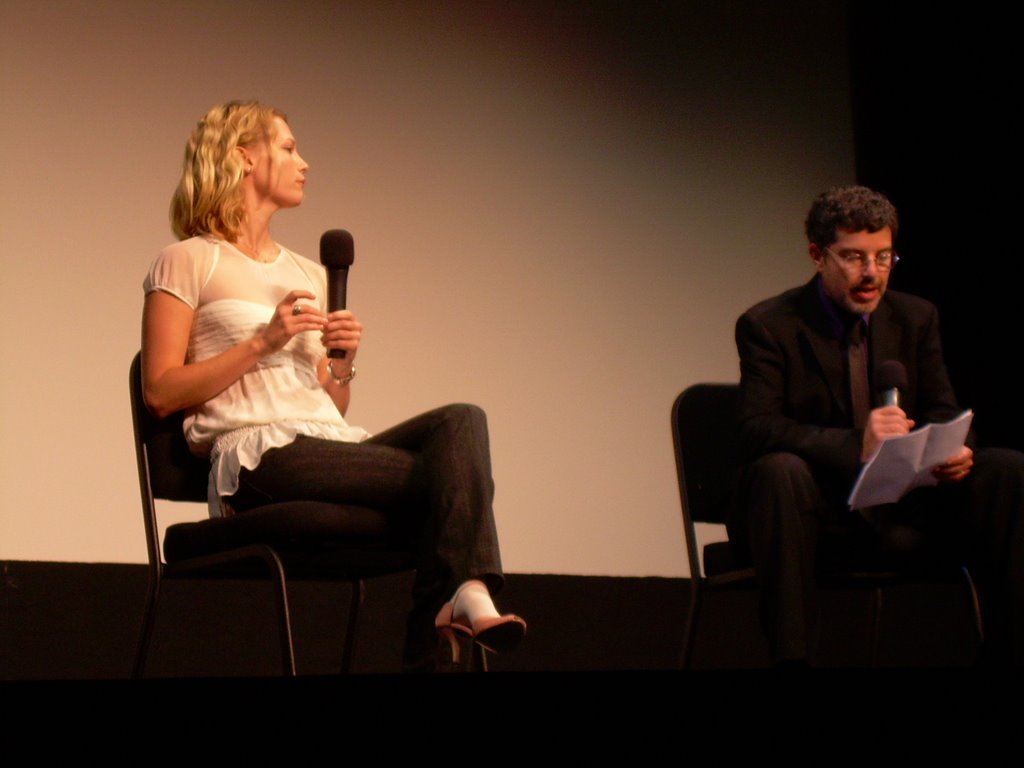
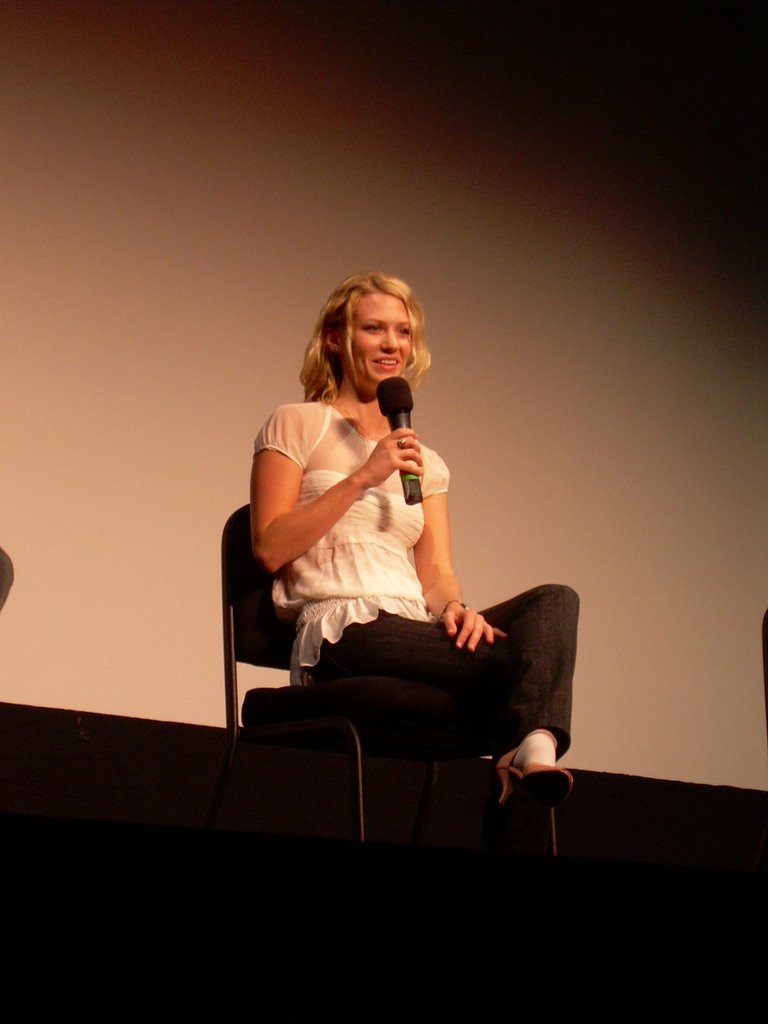
The screening of Swedish Auto -- which has not yet been released in theatres, but has had a good deal of success on the festival circuit -- featured a discussion with its director, Derek Sieg, and actress January Jones, on the stage of the Paramount Theatre. It was moderated by Virginia Film Festival Director Richard Herskowitz.


Derek Sieg, January Jones, and Richard Herskowitz


Derek Sieg and January Jones


January Jones


January Jones and Richard Herskowitz

* * *

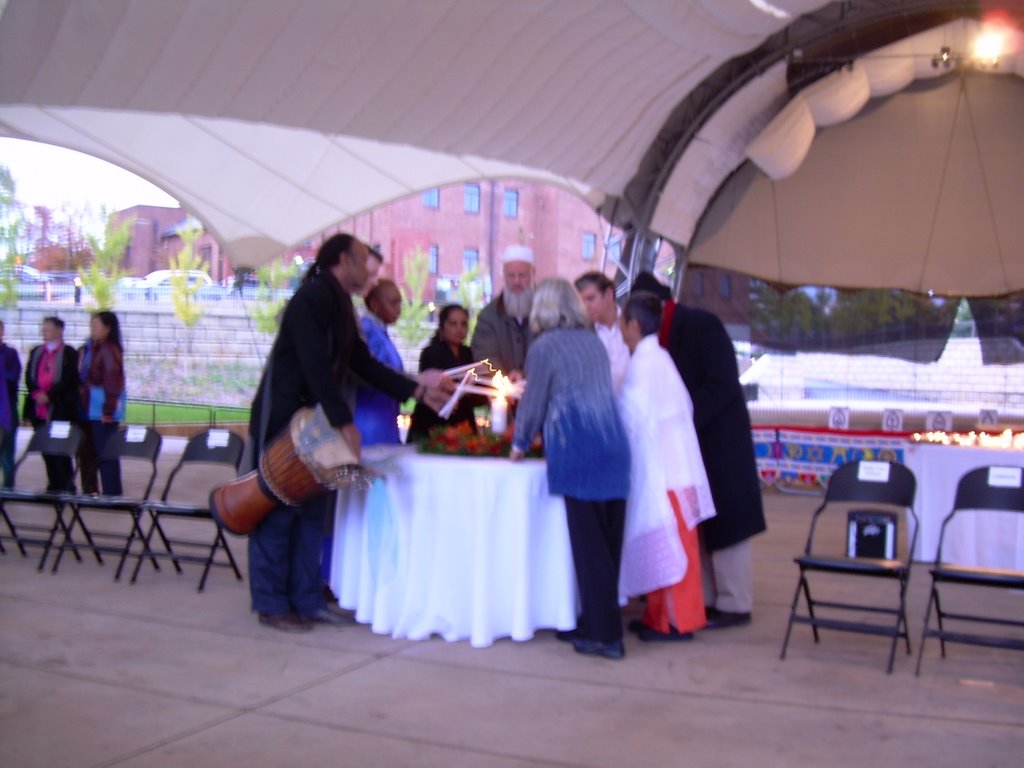
Earlier in the evening, at the Charlottesville Pavilion on the east end of the Downtown Mall, a small group gathered to celebrate various religious traditions and pray for peace. The multifaith ceremony was tied to the theme of the Virginia Film Festival, Revelations: Finding God at the Movies.


Charlottesville religious leaders light candles for peace

* * *

I closed the evening by attending a screening of Monty Python's Life of Brian. The venue was the Newcomb Hall Theatre on the grounds of the University of Virginia, so a large portion of the audience was made up of college students. (To my delight, I was joined for the show by Waldo Jaquith and his wife, Amber.)

Suffice it to say that this movie, which is almost 30 years old, is as relevant today as it was when it first came out. Its portrayal of Middle Eastern politics is more in tune with 2006 A.D. than it is with 33 A.D. Whose side are we on? The Peoples' Front of Judea or the Judean Peoples' Front? Or the Popular Front for Judea? And what should we call a man who wants to be a woman? (Answer: Loretta.) The more things change ...

But remember: "Always look on the bright side of life."

(Life of Brian photo courtesy Virginia Film Festival)

Wednesday, July 26, 2006

Gas Prices: How Much Is Too Much?


Waldo Jaquith posts a chart on his blog that suggests the minimum wage (per hour) is converging with the price of a gallon of gasoline and asks, "What happens when the minimum wage exceeds the cost of a gallon of gasoline?" (meaning, as one of his commenters notes, "when the cost of a gallon of gasoline exceeds the minimum wage").

Waldo does not find this scenario hopeful.

For me, he provides an opportunity to discuss gasoline prices, something I've wanted to do for some time now but just haven't got around to it. I think he frets too much.

The fact is, gasoline prices are not as much of a hardship as one might think, even for those few people who both earn the minimum wage and own a car to use for their personal transportation.

Nobel laureate economist Gary Becker notes on the blog he writes jointly with federal judge Richard Posner:

Gasoline prices have risen by about $1 during the past year to almost $3 a gallon. This is a very large increase over a short period of time, but it should be put in perspective. Spending on gasoline by the average household has risen from about 2% of its total consumer spending to a still low 3%-it reached over 4-1/2% of personal consumption spending in 1981. The real cost of gasoline, adjusted for changes in the price level, is less than in 1981. Since a typical family has a higher real income than it did 25 years ago, the burden of high gas prices is easier to bear now than at that earlier time. The higher price will pinch for families who commute long distances to work in their SUV's, but the price of gasoline does not have a major effect on the many poor families who take public transportation to work.
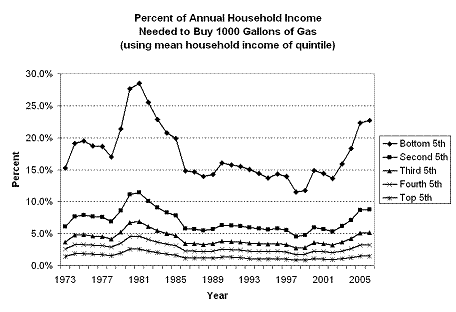
Meanwhile, Glen Whitman, who worked under me as an intern at the International Freedom Foundation (when he was a Koch Fellow and an undergraduate at American University in D.C.) and is now an associate professor of economics at California State University-Northridge, posts this graph on his own blog, Agoraphilia:


Glen explains:
So what can we see? Even looking at the poorest fifth of the population, the fraction of income required to buy gasoline is still lower than it was in the early '80s. Not surprisingly, the fraction has risen a great deal over the last few years, but it still has not surpassed its historical peak. The same holds true for every other income quintile, but the effect is more muted, since higher income means any given price difference will correspond to a smaller fraction of income. (If gas prices stay at their current price of about $2.90/gallon, however, then we could pass that early-80s high-water mark this year.)

How is it possible that the same qualitative pattern holds for both rich and poor, given the rising disparity in income? It’s true that the income gap has increased since the 1970s. But that’s not the same as saying the poor have gotten poorer, because in fact real incomes have risen for every income group over this period. The gap has grown because the rich have gotten a lot richer, while the poor have gotten a little richer.
Glen's explanation goes a long way to answering an unspoken question I have had on my mind: Why does demand for gasoline seem inelastic even in the face of what appear to be dramatic price increases? The reason is that, no matter what income bracket an American might be in, the price is not hitting the pocketbook as hard as it seems to do so on the surface.

Another aspect of the situation is this: As prices rise, despite short-run inelasticity of demand, consumption will decline (due to the substitution effect), and prices will follow. Here is Richard Posner replying to Gary Becker:
In fact the cause of the price spike is primarily, as I said, the increase in crude oil prices, and that increase is in turn primarily the result of rapid growth in demand for oil by China (now the world's second-largest consumer of oil) and India, a growth that has outpaced supply. The notion that this represents a crisis--that the world is running out of oil--is ridiculous. In the short run, with demand rising faster than supply, price rises steeply, producing "obscene" profits since roughly the same quantity is being sold at higher prices. In the longer run, consumption falls as consumers search out substitutes; supply rises as previously uneconomical sources of oil become economical; and so profits fall back to a normal level. . . .

From the broad national standpoint, we should welcome high gasoline prices because it is in the national interest to reduce our consumption of gasoline, and high prices will do that, dramatically so in the long run when more substitution is possible.
We'll leave the question of the minimum wage for another day, unless you'd like to visit my previous posts on it, here and here.

Monday, May 22, 2006

The Mark of the Beast

The newest Virginia Blog Carnival has been posted by James Martin over at The Virginia Progressive. As Waldo Jaquith observed, this week's carnival is post number 666 on that blog, which rounds up all the usual suspects ... and then some.

Friday, January 27, 2006

Back in the Saddle Again

Hearing Waldo Jaquith this morning on WINA Radio's "Charlottesville Live" program, in which he discussed his blogging about "shiny" (but sometimes boring) General Assembly committee hearings, roused me from my torpor and persuaded me to end my weeks-long hiatus from writing.

I actually returned from my East African business trip more than a week ago, but after nearly two weeks away from the Blogger.com screen, it was hard to get started again. (In part, this stems from frustration that the most interesting elements of my trip were private and proprietary, requiring discretion, and therefore non-bloggable. It's the sort of thing to make any writer go "Argggggggh!")

Being out of the Virginia politics loop didn't help any. To tell you the truth, I haven't even looked at a political blog since January 3 -- Virginia- or non-Virginia-related.

While I was away, I missed all sorts of great stories: the fallout from the Jack Abramoff guilty plea, Tim Kaine's inauguration, the General Assembly's overwhelming vote to endorse an anti-marriage amendment to the Virginia Constitution.

But, sitting in my hotel room in Addis Ababa, watching the BBC, I was able to follow the news on Israeli Prime Minister Ariel Sharon's health. Meanwhile, on SkyNews, I could watch relentless reports about Charles Kennedy's resignation as leader of the Liberal Democrats in Britain. (Mr. Kennedy was "tired and emotional," as they say, that is, a wee bit tipsy.) As for SABC, I learned about the handful of former democratically-elected African leaders met in a summit in Maputo to discuss how they can put their elder-statesman status to good use. The simultaneous lead story on CNN International was the search-and-rescue operation in West Virginia for the 13 lost coal miners which, sadly, ended with 12 of them dead.

Speaking of "tired and emotional," while drinking tea in the lounge of the Serena Hotel in Nairobi, I read a side-splitting opinion piece in the Times of London, by Ben MacIntyre, entitled "From squiffy to blotto, a lexicon of lushes/A history of political partying." A representative excerpt:

Politicians have always drunk too much, and always lied about it. In 1957 Nye Bevan, Richard Crossman and Morgan Philips successfully sued The Spectator for claiming that they were drunk at a conference in Venice, which they were. Today the pressure not to drink, and thus the pressure to lie if you do, is greater than ever. New Labour has brought a strange whiff of Puritanism from the likes of Alastair Campbell (teetotal), Peter Mandelson (who is known to sip hot water at dinner parties) and Tony Blair (just a cup of tea, thanks awfully).

A more sober democratic process would probably be happier, and certainly healthier, but it might be even more tense and brittle, and surely less colourful. I suspect that the most famous George Brown drinking anecdote of all immeasurably improved our diplomatic relations with Peru.

At a grand reception in that country in the 1960s, the Labour Foreign Secretary tottered up to a figure resplendent in a fetching purple frock, and slurringly asked her for a dance. She turned him down with the response: “First, you are drunk. Second, this is not a waltz, it is the Peruvian national anthem. And third, I am not a woman, I am the Cardinal Archbishop of Lima.”
What was fun was watching obscure American TV sitcoms on M-Net, a South African-based satellite television service. Sure, they have "Will & Grace" and "The Simpsons." But who has ever heard of "Still Standing"? Or why would anyone want to see the disgraceful "Amish in the City" again? Seriously, does anyone remember "My Big Fat Greek Life"? (Of course, M-Net is reviving, at least for an African audience, the woefully underrated and too-soon canceled "Undeclared.")

It's a small world, after all.

Thursday, December 29, 2005

Another Hundred People

Writing in today's Daily Progress, Liesel Nowak (who usually covers local courts) reports the discovery, by Waldo Jaquith, that there are now at least 100 blogs based in the Charlottesville area.

A list of local blogs that Jaquith has posted at cvilleblogs.com shows the variety of Web logs that are maintained by area residents. The subjects range from politics to computers to cooking.

A blog, as defined by [Merriam-]Webster, is "a Web site that contains an online personal journal with reflections, comments, and often hyperlinks provided by the writer."

"You'll find Republicans, Democrats, Libertarians and Greens talking about politics," Jaquith said. "You'll find food bloggers. You'll find people talking about local music. A lot of people are blogging about computer programs. Some are really boring. Some are really fascinating. Some are dedicated to an individual's life. Sometimes you don't know anything about their lives."
Nowak cites an opinion, shared by Waldo and me, that blogs have their greatest impact at the local level in bringing people together in the 21st century version of talking over the back fence, around the general store's wood stove, or at the barber shop.
"Linking in the local community is more important," Jaquith said. "I think blogs are really beneficial to the community because it forces readers to leave their traditional social circle," Jaquith said. "By reading [local] blogs we really see a pretty good cross section of Charlottesville."

Rick Sincere, a local freelance writer and public relations specialist, has been blogging for a year.

His blog, "Rick Sincere News and Thoughts: Political notes and cultural commentary from a gay, libertarian, Catholic, Republican author and theater critic," contains commentary on current events.

"My initial impulse was to use a blog to post articles I'd already written for other publications. It turned out to be very different," Sincere said.

In writing about local political and cultural events, Sincere has supplemented coverage by local media by covering events such as the Virginia Film Festival, and, as a member of the city's electoral board, hosting debates about electronic voting.

"I think that blogging has its greatest impact locally," Sincere said. "Blogs are replacing the cultural and political events that used to be covered by newspapers. We're the people who can go to a Chamber of Commerce breakfast. We are on the spot when [traditional media] can't be there. Blogs are quite valuable in bringing communities together."
Noting Waldo's desire to see many more local businesses with blogs to promote themselves and their products, Nowak quotes Jim Duncan, who runs a blog on real estate issues:
With his blog "Central VA real estate news, trends and opinions," Jim Duncan seems to be taking advantage of the idea that blogging can bring a local business success.

"I post anything that can remotely be related to real estate, land use, taxes, a lot of politics," Duncan said. "I focus as much as possible on local issues. It's where I live and where I can have an impact."
Many of us who write (mostly) about politics suffer from a sort of tunnel-vision that limits our view of the utility of blogging toward exchanges of ideas in the political sphere.

I agree with Waldo that the real potential of the blogosphere will be in transforming the marketplace, especially the local marketplace, by offering a forum that is a combination Yellow Pages-Better Business Bureau-advertising agency. A business firm's blog can offer so much more information than even a full-page ad in the Yellow Pages could. Unlike a traditional web site, a blog is not (or should not be) static. Local blogs, which might offer consumers a chance to offer their opinions about the firms they do business with, could serve the same function as yearly faculty evaluations do for university students -- and, in providing that kind of information to other consumers, give businesses the kind of feedback they need to improve their products and services.

We're in early days, folks. We have a lot to learn and a lot to try that hasn't even been imagined yet.

Wednesday, November 09, 2005

Write Me In Care Of The Blues

The Charlottesville Electoral Board has completed its canvass of votes for the November 8 General and Special Election and submitted the results to the state. The numbers are posted on the State Board of Elections' web site.

What you won't see there are any of the names written in by voters who were not, for one reason or another, satisfied with the choices offered to them on the ballot.

The "certified" write-in candidate for Governor and Lieutenant Governor, L. Mills Moss, received no votes in either race. No surprise there.

Libertarian Party write-in candidates for those offices fared somewhat better. James W. Lark III received three votes for Governor and one for city Treasurer. Jeff Bowles received one vote for Lieutenant Governor.

Someone named "Bill D. Bypass" was popular enough to be named as an alternative for Governor, Lieutenant Governor, and the House of Delegates. Apparently at least one Charlottesville voter was persuaded by the relentless radio ads, calling for a western bypass, from Albemarle County Board of Supervisors candidate Gary Grant (who was unsuccessful in his race against David Slutzky).

Celebrities also made the list: Uma Karuna Thurman received a vote for Lieutenant Governor, while Harriet Miers was someone's choice (not George Bush's, though) for Attorney General. Jesus Christ and Donald Duck both received votes instead of David Toscano and Tom McCrystal in the House of Delegates race (Mr. Duck getting two).

The Commonwealth's Attorney (an uncontested race featuring only the incumbent, Dave Chapman, on the ballot) had the most write-in votes, 62, with Mr. Belvedere, George Bush, Ward Churchill, Thomas Jefferson, Madonna, Matlock, and favorite son Dave Mathews [sic] making the grade.

The race for Sheriff, in which incumbent Cornelia Johnson ran unopposed, offers a glimpse at how some voters view their hometown. Someone must think of Charlottesville as Dodge City, since he (or she) cast his vote for Matt Dillon, while another must envision Charlottesville as more like Mayberry, since that person's vote went to Andy Taylor. Madonna also got a vote for Sheriff, as did Charlottesville Police Chief Tim Longo and Sergeant Mike Farruggio.

One has to wonder how Bugs Bunny, Jerry Garcia, and James Madison all got votes for Commissioner of Revenue, as well as Johnny Depp, Kermit the Frog, and Alexander Hamilton for city Treasurer. (Hamilton makes a sort of sense, actually.)

Local politicians and political figures also turn up on the list of write-ins:

58th District Delegate Rob Bell was written in for Commonwealth's Attorney, Sheriff, Commissioner of Revenue, and Treasurer. Can he juggle the responsibilities for all those jobs?

In the House of Delegates race, voters also chose City Councilor Rob Schilling, former City Councilor Meredith Richards (2 votes), the 57th District incumbent, Mitch Van Yahres, and Rich Collins, who lost the Democratic nomination for that office to David Toscano in the June primary. (Collins got four write-in votes on Tuesday.)

Alternative choices for Commonwealth's Attorney included Charlottesville Republican Committee Chairman Bob Hodous, local Libertarian activist Arin Sime, and taxpayer advocate Buddy Weber, who also received a vote for Commissioner of Revenue.

Former School Board member Bill Igbani, blogger Waldo Jaquith, and former Fifth Congressional District Republican Party Chairman Randolph Byrd each received a vote for Treasurer.

Charlottesville attorney Tom Albro, who was the first candidate to face Mitch Van Yahres in a House of Delegates election, received votes for that same office once again, Commonwealth's Attorney, and Sheriff.

Quite common were expressions of dissatisfaction with the range of choices on the ballot. These included "None of the Above," which appears as a choice for Lieutenant Governor and Attorney General, and its acronym, NOTA, cast for Commonwealth's Attorney, Sheriff, and Commissioner of the Revenue.

Similar statements of frustration were Alternative, Anyone, Anyone But, Anyone Else, No Choice, No Vote, None, and Someone Honest.

Perhaps the most personal of these seemed to be directed at the sole candidate for Treasurer, incumbent Jennifer Brown: "I Hate You Jennifer."

Monday, November 07, 2005

Class Act

Waldo Jaquith, Norm Leahy, and I were the guest speakers tonight for Larry Sabato's class on campaigns and elections at the University of Virginia. But it was not Larry Sabato who introduced us and led the class. With tonight the eve of the Virginia statewide elections, Mr. Sabato was much in demand elsewhere, responding to questions from TV reporters in Richmond and other cities. In his place, his deputy at the Center for Politics, Ken Stroupe, conducted the discussion.

The three of us were invited to discuss the internet and bloggers and their impact on politics. Waldo, Norm, and I disagreed on little; if anything, our perspectives were remarkably the same, with a few nuances along the edges.

We tried to address the future of blogging, and all of us pretty much agreed that it is not possible to say where political bloggers will be in even just a few years. Norm suggested that we've already "jumped the shark" while Waldo related a self-deprecating story about his days as a teenage teacher of senior citizens. He was teaching this group about computers and the internet about ten years ago, and he told them "we can look at this WWW thing, but the real future is in Gopher. Believe me, in a few years, all you'll be doing is gophering." So much for Waldo's prescience.

Much of the discussion circled around the relationship of bloggers to the mainstream media: how are we like journalists, how are we unlike them? What do bloggers bring to the table that traditional journalists do not? Will newspapers be replaced by blogs?

We also talked about whether, and how, bloggers influence politics. Norm suggested that the biggest impact comes in intra-party discussions, trying to convince people to support one candidate over another in nomination contests, rather than in general elections. He pointed out that, judging from bloggers and commments on blogs in the weeks preceding the June Republican primary, Sean Connaughton and Steve Baril were going to win the GOP nominations for, respectively, lieutenant governor and attorney general. As we now know, both were blown out of the water by their opponents, Bill Bolling and Bob McDonnell.

Norm also said that blogs are a "grass-tops" phenomenon, read by party activists, campaign consultants, political journalists, and candidates. Blogs are not an outreach tool to bring average voters into a campaign's tent. He said there are about 7,000 people in Virginia who regularly read the state's political blogs.

The students of the class were engaged and engaging. They seemed genuinely interested in what we had to say -- and, in fact, in what we have previously written. One student proved that she did her homework when she asked about a specific posting of mine that referred to a bill introduced by Congressman Mike Pence, which would offer bloggers a legal shield for keeping their sources confidential. (She even noted the title of the blog post, "A Very Nice Man.")

Another student wanted to know what newspapers we read. (My answer: I subscribe to the Washington Post, which arrives in my front yard between 2:00 and 3:00 a.m. -- Waldo pointed out that I'm awake to hear it hit the lawn with a thud -- and the Daily Progress, which arrives around 7:00 a.m., and I buy the Washington Times at the store, though I'd subscribe if it had home delivery in Charlottesville.)

I always enjoy speaking to college classes. Years ago I was a regular guest lecturer for Mark Rozell's classes for the Washington Semester Program at the American University. (Mark is now at George Mason University.) I even spoke to that class -- which was made up of college students from around the country who came to Washington to intern on Capitol Hill and at various think tanks around town -- on the very morning that Bill Clinton wagged his finger at the camera and said, "I did not have sexual relations with that woman, Ms. Lewinsky." Talk about making internships sexy!

In those days, I was invited to talk about libertarianism and the Libertarian Party. Since I'm no longer active in the LP, invitations to speak about that party dried up, just as invitations to speak about nuclear weapons policy stopped coming when the Cold War ended, and invitations to give lectures or debate about South Africa disappeared when apartheid went the way of the dodo. (I've got to find myself a more permanent, long-lived topic of expertise.)

When I started this blog just before Christmas last year, I hardly expected that within eleven months I would be invited to speak at a prestigious university about blogging. That idea was simply unimaginable to me. Of course, in a decade, blogging may be as passé as civil defense against nuclear war and South African disinvestment.

After we left the class, I suggested to Waldo that we could turn this into a road show of sorts. We've already been guests on WINA-AM's "Charlottesville Live" program and now Larry Sabato's class. Still, in order to sell something like that, we've got to have more conflict to present. We're just too damn friendly to each other.

Now I must reluctantly get some sleep. My Election Day wake-up call is coming at 4:00 a.m., and a long day will begin. The question is, who will be getting a wake-up call the day after the election?

Sunday, October 09, 2005

When I Found You, Part 4

Every few weeks, I take a look at who is visiting this blog and share with you, my loyal readers, some of the more -- how shall I put this? -- eccentric search terms that bring people here.

You may be also interested to learn the most popular search terms that people use to Google their way to this vicinity. Here are the top ten search strings from among our last 1,ooo visitors:

fecr virginia

dave moffatt

dave moffatt gay

fecr 571

aaron carter pot

fecr in virginia

aaron carter smoking

aaron carter marijuana

rick sincere

dave moffatt nude
Notice some patterns there? Some repeated words and phrases? So do I.

Now, I'm flattered that my own name would make the list -- and to be in such company as Aaron Carter and Dave Moffatt! Considering that the Aaron Carter pot-smoking story is months old -- I first blogged about it in March, with an update in late April, and nothing since then -- I am amazed each day when I see those two postings at or near the top of the list of what people are reading.

As for Dave Moffatt -- well, I can only thank my Canadian readers (as well as many in Thailand, the Philippines, Poland, and Brazil) for coming here to learn about their favorite Canadian Idol contestant.

Apparently a telemarketing/polling firm in Northern Virginia rouses enough curiosity -- or ire -- among the recipients of its call recipients that they Google the number that shows up on their caller IDs and find my remarks about Attorney General candidate Bob McDonnell's campaign. Whether they find those remarks useful or informative, I can't say.

Now, as for the odd and the inscrutable, here we go. Make of these what you will:

"+1"@yahoo.com email addresses of all the clergy men and high priests who are ceo's and owners of firms in america "2005"

ayn rand we the living notes purple monkey

ayn randy
"yahoo.com"

david crockett's homecoming queen 2005

emanate dominion controversy

"jack abramoff" bagel signatures

jerry kilgore cinderella ban

king john sings magna carta

"l. douglas wilder" + "paper moon"

magna carta prom pictures

most famous things in gabon

urban renewal/slum clearance
in north korea
And my favorites, for the sheer contrariness of them:
kilgore "keep gays out of schools"

tim kaine "gays out of our schools"
(By the way, Tim Kaine changed the wording of his infamous "keep gays out of our schools" commercial. The narrator now says "keep gang members out of our schools," enunciated clearly. A lot of people, apparently, misunderstood "gangs" as "gays" and the campaign caught wind of this. Thanks to Waldo Jaquith for bringing me up to date on this.)

Thursday, August 25, 2005

I'm the Greatest Star

Last week, when Waldo Jaquith and I appeared on the "Charlottesville Live" program guest-hosted by Coy Barefoot on WINA-AM radio, I noted somewhat ruefully that, after blogging a few months, I was surprised about which topics attracted the most readers. "When I began blogging, I thought that I would get a lot of readers interested in Stephen Sondheim," I said. "Instead, my most popular posts are about pop stars and teen idols like Aaron Carter and Dave Moffatt."

Now I find that I am not alone in this situation. In last Sunday's Washington Post Magazine, regular columnist Joel Achenbach observes in an article called "The Tail That Wags the Blog":

As an artist, my normal impulse is to write things that people don't care about and, ideally, can't even understand. Gibberish. But my freedom of expression is hampered by the blogging software that tracks every page view. In the old days, the age of print, a journalist had very little data on how many people read a particular story. Now I can track readership second by second, eyeball by eyeball. It's obvious what people want: political screeds and celebrity gossip. A few weeks back, I blogged three paragraphs on Karl Rove. Someone at Google News linked to the blog, and a Rovestorm erupted, a festival of vituperation, with a commensurately outstanding number of page views. Now I pretty much have to write about Rove all the time. (Contrary to what you may have heard, my blog item "Karl Rove Linked to Hoffa Disappearance" was completely fair.)

The continual focus-grouping explains why most bloggers write as though their primary goal is to rise in the Google search results. The more you mention people like Brad Pitt and Angelina Jolie, the more readers you will have, and the more links, and the more you will rise in Google's estimation. I have nothing really to say about Brad Pitt and Angelina Jolie, and am not even remotely interested in Brad Pitt and Angelina Jolie, but I know that my blog will be read by more people if it mentions famous celebrities who might be secretly boinking, such as Brad Pitt and Angelina Jolie.

And let me just add, purely for the sake of Google: sex, alien abduction, Oprah, Tom Cruise, Lindsay Lohan, jumbo hooters the size of watermelons, Dick Cheney, Mark of the Beast, Armageddon, free money.

I haven't written about Brad and Angelina -- or even Brad and Jennifer, for that matter, though I may have once mentioned what a rotten movie Troy was -- but I'm glad to know that I am not the only blogger who attracts readers who are most interested in celebrity gossip. I just hope that that once here, they linger to read other posts on other topics. There's a lot to choose from, and I have nothing against cherry picking.

Friday, August 12, 2005

Turn Your Radio On

Waldo Jaquith and I have been invited to appear on "Charlottesville Live," a local call-in talk show on WINA-AM radio, to discuss blogging and the upcoming Virginia bloggers' conference sponsored by the Sorensen Institute.

Waldo has a leg up on me, since he's been blogging longer than I've known what the Web is. But it should still be a good conversation.

The program is scheduled to take place on Wednesday morning, August 17, from 9:05 to 10:00 a.m. (just before Neal Boortz) on WINA, which is found at 1070 on the AM dial.

One topic that may come up that morning is the recent report from the New Politics Institute, a Democratic think-tank, that says that liberals lag behind conservatives in the political blogosphere. As Donald Lambro explained in Friday's Washington Times:

Liberal activist Web loggers have made major advances on the Internet, but they remain far behind their conservative adversaries among the top 250 political blogs, according to a study by a Democratic think tank.

In a detailed report on the political power being wielded by bloggers, who have become a potent force in national and state campaigns, the study found that while liberals have "a decided advantage" over conservatives among the top 40 blogs (24-16), "conservatives hold a whopping 133 to 77 advantage" among the next 210 blogs.

The study said this was "a serious problem that progressives must confront," if they are going to overcome the conservatives' advantage at the local level.

The report, "Emergence of the Progressive Blogosphere: A New Force in American Politics," was written by Chris Bowers and Matthew Stoller and released on August 10. It says, in part:
Since March of 2005, the total number of blogs has grown from 7.8 million to 14.2 million. At this rate, the online universe is doubling in size every five months.

* * *

There is an emerging social structure of the Internet which includes key differences in how conservatives and progressives use the web to communicate. For years, conservatives dominated the political Internet, with such websites as FreeRepublic.com, the Drudge Report and Newsmax. Moveon.org was one of a few notable, progressive exceptions to conservatives’ online dominance. Their Internet supremacy was anchored in, and improved on, an already existing conservative infrastructure. On the whole, it reflected the top-down, coherent messaging structure that characterizes the conservative movement.

Since 2002, the Dean campaign and other landmark events have caused a new world of online activism to thrive: the blogosphere. The blogosphere, and in particular the progressive blogosphere, have emerged as powerful political forces. Unlike their conservative counterparts, progressive Internet activists have not relied on an existing set of institutional relationships. They have instead forged a new constituency group, a new set of leaders, and a new forest of social relationships. The strengths and weaknesses of each blogosphere are reflected in their origins. Understanding these blogospheres and how to interface with them effectively is critical to succeeding in 21st century politics.

* * *

Bloggers do not reside at the political fringes, and defy easy characterization as “progressive” or “conservative.” They run the full gamut of ideologies, but are united by their shared commitment to active engagement in local, state and national politics. That is why the blogosphere holds such potential for those campaigns and individuals who are prepared to engage with it appropriately.

The authors, who are both experienced bloggers, note:
What is concerning about the current distribution of traffic is that the smaller conservative blogs are much more numerous than the smaller progressive blogs. A MyDD analysis showed that while progressives have an edge in overall traffic, there are more conservative blogs in the top 250 political blogs.

Among the top forty blogs, progressives maintain a decided advantage – twenty-four to sixteen. However, among the next 210 blogs, conservatives hold a whopping 133 to 77 advantage.

This is significant since the smaller a blog is, the more locally focused it tends to be. An edge among small, local, political blogs also means an edge in small, local, political races. While progressives may have a marked advantage in overall blogosphere discourse, it could also be argued that conservatives are taking a decisive lead in the sort of targeted blogging that will provide them with real, tangible benefits in the 2005-2006 elections and beyond.

Their emphasis on smaller, locally-based blogs is well-founded. The sorts of blogs found among the Old Dominion Blog Alliance, for instance, provide news, information, and analysis that is not always found in the daily newspapers and local TV or radio broadcasts that have traditionally brought political news into the home. These blogs are able to report on small community meetings, legislative hearings, and administrative matters that are beyond the reach of mainstream media if only because mainstream newspapers lack the personnel to cover events such as these.

The closest analogy to these local bloggers from years gone by would be the high school sports geek who would serve as a stringer for local weeklies or radio stations, bringing in football scores moments after the final gun. Full-time reporters cannot be physically present at a dozen high-school football games being played simultaneously on a Friday night. Nowadays that stringer might be equipped with a digital video camera and can download game highlights to the web within minutes, beating out the local TV stations for the story.

We are going to see more of this localization play out this year, especially in the handful of contested House of Delegates races across the state, where bloggers' presence at candidates' forums can exponentially increase the potential audience for what is said in front of two dozen Chamber of Commerce members or even fewer neighborhood activists.

Thursday, April 07, 2005

Gay-Baiting Jerry Kilgore

There are early indications that Democrats and other Tim Kaine supporters are going to use innuendo, loaded questions, and sometimes outright accusations to raise doubt in voters' minds about GOP gubernatorial candidate Jerry Kilgore's sexual orientation. (Kilgore faces Warrenton Mayor George Fitch, who took the famous Jamaican bobsled team to the Winter Olympic Games, in the June 14 Republican primary.)

As far back as November 2004, Waldo Jaquith wrote:

Few who recall hearing Kilgore speak (and not many people in the state have) will forget the single most notable aspect of his speaking style. He sounds…well…gay. Perhaps a less controversial word to use would be “effeminate.” His speech pattern is stereotypically that of an effeminate gay man, and there’s really no getting around it.
Tweaking the issue just a bit, he added:
Perhaps the good news for Kilgore is that he may get a few progressive votes. While being perceived as effeminate (and, by extension, being perceived as possibly gay) might be a drawback among radical Republicans, some of my fellow progressives just eat that stuff up.

Then in February, Waldo again brought up the issue of Kilgore's high-pitched, nasal, "effeminate" voice. (To be fair, contemporary accounts of Abraham Lincoln's voice used similar adjectives.) Waldo wrote:
I’ve long been interested in the topic of Jerry Kilgore’s voice. Late last year, some media expressed a great reluctance to acknowledge the elephant in the Kilgore campaign’s living room — the man has a stereotypically effeminate voice. Now to be fair, there’s not a thing that he can do about it, no more than if he was born without a nose or had turned blue. Nor is there, I imagine, any reason why having a high-pitched, soft, nasal voice should keep him from serving as governor effectively. That said, it’s going to have an impact on who votes for him, because many voters will hear him speak and perceive him to be weak, unfairly or not.
Following up with a clarification, Waldo noted in a comment a couple of days later:
Of course, I’ve got no idea of the man’s sexuality (what with the wife and kids, there’s every reason to assume that he’s straight [ObSchrockLink]), but, that said, yes, he sounds like a parody of a stereotypical gay man.
Now the blog "Raising Kaine" raises the point less obliquely in an entry dated April 3:
Second, Jerry Kilgore may or may not be gay, but I have heard from numerous sources, including at least one gay male, that almost every homosexual’s “gaydar” goes off BIG TIME when they see and hear Jerry walk and talk. In fact, I would go so far as to say that the general consensus among the Virginia gay community about Jerry Kilgore is this: they have no proof he’s gay, but, as one said to me, “if he isn’t a closet case, there are no closet cases left.”
What puzzles me is why Virginia Democrats think they can succeed where the Kerry-Edwards campaign failed. In the presidential and vice presidential debates, both John Kerry and John Edwards used every available opportunity to remind voters -- and especially those on the religious right -- that Dick Cheney has a lesbian daughter.

As readers will recall, in the vice presidential debate on October 5, PBS correspondent Gwen Ifill asked a question about same-sex marriage. In his reply, candidate John Edwards said in part:
Now, as to this question, let me say first that I think the vice president and his wife love their daughter. I think they love her very much. And you can't have anything but respect for the fact that they're willing to talk about the fact that they have a gay daughter, the fact that they embrace her. It's a wonderful thing. And there are millions of parents like that who love their children, want their children to be happy.

And I believe that marriage is between a man and a woman, and so does John Kerry.
Dick Cheney, looking a bit peeved and prodded by Ifill to respond to Edwards' comments, said civilly:
IFILL: Mr. Vice President, you have 90 seconds.

CHENEY: Well, Gwen, let me simply thank the senator for the kind words he said about my family and our daughter. I appreciate that very much.

IFILL: That's it?

CHENEY: That's it.
On October 13, during the third Bush-Kerry debate, CBS News correspondent Bob Schieffer asked both candidates, "Do you believe homosexuality is a choice?" Kerry opened his reply by saying:
We're all God's children, Bob. And I think if you were to talk to Dick Cheney's daughter, who is a lesbian, she would tell you that she's being who she was, she's being who she was born as.
As the Des Moines Register pointed out,
Kerry's comments also drew a backlash from interest groups in Iowa on both sides of the issue.

"It was a cheap shot," said state Sen. Neal Schuerer, an Amana Republican who earlier this year led a debate calling on Congress to pass a constitutional amendment defining marriage as being between a man and a woman.

Bill Musser, 46, of Decorah, who in 2002 was joined in a Vermont civil union with Otter Dreaming, 47, said Kerry's reference to Mary Cheney "felt just a little bit uncomfortable to me."
If the Kerry-Edwards strategy was to drive a wedge through the Bush-Cheney base, it failed. One reason was that to many voters, it was unseemly to bring in an unwilling participant -- Mary Cheney -- who was not a candidate herself (and a public figure only by association with her more famous parents).

Will the Democrats in Virginia succeed when the target of their gay-baiting is the candidate himself? Tim Kaine is a favorite of openly gay Democrats. (At a January 2004 Virginia Partisans event -- Virginia Partisans being the counterpart to Log Cabin Republicans -- Kaine received "a rousing ovation.") How do they feel about their fellow Democrats and fellow Kaine supporters using unvarnished gay baiting as a tactic to win election this November?

P.S.: Don't feel too bad for Mary Cheney. She's writing a book . According to recent press reports, she has "signed with Bush strategist Mary Matalin's conservative imprint at Simon & Schuster to pen a book on being 'a political target for the other side":
Besides sharing memories of working on her dad's campaigns since age 8, the former Coors executive finally will respond to Democratic presidential nominee John Kerry, who raised the issue of her homosexuality.

"She never wanted to be the poster girl . . . for gay issues," Matalin said. "She doesn't exist to be the lesbian daughter of the vice president."

But her sexual identity will be a major topic of the tome, which will try to appeal to conservatives, liberals and gays, Matalin said.

The publisher said Cheney will take a shot at "buffoonish" Republican Alan Keyes, who labeled her a "selfish hedonist."
I can't wait to see it. Will it have steamy lesbian love scenes like those in her mother's novel, Sisters, published in 1981? Or will it be a dull and wonkish book about working behind the scenes of a presidential campaign? I suspect it will be somewhere in between.

And I'll try to get an autographed copy of Mary's book to present to Jerry Kilgore -- just to hear his reaction.

Monday, March 14, 2005

Conservative(s) for Jaquith?

Waldo Jaquith -- one-time candidate for Charlottesville City Council, founder of the Virginia Family Values PAC, creator of cvillenews.com and other web sites -- has found himself on more than one list of potential candidates to succeed retiring Delegate Mitch Van Yahres (D-57). (Of course, to my surprise, I have found myself on one of those lists, too, but remember: I am not a candidate.)

Waldo is getting support from unexpected quarters: John Behan, who bills himself as the internet's "first elected blogger", says this on Commonwealth Conservative:

At any rate, I’m not sure what to think of a potential Waldo candidacy. On one hand, I’ve had the opportunity to correspond with Jaquith quite a bit, and I like him personally very much. On the other hand, we disagree on nearly every political issue.

Then again, it might be nice to have another elected blogger here in Virginia. Perhaps he’ll make a statement soon; inquiring minds want to know.

I predict the Democrats in the 57th District will choose their candidate by party primary on June 14.

Lloyd Snook, the Charlottesville representative on the 57th District committee, reports: "Since sending out my e-mail a few nights ago to about 400 people, I have received about 30 responses from Charlottesville Democrats; they break 15-15; 15 favor a primary and 15 favor a caucus or convention." No official position has yet been taken by the Charlottesville Democratic Committee (or its executive committee).

At the same time, the Albemarle County Democratic chair's representative to the 57th District committee, Eric Strucko, favors a primary. As Strucko wrote to George Loper on March 10:
The Albemarle County Democratic Party representative to the 57th House of Delegates District Committee (me) voted clearly and without hesitation for a primary to determine the Democratic nominee for Mitch's seat. The county steering committee overwhelmingly endorsed a primary. I left last night's 57th District Committee meeting feeling that Mitch himself endorses the primary method. This is the most open and inclusive way of selecting our nominee, and will offer all candidates the opportunity to hit the campaign trail early, discuss the issues fully, and set the themes for the fall race. A primary is also the method of choosing nominees endorsed by the Democratic Party of Virginia.
We'll see where this goes -- and whether a primary process favors an establishment politician like David Toscano or a more unconventional candidate like Waldo Jaquith, who, by the way, is currently enrolled in the Sorensen Institute’s Political Leaders Program, a launching pad for many successful candidates (including Charlottesville's own Rob Schilling and the late Emily Couric).

Addendum, 6:01 p.m.: As found on George Loper's always up-to-date web site:
"At a 12:15 press conference today the leadership of the Charlottesville and Albemarle Democratic Committees announced that the nomination of a candidate for the 57th District House of Delegates seat should be made by a primary, to be held June 14 in conjunction with the nomination for state offices. . . .

"Prospective candidates must submit petitions containing the signatures of 125 registered voters in the 57th District, together with a filing fee of $352.80, to the registrar of the jurisdiction in which the candidate lives, no later than April 15, 2005." (Press Release, Electronic mail, March 14, 2005)

Tuesday, January 11, 2005

Virginia Family Values PAC?

Earlier today, I received a call from a reporter for The Hook (a Charlottesville weekly) to comment on a new organization called the Virginia Family Values PAC. She asked me to look at the group's web site and tell her what I thought. (She was seeking out a "libertarian" opinion, but I explained that I'm a Republican activist as well as a libertarian.)

The organization is not what you think. It's been set up to target for defeat those that the PAC considers to be the farthest right-wing members of the General Assembly.

Here are their targets:

Targeted Races

The below are ranked by asininity, from greatest to least. (With the understanding that these guys are all grade-A nutcases.)

Del. Bob Marshall (R-Loudoun/Prince William)
Bob Marshall is the looniest of the looney tunes in the House of Delegates. "Crazy bastard" is probably the best phrase. He still calls female university students "co-eds." He refers to sex between college-aged adults "frat boy antics." He calls birth control pills "sex pills," and has tried repeatedly to get them banned from colleges. As the Virginian-Pilot wrote in an editorial (05/04/2003), Marshall was a harmless lunatic when he was elected a decade ago. Now he's mainstream, not because he's changed, but, terrifyingly, because he's surrounded himself with more and more fellow loonies.

Del. Dave Albo (R-Springfield)
Albo -- we swear we're not making this up -- introduced a bill in the 2004 session that would reduce raping one's own child from a felony to a mere misdemeanor (HB 1054). What the hell? He's generally opposed to sex, like these other guys, but apparently doesn't mind it quite so much when it's a father sodomizing his toddler.

Del. Dick Black (R-Loudoun)
In a "craziest bastard" race, it'd be a close tie between Marshall and Dick Black. Black thinks that sperm is a child, and should be protected accordingly. He thinks that birth control of all types -- the pill, IUDs, condoms, whatever -- should be illegal. He calls them "baby pesticides." He opposes government spending to promote the use of any birth control.

Del. Bob McDonnell (R-Virginia Beach)
Sen. McDonnell isn't satisfied living a sexless life down in Virginia Beach, or even enforcing his opposition to a healthy sex life in his capacity as the chairman of the House Courts of Justice Committee. No, McDonnell would like to be the Virginia Attorney General, and is looking for the Republican nomination to be their candidate. His memory may be a problem though -- after all, he "can't recall" if he's ever engaged in oral or anal sex. Say, Bob? You're not being straight with us, are you?


The reporter had spoken to Dave Albo, who was "baffled" by his inclusion on the list (as was I). Albo was awkward and ineffective in last year's General Assembly session when the legislature considered bills to repeal the Virginia Crimes Against Nature statute in the wake of the Supreme Court's decision in Lawrence v. Texas, but what he did was not malicious, nor was it indicative of an unseemly obsession with other people's sex lives. In the past, Albo has spoken at meetings of Log Cabin Republicans (I know, because I was there, and I asked him a question about Virginia's weak-kneed, toothless charter-schools law). His fumbling of sodomy-law reform is not a reason to put him in the same category as Marshall or Black.

The new Virginia Family Values PAC seems to have taken its cue from South Park in terms of its clever effort at subversion on behalf of authentic family values. (To be fair, South Park uses vulgar language and situations to build an argument for essentially conservative values. This new PAC does not use that strategy but, still, there is no question but that the Virginia Family Foundation will have a cow over this.)

Here's what I mean. Dated January 9, the group's initial press release uses buzzwords that are sure to catch the attention of Goldwater Republicans like myself:

Virginians from across the commonwealth today announced the formation of a non-partisan political action committee to strengthen family values and families' political influence in Richmond and in the November elections. . . .

Virginia Family Values has named four of the candidates that they'll be targeting for removal from office for their anti-family votes: Delegate Bob Marshall (13), Delegate Dave Albo (42), Delegate Dick Black (32), and Delegate Bob McDonnell (84). All four candidates have consistently voted against family and parental rights, and have introduced bills that would increase the size of government while decreasing family freedoms and privacy.

"The family is the foundation of our society," explained PAC founder Waldo Jaquith. "Every time that these legislators have been given the choice between family values and bigger government, they've chosen wrong. They're way out of touch with Virginia values, and we intend to show them the door."


There is little on the PAC's web site that indicates precisely how they are going to target these four Delegates. Will they be supporting Republican primary challengers? (By my estimation, this would be their best strategy, since all four are in safe Republican districts.) If they wait until the general election and support Democratic challengers, will they be able to find other organizations of a common mind to catalyze contributions in sufficient numbers to mount a successful campaign?

I was frank with The Hook's reporter: I said that Bob Marshall is an embarrassment to the Republican Party. As puzzled as I was by David Albo's inclusion in the list, I thought it was unfair, as well, to include Bob McDonnell. McDonnell, despite his famous "Not that I can recall" gaffe, does not seem to be as pathologically sex-obsessed as Black and Marshall.

It's rare to see a group made up of Democratic and liberal activists -- Waldo Jaquith narrowly failed in a bid to get the Charlottesville Democrats' nomination to a City Council seat in 2002, and everyone expects him to return someday and become politically active in city politics once again -- using terms like "RINO" to describe Republicans like Marshall, Black, et al., for whom "RINO" is more accurate than they would be willing to admit. What a pleasure it would be if more Democrats wanted to rid our legislatures of RINOs and replace them with authentic, small-government, Goldwater conservatives.

Will that ever happen? An army of snowmen will reign in Hell before it does.


Be sure to visit my CafePress store for gifts and novelty items!
Read my blog on Kindle!