Showing posts with label Congress. Show all posts

Sunday, February 11, 2018

Briefing with Congressman Tom Garrett and Afghan and Czech Ambassadors

Tom Garrett Hamdullah Mohib Hynek Kmonicek Monticello
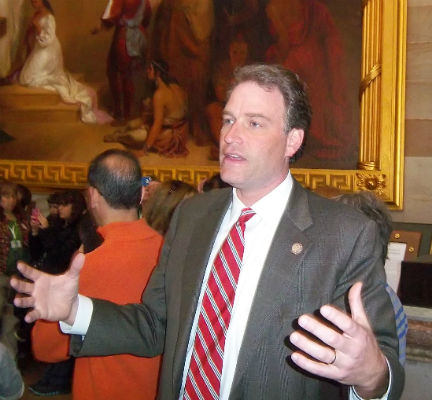
Fifth District Congressman Tom Garrett on Friday hosted several diplomats on a tour of Thomas Jefferson’s home at Monticello. After the tour, he and two of them – Ambassador Hamdullah Mohib from Afghanistan and Ambassador Hynek Kmonícek from the Czech Republic – answered questions from the local Charlottesville news media.

Garrett explained that even though, as a slaveholder, Thomas Jefferson was a flawed individual, the Declaration of Independence that he drafted was a “brilliant” document that led to freedom not only in the United States but around the world. Both Ambassador Mohib and Ambassador Kmonícek acknowledged that they learned things about U.S. history and Jefferson himself by taking the tour of Monticello, and that there are lessons they could convey to their compatriots back home.

(Ambassador Kmonícek joked that, where he comes from, a 200-year-old house is considered new.)

You can see the entire press conference here:

Congressman Garrett also answered questions about current domestic policy. Tyler Hawn of the Charlottesville Newsplex asked him about the budget bill that was passed late in the night and signed Friday morning by President Trump, and whether the process was frustrating. Garrett replied (starting at the 9:28 minute mark in the video):
It’s ironic that we stand at the home of Thomas Jefferson, who drafted the Declaration of Independence, which was signed by people who knew when they put their name on that paper that if they were captured they would be killed. We’ve devolved into a political class with the inability to say “no.”

I voted against the National Defense Authorization Act even though people would describe me as a hawk, because thirty-plus years ago department of defense agreed with other federal agencies to be audited – it’s never been audited.

To continue to spend and spend and spend is a symptom of a political class without the courage to do what they think is right when it’s too difficult and standing for reelection having done what you said, even when it was difficult or uncomfortable, is the hallmark of who we are supposed to be as a people.

I voted against that. I think President Trump was wrong to capitulate on heightened spending. He can spin it however he likes. We need to draw lines and assure that taxpayer dollars are being spent efficiently and on the core functions of government. We’re not doing that. It wasn’t OK when President Obama spent profligately. It’s not OK when President Trump does it. So, yes, I’m frustrated.
Garrett also answered a question (about 10:40 in the video) about pending immigration legislation and how it will affect participants in DACA (Deferred Action for Childhood Arrivals).
That’s going to start in the Senate, for sure, because that’s the chamber where I think they can get something out. I’ve spoken with dozens of DACA recipients – dozens may be low – they can prove it because they’ve filmed me. I’d love to have a solution for DACA. I don’t think deferred action is the proper long-term solution but I’m not going to vote for anything until we secure our southern border.

To do the same thing again and again and expect a different result is the definition of insanity. And I’ve said this to these people with whom I’ve spoken: I think border security should be this AND that, not a this THEN that. We tried this in ’86 with a this-then-that and it failed. And I haven’t had any of the people with whom I’ve spoken who are DACA recipients have a problem with that.

So, I think if we set aside some of the hyperbolic rhetoric that we can get something done but right now people need to step back from the rhetorical edge, acknowledge the existential reality to the young people who are DACA recipients, and also acknowledge that it makes no sense not to take action to secure our southern border.
There are plenty of other gems in the conversation, from both the ambassadors and from Congressman Garrett, who said he would like to do more programs like this, perhaps three or four times each year, bringing ambassadors from Washington to Charlottesville to visit both the University of Virginia and Monticello.

In addition to Tyler Hawn of the Newsplex, Pete DeLuca of NBC29 covered the press event in the Robert H. and Clarice Smith Gallery at Monticello's David M. Rubenstein Visitor Center.

This article was previously published, in slightly different form, on Bearing Drift.


Saturday, December 30, 2017

News Release: LPNOVA Resolution Supporting Concealed Carry Reciprocity

The following news release was received from the Libertarian Party of Northern Virginia (LPNOVA). It was distributed by Reston resident Steve Resz.

The Board of the Libertarian Party of Northern Virginia has passed the following Resolution:  “The Libertarian Party of Northern Virginia (LPNOVA) supports passage of S. 446, H.R.38, and H.R. 2209, people with lawful concealed carry status from other states the same status as lawful in-state concealed carriers.”

S446 John Cornyn reciprocity concealed carry
On June 14, 2017, House Majority Whip Steve Scalise and three other people were wounded when a gunman opened fire on members of the Republican congressional baseball team as they were practicing on a field in Alexandria, Virginia.  In a life and death situation where seconds count, Alexandria police officers arrived “only” three minutes after the first 911 call was received and logged. [1.  NBC News]

Luckily for Scalise and the others, two Capitol Police from D.C. were present and quickly returned the gunman’s fire – one of whom was wounded in the firefight. [2.  New York Times]

Sen. Rand Paul (R-Ky.) told CNN shortly after the dramatic incident that, “Nobody [of the defenseless Congressman, Senators, and aides present] would have survived without the Capitol Hill police … it would have been a massacre without them." According to Senator Paul, “I probably heard 50 to 60 shots.  Then, finally, we heard the response from the Capitol Hill police."[3.  The Hill]

Many people have the impression that our Representatives and Senators are routinely protected by Capitol Police when they are away from the Capitol grounds. They are not. Only the Congressional “leadership” gets such personal, gun-carrying protection. If Majority Whip Scalise had not been a member of the baseball team, there would have been no Capitol Police present.

One might ask themselves: “Don’t important people like that – or their aides/bodyguards – routinely carry concealed weapons for their protection?” The answer is yes. Some do – but only in their home state. However, in this specific case they didn’t because that would have made them criminals. Why? Because the District of Columbia has some of the most restrictive “gun control” laws in the country – and has no reciprocity with any other jurisdiction anywhere in the nation.[4.  D.C. Gun Law]

Therefore, if any of the Congresspeople at the baseball practice did have a concealed carry permit from their home state, and brought a self-defense weapon with them to D.C. they would be violating the law - or any of the Democrat team who had practiced earlier in the morning.

As Rep. Mo Brooks (R-Ala.) noted, “We had nothing but bats to defend ourselves.”

Therefore, the Libertarian Party of Northern Virginia (LPNOVA) supports passage of H.R. 2209 which would guarantee reciprocity for concealed carry permits specifically in the District of Columbia [3.  The Hill]

But why should only our elected representatives be able to protect themselves? What about the citizens who elect them? Don’t they also deserve the right to self-defense guaranteed by the second amendment when they travel to another state or the federal District of Columbia? Of course they do. That’s why LPNOVA also supports passage of S.446 and H.R.38 both of which would allow legal gun owners and concealed carry license holders nationwide to responsibly arm themselves no matter where they are. [3. The Hill] [4.  NRA-ILA]

Steve Resz, LPNOVA Chair, said, “Citizens shouldn’t lose their second amendment right to self-defense when they travel outside their home state.  The U.S. Constitution says, ‘Full Faith and Credit shall be given in each State to the public Acts, Records, and judicial Proceedings of every other State.’ Your marriage license doesn’t become invalid when you travel outside your home state, and neither should your concealed carry license.”


Monday, December 11, 2017

From the Archives - Dick Armey on the U.S. Congress: 'the most dangerous gang of economic illiterates I've ever seen'

Dick Armey on the U.S. Congress: 'the most dangerous gang of economic illiterates I've ever seen'
September 15, 2010 2:52 AM MST

Dick ArmeyAccording to its co-author, former Texas Congressman and House Majority Leader Dick Armey, the new book, Give Us Liberty: A Tea Party Manifesto, came about in response to mean-spirited attacks on Tea Party participants.

“We were sitting around looking at these horrible, mean ways in which these good folks were being characterized,” Armey related, “and we said, ‘Somebody needs to tell the whole story, the true story.’”

Tea Party’s ‘true story’
That “true story,” Armey explained to the Charlottesville Libertarian Examiner, was that, even before the movement had a name, Tea Party activists from around the country sought advice from FreedomWorks, the advocacy group that Armey chairs.

“Almost without exception,” he said, “wherever you look in the country -- California, Florida, wherever -- where somebody wanted to put a group together and start getting the ball rolling, they called us.”

Armey answered questions about his book, the Tea Party, and the 2010 and 2012 elections in an interview on the eve of the second 9/12 Taxpayer March on Washington, which this year attracted a crowd of 100,000 or more protesters who gathered on the West Front of the U.S. Capitol to hear a range of speakers from Colombian immigrant Tito Munoz to former New Mexico Governor Gary Johnson to Virginia Attorney General Ken Cuccinelli.

Understanding Economics

Dick Armey Congress economics
The average Tea Party member, Armey agreed, has a better grasp of economics than the average Member of Congress.

“No doubt about it,” he said. “That’s one of the things that really distresses me.”

The country is in trouble, he added, if Congress Members' “understanding of economics, how the economy works, the world of commerce, where the money comes from, is less than” that of the typical citizen.

“This is a serious problem and I have no doubt about it,” Armey said with emphasis.

“You take a look at the leadership in the House and the Senate and the Executive Branch of government, starting with the President, it is the most dangerous gang of economic illiterates I’ve ever seen in my life.”

No ‘honest curiosity’
Having served in Congress for nearly two decades, Armey had observed the capacity of its Members to understand basic economic concepts.

“It is frightening,” he said. “They don’t have an honest curiosity about economics. I just don’t believe any one of them ever looked at this and asked the question, where’s this money coming from?”

Armey described legislators as “a bunch of kids that found the money tree” who say, “’We can just spend all we want.’”


Publisher's note: This article was originally published on Examiner.com on September 15, 2010. The Examiner.com publishing platform was discontinued July 1, 2016, and its web site went dark on or about July 10, 2016.  I am republishing this piece in an effort to preserve it and all my other contributions to Examiner.com since April 6, 2010. It is reposted here without most of the internal links that were in the original.

Sunday, August 13, 2017

From the Archives: Fifth District congressional candidate Jeffrey Clark endorses idea of liquor sale privatization

Fifth District congressional candidate Jeffrey Clark endorses idea of liquor sale privatization
August 13, 2010 7:07 PM MST

Jeffrey Clark Tom Perriello Bob McDonnell Charlottesville ABC privatization liquor regulation
Just prior to his debate with incumbent Representative Tom Perriello (D-Ivy) at Charlottesville’s Senior Center on August 11, independent congressional candidate Jeffrey Clark gave his opinion on a current statewide issue.

When asked by the Charlottesville Libertarian Examiner what he thinks of Governor Bob McDonnell’s proposals to privatize the state’s monopoly on wholesale and retail sales of distilled spirits, Clark readily replied, “I like it.” It is, he said, “a win for everybody.”

‘A great model’
Pointing out that in “many places” elsewhere in the United States, liquor is sold through private outlets, Clark asked, “If it’s working effectively in other areas of the country and it’s a great model, why not move in that direction here as well?”

Clark explained that he doesn’t see “any reason that would prevent us from” privatizing ABC sales.

“We can get away from the bureaucracy,” he added, noting that “small businesses like restaurants and things like that would welcome the idea of the privatization of the ABC stores.”

Drawing on his own business experience, Clark remarked: “Trust me, I’ve been in restaurant-hotel management for a very long time, and I understand the red tape that can go along with that.

End the red tape
“Listen,” he continued, “just trying to get an opportunity to be able to have the privilege of selling alcohol in your business can be a huge issue of red tape and then you’ve got to go deal with this government bureaucracy that is the ABC stores of Virginia.”

McDonnell’s idea is “a way overdue proposal,” Clark said, wondering “why so long here?” when 32 other states have had private systems for decades.

Like the governor, Clark suggested that ABC privatization is part of a broad-based approach to government reform.

“We really need to look at every program, no matter what it is, even if it seems small, even if it seems like” people are dismissing the idea by saying things like “Oh, the ABC stores, it’s just alcohol, no big deal, we’ll leave it” the way it is, Clark argued.

‘Save a dollar, save a billion’
“Any area where we can look, where we can focus on the small things” the state should consider a change. “If it’s saving [just] a dollar, who cares? If we look to save a dollar, we can eventually save a million, two million, a billion.”

By looking for savings and efficiencies, Clark asserted, “we can start to bring these things back into some type of financial control and better serve the people.”

Clark, who lives in Danville in Southside Virginia, where it is believed much of the opposition to McDonnell’s proposals originates, does not see a downside.

“I don’t think anybody believes that somehow the ABC stores won’t be able to serve the public as well if they’re somehow not under government control,” he said.

“As a matter of fact, I think that most independent businesspeople probably act more responsible in their day to day lives than do government bureaucracies.”

Add Jeffrey Clark’s name to the list of supporters of Bob McDonnell’s ABC privatization efforts.

Publisher's note: This article was originally published on Examiner.com on August 13, 2010. The Examiner.com publishing platform was discontinued July 1, 2016, and its web site went dark on or about July 10, 2016.  I am republishing this piece in an effort to preserve it and all my other contributions to Examiner.com since April 6, 2010. It is reposted here without most of the internal links that were in the original.

Saturday, June 10, 2017

From the Archives: GOP congresswoman headlines youthful same-sex marriage event on Capitol Hill


GOP congresswoman headlines youthful same-sex marriage event on Capitol Hill
July 11, 2012 8:18 PM MST

Young Conservatives for the Freedom to Marry is a new organization that was launched at a reception on July 10 at the Capitol Hill Club, the social club for Republican party members and activists mere blocks from the U.S. Capitol, Supreme Court Building, and Library of Congress.

The featured speaker at the reception was Congresswoman Ileana Ros-Lehtinen (R-Florida), who as chair of the House Foreign Affairs Committee is one of the highest-ranking women and Hispanics in Congress. (Ros-Lehtinen immigrated to the United States from Cuba.)

Calling the gathering of just over 100 people a “great celebration,” Ros-Lehtinen used her brief remarks to outline the shared values of Republicans and conservatives.

‘Core principles’
“This new initiative,” she said, “helps highlight the role of young conservatives and Republicans from around the country who agree on this issue and many others. We are all here because we believe in the same core principles.”

gay marriage Ileana Ros-Lehtinen young conservatives
Those principles, she continued, include limited government.

“We believe that the best way that the federal government can help in spurring economic growth, which we so badly need in this country, is to get out of the way and let the small and medium businesses thrive.”

Another shared principle is, she said, “the equality of opportunity that’s available for each and every one of us, no matter where we come from, no matter our circumstances.”

She emphasized a third principle, “that the individual and the family are the central engines in our society. The right of individuals to lead their lives without government intrusion is a bedrock Republican, conservative value.”

More than sex
That central principle, Ros-Lehtinen said, “is more than just about sexual orientation.”

Ileana Ros-Lehtinen freedom to marry Florida Republican Congress
It is, she explained, “about the fundamental rights that we all share as Americans. It’s bad enough that we have to deal with the overregulation of our economy. No one should have to deal with government red tape when it comes to committing themselves to those whom they love.”

After her remarks, in an informal press gaggle that included the Charlottesville Libertarian Examiner, the twelve-term congresswoman pointed out that an organization like Young Conservatives for the Freedom to Marry represents “a generational shift.”

The question of whether to expand marriage equality in the United States, she predicted, is “a problem that many years down the road, we’ll look back upon this time and say, ‘This was a problem? This was an issue? This was a ballot initiative?’”

‘New image for Republicans’
Ros-Lehtinen, who is seeking re-election this year in Florida's 18th congressional district, said that “things are moving in the right direction thanks to the young people who are making a difference. To harness this energy on this issue,” she said, “is very important” because it presents “a whole new image for Republicans and we’ve got to win the minds and hearts of the next generation.”

From her perspective, she explained, “things are changing slowly -- too slowly for me, but you’ve got to be working the issues at the local level in order to get to the very top.”

She pointed out that the reception was being held in the Capitol Hill Club, a traditional Republican gathering place, yet “everybody’s here and there’s no problem. Maybe even only 20 years ago, this would have created a ruckus.” (Indeed, the room where the reception was held had a portrait of the late Senator Jesse Helms, an ardent opponent of gay rights, hanging on the wall.)

Young Conservatives for the Freedom to Marry, she said, “is organic. It’s from the bottom up. It’s going to change attitudes.”

Pressed by a reporter as to whether she is a supporter of gay marriage, Ros-Lehtinen said firmly, “I am” and then repeated, as if for more emphasis, “No, I am.”


Publisher's note: This article is part of a series to mark June as Gay Pride Month. It was originally published on Examiner.com on July 11, 2012. The Examiner.com publishing platform was discontinued July 1, 2016, and its web site went dark on or about July 10, 2016.  I am republishing this piece in an effort to preserve it and all my other contributions to Examiner.com since April 6, 2010. It is reposted here without most of the internal links that were in the original.

Tuesday, May 16, 2017

Guest Post: Race-Based Rhetoric is Inherently Un-American

by U.S. Representative Tom Garrett

Tom Garrett Congress Virginia Fifth Congressional District Charlottesville
Racism is an abhorrent institution, period. No one who believes they are better, worse, or unequal based on the color of their skin has a place in the District I represent or the America I defend. The charade that took place in Charlottesville on Saturday night was either criminally naïve or an intentional image meant to stoke the bigotry and intolerance that our Commonwealth fought to bury decades ago. Unfortunately, I am under the impression that it was the latter and I have no sympathy for those who embrace it. As I learned more about the gathering that occurred this weekend, purportedly to save the Lee statue from removal, I could not believe what I was hearing. While the First Amendment protects speech and expression, whoever thought that two hundred people carrying torches was anyway productive must have failed basic American history. Regardless of any cause they wanted to represent, their actions spoke for themselves in the message they delivered and that message should be rejected by all of us.

Race relations are a complex issue in the South, especially in Virginia, but I am proud of the special role the Fifth District has played in their progress. It is the home of flawless documents written by flawed men that created a system for all man to be treated as they were created, equally. It is home of General Lee’s surrender, the symbolic end to our bloodiest war and slavery. And it was home to Barbara Johns, a young spark in the Civil Rights movement who led her high school walkout against segregation and became the only student-initiated case in Brown v. Board of Education. These positive legacies inherently stem from dark pasts. We cannot forget where we came from, for progress will not seem as sweet. The pictures and chants of Saturday evening remind us of the darkness that once intimidated millions, but it will not intimidate us now.

I embrace an ideology rooted in protecting the ultimate minority – the individual. Collectivization based on race or any other distinguishing trait has no home in republican principles. These practices inherently divide us, run counter to our core, and regressively reject others from joining our cause. There is no home in my party—the party of our founding documents, the party of Lincoln, and the party that fought to pass the Civil Rights Act—for a race-based organization. For as much rhetoric as the modern Left uses to associate these actions with my party, I expected to see more of Virginia’s democratic leaders condemn these actions, yet Senator Kaine and Governor McAuliffe remain silent.

As a soldier, prosecutor, and legislator, I’ve devoted my life to defending American ideals. Anyone who believes the color of a person’s skin makes us different is an anathema to the values I’ve fought for. We must remove the plank from our own eyes and work together, regardless of partisanship, to reject these organizations and look beyond physical differences on our way to our more perfect union.

Source: Office of Congressman Tom Garrett (R-VA5)

Monday, August 15, 2016

From the Archives: Virginia Congressman Morgan Griffith clarifies aim of his medical marijuana bill

Publisher's note: This article was originally published on Examiner.com on June 11, 2014. The Examiner.com publishing platform was discontinued July 1, 2016, and its web site was scheduled to go dark on or about July 10, 2016.  I am republishing this piece in an effort to preserve it and all my other contributions to Examiner.com since April 6, 2010. It is reposted here without most of the internal links that were in the original.


Virginia Congressman Morgan Griffith clarifies aim of his medical marijuana bill

Although he voted against a budget amendment designed to circumscribe federal interference in the production and distribution of medical marijuana in states that have legalized it, U.S. Representative Morgan Griffith (R-VA9) has introduced his own legislation to address implications for federalism and individual liberty by reforming the nation's drug laws.

Griffith's bill, the “Legitimate Use of Medicinal Marijuana Act” or the “LUMMA,” would allow physicians to prescribe marijuana for various ailments and provide for experimentation and research by universities and pharmaceutical companies. Prescription of cannabis is currently prohibited under federal law and research is severely limited.

Congressman Griffith explained the aims of his bill in an interview with the Charlottesville Libertarian Examiner on the sidelines of the Republican Party of Virginia's state convention in Roanoke on June 7.

Most of the states that have legalized medicinal marijuana “haven't adopted a policy that I would advocate,” Griffith said. “That is a policy that says that you have doctors involved with a prescription, not just a note that says it might be good for you but a prescription so that we can actually see what we're doing.”

Griffith's bill “would also allow for universities and pharmaceutical companies and whomever to start doing experiments with the levels of the THC,” he explained, “because one of the problems you have is, even where people want to use it for medical reasons, whether it be epilepsy or glaucoma and cancer, we don't really know what the right mix of THC and cannabinoid oils are to make the [use of it] most effective for particular patients.”

Currently, he continued, “because it's a Schedule One drug and the DEA won't reduce it to Schedule Two, you really can't get the research that you need to use it for real medicinal purposes.”

Griffith was critical of the way medical marijuana is regulated in those states where it's already legal.

“A lot of the states have a loosey-goosey plan,” he said.

'A serious medication'
“What we need is to have marijuana treated like any other serious drug, like we treat hydrocodone, like we treat barbiturates, like we treat morphine – treat it seriously, [because] it's a serious medication.”

Once the law treats it that way, he said, then the federal government should “step back and let the states decide whether their doctors can make the prescription. Right now they can't because it's against the federal law and you lose your DEA license to prescribe any drug if you do it.”

Now there are “22 states where the federal government looks the other way and doesn't enforce the law [while] we have a federal law that actually makes it a felony for a hospital or a doctor to actually use it in any kind of an efficacious way.”

Under the terms of Griffith's bill, the Drug Enforcement Administration (DEA) would reschedule marijuana from Schedule One to Schedule Two. “Some would argue it ought to be Schedule Three, or maybe even lower, but Schedule Two gets us the research and allows doctors to use it,” he explained.

While Dana Rohrabacher's amendment to a budget bill last month would have ended DEA and Department of Justice interference in states with legal medical marijuana, that approach does not go far enough for Griffith.

'Patchwork set of laws'
“I think a lot of folks feel that voting for these budget amendments is solving the problem,” he said, adding that it “actually makes the problem more complex because then you have a patchwork set of rules across the nation and it's still a violation of federal law.”

As a result, “whenever a new president comes in, they say to the DEA, 'Go get those people, they're in violation of federal law.' I don't want to do that. I want there to be a respect for the law but let's get the law right.”

The right way to reform the law, he explained, is to “have our doctors, our trained medical professionals, prescribing it, and have our universities and our pharmaceutical companies testing it to get the dosage right.”

Griffith's bill, designated HR 4498, currently has two cosponsors: Rep. James Moran (D-VA8) and Rep. Alan Lowenthal (D-CA47). It has been referred to the House Committee on Energy and Commerce, chaired by Michigan Republican Fred Upton, where it awaits action.

SUGGESTED LINKS

Morgan Griffith, Robert Hurt vote against Rohrabacher amendment on medicinal pot
Virginia Republican Congressmen Respond to 2014 State of the Union Message
GOP Senate hopeful Tony DeTora favors marijuana law reform, opposes Mark Warner
Ken Cuccinelli clarifies remarks on marijuana legalization as federalism issue
Justin Bieber, Gary Becker, and the future of marijuana prohibition

Original URL:  http://www.examiner.com/article/virginia-congressman-morgan-griffith-clarifies-aim-of-his-medical-marijuana-bill


Saturday, August 06, 2016

From the Archives: Congressman Scott Rigell on the challenge of reaching independent voters

Publisher's note: This article was originally published on Examiner.com on March 28, 2012. The Examiner.com publishing platform was discontinued July 1, 2016, and its web site went dark on or about July 10, 2016.  I am republishing this piece in an effort to preserve it and all my other contributions to Examiner.com since April 6, 2010. It is reposted here without most of the internal links that were in the original.

This piece became particularly relevant today as Virginia Congressman Scott Rigell (R-Virginia Beach) became the first sitting Member of Congress to endorse Libertarian Gary Johnson for President.


Congressman Scott Rigell on the challenge of reaching independent voters

When Congressman Robert Hurt (R-VA5) hosted a meeting for online journalists in the U.S. Capitol on March 27, he provided an opportunity for them to discuss policy issues and politics with members of the Virginia congressional delegation, including Majority Leader Eric Cantor (R-VA7).

During the lunchtime conversation, which was cut short by a call to vote on the floor of the House of Representatives, three Members of Congress from Virginia – Rob Wittman (R-VA1), Scott Rigell (R-VA2), and Bob Goodlatte (R-VA6) – answered a question posed by the Charlottesville Libertarian Examiner about how Republicans can reach out to libertarian-leaning individuals to earn their votes on Election Day.

Wittman replied first, followed by Rigell, who wondered whether libertarians were a significant component of the voting population in Virginia’s Second Congressional District, which he has represented since 2011.

Second District libertarians

“In the Second District,” he began, “I would not put the percentage of the electorate who self-describes as libertarian” as very high, though he averred that “maybe it’s broader than I believe.”

Rigell said that he “certainly” respects the views of libertarians and that he has “always said that I’m a conservative with a libertarian streak. It comes out every now and then, I suppose, in things that I say.”

He pointed out that the alternative that libertarian voters have to the GOP “would be the Democratic Party” but that “we’re the ones [who] are just absolutely committed to keeping government at its smallest possible state.”

‘Where’s the delta?’

Rigell suggested that “it might be helpful” to have a discussion about the differences in thinking between libertarians and Republicans. As he put it, “Where is the delta between a libertarian and a Republican?”

The way the two groups approach “better roads, better schools, national defense spending,” and other issues might, he said, be “worth exploring, just a little bit.”

For Rigell, the “real challenge,” he explained, “is the competition for the hearts, the minds, the trust, and eventually the vote of the independent voter.”

He added that he would “love to to talk a bit about that,” emphasizing that a discussion about independent voters is “not to diminish the role and influence of the libertarian voters.”

Still, he concluded, “that independent voter’s going to determine where we go” in future elections.

Up next: What Congressman Bob Goodlatte thinks about the “common ground” of libertarians and Republicans.

Suggested Links

Virginia Congressman Rob Wittman mulls GOP outreach to libertarians
Bob Goodlatte remembers 9/11, suggests TSA resources are misallocated
Virginia Congressman Bobby Scott weighs in on budget’s ‘tough choices’
Senator Jim Webb talks about U.S.-Korea free trade and stability in Asia
Highlighting free-speech worries, Virginia politicians disagree on SOPA

With the demise of Examiner.com, the original URL for this article is no longer available.


Wednesday, December 17, 2014

Sanctions: South Africa, Libya, and the Cuban Embargo

Today's announcement from Presidents Barack Obama and Raul Castro about progress toward normalizing relations between the United States and Cuba and the possible end of the 55-year-old embargo on trade with that island nation reminded me of a time, long ago, when I was testifying before the House Foreign Affairs Committee subcommittee on Africa.

The topic was sanctions against South Africa, with an aim of ending apartheid there.

I testified that sanctions were a futile gesture and never worked the way they were intended.

The subcommittee chairman, Howard Wolpe (D-Mich.) identifying me as a conservative -- I was testifying alongside Alan Keyes -- tried to trap me by asking whether I also opposed sanctions against Libya or Cuba. I said yes. He was surprised but commended me for my consistency.

Here's a clip from C-SPAN of that hearing on November 5, 1987:


Here's the entire three-and-a-half hour hearing, which includes testimony from Chester A. Crocker, Assistant Secretary, Department of State-African Affairs; Thomas Reilly Donahue, Secretary-Treasurer, AFL-CIO; Nicholas Haysom, Deputy Director, University of the Witwatersrand, Johannesburg-Centre for Applied Legal Studies; Alan Keyes, Resident Scholar, American Enterprise Institute; James Mndaweni, President, National Council of Trade Unions; Thokoana "James" James Motlatsi, President, South Africa-National Union of Mineworkers; Patrick J. O'Farrell, Executive Director, African-American Labor Center; Richard Sincere, Research Associate, Ethics and Public Policy Center; Damu Smith, Executive Director, Washington Office on Africa; and Peggy Taylor, DirectorAFL-CIO-Legislation.


Monday, July 28, 2014

Washington Post reporter gets several historical facts wrong

An article in the print edition of the Washington Post on Sunday, July 27 (p. C5), includes three glaring errors that would have resulted in a failing grade on an elementary school history test, yet only one of them has been subsequently corrected on the newspaper's web site.

The article, written by Ileana Najarro with a print-edition headline "Wolf is making his last push for holiday," explains how retiring U.S. Representative Frank Wolf (R-VA10) is advancing legislation that would make Washington's Birthday a federal holiday celebrated on the actual date of his birth, February 22, rather than floating each year on the third Monday in February.

One of Najarro's errors relates to how the holiday came to be celebrated on a date other than February 22:
President Rutherford B. Hayes established Washington’s birthday in 1879 as a holiday for the District’s federal workers, Wolf said. The holiday was extended to all federal workers six years later, but it wasn’t until 1971 that it was moved to the third Monday of February as part of President Gerald Ford’s Uniform Monday Holiday Act.
Gerald Ford did not become President until August 1974. The law was passed when Lyndon Johnson was President. Johnson signed it on June 28, 1968, and it took effect January 1, 1971, when Richard Nixon was President. Ford did sign a bill in 1975 that amended the Uniform Monday Holiday Act to restore Veterans' Day commemorations to November 11, regardless of its day of the week.

A second error, also not corrected, misplaces the origins of George Washington:
Sitting in his office, [Wolf] spoke of his geographical connection to the first president: Both were originally from Philadelphia, and both have held office in Winchester.
It used to be said that "every schoolboy knows" some fact about U.S. history. One such fact is that George Washington came from Virginia. He was born in the Northern Neck, in Westmoreland County near Fredericksburg. In later years, Washington made his home at Mount Vernon, just down the Potomac River from the city that bears his name. As a military officer, Washington did maintain an office in Winchester during the 1750s in a building that still stands near Cork and Braddock Streets.

Washington also served his country in Philadelphia, presiding over the Constitutional Convention in 1787 and moving there from New York as President before the capital was established in its present location.

The sole error that was corrected reads, in the print edition, like this:
Although the holiday is still recognized as Washington's Birthday, it's come to be known as Presidents' Day, with several states honoring all presidents at once. Wolf said he abhors this "hijacking" because Washington's birthday is honored equally with that of President Richard M. Nixon, who was impeached.
Andrew Johnson was impeached. Bill Clinton was impeached. Richard Nixon resigned before articles of impeachment could be brought before the House of Representatives for a vote.  If any newspaper's editors should know this, it would be those of The Washington Post.

The Post's correction of this error appears at the top of the page on its web site:
An earlier version of this story incorrectly said that President Nixon was impeached. He resigned before he could be impeached. This version has been corrected.
The "corrected" paragraph says that Nixon "resigned in disgrace."

So... Where were the copy editors?  How did sloppiness like this make it through the Metro section's editorial process?  Will the other errors also merit corrections in print or on the Post's web site?

Note:  The web headline for Najarro's article is: "Rep. Frank Wolf’s final acts include restoring Washington’s Birthday."

(Cross-posted from Where Are the Copy Editors?)


Saturday, June 14, 2014

Flag Day Flashback: Does the U.S. Flag Merit Special Protection?

Today is Flag Day, and thus an appropriate time to revisit an article I wrote almost 15 years ago about flag desecration.

The context that year was the approval in the U.S. House of Representatives of a proposed amendment to the Constitution that would have forbidden desecration of the American flag. This amendment would have carved out an exception to the First Amendment's guarantee of freedom of speech.

The amendment did not proceed any farther and debate and discussion of this issue has subsided. That does not mean it won't come up again, however.

My piece opposing the flag-burning amendment appeared in the Kansas City Star on Sunday, July 4, 1999.  It was apparently part of a pro-con debate on the op-ed page.  I have no idea who my opponent was that day, or what he said.

Does the flag merit special protection?
No: Flag-burning amendment desecrates the Constitution

On June 24, the House of Representatives approved an amendment to the Constitution saying: “The Congress shall have power to prohibit the physical desecration of the flag of the United States.” Now it is up to the Senate to send it to the states for ratification, which requires approval by three-quarters of the state legislatures.

U.S. flag in Washington, D.C.
As we observe Independence Day, it is worth pondering whether such an amendment to the Constitution is good or necessary.

The simplicity of this proposed amendment is beguiling but pernicious. Its essence is to restrict our precious First Amendment freedoms of speech and expression. As repulsive as it may be for citizens to desecrate Old Glory, they have the right to do so in order to express dramatically their views about government policy, American culture or current events. The First Amendment was not designed to protect only popular speech - if it were, it would serve no purpose whatsoever.

In a free society, standards of public morality can be measured only by whether physical coercion -- violence against persons or property -- occurs. There is no right not to be offended by words, actions or symbols. The best response to offensive speech is not punishment by government but more and better speech by concerned citizens.

The restrictive nature of this proposed amendment can be seen in this illustration. Suppose the United States - God forbid - were at war against a foreign adversary. Under the terms of the proposed amendment, it would be acceptable for U.S. citizens to desecrate the flag of our enemy, “Outer Freedonia,” but illegal for citizens (perhaps descendants of Freedonian immigrants) to express their opposition to the war by desecrating the U.S. flag. The imbalance could not be clearer.

U.S. flag in New York
The assertion by proponents of this amendment that flag desecration constitutes “fighting words” -- or speech unprotected by the First Amendment -- leads us down a slippery slope of redefining acceptable political expression to suit the majority's wishes.

Under this amendment, it would be permissible to desecrate a Confederate battle flag, even though that flag is held in high regard by some U.S. citizens. And what about other symbols of our country and its values, such as the Statue of Liberty? Will the First Amendment apply if Lady Liberty is portrayed, say, in an obscene but satirical cartoon?

Some proponents of the amendment, which in fact alters the First Amendment guarantee that ``Congress shall make no law respecting freedom of speech,'' arguing that flag burning and other forms of flag desecration are not speech but actions.

Where is the line between speech and action? The Boston Tea Party was indeed an action: Patriots dumped tons of tea into Boston Harbor while dressed as Native Americans. It was intended and understood to be a powerful symbolic protest against an unwanted tax imposed by the British parliament.

Did American soldiers fight for the flag or for something more?

“The veterans I know didn't fight for the flag, they fought for the things for which the flag stands,” notes Gene Cisewski, chairman of the Liberty Council, which is based in Washington. “That includes freedom of expression.”

Rick Sincere flanked by Soviet and U.S. flags, c. 1984
In his inimitable style, Rep. Barney Frank, a Massachusetts Democrat, made a similar argument during the House debate on the amendment: “We think the danger of discriminatory and arbitrary interference with freedom of expression is so great we'd rather put up with the occasional obnoxious jerk than to empower the government to decide what is acceptable and what isn't.”

Thomas Walls, executive director of the Republican Liberty Caucus, has written: “The United States does not suffer from rampant flag burnings. People have enough respect for the flag to discourage this sort of behavior.” Instead of adopting a flag-burning amendment, Walls asserted, “what needs to be protected from desecration are the principles of freedom our Founders sacrificed so much to establish.”

The flag-desecration amendment apes the laws of countries that do not respect individual freedom or personal responsibility, where criticism of government leaders is a criminal offense. As Cisewski puts it, “This is the same thing Hitler did to protect his swastika. Burning a Nazi flag was a capital offense.”

The U.S. Constitution is far more sacred than any woven symbol of it or our country. We must not allow the Constitution itself to be desecrated by this proposed amendment.

Richard E. Sincere is a member of the national committee of the Republican Liberty Caucus, the organized movement of libertarians within the GOP.


Friday, June 13, 2014

Interview with Morgan Griffith about medicinal marijuana

U.S. Rep. Morgan Griffith (R-VA9)
Although he voted against a budget amendment designed to circumscribe federal interference in the production and distribution of medical marijuana in states that have legalized it, U.S. Representative Morgan Griffith (R-VA9) has introduced his own legislation to address implications for federalism and individual liberty by reforming the nation's drug laws.

Griffith's bill, the “Legitimate Use of Medicinal Marijuana Act” or the “LUMMA,” would allow physicians to prescribe marijuana for various ailments and provide for experimentation and research by universities and pharmaceutical companies. Prescription of cannabis is currently prohibited under federal law and research is severely limited.

Congressman Griffith explained the aims of his bill in an interview with me on the sidelines of the Republican Party of Virginia's state convention in Roanoke on June 7.

Most of the states that have legalized medicinal marijuana “haven't adopted a policy that I would advocate,” Griffith said. “That is a policy that says that you have doctors involved with a prescription, not just a note that says it might be good for you but a prescription so that we can actually see what we're doing.”


'Loosey-goosey'
Griffith's bill “would also allow for universities and pharmaceutical companies and whomever to start doing experiments with the levels of the THC,” he explained, “because one of the problems you have is, even where people want to use it for medical reasons, whether it be epilepsy or glaucoma and cancer – which is authorized [by law] in Virginia – we don't really know what the right mix of THC and cannabinoid oils are to make the most effective for particular patients.”

Currently, he continued, “because it's a Schedule One drug and the DEA won't reduce it to Schedule Two, you really can't get the research that you need to use it for real medicinal purposes.”

Griffith was critical of the way medical marijuana is regulated in those states where it's legal.

“A lot of the states have a loosey-goosey plan,” he said.

“What we need is to have marijuana treated like any other serious drug, like we treat hydrocodone, like we treat barbiturates, like we treat morphine – treat it seriously, [because] it's a serious medication.”

Once the law treats it that way, he said, then the federal government should “step back and let the states decide whether their doctors can make the prescription. Right now they can't because it's against the federal law and you lose your DEA license to prescribe any drug if you do it.”

Now there are “22 states where the federal government looks the other way and doesn't enforce the law [while] we have a federal law that actually makes it a felony for a hospital or a doctor to actually use it in any kind of an efficacious way.”


Rescheduling
Under the terms of Griffith's bill, the Drug Enforcement Administration (DEA) would reschedule marijuana from Schedule One to Schedule Two. “Some would argue it ought to be Schedule Three, or maybe even lower but Schedule Two gets us the research and allows doctors to use it,” he explained.

While Dana Rohrabacher's amendment to a budget bill last month would have ended DEA and Department of Justice interference in states with legal medical marijuana, that approach does not go far enough for Griffith.
“I think a lot of folks feel that voting for these budget amendments is solving the problem,” he said, adding that it “actually makes the problem more complex because then you have a patchwork set of rules across the nation and it's still a violation of federal law.”

As a result, “whenever a new president comes in, they say to the DEA, 'Go get those people, they're in violation of federal law.' I don't want to do that. I want there to be a respect for the law but let's get the law right.”

The right way to reform the law, he explained, is to “have our doctors, our trained medical professionals, prescribing it, and have our universities and our pharmaceutical companies testing it to get the dosage right.”

Griffith's bill, designated HR 4498, currently has two cosponsors: Rep. James Moran (D-VA8) and Rep. Alan Lowenthal (D-CA47). It has been referred to the House Committee on Energy and Commerce, chaired by Michigan Republican Fred Upton, where it awaits action.

Reason magazine this month posted two informative articles about legalize marijuana. In "Weed Isn't All That Scary," syndicated columnist Steve Chapman reports on his experience visiting legal pot shops in Colorado. Elizabeth Nolan Brown published "FAQ: All About Legal Pot," to answer readers' burning questions.

(This article appeared in slightly different form on Examiner.com.)


Saturday, April 19, 2014

Will Fifth District Democrats refuse to challenge Robert Hurt in 2014?

Hurt-Rotunda
Robert Hurt in the U.S. Capitol Rotunda
It appears there is a good chance that Fifth District U.S. Representative Robert Hurt will not face a Democratic challenger in the 2014 general election.

About two months ago, Bearing Drift broke the news that Ben Hudson of Fluvanna County, a retired U.S. Army officer, was seeking the Democratic nomination to challenge Hurt. Hudson had run for the same office in 2012 as a write-in candidate, getting 388 scattered votes.

Subsequently, another candidate emerged. Last month, the Daily Progress reported that television and film actor Lawrence Gaughan of Albemarle County had thrown his hat in the ring.

Both candidates submitted their candidacy papers properly by the April 1st filing deadline. They will both be on the ballot at a convention of Fifth District Democrats to be held at Fluvanna County High School on Saturday, May 31.

A funny thing happened on the way to the nomination, however.

Fifth District Democratic leaders are unimpressed, and in some cases displeased, by the choices they have before them.

Hudson, for instance, despite the tepid results of his write-in candidacy in 2012, had actively opposed Democratic nominee John Douglass. One local Democratic activist told me that he was puzzled over the fact that Hudson had expressed views at odds with Democratic policy positions on about five key issues, positions that he has now reversed without explanation.

For his part, Gaughan -- who has lived outside the district for about five years, until recently -- tried to run against incumbent Virgil Goode and challenger and future congressman Tom Perriello in 2008 as a candidate for the Green Party, but the party's central committee refused to nominate him.

Neither Gaughan nor Hudson has reported any campaign receipts or expenditures to the Federal Election Commission. (During the reporting period ending March 31, Congressman Hurt's campaign received $643,625 in contributions with $378,679 cash on hand and no debts.)

It appears Fifth District Democrats are looking for a way to avoid fielding a weak candidate against Hurt, in the belief that no candidate is better than one who may bring disrepute upon the party.

In fact, "no candidate" is one of the choices that will be on the ballot at the May 31 convention in Fluvanna.

During the delegate selection process, which will take place in the form of "assembled caucuses" in each of the district's cities and counties, according to the convention call,
After caucus participants have been certified as eligible to participate, all participants will be asked to assemble into caucuses, with one caucus for each filed Congressional candidate, a “No Candidate” caucus, and an “uncommitted” caucus.
and this:
A delegate candidate or alternate candidate may indicate a preference for a filed Congressional candidate on his or her filing form, or he or she may file as a “No Candidate” delegate or alternate or as an “Uncommitted” delegate or alternate. If a delegate or alternate candidate fails to indicate a preference on the filing form, the committee shall list such persons as “uncommitted”.
Most pertinent, the convention call exercises an option offered in Section 12.5 of the Democratic Party Plan implemented in September 2013 -- essentially "none of the above" as an alternative to selecting a candidate:
The Temporary Rules Committee shall prepare the pre-printed ballot, which shall be on white paper and which shall contain the names of all filed candidates for Congress as well as the option of selecting "No Candidate".
While Fifth District Democratic party leaders cannot prudently advocate in the open for the "no candidate" option, they are hoping that its prominent inclusion will nudge delegates in that direction. Like their counterparts in the Seventh Congressional District, who are running nobody against House Majority Leader Eric Cantor, they are calculating that having no candidate to run against an incumbent Republican is better for Fifth District Democrats in the long run than having a candidate who will embarrass the party.

The question that remains is this: Will the Libertarian Party or the Independent Green or Green parties take advantage of this potential vacuum to run a challenge against Hurt, who is seeking his third term? Stay tuned -- there may be more news to come.

This article has been cross-posted from Bearing Drift.