Showing posts with label charlottesville. Show all posts

Sunday, November 17, 2019

Gerald Baliles and the Virginia film industry

Former Virginia Governor Gerald Baliles was laid to rest yesterday after a funeral service at Christ Episcopal Church in Charlottesville.  After serving in the House of Delegates and as Attorney General, Baliles was elected governor in 1985 and served a four-year term ending in 1989.  He succeeded Governor Chuck Robb and was, in turn, succeeded by Governor Doug Wilder.

Gerald Baliles Virginia Film Festival 2013
Gerald Baliles (c) Rick Sincere 2013
During his term as governor, Baliles became a co-founder (with Patricia Kluge and others) of the Virginia Festival of American Film, which eventually became the Virginia Film Festival.  The most recent film festival, the 32nd annual, took place across various venues in Charlottesville last month.

At the 26th annual Virginia Film Festival in 2013, I spoke to Governor Baliles -- who was then director of the Miller Center for Public Affairs at the University of Virginia -- and asked him about the beginnings of the film festival and his role in enhancing the footprint of the film industry in Virginia.

Baliles had just moderated a panel discussion following a screening of the CNN documentary film, Our Nixon, with the film's producer, Brian L. Frye, and Miller Center historian Ken Hughes (see below).

I began by asking whether the Virginia Film Festival, as it had developed over the years, had met or exceeded his expectations back in the 1980s.

"When one launches a new venture," he said, "one has a vision. One has hopes, expectations. I thought it was entirely conceivable that the first couple of years, if they went well, would provide the setting for a much larger public acceptance and interest in support of what has come to be known as the Virginia Film Festival."

He conceded that "it is impossible to predict the details but it is also possible to envision the possibilities and that's what we had 26 years ago."

I also asked about his desire to expand the activities of the film industry in Virginia. He explained how he used a legislative maneuver to authorize what became the Virginia Film Office.

Virginia Film Festival logo
Baliles explained that every state in the United States and foreign countries "are competing for production of films in their own localities."

He noted that, "when I was a young legislator, I was struck by a film that was made in Hampton Roads, and I read that the producers had left 40 percent of their budget in Hampton Roads and I thought, 'Why don't we do this sort of thing?'"

After he learned about that, he said, "I put a bill in to create a Virginia film office as a way of enticing producers to come to the state. We would provide advice and counsel and scouting locations and that sort of thing."

The bill failed, however, but then-Delegate Baliles "happened to serve on the Appropriations Committee and the budget always contains a lot of fine print in the back. So, when my bill was killed, I just inserted the same language in the back of the budget. The budget was approved, of course, and so was the film office. The film office then started, I think, to create the possibilities of attracting film producers to the state. The Virginia Film Festival was created 10 to 15 years later, when I was in office as governor."

His aim in seeing more movies in Virginia was not incidental, he continued.

"My interest in film has been one of long standing. I read a lot but I also recognize we are a visual society, and pictures speak louder than words."

The entire interview with former Governor Gerald Baliles is available for listening as part of the November 9 podcast episode of The Score from Bearing Drift, "The Score: Virginia Elections, Candidates Speak, Assessing Politics, Business Ethics, Gerald Baliles."

------------------

Here is the video of Governor Baliles moderating the panel discussion on Our Nixon in 2013:

And here is Governor Baliles introducing a screening of All the President's Men at the Virginia Film Festival in 2012:


He also moderated a post-screening panel discussion about the movie with journalists Carl Bernstein and Bob Woodward:

Unrelated to the Virginia Film Festival, here is former Governor Baliles speaking at the ceremony marking the opening of the visitors' center at Monticello in 2009:


Wednesday, July 03, 2019

From the Archives: Attorney General Cuccinelli calls Charlottesville ABC sting operation 'overkill'

Attorney General Cuccinelli calls Charlottesville ABC sting operation 'overkill'
July 3, 2013 4:17 PM MST

Virginia Attorney General Ken Cuccinelli characterized as “overkill” an ABC sting operation in Charlottesville that resulted in a University of Virginia coed spending a night in jail and being charged with three felonies.

Ken Cuccinelli ABC sting Elizabeth Daly Charlottesville
Cuccinelli, who is also the 2013 Republican nominee for governor, made his remarks during a July 3 interview with afternoon radio host Coy Barefoot on WCHV-FM.

The April 11th incident has received national attention since the charges against Elizabeth Daly were dropped by Charlottesville Commonwealth's Attorney Dave Chapman on June 27. Change.org is currently circulating a petition demanding that the Department of Alcoholic Beverage Control apologize to Daly and her two companions and to discipline the officers involved.

Late in the evening of April 11, Daly and two friends purchased cookie dough, ice cream, and canned sparkling water at the Harris Teeter store in Barracks Road Shopping Center. A group of six ABC agents, mistaking the water for beer, approached them.

The women did not recognize the agents as law enforcement personnel, called 911 to report their fears, panicked, and drove away. Daly was subsequently charged with striking two of the agents with her car and evading arrest, charges that brought with them the threat of up to 15 years in prison.

Well-placed concern

“I think your concern for overkill is well-placed,” Cuccinelli told Barefoot. “Mind you, I have not spoken to the agency about this,” he explained, so his knowledge of the situation has been based upon press reports.

However, Cuccinelli added, “these folks have a job to do, but do you really need a half dozen of them? Let's say this was hard liquor” that Daly allegedly bought. “So what?”

Based on the descriptions he had seen, the Attorney General said, “it seems to me that frankly – even if she bought beer or something – she got more than enough punishment in jail.”

Cuccinelli said, putting himself in the shoes of the women that night, “if I see a bunch of men surrounding me, that's going to instill a lot of fear in me.”

'Extreme measures'

Noting that, as an undergraduate at UVA, he had helped start a sexual assault prevention group on campus, Cuccinelli explained that he is “glad it didn't turn out worse than it did. It would have turned out worse for the agents. If I'm defending myself and I'm in my car, and I'm a young woman worried about sexual assault, I'm going to use extreme measures to keep myself safe.”

Why, he asked, “do we have six ABC agents staking out one store? It doesn't seem particularly wise. You end up with confrontations like this that could turn out a lot worse.”

Asked by Barefoot if he would teach his daughters to behave with the same sort of caution that Daly and her companions displayed that night, Cuccinelli exclaimed: “Absoflippinlutely!

“I would never suggest to my daughters that they just trust what they've been told,” by people who might or might not be law enforcement officers. Those women, he said, “did exactly the right thing” by calling 911 and attempting to drive to the nearest police station.

“The important thing for us on the law enforcement side is we need to learn from this,” Cuccinelli said. “We need to be more concerned about the perspective of the person on the street.”

He pointed out that “the average person buying alcohol, even if they're buying it illegally, does not have the idea of escalating [the act] violently to complete the crime.”

Cuccinelli expressed confidence that higher-level officials at the ABC had already “had some serious conversations with [the agents] about their tactics.”

Looking forward, the gubernatorial candidate concluded, “what the rest of us need to do is [to ensure] the likelihood of this ever happening again gets as close to zero as we can make it.”

Publisher's note: This article was originally published on Examiner.com on July 3, 2013. The Examiner.com publishing platform was discontinued July 1, 2016, and its web site went dark on or about July 10, 2016.  I am republishing this piece in an effort to preserve it and all my other contributions to Examiner.com since April 6, 2010. It is reposted here without most of the internal links that were in the original.


Saturday, June 29, 2019

From the Archives: Charlottesville civil liberties lawyer assesses 2012-13 Supreme Court term

Charlottesville civil liberties lawyer assesses 2012-13 Supreme Court term
June 29, 2013 11:10 PM MST

After 40 years of practicing law, Rutherford Institute founder John Whitehead says he is “creeped out” by the decline in respect for civil liberties in the United States.

Whitehead, author of the new book, A Government of Wolves: The Emerging American Police State (released June 25 by SelectBooks), spoke to the Charlottesville Libertarian Examiner at the Barracks Road Barnes & Noble just before delivering a talk about his fears of increasing authoritarianism in the United States.

John Whitehead Rutherford Institute Supreme Court
A longtime civil-liberties attorney who once represented Paula Jones in her lawsuit against President Bill Clinton, Whitehead offered his assessment of the U.S. Supreme Court term that ended on June 26 with a pair of rulings about gay marriage.

“One of the worst” terms ever, he said sharply.

This year, he said, the Supreme Court “basically upheld policemen taking you into custody and not giving you your Miranda warnings.” The Court also, he explained, eroded the Fifth Amendment privilege against self-incrimination because “now by being silent it's evidence of guilt.”

The Court, he added “approved the strip searching of anybody. If you're arrested now you can be strip searched by police for minor offenses like running a stop sign.”

'Statist Supreme Court'

“What I'm seeing is a very statist Supreme Court,” Whitehead explained.

“Some people say it's a right-wing Supreme Court. Well, I'm not sure it's right-wing. I put it more in the statist camp.”

He said the voting rights decision (in Shelby County v. Holder) was made “as if racism's no longer in America. Well, what I'm seeing in America is, there is a lot of racism.”

He gave the example of how “90 percent of the people who are arrested for marijuana offenses in New York City are either African-American or Hispanic but all evidence shows that whites smoke marijuana at a much higher rate than people with brown skin.”

Justices of the Supreme Court, Whitehead cautioned, are “living in an ivory tower.”

Supreme Court members are “chauffeured about in limousines and they don't know what we have to go through out here, especially if we're people of color.”

Dissenters

On Fourth Amendment rights, Whitehead noted that “Justice [Antonin] Scalia, whom I've been critical of in the past, and the women on the Supreme Court have been great in their dissents.”

Four instance, he said, those four justices objected “to the forced taking of DNA from people now. If you're arrested for anything, they can go into your body and take your DNA.”

The DNA decision is part of what Whitehead calls “the new movement toward bodily probing.”

He explained that, “in large cities across the country, police are stopping men on the street and doing rectum searches, sometimes causing bleeding. This is without a warrant, without arresting them.”

He gave the example of how recently in Texas, “two women were pulled over for throwing a cigarette out of a car. The policeman accused them of smoking marijuana” but when he found no cannabis in the car, “he called for back up, [who] did vaginal and rectum searches on the women without changing their gloves.”

Those Texas police officers, he said, have “been sued for a million and a half – and they should have been sued.”

'462 words'

Offering advice to citizens, Whitehead warned, “I just say, be alert. Let's read the Bill of Rights again. Most people don't even know what's in the Bill of Rights. It's 462 words but most people have never read it. Can you believe that? 462 words, you can read it in less than five minutes.”

Because “we're not teaching [the Constitution] in school anymore, people don't know” what it says.

“If you're stopped on the street and they want to do a really weird search on you,” Whitehead advised, “assert your Fourth Amendment rights.” The police “have to have probable cause.” Before they begin a search, he said, citizens should ask, “Am I doing something illegal, officer?

Next: John Whitehead talks about the growing American police state.


Publisher's note: This article was originally published on Examiner.com on June 29, 2013. The Examiner.com publishing platform was discontinued July 1, 2016, and its web site went dark on or about July 10, 2016.  I am republishing this piece in an effort to preserve it and all my other contributions to Examiner.com since April 6, 2010. It is reposted here without most of the internal links that were in the original.

Sunday, November 04, 2018

2018 Virginia Film Festival: Ben Mankiewicz Discusses Horror Classics

Ben Mankiewicz TCM Virginia Film Festival
Ben Mankiewicz at 2018 Virginia Film Festival
Ben Mankiewicz is a journalist and film historian who is best known as a host on Turner Classic Movies (TCM), where he introduces movies, offering tidbits on how they were made or how they were received by critics and audiences, and what influences they may have had on producers, directors, and screenwriters.

Mankiewicz has been a frequent guest presenter at the Virginia Film Festival in Charlottesville. In 2011, for instance, he introduced the 1973 Terrence Malick film, Badlands, and moderated a discussion with actress Sissy Spacek and designer Jack Fisk. This year, he will be interviewing Peter Bogdanovich (via Skype) about the “new” Orson Welles film, The Other Side of the Wind, and he has introduced two classic horror films.

Movies are in Ben Mankiewicz's blood: He is the cousin of screenwriter Tom Mankiewicz (credits include Diamonds Are Forever, Live and Let Die, and TV's Hart to Hart), grandson of screenwriter Herman J. Mankiewicz (Citizen Kane, The Wizard of Oz, The Pride of the Yankees, among many other credits), and great-nephew of screenwriter, producer, and director Joseph L. Mankiewicz (inter alia, All About Eve, Guys and Dolls, Julius Caesar).

I spoke with Mankiewicz on November 3 after a screening of George A. Romero’s 1968 film, Night of the Living Dead at the Violet Crown cinema on Charlottesville's downtown mall.  This transcribed interview has been slightly condensed and edited for clarity.

RS: Last night you introduced Bride of Frankenstein; tonight you introduced Night of the Living Dead, separated by about 30 years. What were their impacts on film making? They obviously are iconic films.

Night of the Living Dead is one of the most important horror films ever made. Bride of Frankenstein, I think, is one of the best, certainly from different eras. Night of the Living Dead was made during the era, 1967 to 1976, when independent, auteur filmmaking in America was taking over -- really the ten best years of American film making. It was, and then Night of the Living Dead is a good example of that.

Bride of Frankenstein is studio film making at its finest, so they came from completely different systems. Bride of Frankenstein is not as influential as Frankenstein, because it came first, although it’s probably a better film.

It seemed to be a better film to me, watching it last night. What animated George Romero in making this film? Obviously, he had a very low budget, was working largely with what looked like amateur actors, people from community theater…

A lot of just townspeople obviously playing the zombies.

How did he put it all together? Did he know he was creating a genre?

No, no. He certainly didn’t. I mean, he had an interest, there was already zombie culture that was already a thing but he sort of figured out how they looked, how they moved, how they walked (at least on screen). [He worked] creatively with writer John Russo, who he co-wrote it with. They just set the template because there was no rule, right? You can have them do anything. And so all the things we now know, like shooting a zombie in the head, or burn them [Romero invented], because he had the news man explain it.

If I’m not mistaken, the news man [played by Charles Craig], he wrote his own stuff. That’s why it sounds so authentic. He was a real news man, if I remember correctly. But that’s certainly the way it sounds to me. Romero was like, 'Look, here’s the information I want conveyed, now you frame that and say it like it was a real news story.'

Now obviously Romero went on to make several sequels but the actors in the film, I don’t think I’ve seen any of them anywhere again.

They acted a little bit. [Leading man] Duane Jones acted a little bit. He always thought that people would identify him as Ben throughout his career. Some others worked but no, nobody went on to win an Oscar.

That’s true. Well, Ben Mankiewicz, thanks for coming to the Virginia Film Festival. I appreciate your taking time to talk to me.

Oh, I love Charlottesville, I love coming. My pleasure.


The complete audio interview with Ben Mankiewicz will be available for listening on The Score from Bearing Drift, a weekly podcast, on November 10.

Thursday, August 02, 2018

From the Archives: State Senate candidate TJ Aldous wants people to ‘achieve their dreams’

State Senate candidate TJ Aldous wants people to ‘achieve their dreams’
August 2, 2011 9:24 PM MST

Voters in Charlottesville will see the name of only one Republican candidate on the ballot when they go to the polls on November 8.

Examiner.com TJ Aldous Virginia state senate Creigh Deeds
That will be TJ Aldous, an Albemarle County attorney who is running against incumbent state Senator Creigh Deeds (D-Hot Springs) in the 25th state Senate District, which stretches from Charlottesville in the east to Bath County, touching the West Virginia border.

The 25th district also includes 19 precincts in Albemarle County (and parts of three others) as well as Alleghany, Highland, Nelson, and Rockbridge counties, plus the cities of Buena Vista, Covington, and Lexington.

Aldous announced his candidacy on June 28 in press conferences held in both Charlottesville and Buena Vista. In an interview with the Charlottesville Libertarian Examiner on July 2 in Crozet, Aldous said that he began considering a run for office about a month prior to his official announcement.

‘More efficient and more responsive’
What motivated him to run, he said, were his concerns about the economy and “the direction that our country’s headed.”

In order to succeed in an election campaign against an incumbent who is seeking his third full term, Aldous said that “we need people to come together from all walks of life to see the changes that need to be made in our system in order to be better and to be more efficient and more responsive to the people.”

Aldous said that he has observed how people “are expressing that they’re tired of where we are and they want to see something change in how our system works.”

Asked to name the top three issues he will emphasize as he campaigns, Aldous provided a single-minded reply.

“Right now,” he said, “the thing that’s on everybody’s mind is jobs. Jobs and the economy. Say top three? Jobs and the economy, jobs and the economy, jobs and the economy.”

He added, however, that “there are other things that are important to people. There [are] social issues that are important to people. There are other things that are important such as providing an environment where people are free to be able to explore the things that they want to do in their lives, where they aren’t subject to regulation, where they aren’t subject to someone always telling them that they can or can’t do something. So I think those are the things that are most important.”

‘Liberal establishment’
To earn the votes of libertarian voters in the 25th Senate District, Aldous suggested that “we all ought to come together [and] work together to be united in moving against the liberal establishment.”

That can be accomplished, he said, “by finding common goals and common interests. There are a lot of things that I think we all agree on. You look at libertarians, you look at a lot of friends are libertarian, you look at people who are involved in the Tea Party, they have a lot of things in common with what the libertarians want, they have a lot of things in common with what some people would call RINO Republicans want.”

What is needed, he noted, is “to pull those same common things together and move forward in doing something that will be that will change the liberal thought that’s in Richmond, especially in the Senate.”

Although his campaign had just begun at the time of the interview, Aldous said that he had already traveled throughout the district.

“I’ve been over to Bath County, I’ve been over to Highland County, I’ve been over to Covington and Alleghany County,” he said. “I’ve been to Buena Vista and Lexington and Rockbridge and Nelson County. I’ve been all over.”

Aldous concluded by summarizing the central vision of his campaign.

“What we really need,” he said, is “to be focused on helping people achieve their dreams. We can do that by reducing regulation, by making government simpler, by making it more responsive to the people. That’s what I want to see.”

TJ Aldous has an undergraduate degree from Brigham Young University and law degrees from the University of Kansas and New York University. Raised in Hershey, Pennsylvania, he has also lived and worked in Richmond and Denver, as well as serving as a missionary in Argentina for two years.


Publisher's note: This article was originally published on Examiner.com on August 2, 2011. The Examiner.com publishing platform was discontinued July 1, 2016, and its web site went dark on or about July 10, 2016.  I am republishing this piece in an effort to preserve it and all my other contributions to Examiner.com since April 6, 2010. It is reposted here without most of the internal links that were in the original.

Saturday, May 05, 2018

Rundown of Recent Podcasts on 'The Score'

The Score Bearing Drift Rick Sincere podcast radio
As announced here on March 17, I have become host and producer of The Score, a podcast on Bearing Drift, Virginia's leading political web site for conservative and libertarian writers. In addition to appearing on Bearing Drift, The Score is also broadcast over-the-air on WINC-AM and FM in Winchester, Virginia, and is available as a podcast on the Red State Talk Radio Network.

Since that time, I have assembled, edited, and posted eight episodes of The Score, with a wide array of interviews and features.

The first episode ("The Score: Student Debt and Social Security, LPVA Senate Hopeful, and African Progress") appeared March 17 and featured interviews with Elliott Harding, Matt Waters, and Marian Tupy.

My second episode ("The Score: Focus on the First Amendment") had interviews with former ACLU executive director Nadine Strossen, author of HATE: Why We Should Resist It with Free Speech, Not Censorship (published May 1 by Oxford University Press); John Whitehead of the Rutherford Institute; and William Hitchcock of the Miller Center of Public Affairs, who talked about his new book, The Age of Eisenhower.  A bonus feature was an interview about hemp farming with author Doug Fine.

Big Chicken Maryn McKennaThe following week drew on interviews with authors I met at the Virginia Festival of the Book in Charlottesville ("The Score: Senate Hopefuls, True Crime, Big Chicken, and Dead Center"). It also featured interviews with U.S. Senate candidates Corey Stewart and Nick Freitas. The authors included Bill Sizemore, Radley Balko, Maryn McKenna, and Jason Altmire. Added bonus: Albemarle County Sheriff Chip Harding.

The next episode continued with author interviews from the Virginia Festival of the Book ("The Score: Pentagon Science, Richard Nixon, Social Activists, and Nicotine Regulation"), including Sharon Weinberger, Roben Farzad, and John Farrell. I also introduced a feature called "From the Archives" with Ken Hughes of the Miller Center and talked to Jamie Kirchick of the Brookings Institution and Phil Kerpen of American Commitment.

Seven days later, more author interviews ("The Score: Campus Censors, Grassroots Activism, Chappaquiddick, and More") with Keith Whittington, Emily Dufton, Joe Tone, and Jamie Kirchick, in a return appearance, plus a new weekly film review segment with Tim Hulsey, who took a look at the Ted Kennedy biopic Chappaquiddick. We also remembered the late David Rothbard of CFACT in our "From the Archives" retrospective.

Two weeks ago ("The Score: Barbara Bush, Tom Garrett, and Sgt. Stubby"), we spoke to Barbara Perry of the Miller Center about the late First Lady Barbara Bush, had a lengthy two-part interview with Congressman Tom Garrett (R-VA5), and pulled an interview with GMU Professor Colin Dueck "From the Archives." Tim Hulsey reviewed Sgt. Stubby, an animated film about a military dog in World War I.

Little Pink House eminent domain KeloLast week's show ("The Score: Madieu Williams, Tim Kaine, Pink House, General Assembly") included an interview with former NFL player and union representative Madieu Williams; a joint interview with David Toscano, minority leader in the House of Delegates, and state Senator Creigh Deeds; excerpts from an interview with Senegal's ambassador to the United States, Babacar Diagne; and an excerpt from a speech at UVA by Senator Tim Kaine; and Tim Hulsey's reviews of Little Pink House and I Can Only Imagine.  The "From the Archives" segment featured author Evan Thomas.

This week's episode (posted just a few hours ago) has interviews with U.S. Senate candidates E.W. Jackson and Nick Freitas; Delegate Rob Bell; and Will Lyster of the Albemarle Charlottesville Historical Society.  Tim Hulsey reviews Avengers: Infinity War and we look back at the 2012 U.S. Senate campaign with E.W. Jackson in "From the Archives."

I'll post these rundowns periodically and -- I hope -- more frequently in the months to come.


Wednesday, April 18, 2018

Guest Post: Is Ryan Kelly's Pulitzer Prize-winning photograph an American 'Guernica'?

Jennifer Wenzel, Columbia University

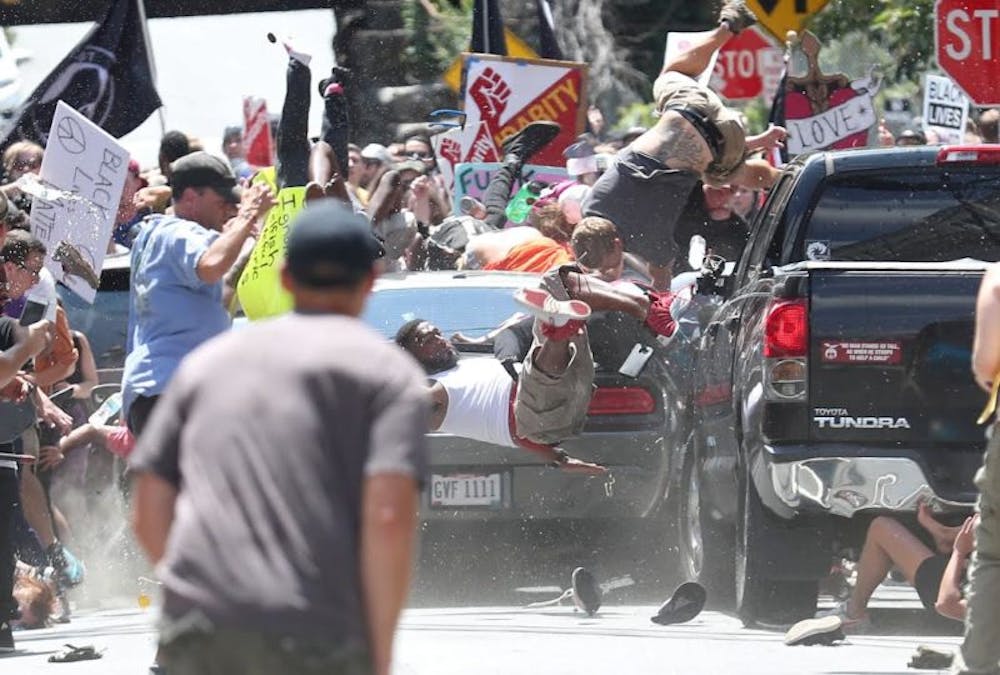
On Aug. 12, 2017, Charlottesville Daily Progress photographer Ryan M. Kelly captured the moment that Nazi sympathizer James Alex Fields, Jr. drove his Dodge Challenger into a crowd of counterprotesters, injuring 19 and killing 32-year-old Heather Heyer. It’s probably the most enduring image to emerge from the weekend of “Unite the Right” rallies in Charlottesville, Va.

Eight months later, Kelly’s iconic photograph from that tragic day has earned him the Pulitzer Prize for Breaking News Photography.

At first glance, the photograph is nearly impossible to make sense of visually or politically. Cars are not supposed to drive into pedestrians; fellow citizens are not supposed to kill each other over political differences. And there’s so much in the frame of the image – so many figures and forms crowded together, most only partially visible – that you can’t take it in all at once.

Pablo Picasso’s 1937 iconic mural “Guernica” might teach us how to interpret this image more closely, and why it is important to do so. Like Kelly’s photograph, “Guernica” conveys a moment of terror through a jumble of forms and fragments that seem to make no sense.

In April 1937, a different sort of “Unite the Right” moment took place in fascist Europe during the destruction of Guernica. At the request of General Franco, the leader of nationalist insurgents in the Spanish Civil War, German and Italian warplanes bombarded the Basque town in northern Spain. Terror rained from the sky: Hundreds of civilians were killed, while military targets were left unscathed.

Days later, as May Day protesters filled the streets of Paris, Pablo Picasso began what would become an anti-war masterpiece.


Pablo Picasso Guernica

Pablo Picasso, ‘Guernica’ (1937).
Reina Sofia


There are uncanny echoes of Picasso’s “Guernica” in Kelly’s photograph. Picasso used the Cubist techniques of fragmentation and collage to create a visual cry of anguish at the destruction wrought by men at the controls of war machines.

To make sense of the painting, you must do the work of reassembling what has been rendered apart. Yet you will never make sense of such destruction. You cannot merely glance at this massive painting or take it in all at once; you must stand and look and witness. There is nothing beautiful about it. It refuses to console. However, in the painting’s abstraction – its matte shades of gray, its distorted figures that stand in for the wounded and the dead – there is a kind of mercy toward its viewers and these victims.

If there is any mercy of abstraction in Kelly’s photograph, it is that of time. The image captures the moment in medias res – when the bodies of the men near its center still evoke the beauty of the human form in its wholeness.


Pulitzer Prize photograph Charlottesville


Ryan M. Kelly/The Daily Progress


Yet we know the victims are not whole; that is why it hurts to look. The contorted positions of the man in red and white sneakers and the man somersaulting above him make sense only in the realm of sports photography. But this is not a game.

Elsewhere the photograph captures only fragments: arms and hands, legs and feet, heads and faces. Empty shoes on the ground. Sunglasses. A cellphone in midair.

You will never make sense of this image because it makes no sense. (Or, rather, it makes as much sense as racism itself.) Yet to look away risks turning away from the truths it tells. A heavy aspect of our national tragedy is that we seem to lack a president – such as Abraham Lincoln – whose heart might break to see such carnage.

As he kept reworking “Guernica,” Picasso painted over a raised fist he had initially drawn near the center of the canvas. Then – as now – the raised fist is a symbol of solidarity against fascism. It makes an eerie reappearance on two posters in the top third of Kelly’s photograph.

“Guernica” includes small lines resembling newsprint. The Charlottesville photojournalist’s image is also crowded with text; some of it implicates the driver, while other words are a call to action.

Clear as day, there’s the incriminating license plate. No one can deny that this car drove into this crowd, as the colluding European fascists did when they claimed that Guernica had been bombed by Spanish Republican forces.

Then there’s the collage of protest signs and street signs that the neo-Nazi at the wheel didn’t heed: Peace/Black Lives Matter. Solidarity. STOP. LOVE. BLACK LIVES. STOP.

Kelly’s photograph redirects these injunctions to the viewer, who’s left to wonder whether this is what our democracy – or the state of our union – looks like.

The ConversationThis is an updated version of an article originally published on Aug. 17, 2017.

Jennifer Wenzel, Associate Professor of English and Comparative Literature and Middle Eastern, South Asian, and African Studies, Columbia University

This article was originally published on The Conversation. Read the original article.


Monday, March 19, 2018

From the Archives: Va. Foundation for Humanities increases private funding, helps mark Civil War

Va. Foundation for Humanities increases private funding, helps mark Civil War
March 19, 2011 12:21 AM MST

Sponsored by the Charlottesville-based Virginia Foundation for the Humanities (VFH), the annual Virginia Festival of the Book brings about 25,000 visitors to the city to hear and engage with authors, publishers, book reviewers, and bibliophiles.

Virginia Humanities Robert Vaughan Virginia Festival of the Book
The 2010 festival hosted 160 events featuring 307 authors, drawing visitors from 35 states and at least six foreign countries.

It should come as no surprise, then, that VFH president Robert Vaughan says, “We’re certainly going to continue this annual book festival, there’s no question about that.”

Vaughan spoke to the Charlottesville Libertarian Examiner at the University of Virginia on March 16, after a presentation on civility in public life by former Iowa congressman Jim Leach, who now serves as chairman of the National Endowment for the Humanities.

Private giving
Asked about what VFH is doing to encourage private philanthropic giving to promote the humanities in Virginia, Vaughan explained that the foundation has “a very active private giving program. Our private giving has increased over the past five years significantly.”

Even before five years ago, he said, private giving “was getting better and better,” but added that in the past half-decade, “we flipped, actually, from being about 60 to 65 percent either federal or state funding to being about 60-plus percent private funding.”

While the VFH does not have any programs to assist private donors looking for potential recipients, Vaughan did say that “we have increased our earned income, which I think is something that both private donors as well as public donors appreciate.”


Women and minorities
Over the next year, Vaughan said, the VFH will continue its traditional programming activities but it is also branching out.

“We’ve always had a long and strong interest in minority communities and minority cultures,” he explained. “We began focusing on women early on,” as well as on “the black community in Virginia, because it’s large and significant and historic.”

VFH, he added, has recently begun to include Virginia’s Native Americans in its programs.

Vaughan also pointed to a couple of events at the book festival that feature speakers from the Muslim world and the Middle East, and explained that these are related to a fellowship program that started about 18 months ago that also includes “Asian immigration and Latino immigration into the Commonwealth of Virginia and the influence and effects that that’s having on the culture, the community, the sense of place that we have.”


Marking the Civil War sesquicentennial
VFH is also involved in efforts to commemorate the 150th anniversary of the American Civil War, which began in April 1861.

“We have been involved with the Virginia Sesquicentennial [of the American Civil War] Commission,” he said, helping “in a minor way” with the seven conferences the commission is putting on. “There have been two so far. The next one will be on May 21st at Virginia Tech, focusing on military" issues.

A larger project that he described is “building an encyclopedia of Virginia, an entirely on-line, digital publication,” which has been in process for about four years.

“It takes a long time because it is gigantic, as you might imagine,” Vaughan explained. “It can include virtually everything – virtually in both ways” that word is used.

The connection to the Civil War commemoration is that for the past year and a half or so, the encyclopedia “decided to focus on the Civil War because of the timing.”

This digital publication, Vaughan noted, also provides “the content for the Sesquicentennial Commission’s web site on the Civil War,” serving as “the educational component of it.”

The encyclopedia’s virtual pages, he concluded, are “quite a glorious record of the good, the bad, the indifferent, about the Civil War and the way that Virginia was involved.”

The VFH-sponsored Virginia Festival of the Book continues through Sunday, March 20, in and around Charlottesville.

Publisher's note: This article was originally published on Examiner.com on March 19, 2011. The Examiner.com publishing platform was discontinued July 1, 2016, and its web site went dark on or about July 10, 2016.  I am republishing this piece in an effort to preserve it and all my other contributions to Examiner.com since April 6, 2010. It is reposted here without most of the internal links that were in the original.

Monday, February 05, 2018

From the Archives: 2013 Charlottesville voters may have historic election for constitutional posts

2013 Charlottesville voters may have historic election for constitutional posts
February 5, 2013 2:06 PM MST

What was so special about 1969?

A recent announcement by Lee Richards that he is retiring as Charlottesville's Commissioner of the Revenue after 20 years in that office raises the possibility that there could be a contested election for that job for the first time in many years.

Charlottesville election 1969 sample ballot Daily Progress
Forty-four years, as it happens.

The first and last time that all five constitutional offices in Charlottesville were contested was 1969, which was also the first time that Virginia voters elected a Republican as governor (Linwood Holton).

It appears that Charlottesville Republicans were unusually well-organized in 1969, since the local party was able to recruit challengers for Commonwealth's Attorney, City Treasurer, Commissioner of the Revenue, City Sergeant (apparently the equivalent of today's Sheriff), and Clerk of the Corporation Court (apparently the equivalent of today's Clerk of the Circuit Court).

According to a front-page note in the Daily Progress of November 6, 1969, “Charlottesville, in a Democratic surge in contrast to its neighbor counties, re-elect[ed] all five constitutional officers over their first GOP challenge.”

Pensioners
There is no voter in Charlottesville younger than 65 years of age who has ever faced a general-election choice for Commissioner of Revenue or Treasurer.

Charlottesville election 2013 constitutional officers
As previously reported by the Charlottesville Libertarian Examiner, an April 2 special election for City Treasurer will be the first contest for that office since November 1969. In that case, independent candidate John Pfaltz is challenging incumbent Democrat Jason Vandever, who succeeded Jennifer J. Brown after she retired for health reasons in October 2012. Brown was first elected on the same ticket as Lee Richards in 1993 and, like Richards, never faced a general-election opponent.

Richards succeeded Ora Maupin, a 17-year incumbent in 1969, retired after the 1993 election with a total of 38 years in office. Maupin had run unopposed in 1965 and in each subsequent election from 1973 through 1989. (A search through city election records found that those from before 1965 are incomplete.)

Maupin's 1969 Republican challenger was Charlotte Frame, described by the Daily Progress as a “teacher of exercise and crafts for the Charlottesville Department of Recreation.”

Two potential candidates have indicated their interest in seeking he Democratic party's nomination for Commissioner of Revenue in the June 11 party primary, Jonathan Stevens and Todd Divers, although neither has filed official candidacy papers. No Republican or independent candidates for the post have so far emerged.

The filing deadline for Democratic primary candidates is 5:00 p.m. on March 28; other candidates have until 7:00 p.m. of primary day, June 11, to get their names on the general election ballot.


Publisher's note: This article was originally published on Examiner.com on February 5, 2013. The Examiner.com publishing platform was discontinued July 1, 2016, and its web site went dark on or about July 10, 2016.  I am republishing this piece in an effort to preserve it and all my other contributions to Examiner.com since April 6, 2010. It is reposted here without most of the internal links that were in the original.

Tuesday, January 23, 2018

From the Archives: Rutherford Institute asks local lawmakers to speak out against drones

Rutherford Institute asks local lawmakers to speak out against drones
January 23, 2013 1:11 AM MST

Rutherford Institute Charlottesville dronesA Charlottesville public-interest law firm has sent a letter to both the Charlottesville City Council and the Albemarle County Board of Supervisors warning of the dangers to civil liberties posed by the use of drones and asking both bodies to pass resolutions demanding protections against drones' misuse.

In a letter dated January 21 and addressed to Charlottesville Mayor Satyendra Huja, Rutherford Institute president John Whitehead points out that recent legislation signed by President Barack Obama “has opened the door for unmanned aerial vehicles” (drones) to fly in the skies of the United States.

In the letter, Whitehead cites predictions that by 2020, there may be as many as 30,000 drones operating in U.S air space. He calls these drones “robotic threats to privacy and security.”

Threats to civil liberties

Whitehead expresses his hope that Charlottesville's City Council will “not only give serious consideration to the dangers posed to our freedoms by these aerial devices but ensure that the people of Charlottesville are protected against any resulting incursions on their rights” that are guaranteed by the U.S. Constitution.

To that end, Whitehead sent a copy of a Rutherford Institute-drafted model resolution for consideration by the city council and the county supervisors.

The resolution is intended to “encourage the General Assembly of Virginia to provide for limitations on the use of evidence obtained from the domestic use of drones and to preclude the domestic use of drones equipped with anti-personnel devices” (that is, weapons).


It notes that “the federal government and the Commonwealth of Virginia have thus far failed to provide reasonable legal restrictions on the use of drones within the United States” and that police departments have started to use drone technology without “any guidance or guidelines from lawmakers.”

In plain language, the resolution calls on Congress and the Virginia General Assembly “to adopt legislation prohibiting information obtained from the domestic use of drones from being introduced into a Federal or State court, and precluding the domestic use of drones equipped with anti-personnel devices, meaning any projectile, chemical, electrical, directed-energy (visible or invisible), or other device designed to harm, incapacitate, or otherwise negatively impact a human being.”

'Get in an uproar'

In an interview on Coy Barefoot's afternoon drive-time radio program on WINA-AM Monday, Whitehead suggested that “if enough cities across the country were to get in an uproar about” the civil liberties threats of drones, “we might be able to limit them some.”

He pointed out that already-existing technology allows drones to “be able to see through the walls of your home.” They are powerful enough, he said, “they are able to watch you in your homes, connect up with all the [electronic] devices in your homes.”

The drones, he said, “are amazing devices,” which include “hummingbird drones that come up to your window and watch you in your home.” Other, non-flying drones look like dogs and can walk "up to your front door.”

Citing Martin Luther King, Jr., Whitehead warned that “it's time to stand up and fight back,” and said that, in the absence of federal limits on drone use, local and state governments must act.

Experts, he said, are “freaking.” If, he said, there is a device “that flies over your home that can see you in your kitchen or upstairs using the bathroom or having sex with your wife, we've entered a whole new era” of threats to privacy and personal liberty.

Drones, he said, are “beyond Orwell. It's scary stuff.”


Publisher's note: This article was originally published on Examiner.com on January 23, 2013. The Examiner.com publishing platform was discontinued July 1, 2016, and its web site went dark on or about July 10, 2016.  I am republishing this piece in an effort to preserve it and all my other contributions to Examiner.com since April 6, 2010. It is reposted here without most of the internal links that were in the original.