A highly respected conservative jurist who sits on the Fourth Circuit Court of Appeals in Richmond has put himself on the record in opposition to amending constitutions -- whether federal or state constitutions -- to define marriage.
Charlottesville resident and University of Virginia alumnus (he graduated from the Law School in 1972 and later taught there) Judge J. Harvie Wilkinson, who was nominated to his current position by President Ronald Reagan in 1984, has an op-ed piece in today's Washington Post that outlines his argument against "constitutionalizing" marriage.
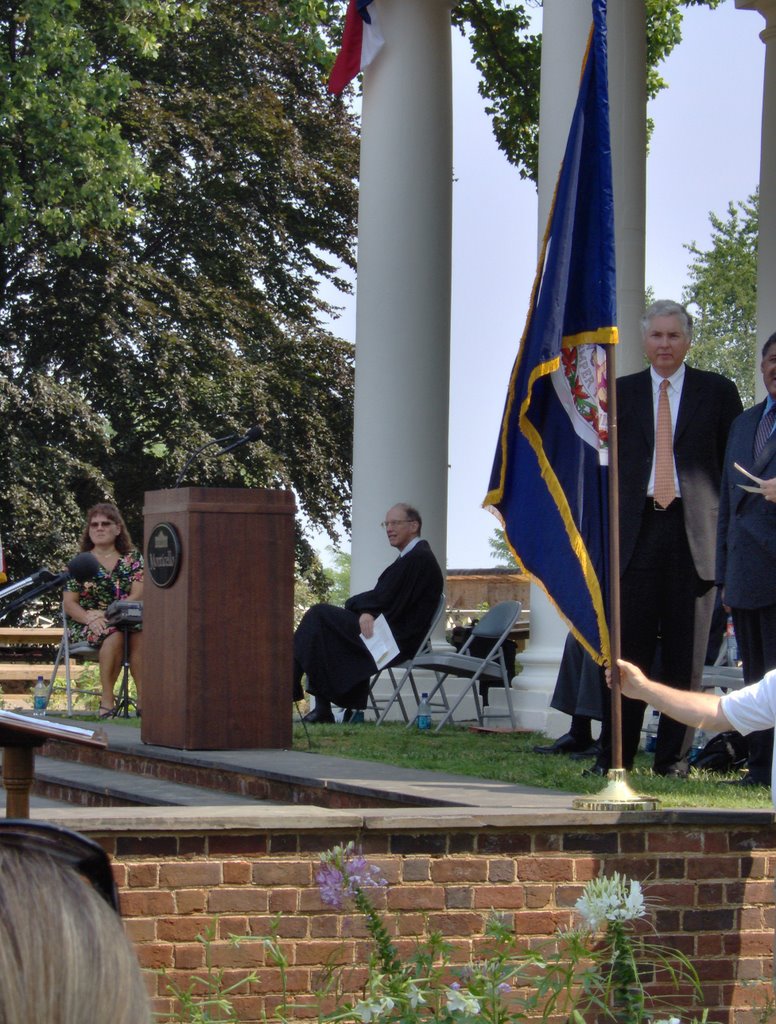
In "Hands Off Constitutions: This Isn't the Way to Ban Same-Sex Marriage," Wilkinson (pictured, seated at Mr. Jefferson's house at Monticello, in the photo on your right) writes:
The Framers meant our Constitution to establish a structure of government and to provide individuals certain inalienable rights against the state. They certainly did not envision our Constitution as a place to restrict rights or enact public policies, as the Federal Marriage Amendment does.Ordinary legislation -- not constitutional amendments -- should express the community's view that marriage "shall consist only of the union of a man and a woman." To use the Constitution for prescriptions of policy is to shackle future generations that should have the same right as ours to enact policies of their own. To use the Constitution as a forum for even our most favored views strikes a blow of uncommon harshness upon disfavored groups, in this case gay citizens who would never see this country's founding charter as their own.
Wilkinson, who was widely touted as a potential successor to Sandra Day O'Connor upon her retirement from the U.S. Supreme Court, notes -- correctly, in my opinion -- that proposals to insert marriage into constitutions are not in keeping with either federal or state constitutional and legal traditions:
To constitutionalize matters of family law is to break with state traditions. The major changes in family law in the 19th and 20th centuries, such as the recognition of married women's property rights and the liberalization of divorce, occurred in most states at the statutory level. Even the infamous bans on interracial marriage were adopted nonconstitutionally by 35 states, and by constitutional amendment in only six.
Where is the threat that justifies so radical a break with our constitutional heritage? State courts in Georgia, New York and Washington have recently rejected invitations to follow Massachusetts and find a right to same-sex marriage in their constitutions. The great majority of state court judges -- more than 80 percent by some counts -- are subject to election in some form and unlikely to overturn state legislatures on so volatile a matter as same-sex marriage. States have numerous tools that enable them to reject objectionable marriages from other jurisdictions -- tools that have long been the basis for refusing to recognize marriages involving polygamy, incest, and underage or mentally incompetent parties.
While Judge Wilkinson does not say so outright, it seems fair to infer from his concluding paragraph that he, like
hundreds of thousands of other Virginians, plans to
vote "no" on the proposed Ballot Question #1 in this November's election. (That ballot measure does much more than simply define marriage. Its complexity can be read in full
at the State Board of Elections web site.) Wilkinson ends his article by saying:
Is it too much to ask that judges and legislatures acknowledge the difficulty of this debate by leaving it to normal democratic processes? In fact, the more passionate an issue, the less justification there often is for constitutionalizing it. Constitutions tempt those who are way too sure they are right. Certainty is, to be sure, a constant feature of our politics -- some certainties endure; others are fated to be supplanted by the certainties of a succeeding age. Neither we nor the Framers can be sure which is which, but the Framers were sure that we should debate our differences in this day's time and arena. It is sad that the state of James Madison and John Marshall will in all likelihood forsake their example of limited constitutionalism this fall. Their message is as clear today as it was at the founding: Leave constitutions alone.
Conservatives -- particularly conservative Republicans, like Lieutenant Governor
Bill Bolling and Attorney General
Bob McDonnell, who have been rather vocal (if not particularly persuasive) in their support of the proposed Marshall/Newman Amendment to George Mason's Virginia Bill of Rights -- will have to come to grips with Judge Wilkinson's principled argument against constitutionalizing marriage law. They might sputter out a response, but they are unlikely to match his deliberateness and erudition. Other conservatives and Republicans have already
shown their willingness to listen to reason on this issue.
In his article, Judge Wilkinson goes a long way toward answering the question that good, solid conservatives ask every time they are confronted with a serious issue of public policy: "
What would Ronald Reagan do?" I hope that voters on November 7 ask themselves the same question before they push the "Cast Ballot" button.
Update: As one might expect,
Judge Wilkinson's article is eliciting a lot of commentary among bloggers. Some posts I have seen (and there are surely others) include comments from
Vivian Paige,
Dale Carpenter at the Volokh Conspiracy,
Delta Mike at the Virginia Progressive, and
J. Sarge at New Dominion,
F. T. Rea at SlantBlog,
Steve Minor at the SW Virginia Law Blog,
A Shot of Southern Comfort,
The Midwestern Gentleman, and
Glenn Reynolds at Instapundit. Meanwhile, somehow I missed an
op-ed in yesterday's Richmond Times-Dispatch by a former Republican legislator on the economic consequences of the proposed amendment.
Another Update: GayPatriotWest, traveling in the great American Southwest,
links to this post and mentions his own personal acquaintance with Judge Wilkinson while he (GPW) was a student at UVa Law School. Milwaukee-based blogger and law student Steve at
Eminent Domain also has a comment, as does Andrew Sullivan, who calls Wilkinson's article "
sane and smart."