Most parents lie to their children. It’s usually done to get the children to behave the way the parents want. One study found that well over 80% of American parents and more than 90% of Chinese parents admitting to this kind of “instrumental” lying. Lying about the existence of Father Christmas often falls into this category, used as a tool to teach pro-social behaviour (helping and sharing) through the promise of presents if the children are good.
Of course, there can be other reasons for carrying on the Santa myth that are more to do with children’s immediate happiness. These could include extending the naivety of childhood and raising the excitement of the holiday season. But given what we know about children’s ability to figure out the truth, it seems likely that slightly older kids may well be playing along with their parents’ fantasy in order to reap the benefits of the promised rewards.
When studies have questioned whether lying to children about Father Christmas does them any harm, the theory seems to be that the dishonesty undermines parents’ image as trustworthy and reliable sources of information. But there’s no real evidence of any lasting damage.
Research with children who no longer believe has shown that they tend to stop believing in Santa around seven years of age. When interviewed about their feelings about being lied to – and how they felt about Santa now – the children generally tended to report positive happy emotions around the topic. Parents, on the other hand, were left saddened by their child’s loss of Santa belief.
Children tend to come to the end of their belief of Santa either through their own tenacious questioning of the logic and practicality of the myth, or by older, more seasoned siblings and peers bursting the bubble. This is particularly the case for today’s tech-savvy kids, who have the internet to answer every question and give them extra space for conversations away from the protective guidance of adults keen to keep the myth alive.
Yet while children often come to the realisation that Santa is not what they had been lead to believe on their own, they also tend to act along with the fiasco and continue to play along with 58% of children in one study playing the role of Santa-believer. This goes counter to the under-sevens’ tendency to correct the mistakes adults make, in speech for example, and to trust more reliable adults.
So what’s in it for the kids in maintaining the lie? Well the commonly written letter to Santa may give us some clues. Rather than reading this note assuming that this child believes in Santa, if we cynically consider that he or she no longer believed in Santa but is playing along – then the child is playing along like a pro.
We can see children’s willingness to play along with pretence and fantasy well beyond the seasonal myths into a more general eagerness to suspend reality for the enjoyment of play, something long associated with their development. The act of playing along may also support children as they test out out their knowledge and theories of the real world.
Logical to pretend
Within the letter to Santa, children often recognise the premise that they should have been good to warrant the requested presents, demonstrating they have followed the behavioural compliance set out by their parents. They put in a good mix of optimistic present requests, but with a placating note for those that might be overreaching and some humbler suggestions with a higher likelihood of approval. Plus there may be a nod to their doting grandparents for the affection it can be assumed they appreciate.
Really, the traditional letter represents a child’s well-constructed communication to people they know are lying in the hope they will reward the pro-social behaviour and willingness to play along. So, while researchers have reported that younger Santa cynics may have well-developed abilities in logic and reasoning, this doesn’t necessarily mean they won’t play along with the myth for a little longer. Doing so may be enjoyable in itself, have some present-shaped benefits, and be a positive family experience.
There is also little evidence that childhood myths challenge otherwise trusted and secure parent-child relationships. Instead, when children realise that their parents were engaged in a protracted deception, the children appear to be less saddened than their parents.
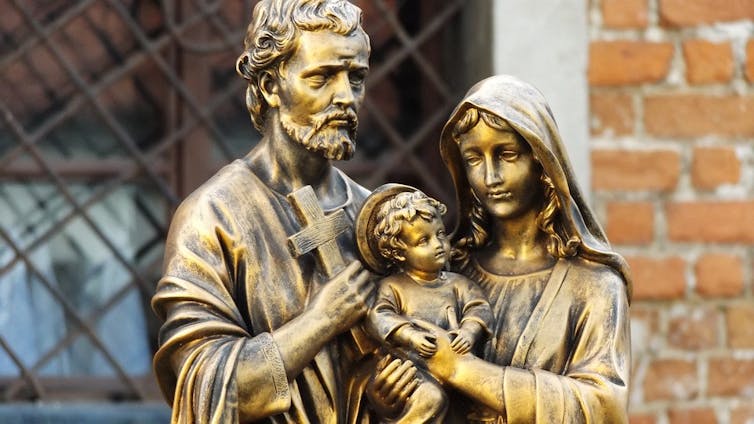
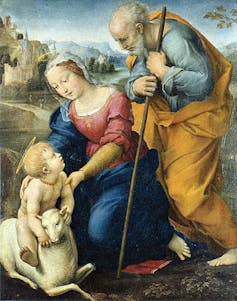
One of his most controversial statements of support came from Alabama State Auditor Jim Ziegler, who declared: “there’s nothing immoral or illegal here…Maybe just a little unusual.” Ziegler went on to appeal to the Christian story of Mary and Joseph:
“Take Joseph and Mary. Mary was a teenager and Joseph was an adult carpenter. They became parents of Jesus.”
I find the allegations against Moore repulsive. But, in addition, as a scholar of early Christianity, Ziegler’s remarks took my breath away. As most Christians would know, an important tenet of Christian theology is that Jesus was born of a virgin mother.
However, there are many other little-known details in early Christian storytelling about the relationship between Mary and Joseph that I learned while researching my book, Jesus, Mary, and Joseph: Family Trouble in the Infancy Gospels. Early Christians believed that Mary and Joseph did not have sex, but there was much more that was worth learning from that relationship.
Listen up, Jim Ziegler.
The gospel narratives
The Christian Bible includes four gospels, or narratives, of the life of Jesus. Two of them, the Gospel of Matthew and the Gospel of Luke, include accounts of Jesus’s birth. These two versions of the “Christmas story” supply almost all of the details about Mary and Joseph that can be found in the Christian Bible.
In Matthew 1-2, readers learn about the birth of Jesus in Bethlehem, the visit of the Magi or “wise men” to see the newborn and the flight of the holy family to Egypt in order to escape King Herod’s killing of infants. Luke 1-2 describes the birth of John (the cousin of Jesus), an imperial census under the Roman Emperor Augustus and the appearance of angels celebrating the birth of Jesus in the skies above Bethlehem.
Both the gospels seem to agree that Mary conceived by supernatural means, not through sexual intercourse. Meanwhile, whatever Zeigler claims, neither the Gospel of Matthew nor the Gospel of Luke specifies the ages of Mary and Joseph.
The Proto-gospel of James
The earliest source to mention ages is another ancient Christian gospel: the Proto-gospel of James. This gospel is a prequel to the more familiar stories of the first Christmas found in the Christian Bible. It was written in the second century A.D., a hundred years or so after the gospels of the Christian New Testament. Critically, it is mostly unknown to Christians because it is not found in their Bibles.
Even so, the Proto-gospel of James is an important witness to the things that mattered to early Christians. The relationship of Mary and Joseph is one of them.
The Proto-gospel of James tends to fill in gaps left by the Gospels of Matthew and Luke. This, for example, is where readers can learn about the parents of Mary – Joachim and Anna – and about the divine intervention that leads to Anna’s conception of Mary.
This gospel also recounts the story of when Mary met Joseph, details absent from the Gospels of Matthew and Luke. In this telling, Joseph, an elderly widower, is chosen by lottery to take care of Mary, who is 12 years old at the time.
Like the Gospels of Matthew and Luke, the Proto-gospel of James reports that Mary does not conceive through sexual intercourse. She receives news from the angel Gabriel that she will become pregnant and bear a son, Jesus. But the Proto-gospel of James’s account adds a new wrinkle: Mary forgets about her encounter with the angel. When she realizes that she’s pregnant, she’s overcome with fear and confusion. Joseph is likewise confused by Mary’s pregnancy. He nevertheless remains loyal and protects the 12-year-old girl. He takes her to a cave outside of Bethlehem. Soon there is a blinding flash of light. As it recedes, a child appears.
Jesus has arrived.
Familiar and unfamiliar
Some of these details will be familiar to readers of the New Testament: the town of Bethlehem, for example, and the angelic announcement to Mary – the Annunciation – that she will become pregnant.
Other details, however, will come as a surprise: Wasn’t Jesus born in Bethlehem, and not, as the Proto-gospel of James reports, outside of Bethlehem in a cave? And what about the story of how Mary met Joseph? The Proto-gospel of James adds to and changes elements of the earlier accounts of Matthew and Luke.
And then there are details that some Christians know from their religion that other Christians do not. Most Orthodox and Roman Catholics, for example, know the names of Anna and Joachim, the parents of Mary, even though they do not include the Proto-gospel of James in their Bibles. Most Protestant Christians, by contrast, will be unfamiliar with these figures.
In fact, the Proto-gospel of James is just one example of a wide range of gospels and other early Christian writings that are not included in the Christian Bible. The storytelling about the holy family alone could fill a bookshelf: There is the Infancy Gospel of Thomas, the Gospel of Pseudo-Matthew and the History of Joseph the Carpenter. Written at different times in different places, these accounts reflect the early Christian fascination with the household of Jesus, Mary and Joseph.
Love is not predatory
One final observation that is relevant to Jim Ziegler’s comments: The Proto-gospel of James goes a step further than the Gospels of Matthew and Luke in making the point that there was no sexual contact between Mary and Joseph.
In the Gospel of Matthew, Joseph overcomes personal anxiety about Mary’s pregnancy. In the Proto-gospel of James, the pregnancy of Mary becomes a matter of public scrutiny: Both Mary and Joseph must drink the “water of refutation,” a life-and-death ordeal designed to test the truth of their claims of not having had sex with one another. Both pass the test.
But the Proto-gospel of James is not just a story about the virginity of Mary, nor is it just about Joseph’s lack of involvement in the conception of Jesus. Mostly, it is a story about two people being swept up in events that they do not understand.
Together, Mary and Joseph risk everything despite not knowing what it all means. Amid the chaos, they learn to lean on each other. While Mary and Joseph do not, according to the Proto-gospel of James, have a physical relationship, they do love one another.
And love should not be compared to the predatory behavior alleged against Roy Moore.
Courtesy of grammarly.com/grammar-check and just in time for Father's Day, we have this test of grammar acumen. Check your skills and be sure to share the results on social media!
Remember, Father's Day is the third Sunday in June each year -- Sunday, June 21, in 2015!
Back in 2008, I offered my recollections of how my family celebrated Christmas as I was growing up in the 1960s and 1970s.
Now I have some videos to illustrate those memories.
I have transferred some ancient home movies, filmed with a Super-8 millimeter camera, to digital format. Through them, one can follow the holiday celebrations of Christmas Eve and Christmas Day in the year 1967.
Yes, 44 years ago. Almost half a century. I was eight years old. I don't remember what it was like to be eight years old, but at least I can see myself then again.
First, the early evening of Christmas Eve. On this occasion, the rotating responsibility of hosting the Czuta family and its branches by marriage (Benkert, Geilenfeldt, Jaeger, Michalak, and Sincere) fell to my parents, so the party was held at our house in Wauwatosa.
Can you believe that one acceptable Christmas present in those days was a decorative ashtray? (Watch carefully and you'll see it.)
Next, my family took to the road -- no doubt leaving the wrapping paper on the floor and half-empty highball glasses on the bar -- to visit with the Sincere family. The first sequence is at my grandparents' home on North 49th Street, with most of my dad's brothers and sisters (especially those who were not yet married) finding their way there as well.
The later sequence is at the home of my Uncle Bill and Aunt Lucy. Note the several pre-teen boys dressed in tacky Batman costumes. (Adam West would appreciate the gesture if not the execution.) Christmas Eve was about the only time that we kids were allowed to stay up well past midnight. My guess is that this footage was shot around 2:00 a.m., even as Santa Claus was gliding up above to deliver his presents to all the good girls and boys.
I'm sure if I uploaded just the 30 seconds or so of the Batman boys, that video would go viral.
Finally, Christmas morning arrives and it is time to open up those presents left behind by St. Nick.
The first 3'30" of this video takes place at the foot of the artificial Christmas tree at my own family's home on West Derby Avenue in Wauwatosa. The gifts that I open up, as toy poodle Tabitha bounds through the discarded wrapping paper, include a toy called "Incredible Edibles" and a "GI Joe Official Space Capsule," commemorating NASA's Gemini program. I also received a bowling ball (it weighed eight pounds, one pound for each year of my age, and did not yet have finger holes drilled into it).
Later, we traveled to the home of my grandparents, Chester and Josephine Michalak, on Spring Drive in Brookfield. Santa left behind a big haul for me and my cousins, Julie and Sheri (my sister, Cathy, and their sister, Jennifer, had not yet been born; our other cousins, Jason and Chris, were more than a decade in the future). Apparently I really liked that tacky Batman costume, since I wore it Christmas morning.
Whether this was a history lesson or simply an exercise in nostalgia, I don't know.
In any case, I wish you a Merry Christmas (1967!) and a Happy New Year!
Many have no doubt heard the story about a syncretistic Christmas display in a Japanese department store that featured a prominent figure of a jolly Santa Claus hanging from a cross. This is likely to be an urban legend but, like many such urban legends, it has wide currency.
Even if the story is true, in a country where fewer than one percent of the people are Christian and, therefore, unfamiliar with Western religious customs and traditions, the odd -- even ghoulish -- pairing of St. Nick and a crucifix can be forgiven as the result of a good-natured desire to be welcoming of foreigners and their beliefs despite ignorance of what we might call "the true meaning of Christmas."
It's a bit harder to be so lenient with residents of a majority-Christian country like the United States, where even non-believers are familiar enough with Christmas customs that they are unlikely to commit religious faux pas.
So I was shocked, to say the least, when I found this item in the clearance aisle of K-mart two days after Easter Sunday: a "Happy Easter Candy Cross" from the R.M. Palmer Company.
Now, I come from a family where Easter breakfast included meticulously-sculpted "butter lambs" made by my grandmother, but they were (to mix a metaphor) cut from the same cloth as dyed-and-labeled-by-name eggs and a basketful of breads, ham, Polish sausage, and horseradish blessed by the priests at St. Hyacinth's, an ethnic Polish parish on the south side of Milwaukee.
Yet when I see a decorated chocolate cross, ready to crunch and mouth-meltable, only one word comes to mind: sacrilege.
Is my reaction a Catholic thing? Do I misconstrue the intentions of something that claims to be "America's Favorite Holiday Candy"? Is my comparison to the crucified Santa out of place?
Next thing you know, they'll be selling lighter-than-air cotton candy to celebrate Ascension Thursday.
This particular volume caught my eye because the 1951-52 school year was the last one that my father attended MUHS. (Today would have been his 76th birthday.) I was also interested to see if I could find a photograph of legendary broadcaster Tom Snyder, who graduated with the class of 1953.
I scored on both counts, but also found a few other interesting things.
For one, it seems that virtually nobody at Marquette High in the early 1950s -- whether students, faculty, or staff -- had first names. Some people in the yearbook were identified with a first initial, if they shared a surname with someone else. The only people with first names were those who shared both a surname and first initial with another person. So, for instance, my dad is identified simply as "Sincere" and the future host of NBC's Tomorrow Show is identified as "Snyder."
I also discovered that there were faculty and staff members at MUHS who spanned the period from 1952 to 1977, the year I graduated. These included math teachers John Fountain and Laurence Kelly, S.J., librarian Miss Elizabeth Connelly, and English teacher Father Richard Forrey, S.J. (I have an even earlier -- 1927 -- Flambeau that has a photograph of Mr. Fountain as a young teacher.)
By sheer coincidence, I found two MUHS graduates of the class of 1952 who later achieved prominence in their closely-related fields.
Tad W. Guzie became a Jesuit priest, theologian, and liturgist. He later was laicized and married, passing away in 2001. Juxtaposed on the same page as his graduation picture is a photograph of John M. Haas, who also became a theologian, specializing in bioethics.
Here is the only photo in the 1952 Flambeau I was able to find with my father in it. He is identified as "Sincere" and is the fourth from the left in the top row:
As for Tom Snyder, I found more than a few mentions of his name.
First, his class photo (he is in the bottom row, far left):
Then I found him as one of the performers in the Prep Players' production of Mary Chase's Pulitzer Prize-winning play, Harvey. He didn't play Elwood P. Dowd (the role made famous by Jimmy Stewart) but rather was cast as Dr. Sanderson:
In years past, it would have been difficult to find something as rare as a nearly 60-year-old high school yearbook. I wasn't exaggerating when I referred to the "magic" of eBay. The Internet has made possible what we thought was impossible.
Update: The Winter 2010 edition of the MUHS alumni magazine arrived in my mailbox today (March 16) with this note on page 32:
Tom Snyder '53, the radio and late night TV talk show pioneer who often remembered Marquette University High School and the Revs. Jerome Boyle SJ and RJ Connell SJ on-air, paid homage to the school with a recent fift that established an endowed scholarship fund in his name....
The Thomas J. Snyder Endowed Scholarship Fund will help support students who demonstrate financial need and who participate in the arts during their time at MUHS.
It wasn't until reading this that I discovered that, not only did Tom Snyder and I attend the same high school (at a distance of about a quarter-century) but we also attended the same elementary school, St. Agnes. (That is, of course, assuming that there has only been one St. Agnes School within the boundaries of the Archdiocese of Milwaukee, the one in Butler.)
On three previous occasions (usually toward the middle of the year), I have posted reminiscences of my summers with St. Bernard's Studio Theatre in Wauwatosa, Wisconsin.
The first two posts offered video and photographs from the summer of 1977, when we mounted a twentieth anniversary production of Meredith Willson's The Music Man.
This time around I am posting something about a show that was produced before I became a participant in St. Bernard's Studio Theatre -- the company's inaugural production of Hello, Dolly!, which went up in the summer of 1975.
The coincidence that brought this material to my attention was a very old, very wrinkled, and very yellowed copy of the Wauwatosa News-Times from July 24, 1975, which had on its cover two photographs taken when my family's house was nearly destroyed by fire. (It goes without saying why I kept the newspaper in my archives.) I just happened to leaf through the paper and discovered inside a photograph and article about Hello, Dolly! that I had never seen before.
My guess is few people have seen this material in the past 33.5 years, either. So, while my inclination was to wait until July to post these clippings, I had to ask: Why wait?
The article mentions several people I remember fondly from my few years with the Studio Theatre company, which was as much a family as it was a performance troupe. The article gives a sense of why this was:
The rousing musical has a cast of 90 amateur performers all from Wauwatosa and surrounding areas, ranging in age from five to 52 years old....
Edward Leahy ..., father of 10 children and one of two men taking the leading role of Horace Vandergelder, will ease through an intricate soft shoe dance with Dolly and some 20 men, representing two generations, in another highlight of the show.
Some of Leahy's family also will be actively engaged in the two weekend productions. Brian, 20, is producer of the show and a member of the chorus. Mrs. Leahy, Danny, Kathleen, and Gerald also are in the chorus and Maureen and Ned are members of the stage crew.
Other families who will participate in the show are Mr. and Mrs. Gordon Rise (he is the other Horace Vandergelder) and Sharon and Scott...; James Jacobs and daughter Patty...; William Staudenmaier and daughter Ann Marie...; Mrs. Irene Alberte, one of two who will do the role of Dolly, and children Lisa, Nancy, and Paul...; and Charles White and daughters Vicki and Peggy....
"Hello Dolly" is being directed and choreographed by Rozeann Campbell..., a teacher of dance at Divine Savior-Holy Angels High School and well-known in Wauwatosa theater. Her oldest daughter, Marla, has done the art work on the set while 15-year-old Suzann is costume mistress and Kimberly, 8, will sing in the chorus.
That pattern of family participation repeated itself in subsequent years: Ed Leahy played Mayor Shinn in The Music Man, Gordon Rise was one of two Tevyes in Fiddler on the Roof, and Irene Alberte played my mother in The Boy Friend, to give just three examples -- and each year also saw their own family members in cast and crew.
Click on the images below to embiggen and read the full article for yourself.
I promise more community theatre memories will be posted this summer.
This past weekend on public radio's A Prairie Home Companion, Broadway director and actor Walter Bobbie reminisced about celebrating Christmas in a Polish-American family in Scranton, Pennsylvania (when Scranton was known more for coal mining than for Dunder-Mifflin paper products) during the 1950s and '60s.
Bobbie's memories described something remarkably close to the Christmas traditions practiced by my own Polish-American family in Milwaukee in the 1960s and '70s.
For instance, Bobbie told the radio audience about the sharing of opłatki (singular: opłatek), a flat wafer similar to the host served at Communion. He noted that his family members would send opłatki in Christmas cards (as did members of my family who would be far away at Christmas time), and that on Christmas Eve, family members would break off a piece and give it to each other, along with a greeting of "Christ's peace." They might, he said, dip it in honey. (We did not include honey in our ritual.)
Little or no food had been eaten during the day. All waited for the most significant moment of the entire Wigilia [vigil] supper, the breaking and sharing of the opłatek. The host and hostess enacted the ancient rite of the opłatek, facing one another each holding an opłatek, each breaking and sharing a part of the other's. They embraced warmly and expressed their love by wishing for each other, a fulfillment of their deepest yearnings. Then they broke and shared the opłatek with each one present, with messages of love (sometimes in rhyme) of good health, happiness, and an untroubled life, for one to be as sweet as the springtime and to live do dosiego roku, to live as long as "Dosia" lived. She was reputed to be many years over a hundred when she died, jolly and alert to the end, but no one could be found who knew her. The hostess performed a special task when she shared her opłatek with all those present. Besides the good wishes and love, she expressed without words that she would share her bread with those present here, should they be in need, just as she herself sould be willing to take from them, should her position be reversed.
The opłatek, frail, perishable, has for all Poles a mystical meaning which cannot be explained logically. At Christmas time it is sent to absent members and close friends in strange lands, who in their loneliness, partake of it, as of communion with their loved ones at home.
The opłatek, of little monatery value, is the treasured link that brings warm memories of Poland to her children settled in different parts of the world. Losing reality for the moment, they once again dream that they are seated with the family at the Wilia table, enjoying the blessing, forgiveness and warmth of those under the parental roof. At the time of this writing, it can be obtained from the nuns in the convents of America where a large number are of Polish ancestry.
Bobbie also said that dinner on Christmas Eve in his home was austere: fried herring, cabbage soup, and prunes for dessert. (This elicited groans from the audience at Town Hall in New York.) I am happy to say that this was not the tradition in my family by the time I was born (my dad usually brought home a bucket of chicken from Dutchland Dairy to spare my mother the task of cooking), but it is similar to the Christmas meal prepared by my great-grandfather and described to me years later by my mother: scrambled eggs, fish, and -- yes! -- prunes for dessert.
Finally, Bobbie said, after the early evening rituals, he and his family crowded into a car and traveled from house to house, starting with the youngest uncle until they ended up at his Uncle Johnny's place in Jersey City.
I thought I was listening to a recitation of my own childhood Christmas memories.
When I was growing up, Christmas Eve was the big affair and Christmas Day, as pleasant as it was, was almost an anticlimactic afterthought. Perhaps Christmas Eve memories remain more vivid to me today because the anxious anticipation of that night made it so embeddable in the mind and soul of a seven-year-old.
Here is how our family celebrated on Christmas Eve.
Each year a different aunt or uncle (siblings of my mother's mother) would host a party for exchange of opłatki and of gifts. Eventually my mother and her sister would, as adults with children, share in the hosting duties. No meal was served -- each individual family would take care of dinner ahead of time -- but dessert was available, and Christmas cookies, and herring and crackers and other delicacies, and plenty of beer and liquor. (This was Milwaukee, after all, and we were Polish.)
Before heading off to the family gathering, my parents would drive over to the convent attached to my school (St. Agnes in Butler) and deliver two gallon jugs of wine and a box of Christmas cookies to the sisters who taught me. It was during one of those deliveries when, at age 7 and sitting in the back seat, I read an article in The Milwaukee Journal that explained the origins of Santa Claus. It opened my eyes but I didn't let on for a while, perhaps thinking that if I revealed a disbelief in Santa, there may not be gifts under the tree for me on Christmas morning.
So one year the party might be at the Michalak residence, the next at the Czutas, the next at the Jaegers, the Geilenfeldts, and eventually at the Benkerts and Sinceres. But the pattern always remained the same: share opłatki and wish everyone, individually, a Merry Christmas, followed by an exchange of presents, with the youngest cousin opening his or hers first, and circling around the room by age until the floor was strewn with wrapping paper and toys and games were piled high in front of each recipient. (The last year I remember hosting at our house was my senior year of high school, 1976, and some classmates of mine from Marquette University High School arrived "unexpectedly," costumed as Santa Claus and his elves. That was a treat for the young ones, of course, and a minor break in the pattern.)
After that party broke up, usually around 10:00 o'clock, we began to make the rounds of homes in the Sincere family. We would start at my father's parents' house, then move on to my Uncle Bill's and Uncle Carl's and sometimes other homes, as well. At each stop there was lots of smoke (cigarette and cigar) and lots of booze.
I am astounded, given the snowy and icy weather that accompanied Christmas Eve in Milwaukee, and given all the heavy drinking going on, that we made it home without crashing into a snowbank or telephone pole. But we did.
As a child, Christmas Eve meant sitting in the back seat of the car, staring out the window at the sky and wondering if I would catch a glimpse of Santa's sleigh. Before leaving our house, we would listen to the Santa trackers from NORAD in periodic broadcasts on radio station WEMP, which played wall-to-wall Christmas music all day and all night. (And not that monotonous dreck played by "all-Christmas" stations these days -- radio stations in the 1960s had a much longer, much more varied playlist than they do in 2008.)
We would finally get home around 3:00 a.m., which is very late for a 7- or 8-year-old. Worn out by all the activities, my dad would carry me into the house, lay me in my bed, and, before I knew it, the sun was shining through my window and I discovered that Santa had, indeed, arrived with a load of presents.
My Christmas-childhood ended, in a manner of speaking, when I was 15 years old. That year, I joined my parents in laying out the gifts underneath the Christmas tree in the late-night hours of Christmas Eve after my younger sister had gone to bed. That transformed me into an adult for the holidays. (The next year, of course, when I was old enough to drive, was even more of a transformation -- I became the designated driver for the evening, which meant my mom and dad could imbibe even more freely than in all previous years. And I'm not talking wassail, either.) With age comes responsibility.
When my parents moved, with my sister, to Las Vegas while I was in college (in 1979), we did our best to continue the traditions with which we had grown up in Milwaukee. Even if it was just the four of us together on Christmas Eve, we would share an opłatek wafer and then attend a Polish-language Mass at St. Anne's Catholic Church on South Maryland Parkway. It was a little bit of snowy home brought to life in the arid desert.
While looking through some old home movies that had been converted to VHS and DVD, I recently came upon a sequence from Christmas in 1959. (Luckily for me, my grandfather -- who took most of the film -- included the date clearly in one shot.) That turns out to be my first Christmas, and you can see me opening presents on Christmas morning -- at the age of eight months!
The family posed and singing in this video seems to be from my mother's father's side of the family: Michalaks and Labinskis and Sasses and Ambrowiaks. In later years, we would celebrate with those branches of the family on a date closer to Epiphany rather than on Christmas Eve, on a Saturday evening in which we went from one house to another in a "progressive" dinner, each home serving a different course in a full meal. (The first two houses would be drinks and hors d'oeuvres, the third house would be drinks and salad, the fourth house would be drinks and the main course, and the last house would serve after-dinner drinks and dessert.)
The musical soundtrack I have added to this video consists of traditional Polish carols -- known as kolendy and pastoralki -- some of which were sung by Walter Bobbie last weekend on A Prairie Home Companion. And so the circle is complete.
Back in February, I posted four videos I called the "Getting High" series. Two of the videos were from Wisconsin (the top of the state capitol, the peak of Rib Mountain), one was from Michigan's Upper Peninsula (Copper Peak ski flying hill), and the last was from Los Angeles (the Getty museum complex).
The first is archival footage I found in some old home movies taken by my grandfather, Chester J. Michalak, in the early 1960s. This film was made while flying over the resort community of Manitowish Waters, Wisconsin, with its extensive chain of lakes. My best guess is that this dates from August 1960, but it could be a year or two older or younger.
The second is more recent. In March 2007, Richard Morrison and I made a trip to Las Vegas, and we visited the Hoover Dam, which rises from the depths of Black Canyon, impeding the Colorado River and creating Lake Mead. Some of the video is taken from inside the bowels of the dam, where the electrical generators are located, and some of it is from the edge of the canyon and from the top of the roadway that traverses the dam itself.
The videos from Nevada were taken just a few days after I purchased my digital video camera, so I was not as adept as I could have been in shooting the scenery. I have learned a lot since then, so I apologize for the intermittent shakiness and quick, unsteady zooms.
Joanne Michalak Sincere would have relished the idea of her birthday and the Super Bowl coinciding.
This was not just because she was a great football fan but also because she was the consummate hostess -- a suburban Milwaukee version of Perle Mesta who adored entertaining. To combine two reasons to throw a party would have been an unmatched delight for her.
Today would have been my mother's 70th birthday, and my most vivid memories of her come from those many occasions in which she hosted a party for a host of reasons: birthdays, wedding anniversaries, baby showers, baptisms, First Communions, confirmations, Mothers' Day, Fathers' Day, Halloween, the Fourth of July, New Year's Day, Christmas, Thanksgiving, and Super Bowl Sunday.
My mother's twin loves of football and entertaining would have been combined in countless ways if it had been possible, during her lifetime, for the Super Bowl to be scheduled on February 3 instead of in January.
To put this in context, one must understand what the culture of Wisconsin is like with regard to the Green Bay Packers. Wisconsinites' obsession with the Packers makes metropolitan Washington's love affair with the Redskins look tepid in comparison.
I had not noticed this in my growing-up years. To be surrounded by Packermania in Wisconsin is much like being a fish, not noticing that one is surrounded by water. The phenomenon hit me about 10 years ago when I made a trip to Milwaukee for an October high school reunion and I realized that I was the virtually the only person in a crowded shopping mall not wearing green and gold.
My blinders may have been strong even as a youth, however. The last time I watched a Super Bowl game on TV -- or, to be more accurate, the last time I was in a room with the Super Bowl playing on television -- was the second time the Packers played in the Big Game. (Do the math.)
This indifference to football was not shared by my mother (or my father, either). Even in the years after my parents left Wisconsin for the desert climate of Las Vegas, they continued to wear Packer gear and even sought out a sports bar that specifically showed Packer games on its big screen. (Video poker was only a secondary draw.)
As for entertaining, my mother was not stingy with the spread. While preparing a big meal -- a standing rib roast on New Year's Day, a turkey on Thanksgiving, grilled steaks during the summer -- she would lay out hors d'oeuvres of numerous varieties:
There would be Vienna sausages or meatballs (or both) in a sauce made of equal parts ketchup and brown sugar; raw ground round of beef (not ground chuck or ground sirloin) slathered on cocktail rye with a big slice of Bermuda onion; baked pizza rolls or cheese puffs made with shredded cheddar and Bisquick mix; and deviled eggs. Ordinary snacks included mixed nuts, pretzels, and cheese and crackers (always Ritz or Saltines). In winter, we'd have pickled herring in wine or cream sauce, served with Triscuits or Wheat Thins. During the summer, she would bring out a crudite tray of sliced carrots, celery, cucumbers -- some from her own backyard garden -- and in the early '70s introduced the heretofore-unheard-of uncooked cauliflower or broccoli with a ranch dressing for dipping. (Unfortunately, when my mother cooked cauliflower or broccoli, it was boiled to death -- something attributable to the times, I guess, and a minor and forgivable flaw.)
For days ahead of a party, my mother would work hard to get the house in order, buying food and drinks -- always a full bar, with a double supply of brandy (it being Wisconsin) -- in advance, cooking what needed to be cooked, freezing what needed to be frozen, thawing what needed to be thawed, decorating according to the season. (Don't get me started on what was required to dress the house for Christmas. Other holidays were a bit more lax.)
She would assign me various tasks. (How else would I have learned the proper way to set a table, with all the silverware configured correctly, and napkins folded nicely on each plate?) I never saw a check list, but she surely must have kept one in her mind, because no matter how chaotic things seemed on the morning of an event, by the time guests arrived, everything was in order and my mom, the hostess, could enjoy the party as much as anyone else.
So it is no stretch of the imagination to suggest that, were she able to celebrate her birthday and Super Bowl Sunday simultaneously, my mother would be enjoying heaven on earth.
A few days ago was my parents' 50th wedding anniversary.
Today marks the 70th anniversary of the wedding of my grandparents (my mother's parents), Chester and Josephine Michalak.
Of course, I have photographs. There are benefits to being a pack rat.
Few people are likely to remember, but -- for reasons that are unclear to me -- my parents had to cancel their original honeymoon plans to take a trip to the Black Hills of South Dakota. Instead, they traveled to Northern Wisconsin for a vacation among the myriad lakes. My grandparents had already planned to travel "up north" at the same time, in part to celebrate their own 20th wedding anniversary.
For years afterward, my father was able to joke about being the only man ever accompanied on his honeymoon by his in-laws.
Were they still with us, today would be my parents' 50th wedding anniversary.
Reproduced below (in two sections, scanned from a tabloid page) is the nicely-detailed wedding announcement that appeared in the Brookfield News (in Brookfield, Wisconsin) on September 12, 1957, just short of three weeks after the ceremony.
Half a century ago, apparently, the bridegroom was an afterthought in a news story about a wedding, relegated to a short sentence at the end and unworthy of inclusion in the accompanying photograph. Things have changed; now Jay Leno regularly puts articles about weddings in his "Headlines" segments on The Tonight Show, and the bit simply wouldn't work if the bridegroom was not featured on an equal basis with the bride.
Click to embiggen, then read down through both JPEGs, returning to the top again for the full story.
A good number of members of the wedding party listed above were able to attend my sister's wedding three years ago in Las Vegas. That was quite a reunion!
Speaking of my sister, she has the official wedding photos from August 24, 1957, in her possession. But I was able to dig up a few snapshots taken by an unknown photographer.
Fortunately, she (I can tell by the handwriting that the Unknown Photog was female) wrote captions on the back of each photograph, which I transcribe below:
"Joanne with Jug Girouard in background, Camille in foreground - Maria way back, Miriam real close, and Theresa to the side"
"Dick & Joanne immediately after ceremony"
"Dick & Joanne Have you ever seen Richard so happy?"
"One of the smarter blogs is the libertarian-leaning collection of Charlottesville posts put up by Rick Sincere..." -- Bob Gibson, The Daily Progress, May 8, 2005


 Within the letter to Santa, children often recognise the premise that they should have been good to warrant the requested presents, demonstrating they have followed the behavioural compliance set out by their parents. They put in a good mix of optimistic present requests, but with a placating note for those that might be overreaching and some humbler suggestions with a higher likelihood of approval. Plus there may be a nod to their doting grandparents for the affection it can be assumed they appreciate.
 And love should not be compared to the predatory behavior alleged against Roy Moore.


 . He didn't play
  (the role made famous by Jimmy Stewart) but rather was cast as Dr. Sanderson:


 .
. and
and  , which we presented in repertory during July 1978.
 that I had never seen before.
 , and Irene Alberte played my mother in


 , published in 1972 by the Polanie Publishing Co. of Minneapolis, gives some background on


