Showing posts with label training. Show all posts

Thursday, October 23, 2008

Charlottesville Election Official Training

With more than 28,000 registered voters this year (up from just over 21,000 four years ago), Charlottesville is gearing up for record turnout on Election Day, coming up in less than a fortnight.

As noted here previously, anticipating the higher number of voters and working to make voting as efficient and manageable as possible, the Electoral Board decided to buy new equipment to supplement the Hart Intercivic eSlate machines that have been used here since May 2002. The complementary eScan system uses paper ballots and a digital scanner to read and record the votes on them. Voters will have a choice whether to use the traditional electronic voting device (the eSlate) or the digitally-scanned paper ballot (the eScan).

In addition, we have purchased electronic pollbooks (EPBs) that promise to make the check-in process smoother than ever. With the entire citywide voter list on every laptop, we no longer have to divide the lines alphabetically -- no more "A-L" and "M-Z", because any voter can walk up to the first free position at what we call the "RVL table" ("RVL" means "registered voters list").

As a consequence of having the additional, new equipment and knowing that heavy turnout will bring with it new challenges, the Office of Voter Registration & Elections decided that it would be best to put a heavy emphasis on training of election officials (pollworkers) this year. Some level of training is required before every election, but this year we thought it best to assure as close to individual attention as possible.

Instead of one big session for all of the pollworkers from across the city, we divided them into four groups. In addition to the usual training for Chief Election Officers, Assistant Chiefs, and Closing Specialists, we also have had separate training sessions for election officers from (1) Recreation and Clark precincts, (2) Walker and Carver precincts, (3) Jefferson Park and Tonsler precincts, and (4) Venable and Alumni Hall precincts. (Venable is now our largest precinct, as measured by number of registered voters, with more than 5,600 and surpassing traditionally largest Recreation.) Moreover, new election officers have been required to attend special training sessions in the registrar's office.

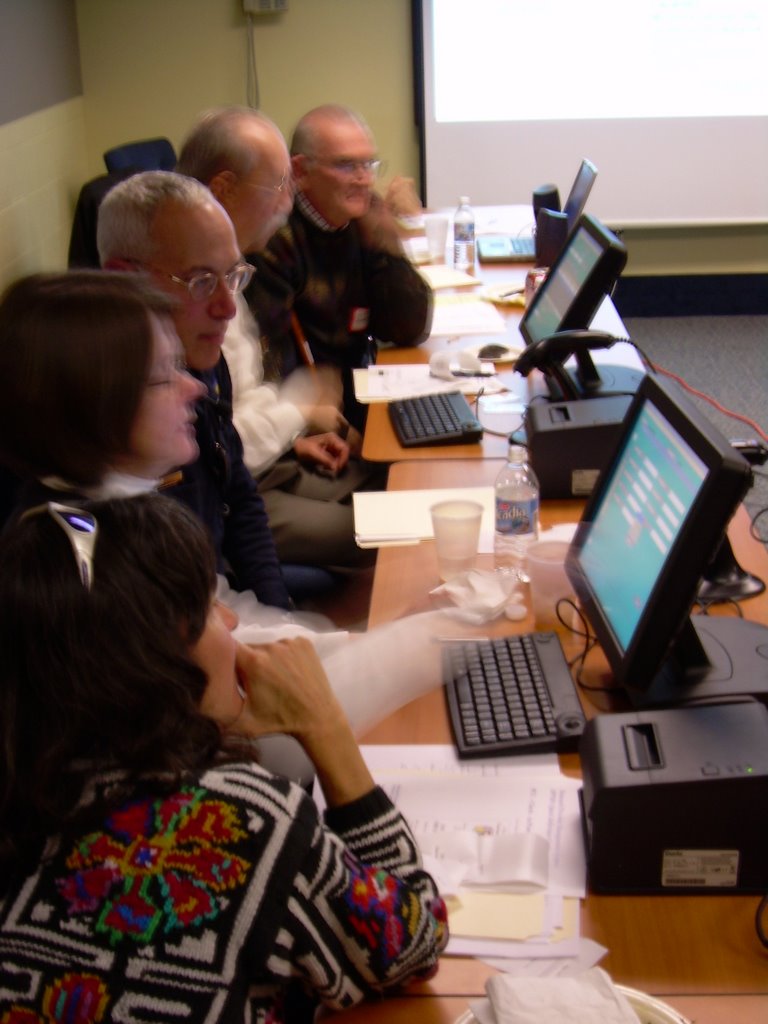
Tonight was the training session for Jefferson Park and Tonsler, held at the Carter Family Life Center on Cherry Avenue, which also serves as the polling place for Jefferson Park precinct. I snapped a few photos with my cell phone to record the event for posterity.


Update:
I will be a guest on "The Schilling Show" on WINA radio (1070 AM) on Monday, October 27, to talk about what to expect on Election Day in Charlottesville -- not just the expected large turnout but also the new voting equipment and streamlined procedures for voter check-in with the EPBs. My segment will be on sometime during the 1:00 - 2:00 p.m. broadcast with host Rob Schilling. If you can't tune in, there will be a podcast available soon after the program has been aired.


Tuesday, October 24, 2006

Charlottesville Election Official Training

Before each election, as in every other voting jurisdiction in Virginia, the Electoral Board and the staff of the Office of Voter Registration and Elections in Charlottesville take several hours to train the election officials (known generically as "pollworkers").

This generally includes going over procedures for Election Day, reviewing changes in election law since the last session of the General Assembly, and hands-on practice with voting equipment.

Because at the upcoming election Charlottesville will be a test site for an electronic poll book, this evening's training in the basement conference room at City Hall included a presentation from Datacard and BEC, the two companies that are providing the equipment for the test. Datacard has more than 35 years' experience in the ID business, and Richmond-based BEC numbers among its clients the University of Virginia, Virginia Tech, the University of Richmond, and various hospitals, businesses, and government agencies around the Commonwealth.

The electronic poll books (or "EPBs") will streamline the check-in process for voters on Election Day. The entire voter registration list for the City of Charlottesville will be on the database.

When a voter checks in, he will either give his name to the worker behind the pollbook or -- and this is a new option -- he will be able to hand the pollworker his Virginia driver's license, which has a scannable bar code. Scanning the bar code will bring up that voter's registration information. If the voter is in the proper precinct and has not voted previously in this election (either by absentee ballot or earlier in the day), he will be given a slip of paper that will be automatically generated by a printer connected to the EPB. Two copies are generated: One is given to the voter, who takes it to the JBC, which will issue an access code. The other will be used by pollworkers to keep a paper record of who has voted in this election.

If it turns out a particular voter is in the wrong precinct, she will be told the address of the proper precinct. If a person's name is not on the registered voters' list but she insists that it should be there, pollworkers know the procedures for issuing a provisional ballot. Provisional ballots are reviewed by and counted by the Electoral Board during the canvass on the day after the election. Votes from valid provisional ballots are included in the official election results that are issued following the canvass.

In case there is an unlikely event such as a power failure or the EPBs otherwise go out of service, each precinct will have an alphabetical voter registration list that can be used as a back-up, so voting can continue uninterrupted.

New pollworkers will be trained on Saturday morning at City Hall. All pollworkers will gather on Monday evening for a final training session, which will include a break-out for each precinct so that Chiefs and Assistant Chiefs can work with their own staffs and answer relevant questions in anticipation of the November 7 election.

Here are some pictures from tonight's training of Chief Election Officers.


Charlottesville General Registrar Sheri Iachetta (rear center) instructs Chief Election Officials about recent changes in the Virginia Election Code.


Datacard representative Chris Wilson points out some of the features of the electronic poll book.


Chief Election Officers practice using the new electronic poll books.


Election workers check out a voter's identification page on the new electronic poll book.


A portable printer like this generates a slip of paper authorizing a voter to receive an access code to use the eSlate machine.

Paul Merrill has a report on the electronic poll books on Channel 29's 11:00 o'clock news.

Monday, October 23, 2006

Student Pollworkers Sworn In


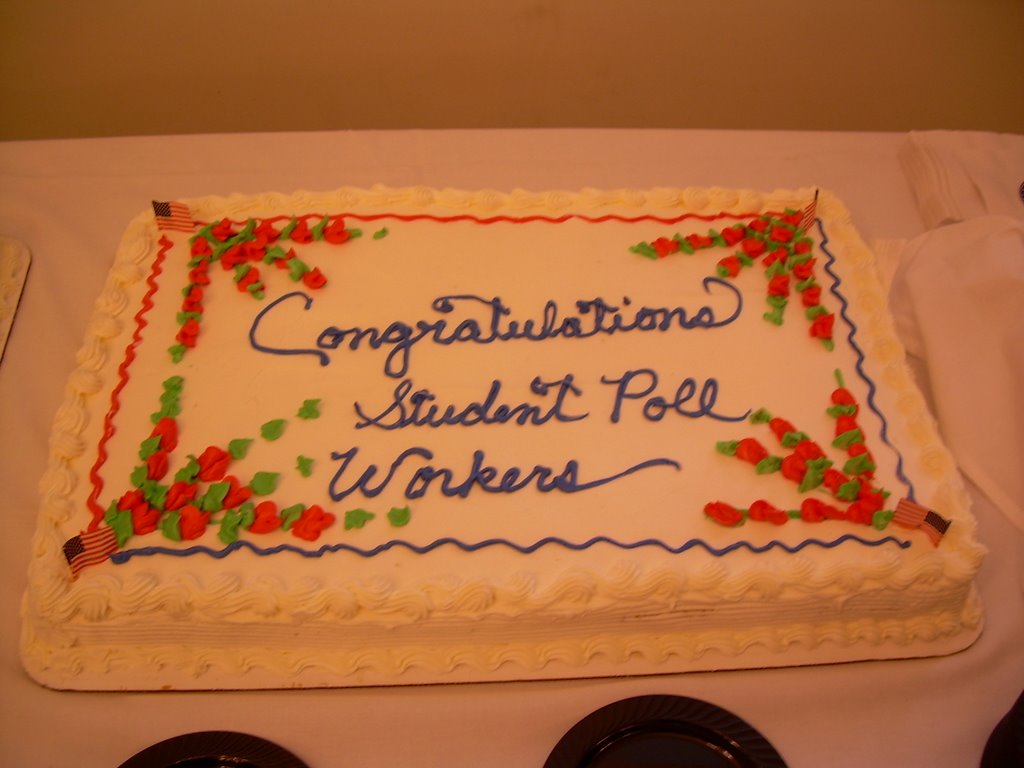
As previously announced, the UVa Center for Politics today sponsored a ceremony to swear in student pollworkers who were recruited by the Center and the Offices of Voter Registration and Elections in Charlottesville and Albemarle County.

The ceremony attracted VIPs from the local, state, and federal level, including Charlottesville Mayor David Brown, Secretary of the State Board of Elections Jean Jensen, and federal Election Assistance Commissioner Graciela Hillman. WCAV-TV has a report (including video) here.

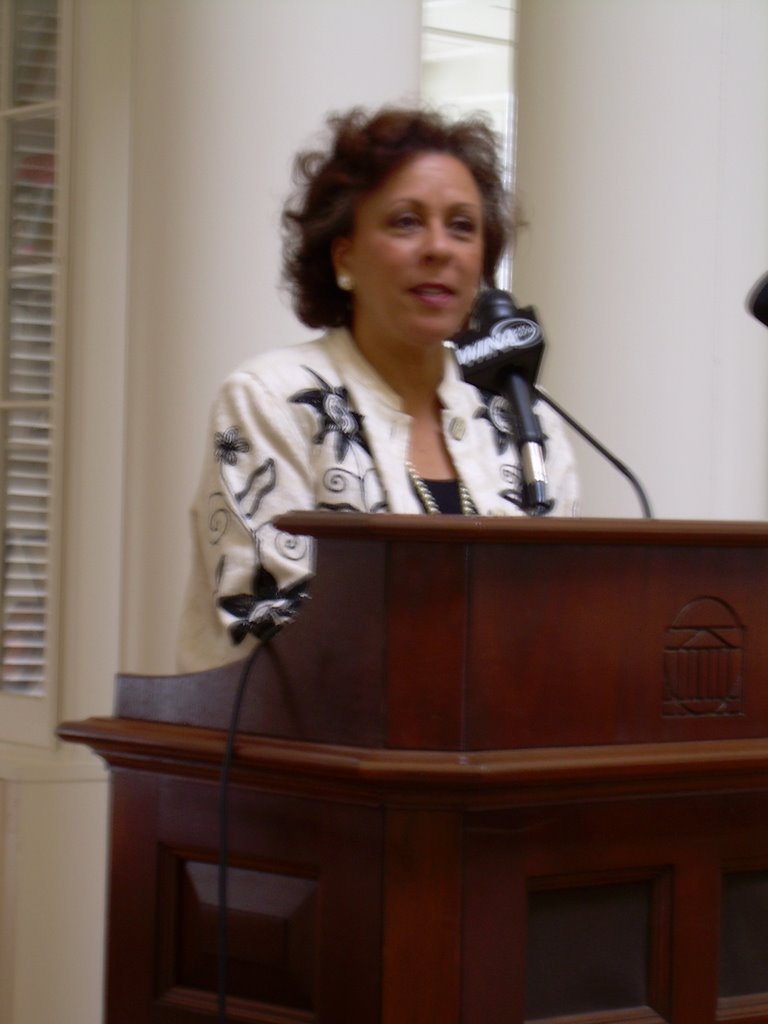
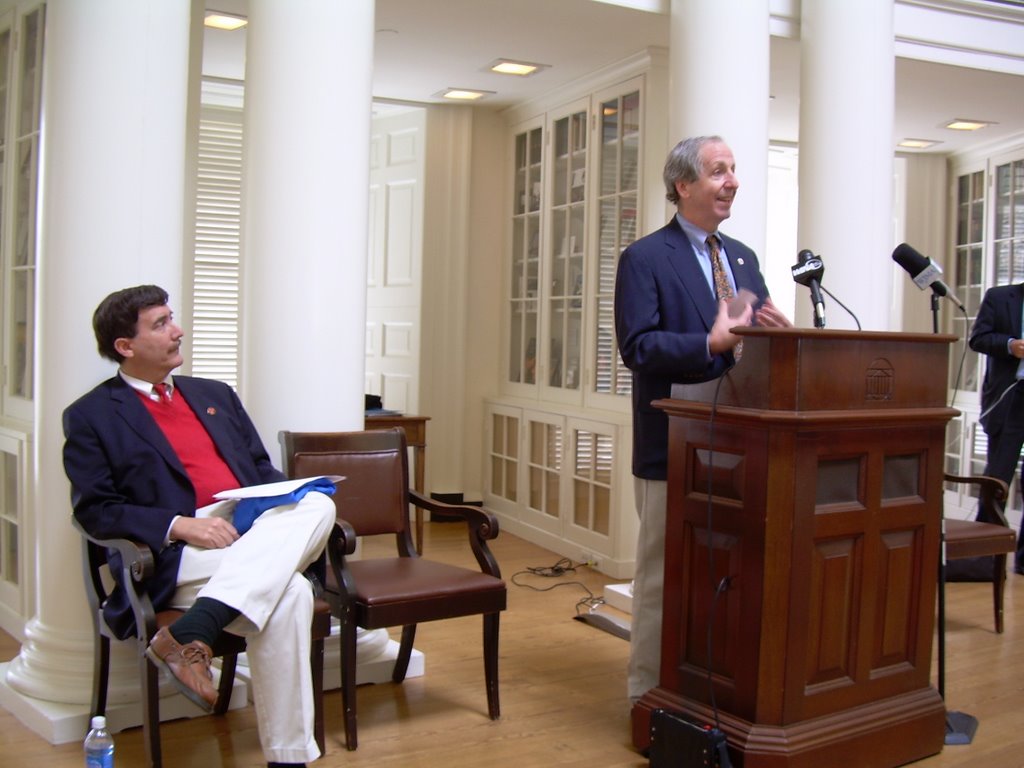
Here are some snapshots from the event, which took place in the Dome Room of the Rotunda on the grounds of the University of Virginia.


Larry Sabato of the UVa Center for Politics welcomes guests and student pollworkers to the Rotunda.


Graciela Hillman of the federal Elections Assistance Commission (EAC) traveled from Washington to attend the ceremony and commend the student pollworkers -- and to suggest Congress should allocate more money for programs to recruit younger pollworkers around the country.


Jean Jensen, secretary of the State Board of Elections, noted the comfort level of college-age people with electronic devices and asked that the new pollworkers convey any ideas they might have for improving the election process, based on their observations on the upcoming Election Day.


Larry Sabato looks on as Charlottesville Mayor David Brown expresses his appreciation for smoothly-run elections and speaks of his own experience in persuading young people to register to vote.


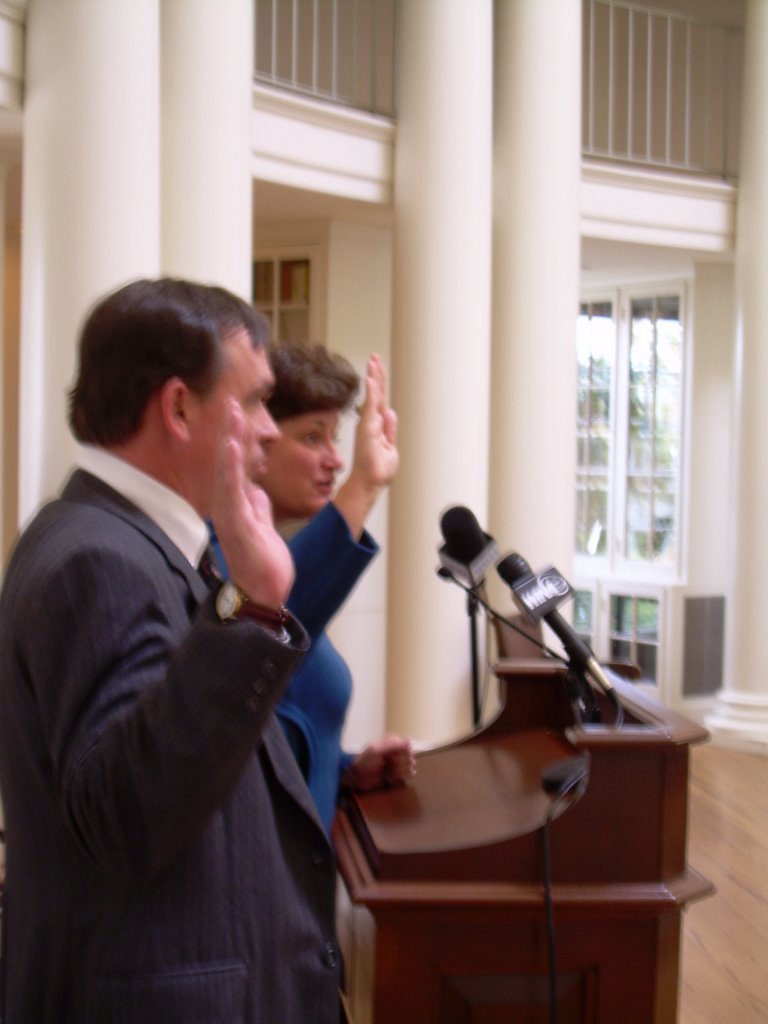
Albemarle County General Registrar Jake Washburn and Charlottesville General Registrar Sheri Iachetta swear in the new student pollworkers.


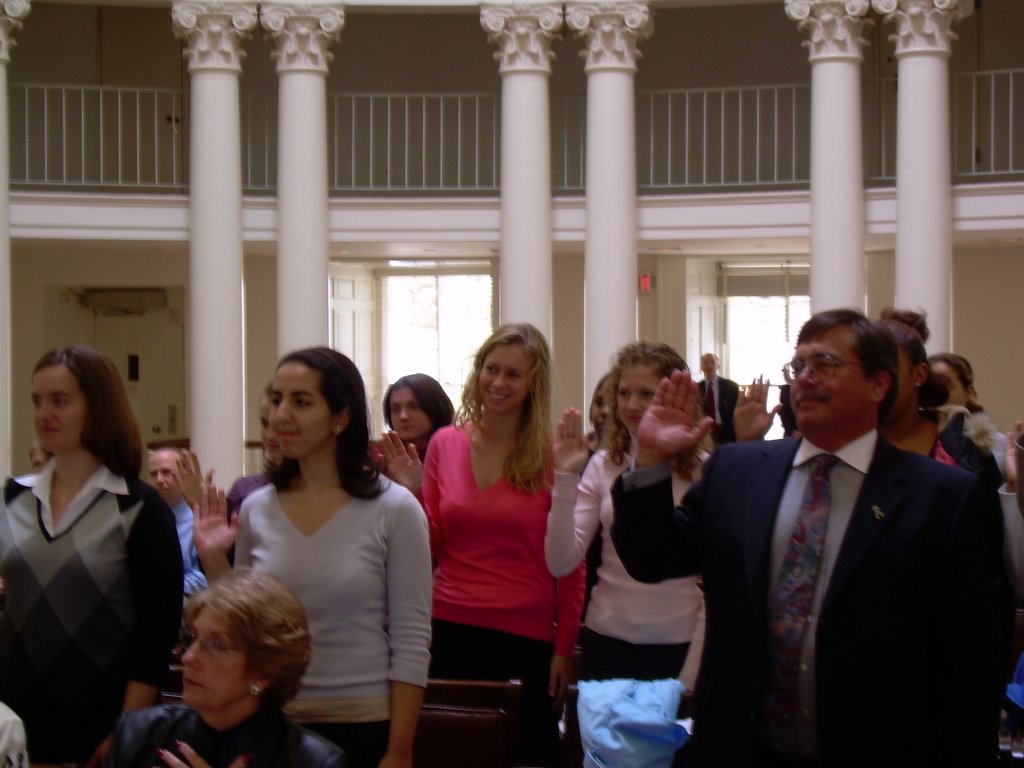
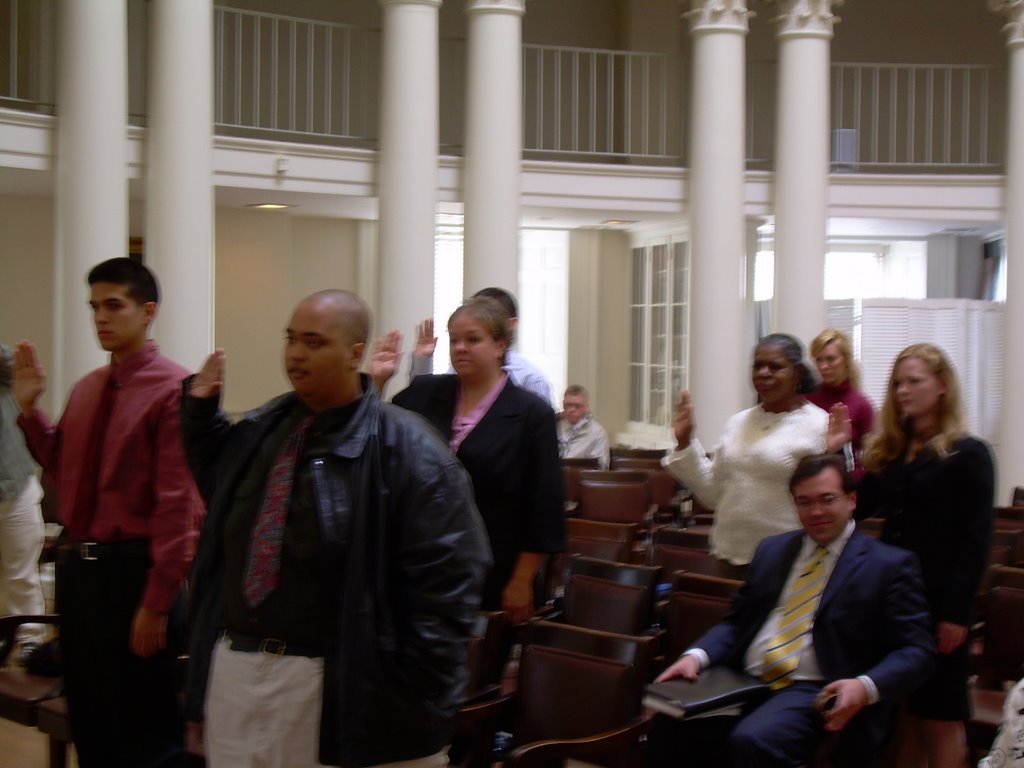
Student pollworkers take the oath.


More student pollworkers swear to uphold the Constitution and the Virginia Election Code.


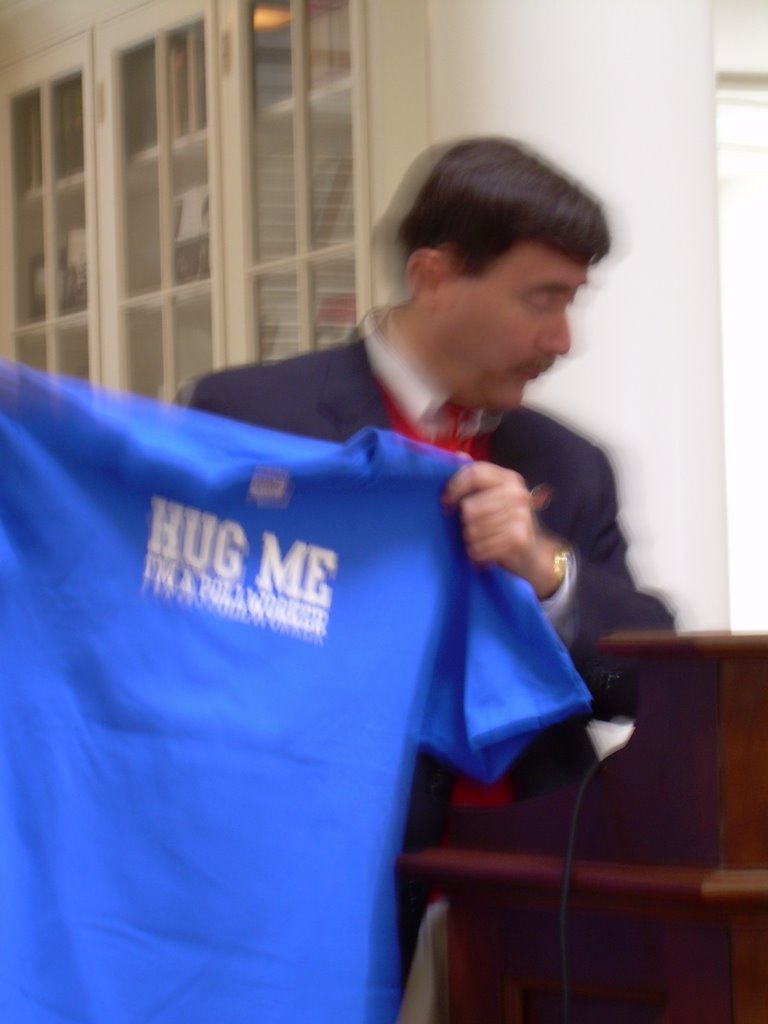
Larry Sabato unveils the student pollworker "uniform" for Election Day. (Sorry for the blurred image, but I thought Chad might like this for a future caption contest!)


Albemarle County Electoral Board Member Will Harvey with SBE Secretary Jean Jensen.

Thursday, October 19, 2006

Student Pollworkers To Be Sworn In

I knew about this earlier, since last month the City of Charlottesville Electoral Board approved the applications of some 75 University of Virginia and Piedmont Virginia Community College students to be election officials.

But now it looks so much more official, with this press release from the University's Center for Politics arriving in my email box:

Center for Politics Hosts Swearing-In Ceremony for Student Poll Workers from U.Va., PVCC --Center for Politics and Offices of Voter Registration Partner to Help Staff Midterm Elections--

CHARLOTTESVILLE – In a new effort to expand civic activity among young citizens, as well as to provide additional staffing at local polling places, the University of Virginia Center for Politics has partnered with the City of Charlottesville Office of Voter Registration and the Albemarle Country Department of Voter Registration & Elections to announce this fall’s Student Poll Worker Swearing-In Ceremony, to take place at 11:00 a.m. on Monday, October 23, at The Rotunda Dome Room on the grounds of the University of Virginia.

This event is hosted by University Professor Larry J. Sabato and the Center for Politics, with City of Charlottesville General Registrar Sheri Iachetta and Albemarle County Elections Manager Clarice Schermerhorn presiding over the ceremony. Several additional special guests will be on hand for the swearing-in ceremony. Members of the media are encouraged to attend.

Currently over 80 students from the University of Virginia and Piedmont Virginia Community College have registered to participate, with training to be completed in time for them to serve as poll workers in the City of Charlottesville and Albemarle County during the November 7 elections for U.S. Senate, House and the three statewide ballot issues.

In attendance at the Student Poll Worker Swearing-In Ceremony will be Federal Election Assistance Commissioner Gracia Hillman, Virginia State Board of Elections Secretary Jean Jensen and Charlottesville Mayor David Brown, along with Iachetta, Schermerhorn and Sabato.

* Event: Student Poll Worker Swearing-In Ceremony
* Location: The Rotunda Doom Room, University of Virginia
* Date: Monday, October 23, 2006
* Time: 11:00 a.m.

The Center for Politics and these Offices of Voter Registration have joined together to fight the alarming trend of civic apathy among the younger demographics. As a group, students and young adults are the least likely to turn out to the polls and vote. While this poses a challenge to programs aiming to increase youth participation, the program seeks to overcome this problem by offering students a unique perspective on democracy.

In August 2006, the Center for Politics was awarded a federal grant from the United States Election Assistance Commission (EAC), to develop programs to recruit and train college students as non-partisan poll workers on Election Day. The awards are part of the Help America Vote College Program which was established by the Help America Vote Act of 2002 (HAVA) to promote college student involvement. The fund will be used to encourage students enrolled at institutions of higher education (including community colleges) to assist in the administration of elections.

“Elections continue to require many more trained poll workers, and these grants will train the next generation,” said EAC Chairman Paul DeGregorio. “We encourage America’s college students to answer the call and provide the critical human resources needed to make democracy happen.”

This funding will allow for the continuation and expansion of the Student Poll Worker Program, begun in early 2006 as a partnership between the Center for Politics and the City of Charlottesville Office of Voter Registration. During the city elections on May 2, 2006, twenty-six University of Virginia students served as poll workers at voting precincts throughout the city, lowering the average age of poll workers in Charlottesville from 55 to 47 years.

According to Center for Politics Director Larry Sabato, “This is a remarkable opportunity for students to participate directly in the American electoral process and become more knowledgeable, engaged citizens. Polling places are the Roman Forums of American politics--they are invaluable opportunities for citizens to come together to support representative democracy, and these students will truly appreciate the uniqueness of our system once they have seen it for themselves.”
I have written before about the need for new and younger election officials. (The average age of pollworkers across the country is over 70.)

The presence of the college students will also be helpful because Charlottesville will be deploying electronic poll books this year for the first time. (As usual, Charlottesville is on the cutting edge in voting technology. We are testing the new e-pollbooks in the full expectation that this will become not just permitted, but required, statewide in the not-too-distant future.) We expect synergy: The student pollworkers will be paired with more experienced election officials, who know the mechanics of election day procedures, and the students can bring their familiarity with electronic devices to the table.

Williamsburg, another college town, has also tested electronic pollbooks, finding that the amount of time voters stand in line waiting their turn has been cut down considerably. As explained by John Yellig in Monday's Daily Progress,
The e-poll books contain the same voter information traditionally found in the heavy paper rosters used by poll workers. But while the paper rosters only contained information for an individual precinct, the e-poll books have information on all of the locality’s voters, which could come in handy for first-time voters who go to the wrong precinct.

In the past, poll workers could only tell voters to call the registrar to find out where to vote. With the e-book, the workers can look up voters and point them in the right direction.

“It has worked wonderfully,” said Dave Andrews, Williamsburg’s voter registrar. “The officers of the election, even folks who have no real computer experience, found it easy to use and were able to find the voters quicker.”
In November 2004, Delegate Robert Marshall (R-Manassas) was upset when the lines at his polling place were unusually long. (You'll remember that the 2004 presidential election had historically high turnout.) To remedy this, he introduced legislation the next year, HB 1808, which "requires the State Board of Elections to provide instructions for the division of pollbooks and voter lists into sections for the efficient processing of voter lines at the polls."

The proposal makes no sense, since local election officials are far more qualified to figure out how best to divide the pollbooks in their jurisdiction than bureaucrats in distant Richmond are. (Should it be A-K and L-Z or A-H, I-Q, and R-Z? A lot depends on local conditions, like the number of Shiffletts registered to vote in a single precinct.) But to my astonishment, the bill passed the General Assembly and is now part of Section 24.2-404 of the Virginia Code.

Having electronic pollbooks eliminates the need for splits. The electronic pollbook can hold the entire, statewide voter registration list, so if a voter from, say, Fluvanna County shows up to vote in Charlottesville, we'll be able to tell him or her where to go to find the appropriate precinct and polling place. (This will really solve problems regarding Alumni Hall Precinct, in the City of Charlottesville, and University Hall Precinct, in Albemarle County, both of which serve UVa populations.) Lines will move faster, and calls from chief election officers to the Office of Voter Registration and Elections will be reduced exponentially.

And having the college pollworkers there, too, beefing up the staff of election officials for the very long day (5:00 a.m. to past 7:00 p.m.), will help a lot in making the whole voting experience more efficient and fun.

Monday, October 02, 2006

Paper or Electronic?

Last week the Washington Times ran an article in the local news section that began:

New Mexico Gov. Bill Richardson visited Maryland yesterday to support Baltimore Mayor Martin O'Malley's bid for governor, but said he agrees with Gov. Robert L. Ehrlich Jr.'s views on paper balloting's superiority to electronic voting.

"I believe that the best way is paper ballots, with optical scanners," Mr. Richardson, a Democrat, said during an event in Silver Spring. "We did that in New Mexico, and it should become nationwide."
The article, by Jon Ward, noted:
Mr. Ehrlich has threatened to call a special session of the General Assembly to discard the entire electronic voting system in favor of paper ballots.
I thought the article cried out for a response, so I wrote one. It appeared in today's letters to the editor column in the Times. (Somehow the editor got the section wrong in the reference to the original article.)
The governors of Maryland and New Mexico may belong to different political parties, but they agree that "the best way" to avoid problematic or fraudulent elections "is paper ballots" rather than electronic voting machines ("Democratic governor backs Ehrlich on balloting," Commentary, Wednesday).

Govs. Bill Richardson and Bob Ehrlich may have confidence in paper ballots but they may be sorely disappointed if they count on them to prevent fraud.

In order to disrupt an election or change its results when electronic voting machines are used, a potential perpetrator must have a sophisticated knowledge, not just of computer hardware and software in general, but of particular hardware and software, plus he must gain physical access to the machinery by overcoming simple and widely-practiced security procedures.

In order to disrupt an election or change its results when paper ballots are used, a potential perpetrator must have: a pen. Or a pencil. And nothing more.

Marking a second (or third) candidate in a "vote for one" race invalidates a ballot for that race, with nobody receiving a vote.

Stray marks made on an optical-scan ballot render that ballot unreadable by a machine, and therefore it must be set aside for hand-counting, when it becomes subject to human error.

All it takes is a pen or pencil to make these marks on paper ballots to change the results of an election.

Paper ballots can also be torn, folded, spindled and mutilated, making them unreadable by either machine or human eyes.

In his 2004 book, "Stealing Elections," Wall Street Journal editorial writer John Fund documents dozens of cases of electoral fraud involving paper (either voter registration forms or paper ballots) over the past two decades. At the same time, he notes in regard to electronic voting machines, that "in the twenty-plus years that these machines have been used, in many counties all across the country, there has never been a verified case of tampering."

There are many other problems involving paper ballots, but one thing is clear: They will not stop perceived or actual election fraud.
In the print edition, my letter was placed at the head of the letters column, just below the editorial cartoon by Bill Garner. Sadly, though -- despite the prominent placement -- I don't think this will put an end to the debate.

Friday, September 22, 2006

Talking Sense

The Washington Post today has an atypically sensible editorial about the primary election fiasco last week in Maryland and how to address the problems as we approach the general election of November 7.

Echoing (modesty forces me to add "unconsciously") my comments of September 17, the Post says:

Most of the problems on Sept. 12 resulted from human error: officials forgetting to deliver cards to operate machines, judges not showing up, workers failing to remove memory cards. The one big equipment problem had to do with the electronic poll books (used by poll workers to check voters off as they come in) and not, as Mr. Ehrlich might have you believe, with the machines voters use to cast their ballots.
The Post also corrects the widely-held but mistaken belief that the human errors were attributable to the newness of the voting machines:
In fact, not only did the touch-screen voting machines work largely without incident across the state in the recent primary, but this was not the first time they have been employed. In the 2002 election, when Mr. Ehrlich became governor, four counties -- including the state's largest, Montgomery -- used these units. In the 2004 presidential election, every locality except Baltimore City used them. So why is this an issue now?
The fact that Montgomery County has been using these machines for at least four years makes the performance of its top election officials even more shameful.