Saturday, September 16, 2006

HBO's AuH2O Documentary

According to a review in Friday's Washington Times, HBO will be debuting a new documentary about the late Barry Goldwater, who served as U.S. Senator from Arizona and as the Republican presidential candidate in 1964. Goldwater's candidacy, perhaps more than any other single event, catalyzed disparate strains of conservatism into what became the modern conservative movement that resulted in the election of Ronald Reagan in 1980.

To this day, people like myself proudly call themselves Goldwater conservatives or Goldwater/Reagan conservatives, distinguished from the faux conservatism of George W. Bush and the current Republican Congress.

In his review, Scott Galupo shows he understands the fundamental, philosophical core of Barry Goldwater. (He suggests that the documentary, even though it is produced and narrated by Senator Goldwater's granddaughter, fails to do that.) Galupo writes:

... "Goldwater" gives the game away when it conveniently rejects whichever planks of the limited-government platform it disagrees with. Take the senator's opposition to the 1964 Civil Rights Act. There, according to the documentary, Mr. Goldwater was plainly wrong, both morally and on the facts. Yet, on abortion and homosexuals, it rhapsodizes about Mr. Goldwater's broad-mindedness.

Sorry. This does not a maverick make. If you had one of those think tanky graphs that expand on the simplistic left-right spectrum, Mr. Goldwater's libertarian politics were remarkably consistent.

Not unlike his more successful legatee, President Ronald Reagan, he held fast to a few principles -- essentially, that the federal government should stay out of people's personal lives, but still be strong enough to kick the commies in the groin.

Later in his career, he took the same laissez-faire view on abortion and homosexual rights (issues, Mr. Will notes, that didn't figure on the national agenda in the 1960s) that he took on economic entrepreneurship.

Let's be clear: When Barry Goldwater stood on the rostrum of the Republican National Convention in San Francisco and said, "Extremism in the defense of liberty is no vice," he was being brave. He was bucking centrist complacency -- including eight years under the Republican accommodationist Dwight Eisenhower -- that took ever-bigger government and international communism for granted.

In the spirit of National Review magazine's founding credo of "Standing athwart history, yelling 'Stop,'" Barry Goldwater confronted the morality of statism when to do so was highly unfashionable -- not to mention politically suicidal: Sitting President Lyndon B. Johnson beat him by 16 million votes.

Conversely, to say, in 1993, that the military's ban on homosexuals was "dumb" earned you a round of applause from those mavericks who run the New York Times.

Miss Goldwater may gain personal comfort from the knowledge of her grandfather's social libertarianism -- and any truthful account of Mr. Goldwater's public life should acknowledge it.
When Senator Goldwater passed away, I wrote a tribute that appeared in several publications ("Barry Goldwater: Conservative Icon, Libertarian Visionary"), which looks at the historical record and explains why he remains such a hero to libertarians and conservatives alike.

I, for one, am looking forward to seeing the documentary, which promises to be both informative and entertaining, even if (as Galupo suggests) flawed. According to HBO,
Mr. Conservative: Goldwater on Goldwater includes interviews with Senators Edward Kennedy, Hillary Rodham Clinton (a onetime "Goldwater Girl") and John McCain (who succeeded Goldwater in Arizona); former TV anchorman Walter Cronkite; humorist Al Franken; TV correspondent Robert MacNeil; former Washington Post editor Ben Bradlee; author George Will; 60 Minutes' Andy Rooney; CBS News' Bob Schieffer; White House reporter Helen Thomas; political consultant James Carville; former White House Counsel John Dean; Goldwater's brother, Bob; sons Barry, Jr. (a onetime House Representative from California) and Michael; daughters Joanne and Peggy; and others.
Mr. Conservative: Goldwater on Goldwater will be broadcast on HBO for the first time on Monday, September 18, at 9:00 p.m. (EDT). There will surely be multiple replays. A one-minute video preview can be watched on HBO's web site.

Even though Mr. Conservative: Goldwater on Goldwater's premiere conflicts with the new weekly episode of Weeds on Showtime (one of the best written comedies on TV, cable or otherwise, with a sly social and political commentary that catches viewers by surprise), I'll just delay watching Weeds until later in the evening. Barry Goldwater's legacy deserves at least that much.

I have to add that the timing of the premiere of this documentary, coincident with the publication of Ryan Sager's The Elephant in the Room, about the tension between libertarian and social conservative elements in the conservative movement (and the Republican party), is precious. The two launches are complementary.

Friday, September 15, 2006

The Burning Question

The Commonwealth Coalition has unveiled its first television commercial in its campaign against the Marshall/Newman Amendment (Question #1 on the November 7 ballot in Virginia.) Here's the ad as it appears on YouTube:


Comments about this TV commercial are welcome, of course. Readers, what do you think?

One comment I would make is that George Mason's Virginia Declaration of Rights was not so much an inspiration for Mr. Jefferson in writing the Declaration of Independence as it was in regard to Mr. Madison's drafting of the Bill of Rights to the U.S. Constitution. But this is a political commercial, not a history lesson, so I'll let it pass.

Thursday, September 14, 2006

More Opposition to Marshall/Newman

I almost missed this Monday post by attorney Steve Minor at the SW Virginia Law Blog, who notes the names of many Virginia lawyers who argue that the Marshall/Newman Amendment will have adverse effects beyond the simple prohibition of same-sex marriage that its proponents claim.

Steve goes on to write:

One of these days, I'll post my views on the amendment. I think that probably I am against it, just because it is mean-spirited and mostly a waste of time. The key legal issue, in my view, is wholly omitted from the Arnold & Porter brief, and that is whether a constitutional amendment, as opposed to mere legislation, would improve Virginia's position if and when the question is raised as to whether Virginia's institutions are obligated by the Full Faith and Credit clause of the U.S. Constitution to honor same-sex marriages or other domestic arrangements that are recognized by the laws of other states, principally Vermont and Massachusetts. I would not expect that the Virginia Supreme Court, notwithstanding its lame decision in the Martin case, will ever come out with an opinion like Goodridge. Indeed, the more liberal appeals courts in New York and Washington state have refused to join Massachusetts in finding state marriage laws unconstitutional.

Besides the legal arguments, I think the stigmatization of homosexuals for mostly political purposes is offensive, and an unfitting subject of legislative priority.
That last sentence encapsulates the situation perfectly. I only wish it fit on a bumper sticker.

SNAFU, or Not SNAFU?

In a statement sure to rank alongside "Brownie, you're doing a heckuva job!" in the book of misunderestimated quotations, Nancy Dacek, president of the elections board in Montgomery County, Maryland, told the Washington Post: "It wasn't a screw-up. It was a mistake."

It was a screw-up. Such a big screw-up, in fact, that a synonym for "screw" beginning with the letter "F" should be used to describe it. It was a screw-up of major proportions.

I have been in Roanoke for annual training of local electoral board members by the State Board of Elections, so it is rather ironic that I learned late about the horrible performance by election officials in Maryland. (I simply wasn't watching the TV news as I normally do, not paying attention while preoccupied elsewhere.)

For others coming late to the story, here it is in a nutshell:

Polling places in Montgomery County opened up for the primary election on Tuesday with all the equipment in place except for one vital item -- the access cards (sort of like ATM cards) that voters use to activate the voting machines. The access cards also include information about which ballot the voter sees on the machine. (If there are two party primaries on the same day, for instance, a Republican voter gets a card to activate a Republican ballot, while a Democratic voter gets a card that activates the Democratic ballot.)

The person in charge of packing the bags with equipment that precinct officials need to run their polls simply forgot to pack the cards. As David Montgomery reported in the Post Style section:

Here's what happened: Elections workers assembling packages for the polls somehow forgot to include the plastic ATM-like cards needed for each voter to use the electronic voting system. Workers had a checklist that was supposed to include the vital cards, so no one would forget: A low-tech redundancy against a botched election.

Instead, the cards remained at election headquarters, locked securely in a big blue cage on wheels, hiding in plain sight.

Nobody noticed until the morning of the election when election judges opened their poll packages.

Drivers rushed the cards to the precincts, but meanwhile 10,000 to 12,000 voters had to use paper provisional ballots over the course of the day. Many others reportedly left in frustration without voting, and the whole mess now is attached to that election hangover phrase, "under investigation."

This was a screw-up, plain and simple. It wasn't a mistake, it was malfeasance.

So it's no wonder that politicians and voters are asking for the county's top election officials' heads on a platter:

Montgomery County Executive Douglas M. Duncan called yesterday for the county's top two elections officials to be fired, saying they were responsible for the widespread voting problems that marred Tuesday's primary election.

Duncan's demand, joined by County Council President George L. Leventhal (D-At Large), came on a day of intense activity with the same basic intent: to find out what went wrong and who was to blame.

"I cannot recall a failure of local government like this," Leventhal said, adding that the county's Elections Board needs to be overhauled. "It is absolutely unacceptable and unconscionable."

Even though Dacek is an appointee of Maryland's Republican Governor, Bob Ehrlich, this should not be seen as a partisan issue. While election officials in Maryland and Virginia (and elsewhere in the country) are technically political appointees, in practice they take off their political hats for the running of elections and are essentially non-partisan. Their job is to serve the voters and candidates in as neutral and even-handed a fashion as possible. That is their mission and it should be their principle, too.

It is important to note that the electronic voting machines in Montgomery County did not fail. People failed. People failed to do the jobs they were charged with doing. As one expert told the Washington Post:
"The thing that gets lost in many current discussions of election reform is the degree to which elections are an intensely human affair," says Doug Chapin, director of Electiononline.org in Washington, a nonpartisan clearing house for election reform information. "In an election you've got millions of voters encountering thousands of poll workers at hundreds of polling locations, which creates an almost exponential opportunity for error."
The problems extended beyond just one county, too, and the problems were essentially human ones. In some jurisdictions, for instance, some polling places opened late because the precinct officials ("election judges," in Maryland's parlance) showed up late. In Baltimore there were reports that some of the election judges appeared to be "intoxicated."

Because of the delays and inability to use the voting equipment, paper ballots were issued, to be used provisionally after a judge ordered polls to be open for an extra hour. But some of the paper ballots were marked for the wrong precinct, and in other precincts, there were too few ballots, so voters were using scraps of paper to mark their choices. Some were using pencils to mark their ballots! (Pencil marks can be erased and rewritten; unless one is using an optical scan system that specifically calls for using a No. 2 Ticonderoga, a ballot should be marked in blue or black ink.)

Widespread use of paper ballots, especially in chaotic circumstances like this, is an invitation to fraud. Paper is easily lost, torn, marred, or re-marked. It lacks the surety and control that electronic balloting does (or, for that matter, that lever machines and, under most circumstances, punchcard machines, did). That is why paper ballots have to be kept even more secure than electronic machines are -- and, as I have written before (on more than one occasion), electronic voting equipment is, or should be, kept highly secure.

So the prize for gross incompetency again goes to Nancy Dacek. From David Montgomery's article in the Washington Post:

Andrea LaRue, a lawyer volunteering on behalf of U.S. Senate candidate Ben Cardin, steps up to the counter with a question for Dacek.

"Do you have a chain-of-custody plan for the provisional ballots?" LaRue asks.

"A who?" Dacek replies.

Who, indeed! And "who" should resign, rather than whine, is Nancy Dacek. Any election official with integrity who presides over an election as badly executed as the one in Maryland was on September 12 would do so, even before receiving a request from voters or elected officials. Taking responsibility is the right thing to do; passing the buck is not.

Wednesday, September 13, 2006

Terence Has Two Fathers

Things are different in the Netherlands. (We knew that.)

Here's a clip from what looks to be the Dutch version of "America's Most Talented Kid" (De Begaafdste Tiener in Holland?) in which young Terence and a chorus of teens and pre-teens sing about his banally normal family life -- Terence and his "two real fathers."

I dare anyone to watch this without smiling and simultaneously holding back tears.


As the person who posted this video to YouTube says about Terence: "He likes them alot and he sings a song about them."

Note, too, that with same-sex marriage legal in the Netherlands, Terence does not live in some legal limbo with no certainty about who has responsibility for his well-being. There's no question about who can make educational or medical decisions for him, or who will take care of him if one of his parents passes away in an untimely manner. Terence recognizes tacitly this even if he sings mostly about homely things, like how his fathers are "sometimes cool and sometimes strict" and how the three of them "watch soaps on TV."

"Twee Vaders" -- sounds like any typical family, no?

Tuesday, September 12, 2006

GLIL President to Speak at Virginia Tech

The following news release (in a slightly different form) was sent out today by Gays and Lesbians for Individual Liberty:

News Release from
Gays and Lesbians for Individual Liberty
P.O. Box 3913
Charlottesville, VA 22903
www.glil.org


GLIL President to Speak at Virginia Tech on Marriage Amendment, September 14

(Blacksburg, Va., September 12, 2006) --- Richard Sincere, president of Gays and Lesbians for Individual Liberty (GLIL), will speak at Virginia Tech on Thursday, September 14, about the proposed Marshall/Newman Amendment to the Virginia state constitution (the so-called “marriage amendment”).

The event, sponsored by the Libertarians at Virginia Tech and other student organizations, will take place in the Squires Haymarket Theater from 7:00 to 9:00 p.m. Molly McClintock of the Commonwealth Coalition will also speak. Delegate James M. Shuler (D-12th District) will introduce the program.

Richard Sincere was the first openly gay candidate for public office in Virginia, running twice for the House of Delegates in District 49 (1991 special election and 1993 general election) and for Arlington County Treasurer (1991 general election). He has served as chairman of the Libertarian Party of Virginia. In addition to serving as president of Gays and Lesbians for Individual Liberty (www.glil.org), a non-partisan organization, Sincere is also vice-chairman of the Republican Liberty Caucus of Virginia and is the Republican member of the Electoral Board for the City of Charlottesville.

A widely published writer on public policy topics, Richard Sincere is the author of two books on U.S. policy toward Africa. He has contributed articles to the Wall Street Journal, Washington Times, Roanoke Times, and other newspapers. He is the entertainment editor for The Metro Herald, an African-American weekly based in Alexandria, Virginia.

The Commonwealth Coalition (www.votenova.org) is spearheading opposition to the Marshall/Newman Amendment, urging Virginians to “vote no” on Ballot Measure #1 on November 7.

In addition to the Libertarians at Virginia Tech, Thursday’s forum is cosponsored by the Lesbian, Gay, Bisexual, Transgender Alliance; Amnesty International; and the Young Democrats at Virginia Tech.

Gays and Lesbians for Individual Liberty was founded in February 1991 to advance the ideas of economic and personal freedom and individual responsibility. It has members across the United States and in several foreign countries. For more information, visit http://www.glil.org.

-30-


Carnival of Liberty LXII


Welcome to the 62nd edition of the Carnival of Liberty! Thanks to everyone who submitted an article for inclusion. We received emails from far and wide.

As we continue to watch and participate in commemorations of the terrorist attacks of September 11, 2001, it is noteworthy that Wired News suggests that 9/11 might be called "the birth of the blog."

Reporter Robert Andrews writes:

While phone networks and big news sites struggled to cope with heavy traffic, many survivors and spectators turned to online journals to share feelings, get information or detail their whereabouts. It was raw, emotional and new -- and many commentators now remember it as a key moment in the birth of the blog....

The chaos was "a galvanizing point for the blogging world," said Dan Gillmor, director of the Center for Citizen Media.

"We had this explosion of personal, public testimony and some of it was quite powerful," Gillmor said. "I remembered that old cliche that journalists write the first rough draft of history. Well now bloggers were writing the first draft."

Quoting social media consultant Matthew Yeomans, Andrews continues:
"Back in 2001, blogs were still very much the geek toy of the Slashdot set," he said. "(But) this collective tragedy demanded a forum to be shared by people all around the world who wanted to talk about what happened with anyone because it was the only way of making any sense of it. Were it to happen again, blogs and social networks would play an enormously cathartic role."
How far we have come in five years! Now, on with the Carnival...

It's hard to categorize this week's entries. They come from across the spectrum of points of view and topics. First, some comments on the election season:

From New York, Mondo QT's Carola Von Hoffmannstahl-Solomonoff reports in "Dogs, Guns, & Cheese" about odd items landing in voters' mailboxes in the days leading up to the Democratic primary election, including a pair of shoes purported to belong to Eliot Spitzer. Who sent them?
The answer is attorney general wannabe Andrew Cuomo, on a campaign flyer for himself. Over a pic of a pair of shoes, a banner declares "Eliot Spitzer is leaving some very big shoes to fill." Inside the flyer lie reasons why Andy Boy's feet will fit. But before buying his Cinderella reasons to believe, take a long look at those shovels. How do we know they actually belong to Eliot Spitzer? Nowhere on the flyer is there a sworn statement to that effect. Until Spitzer steps forward and says yes, those shoes are mine, Andrew Cuomo's claims should be viewed as suspect.
Meanwhile, from Chicago, where politics is always interesting, Mark Draughn of Windypundit (is that a redundant title?) takes issue with former New York Mayor Ed Koch. Mark writes in "Have Faith in Democracy":
In order to have a democracy like ours, you have to have elections. In order to have meaningful elections, you have to allow all sides to make an argument to the people, and that argument can include criticism of the other side, even if the other side currently holds the office under contention, even if the criticism is vicious, and even in time of war.

I don't see how it can be any other way. Being an elected official, even the President, means we get to kick your ass around the schoolyard whenever we feel like it. If that means people are going to "demean and weaken the president in wartime", so be it. It's part of the price we pay for having a democracy.

Over at Fearless Philosophy for Free Minds, Stephen Littau wrestles with the dilemmas of voting when no political party matches one's values. In "Choose and lose," he writes:
For the first time in my life, with roughly two months until an election, I am unsure as to how or even if I will vote. No matter how I vote I will be forced to compromise some of my values. This is nothing new of course given the choice between the socialist party (the Democrat Party) and the socialist-light party (the Republican Party).
The eponymous Phil of Phil for Humanity argues for abolishing the Electoral College in an article he calls "Obsoleting the Electoral College." One reason he finds relevant:
[Electoral] officials only "pledge" that they will vote for the candidate that the state's majority has voted for. A "faithless elector" is a person who casts the state's electoral vote for no one or someone who the majority of the state's voters did not vote for. As of 2006, there have been 158 faithless electors. In all fairness, 71 of those votes were because the candidate they were suppose to cast their vote for passed away before the election of the Electoral College. In only 24 states, there are laws against electoral officials not voting for the candidate that they pledged to vote for, but they have never been enforced. Whatever the reasons that faithless electors have for not voting for who they pledged to vote for, this reason alone is sufficient to obsolete the Electoral College.
Next, we have a few posts about civil rights and civil liberties.

David at Equality Loudoun (that would be Loudoun County, Virginia, one of the fastest-growing counties in the United States, according to the Census Bureau) questions the sincerity of the proponents of a constitutional ban on same-sex marriage in the Old Dominion, which voters may accept or reject in a referendum this November. In "An Interesting 'Social Contract,'" David suggests that his interlocutors' logic follows this pattern:
In other words, if you are a member of a socially marginalized group, that in and of itself proves that you don’t deserve to be protected by the constitution from mob rule. If you are a member of a socially marginalized group, and you have the audacity to use your fundamental right to petition the government, that justifies the majority foreclosing on your abilty to use that right.

And you shouldn’t have gone out alone at night, and what were you thinking, wearing that?

Newbie blogger Steve Foerster of Chrysology (who, until a few days ago, had never heard of a "blog carnival") explains why "I will not be silent":
I can't help but wonder, if Western society accepts condemnation of those who are different, isn't its difference from a society based on Sharia no longer one of kind but only of degree? It is precisely to the extent that we do not act that way that gives us the moral high ground. Don't get me wrong, I realize that people with minority opinions in the West have a great deal more freedom of expression than people in Iran, Saudi Arabia, Uzbekistan, and many other places. But when it comes to liberty, it's not about outrunning the other guy -- it's about outrunning the bear.
Perry Eidelbus, the proprietor of Eidelblog, has a righteous rant about public accommodations laws in "'Accommodation': a euphemism for using government to coerce." He argues:
"Because it's the law" is the most idiotic way to excuse government coercion. Some liberals and conservatives genuinely don't understand, as Don Boudreaux explained, that just because something is "the law," that still does not make it right. Others do understand that but will invoke "the law" when it suits their political agenda. "Eminent domain" is the law by which many governments at various levels have stolen people's land and homes. It was "the law" in Denmark for Jews to wear armbands. It has almost universally been "the law" in dictator-ruled societies that if you dissent, you can be jailed or executed. It was the law in many states, for the first several decades of United States history, that you could literally own another human being.
Ogre, over at Ogre's Politics and Views (naturally), has good news for drug dealers in a piece he calls "Hiding Drugs Okay":

If you're a drug dealer, today is a good day for you. The North Carolina court of appeals has ruled that it's okay to hide drugs under your balls because police aren't allowed to search for drugs there, even if you're a convicted drug dealer in a known drug area acting nervous because you're dealing and carrying drugs.

Yes, the court actually ruled it was unreasonable to look down a man's pants for drugs, even when that man has given consent to a search and has numerous prior convictions for dealing drugs (and yet is still on the street).

(Don't worry, lovers of liberty: Ogre thinks the War on Drugs is a dismal failure and deserves to end.)

It wouldn't be a Carnival of Liberty without a look at the looney left, this time from Canada. (I promised more Canadian content on this blog many months ago, and here it is.) Writing at The London Fog -- that's London, Ontario -- Lisa finds a frightening letter to the editor in her local newspaper and responds with Swiftian wit in "Thanks for the taxes all those years, now get on the ice floe":
The slack left by our vanishing gerontologists will be taken up by increasing employment opportunities in Euthanasia Science. We must fully fund research into the relative contributory value of different communities, so as to be able to move forward, allocating our scarce health care resources only to those communities that can demonstrate added value on an ongoing basis. A commitment to the values of life and health for all Canadians requires that we share the means for their preservation only with the robust and strong, those who are still able to demonstrate their ability to simultaneously pull their own weight, hold up the social safety net, and properly sort garbage and recyclables under their own power. As a society we must demand no less of each and every human resource.
Finally, a couple of 9/11 pieces:

Dan Melson at Searchlight Crusade has a piece called "9/11: Five Years On," in which he writes:
I would love to resolve this whole Islamic extremism thing by negotiation. I make my living as a negotiator, after all. An ideal negotiation is one where both parties believe they are better off as the result of the negotiation, and would willingly sign the same deal again. And therein lies the problem. The extremists will sign any number of deals we propose to them, but they will not honor them. Unlike a business negotiator, they feel no need to honor them beyond whatever transient benefits may accrue to them through doing so. If the extremists would honor the results of such negotiation, it would be far cheaper than any military action. With what we've spend fighting Islamic extremism thus far, every single man, woman and child in the Muslim world could have at least a couple thousand dollars. We could have built them such beautiful cities, turned their lands into a paradise, and increased their economy at least tenfold. What rational person would refuse such a deal?

The problem is that they are not responding rationally to events, nor will they honor agreements they make one instant longer than they feel it is in their best interests to do so.
Carnival newcomer Tim Hulsey, who blogs at My Stupid Dog, discusses "Bad Taste and 9/11" (which I discussed earlier today). Tim finds value in sick jokes told in the aftermath of tragedy, saying:
I won't forget all the beer I drank in the days following 9/11, or the things my friends and I imagined doing with those little white candles. I won't forget the nasty cracks we made about how "we love to fly and it shows," or the retellings of old Space Shuttle Challenger jokes, with the names changed in honor of United 93 ("How do we know [insert victim's name] had dandruff?"). Most of all, I remember a local poet-cum-journalist who commemorated the Twin Towers with a rousing barroom rendition of "I Fall to Pieces."

Oddly enough, I feel deep gratitude for these moments: They constitute some of my warmest, most convivial memories involving fellow human beings. I'm not sure why. In those nerve-wracking days after the attacks, when we didn't know what had happened or if we would be next, dirty jokes and gallows humor were not merely a relief, they were a lifeline, attached as they were to the real business of day-to-day living. Perhaps we needed mirth and comfort, and would do anything to find it. That it was frequently callous, even cruel, was doubtless true but somewhat beside the point.
That's it for the 62nd Carnival of Liberty. Next week's Carnival will be hosted at The Unrepentant Individual.

One final note: This week's Virginia Blog Carnival is also up at Craig's Musings. Even if you're not from Virginia, take a look.

Update: History Carnival XXXIX is up at Cliopatria, a group blog on George Mason University's History News Network. It mentions my photoblog of the Speaker's House in Trappe, Pennsylvania. The same piece is featured in "Travel Carnival 4: Nature's Bounty" at TripHub, which describes itself as "a blog devoted to group travel."

Late Entry: Mike Wallach at Divided We Stand United We Fall has a touching 9/11-related "meditation on the death and remarkable life of Rick Rescorla" entitled "A good death."

Anomalies?

In a blogpost about what he calls "anomalous responses" in the days after the 9/11 attacks, Tim Hulsey describes the way in which humor served as a leavening among the many other emotions that people felt. Specifically, he remembers jokes told in bad taste, and he remembers them fondly.

Tim writes in "Bad Taste and 9/11":

In the 1930s, Russian theorist Mikhail Bakhtin wrote extensively about the "carnivalesque" -- which in its broadest sense is a way to live in opposition to the tyranny of "official" society, and in its more narrow sense is a safety valve for impulses that do not lend themselves to strict control. According to Bakhtin, the medieval carnival provided a safe space for ordinary citizens to mock the rigid dogma of the medieval Church through scatological and sexual humor. Free for a brief time from strict social roles, peasants could lampoon priests, women could dance in the streets, and cats could look at kings. The carnivalesque, in short, reminds us that everyone in the power structure is human, and therefore subject to the same infirmities, foibles and peccadilloes as everyone else. (Of course, Bakhtin's real target was not the medieval Church, but Soviet totalitarianism under Stalin, an ideological tyranny which left no room even for social safety valves -- and which therefore had little use for Bakhtin's scholarship.)

In the days after 9/11, my friends and I shared a carnivalesque perspective without knowing it. Of course, we did not seek refuge from governmental or religious tyranny as such. Instead, we fled from something more nebulous, a tyranny of popular sentiment that permitted ordinary citizens to do no more than weep and pray. We were told that Americans had to sympathize with the victims and trust our president unconditionally; anything more or less from that standard line and we were practically playing into the terrorists' hands. Still, my friends and I had to "cock a snook" at this atrocity for the same reason little boys have to tell jokes about Helen Keller (or in extreme cases, Anne Frank). We had had enough of plaster saints and cardboard leaders, of souls soaring in the ether. The sick humor about the victims reminded us of the fact and perhaps the finality of the body: It was anti-spiritual, at a time when a certain mysticism on matters of life and death was considered almost mandatory within the American body politic.
His post reminded me of a news report I read about a recent scholarly book about jokes told in Germany during the Nazi era. David Crossland sums up the books findings in Der Spiegel:
A new book about humor under the Nazis gives some interesting insights into life in the Third Reich and breaks yet another taboo in Germany's treatment of its history. Jokes told during the era, says the author, provided the populace with a pressure release.
The Times of London gave a few examples of jokes collected in the book:

  • Hitler visits a lunatic asylum. The patients give the Hitler salute. As he passes down the line, he comes across a man with his hands by his side. “Why aren’t you saluting like the others?” he barks. “Mein Führer, I’m the nurse, I’m not crazy!”
  • The vanity of leading Nazis was fertile territory. In one cartoon Göring has attached an arrow to the row of medals on his tunic. It reads “continued overleaf”
  • In another, a commentator notes: “The new race will be slim like Göring, blond like Hitler and tall like Goebbels.”
  • Two Berliners meet in early 1945. “What will you do after the war?” asks one. “I'll finally go on a holiday and will take a trip round Greater Germany,” his friend replies. “And what will you do in the afternoon?”
  • As the persecution of the Jews worsened, they relied upon humour: Levi and Hirsch meet in the African jungle, each with a rifle. “What are you doing here?” asks Hirsch. “I’ve got an ivory carving business in Alexandria and I shoot my own elephants,” says Levi. “And you?” “I manufacture crocodile leather goods in Port Said and shoot my own crocodiles — and what happened to our friend Simon?” “He’s turned into a real adventurer. He stayed in Berlin.”

  • With the retrospect of 60 years, these jokes-- collected in the book, "Heil Hitler, The Pig is Dead," by film director and screenwriter Rudolph Herzog -- seem mildly funny but somewhat perplexing, since we don't know the personalities involved. (Imagine someone making a joke about James Webb's charisma 60 -- or 6 -- years from now.) But for people in Nazi Germany, telling them entailed great risks: some people were executed for repeating these jokes, others were jailed. Employers would likely sack anyone who created a hostile business environment by making fun of Hitler.

    In times of crisis -- as I noted in my earlier piece on "homo ludens" (playful man) -- human beings survive through their higher faculties, including joking about their plight. Call it whistling past the graveyard, but this is something that goes far deeper. And we should acknowledge and appreciate it rather than feign shock and offense about it.

    Monday, September 11, 2006

    9/11 Remembered

    On Saturday night, while driving near the Pentagon, I suddenly came upon several shafts of light shooting into the sky. From the off-ramp of I-395 to Columbia Pike in Arlington, I saw that one of the Pentagon's five walls had been bathed in blue light, with a huge American flag draped over the middle. Until then, I had been unaware that the commemoration of the terrorist attacks of September 11, 2001, had begun. This was certainly a dramatic reminder.

    The airwaves are full of news reports, documentaries, and dramatizations regarding the events of five years ago. They bring to mind nothing less than the similar surfeit of remembrances on significant anniversaries of the assassination of John F. Kennedy. (The two events are quite similar in the way in which Americans were glued to their televisions and radios for several days, eager to obtain any tidbit of news.)

    In the immediate aftermath of 9/11, I wrote an essay for The Metro Herald in Alexandria that must have seemed dissonant at the time. Perhaps it still seems so. But I thought I would repost it here as my own contribution to the recollections that begin with the question, "Where were you when you heard...?"

    From The Metro Herald, September 21, 2001:

    Playtime as the Guardian of the Soul
    Richard E. Sincere, Jr.
    Metro Herald Charlottesville Bureau Chief

    (Charlottesville, VA, September 16, 2001) --- In his brief but brilliantly insightful 1970 book, A Rumor of Angels, Peter L. Berger describes how we can find evidence for the existence of God in the everyday actions and interactions of people. This is not a book about tabloid “miracles”; no statues that bleed nor satanic faces in rising smoke here. No, it is about average people, sometimes in extraordinary situations.

    Berger discusses the people of Vienna at the end of World War II. Their country had been devastated, first by Nazi occupation, then by war. Like other cities in Central Europe, Vienna lay in ruins. Buildings were destroyed, streets were upended, the city was home to wandering refugees and returning soldiers.

    Amid all this, however, one of the city’s first actions was to reopen the Stadtöper, the city opera house, and begin musical performances. Concerts and recitals were presented even before the holes in the roof were repaired. Audiences could see the stars from their seats.

    Berger uses this example, among others – such as reports of concentration camp inmates who played and sang music despite their imprisonment – as evidence of the human impulse to retain hold of our humanity even during great crises. It is no accident that “the humanities” – literature, music, drama, painting, sculpture, and the rest – are called just that: humanities. Human, humane, humanities. These are intrinsic to defining ourselves as human. We rise above beasts because we have humanity. We seek to better ourselves, to escape the bounds of earthly reality. Instead, we create our own reality. We are greater than our circumstances.

    More recently, we have seen this impulse at work in Israel during the Gulf War. Who can forget televised images of Isaac Stern playing his violin in a concert hall, under the threat of a Scud missile attack, with the entire audience wearing gas masks?

    Berger talks about “homo ludens”: man at play. He notes how through sport (and, by extension, theatre, movies, music, etc.), people slip beyond the constraints of time and space and bring themselves closer to God. We don’t think about it this way. We think of playtime as mundane. Far from it; it is transcendent.

    What prompts me to discuss at length a book I haven’t read in more than 20 years? It stems from my disappointment in one response to the terrorist attacks on the United States. Specifically, I feel the cancellation of sporting events, concerts, and theatrical performances more than four days after the attacks was ill-advised.

    It is understandable that, in the immediate aftermath of the bombings, regularly scheduled events should be canceled or postponed. The situation was fluid; no one knew what might happen; Americans wanted to remain near their TVs to keep informed; and, not least, there was a sense that amusement would show disrespect to the dead and the survivors.

    Yet it is also important, for reasons of our own humanity, that life should return to normal as soon as possible. To postpone everyday life, in all but the localities most immediately affected by the attacks, risks feeding survivor guilt, self-pity, and a sense of victimhood. None of this is healthy, nor is it humane. We need upliftment – sports, arts, and entertainment provide it.

    Here in Charlottesville, Virginia, a weekly event called “Fridays After Five” – free music downtown, with food and beverages and crowds – was first announced to go on as scheduled, then modified with a public demonstration of support for the victims, then canceled unexpectedly and replaced with a candlelight vigil. The confused result was that virtually nothing happened: Charlottesvillians were unable to reassert their humanity and celebrate their lives, nor were they able to effectively reflect on, and make tribute to, the fallen.

    That same night in Charlottesville, however, Live Arts, a local theatre company, went ahead with the opening performance of W;t, a play about cancer and the life of the mind, by Margaret Edson. (It earned the Pulitzer Prize for drama.) Artistic director John Gibson spoke to the audience before the curtain rose, explaining – almost apologetically – why Live Arts had gone on as scheduled. His comments were gratuitous. That the show went on spoke for itself; it demonstrated again the vitality of the human spirit recovering from, and overcoming, crisis.

    Writing in The New Republic in November 1914, shortly after the start of the Great War – what we now call World War I – Rebecca West said, in a warning to those who would use the war as an excuse to set aside what makes us humane in favor of that which makes us brutish: “Decidedly we shall not be safe if we forget the things of the mind. Indeed, if we want to save our souls, the mind must lead a more athletic life than it has ever done before, and must more passionately than ever practise and rejoice in art. For only through art can we cultivate annoyance with inessentials, powerful and exasperated reactions against ugliness, a ravenous appetite for beauty; and these are the true guardians of the soul.”

    She was right then; we should heed her words now. Life, in all its fullness, must continue unrelentingly. If not, the terrorists have won the day.

    For those who might be interested, you can find other posts that relate to 9/11 and its aftermath elsewhere on this blog, including:

    "Swedish TV, the PATRIOT Act, and Charlottesville" (January 1, 2005)

    "PATRIOT Act Violates Civil Liberties, DOJ Says" (April 5, 2005).

    "PATRIOT Act Reform Caucus Announced" (April 27, 2005).

    "GMU Students Plan Terrorist Strike in Northern Virginia" (April 14, 2005)

    "Diverse Coalition Brings PATRIOT Act Concerns to Congress" (April 19, 2005)

    "Abolishing Cash: Fantasy or Nightmare?" (June 16, 2005)

    "Everything Old Is New Again" (September 23, 2005)

    "Reading" (September 20, 2005), about books that gained relevance after the attacks, originally published on September 28, 2001.

    "There Is Nothing Like a Dane" (February 5, 2006)

    "My Lunch with Dick Cheney" (June 19, 2006)

    Watch This Space!


    Don't forget, I'll be hosting the 62nd weekly Carnival of Liberty on Tuesday.

    It's not too late to submit a post for inclusion in the Carnival. (Please get it to me by 2:00 p.m. today, September 11.) Use the Carnival Submit Form to facilitate your entry.

    We already have several interesting and provocative entries, including at least one from a Carnival newbie.

    I'm not sure what time on Tuesday you'll be able to find the Carnival of Liberty here. I'd say it will be posted sometime between 12:01 a.m. and 11:59 p.m.

    Update: The Carnival of Liberty is now up and ready for you to read. You can find it here.

    Friday, September 08, 2006

    Visiting the Speaker's House

    About 25 miles due west of Center City Philadelphia is the small town of Trappe, Pennsylvania. There, along a busy commercial strip, stands the home the first Speaker of the U.S. House of Representatives. Currently in dilapidated condition, the 18th-century residence of Frederick Muhlenberg has recently been purchased by a group of local residents interested in preserving this bit of history and restoring it for educational, archeological, and tourism purposes.

    Most Americans know who our first president and vice-president were (George Washington and John Adams, in case non-Americans are reading this), but if asked, probably few could name Frederick Muhlenberg as the first Speaker of the House.

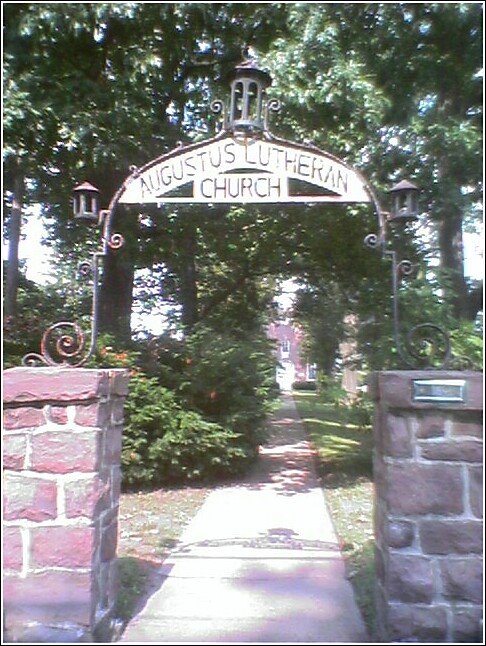
    A first-generation American, Frederick Muhlenberg was born in Trappe on January 1, 1750. His father, Henry Melchior Muhlenberg, founded Augustus Lutheran Church in Trappe, which is thought to be the oldest Lutheran church continuously in use, without major architectural or decorative changes, in the United States.

    Following in his father's footsteps, as a young man, Muhlenberg went to Germany for his education and became a Lutheran minister. During the Revolutionary War, he was in New York when the British marched on the city, forcing him and his family to flee to his parents’ home in Trappe. There Frederick purchased a fifty-acre property in 1781.

    Architectural evidence indicates that Muhlenberg modified an existing dwelling into a side-passage, double parlor residence in the manner of a stylish urban townhouse. In a letter to his brother Henry, Muhlenberg described how he greatly enjoyed working in his gardens, fields, and the dry goods store he operated on the property. While living in this house, Frederick was elected speaker of the Pennsylvania General Assembly and president of the Pennsylvania Constitutional Convention. Muhlenberg was a powerful leader in local and state politics, serving as the president of the Pennsylvania Constitutional Convention and first President Judge, Recorder of Deeds, and Register of Wills in Montgomery County.

    In 1789, Trappe-area voters sent Muhlenberg to the first U.S. Congress, where he was elected to the precedent-setting role of the first Speaker of the House and became the first to sign the Bill of Rights. Muhlenberg sold his Trappe estate to his sister and brother-in-law in 1791 and moved to Philadelphia, where he served in the next three congresses and was elected again as speaker of the third congress. In 1800 he moved to Lancaster, where he died the following year at the age of fifty-one. (He accomplished a lot in a short lifetime.)

    I have been in Montgomery County, Pennsylvania, for the past couple of days on business, and I had an opportunity to visit the Muhlenberg House in Trappe. To be perfectly frank, it is not ready for prime time, but a local group called Save the Speaker's House, Inc., has acquired the property and is now laying the groundwork for restoring it. Plans include building a facility with a lecture hall, classrooms, and administrative offices in the large backyard, and digging trenches for exploration by archeologists and archeology students. (The history department at Ursinus College is partnered with Save the Speaker's House for educational programs.)

    The Montgomery County Commissioners have called the Frederick Muhlenberg house “a vital piece of our history” and Trappe Borough Council declared the Speaker’s House an official “historic treasure.". The house, across from the Trappe Shopping Center, has seen much change and neglect over the last century. Save the Speaker's House says that the restoration will revitalize its Main Street neighborhood and attract visitors to the historic and cultural resources of the local community. (Other nearby landmarks are Ursinus College, in next-door Collegeville, and Valley Forge National Historic Park, which is about 8 miles away.) The goal of Save the Speaker's House is to raise the $1.5 million necessary to restore the house to the period of 1781-1803, when Muhlenberg and his family lived there.

    While in Trappe, I snapped a few photos of the Speaker's House (which is not yet open to the public) and his father's church down the street, using my handy camera phone. The Frederick Muhlenberg house, modest as it is, is not exactly Mount Vernon or Monticello -- or even Ash Lawn-Highland -- but it still represents an important, if relatively unnoted, part of our early post-revolutionary, early-republican history.


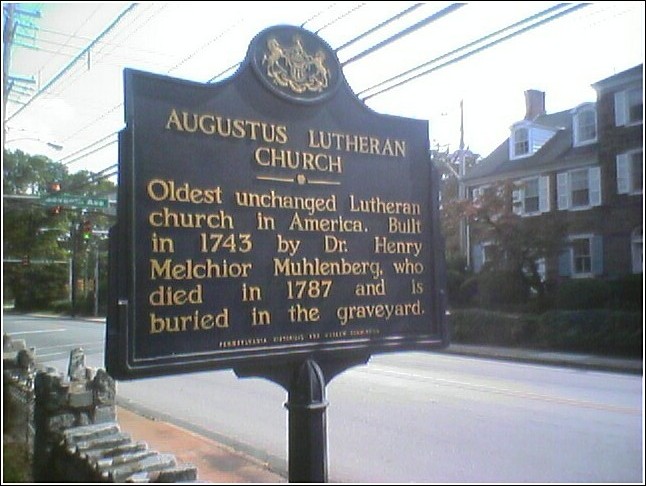
    This sign in front of the Speaker's House is the only visible indication of the historic site behind it


    The back of the house dates to the original construction in the 1740s...


    ...the front of the house, which faces the street, is only about 110 years old


    In the backyard is the Speaker's Outhouse.

    Far better preserved, largely because it has been in use, serving its original purpose, for more than two centuries, is Augustus Lutheran Church, just a few blocks west of the Speaker's House along Main Street in Trappe:


    The church is a simple structure, shaped much like a barn.


    Lutheran congregations from across the United States have contributed financially toward the upkeep and preservation of Augustus Lutheran Church; this plaque offers them some thanks.


    Contrary to what some wags suggest, this well is not also a baptismal font.


    The church cemetery is large and still in use.


    While the old Augustus Lutheran Church is still used for special occasions, a larger sanctuary serves the congregation for regular services.

    Thursday, September 07, 2006

    Slow News Day

    It must be a slow news day at the Jewish Daily Forward, a venerable New York-based newspaper.

    Here are two of the five headlines on Friday's front page:


    and


    Meanwhile, buried on page three is a story about political pressures that may force Hamas to join forces with its rival party in the Palestinian authority, Fatah, or face a total collapse.

    The first article noted above, written by reporter Rebecca Spence, is about the owners of a barbecue restaurant in Rockaway Beach, Missouri. (Talk about "far Rockaway"!) Rockaway Beach was once a thriving tourist resort but in recent years has fallen on hard times due to competition from the far glitzier nearby town of Branson (where, Tim Hulsey tells me, one can see Anita Bryant perform early in the morning -- early enough so you can skip breakfast in an effort not to lose it during her stage show).

    Spence reports:
    Branson counts about 10 million visitors in a year. So when two men, known to have catered food for The Oak Ridge Boys, arrived from Branson and set up a barbecue restaurant that attracted some 500 people Saturday nights for live music and dancing, many town residents credited them with helping to revive their flagging economy.

    But the pair’s presence also generated a flurry of controversy. According to the two men, a handful of local figures, including the mayor and the president of the Chamber of Commerce, have tried — with little success — to drive them out of town. One member of the barbecuing duo, Ron Mangum, had a Jewish father and retains a strong Jewish identity, which he suggests is one factor in the opposition he faces. But he says the issue has more to do with the fact that he and his business partner, Brian Mellott, are also partners after hours.

    At a recent party to celebrate a developer’s bid to build a casino in Rockaway Beach, population 600, the mayor was reported to have been crystal clear in expressing his sentiments about Mangum — who is also the publisher of the Oklahoma-based gay newspaper the Gay Guardian — and his partner, Mellott. According to witnesses, Mayor Tom Strom said that he was “tired of the two faggots down the street, and if I don’t start getting the support of the ones here, I am going to resign.”

    Seven of the 16 residents who attended the gathering, including the hostess, Susan Riggs, one of the town’s four aldermen, have signed notarized affidavits attesting to the mayor’s inflammatory remarks.
    Nice mayor. Maybe he should move to Branson to be close to the orange juice queen.

    The second article, by Nathaniel Popper, begins:
    The evening of August 30 was a dark one for the kosher food ndusry.

    First, a group of rabbis in New York discovered boxes upon boxes of nonkosher meat in the warehouse of a major kosher meat distributor. At roughly the same time, in Pennsylvania, federal agents seized 726 pounds of marijuana at a kosher slaughterhouse.

    The drug bust occurred in Birdsboro at the G & G Poultry facility, which produces kosher chicken under the strictest rabbinic supervision. According to an affidavit from a federal customs agent, the authorities tracked the movement of marijuana in and out of the factory’s parking lot for more than a week before moving in.
    I can see the listing on Amazon.com now: The Alice B. Toklas Kosher Cookbook.

    Wednesday, September 06, 2006

    'The Elephant in the Room'


    Today the Cato Institute in Washington hosted a forum on New York Post columnist Ryan Sager's new book, The Elephant in the Room: Evangelicals, Libertarians, and the Battle to Control the Republican Party. Sager, who also writes at RealClearPolitics.com, made a brief presentation about the book, followed by comments from U.S. News and World Report political analyst Michael Barone and questions from the audience.

    The F.A. Hayek Auditorium was filled to capacity, with extra chairs brought in and more than a dozen audience members watching on a TV monitor in an overflow room. There was clearly a lot of interest in this book's topic.

    Sager, who once interned at the Cato Institute and also served as a research assistant to Cato executive vice president David Boaz, began by noting that "as Republican-controlled Washington looks more and more like Animal Farm, the Cato Institute is our own slice of The Fountainhead," which brought chuckles from the largely libertarian audience.

    On the surface, Sager suggested, the Republican Party looks quite successful, with control of many statehouses as well as the White House and both houses of Congress. But the GOP, he said, tends to "mistake winning for actual victory." While part of the problem is George W. Bush, there is something deeper the Republicans must be concerned with, "a tear in the fabric of the conservative movement."

    "This isn't a 2006 crisis," he said, referring to anticipated losses at the polls this coming November, "it's an existential crisis of the conservative movement."

    Sager referred to the conservative movement's past, and directed his audience specifically to look at the writings of Frank Meyer in the 1950s, whose theory of "fusionism" brought together disparate elements in the conservative movement -- what today we call libertarians and social conservatives, but who were then known as libertarians and traditionalists.

    The big issue then was the Cold War, with both libertarians and "trads" opposing communism -- libertarians because communism was anti-liberty, traditionalists because communism was "godless."

    There was a formulation at play, which stated that "traditionalist ends could be achieved through libertarian means." This allowed the two factions to work together for common purposes despite differences in approach and philosophy.

    Meyer's theory of fusionism was applied successfully when the factions coalesced to support Barry Goldwater for president in 1964. Although Goldwater lost the election, a new movement was born that eventually resulted in the election of Ronald Reagan, who also effectively held together the factions within the conservative movement. Sager describes the Reagan presidency as "the height of fusionism."

    When the Cold War ended during the Bush I administration and George H.W. Bush broke his "no new taxes" pledge, the glue that held the conservative movement dissipated. Then the Clinton administration came along to reunite the conservative movement, with the result being the Newt Gingrich-led, successful effort of the GOP to retake control of Congress for the first time in four decades.

    All this leads to the question, How did we end up with George W. Bush? Sager's answer is that the Republican party began believing its own bad press, and thought that it had to overcome a reputation for meanness. Thus we got "'compassionate conservatism' instead of 'conservatism.'" Sager said it was unclear whether Bush's intentions were truly conservative or if he misled voters to believe he was a conservative when, in fact, he was not.

    Speaking aphoristically, Sager concluded: "Bush lied, conservatism died."

    Bush's defenders, Sager said, like to blame the growth of government during the last six years on a response to 9/11. But that "doesn't add up," he said, since most of the growth in government has nothing to do with the war on terror, listing as examples No Child Left Behind, the Medicare drug boondoggle, the transportation pork bill, the anti-First Amendment McCain-Feingold campaign finance "reform" law, and other non-defense related expansions in the federal government and violations of civil liberties.

    Sager warned that, although the Republicans have still been winning elections while all this has been going on, "a reckoning is on its way." He said that 2008 is the year in which we will see where the party is going, specifically whether it will return to the traditional, pre-Bush emphasis on small-government conservatism.

    Sager then shifted gears a bit to look at a regional divide in the American political landscape. He pointed out that the South, where the GOP has a lot of its electoral base, is more heavily social conservative, while the interior West (that is, the western states excluding California, Oregon, and Washington) is more heavily libertarian. He noted that, while most press reports after the 2004 election looked at the closeness of the outcome in Ohio (which, I might add, John Kerry is still whining about), the White House could also have gone to the Democrats if 70,000 votes in Colorado, Nevada, and New Mexico had shifted from red to blue.

    The Democrats, he said, are beginning to understand the opportunity they face in the West. They have elected four governors there in recent years and are beginning to formulate a message that appeals to small-government-oriented, leave-me-alone voters in that region.

    Sager concluded his remarks by suggesting that a return to fusionism will save the GOP. He said there are two major areas of common ground that need to be pursued: (1) a renewal of the commitment to school choice, which both libertarians and social conservatives value, if for different reasons; and (2) taking on the mantle of cultural federalism and "dropping the national crusade against gays." If Massachusetts or Vermont or Connecticut want gay marriage, he said, the federal government should not stand in their way.

    Ending with a quotation from Frank Meyer, Sager said that "truth withers when freedom dies, however righteous the authority that kills it; and free individualism uninformed by moral value rots at its core and soon brings about conditions that pave the way for surrender to tyranny."

    For his part, Michael Barone said that, although he largely agrees with Sager, he wanted to focus on his disagreements, starting with a disagreement with the statement that "Bush lied, conservativism died." Barone said "there is a certain anger in this book, which is a young man's book. In 40 years, we'll see a mellower Ryan."

    Barone argued that the "current state of polarization of the parties is in part an accidental matter of candidates."

    He noted that both Bill Clinton and George W. Bush were born in 1946, the first year of the baby boom, and both graduated from high school in 1964, which was the high-water mark for SAT scores. Both, he pointed out, ran for president with a platform that promised they would be moderate but both ended up as polarizing figures. Using these as examples, he said, a lot of political alignment is actually "artifacts of candidates."

    By 2008, Barone said, we will have a different set of characters, and he referred the audience to his column in this week's U.S. News and World Report, which compares several of the leading candidates for president in both parties.

    The leading candidates for the Republicans, Rudy Giuliani and John McCain, he said, are not pure libertarians, but both have aspects that appeal to libertarian voters. McCain, for instance, "would veto some spending bills." He also noted a recent poll that indicated a Giuliani-McCain ticket would beat a Clinton-Gore ticket, with a concentration of votes in the interior West, the region Sager identifies as most libertarian-leaning.

    Barone was critical of Sager for tending to "concentrate too much on national politics." He assumes the "Franklin Roosevelt model" that says nothing happens unless Congress passes a bill to address it. Reform, however, "is bubbling up from states and localities." In mid-century America, he said, the country was centralizing. "We have moved to a more decentralized, market-oriented country."

    He gave as an example education. "School choice is bottom-up," he said, starting in places like Milwaukee and Cleveland. In the District of Columbia, 24 percent of government school students are enrolled in charter schools.

    "I see No Child Left Behind as a federal attempt to accelerate the process against the institutionalized opposition" to education reform, Barone said, mentioning teachers' unions and education schools as the chief opponents.

    "The biggest difference I have" with Sager, Barone said, is that it is "less important to shrink government and more important to promote choice and accountability."

    The book forum on The Elephant in the Room: Evangelicals, Libertarians, and the Battle to Control the Republican Party is available in a webcast at the Cato Institute's web site.

    Carnivals of Liberty and Virginia

    Two more blog carnivals are up, both referring readers to my post last week on "Property Rights and Human Rights."

    This week's Virginia Blog Carnival is rather thinly populated, but Rocinante shoulders its burdens nobly (as one might expect). Despite the low number of submissions, it's worth a look.

    Quotulaciousness
    (say that five times fast) hosts this week's Carnival of Liberty, which he divides taxonomically under quasi-academic categories: political science, philosophy, economics, sports, legal, environmental, war, and "it doesn't fit anywhere."

    As I mentioned last week, I will be hosting the Carnival of Liberty on September 12, and I invite blog-writing readers (or readers who blog) to submit their best posts of this week within that broad category. Deadline for submissions will be around 6:00 p.m. (EDT) on Monday, September 11. There is a form to submit entries at Conservative Cat.

    Tuesday, September 05, 2006

    Wilkinson: Keep Marriage Out of Constitutions


    A highly respected conservative jurist who sits on the Fourth Circuit Court of Appeals in Richmond has put himself on the record in opposition to amending constitutions -- whether federal or state constitutions -- to define marriage.

    Charlottesville resident and University of Virginia alumnus (he graduated from the Law School in 1972 and later taught there) Judge J. Harvie Wilkinson, who was nominated to his current position by President Ronald Reagan in 1984, has an op-ed piece in today's Washington Post that outlines his argument against "constitutionalizing" marriage.

    In "Hands Off Constitutions: This Isn't the Way to Ban Same-Sex Marriage," Wilkinson (pictured, seated at Mr. Jefferson's house at Monticello, in the photo on your right) writes:

    The Framers meant our Constitution to establish a structure of government and to provide individuals certain inalienable rights against the state. They certainly did not envision our Constitution as a place to restrict rights or enact public policies, as the Federal Marriage Amendment does.

    Ordinary legislation -- not constitutional amendments -- should express the community's view that marriage "shall consist only of the union of a man and a woman." To use the Constitution for prescriptions of policy is to shackle future generations that should have the same right as ours to enact policies of their own. To use the Constitution as a forum for even our most favored views strikes a blow of uncommon harshness upon disfavored groups, in this case gay citizens who would never see this country's founding charter as their own.

    Wilkinson, who was widely touted as a potential successor to Sandra Day O'Connor upon her retirement from the U.S. Supreme Court, notes -- correctly, in my opinion -- that proposals to insert marriage into constitutions are not in keeping with either federal or state constitutional and legal traditions:

    To constitutionalize matters of family law is to break with state traditions. The major changes in family law in the 19th and 20th centuries, such as the recognition of married women's property rights and the liberalization of divorce, occurred in most states at the statutory level. Even the infamous bans on interracial marriage were adopted nonconstitutionally by 35 states, and by constitutional amendment in only six.

    Where is the threat that justifies so radical a break with our constitutional heritage? State courts in Georgia, New York and Washington have recently rejected invitations to follow Massachusetts and find a right to same-sex marriage in their constitutions. The great majority of state court judges -- more than 80 percent by some counts -- are subject to election in some form and unlikely to overturn state legislatures on so volatile a matter as same-sex marriage. States have numerous tools that enable them to reject objectionable marriages from other jurisdictions -- tools that have long been the basis for refusing to recognize marriages involving polygamy, incest, and underage or mentally incompetent parties.

    While Judge Wilkinson does not say so outright, it seems fair to infer from his concluding paragraph that he, like hundreds of thousands of other Virginians, plans to vote "no" on the proposed Ballot Question #1 in this November's election. (That ballot measure does much more than simply define marriage. Its complexity can be read in full at the State Board of Elections web site.) Wilkinson ends his article by saying:
    Is it too much to ask that judges and legislatures acknowledge the difficulty of this debate by leaving it to normal democratic processes? In fact, the more passionate an issue, the less justification there often is for constitutionalizing it. Constitutions tempt those who are way too sure they are right. Certainty is, to be sure, a constant feature of our politics -- some certainties endure; others are fated to be supplanted by the certainties of a succeeding age. Neither we nor the Framers can be sure which is which, but the Framers were sure that we should debate our differences in this day's time and arena. It is sad that the state of James Madison and John Marshall will in all likelihood forsake their example of limited constitutionalism this fall. Their message is as clear today as it was at the founding: Leave constitutions alone.
    Conservatives -- particularly conservative Republicans, like Lieutenant Governor Bill Bolling and Attorney General Bob McDonnell, who have been rather vocal (if not particularly persuasive) in their support of the proposed Marshall/Newman Amendment to George Mason's Virginia Bill of Rights -- will have to come to grips with Judge Wilkinson's principled argument against constitutionalizing marriage law. They might sputter out a response, but they are unlikely to match his deliberateness and erudition. Other conservatives and Republicans have already shown their willingness to listen to reason on this issue.

    In his article, Judge Wilkinson goes a long way toward answering the question that good, solid conservatives ask every time they are confronted with a serious issue of public policy: "What would Ronald Reagan do?" I hope that voters on November 7 ask themselves the same question before they push the "Cast Ballot" button.


    Update: As one might expect, Judge Wilkinson's article is eliciting a lot of commentary among bloggers. Some posts I have seen (and there are surely others) include comments from Vivian Paige, Dale Carpenter at the Volokh Conspiracy, Delta Mike at the Virginia Progressive, and J. Sarge at New Dominion, F. T. Rea at SlantBlog, Steve Minor at the SW Virginia Law Blog, A Shot of Southern Comfort, The Midwestern Gentleman, and Glenn Reynolds at Instapundit. Meanwhile, somehow I missed an op-ed in yesterday's Richmond Times-Dispatch by a former Republican legislator on the economic consequences of the proposed amendment.

    Another Update: GayPatriotWest, traveling in the great American Southwest, links to this post and mentions his own personal acquaintance with Judge Wilkinson while he (GPW) was a student at UVa Law School. Milwaukee-based blogger and law student Steve at Eminent Domain also has a comment, as does Andrew Sullivan, who calls Wilkinson's article "sane and smart."

    Friday, September 01, 2006

    Property Rights and Human Rights


    In a letter to the editor of the Charlottesville Daily Progress, which appeared on Thursday, Uriah J. Fields of Albemarle County uses the complaint of one-time state legislative candidate Rich Collins against a local property owner to assert that Collins' First Amendment rights were violated.

    I have written about the Collins case before, shortly after it hit the news ("Candidate Rich Collins Arrested," May 15, 2005, and "Update on Trespasser Rich Collins," May 24, 2005). Mr. Fields' letter made me want to revisit the issue, because he shows in his writing how widely the concept of property rights is misunderstood.

    Fields writes
    :

    ... since it is the public who patronizes shopping centers and makes it possible for them to exist, they should not be designated as private property. Shopping centers are “property in common” and should be designated as such.

    Much too often property rights are allowed to trump human rights. This must cease.

    The deprivatization of shopping centers needs to become a priority issue for politicians in Virginia who have been elected by the people to, among other things, safeguard their First Amendment free-speech right.

    Whether Fields actually believes that shopping centers should be owned by the government is somewhat beside the point. He may be a socialist, or he may not be. He can try to defend his views in favor of that failed political and economic system if he likes.

    What I want to focus on is his statement that "property rights are allowed to trump human rights," as though he is talking about two separate and incompatible categories.

    The fact is, human rights do not exist in the absence of private property. Property rights are human rights because the rights we are talking about in the phrase "property rights" do not inhere to the property (whether real estate, intellectual property, capital goods, or the clothes on one's back) but to the human beings who own that property.

    As UCLA economics professor Armen A. Alchian has noted in The Concise Encylopedia of Economics:
    One of the most fundamental requirements of a capitalist economic system—and one of the most misunderstood concepts—is a strong system of property rights. For decades social critics in the United States and throughout the Western world have complained that "property" rights too often take precedence over "human" rights, with the result that people are treated unequally and have unequal opportunities. Inequality exists in any society. But the purported conflict between property rights and human rights is a mirage—property rights are human rights....

    Private property rights do not conflict with human rights. They are human rights. Private property rights are the rights of humans to use specified goods and to exchange them. Any restraint on private property rights shifts the balance of power from impersonal attributes toward personal attributes and toward behavior that political authorities approve. That is a fundamental reason for preference of a system of strong private property rights: private property rights protect individual liberty. [Emphasis added]
    As it happens, George Mason University economist Walter Williams addresses this issue (from a somewhat different angle) in one of his most recent syndicated columns. Dr. Williams invokes one of the Founders to conclude his column:
    John Adams warned, "The moment the idea is admitted into society that property is not as sacred as the laws of God, and there is not a force of law and public justice to protect it, anarchy and tyranny commence. Property must be sacred or liberty cannot exist."
    I could continue by citing John Locke and other notable philosophers about the importance of private property to liberty, but I thought this remark of poet e. e. cummings (which I found in a handy reference on my shelf, 20,000 Quips & Quotes, compiled by Evan Esar) put it nicely:
    Private property began the instant somebody had a mind of his own.
    That's what it's all about: the autonomy of the individual against the all-encompassing state or tribe. Private property is not opposed to human rights; it is what makes respect for human rights possible and their protection mandatory.