Showing posts with label August 12. Show all posts

Wednesday, April 18, 2018

Guest Post: Is Ryan Kelly's Pulitzer Prize-winning photograph an American 'Guernica'?

Jennifer Wenzel, Columbia University

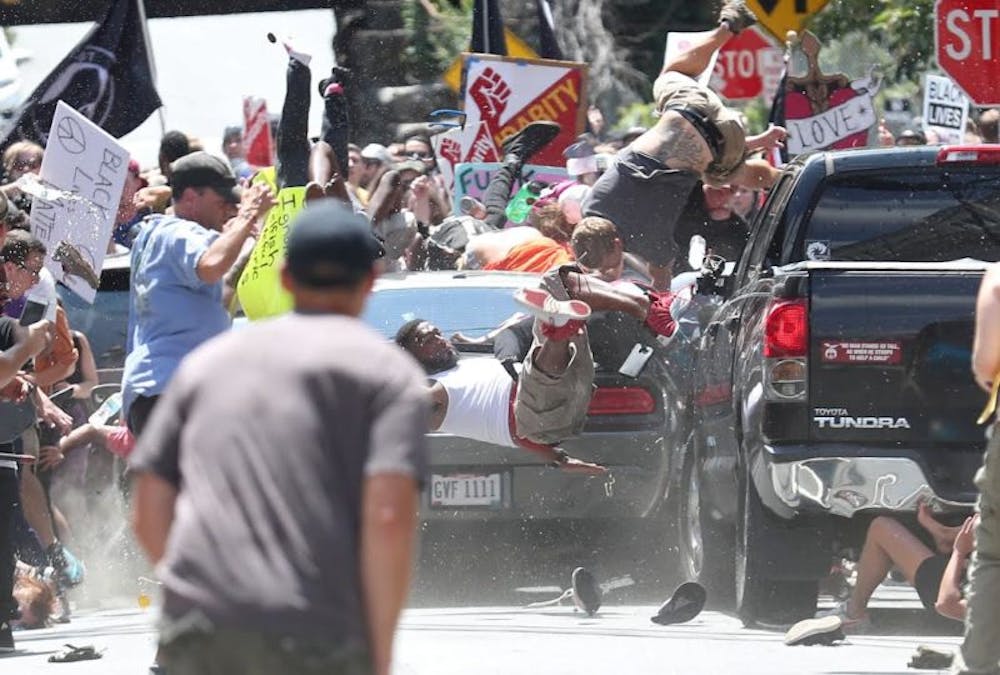
On Aug. 12, 2017, Charlottesville Daily Progress photographer Ryan M. Kelly captured the moment that Nazi sympathizer James Alex Fields, Jr. drove his Dodge Challenger into a crowd of counterprotesters, injuring 19 and killing 32-year-old Heather Heyer. It’s probably the most enduring image to emerge from the weekend of “Unite the Right” rallies in Charlottesville, Va.

Eight months later, Kelly’s iconic photograph from that tragic day has earned him the Pulitzer Prize for Breaking News Photography.

At first glance, the photograph is nearly impossible to make sense of visually or politically. Cars are not supposed to drive into pedestrians; fellow citizens are not supposed to kill each other over political differences. And there’s so much in the frame of the image – so many figures and forms crowded together, most only partially visible – that you can’t take it in all at once.

Pablo Picasso’s 1937 iconic mural “Guernica” might teach us how to interpret this image more closely, and why it is important to do so. Like Kelly’s photograph, “Guernica” conveys a moment of terror through a jumble of forms and fragments that seem to make no sense.

In April 1937, a different sort of “Unite the Right” moment took place in fascist Europe during the destruction of Guernica. At the request of General Franco, the leader of nationalist insurgents in the Spanish Civil War, German and Italian warplanes bombarded the Basque town in northern Spain. Terror rained from the sky: Hundreds of civilians were killed, while military targets were left unscathed.

Days later, as May Day protesters filled the streets of Paris, Pablo Picasso began what would become an anti-war masterpiece.


Pablo Picasso Guernica

Pablo Picasso, ‘Guernica’ (1937).
Reina Sofia


There are uncanny echoes of Picasso’s “Guernica” in Kelly’s photograph. Picasso used the Cubist techniques of fragmentation and collage to create a visual cry of anguish at the destruction wrought by men at the controls of war machines.

To make sense of the painting, you must do the work of reassembling what has been rendered apart. Yet you will never make sense of such destruction. You cannot merely glance at this massive painting or take it in all at once; you must stand and look and witness. There is nothing beautiful about it. It refuses to console. However, in the painting’s abstraction – its matte shades of gray, its distorted figures that stand in for the wounded and the dead – there is a kind of mercy toward its viewers and these victims.

If there is any mercy of abstraction in Kelly’s photograph, it is that of time. The image captures the moment in medias res – when the bodies of the men near its center still evoke the beauty of the human form in its wholeness.


Pulitzer Prize photograph Charlottesville


Ryan M. Kelly/The Daily Progress


Yet we know the victims are not whole; that is why it hurts to look. The contorted positions of the man in red and white sneakers and the man somersaulting above him make sense only in the realm of sports photography. But this is not a game.

Elsewhere the photograph captures only fragments: arms and hands, legs and feet, heads and faces. Empty shoes on the ground. Sunglasses. A cellphone in midair.

You will never make sense of this image because it makes no sense. (Or, rather, it makes as much sense as racism itself.) Yet to look away risks turning away from the truths it tells. A heavy aspect of our national tragedy is that we seem to lack a president – such as Abraham Lincoln – whose heart might break to see such carnage.

As he kept reworking “Guernica,” Picasso painted over a raised fist he had initially drawn near the center of the canvas. Then – as now – the raised fist is a symbol of solidarity against fascism. It makes an eerie reappearance on two posters in the top third of Kelly’s photograph.

“Guernica” includes small lines resembling newsprint. The Charlottesville photojournalist’s image is also crowded with text; some of it implicates the driver, while other words are a call to action.

Clear as day, there’s the incriminating license plate. No one can deny that this car drove into this crowd, as the colluding European fascists did when they claimed that Guernica had been bombed by Spanish Republican forces.

Then there’s the collage of protest signs and street signs that the neo-Nazi at the wheel didn’t heed: Peace/Black Lives Matter. Solidarity. STOP. LOVE. BLACK LIVES. STOP.

Kelly’s photograph redirects these injunctions to the viewer, who’s left to wonder whether this is what our democracy – or the state of our union – looks like.

The ConversationThis is an updated version of an article originally published on Aug. 17, 2017.

Jennifer Wenzel, Associate Professor of English and Comparative Literature and Middle Eastern, South Asian, and African Studies, Columbia University

This article was originally published on The Conversation. Read the original article.


Tuesday, November 14, 2017

'Charlottesville: Our Streets' Premieres as Work-in-Progress at Va. Film Festival

Virginia Film Festival 2017 Charlottesville Our Streets
Having its world premiere at the Virginia Film Festival exactly three months after the events of August 12 that it portrays, the Rashomon-like "Charlottesville: Our Streets" appears while psychic and physical wounds are still raw and the political repercussions -- especially for local government -- have not yet been fully played out.

The program notes provided by the Virginia Film Festival are deceptively understated:
A stark look at the devastating events that transpired in Charlottesville in August of this year, there will be much to discuss after this screening. A team of local filmmakers, photographers, and journalists has compiled footage and stills from over 30 cameras, with 20 interviews from first-person witnesses from the fateful Unite The Right rally of August 12th. The country watched as white supremacists’ demonstrations violently escalated, resulting in multiple injuries and the death of Heather Heyer. This feature documentary is an objective observation how the events unfolded, delivering a stark and sometimes brutal telling of individual truths from the perspectives of the people who were there.
Washington Post reporter Joe Heim listed the questions posed by "Charlottesville: Our Streets" in a front-page Metro section story in Sunday morning's editions.
...how that August weekend in Charlottesville will be most remembered is now in the hands of many different storytellers who will shape a shared history. Will it be seen primarily as the place where an ascendant white power movement came out of online nooks and crannies and showed its face to the world? Will it be remembered for those who took to the streets to stand up to the marchers and keep their rally from taking place? Or will it be recalled as a failure of leaders and police to keep the two sides apart and prevent a deadly outcome?
On Sunday afternoon in front of a packed house at the Paramount Theater, the producers of "Charlottesville: Our Streets," Jackson Landers (who also wrote the script) and Brian Wimer (who also directed), participated in a post-screening panel discussion moderated by radio host Coy Barefoot, along with journalist colleague Natalie Jacobsen -- who helped collect and sort the hundred of hours of video clips so they could be reviewed and chosen through a systematic process -- and two interview subjects from the film.


The movie drew both applause and jeers as it featured comments from both the neo-Nazis and Confederate nostalgists who invaded Charlottesville for the so-called "Unite the Right" rally over the weekend of August 11-12, and various counterprotesters from the clergy, antifa, and regular folks opposed to racism and anti-Semitism.

Landers and Wimer endeavored to be as objective as possible, letting the interviews and images tell the story and putting the burden of drawing conclusions on the audience, whose members are intelligent enough to interpret what they see.

Using a combination of talking-head interviews and "found footage" from among hundreds of hours of video taken by dozens of amateur and professional photographers on the scene that day, "Charlottesville: Our Streets" shows the chaos and the violence in a nearly unfiltered manner. Much of the video has not been previously seen by anyone other than those who took it, and one takeaway is that what did make its way to television news programs pulled its punches.

Writing in the Richmond Times-Dispatch on Monday, Tony Farrell described the film as
an astounding feat of bootstrapping journalism: a near-definitive visual chronicle of a day that spun slowly but wildly out of control, told through the mostly dispassionate points of view of countless cameras that captured all sides of the action.
He added:
Landers and Wimer also conducted 32 interviews with people who took part in or witnessed the violence that day — pastors, peace activists, Charlottesville residents and even members of the white supremacist groups that descended on the city for the long-planned Unite the Right rally to protest the removal of a Robert E. Lee statue in the center of town.

Landers and Wimer, longtime area residents unacquainted before Aug. 12 but both witnesses to the day’s brawling and mayhem, connected in the weeks after the violence and saw the value in documenting events they felt had been incorrectly reported or misrepresented through rumor-mongering and conspiracy theories.
In a report for public radio station WCVE, veteran Charlottesville journalist Hawes Spencer sampled the opinions of audience members at Sunday's screening. He found three widely different reactions:
Militia member Daniel Bollinger appears in “Our Streets” and attended its premiere. “It’s almost undescribable because it brings back so many memories from that day.”

Filmgoer Jim Hingeley says the picture succeeds. “It pulled it all together in a coherent way.”

However, transgender activist Emily Gorcenski finds the film unfair. “This drive towards objectivity is just enabling the side that wants to kill all Jewish people.”
Speaking of local journalists, a few of them are interviewed on screen.  Chris Suarez of the Daily Progress and Lisa Provence of C-VILLE Weekly both describe what they saw that Saturday morning.  (WCHV radio host Joe Thomas is seen arguing with a protester in a video clip.)

Charlottesville Our Streets Jackson Landers Brian Wimer
One thing I learned from the film was that the violence on August 12 was much worse than I had thought, based on the TV news reports I had seen; "Our Streets" shows clearly how the local and state police failed to intervene when the street fights began, standing at a distance and observing without taking action. As former Charlottesville Mayor Dave Norris says in an interview in the film, anyone who asserts there was no "stand-down" order is being "deceitful."

I earlier referred to "Charlottesville: Our Streets" as Rashomon-like, and this is borne out by its multiple points of view. One of the things that struck me was how, in almost every shot, there were several other cameras making their own recordings of the same scene from different angles. What those photographers captured could well compose another movie from which entirely different conclusions could be drawn.

"Charlottesville: Our Streets" does not yet have a distributor, but the producers hope to take it to other film festivals and to college campuses around Virginia and beyond. A "pay-what-you-can" screening is tentatively planned for next month. The filmmakers' aim is to return Charlottesville's name to what it was before it became a hashtag.

Full disclosure: Jackson Landers and I, along with Shaun Kenney, are weekly guests on Coy Barefoot's radio program on 94.7 WPVC-FM in Charlottesville, where we discuss local, state, and national politics for an hour beginning at 5:00 o'clock each Monday afternoon. The events of August 12 have been a frequent topic of our conversation since even before they occurred.  On November 13, with Jeff Lenert substituting for Shaun Kenney, we spent more than an hour in a panel discussion about the panel discussion.  Listen to the podcast.


-----------------------------------------------------------

Note: This post is adapted and expanded from a previous article on Bearing Drift by the same author.