Showing posts with label racism. Show all posts

Saturday, December 30, 2017

Guest Post: The myth that the English have a common Anglo-Saxon origin

Duncan Sayer, University of Central Lancashire

The idea that there is a common Anglo-Saxon ancestry based on biology is gaining currency among some right-wing and religious groups in the UK and US.

In the UK, the new leader of the UK Independence Party, Henry Bolton, suggested in a radio interview in October that “in certain communities the indigenous Anglo-Saxon population is nowhere to be seen.”
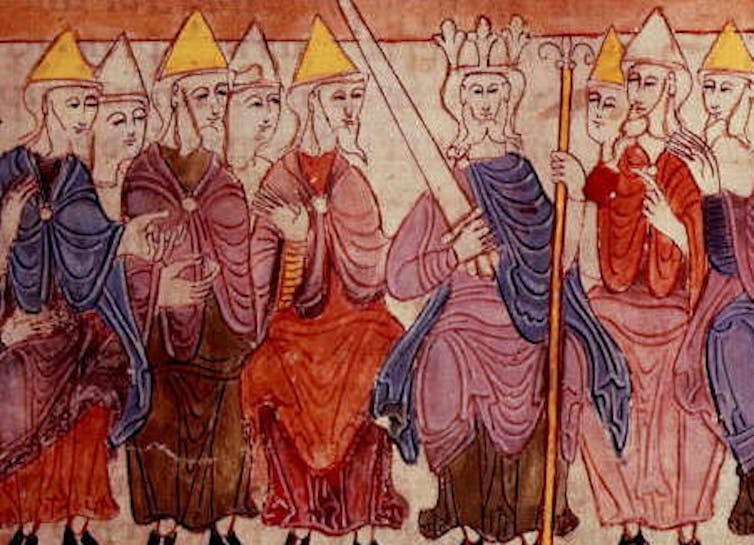


Witan hexateuch via Wikimedia Commons

A diverse history.
Witan hexateuch via Wikimedia Commons


In August, a religious group called the Odinist Fellowship wrote to the Church of England demanding two churches as reparations for a “spiritual genocide” which it claims began in the seventh century AD.

The Odinists use old Icelandic texts to reconstruct the “indigenous” religion of the Anglo-Saxons which they claim was oppressed with the arrival of Christianity. The Anglo-Saxons are commonly believed to have migrated into Briton in the fifth and sixth century AD. Iceland by contrast was inhabited in the ninth century by Viking settlers. In the US, this mixed up medievalism is associated with the white supremacist alt-right who use Anglo-Saxon and Viking motifs.

But archaeological research, which examines ancient DNA and artefacts to explore who these “indigenous” Anglo-Saxons were, shows that the people of fifth and sixth century England had a mixed heritage and did not base their identity on a biological legacy. The very idea of the Anglo-Saxon ancestor is a more recent invention linked closely with the English establishment.


Listen: The Anthill podcast episode on myths includes a segment on myths about race


The Anthill 20: Myths.
CC BY-ND38,2 Mo (download)


What DNA evidence shows


For decades, archaeologists and geneticists have sought to identify Anglo-Saxons in England. An early attempt in 2002 relied on modern DNA with a study of the male Y chromosome suggesting there had been a 95% population replacement of Britons by the Anglo-Saxons, comprised of different people from Northern Europe. But another study, based on mitochondrial DNA which is inherited from the mother, found no evidence of significant post-Roman migration into England. A third paper suggested that the genetic contribution of the Anglo-Saxons in south-eastern England was under 50%.

The discrepancies between the findings are because these three papers used modern DNA and worked backwards. Work my colleagues and I have undertaken looked at the question from the other direction – by working with ancient DNA.

The results from our recent study were published in Nature Communications and included evidence from an Anglo-Saxon site I excavated in Oakington, Cambridgeshire. In total ten skeletons were investigated. These included seven early medieval graves dating to between the fifth and eighth century – four from Oakington and three from Hinxton – and three earlier Iron Age graves from Cambridgeshire, dating to between the second century BC and the first century AD, to provide the genome of the antecedent inhabitants of Briton.

We used a novel method called “rarecoal” to look at ancestry based on the sharing of rare alleles, which are the building blocks of genes. Our research concluded that migrants during what’s now thought of as the Anglo-Saxon period were most closely related to the modern Dutch and Danish – and that the modern East English population derived 38% of its ancestry from these incomers. The rest of Britain, including today’s Scottish and Welsh, share 30% of their DNA with these migrants.
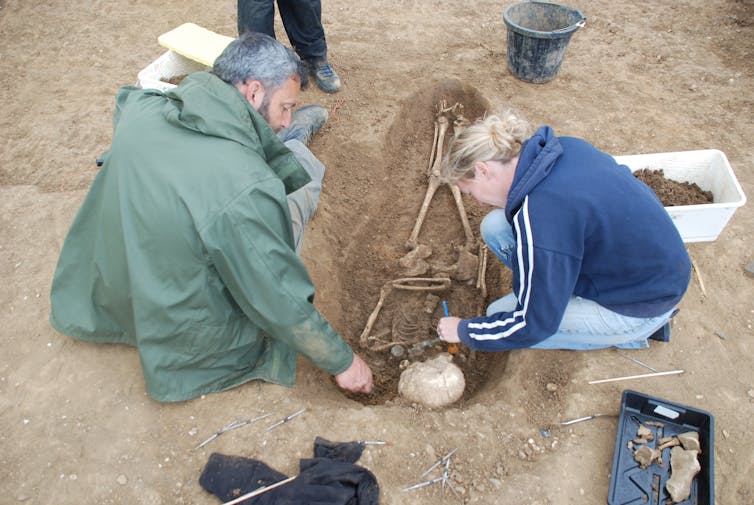


Excavating at Oakington. Duncan Sayer

Excavating at Oakington.
Duncan Sayer, Author provided


The analysis of DNA of four individuals from the Oakington Anglo-Saxon cemetery identified that one of them was a match with the Iron Age genome, two were closest to modern Dutch genomes, and one was a hybrid of the two. Each of these burials was culturally Anglo-Saxon because they were buried in the same way, in the same cemetery. In fact, the richest assemblage of Anglo-Saxon artefacts came from the individual with the match for Iron Age genetic ancestry, and so was not a migrant at all.

It shows that these ancient people did not distinguish biological heritage from cultural association. In other words, someone who lived and died in the fifth or sixth century Anglo-Saxon village of Oakington could have been biologically related to an earlier inhabitant of England, a recent migrant from continental Europe or a descendent of either or both – they were all treated the same in death.

Writing Anglo-Saxons into history


Biologically then these people were a mixed group who shared what we consider Anglo-Saxon culture. But they did not think of themselves as Anglo-Saxons.

The idea of the Anglo-Saxon is a romanticised and heavily politicised notion. When Gildas, a sixth century Monk wrote De Excidio et Conquestu Britanniae (On the Ruin and Conquest of Britain) he referred only to Saxons. Writing 200 years later, the Venerable Bede used the word “Anglorum” in his ecclesiastical history to describe a people unified under the church. In the ninth century, Alfred the Great used the term Anglo-Saxon to describe the extent of his realm – but this description did not persist.

It was not until the 16th century that pre-Norman people were consistently described as Anglo-Saxons. Previously, stories like the 1485 Le Morte d'Arthur, by Thomas Malory, romanticised Arthurian antagonists who defended Britain from invading Saxons. This origin story was important enough to late medieval Englishness that Henry VIII installed a round table in Winchester castle.
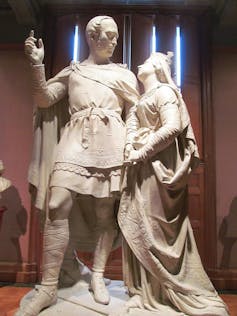


 Victoria and Albert: Anglo-Saxon style.

Victoria and Albert: Anglo-Saxon style.
David Holt London/flickr, CC BY


It was not until the 19th century that Anglo-Saxon poems such as Beowulf, the Seafarer and the Wanderer were translated into English as interest in Anglo-Saxons grew. In London’s National Portrait Gallery, there is a statue of Queen Victoria and Prince Albert of Saxe-Coburg and Gotha dressed as Anglo-Saxon monarchy – a commission that equated their Germanic descent with that of their subjects. This Anglo-Saxon origin story has its roots in politics, downplayed when anti-German sentiment during World War I prompted the royals to change their name from Saxe-Coburg-Gotha to Windsor in 1917.

A convenient, but inaccurate label


The people of the fifth, sixth and seventh century certainly did not think of themselves as Anglo-Saxons and would not have understood the description. Migration into the UK took place in deep prehistory, throughout the Roman and post-Roman periods – a fact which the Classicist Mary Beard was lambasted for defending on Twitter in August.

Migration then continued with Viking settlement in the ninth and eleventh centuries. Dutch and European migration into England was present throughout the middle ages and particularly pronounced in the 16th and 17th century as Flemish weavers fled religious persecution.

Today, the term Anglo-Saxon is a convenient label for those opposed to future immigration. While it collectively describes some post-Roman and early medieval culture, it has never accurately described a biological ethnicity nor an indigenous people. The DNA evidence points to an integrated people of mixed ancestry who lived side by side.

Anglo-Saxon ancestry is a modern English myth – the English are not descended from one group of people, but from many and that persists in our culture and in our genes.


The ConversationTo hear more on myths about race, listen to the December episode of The Anthill podcast on myths, featuring an interview with Duncan Sayer.

Duncan Sayer, Reader in Archaeology, University of Central Lancashire

La version originale de cet article a été publiée sur The Conversation.

Saturday, November 25, 2017

From the Archives - "The Gate of Heaven": Two Lives Examined

This review appeared in The Metro Herald in November 1996:

"The Gate of Heaven": Two Lives Examined
Rick Sincere
Metro Herald Entertainment Editor

Usually, when artists portray the meeting of cultures, they express it as a confrontation, a "culture clash." Seldom do they show the other side -- the meshing of cultures, their ability to complement each other, the capacity of people from different backgrounds to learn from each other and to grow more completely as human beings.

Ford's Theatre Washington DC This "other side" is shown with accomplishment by the creators of The Gate of Heaven, which opened at Ford's Theatre in Washington on October 23. Ford's outgoing artistic director (and main engine of growth) Frankie Hewett introduced the play to the audience by saying there is "no better theatre, and no better city in America, to present this play." The Washington premiere was made possible through a financial partnership with General Dynamics, which underwrote much of the costs for transferring the production from San Diego, where it was first produced.

The Gate of Heaven is a collaborative effort in which the two actors -- Lane Nishikawa and Victor Talmadge -- are also the playwrights. They benefited from the dramaturgical contribution of Tony Award-winning playwright David Henry Hwang (M. Butterfly) and director Benny Sato Ambush. It tells the story of two men, Japanese-American soldier Kiyoshi "Sam" Yamamoto (Nishikawa) and Leon Ehrlich (Talmadge), an East European Jew rescued by Yamamoto from the Dachau concentration camp at the end of the Second World War.

Ten years later, after searching far and wide, Ehrlich locates Yamamoto in San Francisco, eager to thank the American for saving his life. In the decade since the end of the war, Yamamoto had become an accountant while Ehrlich had, in turn, moved to Israel, fought in the war for independence there, come to America (where he became a citizen and a psychiatrist working for the Army).

From that point forward, Yamamoto and Ehrlich -- Sam and Leon -- become fast friends. Each teaches the other about his life and culture. Leon, who never marries, is adopted into Sam's family. Despite arguments and personal tragedies, their friendship persists throughout the next 40 years of their lives.

The Gate of Heaven deals with issues that many Americans would like to sweep under the carpet, including racism and the forced relocation of Japanese-American citizens into concentration camps during World War II. Sam's family had been relocated while he volunteered to serve in the 442nd Regiment, the most highly decorated unit in American history -- consisting almost entirely of Japanese-Americans whose families were living in horrid conditions in prison camps in Utah and Arizona. Worse, even while wearing his country's uniform and medals awarded for valor and several Purple Hearts, Sam and his fellows from the 442nd are derided and spat upon when they return home from the war. Restaurants refuse to serve them because they are "Japs."

The issue of racism comes to the surface -- and works dramatically as a means to cause a temporary estrangement between Sam and Leon -- on the occasion of the U.S. Bicentennial, the 4th of July in 1976. A seemingly simple conversation about what restaurant they should patronize -- Sam wants "American food," like steak while Leon wants something exotic, like sushi -- turns into a vivid exposition of racist undercurrents in American society. One example stands out: Earlier in the day, tourists had approached Sam and Leon asking for directions. They spoke only to Leon -- the immigrant with a foreign accent, who happens to have white skin -- while ignoring Sam -- the native-born American with no accent but with a different complexion. The tourists simply assumed that Leon was American and Sam was foreign, even though the opposite was true. This, Sam says, is one of the subtle but constant reminders of America's residual racism.

To Leon, this seems trivial. He had, after all, lived through the Holocaust, when his entire family and 6 million other Jews had been exterminated by "real" racists. He had seen the ethnic conflicts in Palestine after the war, and in contrast America is a paradise.

Voices are raised, leading to a separation of the friends lasting for several years.

The Gate of Heaven is an episodic drama. Many of the plot lines are revealed not linearly, but through flashbacks and asides and allusions. There are twists that do not become clear until late in the play. Nonetheless, the various facets come together seamlessly, creating a luminous gem of the theatre.

Much credit goes to the actors, Nishikawa and Talmadge, who have chosen difficult parts to portray. Not many actors can carry off the aging process of two men over a 50-year period with the same level of excellence as these two do.

Both actors are approximately the same age as their characters are at the beginning of the play. Nishikawa does a marginally better job at aging his character, Sam, in large part because his aging process is more subtle. He does this mostly through changing his voice, making it, over the years, huskier and more gravelly. For his part, Talmadge ages his character more physically -- letting his hairline recede, growing a mustache, slouching at the shoulders -- but he also uses his voice to show the passage of time. As Leon, Talmadge begins the play with a heavy East European accent, but slowly discards it so that by the end of the evening, one can hardly tell Leon's foreign origins. This is a realistic way to portray an immigrant, most of whom lose their accents over time. He easily could have kept the dialect throughout the play, but by choosing this method, he underscored the "Americanness" of Leon, his equal status to Sam.

The first performance of The Gate of Heaven actually took place at the U.S. Holocaust Museum, a quite appropriate venue. The play provides a starting point for discussing the Holocaust and also the culpability of the U.S. government in oppressing its citizens of foreign origin (primarily Japanese-Americans). As a matter of fact, Ford's Theatre has provided a study guide for the play that can be used with high school (or college) history classes ("Backstage View: A Teacher's Guide to The Gate of Heaven," by Davi Walders, available from the Audience Development Director at Ford's Theatre, 202-638-2367 or http://www,fordstheatre.org).

The Gate of Heaven is simultaneously entertaining and instructive. It is poignant as well as hard-hitting. It successfully demonstrates how individuals can adapt to changing circumstances, how we can learn from each other and adopt other people's customs as our own, and how we are all better people when we do so. It accomplishes this without being preachy or didactic, keeping entirely within the dramatic context set by the playwrights, director, dramaturg, and scenic and costume designers.

Because it is a two-character play, The Gate of Heaven will probably gain a great following among community-theatre groups around the country. Props and setting are simple, so even the smallest low-budget company might be able to mount an adequate production. Whether amateur groups can find actors as excellent as Nishikawa and Talmadge remains to be seen, however.

Ford's Theatre deserves commendation for bringing The Gate of Heaven back to Washington for an extended run. Performances are Tuesday through Sunday evenings at 7:30 p.m., Thursday matinees at 1:00 p.m. (perfect for class trips) and Sunday matinees at 3:00 p.m. Signed performances will take place on Wednesday, November 13, at 7:30 p.m. and on Sunday, November 17 at 3:00 p.m. For ticket information, call the Ford's Theatre box office at 202-638-2367 or ProTix at 703-218-6500.


Tuesday, November 14, 2017

'Charlottesville: Our Streets' Premieres as Work-in-Progress at Va. Film Festival

Virginia Film Festival 2017 Charlottesville Our Streets
Having its world premiere at the Virginia Film Festival exactly three months after the events of August 12 that it portrays, the Rashomon-like "Charlottesville: Our Streets" appears while psychic and physical wounds are still raw and the political repercussions -- especially for local government -- have not yet been fully played out.

The program notes provided by the Virginia Film Festival are deceptively understated:
A stark look at the devastating events that transpired in Charlottesville in August of this year, there will be much to discuss after this screening. A team of local filmmakers, photographers, and journalists has compiled footage and stills from over 30 cameras, with 20 interviews from first-person witnesses from the fateful Unite The Right rally of August 12th. The country watched as white supremacists’ demonstrations violently escalated, resulting in multiple injuries and the death of Heather Heyer. This feature documentary is an objective observation how the events unfolded, delivering a stark and sometimes brutal telling of individual truths from the perspectives of the people who were there.
Washington Post reporter Joe Heim listed the questions posed by "Charlottesville: Our Streets" in a front-page Metro section story in Sunday morning's editions.
...how that August weekend in Charlottesville will be most remembered is now in the hands of many different storytellers who will shape a shared history. Will it be seen primarily as the place where an ascendant white power movement came out of online nooks and crannies and showed its face to the world? Will it be remembered for those who took to the streets to stand up to the marchers and keep their rally from taking place? Or will it be recalled as a failure of leaders and police to keep the two sides apart and prevent a deadly outcome?
On Sunday afternoon in front of a packed house at the Paramount Theater, the producers of "Charlottesville: Our Streets," Jackson Landers (who also wrote the script) and Brian Wimer (who also directed), participated in a post-screening panel discussion moderated by radio host Coy Barefoot, along with journalist colleague Natalie Jacobsen -- who helped collect and sort the hundred of hours of video clips so they could be reviewed and chosen through a systematic process -- and two interview subjects from the film.


The movie drew both applause and jeers as it featured comments from both the neo-Nazis and Confederate nostalgists who invaded Charlottesville for the so-called "Unite the Right" rally over the weekend of August 11-12, and various counterprotesters from the clergy, antifa, and regular folks opposed to racism and anti-Semitism.

Landers and Wimer endeavored to be as objective as possible, letting the interviews and images tell the story and putting the burden of drawing conclusions on the audience, whose members are intelligent enough to interpret what they see.

Using a combination of talking-head interviews and "found footage" from among hundreds of hours of video taken by dozens of amateur and professional photographers on the scene that day, "Charlottesville: Our Streets" shows the chaos and the violence in a nearly unfiltered manner. Much of the video has not been previously seen by anyone other than those who took it, and one takeaway is that what did make its way to television news programs pulled its punches.

Writing in the Richmond Times-Dispatch on Monday, Tony Farrell described the film as
an astounding feat of bootstrapping journalism: a near-definitive visual chronicle of a day that spun slowly but wildly out of control, told through the mostly dispassionate points of view of countless cameras that captured all sides of the action.
He added:
Landers and Wimer also conducted 32 interviews with people who took part in or witnessed the violence that day — pastors, peace activists, Charlottesville residents and even members of the white supremacist groups that descended on the city for the long-planned Unite the Right rally to protest the removal of a Robert E. Lee statue in the center of town.

Landers and Wimer, longtime area residents unacquainted before Aug. 12 but both witnesses to the day’s brawling and mayhem, connected in the weeks after the violence and saw the value in documenting events they felt had been incorrectly reported or misrepresented through rumor-mongering and conspiracy theories.
In a report for public radio station WCVE, veteran Charlottesville journalist Hawes Spencer sampled the opinions of audience members at Sunday's screening. He found three widely different reactions:
Militia member Daniel Bollinger appears in “Our Streets” and attended its premiere. “It’s almost undescribable because it brings back so many memories from that day.”

Filmgoer Jim Hingeley says the picture succeeds. “It pulled it all together in a coherent way.”

However, transgender activist Emily Gorcenski finds the film unfair. “This drive towards objectivity is just enabling the side that wants to kill all Jewish people.”
Speaking of local journalists, a few of them are interviewed on screen.  Chris Suarez of the Daily Progress and Lisa Provence of C-VILLE Weekly both describe what they saw that Saturday morning.  (WCHV radio host Joe Thomas is seen arguing with a protester in a video clip.)

Charlottesville Our Streets Jackson Landers Brian Wimer
One thing I learned from the film was that the violence on August 12 was much worse than I had thought, based on the TV news reports I had seen; "Our Streets" shows clearly how the local and state police failed to intervene when the street fights began, standing at a distance and observing without taking action. As former Charlottesville Mayor Dave Norris says in an interview in the film, anyone who asserts there was no "stand-down" order is being "deceitful."

I earlier referred to "Charlottesville: Our Streets" as Rashomon-like, and this is borne out by its multiple points of view. One of the things that struck me was how, in almost every shot, there were several other cameras making their own recordings of the same scene from different angles. What those photographers captured could well compose another movie from which entirely different conclusions could be drawn.

"Charlottesville: Our Streets" does not yet have a distributor, but the producers hope to take it to other film festivals and to college campuses around Virginia and beyond. A "pay-what-you-can" screening is tentatively planned for next month. The filmmakers' aim is to return Charlottesville's name to what it was before it became a hashtag.

Full disclosure: Jackson Landers and I, along with Shaun Kenney, are weekly guests on Coy Barefoot's radio program on 94.7 WPVC-FM in Charlottesville, where we discuss local, state, and national politics for an hour beginning at 5:00 o'clock each Monday afternoon. The events of August 12 have been a frequent topic of our conversation since even before they occurred.  On November 13, with Jeff Lenert substituting for Shaun Kenney, we spent more than an hour in a panel discussion about the panel discussion.  Listen to the podcast.


-----------------------------------------------------------

Note: This post is adapted and expanded from a previous article on Bearing Drift by the same author.


Guest Post: Anti-Racists Should Think Twice about Allying with Socialism

Modern racial justice movements like Black Lives Matter are embracing the historically false assumption that socialism is anti-racist.

by Marian L. Tupy

Speaking to the Los Angeles Times last August, the co-founder of Black Lives Matter, Patrisse Cullors, stated that BLM would not sit at the table with President Trump because he “is literally the epitome of evil, all the evils of this country – be it racism, capitalism, sexism, homophobia”.

Swastika hammer and sickle
Trump’s views and actions aside, calling capitalism evil and conflating it with racism is noteworthy. The same goes for the increasing tendency among racial justice advocates to embrace the left-wing economic agenda.

So much so that Ryan Cooper, a columnist for The Week, wrote a column titled, Is Black Lives Matter turning socialist? As Cooper approvingly noted, BLM has adopted a “hugely aggressive – and firmly leftist – economic program”.

On the other side of the Atlantic, Natalie Jeffers, who cofounded BLM in the United Kingdom, urged her followers to: “Fight racism with solidarity. Fight capitalism with socialism. We must organize – dedicate ourselves to revolutionary politic power.”

The Black Lives Matter Movement, a separate British organization, was founded by Gary McFarlane, a representative of the Socialist Workers Party, who writes for the Socialist Review and the Socialist Worker, and claims that, “Capitalism is racist from the top to the bottom”. His cofounders, including Kate Hurford, Harold Wilson, and Naima Omar, have also written for those two publications.

There is, in other words, a growing assumption among racial justice advocates that more socialism would result in less racism and, even, that socialism is, in itself, anti-racist. There is, in fact, no such necessary connection between socialism and anti-racism, as a closer look at early socialist writings amply shows.


Socialists Had a Lot to Say About Race
Marlborough Churchill familyTo start with, it is important to note that the meaning of the word “race” changed over time. Today, most people think of races in terms of color, as in “black” and “white.” Historically, however, race was also a synonym for a nation or, even, a family. In his 1933 book, Marlborough: His Life and Times, Winston Churchill noted: “Deep in the heart of the Prussian state and race lay the antagonism to France.” The English artist Mary Granville, in turn, referred to Churchill’s family as the “Marlborough race” in her 1861 book, Autobiography and Correspondence.

Race was always a part of socialist thought.

But race, whether narrowly (black and white) or broadly (skin color, nation, and family) understood, was always a part of socialist thought. In 1894, for example, Friedrich Engels wrote a letter to the German economist Walther Borgius. In it, Engels noted, “We regard economic conditions as that which ultimately determines historical development, but race is in itself an economic factor.”

In his 1877 Notes to Anti-Dühring, Engels elaborated on the subject of race, observing “that the inheritance of acquired characteristics extended … from the individual to the species.” He went on, “If, for instance, among us mathematical axioms seem self-evident to every eight-year-old child and in no need of proof from evidence that is solely the result of ‘accumulated inheritance.’ It would be difficult to teach them by proof to a bushman or to an Australian Negro.”

It is noteworthy that Engels wrote those words 16 years before Francis Galton, writing in Macmillan’s Magazine, urged humanity to take control of its own evolution by means of “good breeding” or eugenics. Speaking of which, Sidney and Beatrice Webb, who were both socialists and eugenicists, bemoaned the falling birthrates among so-called higher races in the New Statesman in 1913. They warned that “a new social order [would be] developed by one or other of the colored races, the Negro, the Kaffir or the Chinese”.

Che Guevara, the Argentine revolutionary and friend of the Cuban dictator Fidel Castro, offered his views on race in his 1952 memoir The Motorcycle Diaries, writing, “The Negro is indolent and lazy and spends his money on frivolities, whereas the European is forward-looking, organized and intelligent.”

Karl Marx came close to advocating genocide.


Socialists Are Historically Pro-Genocide
In addition to racism, early socialist writings contained explicit calls for genocide of backward peoples. The toxic mix of those two illiberal ideas would result in at least 80 million deaths during the course of the 20th century.

In the New York Tribune in 1853, Karl Marx came close to advocating genocide, writing, “The classes and the races, too weak to master the new conditions of life, must give way.” His friend and collaborator, Engels, was more explicit.

In 1849, Engels published an article in Marx’s newspaper, Neue Rheinische Zeitung. In it, Engels condemned the rural populations of the Austrian Empire for failing enthusiastically to partake in the revolution of 1848. This was a seminal moment, the importance of which cannot be overstated.

“From Engels' article in 1849 down to the death of Hitler,” George Watson wrote in his 1998 book The Lost Literature of Socialism, “everyone who advocated genocide called himself a socialist.”
So, what did Engels write?
Among all the large and small nations of Austria, only three standard-bearers of progress took an active part in history, and still retain their vitality – the Germans, the Poles and the Magyars. Hence they are now revolutionary. All the other large and small nationalities and peoples are destined to perish before long in the revolutionary world storm. For that reason they are now counter-revolutionary.
“The Austrian Germans and Magyars will be set free and wreak a bloody revenge on the Slav barbarians,” he continued. “The next world war will result in the disappearance from the face of the earth not only of reactionary classes and dynasties, but also of entire reactionary peoples. And that, too, is a step forward.”

Here Engels clearly foreshadows the genocides of the 20th-century totalitarianism in general and the Soviet regime in particular. In fact, Joseph Stalin loved Engels’ article and commended it to his followers in The Foundations of Leninism in 1924. He then proceeded to suppress Soviet ethnic minorities, including the Jews, Crimean Tatars, and Ukrainians.

It is unsurprising that Nazi Germany, with its concentration camps and omnipresent secret police, came so close to resembling the Soviet Union.

Adolf Hitler, who admired Stalin for his ruthlessness and called him a “genius,” was also heavily influenced by Marx. “I have learned a great deal from Marxism,” Hitler said, “as I do not hesitate to admit.” Throughout his youth, Hitler “never shunned the company of Marxists” and believed that while the “petit bourgeois Social Democrat … will never make a National Socialist … the Communist always will.”

Hitler’s “differences with the communists”, argued Watson, “were less ideological than tactical”. Hitler embraced German nationalism so as not to “compete with Marxism on its own ground,” but explicitly acknowledged that “‘the whole of national socialism’ was based on Marx.” It is, therefore, unsurprising that Nazi Germany, with its concentration camps and omnipresent secret police, came so close to resembling the Soviet Union.

How much did the Nazis learn from the Soviets?

Rudolf Hess Commandant of AuschwitzIn his 1947 memoir Commandant of Auschwitz: The Autobiography of Rudolf Hoess, Hoess recalled that the Germans knew of the Soviet program of extermination of the enemies of the state through forced labor as early as 1939. “If, for example, in building a canal, the inmates of a [Soviet] camp were used up, thousands of fresh kulaks or other unreliable elements were called in who, in their turn, would be used up.” The Nazis would use the same tactic on the Jewish slave laborers in, for example, munition factories.

Following their invasion of the Soviet Union in 1941, wrote Watson, the Germans collected information on the immense scale of the Soviet camp system and were impressed by the “Soviet readiness to destroy whole categories of people through forced labor.”

Communist terror continues to be shrouded in ontological fog.

After the war ended, Stalin was deeply worried about what the Germans knew with regard to the Soviet camp system and the crimes that the Soviets committed in the territories they conquered following the signing of the Molotov-Ribbentrop Pact. He sent Andrey Vyshinsky, the mastermind of Stalin’s Great Purge (1936-1938), to Nuremberg to steer the war crimes tribunal away from inconvenient lines of inquiry.

Today we are familiar with the aggregate numbers of people who died as a result of the socialist experiment, but communist terror continues to be shrouded in ontological fog. As such, the Nazi extermination of the Jews is generally condemned as an example of race hatred. The Soviet extermination of specific groups of people, in contrast, is generally seen as part of a much less toxic “class struggle.”

The Strange Separation of "Race Hate" and "Class Struggle"
The Marxist theory of history focused on class struggle and posited that feudalism was destined to be superseded by capitalism. Capitalism, in turn, was destined to give way to communism. Marx saw himself chiefly as a scientist and thought that he had discovered an immutable law of evolution of human institutions, from barbarism at the one end to communism at the other end. (Hence the idea of “scientific socialism” that Engels promoted after Marx’s death.)

Peoples stuck in feudalism, like the Slavs, “as well as Basques, Bretons and Scottish Highlanders”, could not progress straight from feudalism to communism. They would have to be exterminated – so as not to keep everyone else back! Watson noted, “They were racial trash, as Engels called them, and fit only for the dung-heap of history.”

How, then, are we to think of socialism and race, and does the answer to that question have any bearing on the distinction that has been drawn between the Nazi and communist atrocities?

The best that can be said of the socialists is that their victims were more varied than those of Hitler. 

H.G. WellsIn his 1902 Anticipations of the Reaction of Mechanical and Scientific Progress upon Human life and Thought, H.G. Wells wrote, “There is a disposition in the world, which the French share, to grossly undervalue the prospects of all things French, derived, so far as I can gather, from the facts that the French were beaten by the Germans in 1870, and that they do not breed with the abandon of rabbits or negroes.”


“I must confess,” he continued, that “I do not see the Negro and the poor Irishman and all the emigrant sweepings of Europe, which constitute the bulk of the American Abyss, uniting to form that great Socialist party.”

Note the ease with which the socialist author of such best-sellers as The Time Machine (1895), The Island of Doctor Moreau (1896), The Invisible Man (1897), and The War of the Worlds(1898), conflates backward whites and backward blacks.

To Wells, both were primitive and, consequently, unsuited to be the torchbearers of socialism. That’s perfectly consonant with Marx’s theory of history, which was, by definition, universal in applicability. Creation of a socialist utopia, therefore, depended on the extermination of all races, broadly understood, who stood in the way of socialist revolution. As such, it included black “Bushmen” and white Bretons.

In contrast to Marx, Hitler’s utopia was not universal. Hitler, the leader of the National Socialist German Worker’s Party (Nationalsozialistische Deutsche Arbeiterpartei), wanted to create socialism in only one country, Germany. Hitler’s hatred of the Jews, for example, was partly rooted in his belief that capitalism and international Jewry were two sides of the same coin. As he once famously asked, “How, as a socialist, can you not be an anti-Semite?”

The old distinction between the crimes of National Socialism and socialism proper seems to be untenable.

To achieve their socialist goals, wrote Götz Aly in his 2008 book Hitler’s Beneficiaries: Plunder, Racial War, and the Nazi Welfare State, the Germans confiscated gold, food, clothing, and machinery throughout the territories they conquered. They also put the conquered peoples to work in German slave labor and extermination camps, and factories.

In conclusion, the old distinction between the crimes of National Socialism (as purely racist) and socialism proper (as lacking a racial component) seems to be untenable. Both the perpetrators of Nazi atrocities (ie, the Germans) and their victims, including the Jews and the Slavs, were white. As such, Nazi atrocities make little sense on the narrow definition of racism (i.e., black versus white). They do make sense in the broader context – the perceived necessity to exterminate all peoples who stood in the way of achieving Hitler’s utopian ideal.

But, the same can be said of communist atrocities. The early socialists certainly toyed with the idea of racial inferiority of the darker races (i.e., narrow definition of racism), but ultimately embraced a program of genocide that was more encompassing. The best that can be said of the socialists, therefore, is that their victims were, in accordance with the universal aspirations of Marxism, more varied than those of Hitler. Let us hope that’s not the sort of inclusivity that Black Lives Matter on both sides of the Atlantic strives for.

Reprinted from CapX

Marian L. Tupy

Marian L. Tupy is the editor of HumanProgress.org and a senior policy analyst at the Center for Global Liberty and Prosperity.


This article was originally published on FEE.org. Read the original article.


Tuesday, August 15, 2017

Updated: Gary Johnson and Cliff Hyra React to #Charlottesville

Gary Johnson Charlottesville City Hall Jefferson Madison Monroe
Gary Johnson
Former New Mexico Governor Gary Johnson, who was the Libertarian Party's nominee for President in 2012 and 2016, issued a statement on the afternoon of August 14 in reaction to the events this past weekend in Charlottesville, Virginia.

Johnson posted his remarks on Facebook:

Racism killed people in Charlottesville this weekend. That is as un-American as it gets.

In the nation our Founders created, even a tiny minority of vile and repugnant 'demonstrators' enjoys the right to express racist white-supremacist evil.

BUT, the rest of us -- the overwhelming majority -- have the right, and I believe, the obligation, to condemn racism of every form. And when racist hate becomes violence and murder, we must respond with nothing less than the full force of the law.

Late Saturday night, Cliff Hyra, the Libertarian Party's 2017 nominee for Governor of Virginia, issued a similar statement, also on Facebook, reacting with shock and disbelief to the carnage precipitated by the presence of neo-Nazis, unabashed racists, and Confederate sympathizers in Charlottesville:
Cliff Hyra Libertarian Party Virginia Governor Charlottesville
Virginia gubernatorial candidate Cliff Hyra
Horrific and tragic events in Charlottesville today. White nationalists and neo-Nazis threaten the liberty of us all, and as Virginians we must stand united against them. My heart goes out to the victims of the brutal terrorist attack and their families. I wish a swift and full recovery to those hospitalized, and offer my deepest condolences to the families and friends of those who lost their lives.

It is shocking and unbelievable to me that a political disagreement over statues could serve as an excuse for violent combat and heinous murder. I am heartbroken today, and also fearful for the future of our country and our commonwealth. We must act now to root out and extirpate all support for political violence. Peaceful discussion and political action are the only way forward.

Update, August 15: Gary Johnson expanded on his thoughts about last weekend's events and their aftermath in an article for The Jack News headlined "In the Wake of Charlottesville, Let’s Look for Solutions and Not Blame."

Saturday, August 12, 2017

Guest Post: The Violence in Charlottesville

by Jeffrey A. Tucker

Robert E Lee Statue Emancipation Park Charlottesville Virginia
Robert E. Lee statue in Charlottesville
The vast majority of people in the United States have no interest whatsoever in street battles between the alt-right (better described today in more poignant terms) and the counter-protesters. Most people have normal problems like paying bills, dealing with kids, getting health care, keeping life together under all the usual strains, and mostly want these weird people to go away. So, of course, people are shocked at scenes of young people in the streets of this picturesque town with a university founded by Thomas Jefferson screaming, “Jews will not replace us.”

It’s hard to see, hard to hear. But they are not going away. For some people with heads full of violent ideology, what's happened so far is not enough. They imagine that with their marches, flags, uniforms, slogans, chants, screams, and guns, they will cause history to erupt and dramatically turn to favor them over the people they hate. Indeed, what is unfolding right now, with real loss of property and life, has gone beyond politics as usual and presages something truly terrible from the past, something most of us had previously believed was unrepeatable.

What in the world causes such a thing? It’s not about bad people as such. Many of the young men and women involved in this movement were raised in good homes and, under normal conditions, would never hurt anyone. What this is about is bad ideas. They crawl into the brain and cause people to imagine things that do not exist. It can be like a disease that a person doesn’t even know that he or she has. It causes people to seethe with hatred for no apparent reason, to long for the extermination of people who have never done anything wrong, to imagine insane outcomes of social struggles that have zero chance of succeeding.

The Group
The implausibility of their ideas is disguised by group psychology. They hang around people who think these same things and egg each other on in shared resentments and dreams of new powers they can acquire if they act boldly, bravely, and with determination. They conjure up scapegoats (blacks, Jews, women, Antifa, gays, and a government that is supposedly giving them all privileges at their expense) and begin to believe that the only way forward is to destroy them all in some grand uprising, after which they will seize power and rule forever.

Yes, I know it sounds insane. But one thing you learn from history is that no idea is too insane to be off limits to a group infected with a longing to rule. Any means to the end will do, with the end deeply embedded in the fevered imagination of the group member who finds mission, meaning, and significance from some struggle.

The Statue Myth
Much of the media coverage about the violence in Charlottesville, Virginia report that this all began with a dispute over the fate of a statue of the Civil War Confederate general Robert Lee that sits downtown. The city council voted to take it down; the protesters want it to remain as a symbol of white pride and rule (which is absurd because General Lee would have been thoroughly repulsed by the ideology these people represent). In actual fact, the dispute over this statue is a complete distraction from the real motivation here.

What this really is: an explosive expression of an idea that has been brewing in a malevolent movement that has been gaining steam for very a long time. After the Second World War, most people imagined that Nazi ideology was gone from the earth and that the only real totalitarian view that remained to threaten liberty was Communism. That might have been true for a few decades, but matters began to change in the 1990s, as new violent strains of statism begin to arise.

The Deep History
For the last two years, I’ve written about the deep history of this violent strain, which can be described variously as Nazism, fascism, alt-right, white supremacy, white nationalism, neo-reaction, or, my preferred and more technical moniker (borrowed from Ludwig von Mises), right-Hegelianism. People have variously wondered why I’ve spent so much time and energy digging through the works of people like Johann Fichte, Houston Stewart Chamberlain, Thomas Carlyle, John Ruskin, Charles Davenport, Oswald Spengler, Carl Schmitt, Julius Evola, Giovanni Gentile, and so on (many of my writings on these people are here). All of these ideas existed long before Hitler and the Nazis – and caused enormous damage in the world long before the Holocaust – and they persist after them.

It’s true that probably not even one of the protesters in Charlottesville have read these thinkers, much less the traditional liberal response to these rightist strain of anti-liberalism. How can they possibly be responsible?

Ideas are strangely magical, like time-traveling spiritual DNA, moving from brain to brain like a genetic mutation and just as unpredictably. Keynes was right to observe that most politicians are slaves to some defunct economist; in the same way these violent thugs are slaves to some defunct philosopher who loathed the emergence of universal freedom in the world during the 19th century and were determined to set it back.

Propagandists for Evil
At the same time, there must be some mode of transmission for ideas. The leaders of this movement serve the purpose well, but there is a deeper root. I’ve been very reluctant to mention what might be the most influential tract among the rise of the hard statist right in the last few decades, but given where we are with all of this, it is time. The book is The Turner Diaries, written by “Andrew McDonald” who was really William Pierce, a brilliant physicist whose mind was taken over by Nazi ideology, precisely because he was steeped in the literature above.

I do not recommend reading this book. You can’t unread it. It is their roadmap. I can recall the first time I read it. I was shaken to my very core, and it was the beginning of a new realization of the task before us, to combat this horror with every bit of intellectual energy.

It is the story of a small junta of whites who set out to reverse history with a series of killings, starting with Jews, then blacks, then communists, and then, inevitably, apologists for the merchant class and libertarians (they hate us deeply too). What you learn early on here is that this movement is absolutely socialist, just in a different way from the more-famous left-wing socialists. They are not red shirts but brown shirts, so they have a different agenda. It’s not about class struggle. It’s about race struggle, religious struggle, gender identity struggle, national struggle. 

So what happens? They rally the masses to their side with a growing amount of bloodshed, gain control of the government, set up a centrally planned socialist state, get hold of the nuclear stockpile and slaughter all non-whites in the world. Sorry for the spoiler.


The Genetic Code
Why would anyone rally behind such a ghastly book? Again, the human mind is capable of imagining terrible things, and that which we imagine to be true influences actions. Ideas, as they say, have consequences. Hence, anyone who has followed the transmission of these ideas over the last decades could see where this is heading.

What happens now? The tragedy is compounded, with a burgeoning leftist movement to counter the emerging threat from the opposite side, and a government ready to exploit the conflict between the two to crack down further on human rights and freedoms. It’s the perfect storm.


Our Task
The question is: what to do now? The answer lies in the source of the problem. The huge mess began with bad ideas. The only means available – and it is the most powerful – is to fight bad ideas with good ideas. We all need to throw ourselves into the intellectual battle most of all and as never before. What are those good ideas?

The progress of the last 500 years shows us precisely what the good ideas are: social harmony, human rights, the aspiration of universal dignity, the conviction that we can work together in mutual advantage, the market economy as a means of peace and prosperity, and, above all else, the beauty and magnificence of the idea of liberty itself.

Let us all – those who love peace, prosperity, and human flourishing for all – not despair but rather rededicate ourselves to the mission of replacing bad ideas with good ones. Our predecessors in this mission faced far worse odds and they prevailed, and they were far fewer than us. We can too, provided we think, speak, and act with courage and conviction in favor of all that is beautiful and true. This is how the left/right cycle of violence will be replaced by the highest longings of the human heart.


Jeffrey A. Tucker is Director of Content for the Foundation for Economic Education. He is also Chief Liberty Officer and founder of Liberty.me, Distinguished Honorary Member of Mises Brazil, research fellow at the Acton Institute, policy adviser of the Heartland Institute, founder of the CryptoCurrency Conference, member of the editorial board of the Molinari Review, an advisor to the blockchain application builder Factom, and author of five books. He has written 150 introductions to books and many thousands of articles appearing in the scholarly and popular press.


This article was originally published on FEE.org. Read the original article.


Tuesday, May 16, 2017

Guest Post: Race-Based Rhetoric is Inherently Un-American

by U.S. Representative Tom Garrett

Tom Garrett Congress Virginia Fifth Congressional District Charlottesville
Racism is an abhorrent institution, period. No one who believes they are better, worse, or unequal based on the color of their skin has a place in the District I represent or the America I defend. The charade that took place in Charlottesville on Saturday night was either criminally naïve or an intentional image meant to stoke the bigotry and intolerance that our Commonwealth fought to bury decades ago. Unfortunately, I am under the impression that it was the latter and I have no sympathy for those who embrace it. As I learned more about the gathering that occurred this weekend, purportedly to save the Lee statue from removal, I could not believe what I was hearing. While the First Amendment protects speech and expression, whoever thought that two hundred people carrying torches was anyway productive must have failed basic American history. Regardless of any cause they wanted to represent, their actions spoke for themselves in the message they delivered and that message should be rejected by all of us.

Race relations are a complex issue in the South, especially in Virginia, but I am proud of the special role the Fifth District has played in their progress. It is the home of flawless documents written by flawed men that created a system for all man to be treated as they were created, equally. It is home of General Lee’s surrender, the symbolic end to our bloodiest war and slavery. And it was home to Barbara Johns, a young spark in the Civil Rights movement who led her high school walkout against segregation and became the only student-initiated case in Brown v. Board of Education. These positive legacies inherently stem from dark pasts. We cannot forget where we came from, for progress will not seem as sweet. The pictures and chants of Saturday evening remind us of the darkness that once intimidated millions, but it will not intimidate us now.

I embrace an ideology rooted in protecting the ultimate minority – the individual. Collectivization based on race or any other distinguishing trait has no home in republican principles. These practices inherently divide us, run counter to our core, and regressively reject others from joining our cause. There is no home in my party—the party of our founding documents, the party of Lincoln, and the party that fought to pass the Civil Rights Act—for a race-based organization. For as much rhetoric as the modern Left uses to associate these actions with my party, I expected to see more of Virginia’s democratic leaders condemn these actions, yet Senator Kaine and Governor McAuliffe remain silent.

As a soldier, prosecutor, and legislator, I’ve devoted my life to defending American ideals. Anyone who believes the color of a person’s skin makes us different is an anathema to the values I’ve fought for. We must remove the plank from our own eyes and work together, regardless of partisanship, to reject these organizations and look beyond physical differences on our way to our more perfect union.

Source: Office of Congressman Tom Garrett (R-VA5)