Showing posts with label The Conversation. Show all posts

Saturday, April 20, 2019

Guest post: Easter – a Christian festival that feels pagan


Jane Stevenson, University of Oxford

There’s a lot of confusion about Easter – not least because this most important of all Christian festivals moves around so much from year to year, decided by a complex set of calculations based on the vernal equinox and the phase of the moon. Easter symbols – eggs, bunnies, lambs and the rest – give the festivities an air of pre-Christian paganism.

happy easter chocolate candy crossSo where do the origins of Easter and the rituals observed by so many – whether Christian or not – really lie?

The first mention of Eostre is in the eighth century, in The Venerable Bede’s frustratingly cryptic account of the native Anglo-Saxon calendar in De Temporum Ratione (On the Reckoning of Time). The Anglo-Saxon equivalent of April called Eostremonath is named for the goddess Eostre – but we only know about Eostre via Bede’s writings and the only thing he tells us about her is that “feasts were celebrated” in her honour. So, if modern Easter is frequently a festival of overeating, this has tradition on its side.

But Eostre was evidently significant enough for the Anglo-Saxons to later transfer her name to the Christian festival of the resurrection rather than adopting the Latin name “Pascha”.

Similarly, Easter is “Ostern” in German – which implies she must have been known outside England. Confusingly, the great 19th-century folklorist and philologist, Jacob Grimm, invented a German goddess called Ostara – “the divinity of the radiant dawn, upspringing light, a spectacle that brings joy and blessing” – on purely etymological grounds: the name is derived from a proto-Indo-European root meaning “to shine”. But Grimm didn’t present a shred of supporting evidence that such a deity had ever been worshipped in Germany, leaving us with just Bede to go on.

Easter roughly coincides with the spring equinox – so there is a good deal of lore attached to the season which is not actually Christian. Easter is preceded by Lent – a period of fasting in memory of Christ’s 40 days in the wilderness. But it is also a season when, in pre-modern Europe, food would have been running low. Winter supplies would have been coming to an end and there was not enough sun and spring growth yet for hens to start laying and cows to give milk. In a sense, therefore, Easter is a natural feast – to celebrate passing out of that hardship.

Easter and Passover


The association of lamb with Easter is something we have borrowed from Jewish tradition and Passover – which was also the festival that Jesus and his disciples celebrated with their Last Supper.

At least as far back as the 15th century, Easter was also marked in England by eating “tansies” – a kind of custardy pudding made with the bitter (and poisonous) herb tansy and sometimes with other bitter greens such as nettles. The 17th-century antiquarian John Aubrey adds a further detail:

Our tansies at Easter have reference to the bitter Herbs [eaten at Passover by Jews] though at the same time ’twas always the Fashion for a man to have a gammon of Bacon, to shew himself to be no Jew.


Eggs are an ancient and natural symbol of returning life in many parts of Europe, but the Easter egg may also derive from Passover – which includes, among various symbolic foods, a roasted egg: the beitzah. Until at least the mid-20th century, more people marked Easter with decorated, hard-boiled hen’s eggs than chocolate ones.

The earliest documented mention in England of decorated eggs comes in 1290, from the household accounts of King Edward I for 1290, which records the purchase and decoration of 450 eggs , some gilded, some dyed. These eggs were presented to the royal household at Easter, and cost 18 pence.

In many parts of Britain the custom was for people, children especially, to play with their “pace-eggs” by rolling them down a chosen slope before eating them. In Iona and Peter Opie’s 1959 study The Lore and Language of Schoolchildren, a child reports that: “In Cumberland we take more notice of the pace eggs than chocolate eggs.” Easter eggs as also rolled on the lawn of the US White House, a custom going back to 1878.

Bunny business


The association of hares with Easter also considerably predates foil-wrapped chocolate bunnies. As early as 1682, Georg Franck von Franckenau’s essay De ovis paschalibus (About Easter Eggs) speaks of a German tradition of an Easter hare bringing coloured Easter eggs for the children.

In southern Germany, children used to be told that a hare laid the pace-eggs and they would make a nest for the creature to lay them in. The Easter hare was also known in parts of the British Isles and was particularly associated with having to hunt out eggs hidden in the garden, where the hare was supposed to have put them.

A curious entry in the Calendar of State Papers for April 2 1620, suggests that hares were also often eaten at Easter:

Thos. Fulnety solicits the permission of Lord Zouch, Lord Warden of the Cinque Ports, to kill a hare on Good Friday, as huntsmen say that those who have not a hare against Easter must eat a red herring.

Hares were also ritually hunted at Easter in England – there is a note in the Chamberlains’ Accounts for the year 1574 that twelvepence was “given to the hare-finders at Whetston Court”.

An Easter hare hunt survived as part of Leicester’s ritual year as late as the 18th century, though by then a dead cat was substituted for an actual hare. Jacob Grimm, looking at this evidence for an association of ritual activity involving hares with the Easter season, conjectured that the hare was sacred to the goddess Ostara, piling one conjecture on top of another.

So the truth is that Easter rituals as we know them today represent an untidy collection of customs connected with celebrating spring growth and the end of austerity – a time for new clothes and rich food. Any connection with pre-Christian paganism is entirely coincidental.The Conversation

Jane Stevenson, Senior Research Fellow at Campion Hall, University of Oxford

This article is republished from The Conversation under a Creative Commons license. Read the original article.


Sunday, February 24, 2019

Guest Post: 2019 Oscars may be more remembered for the crises than the ceremony


Julie Lobalzo Wright, University of Warwick

Comedian Kevin Hart lasted just three days as the host of the 2019 Academy Awards. Almost immediately after his name was announced on December 4, a backlash began on social media about homophobic jokes Hart had made on Twitter between 2009 and 2011. After refusing to apologise, even when the Academy demanded it, Hart stepped down as host on December 7, leaving the ceremony without a host.

The last time that happened was in 1989, an occasion the Academy would prefer to forget as, instead of a host, producer Allan Carr had arranged a bizarre revue involving Snow White and Rob Lowe singing Proud Mary. Disney sued for breach of copyright.

This year’s ceremony is shaping up to be just as controversial. Ratings for the awards show have been declining for some years, perhaps because people have grown tired of the overt political messaging. (It’s interesting to note here that there’s also a strong correlation between the box office performance of the film that wins multiple Oscars and the ratings for the awards show. So, in 1998, when Titanic won 11 Oscars and took US$2.1 billion worldwide, more than 57m people watched the show. Last year, when The Shape of Water won best picture – having earned less than US$200m at the box office – less than half that number of people tuned in: 26.5m.)

With the thought of boosting ratings this year, in August the Academy proposed the introduction of a new category: best popular film. This was widely thought to be a Really Bad Idea.


People involved in fims such as Black Panther, which took more than $US1 billion within 26 days of release, asked whether the film’s global popularity meant it would be pigeonholed as “popular” rather than “excellent”. “What,” asked the New York Times,, “if it received a nomination for the populist Oscar but not for best overall picture? Would that mean Black Panther and films like it were second-class citizens?” The idea was swiftly shelved.

At least it will be diverse


In the end, when the nominations were announced in February, box office behemoths, such as Black Panther (the first best picture award for a superhero movie), were nominated alongside critical successes, such as The Favourite and Roma.

Queen biopic, Bohemian Rhapsody (which has also done very brisk box office at US$850m and counting) is also nominated for best picture, despite mixed critical reviews – the film has the lowest average scores of any of the best picture nominees on Rotten Tomatoes. The Guardian reviewer, Steve Rose took particular exception to the film’s handling of Freddie Mercury’s private life, casting “Mercury’s wilderness years as a symptom of his gayness”. And, shortly after the Queen biopic won best picture at the Golden Globes, The Atlantic published a long list of allegations of sexual misconduct against director Bryan Singer, who had been fired by 20th Century Fox in December 2017, with three weeks of filming left – reportedly over differences with the cast and crew. His name was removed from nominations at the Baftas. Singer has denied the allegations, telling the BBC that the story “rehashes claims from bogus lawsuits filed by a disreputable cast of individuals willing to lie for money or attention”.


One accusation this year’s Oscars is hoping to avoid is the unwelcome tag of #oscarssowhite, which has dogged the awards in recent years, exposing the lack of diversity in Hollywood cinema and in the voting branch of the Academy. Nominations for Black Panther and Blackkklansman, in addition to the Mexican film Roma and the queer female ensemble film The Favourite, should ensure the ceremony has at least the impression of diversity it has so craved previously.

Bad timing


But, ever conscious of ratings, the show’s planners set about designing a shorter ceremony, hoping to encourage viewers who have previously been put off by a running time of three and a half hours (four hours and 23 minutes in 2002). But when it was announced that only two of the five songs nominated in the best original song category would be performed, there was a widespread backlash – and musicians reportedly showed solidarity: either all the songs would be performed, or none. Once again the Academy relented.

It was also announced that four awards would be given out during the ad breaks – cinematography, film editing, live action short, and makeup and hairstyling. None of these categories, it was quickly noticed, involved nominees representing films made by Disney (the parent company of ABC, the network broadcasting the ceremony). And surely cinematography and editing are two of the most fundamental crafts to the art of cinema. Movie makers certainly thought so.


After protests from, notably, the American Society of Cinematographers as well as a host of big names such as Martin Scorsese, Alfonso Cuarón, Spike Lee and Quentin Tarantino, within the week the Academy announced that all 24 awards would be presented live on TV.


What else could go wrong? It is possible the awards will still feature spontaneous moments, surprise wins, and sensational stars to supplant the months of negative publicity leading up to the event. Only two years ago when an otherwise fairly unremarkable evening became one of the most talked-about Oscars in years when Faye Dunaway and Warren Beatty read out the wrong name for best picture. This year it’s going to take something pretty sensational or outrageous on the night to save the Oscars from being remembered as a fiasco from planning to broadcast.The Conversation

Julie Lobalzo Wright, Teaching Fellow in Film Studies, University of Warwick

This article is republished from The Conversation under a Creative Commons license. Read the original article.

Guest Post: Oscars 2019: Roma, Yalitza Aparicio and the fascinating history of non-professional actors

Catherine O'Rawe, University of Bristol

The surprise nomination of non-professional indigenous woman Yalitza Aparicio for this year’s best actress Oscar for her role as a domestic servant in Alfonso Cuarón’s critically acclaimed Roma has been greeted as a “fairytale”.

Aparicio was training to be a teacher when she reluctantly went to an audition where Cuarón was immediately struck by her. Her presence and her similarity to his own childhood maid – on whom the film is based – secured her the role.


Propelled into the spotlight by her role, she has become the first indigenous woman to grace the cover of Mexican Vogue. She also endeared herself to her growing social media following by uploading to Twitter a video of her sobbing reaction to news of her nomination.


If Aparicio wins, she will be the first indigenous Latina Oscar winner and will join the small number of non-professional actors to win an Oscar in recent times. This number includes Anna Paquin for her role in The Piano (1993) and Haing S Ngor, a former doctor from Cambodia, who won the 1985 best supporting actor Oscar for his role in Roland Joffe’s The Killing Fields, in which his own traumatic experiences informed his outstanding performance as a local journalist.

In the same year as acclaimed indie hits such as Chloé Zhao’s The Rider, in which Brady Jandreau played a version of himself as an injured rodeo rider, and Crystal Moselle’s Skate Kitchen, featured an all-girl skate collective from New York, it seems that authenticity in casting and performance is all the rage.

But Aparicio also stands out as being typical of the non-professional’s experience throughout cinema history. Her “journey” from naïve provincial girl to the red carpet hits many familiar notes. Interviews emphasise how little she understood of cinema, and how she had never heard of Cuarón and feared the job offer might be a trafficking scam.

Authenticity


Aparicio’s unpolished and untrained authenticity is sharply juxtaposed with the glamorous world in which she now finds herself. Part of the non-professional’s effect is to throw into relief the extraordinariness of stars, as well as their proficiency, understood as a product of years of training and dedication to their craft. Aparicio’s novelty, spontaneity, and natural appearance are all singled out as antithetical to the professionalism of her co-star, experienced stage actress Marina De Tavira, who has also been nominated for an Oscar.

Her story mirrors the “discovery” of Barkhad Abdi, the untrained Somali-American who played a memorable co-lead to Tom Hanks in Captain Phillips. It also recalls the children recruited by Danny Boyle from the Mumbai slums for global hit Slumdog Millionaire.


In the latter case, ethical concerns around the effects of sudden fame on vulnerable children were recognised by Boyle. He set up a trust fund for them, though this didn’t prevent allegations that the father of one of the girls tried to sell her to capitalise on her fame.

Power imbalance


The non-professional child actor came to prominence in post-WWII Italian neorealism, which specialised in taking performers from the streets. Vittorio De Sica’s Oscar-winning 1948 classic Bicycle Thieves was particularly celebrated for its non-actors, chosen for their faces and bodies rather than any acting talent.


Lamberto Maggiorani, who played the tragic father, lost his factory job after the film and struggled to find work as an actor; he repeatedly begged De Sica to help him out. Meanwhile, nine-year-old Enzo Staiola made several further films and retired at the age of 15. However, accounts of his treatment on set , which included De Sica publicly humiliating him to make him cry, match other testimonies of neorealist directors extracting performances from non-professionals by insulting and even beating them.

This power differential, always implicit in the actor-director relationship, is obviously exacerbated when the actor is inexperienced and has no manager to guide them through the film industry. While Aparicio and Cuarón’s on-set relationship seems to have been affectionate, one anecdote about the film’s shooting is somewhat disturbing. In a central, traumatic scene for her character Cleo, Cuarón admitted that he deliberately withheld from Aparicio what would happen. Her anguished reaction is genuine – and presumably she could not be trusted to generate that response otherwise.

Aparicio has declared that she would like to continue to act, though she admits that Roma may be a one-off. French film critic André Bazin wrote of neorealist actors that the non-professional can be used only once because their effect can never be replicated. But non-professionals have gone on to career success – Paquin, obviously, as well as Sasha Lane, discovered by Andrea Arnold for her film American Honey, is continuing to work. So is Abdi, though in low-profile parts. Others, like the kids of Slumdog Millionaire, have returned to their old lives.

In all the press talk and interviews with Cuarón and Aparicio, one thing is never mentioned: pay. While one presumes that she received a fair salary for the part, non-professionals generally come cheap because it’s often assumed that part of the reward is the experience itself, the fairytale story. But when the magic finishes and the closing credits roll, they all too often find themselves alone.The Conversation

Catherine O'Rawe, Professor of Italian Film and Culture, University of Bristol

This article is republished from The Conversation under a Creative Commons license. Read the original article.

Wednesday, December 12, 2018

Guest Post: An archaeological dig in Israel suggests how feasting became an important ritual


Natalie Munro, University of Connecticut

This holiday season millions of families will come together to celebrate their respective festivals and engage in myriad rituals. These may include exchanging gifts, singing songs, giving thanks, and most importantly, preparing and consuming the holiday feast.


Archaeological evidence shows that such communally shared meals have long been vital components of human rituals. My colleague Leore Grosman and I discovered the earliest evidence of a ritual feast at a 12,000-year-old archaeological site in northern Israel and learned how feasts came to be integral components of modern-day ritual practice.


First, what are rituals?


Rituals involve meaningful, often repeated actions. In modern-day practices they are expressed through rites such as the hooding of a doctoral student, birthdays, weddings or even sipping wine at Holy Communion or lighting Hanukkah candles.


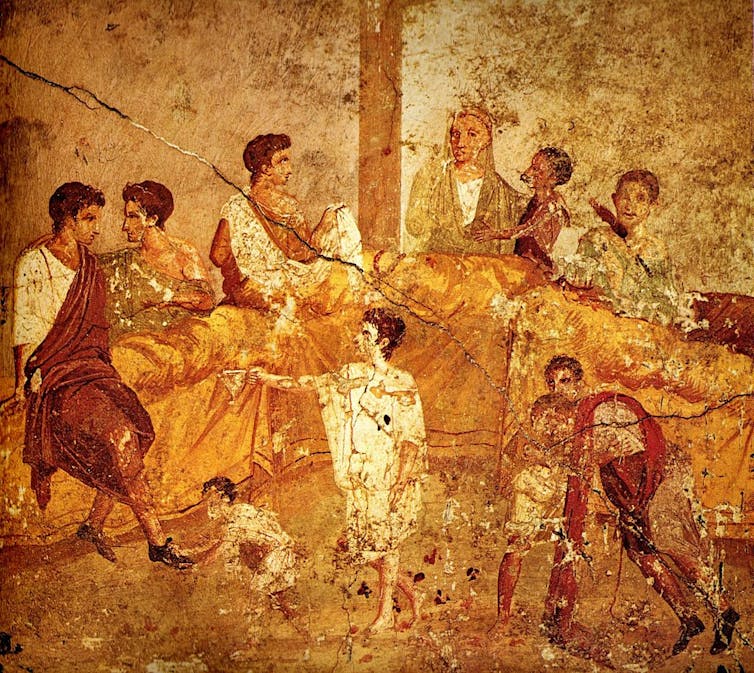
Pompeii family feast painting Naples

Pompeii family feast painting, Naples.
Unknown painter before 79 AD, via Wikimedia Commons


Ritual practice may have emerged along with other early modern human behaviors more than 100,000 years ago. However, proving this with material evidence is a challenge. For example, researchers have found that both Neanderthals and early modern humans buried their dead, but scholars weren’t certain whether this was for spiritual or symbolic reasons and not for something more mundane like maintaining site hygiene. Likewise, the discovery of 100,000-year-old symbolic artifacts like pierced shell ornaments and decorated chunks of red ochre in caves in South Africa, was not sufficient to prove that they were part of any ritual activities.

It was only when archaeologists found these artifacts, placed in graves going back 40,000-20,000 years, that it was confirmed they were part of ritual practice.

The first feasts


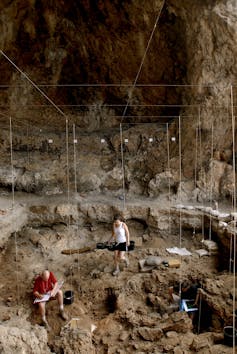
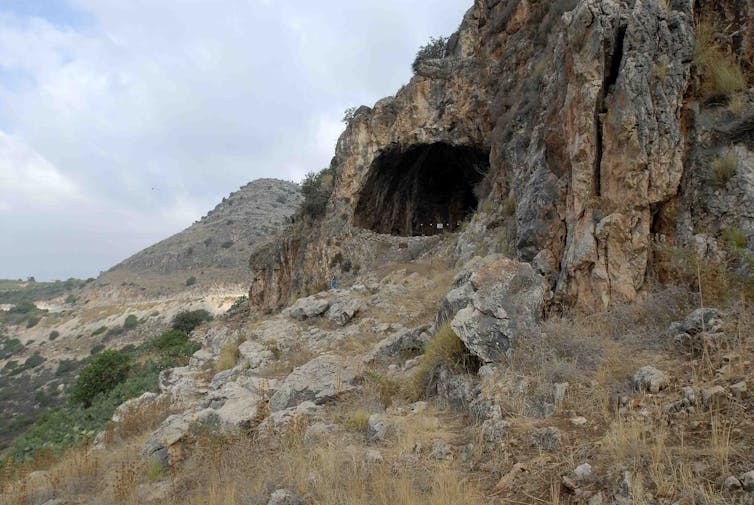
We had a similar experience during our research. When Leore Grosman and I first embarked on the excavations at Hilazon Tachtit in the late 1990s, we were only hoping to document the activities of the last hunter-gatherers in Israel, at what appeared to be a small campsite. It was only over several seasons of excavation that it slowly became clear to us that this was not a site where people had lived. Rather it was a site for rituals.


Hilazon Tachtit cave interior. Naftali Hilger

Hilazon Tachtit cave interior.
Naftali Hilger, CC BY-NC-ND


No houses, fireplaces or cooking areas were recovered. Instead the cave yielded the skeletal remains of at least 28 individuals interred in three pits and two small structures.

One of these structures contained the complete skeleton of an older woman, who we interpreted as a shaman based on her special treatment at death. Her grave stood apart due to its fine construction – the walls were plastered with clay and inset with flat stone slabs. Even more remarkable was the eclectic array of animal body parts buried alongside of her. The pelvis of a leopard, the wing tip of an eagle, the skulls of two martens and many other unusual body parts surrounded her skeleton.

The butchered remnants of more than 90 tortoises buried in the grave and the leftovers of at least three wild cattle deposited in a second adjacent depression excavated in the cave floor represent the remains of a funeral feast.


Hilazon Tachtit cave. Naftali Hilger

Hilazon Tachtit cave.
Naftali Hilger, CC BY-NC-ND


The outstanding preservation of the grave enabled us to detect multiple phases of a ritual performance that included the consumption of the feast, the burial of the woman, and the filling of the grave in several stages, including the intentional deposition of garbage from the feast.

Feasting at the beginning of agriculture


Archaeologists have found other sites that show evidence of ritual feasting. Many of these date to the time when humans were beginning to farm.


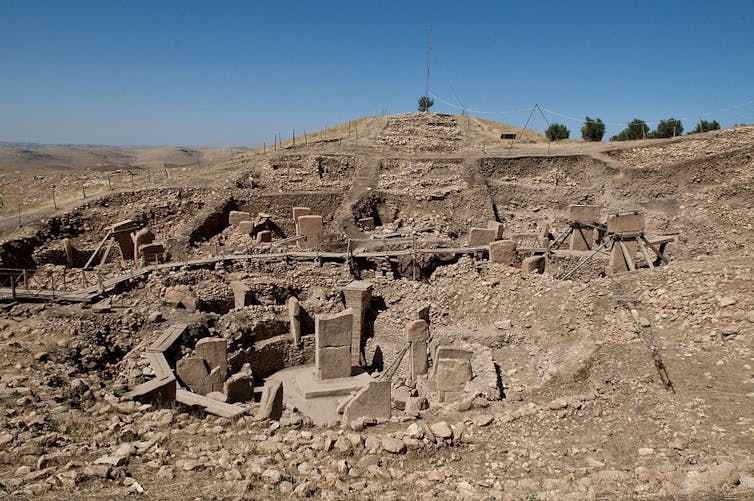
Site of Göbekli Tepe. Teomancimit

Site of Göbekli Tepe.
Teomancimit (Own work) , via Wikimedia Commons, CC BY-SA


One of the most striking is the site of Göbekli Tepe in southeastern Turkey, dating slightly later than Hilazon Tachtit. It includes multiple large structures adorned with benches and giant stone slab carved with exquisite animal depictions in relief dating to 11-12,000 years ago. Perhaps, these were very early communal buildings. The archaeologists who excavated Göbekli Tepe argue that massive quantities of animal bones associated with the structures represent the remains of feasts.

Twelve thousand years ago humans were still hunter-gatherers, subsisting entirely on wild foods. Nevertheless, these people differed from those who went before – they were sitting on the brink of the transition to agriculture, one of the most significant economic, social and ideological transformations in human history.

Sickle blades and grinding stones used to harvest and process cereal grains are found at Hilazon Tachtit and other contemporary archaeological sites. These findings indicate that these ritual feasts started around the same time that people adopted agriculture. When people began to rely more heavily on wild cereals like wheat and barley, they became increasingly tethered to landscapes that were ever more crowded and began to settle into more permanent communities. In other words, feasting became a part of their life, once they moved away from nomadic life.

Rituals that bind


These feasts had an important role to play. Adapting to village life after hundreds of millennia on the move was no simple act. Research on modern hunter-gatherer societies shows that closer contact between neighbors dramatically increased social tensions. New solutions to avoid and repair conflict were critical.

The simultaneous appearance of feasting, communal structures and specialized ritual sites suggest that humans were seeking to solve this problem by engaging the community in ritual practice.

One of the central functions of ritual in these communities was to provide a kind of social glue that bound community members by promoting social cohesion and solidarity. Feasts generate loyalty and commitment to the community’s success. Sharing food is intimate and it builds trust.

Communal rituals would have provided a shared sense of identity at a time when social circles were increasing in scale and permanence. They reinforced new ideologies that emerged out of a dramatic reorganization of economic and social life.

Role of feasts today

Feasting plays the same essential role today. Like the earliest feasts, our holiday celebrations are replete with actions that are repeated year after year.

The holiday feast today builds family traditions. By cooking and sharing food together, telling stories of past holidays and exchanging intergenerational wisdom, holiday rituals bond extended families and give them a shared identity.The Conversation

Natalie Munro, Professor, University of Connecticut

This article is republished from The Conversation under a Creative Commons license. Read the original article.


Monday, December 10, 2018

Guest Post: How to survive annoying relatives this holiday season

Jamie Gruman, University of Guelph

Social allergies are a lot like seasonal allergies. They’re annoying, exhausting and hard to avoid. They’re also especially common around the holidays. That’s because the holidays put you at a high risk of exposure. Swap the dander and flourishing ragweed for your not-so-favourite acquaintances and intolerable relatives and there you have it — a full-blown case of social allergies.

Merry Christmas Polish Poland ornamentsSocial allergens are the revolting, repetitive habits of our friends and family members that rub us the wrong way and drive us crazy.

Maybe it’s the way your aunt constantly complains about frivolous things. Or perhaps it’s how your father-in-law smacks his lips and wipes his mouth with the back of his hand when he eats. Or could it be the way your cousin can’t have a conversation without droning on about himself?

All of us have allergies to people whose seemingly inconsequential behaviour repulses us. The emotional and physical symptoms these social allergens produce arise within minutes of exposure, making us want to immediately evacuate the toxic environment.

The holiday season social allergy


Like seasonal allergies, social allergies are sometimes inescapable. Triggers include the many obligatory get-togethers that come with the holidays. For many, the season, beginning with American Thanksgiving, is supposed to be a time to recharge our batteries: recover from the unreasonable deadlines, numerous pressures and other demands we face on a daily basis. Social allergies can interfere with that plan.

During the holiday season, we are faced with numerous social commitments and in some cases this means spending time with people who grate on our nerves and hinder us from refuelling. Rather than having a few days off to decompress, we spend our time away from work filled with dread, anxiety and exasperation because we have to endure people we are allergic to.

Although we can get out of some noxious social situations, there are others that are almost mandatory.

So, what are the social antihistamines that will help us cope?

Limit exposure


One effective way to prevent a social allergic reaction is to limit your exposure. In the same way a person allergic to cats should avoid snuggling up in bed with a pride of domestic felines, a person with social allergies should avoid staying in an environment full of social allergens.

By minimizing the amount of time you are in contact with the allergens, you attack the problem directly, fostering resilience and recovery by reducing your exposure to a hazardous situation.

This means leave early or come late. Have a strategy to restrict the amount of time you spend surrounded by your social allergens. While you are at the gathering, be strategic about the social situations you place yourself in. When finding a spot at the dinner table, don’t sit next to Cousin So-and-so or Aunt M and definitely don’t sit in full view of your lip-smacking father-in-law. Find a place setting that allows you to have a break from your social allergens.


Validate


We have the power to exert some control over many social allergens.

For example, when speaking with a self-centred toxic relative, she’s looking for a certain type of reaction from you. In many cases, the wanted reaction is simple: it’s support and validation.

While you may want to shut off the stream coming out of auntie’s mouth, this will not actually help calm your allergic reaction. But if you spend some time to first provide the validation she seeks, you could potentially satisfy her craving and extinguish the behaviour you find repellent.

Give feedback


If you can no longer tolerate seeing scraps of food on the back of your father-in-law’s hand, consider speaking to him about his eating habits. But remember that conversations not only convey information, they also have implications for relationships and identities.

Make it clear that you want to help him avoid embarrassing himself and that you’re speaking to him about this because you love him. And see if you can bring up the topic indirectly so that you don’t come across as intrusive. Giving feedback to people often fails to change their behaviour if we’re not sensitive about how it might be received.

Mindfulness


If giving feedback to your father-in-law doesn’t seem like the best idea, you can instead try practising mindfulness. Mindfulness is a non-judgmental state of present moment awareness.

When social allergens start bothering you, pay attention to your own internal irritation without evaluating it. Don’t cling to it and don’t push it away. Just follow it. Watching the ebbs and flows of your experience has a way of putting distance between you and your reactions through a process called reperceiving.

Mindfulness won’t necessarily prevent the allergen from bothering you, but it will help you control how much it annoys you and how quickly you recover from its effects.

Social allergies can burn you out and change a relaxing holiday into a stressful test of endurance. To get a boost during holiday time, you need to make sure that you spend your time with people who recharge and revitalize you.

Also, mitigate your averse reaction to people’s annoying habits. A few simple steps can transform your holiday into one that lets you enjoy a happy, healthy break, instead of having to contend with social allergies.

The author thanks Deirdre Healey’s assistance with this article.The Conversation

Jamie Gruman, Professor of Organizational Behaviour, University of Guelph

This article is republished from The Conversation under a Creative Commons license. Read the original article.


Saturday, December 08, 2018

Guest Post: We found grizzly, black and polar bears together for the first time

Douglas Clark, University of Saskatchewan

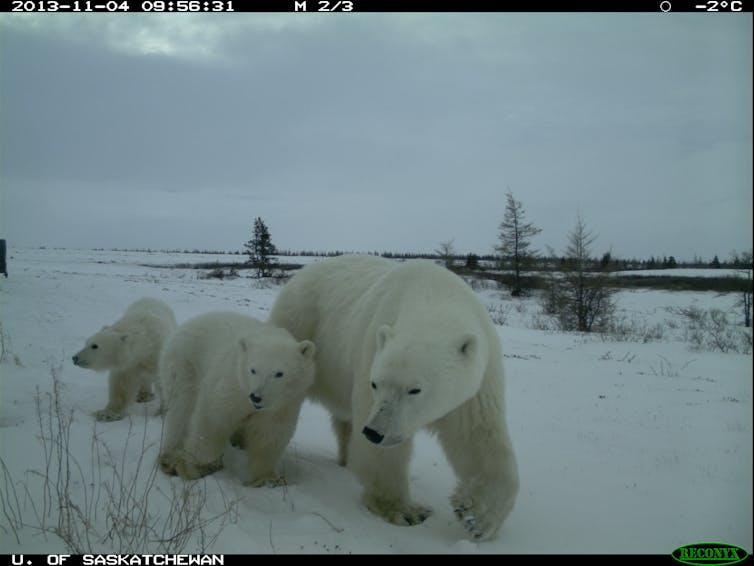
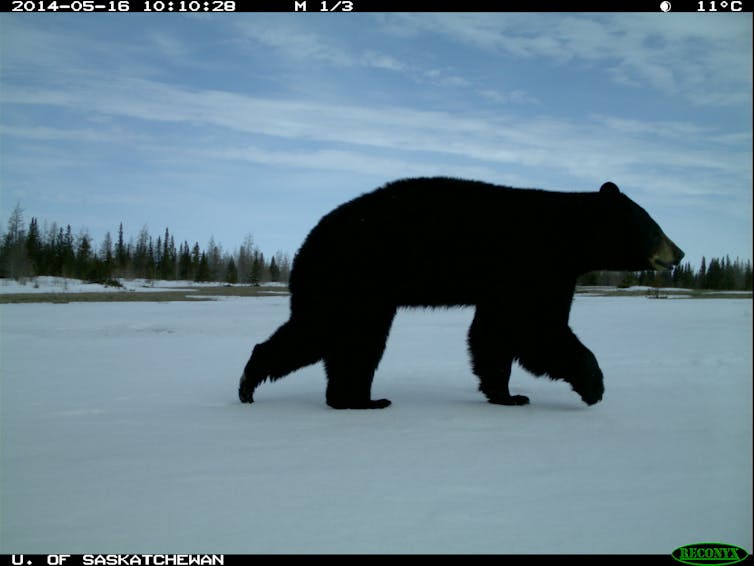
North America’s three bear species — black bears, grizzly bears and polar bears — don’t typically live in the same place. But in Wapusk National Park, on the west coast of Hudson Bay, in northern Manitoba, we caught all three bears on camera — for the first time.

My colleagues and I began studying the bears in Wapusk in 2011, after more polar bears than expected began visiting new field camps in the park. We used remote cameras — a widespread, economical and non-invasive tool for studying wildlife — to find out why and when the polar bears were visiting these camps.

The cameras picked up more than 366 visits by polar bears to the camps in five years. They also detected other bears.

A bevy of bears


Wapusk is best known for its polar bears. They come ashore in the summer and autumn when the sea ice in Hudson Bay melts. Some stay for the winter to den in the permafrost where they give birth. What we see on the cameras reflects that pattern.

But Wapusk also lies along the northern edge of the boreal forest, where black bears are well established. We saw them too, but we were surprised that their visits to our most southerly cameras, on the Owl River, were almost as numerous as those by polar bears.


Grizzly bears Wapusk National Park.

Grizzly bears visited all three study sites along the coast of Wapusk National Park.
(Douglas Clark), CC BY-ND


What was new to us were the grizzlies. It wasn’t just one or two transient bears, but several, and we suspect at least one of them may be denning there.

Barren-ground grizzly bears have been expanding their range across the Arctic in recent decades. In Wapusk, they’ve been increasingly frequent since the 1990s, and have even shown up in the nearby town of Churchill.

Ecosystem convergence


There’s much our observations don’t tell us, but they are significant for conservation efforts and, more fundamentally, for understanding what to do with these new ecological insights.

Three dynamic ecosystems — forest, tundra and ocean — converge at Wapusk, and all are changing quickly as the Arctic warms.

What we’ve seen in Wapusk is consistent with how researchers expect northern carnivore populations to respond to climate change. The waking life of all bear species is governed by their need to accumulate fat stores for the next hibernation, so this overlap is most likely a response to changes in the availability of bear foods. Which foods, however, we don’t yet know.


polar bears Wapusk National Park

Three polar bears walk past a camera trap in Wapusk National Park.
(Douglas Clark), CC BY-ND


We also don’t know how these species interact with each other, but we predict that grizzlies will benefit most since they dominate both other species elsewhere.

Grizzly bears have displaced and eaten black bears and polar bears in other places, and polar-grizzly hybrids have been documented in the Northwest Territories. It’s clear that the potential for hybridization exists in western Hudson Bay too.

Polar bears and grizzly bears face conservation challenges in many parts of Canada. Learning more about they way they interact with each other — and their surroundings — would probably tell us more about why they are now inhabiting the same place.

Controversial change


But how might we use this information?

When environmental changes occur in national parks, they often become controversial. People often assume the conditions present when the park was established, or the status quo, are “baselines” that must be protected, even though they may just be snapshots in ecological time.

Change has become increasingly central in ecological theory, and its implications have produced heated debate within the conservation community.


Black bears boreal forest Wapusk National Park.

Black bears are well established in the boreal forest of Wapusk National Park.
(Douglas Clark), CC BY-ND


This matters for the grizzly because its expansion into the Arctic has been portrayed as a threat to polar bears. Some argue such a threat should be removed.

In 1998, when I worked in Wapusk, I was told by a manager to get rid of the first grizzly we saw. (I didn’t.)

Such actions might not be wise since the long and complex evolutionary relationship between grizzlies and polar bears suggests their populations have, at times, benefited from the other.

Instead of looking at this new range overlap as a risk to any of the bears, my colleagues and I think it should be viewed as an ecological response to environmental change that needs to be better understood.

What’s at stake?


While locals may not be surprised by this scientific observation of the three bears, it is a novel situation that we can learn from — and one that matters beyond northern Manitoba.

Climate change will continue to move species around and create new combinations of them. It’s no easy task for wildlife or park managers to determine which environmental changes are desirable and which aren’t.

Wapusk, however, is a co-managed park that aims to integrate scientific and traditional knowledge with human values. It is equipped for addressing these hard questions. And the question of how to navigate increasing environmental variability more effectively — while recognizing the stakes local people have in these conservation decisions — is the biggest challenge environmental managers face today.

This particular story of the three bears isn’t over, and we don’t know how it will end. Consequently, we need to bring a heavy dose of humility to answering the scientific and societal questions the three bears have handed us.The Conversation

Douglas Clark, Centennial Chair in Human Dimensions of Environment & Sustainability, University of Saskatchewan

This article is republished from The Conversation under a Creative Commons license. Read the original article.
Thursday, December 06, 2018

Guest Post: Why adult video stars rely on camming

Sophie Pezzutto, Australian National University

With pirated and amateur pornography widely available online, porn no longer provides a steady income for many working in the adult industry. During my research interviewing transgender porn stars in Las Vegas, the overwhelming majority of those interviewed said that now, more than ever, they rely on a variety of other income streams beyond the traditional porno shoot with a studio.

Being a porn star today typically involves a range of sex work, from selling self-produced clips, to offering phone sex services, being an escort, taking care of “sugar daddies” (i.e. rich, usually older men), or “camming” on the internet. Previously regarded as not worth the time for many porn stars, using a webcam from the comfort of one’s home to broadcast oneself masturbating or having sex has emerged as a popular choice.

Indeed, while just 15 years ago, pre-recorded porn such as DVDs, pay sites, and clips generated twice as much revenue worldwide as camming, today that ratio has been reversed. In 2018, the camming industry is estimated to generate US$2 billion in annual revenue worldwide, according to Stephen Yagielowicz, a spokesperson for XBIZ, the adult industry’s leading business publication.

The daily life of a cam performer


porn star coming out “Camming” can be likened to an online strip show where the cam performer uses the webcam on their computer to put on a show for anyone in their chat room. The performer usually sets tipping goals and the more people tip by pledging tokens, the more happens on screen.

Typically, it involves numerous sex toys and ultimately orgasm, but many of the shows get very creative. They can feature anything from fortune wheels and costumes, to “couple shows” with partners and guest appearances from other cam performers.

During the show, viewers get to chat with the cam performer, often requesting sexual acts and sometimes simply asking them questions about their life. There are no fixed rules on length and format of a cam show, but it usually takes anywhere from one to four hours. Many of my informants in Las Vegas cam anywhere between two to six hours a day, multiple times a week.

Cam performers usually run sessions in intervals, timing them to coincide with office hours in big cities on the east coast such as New York and Chicago: one cam show in the morning just before offices open, one during lunch break, and one just before people head home to their families.

While not all cam models shoot studio porn, many porn performers are increasingly camming. Established trans porn stars can make anywhere around US $100 - $200 an hour through camming: “As porn performers we are able to leverage our already existing fan base”, one of my main informants explained to me. For last year’s Christmas special her chat room peaked at 30,000 viewers – the average size of a Mets baseball game.

The changing structure of porn


Porn performers in the industry are generally contracted and paid on a shoot by shoot basis. Trans women in porn generally make anywhere between US$800-1,200 for a sex scene that involves penetration (which is slightly higher than the average cisgender performer, but lower than the highest paid cisgender stars). The number of shoots however, fluctuate a lot. A performer can get booked up to six times a month (in some instances even more), but other months they might not get booked at all.


Read more:
Explainer: what does it mean to be 'cisgender'?


“After they’ve shot you a bunch of times, there usually is a month or two where you don’t get any shoots”, one research participant told me. As a consequence, performers may go several months without a single shoot, which makes budgeting extremely difficult.

In addition to this income insecurity, there are numerous expenses not covered by the companies hiring the performers, such as wardrobe, STI testing, transportation, and accommodation costs. “Factoring in all my expenses and the money I lose from not camming, porn does not really make me money”, said one of my informants. “I see porn mainly as a marketing tool for myself.”

Camming is booming and here to stay


Camming has proven itself more resilient to piracy than studio pornography primarily due to the personal nature of cam shows. “For many viewers it is a unique opportunity to interact with their favourite porn star on a regular basis,” one participant remarked. “That’s something they don’t get from regular porn”.

As a consequence the camming industry has boomed and income from it can make up most of even a well-known porn star’s earnings. Work is not only more consistent, but also much safer: “If I focus on making my money with solo shows then I don’t even have to worry anymore about HIV scares in the industry,” one of my participants pointed out after a recent incident.

At the same time however, camming can be very tough work. One informant told me: “some days I end up crying because people either don’t tip you for hours at a time or tip you just to say nasty things”. Further, cam companies, which host web cam performers, take incredibly high commissions of anywhere between 50 – 70% on every dollar earned by the cam performer.

These draw-backs notwithstanding, camming is set to grow with more and more porn stars relying on it to provide a regular income. Given the various risks of much other sex work, this might not necessarily be a bad thing.The Conversation

Sophie Pezzutto, PhD Candidate in Anthropology, Australian National University

This article is republished from The Conversation under a Creative Commons license. Read the original article.

Wednesday, December 05, 2018

Guest Post: How Hanukkah came to America


Dianne Ashton, Rowan University

Hanukkah may be the best known Jewish holiday in the United States. But despite its popularity in the U.S., Hanukkah is ranked one of Judaism’s minor festivals, and nowhere else does it garner such attention. The holiday is mostly a domestic celebration, although special holiday prayers also expand synagogue worship.

So how did Hanukkah attain its special place in America?

Hanukkah’s back story


The word “Hanukkah” means dedication. It commemorates the rededicating of the ancient Temple in Jerusalem in 165 B.C. when Jews – led by a band of brothers called the Maccabees – tossed out statues of Hellenic gods that had been placed there by King Antiochus IV when he conquered Judea. Antiochus aimed to plant Hellenic culture throughout his kingdom, and that included worshipping its gods.

Legend has it that during the dedication, as people prepared to light the Temple’s large oil lamps to signify the presence of God, only a tiny bit of holy oil could be found. Yet, that little bit of oil remained alight for eight days until more could be prepared. Thus, each Hanukkah evening, for eight nights, Jews light a candle, adding an additional one as the holiday progresses throughout the festival.

Hanukkah’s American story


Dianne Ashton Hanukkah in America Chanukah historyToday, America is home to almost 7 million Jews. But Jews did not always find it easy to be Jewish in America. Until the late 19th century, America’s Jewish population was very small and grew to only as many as 250,000 in 1880. The basic goods of Jewish religious life – such as kosher meat and candles, Torah scrolls, and Jewish calendars – were often hard to find.

In those early days, major Jewish religious events took special planning and effort, and minor festivals like Hanukkah often slipped by unnoticed.

My own study of American Jewish history has recently focused on Hanukkah’s development.

It began with a simple holiday hymn written in 1840 by Penina Moise, a Jewish Sunday school teacher in Charleston, South Carolina. Her evangelical Christian neighbors worked hard to bring the local Jews into the Christian fold. They urged Jews to agree that only by becoming Christian could they attain God’s love and ultimately reach Heaven.

Moise, a famed poet, saw the holiday celebrating dedication to Judaism as an occasion to inspire Jewish dedication despite Christian challenges. Her congregation, Beth Elohim, publicized the hymn by including it in their hymnbook.

This English language hymn expressed a feeling common to many American Jews living as a tiny minority. “Great Arbiter of human fate whose glory ne'er decays,” Moise began the hymn, “To Thee alone we dedicate the song and soul of praise.”

It became a favorite among American Jews and could be heard in congregations around the country for another century.

Shortly after the Civil War, Cincinnati Rabbi Max Lilienthal learned about special Christmas events for children held in some local churches. To adapt them for children in his own congregation, he created a Hanukkah assembly where the holiday’s story was told, blessings and hymns were sung, candles were lighted and sweets were distributed to the children.

His friend, Rabbi Isaac M. Wise, created a similar event for his own congregation. Wise and Lilienthal edited national Jewish magazines where they publicized these innovative Hanukkah assemblies, encouraging other congregations to establish their own.

Lilienthal and Wise also aimed to reform Judaism, streamlining it and emphasizing the rabbi’s role as teacher. Because they felt their changes would help Judaism survive in the modern age, they called themselves “Modern Maccabees.” Through their efforts, special Hanukkah events for children became standard in American synagogues.

20th-century expansion


By 1900, industrial America produced the abundance of goods exchanged each Dec. 25. Christmas’ domestic celebrations and gifts to children provided a shared religious experience to American Christians otherwise separated by denominational divisions. As a home celebration, it sidestepped the theological and institutional loyalties voiced in churches.

For the 2.3 million Jewish immigrants who entered the U.S. between 1881 and 1924, providing their children with gifts in December proved they were becoming American and obtaining a better life.

But by giving those gifts at Hanukkah, instead of adopting Christmas, they also expressed their own ideals of American religious freedom, as well as their own dedication to Judaism.

After World War II, many Jews relocated from urban centers. Suburban Jewish children often comprised small minorities in public schools and found themselves coerced to participate in Christmas assemblies. Teachers, administrators and peers often pressured them to sing Christian hymns and assert statements of Christian faith.

From the 1950s through the 1980s, as Jewish parents argued for their children’s right to freedom from religious coercion, they also embellished Hanukkah. Suburban synagogues expanded their Hanukkah programming.

As I detail in my book, Jewish families embellished domestic Hanukkah celebrations with decorations, nightly gifts and holiday parties to enhance Hanukkah’s impact. In suburbia, Hanukkah’s theme of dedication to Judaism shone with special meaning. Rabbinical associations, national Jewish clubs and advertisers of Hanukkah goods carried the ideas for expanded Hanukkah festivities nationwide.

In the 21st century, Hanukkah accomplishes many tasks. Amid Christmas, it reminds Jews of Jewish dedication. Its domestic celebration enhances Jewish family life. In its similarity to Christmas domestic gift-giving, Hanukkah makes Judaism attractive to children and – according to my college students – relatable to Jews’ Christian neighbors. In many interfaith families, this shared festivity furthers domestic tranquility.

In America, this minor festival has attained major significance.The Conversation

Dianne Ashton, Professor of Religion, Rowan University

This article is republished from The Conversation under a Creative Commons license. Read the original article.