Showing posts with label American history. Show all posts

Friday, November 23, 2018

Guest Post: Why the Pilgrims were actually able to survive


Peter C. Mancall, University of Southern California – Dornsife College of Letters, Arts and Sciences

Sometime in the autumn of 1621, a group of English Pilgrims who had crossed the Atlantic Ocean and created a colony called New Plymouth celebrated their first harvest.

They hosted a group of about 90 Wampanoags, their Algonquian-speaking neighbors. Together, migrants and Natives feasted for three days on corn, venison and fowl.

In their bountiful yield, the Pilgrims likely saw a divine hand at work.

As Gov. William Bradford wrote in 1623, “Instead of famine now God gave them plenty, and the face of things was changed, to the rejoicing of the hearts of many, for which they blessed God.”

But my recent research on the ways Europeans understood the Western Hemisphere shows that – despite the Pilgrims’ version of events – their survival largely hinged on two unrelated developments: an epidemic that swept through the region and a repository of advice from earlier explorers.

A ‘desolate wilderness’ or ‘Paradise of all parts’?


Bradford’s “Of Plymouth Plantation,” which he began to write in 1630 and finished two decades later, traces the history of the Pilgrims from their persecution in England to their new home along the shores of modern Boston Harbor.
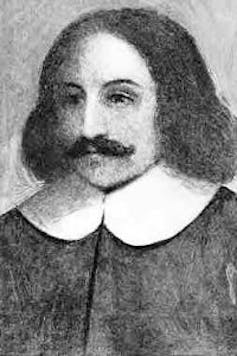


William Bradford Plymouth Plantation

William Bradford’s writings depicted a harrowing, desolate environment.


Bradford and other Pilgrims believed in predestination. Every event in their lives marked a stage in the unfolding of a divine plan, which often echoed the experiences of the ancient Israelites.

Throughout his account, Bradford probed Scripture for signs. He wrote that the Puritans arrived in “a hideous and desolate wilderness, full of wild beasts and wild men.” They were surrounded by forests “full of woods and thickets,” and they lacked the kind of view Moses had on Mount Pisgah, after successfully leading the Israelites to Canaan.

Drawing on chapter 26 of the Book of Deuteronomy, Bradford declared that the English “were ready to perish in this wilderness,” but God had heard their cries and helped them. Bradford paraphrased from Psalm 107 when he wrote that the settlers should “praise the Lord” who had “delivered them from the hand of the oppressor.”

If you were reading Bradford’s version of events, you might think that the survival of the Pilgrims’ settlements was often in danger. But the situation on the ground wasn’t as dire as Bradford claimed.
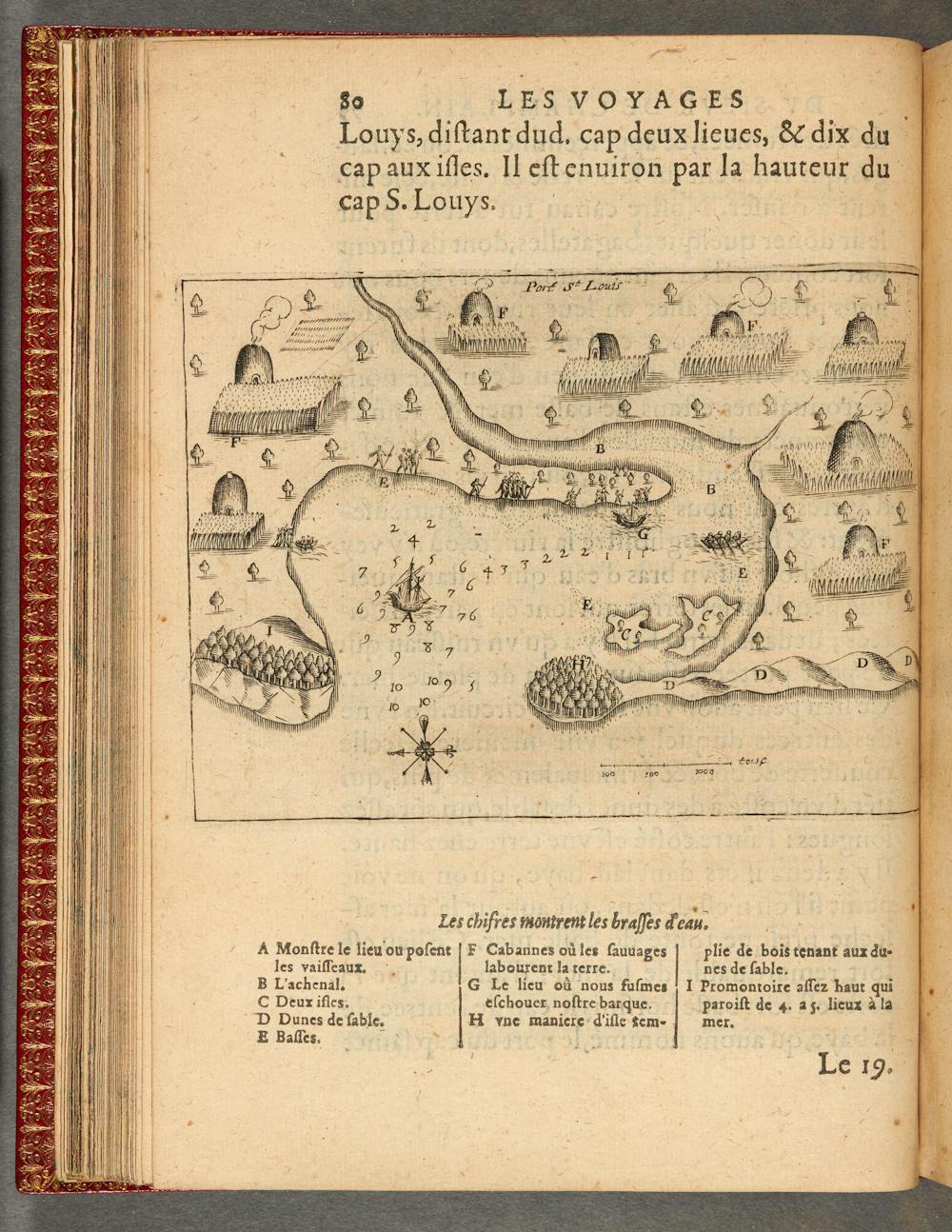


The French explorer Samuel de Champlain depicted Plymouth as a region that was eminently inhabitable.
Source., Author provided


Earlier European visitors had described pleasant shorelines and prosperous indigenous communities. In 1605, the French explorer Samuel de Champlain sailed past the site the Pilgrims would later colonize and noted that there were “a great many cabins and gardens.” He even provided a drawing of the region, which depicted small Native towns surrounded by fields.

About a decade later Captain John Smith, who coined the term “New England,” wrote that the Massachusetts, a nearby indigenous group, inhabited what he described as “the Paradise of all those parts.”

‘A wonderful plague’


Champlain and Smith understood that any Europeans who wanted to establish communities in this region would need either to compete with Natives or find ways to extract resources with their support.

But after Champlain and Smith visited, a terrible illness spread through the region. Modern scholars have argued that indigenous communities were devastated by leptospirosis, a disease caused by Old World bacteria that had likely reached New England through the feces of rats that arrived on European ships.

The absence of accurate statistics makes it impossible to know the ultimate toll, but perhaps up to 90 percent of the regional population perished between 1617 to 1619.

To the English, divine intervention had paved the way.

“By God’s visitation, reigned a wonderful plague,” King James’ patent for the region noted in 1620, “that had led to the utter Destruction, Devastacion, and Depopulation of that whole territory.”

The epidemic benefited the Pilgrims, who arrived soon thereafter: The best land had fewer residents and there was less competition for local resources, while the Natives who had survived proved eager trading partners.

The wisdom of those who came before


Just as important, the Pilgrims understood what to do with the land.

By the time that these English planned their communities, knowledge of the Atlantic coast of North America was widely available.

Those hoping to create new settlements had read accounts of earlier European migrants who had established European-style villages near the water, notably along the shores of Chesapeake Bay, where the English had founded Jamestown in 1607.

These first English migrants to Jamestown endured terrible disease and arrived during a period of drought and colder-than-normal winters. The migrants to Roanoke on the outer banks of Carolina, where the English had gone in the 1580s, disappeared. And a brief effort to settle the coast of Maine in 1607 and 1608 failed because of an unusually bitter winter.

Many of these migrants died or gave up. But none disappeared without record, and their stories circulated in books printed in London. Every English effort before 1620 had produced accounts useful to would-be colonizers.

The most famous account, by the English mathematician Thomas Harriot, enumerated the commodities that the English could extract from America’s fields and forests in a report he first published in 1588.

The artist John White, who was on the same mission to modern Carolina, painted a watercolor depicting the wide assortment of marine life that could be harvested, another of large fish on a grill, and a third showing the fertility of fields at the town of Secotan. By the mid-1610s, actual commodities had started to arrive in England too, providing support for those who had claimed that North American colonies could be profitable. The most important of these imports was tobacco, which many Europeans considered a wonder drug capable of curing a wide range of human ailments.

These reports (and imports) encouraged many English promoters to lay plans for colonization as a way to increase their wealth. But those who thought about going to New England, especially the Pilgrims who were kindred souls of Bradford, believed that there were higher rewards to be reaped.

Bradford and the other Puritans who arrived in Massachusetts often wrote about their experience through the lens of suffering and salvation.

But the Pilgrims were better equipped to survive than they let on.The Conversation

Peter C. Mancall, Andrew W. Mellon Professor of the Humanities, University of Southern California – Dornsife College of Letters, Arts and Sciences

This article is republished from The Conversation under a Creative Commons license. Read the original article.
Thursday, November 22, 2018

Guest Post: How advertising shaped Thanksgiving as we know it

Samantha N. N. Cross, Iowa State University

I have always been intrigued by Thanksgiving – the traditions, the meal, the idea of a holiday that is simply about being thankful.

For my family, Thanksgiving is all about the food. Some foods, like turkey and mashed potatoes, may be familiar. But there are a few twists. Since I grew up in the Caribbean, I’m allowed a Caribbean dish or two. The reliability of the menu – with a little flexibility sprinkled in – seems to unite us as a family while acknowledging our different cultural backgrounds.


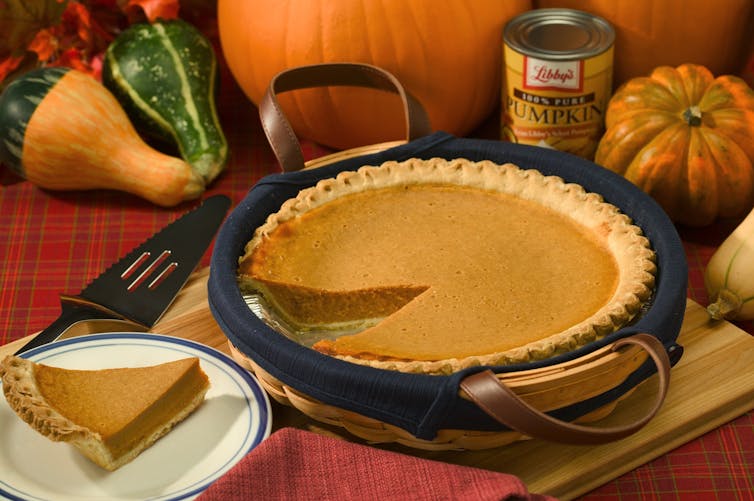
Pumpkin pie Thanksgiving

Libby’s continues to fiercely compete with pumpkin pie peddlers Borden’s, Snowdrift and Mrs. Smith’s for a place on the Thanksgiving table.
Jean Beaufort


Chances are you and your family have similar traditions. Filipino-American families might include pancit. Russian-American families might serve a side dish of borscht. That’s what makes Thanksgiving unique. It’s a holiday embraced by people regardless of their religion or ethnicity.

Yet despite this adaptability, there’s a core part of the meal that almost everyone embraces. How did this come to be? Although few appreciate it, advertisers have shaped the meal as much as family tradition.

A uniquely broad appeal


When Sarah Josepha Hale, the editor of Godey’s Lady’s Book, first advocated for Thanksgiving as a national holiday in 1846, she argued that it would unify the country. In our research, my colleagues and I have been able to show that Hale’s vision for the holiday has been largely fulfilled: Inclusivity of people and traditions has been Thanksgiving’s hallmark quality.

A reason for its broad appeal is that it lacks any association with an institutionalized religion. As one interviewee told us, “There is no other purpose than to sit down with your family and be thankful.” And after interviewing a range of people – from those born in the U.S. to immigrants from countries like South Africa, Australia and China – it became obvious that the principles and rituals they embraced during the holiday were universal no matter the culture: family, food and gratitude.

But as a relatively new holiday – one not tied to a religious or patriotic tradition – a shared understanding of the celebration and the meal is crucial to ensure its long-term survival.

While there might be subtle variations, the Thanksgiving meal is the lodestone of the holiday, the magnet that brings people together. Today, familiar items constitute the meal: turkey, cranberry sauce, stuffing, gravy, alcohol, salad, apple pie and pumpkin pie. Many of our interviewees tended to serve some version of this list.

But why these items and not others? What makes turkey, cranberry sauce and pumpkin pie so special? My colleagues and I studied 99 years of Thanksgiving ads in Good Housekeeping magazine to find out.

Marketing a ritual


Starting with Thanksgiving’s early champion, Sarah Josepha Hale, the history of Thanksgiving is rooted in marketing. Marketers not only helped create many of the rituals and cultural myths associated with the Thanksgiving meal, but they also legitimized and maintained them.


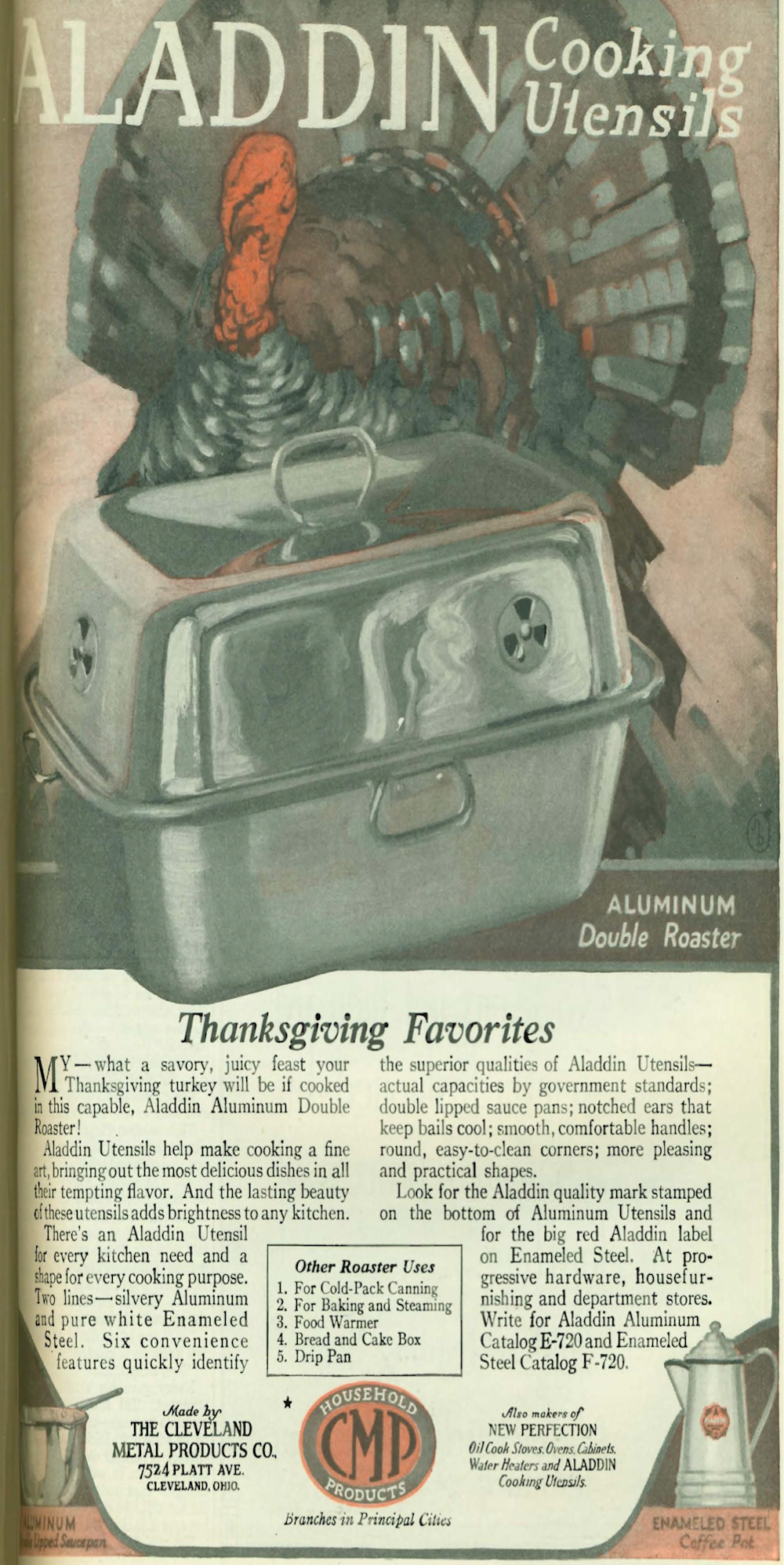
Aladdin Cooking Utensils advertises its double roaster in a 1920 issue of Good Housekeeping.

Aladdin Cooking Utensils advertises its double roaster in a 1920 issue of Good Housekeeping.
Good Housekeeping


Initially, the Thanksgiving turkey competed with other meats, like duck, chicken and goose, for centerpiece at the Thanksgiving table.

But by the 1920s, turkey had become the only meat advertised. Early ads would focus on how to prepare and present the perfect bird, promoting branded tools like roasters, ranges, pop-up thermometers and oven-cooking bags.

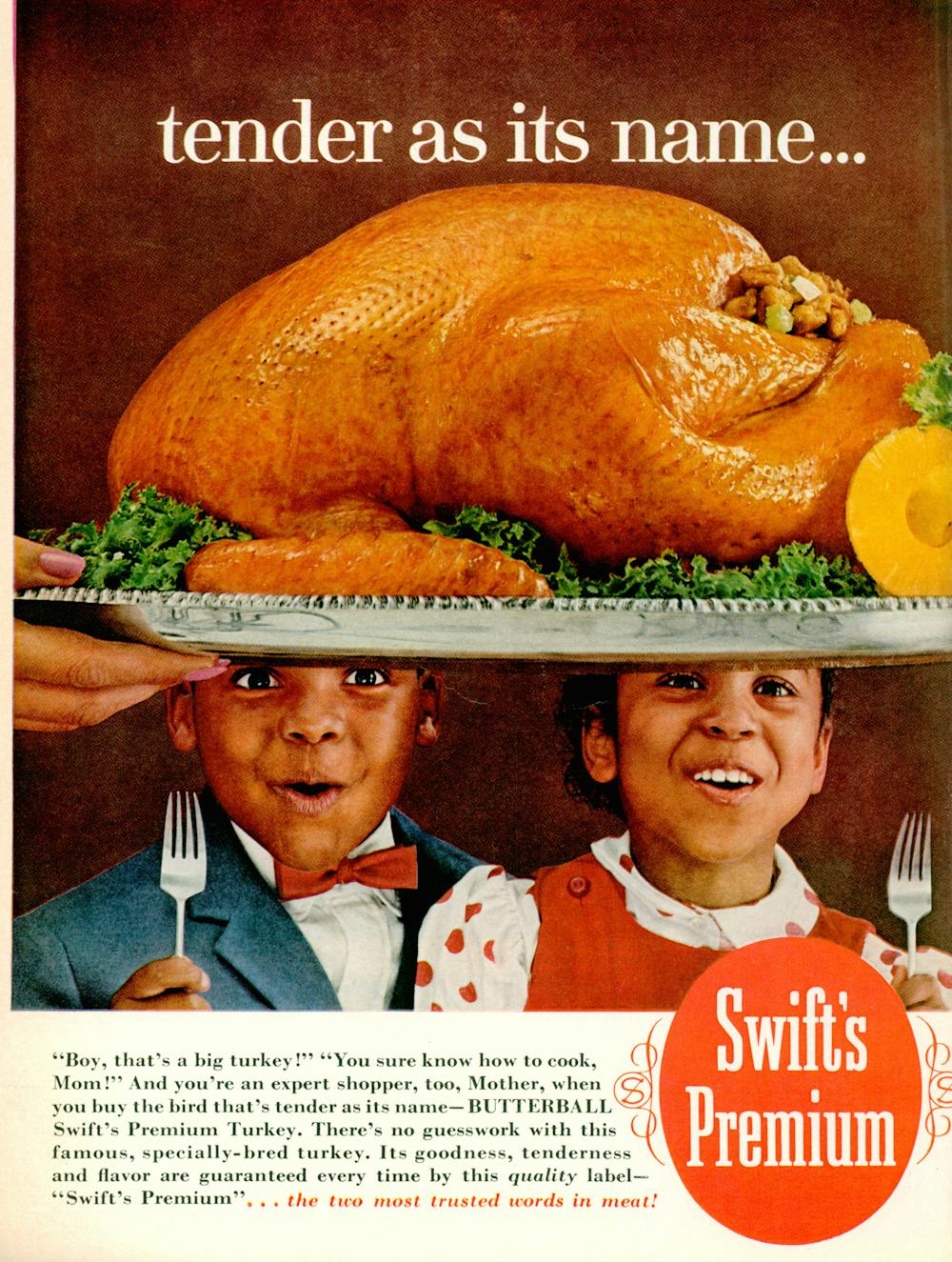
Iconic Swift’s Premium turkey ads focused on the sacredness of the meal by featuring families at prayer, giving thanks before the meal begins. The importance of the turkey to the Thanksgiving celebration dominates, helping to perpetuate the Thanksgiving turkey tradition.

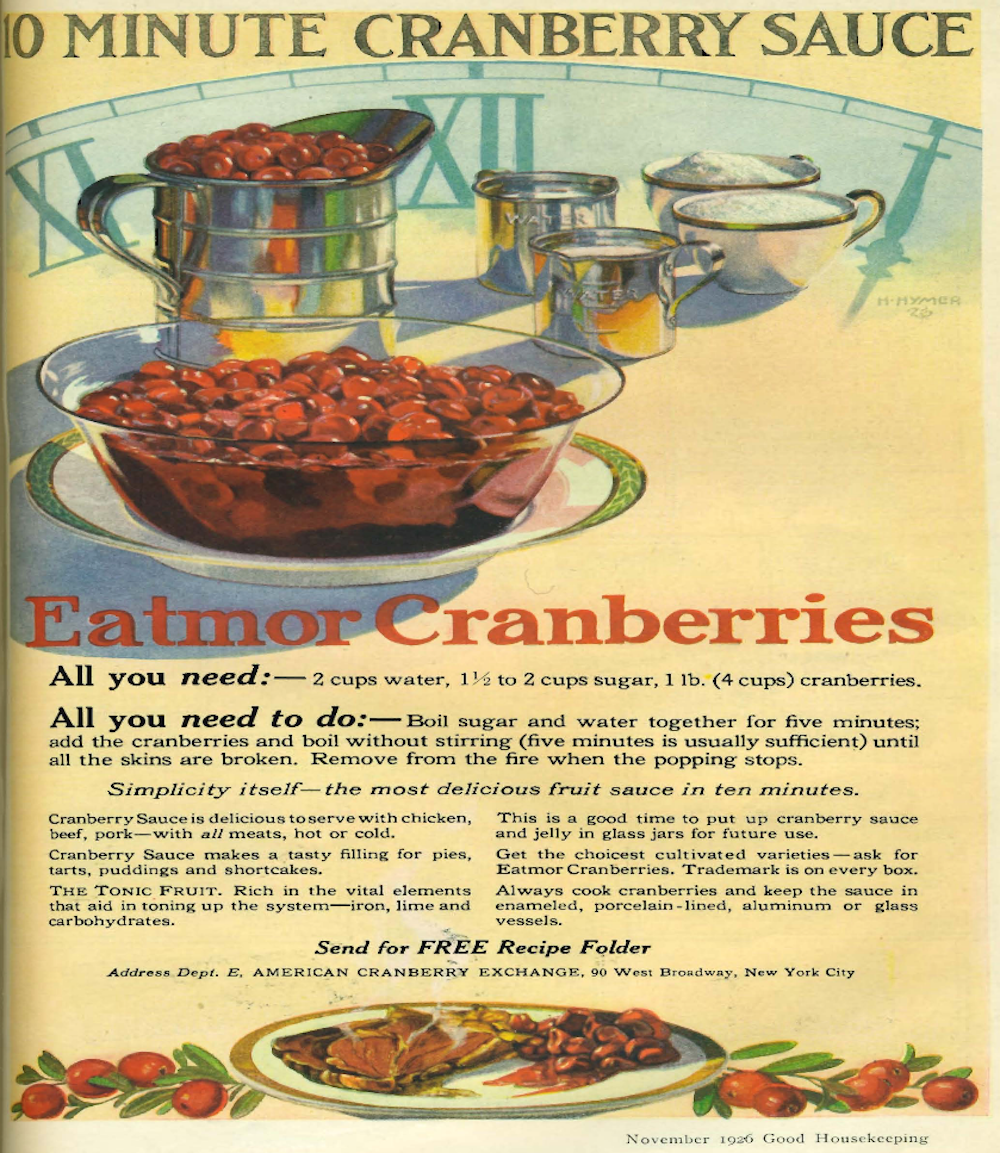
Meanwhile, early ads for the Eatmor Cranberry Company positioned their whole cranberries as a perfect complement to any and all Thanksgiving meat dishes. This brand dominated until the 1930s when another brand, Ocean Spray, entered with its canned gelatin cranberry sauce.


Eatmor Cranberries Thanksgiving advertising

Eatmor Cranberries – which used to be the king of Thanksgiving cranberry sauce – advertises in a November 1926 issue of Good Housekeeping.
Good Housekeeping


Ads for both brands implied that cranberry sauce has been around since the first Thanksgiving dinner, which was highly unlikely. However, the brand positioning war successfully promoted cranberry sauce as the natural condiment for the Thanksgiving turkey. Ocean Spray would triumph and, to this day, promotes whole cranberries and canned gelatin.

Considered by many to be the quintessential Thanksgiving dessert, pumpkin pie also wasn’t present at the first Thanksgiving meal. (The Pilgrims lacked the butter, wheat flour and sugar to make the pastry.) Nonetheless, beginning as early as 1925, a range of brands – for example, Borden’s, Snowdrift, Mrs. Smith’s and Libby’s – have competed fiercely to connect pumpkin pie to the season, the holiday and the meal. It’s a rivalry that continues to this day.

The role of the consumer


Not every product category or brand succeeded in becoming a core part of the Thanksgiving meal.


A Swift’s Premium Turkey ad from 1964.

A Swift’s Premium Turkey ad from 1964.
Wishbook


A Welch’s ad from the 1960s implies that the first Thanksgiving meal included juice made from grapes. In 1928, Diamond marketed their walnuts as an accessory to dress up Thanksgiving dishes. Despite vociferous ad campaigns, few associate Welch’s grape juice or Diamond walnuts with Thanksgiving today.

But those early 20th-century ads for turkey clearly resonated: Today, nearly 88 percent of U.S. households have turkey on Thanksgiving, and approximately 20 percent of the turkeys consumed in any given year are consumed at Thanksgiving. This is a testament to the enduring influence of marketing on the holiday. For brands like Butterball (formerly Swift’s Premium), Thanksgiving is big business.

Whether you’re a turkey fan or not, prefer apple pie to pumpkin pie, enjoy canned gelatin over whole cranberry sauce, by celebrating Thanksgiving, you play a role as well. Marketers may have shaped many of the rituals of the holiday. But all Americans – from all backgrounds – certainly do their part to maintain them.

The ConversationAfter all, brands need customers to survive.

Samantha N. N. Cross, Associate Professor of Marketing, Iowa State University

This article was originally published on The Conversation. Read the original article.

Wednesday, November 21, 2018

Guest Post: The Lesser Known History of Thanksgiving in America

For a time, peace and plenty resulted not in a grateful America but in a complacent one.

by James R. Harrigan

On October 3, 1789, George Washington signed the first Thanksgiving Proclamation of the newly constituted American Republic. He called upon the American people to enjoy “a day of Public Thanksgiving and Prayer, to be observed by acknowledging with grateful hearts the many and signal favors of Almighty God.”

The Early Days of Giving Thanks
It had been a long and difficult road to Independence, and America was still reeling from the failed Articles of Confederation and the fight to adopt the new Constitution. Washington had seen the struggle first-hand, and he knew, perhaps more than anyone, that America was nothing less than a series of miracles. And he saw to it that the nation gave thanks.

Sarah Hale Thanksgiving historyThis was not the first celebration of Thanksgiving in America; the Pilgrims’ 1621 celebration with the Wampanoag in Plymouth holds that honor. Nor was this even Washington’s first Thanksgiving; he had proclaimed a Thanksgiving in December 1777 in the wake of the Continental Army’s victory over the British at Saratoga. This was, though, the first Thanksgiving of the American Republic. It was the first national Thanksgiving.

Washington went on to declare another observance in 1795, and his successor, John Adams, followed suit in 1798 and 1799. But as America’s position in the world was steadily established, and as the debate on the separation of church and state began to take shape, Thanksgiving was all but forgotten on the national stage.

A condition of peace and plenty resulted not in a grateful America but in a complacent one. The War of 1812, though, reminded Americans that their collective place in the world was more tenuous than they had realized. And at the close of the war in 1814 James Madison proclaimed “a day of public humiliation and fasting and of prayer to Almighty God for the safety and welfare” of the United States. Madison declared another Thanksgiving in 1815.

And then nearly half a century passed.

The Birth of Thanksgiving As We Know It
Thanksgiving historyOnce again things were calm, and once again national Thanksgiving observances fell by the wayside. The Founding Generation, America’s finest generation, had passed, and with them the possibility of a national gratefulness seemed to pass as well. Just as the War of 1812 had reminded the nation of its precariousness, though, the Civil War shattered the illusion of American harmony. Abraham Lincoln had warned the nation in 1858 that “A house divided against itself cannot stand,” and by 1863 the divided country was indeed in danger of falling.

Americans turned to Lincoln, and Lincoln turned to God. Even in the midst of the bloodiest war ever fought on American soil, Lincoln saw America’s blessings. “The year that is drawing toward its close,” he said, “has been filled with the blessings of fruitful fields and healthful skies. To these bounties, which are so constantly enjoyed that we are prone to forget the source from which they come, others have been added which are of so extraordinary a nature that they can not fail to penetrate and soften even the heart which is habitually insensible to the ever-watchful providence of Almighty God.”

At America’s lowest ebb, the nation’s most dedicated servant chose to give thanks rather than bemoan his own, and America’s collective, lot, and there were indeed reasons to be thankful. As Lincoln said,

Peace has been preserved with all nations, order has been maintained, the laws have been respected and obeyed, and harmony has prevailed everywhere, except in the theater of military conflict, while that theater has been greatly contracted by the advancing armies and navies of the Union.”
And this was the birth of Thanksgiving as we have come to know it. In the worst of times, in conditions so dire that the continued existence of the Republic was unsure, Lincoln taught us to look beyond ourselves…to be truly thankful for the blessings that we have received. And so it has been for 143 years.

As we celebrate Lincoln’s holiday on the last Thursday in November, take a moment to contemplate the series of miracles that brings and keeps us together. Take a cue from Washington and sense the magnitude of the achievement of the generation that built this country, oftentimes through little more than force of will. Take a cue from Lincoln and appreciate the blessings that we do enjoy rather than pining for things we don’t. Take a cue from the best America has produced and say a prayer of thanks.

Happy Thanksgiving!

Reprinted from Vision and Values.

James R. Harrigan Thanksgiving FreedomTrust

James R. Harrigan is CEO of FreedomTrust.


This article was originally published on FEE.org. Read the original article.


Monday, November 19, 2018

Guest Post: How Communism Almost Ruined The First Thanksgiving

The Plymouth Pilgrims progressed from the false dream of communism to the sound realism of capitalism.

by Richard M. Ebeling

This time of the year, whether in good economic times or bad, Americans gather with their families and friends and enjoy a Thanksgiving meal together. It marks a remembrance of those early Pilgrim Fathers who crossed the uncharted ocean from Europe to make a new start in Plymouth, Massachusetts. What is less appreciated is that Thanksgiving is also a celebration of the birth of free enterprise in America.

The English Puritans, who left Great Britain and sailed across the Atlantic on the Mayflower in 1620, were not only escaping from religious persecution in their homeland. They also wanted to turn their back on what they viewed as the materialistic and greedy corruption of the Old World.

Plymouth Colony Planned as Collectivist Utopia
thanksgiving table food turkeyIn the New World, they wanted to erect a New Jerusalem that would not only be religiously devout but be built on a new foundation of communal sharing and social altruism. Their goal was the communism of Plato’s Republic, in which all would work and share in common, knowing neither private property nor self-interested acquisitiveness.

What resulted is recorded in the diary of Governor William Bradford, the head of the colony. The colonists collectively cleared and worked the land, but they brought forth neither the bountiful harvest they hoped for, nor did it create a spirit of shared and cheerful brotherhood.

The less industrious members of the colony came late to their work in the fields and were slow and easy in their labors. Knowing that they and their families were to receive an equal share of whatever the group produced, they saw little reason to be more diligent in their efforts. The harder working among the colonists became resentful that their efforts would be redistributed to the more malingering members of the colony. Soon they, too, were coming late to work and were less energetic in the fields.

Collective Work Equaled Individual Resentment
As Governor Bradford of the Plymouth Colony explained in his old English (though with the spelling modernized):

For the young men that were able and fit for labor and service did repine that they should spend their time and strength to work for other men’s wives and children, without recompense. The strong, or men of parts, had no more division of food, clothes, etc. than he that was weak and not able to do a quarter the other could; this was thought injustice. The aged and graver men to be ranked and equalized in labor, and food, clothes, etc. with the meaner and younger sort, thought it some indignant and disrespect unto them. And for men’s wives to be commanded to do service for other men, as dressing their meat, washing their clothes, etc. they deemed it a kind of slavery, neither could husbands brook it.”
Because of the disincentives and resentments that spread among the population, crops were sparse and the rationed equal shares from the collective harvest were not enough to ward off starvation and death. Two years of communism in practice left alive only a fraction of the original number of the Plymouth colonists.

Private Property as Incentive to Industry
Realizing that another season like those that had just passed would mean the extinction of the entire community, the elders of the colony decided to try something radically different: the introduction of private property rights and the right of the individual families to keep the fruits of their own labor.

As Governor Bradford put it:
And so assigned to every family a parcel of land, according to the proportion of their number for that end . . . This had a very good success; for it made all hands very industrious, so as much more corn was planted then otherwise would have been by any means the Governor or any other could use, and saved him a great deal of trouble, and gave far better content. The women now went willingly into the field, and took their little-ones with them to set corn, which before would a ledge weakness, and inability; whom to have compelled would have been thought great tyranny and oppression.”
The Plymouth Colony experienced a great bounty of food. Private ownership meant that there was now a close link between work and reward. Industry became the order of the day as the men and women in each family went to the fields on their separate private farms. When the harvest time came, not only did many families produce enough for their own needs, but also they had surpluses that they could freely exchange with their neighbors for mutual benefit and improvement.

In Governor Bradford’s words:
By this time harvest was come, and instead of famine, now God gave them plenty, and the face of things was changed, to the rejoicing of the hearts of many, for which they blessed God. And the effect of their planting was well seen, for all had, one way or other, pretty well to bring the year about, and some of the abler sort and more industrious had to spare, and sell to others, so as any general want or famine hath not been amongst them since to this day.”

Rejecting Collectivism for Individualism
Hard experience taught the Plymouth colonists the fallacy and error in the ideas that since the time of the ancient Greeks had promised paradise through collectivism rather than individualism. As Governor Bradford expressed it:
The experience that was had in this common course and condition, tried sundry years, and that amongst the Godly and sober men, may well convince of the vanity and conceit of Plato’s and other ancients; -- that the taking away of property, and bringing into a common wealth, would make them happy and flourishing; as if they were wiser than God. For this community (so far as it was) was found to breed confusion and discontent, and retard much employment that would have been to their benefit and comfort.”
Was this realization that communism was incompatible with human nature and the prosperity of humanity to be despaired or be a cause for guilt? Not in Governor Bradford’s eyes. It was simply a matter of accepting that altruism and collectivism were inconsistent with the nature of man and that human institutions should reflect the reality of man’s nature if he is to prosper. Said Governor Bradford:
Let none object this is man’s corruption, and nothing to the curse itself. I answer, seeing all men have this corruption in them, God in his wisdom saw another course fitter for them."
The desire to “spread the wealth” and for government to plan and regulate people’s lives is as old as the utopian fantasy in Plato’s Republic. The Pilgrim Fathers tried and soon realized its bankruptcy and failure as a way for men to live together in society.

They, instead, accepted man as he is: hardworking, productive, and innovative when allowed the liberty to follow his own interests in improving his own circumstances and that of his family. And even more, out of his industry result the quantities of useful goods that enable men to trade to their mutual benefit.

Giving Thanks for the Triumph of Freedom
Thanksgiving traditionsIn the wilderness of the New World, the Plymouth Pilgrims progressed from the false dream of communism to the sound realism of capitalism. At a time of economic uncertainty and growing political paternalism, it is worthwhile recalling this beginning of the American experiment and experience with economic freedom.

This is the lesson of the First Thanksgiving. This year, when we, Americans sit around our dining table with family and friends, we should also remember that what we are really celebrating is the birth of free men and free enterprise in that New World of America.

The true meaning of Thanksgiving, in other words, is the triumph of Capitalism over the failure of Collectivism in all its forms.

Richard M. Ebeling


Richard M. Ebeling is BB&T Distinguished Professor of Ethics and Free Enterprise Leadership at The Citadel in Charleston, South Carolina. He was president of the Foundation for Economic Education (FEE) from 2003 to 2008.


This article was originally published on FEE.org. Read the original article.


Saturday, May 05, 2018

Rundown of Recent Podcasts on 'The Score'

The Score Bearing Drift Rick Sincere podcast radio
As announced here on March 17, I have become host and producer of The Score, a podcast on Bearing Drift, Virginia's leading political web site for conservative and libertarian writers. In addition to appearing on Bearing Drift, The Score is also broadcast over-the-air on WINC-AM and FM in Winchester, Virginia, and is available as a podcast on the Red State Talk Radio Network.

Since that time, I have assembled, edited, and posted eight episodes of The Score, with a wide array of interviews and features.

The first episode ("The Score: Student Debt and Social Security, LPVA Senate Hopeful, and African Progress") appeared March 17 and featured interviews with Elliott Harding, Matt Waters, and Marian Tupy.

My second episode ("The Score: Focus on the First Amendment") had interviews with former ACLU executive director Nadine Strossen, author of HATE: Why We Should Resist It with Free Speech, Not Censorship (published May 1 by Oxford University Press); John Whitehead of the Rutherford Institute; and William Hitchcock of the Miller Center of Public Affairs, who talked about his new book, The Age of Eisenhower.  A bonus feature was an interview about hemp farming with author Doug Fine.

Big Chicken Maryn McKennaThe following week drew on interviews with authors I met at the Virginia Festival of the Book in Charlottesville ("The Score: Senate Hopefuls, True Crime, Big Chicken, and Dead Center"). It also featured interviews with U.S. Senate candidates Corey Stewart and Nick Freitas. The authors included Bill Sizemore, Radley Balko, Maryn McKenna, and Jason Altmire. Added bonus: Albemarle County Sheriff Chip Harding.

The next episode continued with author interviews from the Virginia Festival of the Book ("The Score: Pentagon Science, Richard Nixon, Social Activists, and Nicotine Regulation"), including Sharon Weinberger, Roben Farzad, and John Farrell. I also introduced a feature called "From the Archives" with Ken Hughes of the Miller Center and talked to Jamie Kirchick of the Brookings Institution and Phil Kerpen of American Commitment.

Seven days later, more author interviews ("The Score: Campus Censors, Grassroots Activism, Chappaquiddick, and More") with Keith Whittington, Emily Dufton, Joe Tone, and Jamie Kirchick, in a return appearance, plus a new weekly film review segment with Tim Hulsey, who took a look at the Ted Kennedy biopic Chappaquiddick. We also remembered the late David Rothbard of CFACT in our "From the Archives" retrospective.

Two weeks ago ("The Score: Barbara Bush, Tom Garrett, and Sgt. Stubby"), we spoke to Barbara Perry of the Miller Center about the late First Lady Barbara Bush, had a lengthy two-part interview with Congressman Tom Garrett (R-VA5), and pulled an interview with GMU Professor Colin Dueck "From the Archives." Tim Hulsey reviewed Sgt. Stubby, an animated film about a military dog in World War I.

Little Pink House eminent domain KeloLast week's show ("The Score: Madieu Williams, Tim Kaine, Pink House, General Assembly") included an interview with former NFL player and union representative Madieu Williams; a joint interview with David Toscano, minority leader in the House of Delegates, and state Senator Creigh Deeds; excerpts from an interview with Senegal's ambassador to the United States, Babacar Diagne; and an excerpt from a speech at UVA by Senator Tim Kaine; and Tim Hulsey's reviews of Little Pink House and I Can Only Imagine.  The "From the Archives" segment featured author Evan Thomas.

This week's episode (posted just a few hours ago) has interviews with U.S. Senate candidates E.W. Jackson and Nick Freitas; Delegate Rob Bell; and Will Lyster of the Albemarle Charlottesville Historical Society.  Tim Hulsey reviews Avengers: Infinity War and we look back at the 2012 U.S. Senate campaign with E.W. Jackson in "From the Archives."

I'll post these rundowns periodically and -- I hope -- more frequently in the months to come.


Thursday, November 30, 2017

Guest Post: Casablanca at 75 – still a classic of WWII propaganda

Stephen McVeigh, Swansea University

Casablanca, which brought together the combined star-power of Humphrey Bogart and Ingrid Bergman, remains one of the best-loved movies ever produced in Hollywood. But the film, which hit the silver screen on November 26 1942, is more than just a love story set in Morocco. Released in the aftermath of the Japanese attack on Pearl Harbor – which propelled a reluctant United States to enter World War II – the film was actually a classic piece of propaganda cinema masquerading as popular entertainment.

Casablanca movie poster
When war broke out in Europe in September 1939, the United States was the only major power with neither an intelligence nor a propaganda agency. But this all changed after the attack on Pearl Harbor in December 1941. Just as intelligence would be essential for shaping and directing political and military objectives in Europe and Asia as the conflict spread, propaganda would be vital for supporting the American war effort by shaping and directing American ideas and beliefs in relation to the conflict.

In June 1942, the office of war information (OWI) was set up to promote the war effort and was given the task of developing campaigns to enhance public understanding of the war at home and abroad. A key element of this was the co-ordination of government information activities, as well as liaising with the press, radio, and – crucially – motion pictures.

In effect, the OWI was charged with selling the war. After experimenting with propaganda in the form of posters and documentaries, the OWI turned to more imaginative sources. Its director, Elmer Davis – formerly a reporter with the New York Times and CBS – made this key observation:

The easiest way to inject a propaganda idea into most people’s minds is to let it go in through the medium of an entertainment picture when they do not realise they are being propagandised.

Hollywood would play a significant role in this. For box office reasons as much as political ones, Hollywood was eager to harness the medium of entertainment to support the war effort. And so several popular films made at this time – including Mrs Miniver (1942), The More the Merrier (1943), This is the Army (1943), Since You Went Away (1944) – combined traditional artistic and entertainment concerns with a purposeful political dimension.

The agency issued specific guidelines, as well as reviewing scripts and early cuts of films, making suggestions for insertions or deletions. It required film makers to consider seven questions before producing a movie:

  1. Will this picture help win the war?
  2. What war information problem does it seek to clarify, dramatise, or interpret?
  3. If it is an “escape” picture, will it harm the war effort by creating a false picture of America, her allies, or the world we live in?
  4. Does it merely use the war as the basis for a profitable picture, contributing nothing of real significance to the war effort and possibly lessening the effect of other pictures of more importance?
  5. Does it contribute something new to our understanding of the world conflict and the various forces involved, or has the subject already been adequately
  6. When the picture reaches its maximum circulation on the screen, will it reflect conditions as they are and fill a need current at that time, or will it be out-dated?
  7. Does the picture tell the truth or will the young people of today have reason to say they were misled by propaganda?

A beautiful friendship


At the heart of Casablanca is a concern with the implications of American isolationism in the context of the threat posed to Europe by Nazism.


Elements of the dialogue between characters in the film echo and then argue with contemporary American foreign policy attitudes – offering reasons to engage. Bogart is perfectly cast as cynical bar owner Rick, an American formerly living in Paris who has fled the German occupation to open his Café Americain, which has become a melting pot of wartime nationalities. Rick advances what had traditionally been a popular American justification for isolationism:

I stick my neck out for nobody. The problems of this world are not in my department. I’m a saloon keeper.“

But for Roosevelt’s administration – and for increasing numbers of Americans – the attack on Pearl Harbor had shattered any lingering illusions that America might turn its back on the world. From this perspective the story of Casablanca is the story of Rick’s transition from aloof to engaged. This is made explicit by the owner of the Blue Parrot cafe, Signor Ferrari (Sydney Greenstreet), who tells Rick:

My dear Rick, when will you realise that in the world today, isolationism is no longer a practical policy?

But more dynamic than these relatively subtle pieces of dialogue is the famous scene where Rick clearly takes sides, showing the audience who he believes are the heroes and the villains of the European conflict.


A contingent of German officers is singing nationalist songs. Victor Lazlo (Paul Heinreid), a heroic resistance fighter who represents the nobility and sacrifice of the oppressed Europeans, demands that the band play "La Marseillaise," the French national anthem. The band look to Rick, who nods assent and in that nod he relinquishes his isolationism. The anthem is rousingly played and the Nazis, who initially try to sing more loudly, are drowned out by the patrons singing in unison and they give up. By identifying with Rick, moviegoers were encouraged to make the same choice.

Casablanca is a dramatic, heartbreaking movie, an unsurpassed classic from Hollywood’s golden era. But it is also an extremely effective piece of propaganda cinema, persuading an American audience reluctant to commit to another European conflict to set aside its isolationism simply by dramatising the heroism of the European resistance to Nazi Germany.

Stephen McVeigh, Associate Professor in War and Society, Swansea University

This article was originally published on The Conversation. Read the original article.

Monday, November 20, 2017

Guest Post: What the first Thanksgiving dinner actually looked like

Julie Lesnik, Wayne State University

Most Americans probably don’t realize that we have a very limited understanding of the first Thanksgiving, which took place in 1621 in Massachusetts.

Indeed, few of our present-day traditions resemble what happened almost 400 years ago, and there’s only one original account of the feast.

As an anthropologist who specializes in reconstructing past diets, I can say that even though we don’t have a definitive account of the menu at the first Thanksgiving, letters and recorded oral histories give us a pretty good idea of what they probably ate. And we know for a fact that it didn’t include mashed potatoes and pumpkin pie.


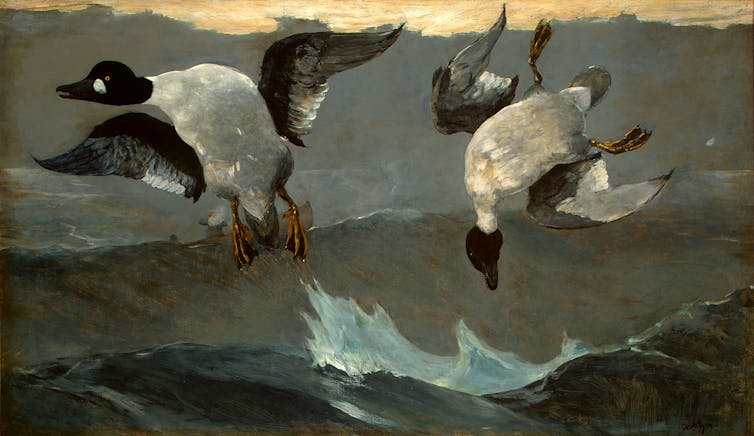
waterfowl Winslow Homer Thanksgiving

Waterfowl – not turkey – would have been the main course.
Winslow Homer, 'Right and Left' (1909), National Gallery of Art


A main course of waterfowl and venison


The main course is the one scholars can speak about with certainty.

The only eyewitness account of the first Thanksgiving comes from a letter written by Edward Winslow on Dec. 11, 1621. In it, he describes how the Puritans, after utilizing fertilization methods imparted by Tisquantum (also known as “Squanto”), had their first successful harvest. To celebrate, Governor William Bradford “sent four men on fowling” and they returned later that day with enough food to feed the colony for almost a week. Since waterfowl was plentiful in the Massachusetts Bay area, it’s widely accepted that they were eating goose and duck rather than turkey.

The letter also recounts that the Wampanoag leader Massasoit Ousamequin was present, along with “some ninety men,” and that they gifted five deer to the governor. Therefore, venison likely had a prominent place alongside waterfowl on the first Thanksgiving table.

Not cranberry sauce, but sobaheg stew


The natural bogs of the the region contained wild cranberries that could be dried and used all winter to bring variety and vitamin C into the diets of the Wampanoags. They even have their own holiday, Cranberry Day, that resembles our Thanksgiving.

However, there’s no account of cranberries at the first Thanksgiving, nor is there any mention of cranberries in other records of foods introduced to people who arrived on the Mayflower.

This may be due, in part, to the location of Plymouth Plantation relative to the boggy regions of Massachusetts, which are several miles away.

If bogs were not in the immediate area, then the fruit may not have been as readily used by the Wampanoags of this region as they were in other places with Wampanoag settlements, like Martha’s Vineyard.

Instead, for a side dish to the main course, a stew called sobaheg was most likely served. An easy way to make use of seasonal ingredients, the stew often included a mixture of beans, corn, poultry, squash, nuts and clam juice. All are used in the traditional dish today, and all would have been available in 1621. In fact, clams, fish and other seafood were abundant in the area, so they were probably present in some form, whether in sobaheg or another dish.

For carbs, look to cornbread, not potatoes


Historians attribute the first New England crop of potatoes to Derry, New Hampshire in 1722, so there’s no way mashed potatoes could have made an appearance during the first Thanksgiving.

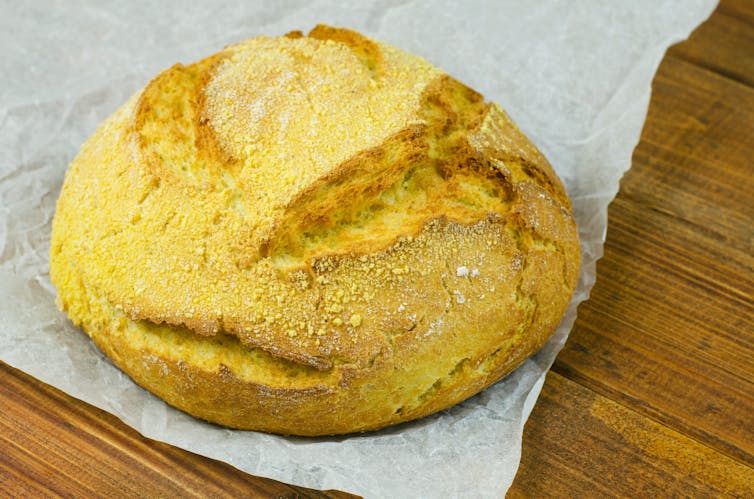
Corn, on the other hand, was the staple starch of the time, and in the published notes of William J. Miller on the Wampanoag tribe, he indicates that among the foods introduced to them, the corn bread, called maizium, was “kind.” European settlers didn’t often speak favorably of indigenous food, so mazium stands out as a recipe that likely made it onto the table at this first feast.


Thanksgiving cornbread

Potatoes weren’t around in 17th-century New England, but corn was plentiful.
Natalija Sahraj


A ‘green sauce’ gravy


Although the settlers may have made a gravy out of the drippings from the meats procured for the feast, a common staple for these early colonizers was a dish known simply as “green sauce.”

Although the best accounts of this sauce come from later records when households had their own gardens of European crops, recipes also utilized crops introduced to them by the Wampanoag. In addition to the corn (and barley) mentioned in Winslow’s letter, the harvest of 1621 likely included beans, squash, onions, turnips and greens such as spinach and chard. All could have been cooked at length to create a pulpy sauce that later became a staple in early New England homes.

What about dessert?


A regular supply of sugar or maple syrup wasn’t available in the area until much later. Sugar, which was the major export of Caribbean plantations, didn’t become popular in New England until the 18th century.

As for maple syrup, Native Americans of the Northeast are credited as the first to procure it; however, it’s believed that European settlers didn’t begin harvesting it until 1680.

The ConversationAlthough it is tough to think of Thanksgiving without decadent sweets, at least the first attendees were spared the awkwardness of having to refuse dessert after such a large feast.

Julie Lesnik, Assistant Professor of Anthropology, Wayne State University

This article was originally published on The Conversation. Read the original article.

Thursday, December 29, 2016

Guest Post: How the American Civil War cemented modern Christmas traditions


by David Anderson, Swansea University

Shortly before Christmas Day 1864, Abraham Lincoln received an extraordinary Christmas present – Savannah, Georgia. Union General William Sherman presented the captured city to the president via telegram, noting his gift included guns, ammunition, and several thousand bales of cotton.

Thomas Nast Civil War Christmas
Thomas Nast, couple separated by Civil War, 1863
An unusual gift, but the tale hints at how traditions bend during wartime. By the time the war broke out, the majority of Christmas traditions that we would recognise – and indeed celebrate today – were in place in America. Many of these built upon traditions from Europe. But the way these were upheld during the war went a long way towards cementing aspects of the American Christmas that has since been commercialised and exported around the globe.

Victorian-era Americans popularised Christmas trees, decorations, Christmas cards, gift giving, carol singing, and even Santa Claus. In doing so, they inaugurated holiday commercialism, transforming the American Christmas from the sacred to the secular and a celebration couched around the virtues of family life, particularly the joy of children.

Christmas tends to assume a strong sense of its own significance in times of protracted conflict. On the Civil War home front, wives, mothers and sisters greeted Christmas during the war with ominous foreboding, worrying about absent husbands, fathers and sons. Diarist Mary Boykin Chesnut offered her thoughts in verse:

Darkest of all Decembers

Ever my life has known

Sitting here by the embers

Stunned – helpless – alone.

Many women, both north and south, spent their Christmases making clothes for soldiers, tending to the sick and wounded in hospitals, or preparing holiday food boxes – a gift from home that soldiers keenly anticipated.

But children felt the temper of the times more than most. Toys and decorations for many southern children were usually homemade because of the scarcity of materials and crippling wartime prices. Common gifts included various fruits and assortments of nuts, candy, popcorn and cakes. Other children were not so lucky. Confederate General Howell Cobb’s children were informed that the Yankees had shot Santa Claus.

On the front line


Usually in camp for the winter months, soldiers’ minds inevitably turned toward thoughts of home and hearth at yuletide. Men in both armies tried to replicate the family Christmas in their encampments. One Union solider stated: “In order to make it look much like Christmas as possible, a small tree was stuck up in front of our tent, decked with hard tack and pork, in lieu of cakes and oranges, etc.”

Harper's Weekly Civil War Santa Claus
Santa Claus in 1862
Cartoonists’ Winslow Homer and Thomas Nast’s morale-boosting sketches for Harper’s Weekly presented Union soldiers excitedly opening Christmas boxes and gifts. Nast’s famous sketch for the Christmas 1862 edition depicted a patriotic Santa, dressed in a star-spangled banner, distributing seasonal good cheer to Union soldiers from his sleigh. The image of this portly, joyful, white-bearded man carrying a bag full of gifts has since been maintained and become a central part of the international Christmas.

And there were indeed seasonal entertainments to occupy even the most forlorn of souls: parties, games, singing and dancing. Interestingly, there are some examples of seasonal fraternisation between Union and Confederate soldiers – swapping newspapers and coffee, even snowball fights – that bring to mind the famous game of football between British and German soldiers during World War I.

Soldiers huddled around campfires and reminisced of loved ones and festive repasts. But separated from their homes and families, homesickness took hold. William Downer, an imprisoned Confederate cavalryman, cut a dejected figure. “This is Christmas Eve and oh how lonely I feel,” he confessed to his diary in 1864. “The thought of home and my dear wife and children being so far away … confined in prison makes me feel as if I had not a friend on earth.”

Christmas in slavery


For some enslaved African Americans, Christmas meant extra leisure time from daily routines, gifts, additional food rations, as well as relaxed restrictions on movement between plantations and farms. Convinced of their own benevolent rule, masters often permitted their enslaved peoples to attend dances, minstrel shows and tea parties – and to participate in other forms of entertainment such as boxing and wrestling competitions. “Christmas was the greatest holiday time that the slaves had,” remarked Allen Parker in his post-war reminiscence, a chronicle of his early years in servitude along the eastern coast of North Carolina through to his escape to a Union gunboat in 1862.

Of course, the day-to-day realities of antebellum slave life were scarcely as generous or bountiful as nostalgic memoirs, written many years after the events they describe, might suggest. Although Solomon Northup, a free black from New York who was kidnapped into slavery, wrote of Christmas in Twelve Years a Slave as a “time of feasting, and frolicking, and fiddling,” he also recognised that the Christmas holidays amounted to “the only days” when the enslaved were “allowed a little restricted liberty, and heartily indeed do they enjoy it”.

Some slaves insisted that the Christmas season differed little from other plantation holidays while others were threatened that Christmas would not come at all if they misbehaved. Perhaps the most heartrending exposé of a plantation Christmas during the late days of slavery came from Harriet A Jacobs. In her autobiography, Incidents in the Life of a Slave Girl (1861), Jacobs described a Christmas she spent concealed in the crawl space of her grandmother’s house after absconding from her master and his sexual advances.

Careful scrutiny of American Civil War-era letters, diaries, and reminiscences, from civilians and soldiers alike, reveal the hopes and fears of those who lived through this tumultuous period in the nation’s history. The Christmas season served as an occasion to remind mid-19th century Americans of the importance of home and its associations, of invented traditions. Therein evolved the modern Christmas.

The Conversation

David Anderson, Senior Lecturer in American History, Swansea University

This article was originally published on The Conversation. Read the original article.