Showing posts with label Pennsylvania. Show all posts

Saturday, August 05, 2017

From the Archives: Economist Antony Davies debunks arguments against liquor sale privatization


Economist Antony Davies debunks arguments against liquor sale privatization
August 5, 2010 5:12 PM MST

Based on studies he has done regarding the privatization of alcoholic beverage sales in other states, Duquesne University economist Antony Davies concludes that “the major opposition surrounds the social impact of privatizing alcohol. The conventional wisdom would say if you privatize alcohol, the state loses control, and you will see more social problems associated with drinking.”

Empirically, however, this is not true, Davies told the Charlottesville Libertarian Examiner in a telephone interview on August 5. He distinguished between levels of “control,” from the free-market systems that exist in most states, to moderate control (such as in Virginia, where beer and wine are sold by private businesses) to full control (such as Pennsylvania, where even beer and wine are sold by a state-owned monopoly).

No Substantial Difference
A 2009 study he wrote for the Commonwealth Foundation for Public Policy Alternatives (a Pennsylvania think tank) with fellow Duquesne economist John Pulito, resulted in these findings, based on statistics from 1970 through 2006:

Antony Davies Mercatus Center Duquesne University liquor law Virginia ABC
“….advocates claim that the social goals of reducing alcohol consumption, underage drinking, and alcohol-related traffic deaths justify controlling wholesale and retail alcohol markets.

“Evidence from 48 states over time shows no link between market controls and these social goals.”

Dr. Davies said in the interview that “we’re not seeing any evidence that greater control leads to better social outcomes.”

There is an exception, however, that Davies pointed out over the telephone: “DUI fatalities are significantly higher in states with more control than states with less control.”

Other factors, however, are different, he said. “If you look at per capita alcohol consumption, there’s no difference as you move from full to moderate to light control.”

Underage Drinking
As to claims that state-owned liquor stores are a better protection against selling alcohol to minors and underage drinking, Davies explained that people think “at a gut level” that private businesses “have an incentive to sell to minors. We see that’s not the case.”

Why not? “If alcohol is sold in the private market, the owner of the store has a profit incentive not to sell to minors, because if he gets caught, he loses his license. He wants to protect his business.”

Davies, who is also a visiting scholar at the Mercatus Center at George Mason University in Northern Virginia, concludes: “If you look at the data, there’s no clear pattern [that emerges showing] that imposing more control reduces underage drinking.”

Financial Arguments
In addition to the “social outcome” arguments against privatization, Davies said that “there are some financial arguments but they tend not to hold too much water.”

Those arguments, he said, “are pretty easily knocked down when you realize the state can continue to tax alcohol regardless of whether it’s sold publicly or privately.”

Davies pointed to legislation currently under consideration by Pennsylvania, which proposes to sell that state’s alcoholic beverage stores. “What’s pushing this [proposal] is the budget crunch. Selling the state store system would immediately raise the $2 billion necessary to close the budget gap.”

From the state’s perspective, Davies continued, “this is a win-win situation financially. The state can sell off its ABC system for a lump sum of cash and then continue to collect alcohol taxes and fees.”

As for Virginia, Professor Davies said he did a “back of the envelope calculation” after “looking at latest ABC statement of revenues.” Superficially, he said, “Virginia would lose about 30 percent of what it’s taking in” in operating profits.

What that doesn’t take into account, however, is lost revenue from Virginia customers who do their shopping in the District of Columbia, Maryland, West Virginia, and North Carolina. Nor does it account for the revenue increases that will result from private operation of liquor stores.

“Here’s why it may be revenue-positive,” he explained. “You achieve all these things – more convenient locations, more convenient hours, better customer service, so sales will increase. Plus auctioning off licenses” will result in previously unavailable revenue for the state.

Rent Seekers
Davies also addressed why one of the primary opponents of ABC privatization would be groups like the beer wholesalers, whose products are already sold in privately owned stores.

“Beer wholesalers,” he said, “are most against privatization of wine and spirits because it increases their competition.” By making comparable products more easily available to the same customers, “that’s going to eat into the profits of the beer distributors.”

In that regard, Davies offered some advice for voters and taxpayers who are paying attention to the privatization debate in Virginia:

“Generally speaking, the economists’ mantra is ‘follow the money.’ If you find someone arguing for or against a regulation, ask where he gets his money from.”

That seems to be a simple explanation of the motivation of some opponents of ABC privatization.

Publisher's note: This article was originally published on Examiner.com on August 5, 2010. The Examiner.com publishing platform was discontinued July 1, 2016, and its web site went dark on or about July 10, 2016.  I am republishing this piece in an effort to preserve it and all my other contributions to Examiner.com since April 6, 2010. It is reposted here without most of the internal links that were in the original.


Wednesday, July 09, 2008

The Speaker's House Has a Blog

Those of us who live in Virginia are downright spoiled by the presence of historic homes. Just within a few-mile radius of Charlottesville, we have Monticello (home of Thomas Jefferson), Montpelier (home of James Madison), and Ash Lawn-Highland (home of James Monroe). There are also Mount Vernon (home of George Washington) and Gunston Hall (home of George Mason) in Northern Virginia, the John Marshall House and the White House of the Confederacy in Richmond, John Tyler's plantation house (Sherwood Forest in Charles City County), Stratford Hall (birthplace of Robert E. Lee), and many more.

Up in Trappe, Pennsylvania (I'm sure you've never heard of it) is a home belonging to the first Speaker of the House of Representatives, Frederick Muhlenberg. Long in disrepair, the Speaker's House, as it has come to be known, has recently been rescued by a non-profit group and will soon be open to the public for tours just like our stately homes in Virginia.

I visited the Speaker's House in 2006, I photoblogged about it a while back.

Now it turns out that the historians working on the Speaker's House have started a blog of their own, which you can find here. It looks like the blog will be used to alert people to activities and events attached to the Speaker's House:

This blog will post updates on the renovation done to the House, any new artifacts or historical records discovered in connection with the House, interesting historical facts and anecdotes about the House and its inhabitants, and best of all, your story.

Don’t forget to come to our Bar-b-que and Open House Fundraiser on July 26, 2008, 11:30 AM – 7:00 PM. Check out our announcement on our Home Page!

The blog is an effort, in addition to the Speaker's House web site, to bring the Frederick Muhlenberg House (and Muhlenberg himself) to the attention of the history-hungry public.

Although Muhlenberg may seem obscure when compared to such giants as Benjamin Franklin, Thomas Jefferson, or Alexander Hamilton, he played an important role in the founding of this country and its constitutional order: In addition to being the Speaker of the House in the First Congress, Muhlenberg was a member of the Continental Congress, a delegate to the Pennsylvania Constitutional Convention, and the first signer of what we know as the Bill of Rights.

Friday, September 08, 2006

Visiting the Speaker's House

About 25 miles due west of Center City Philadelphia is the small town of Trappe, Pennsylvania. There, along a busy commercial strip, stands the home the first Speaker of the U.S. House of Representatives. Currently in dilapidated condition, the 18th-century residence of Frederick Muhlenberg has recently been purchased by a group of local residents interested in preserving this bit of history and restoring it for educational, archeological, and tourism purposes.

Most Americans know who our first president and vice-president were (George Washington and John Adams, in case non-Americans are reading this), but if asked, probably few could name Frederick Muhlenberg as the first Speaker of the House.

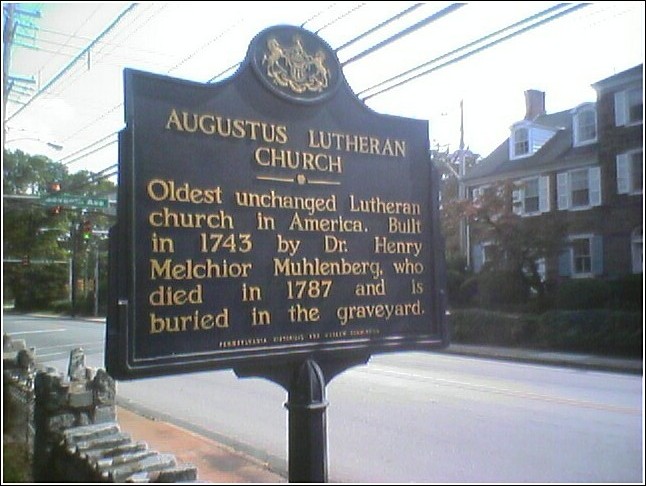
A first-generation American, Frederick Muhlenberg was born in Trappe on January 1, 1750. His father, Henry Melchior Muhlenberg, founded Augustus Lutheran Church in Trappe, which is thought to be the oldest Lutheran church continuously in use, without major architectural or decorative changes, in the United States.

Following in his father's footsteps, as a young man, Muhlenberg went to Germany for his education and became a Lutheran minister. During the Revolutionary War, he was in New York when the British marched on the city, forcing him and his family to flee to his parents’ home in Trappe. There Frederick purchased a fifty-acre property in 1781.

Architectural evidence indicates that Muhlenberg modified an existing dwelling into a side-passage, double parlor residence in the manner of a stylish urban townhouse. In a letter to his brother Henry, Muhlenberg described how he greatly enjoyed working in his gardens, fields, and the dry goods store he operated on the property. While living in this house, Frederick was elected speaker of the Pennsylvania General Assembly and president of the Pennsylvania Constitutional Convention. Muhlenberg was a powerful leader in local and state politics, serving as the president of the Pennsylvania Constitutional Convention and first President Judge, Recorder of Deeds, and Register of Wills in Montgomery County.

In 1789, Trappe-area voters sent Muhlenberg to the first U.S. Congress, where he was elected to the precedent-setting role of the first Speaker of the House and became the first to sign the Bill of Rights. Muhlenberg sold his Trappe estate to his sister and brother-in-law in 1791 and moved to Philadelphia, where he served in the next three congresses and was elected again as speaker of the third congress. In 1800 he moved to Lancaster, where he died the following year at the age of fifty-one. (He accomplished a lot in a short lifetime.)

I have been in Montgomery County, Pennsylvania, for the past couple of days on business, and I had an opportunity to visit the Muhlenberg House in Trappe. To be perfectly frank, it is not ready for prime time, but a local group called Save the Speaker's House, Inc., has acquired the property and is now laying the groundwork for restoring it. Plans include building a facility with a lecture hall, classrooms, and administrative offices in the large backyard, and digging trenches for exploration by archeologists and archeology students. (The history department at Ursinus College is partnered with Save the Speaker's House for educational programs.)

The Montgomery County Commissioners have called the Frederick Muhlenberg house “a vital piece of our history” and Trappe Borough Council declared the Speaker’s House an official “historic treasure.". The house, across from the Trappe Shopping Center, has seen much change and neglect over the last century. Save the Speaker's House says that the restoration will revitalize its Main Street neighborhood and attract visitors to the historic and cultural resources of the local community. (Other nearby landmarks are Ursinus College, in next-door Collegeville, and Valley Forge National Historic Park, which is about 8 miles away.) The goal of Save the Speaker's House is to raise the $1.5 million necessary to restore the house to the period of 1781-1803, when Muhlenberg and his family lived there.

While in Trappe, I snapped a few photos of the Speaker's House (which is not yet open to the public) and his father's church down the street, using my handy camera phone. The Frederick Muhlenberg house, modest as it is, is not exactly Mount Vernon or Monticello -- or even Ash Lawn-Highland -- but it still represents an important, if relatively unnoted, part of our early post-revolutionary, early-republican history.


This sign in front of the Speaker's House is the only visible indication of the historic site behind it


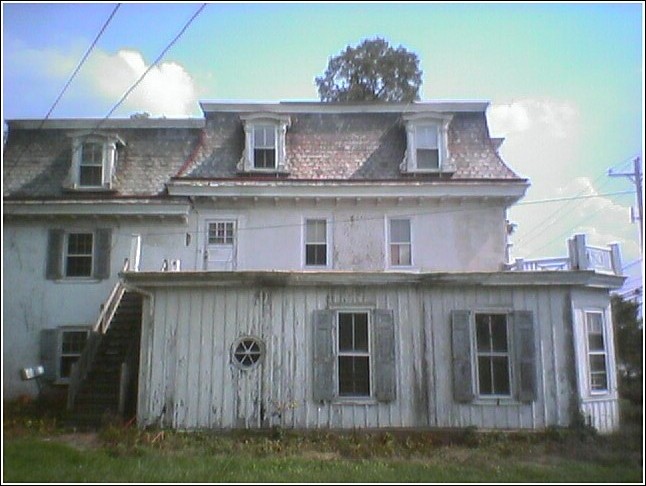
The back of the house dates to the original construction in the 1740s...


...the front of the house, which faces the street, is only about 110 years old


In the backyard is the Speaker's Outhouse.

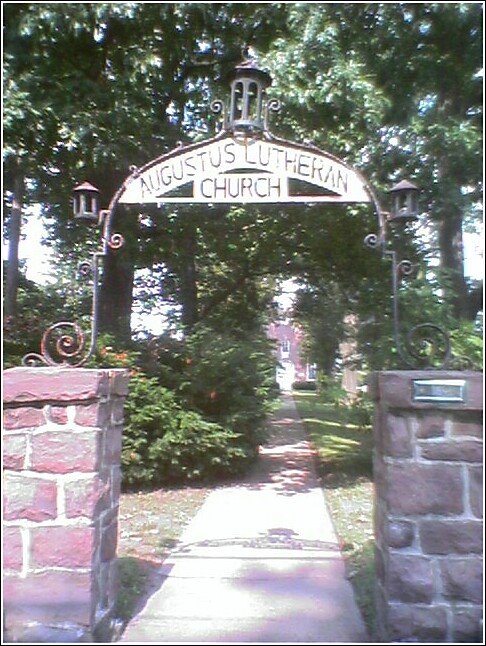
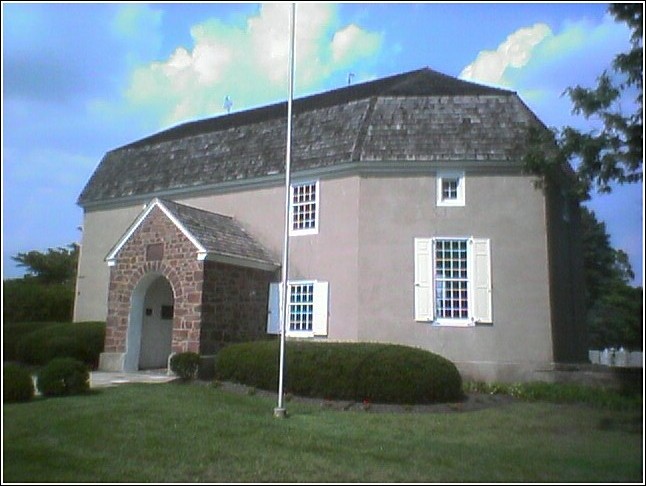
Far better preserved, largely because it has been in use, serving its original purpose, for more than two centuries, is Augustus Lutheran Church, just a few blocks west of the Speaker's House along Main Street in Trappe:


The church is a simple structure, shaped much like a barn.


Lutheran congregations from across the United States have contributed financially toward the upkeep and preservation of Augustus Lutheran Church; this plaque offers them some thanks.


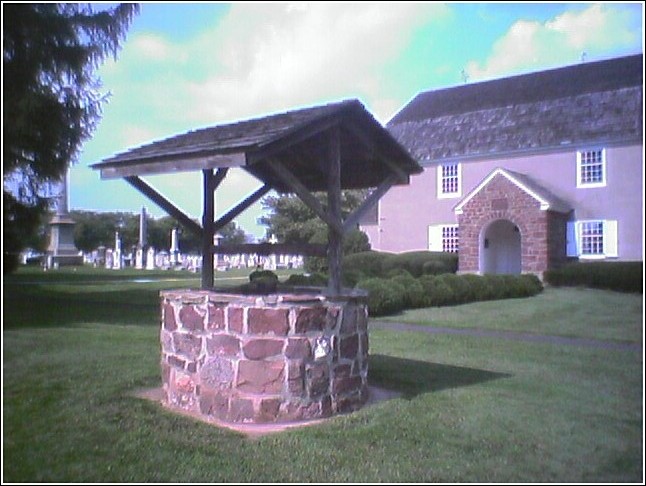
Contrary to what some wags suggest, this well is not also a baptismal font.


The church cemetery is large and still in use.


While the old Augustus Lutheran Church is still used for special occasions, a larger sanctuary serves the congregation for regular services.