Showing posts with label alcohol. Show all posts

Saturday, December 16, 2017

Guest Post: Historically Religious Origins of Wine, Beer, and Liquor


Michael Foley, Baylor University

Each year the holidays bring with them an increase in both the consumption of alcohol and concern about drinking’s harmful effects.
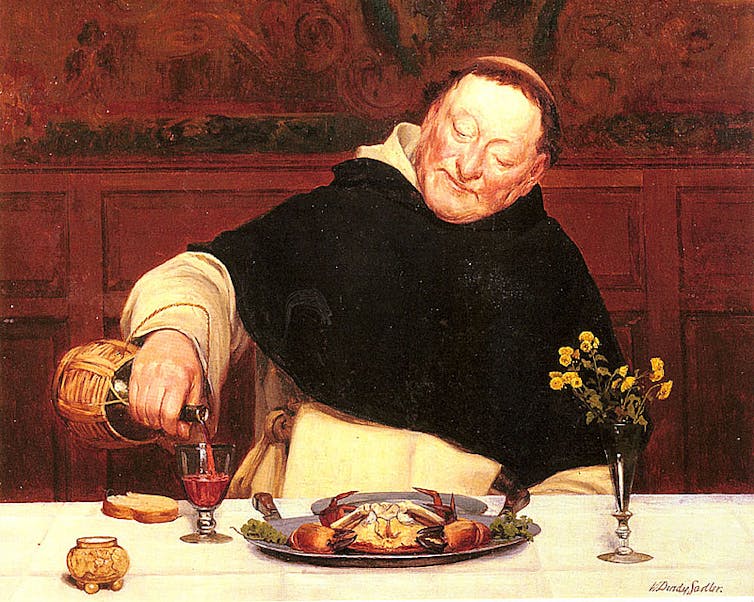


Religious Origins of Wine, Beer, and Liquor

Pious drinking.
Walter Dendy Sadler via Wikimedia Commons


Alcohol abuse is no laughing matter, but is it sinful to drink and make merry, moderately and responsibly, during a holy season or at any other time?

As a historical theologian, I researched the role that pious Christians played in developing and producing alcohol. What I discovered was an astonishing history.

Religious orders and wine-making


Wine was invented 6,000 years before the birth of Christ, but it was monks who largely preserved viniculture in Europe. Religious orders such as the Benedictines and Jesuits became expert winemakers. They stopped only because their lands were confiscated in the 18th and 19th centuries by anti-Catholic governments such as the French Revolution’s Constituent Assembly and Germany’s Second Reich.

In order to celebrate the Eucharist, which requires the use of bread and wine, Catholic missionaries brought their knowledge of vine-growing with them to the New World. Wine grapes were first introduced to Alta California in 1779 by Saint Junipero Serra and his Franciscan brethren, laying the foundation for the California wine industry. A similar pattern emerged in Argentina, Chile and Australia.
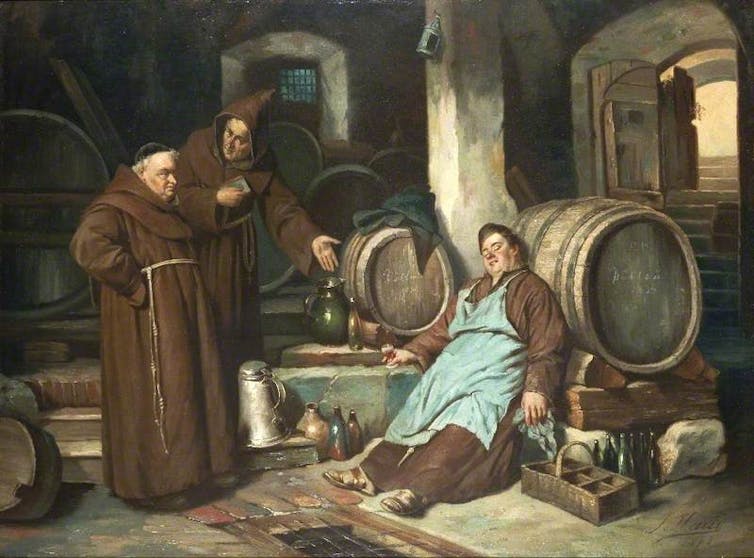


Religious Origins of Wine, Beer, and Liquor alcoholic beverages

Monks in a cellar.
Joseph Haier 1816-1891, via Wikimedia Commons


Godly men not only preserved and promulgated oenology, or the study of wines; they also advanced it. One of the pioneers in the “méthode champenoise,” or the “traditional method” of making sparkling wine, was a Benedictine monk whose name now adorns one of the world’s finest champagnes: Dom Pérignon. According to a later legend, when he sampled his first batch in 1715, Pérignon cried out to his fellow monks:

“Brothers, come quickly. I am drinking stars!”

Monks and priests also found new uses for the grape. The Jesuits are credited with improving the process for making grappa in Italy and pisco in South America, both of which are grape brandies.

Beer in the cloister


And although beer may have been invented by the ancient Babylonians, it was perfected by the medieval monasteries that gave us brewing as we know it today. The oldest drawings of a modern brewery are from the Monastery of Saint Gall in Switzerland. The plans, which date back to A.D. 820, show three breweries – one for guests of the monastery, one for pilgrims and the poor, and one for the monks themselves.

One saint, Arnold of Soissons, who lived in the 11th century, has even been credited with inventing the filtration process. To this day and despite the proliferation of many outstanding microbreweries, the world’s finest beer is arguably still made within the cloister – specifically, within the cloister of a Trappist monastery.

Liquors and liqueurs


Equally impressive is the religious contribution to distilled spirits. Whiskey was invented by medieval Irish monks, who probably shared their knowledge with the Scots during their missions.


monk sneaking a drink monasteries liqueur beer wine

Monk sneaking a drink.
Scanned from Den medeltida kokboken, Swedish translation of The Medieval Cookbook by Maggie Black, via Wikimedia Commons.


Chartreuse is widely considered the world’s best liqueur because of its extraordinary spectrum of distinct flavors and even medicinal benefits. Perfected by the Carthusian order almost 300 years ago, the recipe is known by only two monks at a time. The herbal liqueur Bénédictine D.O.M. is reputed to have been invented in 1510 by an Italian Benedictine named Dom Bernardo Vincelli to fortify and restore weary monks. And the cherry brandy known as Maraska liqueur was invented by Dominican apothecaries in the early 16th century.

Nor was ingenuity in alcohol a male-only domain. Carmelite sisters once produced an extract called “Carmelite water” that was used as a herbal tonic. The nuns no longer make this elixir, but another concoction of the convent survived and went on to become one of Mexico’s most popular holiday liqueurs – Rompope.

Made from vanilla, milk and eggs, Rompope was invented by Clarist nuns from the Spanish colonial city of Puebla, located southeast of Mexico City. According to one account, the nuns used egg whites to give the sacred art in their chapel a protective coating. Not wishing the leftover yolks to go to waste, they developed the recipe for this festive refreshment.

Health and community


So why such an impressive record of alcoholic creativity among the religious? I believe there are two underlying reasons.

First, the conditions were right for it. Monastic communities and similar religious orders possessed all of the qualities necessary for producing fine alcoholic beverages. They had vast tracts of land for planting grapes or barley, a long institutional memory through which special knowledge could be handed down and perfected, a facility for teamwork and a commitment to excellence in even the smallest of chores as a means of glorifying God.
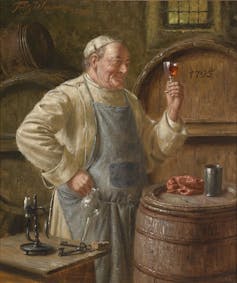


alcoholic beverages promote health

Historically, alcohol was seen to be promoting health.
Fritz Wagner (1896-1939) (Dorotheum) , via Wikimedia Commons


Second, it is easy to forget in our current age that for much of human history, alcohol was instrumental in promoting health. Water sources often carried dangerous pathogens, and so small amounts of alcohol would be mixed with water to kill the germs therein.

Roman soldiers, for example, were given a daily allowance of wine, not in order to get drunk but to purify whatever water they found on campaign. And two bishops, Saint Arnulf of Metz and Saint Arnold of Soissons, are credited with saving hundreds from a plague because they admonished their flock to drink beer instead of water. Whiskey, herbal liqueurs and even bitters were likewise invented for medicinal reasons.

And if beer can save souls from pestilence, no wonder the Church has a special blessing for it that begins:

The Conversation“O Lord, bless this creature beer, which by Your kindness and power has been produced from kernels of grain, and may it be a health-giving drink for mankind.”

Michael Foley, Associate Professor of Patristics, Baylor University

This article was originally published on The Conversation. Read the original article.

Saturday, August 26, 2017

From the Archives - Privatizing ABC: Virginia Institute's John Taylor wants 'a small government I can easily monitor'

Privatizing ABC: Virginia Institute's John Taylor wants 'a small government I can easily monitor'
August 26, 2010 12:26 PM MST

John Taylor Virginia Institute of Public Policy ABC privatization liquor law alcohol regulation
Tonight in Harrisonburg, Governor Bob McDonnell will be holding the sixth in his series of eight town hall meetings on the topic of reforming Virginia’s government. As always, the centerpiece of the governor’s presentation will be his proposals to privatize the state’s monopoly on the wholesale and retail sale of distilled spirits, which dates to 1934 and the end of alcohol Prohibition.

Earlier this month, the Virginia Institute for Public Policy, a state-level think tank based in Gainesville, published a study called Impaired Judgment: The Failure of Control States to Reduce Alcohol-Related Problems, written by George Mason University economist Donald Boudreaux and Julia Williams, a consultant with the Regulatory Economics Group, LLC.

‘No statistically significant difference’
A few days after the study was released, the Charlottesville Libertarian Examiner caught up with Institute president John Taylor in Richmond, who summarized its findings.

“We looked at the public health and safety aspects of privatizing the state-owned liquor stores,” Taylor explained, comparing “the control stores that have monopolies over the sale of distilled spirits vs. the license states where the state government will sell licenses to private vendors to sell distilled spirits.”

These findings closely match those found by Duquesne University economist Antony Davies in research he did for a Pennsylvania think tank.

The three areas examined in the study, he said, “were alcohol-related deaths, binge drinking, and drunk-driving fatalities. In those three areas, what we found was there’s no statistically significant difference between the control states and the license states. There just isn’t.”

If one argues that “we have to control distilled spirit sales and give the government a monopoly,” Taylor said, “then public health and public safety [are] not really the excuse,” repeating for emphasis: “In those three areas, there is really not a need or an excuse for the government to be involved.”

With regard to the revenue that could be gained (or lost) through privatization, Taylor said that he understands the governor has claimed privatization will result in a windfall of $500 million that will be applied to transportation program.

‘Moral hazard’
However, he added, “To me, the revenue argument is not a good argument to begin with, because I don’t believe selling liquor is a core function of government. If you can say, ‘well, yeah, but the state makes a lot of money off of it,’ [then] the state might make a lot of money off a lot of things that should be private industries.”

Turning sardonic, Taylor added with a smile:

“I mean, if we allow them to have a monopoly to sell liquor, before you know it, they’ll take over car companies, insurance companies, banks – oh, sorry, they already do that.”

Having government involved in one consumer business, like liquor, Taylor argued, is the start of “a slippery slope and it’s a moral hazard. I just don’t want our government involved in this. I want a small government that I can easily monitor to make sure I know what they’re doing so that I can bash them when they overstep their bounds.”

Asked what he has heard from members of the General Assembly, who will have to vote to approve any privatization program, Taylor noted that “there are some that have expressed views that they don’t want to give up the ABC stores simply because they think it would be a loss of revenue.”

‘Not a core function’
At the same time, however, he pointed out that “the more conservative members of the General Assembly would agree that this is really not a core function of government and the government should get out of it.”

Following tonight’s town hall in Harrisonburg, Governor McDonnell will meet with voters and taxpayers in Danville on August 30 and in Bristol on August 31. Press reports indicate that he will officially release his ABC privatization proposals on September 8, for the consideration of the Government Reform Commission.

Publisher's note: This article was originally published on Examiner.com on August 26, 2010. The Examiner.com publishing platform was discontinued July 1, 2016, and its web site went dark on or about July 10, 2016.  I am republishing this piece in an effort to preserve it and all my other contributions to Examiner.com since April 6, 2010. It is reposted here without most of the internal links that were in the original.


Wednesday, August 09, 2017

From the Archives: State Senator Ralph Smith 'keeping his powder dry' on ABC privatization proposals

State Senator Ralph Smith 'keeping his powder dry' on ABC privatization proposals
August 9, 2010 2:25 AM MST

Ralph Smith ABC privatization liquor law alcohol regulation Prohibition
Governor Bob McDonnell’s first town hall meeting on government reform was held in the chambers of the Roanoke County Board of Supervisors, in the backyard of state Senator Ralph Smith (R-22), a former mayor of Roanoke whose district encompasses all of Botetourt County, parts of Montgomery and Roanoke counties, and the cities of Radford and Salem. (The city of Roanoke is represented in the state senate by Democrat John Edwards.)

Smith introduced McDonnell at the start of the meeting. After the event ended, he spent a few minutes answering questions from the Charlottesville Libertarian Examiner.

Smith’s assessment of the town hall was positive.

Learning from the public
“I think we all learned by it,” he said. “I feel sure the Governor’s learned new angles by this. I certainly did.”

The senator was particularly impressed by the way Governor McDonnell handled difficult – if not hostile – questions from the audience.

On occasions like this, he said, “no one’s going to like everything you do.” McDonnell “did an excellent job of dealing with those issues which are pretty much in opposition from the direction he wants to go.” For that, Smith concluded, “he gets good credit.”

With regard to the specific question of McDonnell’s proposals for privatization of the sales and distribution of distilled spirits, Smith put on a positive face but was nonetheless noncommittal.

Wait and see on ABC
“I’m like probably a majority of the members of the General Assembly,” he explained, who want to “see more detail and expect to learn a little bit more in the next couple of days.”

Smith said of himself that “I’m a private-enterprise guy, so that kicks in, but I also realize that this is not a product like shoes and razor blades and everything else, when you’re dealing with alcohol,” suggesting that alcohol sales should be treated differently under the law than other consumer products.

Asked if he has a sense of what the General Assembly is thinking, Smith replied:

“Most everyone’s keeping their powder dry,” but he added that the opposition party – the Democrats, who have a majority in the state Senate – are unlikely to be supportive.

Still, Smith does not think support or opposition to these proposals will be driven entirely by partisanship.

“It’ll be back and forth,” he said, although “I think the partisanship will handicap it, somewhat.”

Rural-suburban split
What’s more likely is a rural-suburban split among legislators, depending on the constituencies they represent.

“You’re going to see some of that, clearly, yes,” he noted, pointing out that “Southwest Virginia is going to be the most conservative part of it.”

On the other hand, he said, “there are pockets around the Commonwealth,” which he identified as “the heavily populated areas, without naming the specifics,” where the transition will be welcomed by those who have seen free-market sales in other parts of the country.

At the same time, he expressed some concern that those other states serve as examples of where they “have one [liquor store] essentially on every corner.” In his own visits to other states he has seen “gaudiness” and thinks those stores are “pretty tacky visually.”

Still, he added, “I can’t imagine that it doesn’t encourage more alcohol consumption,” an assertion contradicted by studies such as one released last week by the Virginia Institute of Public Policy, and by some of the research done by economist Antony Davies, who was interviewed by the Charlottesville Libertarian Examiner last Thursday.

Publisher's note: This article was originally published on Examiner.com on August 9, 2010. The Examiner.com publishing platform was discontinued July 1, 2016, and its web site went dark on or about July 10, 2016.  I am republishing this piece in an effort to preserve it and all my other contributions to Examiner.com since April 6, 2010. It is reposted here without most of the internal links that were in the original.

Tuesday, August 08, 2017

From the Archives: Interview with Virginia Governor Bob McDonnell on ABC privatization - Part 2

Examiner.com exclusive: Interview with Virginia Governor Bob McDonnell on ABC privatization - Part 2
August 8, 2010 2:45 AM MST

Just before the first of eight town hall meetings he is hosting around the state, Virginia Governor Bob McDonnell sat down in Roanoke with the Charlottesville Libertarian Examiner for an exclusive interview.

As a Republican candidate for governor in 2009, McDonnell had promised to privatize the state’s system of alcoholic beverage control (ABC), which includes government ownership of liquor wholesale and retail operations. The system dates to 1934, after the passage of the 21st Amendment to the U.S. Constitution, which ended alcohol Prohibition.

Unlike distilled spirits, beer and wine are sold privately, through both wholesalers and retailers, in Virginia.

Answering Opponents
In continuing the conversation about ABC reform, McDonnell was asked about opponents of privatization, which may include beer wholesalers and others who fear competition in a free-market environment.

Virginia governor Bob McDonnell ABC privatization liquor law
“Once the proposal is announced,” he said, adding “on exactly what the right mechanics are, it will then go to my government reform commission.”

After getting input from the commission and from citizens, the administration “will address some of the concerns that people have,” such as fears that money will be taken from the state’s general fund and that there might be an increase in crime in the absence of direct government control of liquor sales.

Privatization, McDonnell said, “maximizes the competition to reduce price, increase quality, [and] increase convenience. I think everybody will have a fair shake at getting a distribution license. We’ll still have strong enforcement of the rules; it will just be done by a private vendor, not by a government monopoly.”

Addressing the concerns of beer wholesalers and others who fear competition, he said, “at the end of the day, if people think that somehow this privatization might not be good for their business, then maybe they’ll still be opposed to it. But we’re going to knock down most of the opposition”

Creating and Retaining Jobs
McDonnell believes strongly that privatizing the ABC system will create jobs, but he also believes a new system will accommodate current ABC workers.

“We have 2,500 employees right now that work in the state system for ABC. We think they’re good employees,” he asserted. New, private-sector vendors “will have every incentive to try to hire the government workers.”

Virginia governor Bob McDonnell Rick Sincere ABC privatization alcohol regulation
Rick Sincere interviews Bob McDonnell
McDonnell said, “it’s obvious” why the new owners will want to retain most of the current workers. “They’re trained, they know the system.”

Beyond job creation, however, the emphasis on McDonnell’s mind is what he calls privatization’s “biggest benefit”: an immediate windfall of “$500 million or more for transportation.”

Over the past several years, he said, “there’s been a lot of discussion about transportation and many proposals have failed.”

Unlike those, this proposal, McDonnell said, “is one that uses the free market, gets the government out of business, [creates] smaller government [and] more competition, and generates a half a billion for transportation.

“To me,” he concluded, “that’s a win-win and I think it’s one of the biggest reasons we’ll have public support for this idea.”

Part 1 of Governor McDonnell’s interview with the Charlottesville Libertarian Examiner is available on Examiner.com. See the attached video for a complete recording of the conversation.


Publisher's note: This article was originally published on Examiner.com on August 8, 2010. The Examiner.com publishing platform was discontinued July 1, 2016, and its web site went dark on or about July 10, 2016.  I am republishing this piece in an effort to preserve it and all my other contributions to Examiner.com since April 6, 2010. It is reposted here without most of the internal links that were in the original.


Saturday, August 05, 2017

From the Archives: Economist Antony Davies debunks arguments against liquor sale privatization


Economist Antony Davies debunks arguments against liquor sale privatization
August 5, 2010 5:12 PM MST

Based on studies he has done regarding the privatization of alcoholic beverage sales in other states, Duquesne University economist Antony Davies concludes that “the major opposition surrounds the social impact of privatizing alcohol. The conventional wisdom would say if you privatize alcohol, the state loses control, and you will see more social problems associated with drinking.”

Empirically, however, this is not true, Davies told the Charlottesville Libertarian Examiner in a telephone interview on August 5. He distinguished between levels of “control,” from the free-market systems that exist in most states, to moderate control (such as in Virginia, where beer and wine are sold by private businesses) to full control (such as Pennsylvania, where even beer and wine are sold by a state-owned monopoly).

No Substantial Difference
A 2009 study he wrote for the Commonwealth Foundation for Public Policy Alternatives (a Pennsylvania think tank) with fellow Duquesne economist John Pulito, resulted in these findings, based on statistics from 1970 through 2006:

Antony Davies Mercatus Center Duquesne University liquor law Virginia ABC
“….advocates claim that the social goals of reducing alcohol consumption, underage drinking, and alcohol-related traffic deaths justify controlling wholesale and retail alcohol markets.

“Evidence from 48 states over time shows no link between market controls and these social goals.”

Dr. Davies said in the interview that “we’re not seeing any evidence that greater control leads to better social outcomes.”

There is an exception, however, that Davies pointed out over the telephone: “DUI fatalities are significantly higher in states with more control than states with less control.”

Other factors, however, are different, he said. “If you look at per capita alcohol consumption, there’s no difference as you move from full to moderate to light control.”

Underage Drinking
As to claims that state-owned liquor stores are a better protection against selling alcohol to minors and underage drinking, Davies explained that people think “at a gut level” that private businesses “have an incentive to sell to minors. We see that’s not the case.”

Why not? “If alcohol is sold in the private market, the owner of the store has a profit incentive not to sell to minors, because if he gets caught, he loses his license. He wants to protect his business.”

Davies, who is also a visiting scholar at the Mercatus Center at George Mason University in Northern Virginia, concludes: “If you look at the data, there’s no clear pattern [that emerges showing] that imposing more control reduces underage drinking.”

Financial Arguments
In addition to the “social outcome” arguments against privatization, Davies said that “there are some financial arguments but they tend not to hold too much water.”

Those arguments, he said, “are pretty easily knocked down when you realize the state can continue to tax alcohol regardless of whether it’s sold publicly or privately.”

Davies pointed to legislation currently under consideration by Pennsylvania, which proposes to sell that state’s alcoholic beverage stores. “What’s pushing this [proposal] is the budget crunch. Selling the state store system would immediately raise the $2 billion necessary to close the budget gap.”

From the state’s perspective, Davies continued, “this is a win-win situation financially. The state can sell off its ABC system for a lump sum of cash and then continue to collect alcohol taxes and fees.”

As for Virginia, Professor Davies said he did a “back of the envelope calculation” after “looking at latest ABC statement of revenues.” Superficially, he said, “Virginia would lose about 30 percent of what it’s taking in” in operating profits.

What that doesn’t take into account, however, is lost revenue from Virginia customers who do their shopping in the District of Columbia, Maryland, West Virginia, and North Carolina. Nor does it account for the revenue increases that will result from private operation of liquor stores.

“Here’s why it may be revenue-positive,” he explained. “You achieve all these things – more convenient locations, more convenient hours, better customer service, so sales will increase. Plus auctioning off licenses” will result in previously unavailable revenue for the state.

Rent Seekers
Davies also addressed why one of the primary opponents of ABC privatization would be groups like the beer wholesalers, whose products are already sold in privately owned stores.

“Beer wholesalers,” he said, “are most against privatization of wine and spirits because it increases their competition.” By making comparable products more easily available to the same customers, “that’s going to eat into the profits of the beer distributors.”

In that regard, Davies offered some advice for voters and taxpayers who are paying attention to the privatization debate in Virginia:

“Generally speaking, the economists’ mantra is ‘follow the money.’ If you find someone arguing for or against a regulation, ask where he gets his money from.”

That seems to be a simple explanation of the motivation of some opponents of ABC privatization.

Publisher's note: This article was originally published on Examiner.com on August 5, 2010. The Examiner.com publishing platform was discontinued July 1, 2016, and its web site went dark on or about July 10, 2016.  I am republishing this piece in an effort to preserve it and all my other contributions to Examiner.com since April 6, 2010. It is reposted here without most of the internal links that were in the original.


Saturday, March 21, 2015

Guest Post: Will Hammer on 'Judicial and Police Reform'

(Will Hammer is a candidate for the Virginia General Assembly. He submitted this opinion piece as a guest post to Rick Sincere News & Thoughts.)

------------

Judicial and Police Reform Needed
by Will Hammer

The recent appalling incident that left UVA honor student Martese Johnson bloodied and arrested is yet another example of the apparent increase of excessive force used by police across the country. Unfortunately, this incident is nothing new as police brutality, especially against minorities, has been a widespread problem in this country for a very long time. Technology has just allowed for this issue to come to light, allowing anyone to record high definition video at anytime and anywhere with their phones.

Will Hammer (left) with Robert Sarvis in Buena Vista, September 2014
The news has been peppered with similar incidents over the last year, luckily this one did not end fatally unlike many of the others. While there are discrepancies with what happened leading up to the Michael Brown incident, there is no doubt that the Eric Garner tragedy was unjustified. Technology allowed us to see that Eric Garner did not aggress against the police officers who would go on to put him into a chokehold, resulting in Garner’s death. A good Samaritan filmed the altercation, preventing Eric Garner from becoming just another statistic.

Though film evidence is not available, it appears that Martese did nothing to warrant the excessive force that was used against him. He was not intoxicated nor did he present a fake ID, though, even if he did, that still would not warrant the actions of the ABC police. With that thought in mind, it makes me wonder why a regulatory agency even has law enforcement officers to begin with.

Incidents like this, and the numerous police brutality videos found online, hurt public trust in the police. Law abiding citizens feel anxious and nervous around police officers, worrying if they are unknowingly doing something that would warrant the police officer to ticket or arrest them. Last year I was pulled over for speeding. I was doing 37 in a 35 that just turned into a 25 when the police officer coming the other way flashed his lights. The police officer approached my car with his hand on his gun and kept it there the whole time, barely showing his face by leaning forward. I had my hands on the steering wheel, showed no aggression or agitation. Why was I treated like a criminal? It has become the norm and it’s abhorrent. People of all social backgrounds, ethnicities, sex, and age get the same treatment. There seems to be more and more insulation between law enforcement and the communities; the mantra “to serve and protect”, has become “to fine and arrest”.

So how do we bridge the disconnect between law enforcement and the community? We need judicial and police reform. There needs to be more transparency, less victimless crimes and finable offenses, and better training.

To create more transparency, we must take several steps. First, we need legislation requiring all law enforcement agents to wear body cameras as well as heavy penalties if the cameras, memory cards, or video are tampered. Second, internal affairs is a conflict of interest because they are not an independent department. We need to have an independent organization where citizens can report incidents involving police. Also, there needs to be legislation requiring police officers to file a ‘use of force incident report’ for every matter that requires any force, not just the use of their firearm.

It is said that the average citizen commits 3 felonies daily on average in the US. This statistic is appalling and just shows how ridiculous and numerous laws have become. About ½ of the prison population stems from victimless crimes. Peaceful citizens get locked up for longer sentences than child molesters. It is clear the system is broken. Legalization of marijuana will greatly reduce the military aspect of police, reduce spending, and reduce crime rates. Look at Colorado and the success they have had with legalization. Violent crime is down, more tax money goes to schools; it’s been a huge success.

Finally, police need to be trained and acclimated into their communities. The police officer who pulled me over seemed scared, as if he was waiting for me to attack. Police officers need to be trained to not assume everyone is a violent criminal and to not rush to use their firearms. Police need to be able to protect themselves, obviously, but not to the point where it makes everyone feel like a criminal or in danger from the officer.

In conclusion, there is a rampant issue across the US of excessive force being used by law enforcement and it disproportionately affects black males. This is not a new issue, but rather a problem that has been going unchecked and expanding for decades if not for a century. Apart from that, we have a system where just about every citizen is committing crimes. The US has the highest incarceration rate in the world because of this, about half being non-violent. We need serious judicial and police reform to bring about transparency, less victimless crimes and finable offenses, and better training for law enforcement to protect and serve, not fine and arrest.

* * * * * *

Will Hammer is a resident of Staunton. He ran for US Congress last year and is currently seeking the Libertarian Party nomination to run against Dickie Bell for the VA House of Delegates, 20th District.


Friday, December 05, 2014

'Bootleggers and Baptists': An Interview with Adam Smith

Over on Book Reviews by Rick Sincere is a recent interview with economist Adam Smith of Johnson & Wales University.

Smith is the coauthor, with his grandfather Bruce Yandle, of Bootleggers & Baptists: How Economic Forces and Moral Persuasion Interact to Shape Regulatory Politics, which was published by the Cato Institute in September.

The two authors gave a presentation about their book at Cato in October. Afterward, I spoke to Smith about the book and its title. Here is an excerpt:

Smith explained that the term “bootleggers and Baptists” originated during alcohol Prohibition in the 1920s, when “you had bootleggers and Baptists with aligned interests” even if they did not realize it.

Baptists, he explained, proclaimed “Down with legalized distribution of alcohol!” because they saw drinking as morally detrimental. Bootleggers, too, proclaimed “Down with legalized distribution of alcohol!” because Prohibition raised the price of illegal liquor and fed more profits to the bootleggers.

“It was a boon to the bootleggers,” Smith explained, “and the Baptists were kind of oblivious to that situation.”

Broadening the concept to include other kinds of regulations, Smith said, “what we see today in our modern political economy [are] many, many manifestations of the same kinds of strange bedfellows.”

More and more, he said, “we're seeing that those bedfellows are recognizing one another and coming together to form even more powerful would-be bootlegger/Baptist coalitions.”

There is also a relationship between “bootleggers and Baptists” and “crony capitalism,” when government grants preferential treatment to certain, well-connected businesses.

Smith said that, in the book “we call it 'bootlegger/Baptist' capitalism instead of crony capitalism.”
Read the whole thing here.


Thursday, December 05, 2013

Today Is Repeal Day - Let's Celebrate!

Today, across the country, Americans are celebrating "Repeal Day." As David Boaz of the Cato Institute put it, "Today is a great day for freedom."

What's the celebration about? We are commemorating the 80th anniversary of the 21st Amendment, which was ratified on December 5, 1933, and took effect ten days later (coinciding with Bill of Rights Day). Ratification was confirmed by a vote of the Utah legislature to repeal the 18th Amendment that prohibited the manufacture, distribution, and sale of alcoholic beverages within the boundaries of the United States.

While it would be easy to attribute the celebration to nothing more than the desire of Americans to imbibe a shot and a beer without bribing a police officer or paying a mobster, the repeal of the Prohibition amendment represents something far more fundamental: It means that, despite Ronald Reagan's quip that "the nearest thing to eternal life we will ever see on this earth is a government program," it is indeed possible to end programs that fail miserably, are counterproductive, increase the size and scope of government, and intrude in the private lives of citizens.

In other words, the 21st Amendment should offer a lesson for everyone who wants to repeal Obamacare (or, for that matter, marijuana prohibition and NSA domestic spying).

Although recent history may give more reason for pessimism, it is not impossible to reverse a bad government program. The effort may take hard work, extend over a long time (Prohibition lasted almost 14 years and its effects are still with us -- such as Virginia's socialist liquor monopoly), and encounter setbacks, but success can happen.

With that in mind, to quote Franklin D. Roosevelt, "What America needs now is a drink!" Toast now; legislate later.

(Cross-posted from Bearing Drift)


Monday, October 14, 2013

Gubernatorial Candidates Weigh in on Alcoholic Beverage Laws and Regulations

Two of the three candidates for Virginia governor in 2013 have addressed questions concerning the state's alcoholic beverage laws, with special scrutiny on the Alcoholic Beverage Control board (ABC) and the scope of its authority.

Ken Cuccinelli in Charlottesville on May 20, 2013
Virginia Attorney General Ken Cuccinelli characterized as “overkill” an ABC sting operation in Charlottesville that resulted in a University of Virginia coed spending a night in jail and being charged with three felonies.

Cuccinelli, who is also the 2013 Republican nominee for governor, made his remarks during a July 3 interview with radio host Coy Barefoot on WCHV-FM in Charlottesville.

The April 11 incident has received national attention since the charges against Elizabeth Daly were dropped by Charlottesville Commonwealth's Attorney Dave Chapman on June 27. Change.org circulated a petition demanding that the Department of Alcoholic Beverage Control apologize to Daly and her two companions and to discipline the officers involved.

Late in the evening of April 11, Daly and two friends purchased cookie dough, ice cream, and canned sparkling water at the Harris Teeter store in Barracks Road Shopping Center. A group of six ABC agents, mistaking the water for beer, approached them.

The women did not recognize the agents as law enforcement personnel, called 911 to report their fears, panicked, and drove away. Daly was subsequently charged with striking two of the agents with her car and evading arrest, charges that brought with them the threat of up to 15 years in prison.


Well-placed concern
“I think your concern for overkill is well-placed,” Cuccinelli told Barefoot. “Mind you, I have not spoken to the agency about this,” he explained, so his knowledge of the situation has been based upon press reports.

However, Cuccinelli added, “these folks have a job to do, but do you really need a half dozen of them. Let's say this was hard liquor” that Daly allegedly bought. “So what?”

Based on the descriptions he had seen, the Attorney General said, “it seems to me that frankly – even if she bought beer or something – she got more than enough punishment in jail.”

Cuccinelli said, putting himself in the shoes of the women that night, “if I see a bunch of men surrounding me, that's going to instill a lot of fear in me.”


'Extreme measures'

Noting that, as an undergraduate at UVA, he had helped start a sexual assault prevention group on campus, Cuccinelli explained that he is “glad it didn't turn out worse than it did. It would have turned out worse for the agents. If I'm defending myself and I'm in my car, and I'm a young woman worried about sexual assault, I'm going to use extreme measures to keep myself safe.”

Why, he asked, “do we have six ABC agents staking out one store? It doesn't seem particularly wise.   You end up with confrontations like this that could turn out a lot worse.”

Asked by Barefoot if he would teach his daughters to behave with the same sort of caution that Daly and her companions displayed that night, Cuccinelli exclaimed: “Absoflippinlutely!

“I would never suggest to my daughters that they just trust what they've been told,” by people who might or might not be law enforcement officers. Those women, he said, “did exactly the right thing” by calling 911 and attempting to drive to the nearest police station.

“The important thing for us on the law enforcement side is we need to learn from this,” Cuccinelli said. “We need to be more concerned about the perspective of the person on the street.”

He pointed out that “the average person buying alcohol, even if they're buying it illegally, do not have the idea of escalating [the act] violently to complete the crime.”

Cuccinelli expressed confidence that higher-level officials at the ABC has “had some serious conversations with [the agents] about their tactics.”

Looking forward, the gubernatorial candidate concluded, “what the rest of us need to do is [to ensure] the likelihood of this ever happening again gets as close to zero as we can make it.”

In an interview with me at a campaign stop in Richmond, Libertarian Party gubernatorial nominee Robert Sarvis expressed his own views on Virginia's liquor laws.

Robert Sarvis in Charlottesville on August 5, 2013
When current Governor Bob McDonnell took office in 2010, the first major proposal that made was to privatize the wholesale and retail sales operations that put Virginia in the liquor business. “Privatizing the ABC” was a rallying cry for the McDonnell administration through the summer and fall of 2010, but when the General Assembly considered his proposals during its 2011 session, it rejected them.

'No-brainer'
“ABC privatization is just a no-brainer for a lot of reasons,” Sarvis said. “That's something that I'm going to press for.”

Sarvis's “approach to liquor laws should be part of a greater push for reform of drug laws,” he added. “We should rationalize our laws in both areas so that we're not having government try [to] do everything and micromanage our lives.”

How could Sarvis succeed where McDonnell failed?

“I'm uniquely positioned to work with people in both parties on issues that would just be non-starters if you have a major-party governor,” he said. “The opposing party in the legislature is going to be obstructionist but” Sarvis believes he can work with the General Assembly “on that and many other issues.”

Success, he said, depends on “not just ramming through what I want” but “it's giving voice to the people” that matters.

'Freedom creates responsibility'
“We should enable people,” he explained, “to engage in activities they want to and be responsible. Freedom creates responsibility just as responsible citizens appreciate freedom. You can't have one without the other.”

The government monopoly on liquor sales in Virginia, Sarvis said, is “partly a nanny-state thing and partly a government-control issue. The government is afraid of relinquishing control over that – it's a moneymaker – [but] we should not be having the government run industries for the purpose of raising money” to add to state coffers.

On a related matter, Sarvis said he is “certainly open to” returning Virginia's minimum legal drinking age to 18.

“Our prohibitionist mentality and treating people like children oftentimes creates the problems that we think are being addressed by the laws that we've created,” and that includes drinking-age laws, he said.

In considering changing the drinking-age laws, Sarvis said, “I'm really pushing for respecting people's freedom and responsibility.”

Sarvis also addressed ABC issues at a press conference in Charlottesville on August 5.


The candidate spoke outside the ABC store located in the Barracks Road Shopping Center, the place where Elizabeth Daly and her companions were ambushed by ABC agents on the night of April 11.

(This article is adapted from two previously published pieces on Examiner.com.)


Saturday, October 05, 2013

Combating Drunk Driving Without Compromising Liberty and Safety

(This article originally appeared on Virginia Politics on Demand on May 28, 2013.)

This past Memorial Day weekend marked the start of the summer driving season, and with it came warnings about drunk driving and other traffic hazards.  As Hoai-Tran Bui reported for WTOP radio in Washington:
Memorial Day weekend is one of the most dangerous holidays of the year for drivers.

Kurt Erickson, with the Washington Regional Alcohol Program, says there's a significant increase in drunken driving deaths during Memorial Day weekend.

In 2011 (the latest year that data is available), 406 people lost their lives nationwide during the three-day weekend, according to the National Highway Traffic Safety Administration (NHTSA).

"Forty percent of all traffic fatalities that happen in this country over Memorial Day were actually caused by drunk drivers," Erickson says. "That compares to 31 percent during the other parts of the year."
The good news in Virginia is that, overall, Memorial Day traffic accidents declined this year, according to Doris Taylor at WTKR-TV in Hampton Roads:
Officials say the state of Virginia had a major decline in fatalities on Memorial Day Weekend this year. They investigated about 620 crashes that resulted in 141 injuries and 7 deaths.

The number of deaths dropped into the single digits this year, the first time since 2009.

Preliminary reports show that seven people lost their lives this weekend in traffic accidents all over the state including one in Newport News, Carroll County and Southampton.

Police also stopped 11, 9900 [sic] speeders and 2,609 reckless drivers. Officers were able to arrest 137 drunk drivers.
These statistics arrive in the context of a recent call by the National Transportation Safety Board (NTSB) to revise the definition of drunkenness for purposes of arresting drivers who are "under the influence."

With the utopian goal of "reaching zero" drunk-driving fatalities, the NTSB recognizes in a report released May 14 that
the number of lives lost annually in alcohol-impaired-driver-related crashes declined 53 percent, from 21,113 in 1982 to 9,878 in 2011; and the percentage of highway fatalities resulting from alcohol-involved crashes is down from 48 percent in 1982 to about 31 percent today.
Despite this notable record of success over the past three decades, however, the NTSB recommends that, although "the majority of alcohol-impaired drivers in fatal crashes have BAC levels well over 0.08,"
the 50 states, the Commonwealth of Puerto Rico, and the District of Columbia establish a per se BAC limit of 0.05 or lower for all drivers who are not already required to adhere to lower BAC limits.
The Chicago Tribune's Steve Chapman explains the practical effect of adopting this recommendation:
From the standpoint of individual behavior, that would be a significant change. A 180-lb. man could be legally impaired if he had three drinks in an hour (versus four drinks today) while a 140-lb. woman could earn a set of handcuffs with just two drinks in an hour (compared to three under the current rule).
Some 20 years ago, when the Virginia General Assembly was considering a bill to lower the blood alcohol concentration threshold for drunk driving from 0.10 to 0.08, I testified before the Senate Courts of Justice Committee (then chaired by Arlington Democrat Edward Holland) alongside Candy Lightner, the founder of Mothers Against Drunk Driving.

We both argued against a change in the law, pointing out that revising the technical definition of impairment downward would simply redistribute law enforcement resources without actually preventing any drunk-driving incidents. Lightner said that educational efforts and changes in the culture -- that is, changing people's attitudes about the acceptability of driving while intoxicated -- would be more effective.

Lightner also said:
Half of the drinking drivers involved in fatal crashes have a BAC of 0.17 or greater. Even among young people aged 16 to 24, the great majority of deaths involve drinkers with a BAC of at least 0.15 percent. Lowering the blood alcohol content won't make a difference to these offenders.
I drew on research that probably still holds true:
Minnesota Judge Dennis Challeen, who over the past 30 years has sentenced hundreds of people for DWI violations, agrees with Lightner. "Most drunk driver fatalities," he notes, "have BAC levels close to 0.20, twice the legal limit. If lawmakers reduce the limit to 0.08, they are simply catching more of the wrong people, the people who are not the problem."

Judge Challeen further argues that stricter laws will be ineffective because those who do not need to be sanctioned -- law-abiding citizens and responsible drinkers -- are most likely to be "self-correcting," while chronic drunks and scofflaws are least likely to respond to harsher penalties.

The fact is, by changing the definition of drunkenness, we enable the police to arrest more people. That may seem tough, but the effect is clogging the courts with people who are not really the problem, creating conditions whereby truly dangerous people are let off without punishment so that we can make room for the minor offender.

The author of Confronting Drunk Driving, Professor H. Laurence Ross, estimates a potential increase of 60 percent of DWI arrests under the new definition with the possibility of no decrease in fatalities. "Adoption of 0.08 percent BAC has not to date been accompanied by any comparable new investments in police resources," Dr. Ross reports, "thus diluting an already inadequate control system. The effect may well be to reduce the chances of any impaired drivers being arrested."
Candy Lightner argued then that
Rather than put our limited resources into laws that fail to address the real problem, we need better enforcement of existing laws and proven policies that have demonstrated a significant impact... If we really want to save lives, let's go after the most dangerous drivers on the road. Putting our trust in new laws and regulations that only address the tip of the iceberg will not make our highways safer.
That point is echoed by Steve Chapman in his reaction to the NTSB's most recent recommendations:
Under a tighter BAC, the same number of cops will be chasing a lot more offenders. An officer who is busy arresting someone with a .05 level, who poses a small danger, will not be able to arrest someone with a .10 or .15 level, who poses a huge danger....

It may come as a surprise to hear that the organization that deserves much of the credit for raising public awareness of the problem, Mothers Against Drunk Driving, has declined to endorse this proposal. It prefers to focus on greater efforts to enforce existing laws, while requiring ignition interlocks for every DUI offender.

NTSB acknowledges this last policy would save some 1,100 lives per year -- far more than a lower BAC would save. It also has the virtue of disabling the few guilty without inconveniencing the many innocent.

In a free society, trying to reach zero carries too high a cost. Better to settle for making progress.
Utah was the first state to change its BAC definition to 0.08 in 1983. Other states followed slowly on their own initiative, but it was federal carrot-and-stick incentives that eventually forced the rest of the country into uniformity, regardless of the effectiveness of the legislation on solving the problem it purported to address.

While we will hear protests from state capitals -- including Richmond -- against the NTSB's most recent recommendations, it won't be long before Congress acts and threatens to withhold federal highway funding from any state that does not go along with the proposal. It's only a matter of time, and it won't save any lives or property.


Friday, April 08, 2011

Lookin' Forward to the Weekend with Legal News About Beer

As the ubiquitous song goes:

It's Friday, Friday
Gotta get down on Friday
Everybody's lookin' forward to the weekend, weekend
Friday, Friday
Gettin' down on Friday
Everybody's lookin' forward to the weekend
Although Rebecca Black and her teenage friends may look forward to "kickin' in the front seat" and "sittin' in the back seat" and "partyin'" as Saturday approaches (followed, of course, by Sunday, which "comes after ... wards") with age-appropriate soft drinks, those a bit older might be mulling over what kinds of adult beverages they'll be consuming this weekend.

Thus it is that a couple of legal cases involving beer come to our attention.

Reported by the law firm of Shook, Hardy, & Bacon (bacon is everywhere nowadays, even in ice cream dishes at Denny's) in its on-line newsletter, Food & Beverage Litigation Update, one case comes from Europe and one from the United States.

The European case involves the use of "Bud" as a brand name for beer, and it is a new ruling on an old dispute.
Czech and U.S. brewers seeking to market their beers under the name “Bud,” have apparently been at odds since the early 1900s. In the latest installment of the dispute, the Court of Justice of the European Communities has set aside a decision of the Court of First Instance which allowed the Czech brewer to oppose Anheuser-Busch’s registration of “Bud” in Europe.  Anheuser-Busch Inc. v. Budějovický Budvar, No. C-96-09 (E.C.J., decided March 29, 2011). While the Court of Justice upheld some of the lower court’s rulings, it determined that the lower court erred (i) in the factors it relied on to decide if a “sign,” or trademark, in opposition to a new registration was used in a sufficiently significant manner, and (ii) in holding that the use of the sign in opposition does not necessarily have to occur before the date of the application for new
registration.
The language may be dry, but the beverage is still just as wet as you might expect.

The American case a bit more racy and it involves a microbrewery. Microbrewers, by their nature, are always more interesting and adventurous.
Flying Dog Brewery has filed a lawsuit under the First Amendment, alleging that the Michigan Liquor Control Commission and its individual members violated its free speech rights by prohibiting the company from selling Raging Bitch Twentieth Anniversary Belgian-Style India Pale Ale. Flying Dog Brewery, LLP v. Mich. Liquor Control Comm’n, No. n/a (U.S. Dist. Ct., W.D. Mich., filed March 25, 2011). According to the complaint, a British artist, who once worked with journalist Hunter S. Thompson, designed Flying Dog’s beer labels, including the one at issue. The defendants rejected Flying Dog’s application for a license to sell the pale ale in the state, allegedly finding “that the proposed label which includes the brand name ‘Raging Bitch’ contains such language deemed detrimental to the health, safety, or welfare of the general public.”
If I can find a six-pack of Raging Bitch, I may drink one or two this weekend while reading a new book that arrived from Amazon.com this week: Prohibition in Washington, D.C.: How Dry We Weren't, by my friend, Garrett Peck. If anything shows the residuum of Prohibition remaining in U.S. law, it's a ruling by a regulatory body that says the name of a beer -- even if it's "Raging Bitch" can be "detrimental to the health, safety, or welfare" of anybody.

Be sure to visit my CafePress store for gifts and novelty items!
Read my blog on Kindle!
Follow my tweets on Twitter!