The origins of our days of the week lie with the Romans. The Romans named their days of the week after the planets, which in turn were named after the Roman gods:
dies Solis “the day of the sun (then considered a planet)”
dies Lunae “the day of the moon”
dies Martis, “the day of Mars”
dies Mercurii, “the day of Mercury”
dies Iovis, “the day of Jupiter”
dies Veneris, “the day of Venus”
dies Saturni, “the day of Saturn”
When the Germanic-speaking peoples of western Europe adopted the seven-day week, which was probably in the early centuries of the Christian era, they named their days after those of their own gods who were closest in attributes and character to the Roman deities.
It was one of those peoples, the Anglo-Saxons, that brought their gods and language (what would become English) to the British Isles during the fifth and sixth centuries AD.
In English, Saturday, Sunday and Monday are named for Saturn, the sun and moon respectively, following the Latin.
The remaining four days (Tuesday, Wednesday, Thursday and Friday) are named for gods that the Anglo-Saxons probably worshipped before they migrated to England and during the short time before they converted to Christianity after that.
Tuesday is named for the god Tiw, about whom relatively little is known. Tiw was probably associated with warfare, just like the Roman god Mars.
Wednesday is named for the god Woden, who is paralleled with the Roman god Mercury, probably because both gods shared attributes of eloquence, the ability to travel, and the guardianship of the dead.
Thursday is Thunor’s day, or, to give the word its Old English form, Thunresdæg “the day of Thunder”. This sits beside the Latin dies Iovis, the day of Jove or Jupiter. Both of these gods are associated with thunder in their respective mythologies.
You may recognise a similarity here with the name of the famous Norse god Thor. This may be more than coincidence. Vikings arrived in England in the ninth century, bringing their own very similar gods with them. Anglo-Saxons were already Christian by this time, but may have recognised the similarity between the name of their ancestors’ deity Thunor and the Norse god. We don’t know, but the word Thor does appear in written texts from the period.
Friday is the only weekday named for a female deity, Frig, who is hardly mentioned anywhere else in early English. The name does appear, however, as a common noun meaning “love, affection” in poetry. That is why Frig was chosen to pair with the Roman deity Venus, who was likewise associated with love and sex, and was commemorated in the Latin name for Friday.
Of gods and weekdays
The concept of the week, that is, a cycle of seven numbered or named days with one of them (usually Sunday or Monday) fixed as the first, was originally probably associated with the Jewish calendar. This was complicated by the fact that early medieval Europe inherited its idea of the week from imperial Rome, via the Christian church.
In early Christianity the reckoning of time was crucial to the proper celebration of the church’s feast days and holidays, especially the variable feast of Easter.
We find day names similar to English in related European languages, like Dutch, German, and all the Scandinavian or Norse languages. Gods with comparable names, like Tyr, Othinn, Thor and Frigg, were certainly known to the Scandinavians and gave their names to weekdays in Scandinavian languages (compare Modern Danish tisdag, onsdag, torsdag, fredag).
The Latin names for the days of the week, and the Roman gods for which they were named, still live on in all the European Romance languages, like French, Spanish and Italian. Think of French lundi, mardi, mercredi, jeudi and vendredi, for example, and you will find the Latin Luna, Mars, Mercurius, Iovis and Venus hidden behind them.
January 1 can be a day of regret and reflection – did I really need that fifth glass of bubbly last night? – mixed with hope and optimism for the future, as we make plans to renew gym memberships or finally sort out our tax files. This January ritual of looking forward and backward is fitting for the first day of a month named after Janus, the Roman god of beginnings and endings.
Doorkeeper of the heavens
In Roman mythology, Janus was a king of Latium (a region of central Italy), who had his palace on the Janiculum hill, on the western bank of the River Tiber. According to the Roman intellectual Macrobius, Janus was given divine honours on account of his own religious devotion, as he set a pious example for all his people.
Roman coin showing the two-headed Janus. Wikimedia Commons
Janus was proudly venerated as a uniquely Roman god, rather than one adopted from the Greek pantheon. All forms of transition came within his purview – beginnings and endings, entrances, exits, and passageways. The name Janus (Ianus in Latin, as the alphabet had no j) is etymologically related to ianua, the Latin word for door. Janus himself was the ianitor, or doorkeeper, of the heavens.
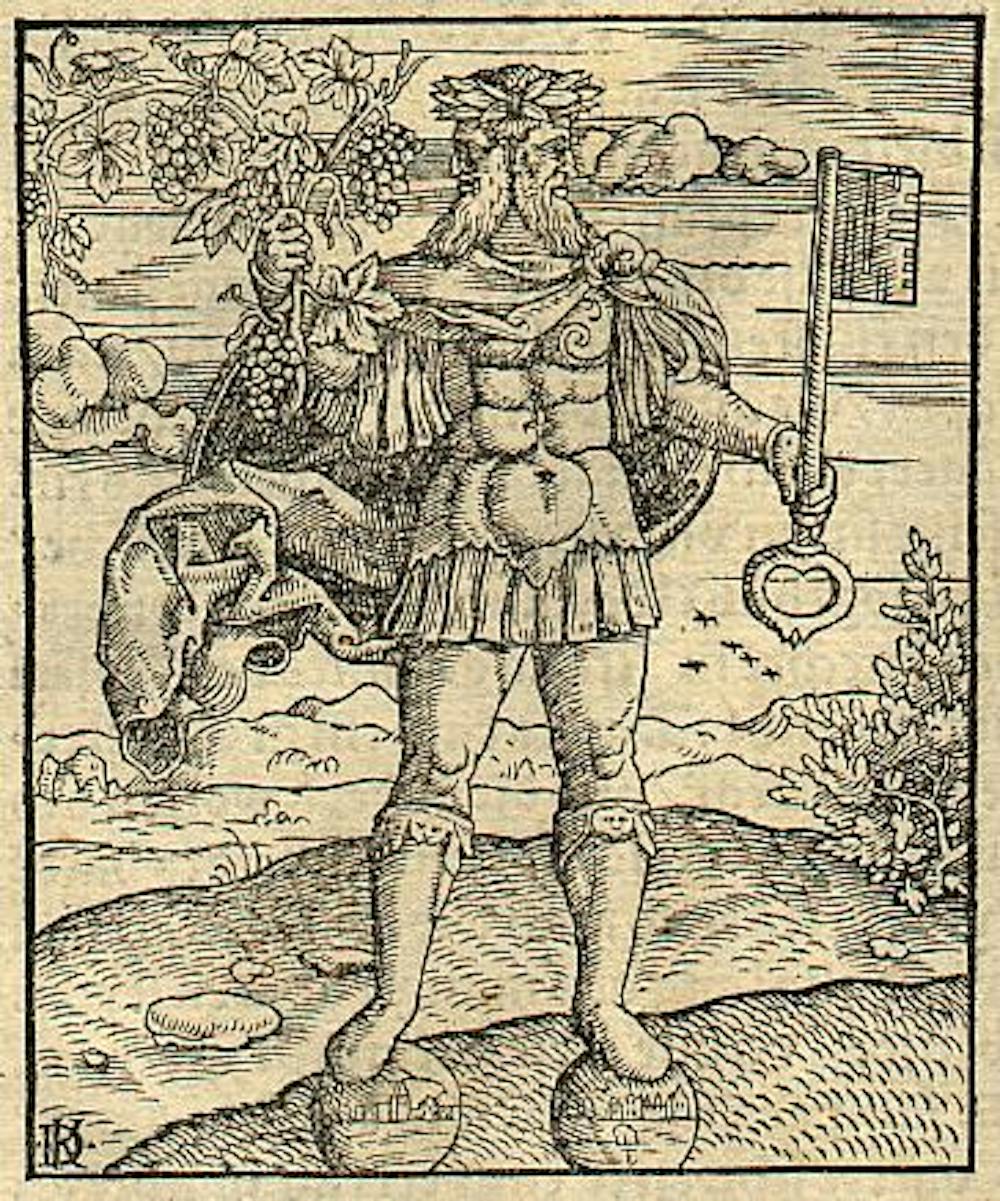
The cult statue of Janus depicted the god bearded with two heads. This meant that he could see forwards and backwards and inside and outside simultaneously without turning around. Janus held a staff in his right hand, in order to guide travellers along the correct route, and a key in his left to open gates.
War and Peace
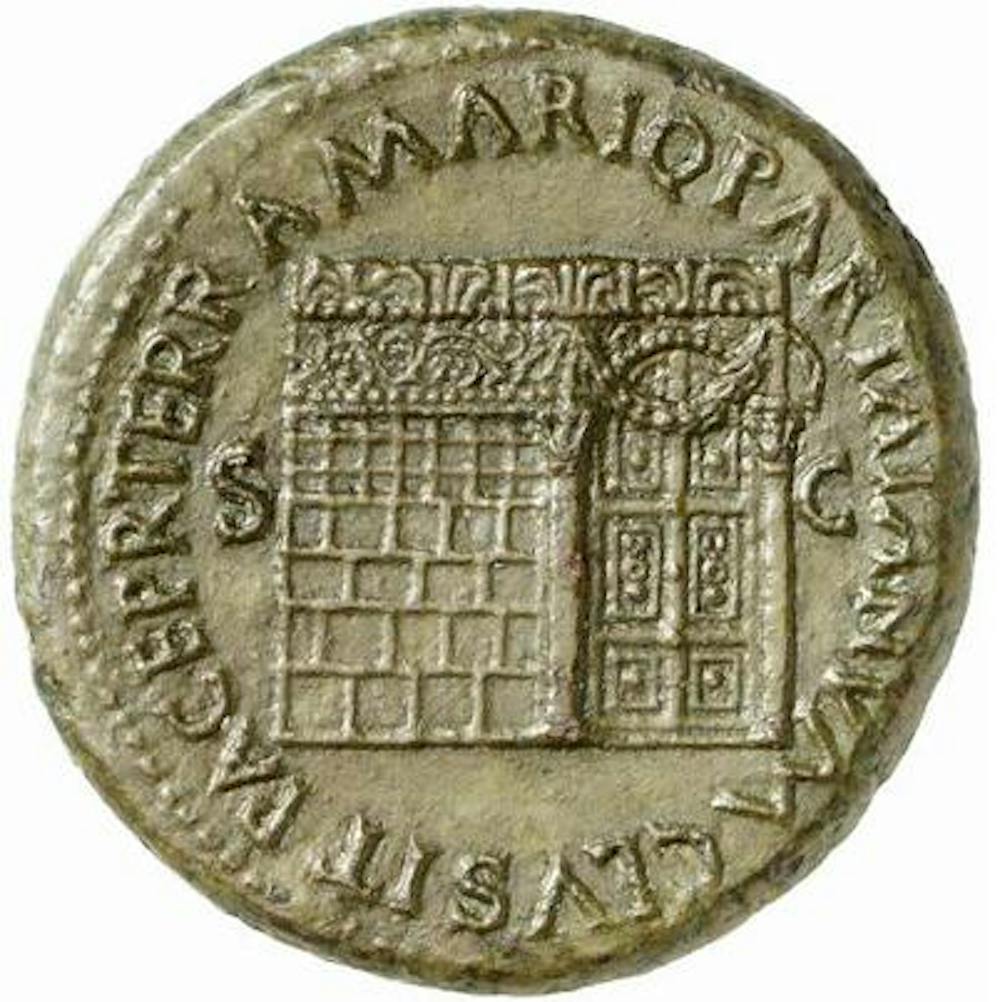
Shrine of Janus, as depicted on a coin of the emperor Nero. Wikimedia Commons
Janus is famously associated with the transition between peace and war. Numa, the legendary second king of Rome, who was famed for his religious piety, is said to have founded a shrine to Janus Geminus (“two-fold”) in the Roman Forum, close to the Senate House. It was located in the place where Janus had bubbled up a spring of hot boiling water in order to thwart an attack on Rome by the Sabines.
The shrine was an enclosure formed by two arched gates at each end, joined together by walls to form a passageway. A bronze statue of Janus stood in the middle, with one head facing towards each gate. According to the historian Livy, Numa intended the shrine:
as an index of peace and war, that when open it might signify that the nation was in arms, when closed that all the peoples round about were pacified.
The gates of Janus are said to have stayed closed for 43 years under Numa, but rarely remained so thereafter, although the first emperor Augustus boasted that he closed the shrine three times. Nero later celebrated his conclusion of peace with Parthia by minting coins showing the gates of Janus firmly shut.
Happy New Year
The God Janus by Sebastian Münster, 1550. Wikimedia Commons
Romans believed that the month of January was added to the calendar by Numa. The association between Janus and the calendar was cemented by the construction of 12 altars, one for each month of the year, in Janus’s temple in the Forum Holitorium (the vegetable market). The poet Martial thus described Janus as “the progenitor and father of the years”.
From 153 BC onwards, the consuls (the chief magistrates of the Republic) took office on the first day of January (which the Romans called the Kalends). The new consuls offered prayers to Janus, and priests dedicated spelt mixed with salt and a traditional barley cake, known as the ianual, to the god. Romans distributed New Year’s gifts of dates, figs, and honey to their friends, in the hope that the year ahead would turn out to be sweet, as well as coins – a sign of hoped-for prosperity.
Janus assumed a key role in all Roman public sacrifices, receiving incense and wine first before other deities. This was because, as the doorkeeper of the heavens, Janus was the route through which one reached the other gods, even Jupiter himself. The text On Agriculture, written by Cato the Elder, describes how offerings would be made to Janus, Jupiter, and Juno as part of the pre-harvest sacrifice to ensure a good crop.
So if you’re feeling caught between two worlds this January 1, why not head outside and celebrate Roman-style? Pack up some sweets to share, grab your keys, and shut the door on 2017.
This Sunday, April 16, Christians will be celebrating Easter, the day on which the resurrection of Jesus is said to have taken place. The date of celebration changes from year to year.
The reason for this variation is that Easter always falls on the first Sunday after the first full moon following the spring equinox. So, in 2018, Easter will be celebrated on April 1, and on April 21 in 2019.
I am a religious studies scholar specializing in early Christianity, and my research shows that this dating of Easter goes back to the complicated origins of this holiday and how it has evolved over the centuries.
Easter is quite similar to other major holidays like Christmas and Halloween, which have evolved over the last 200 years or so. In all of these holidays, Christian and non-Christian (pagan) elements have continued to blend together.
Easter as a rite of spring
Most major holidays have some connection to the changing of seasons. This is especially obvious in the case of Christmas. The New Testament gives no information about what time of year Jesus was born. Many scholars believe, however, that the main reason Jesus’ birth came to be celebrated on December 25 is because that was the date of the winter solstice according to the Roman calendar.
Since the days following the winter solstice gradually become longer and less dark, it was ideal symbolism for the birth of “the light of the world” as stated in the New Testament’s Gospel of John.
Similar was the case with Easter, which falls in close proximity to another key point in the solar year: the vernal equinox (around March 20), when there are equal periods of light and darkness. For those in northern latitudes, the coming of spring is often met with excitement, as it means an end to the cold days of winter.
Spring also means the coming back to life of plants and trees that have been dormant for winter, as well as the birth of new life in the animal world. Given the symbolism of new life and rebirth, it was only natural to celebrate the resurrection of Jesus at this time of the year.
The naming of the celebration as “Easter” seems to go back to the name of a pre-Christian goddess in England, Eostre, who was celebrated at beginning of spring. The only reference to this goddess comes from the writings of the Venerable Bede, a British monk who lived in the late seventh and early eighth century. As religious studies scholar Bruce Forbessummarizes:
“Bede wrote that the month in which English Christians were celebrating the resurrection of Jesus had been called Eosturmonath in Old English, referring to a goddess named Eostre. And even though Christians had begun affirming the Christian meaning of the celebration, they continued to use the name of the goddess to designate the season.”
Bede was so influential for later Christians that the name stuck, and hence Easter remains the name by which the English, Germans and Americans refer to the festival of Jesus’ resurrection.
The connection with Jewish Passover
It is important to point out that while the name “Easter” is used in the English-speaking world, many more cultures refer to it by terms best translated as “Passover” (for instance, “Pascha” in Greek) – a reference, indeed, to the Jewish festival of Passover.
In the Hebrew Bible, Passover is a festival that commemorates the liberation of the Jewish people from slavery in Egypt, as narrated in the Book of Exodus. It was and continues to be the most important Jewish seasonal festival, celebrated on the first full moon after the vernal equinox.
At the time of Jesus, Passover had special significance, as the Jewish people were again under the dominance of foreign powers (namely, the Romans). Jewish pilgrims streamed into Jerusalem every year in the hope that God’s chosen people (as they believed themselves to be) would soon be liberated once more.
On one Passover, Jesus traveled to Jerusalem with his disciples to celebrate the festival. He entered Jerusalem in a triumphal procession and created a disturbance in the Jerusalem Temple. It seems that both of these actions attracted the attention of the Romans, and that as a result Jesus was executed around the year A.D. 30.
Some of Jesus’ followers, however, believed that they saw him alive after his death, experiences that gave birth to the Christian religion. As Jesus died during the Passover festival and his followers believed he was resurrected from the dead three days later, it was logical to commemorate these events in close proximity.
Some early Christians chose to celebrate the resurrection of Christ on the same date as the Jewish Passover, which fell around day 14 of the month of Nisan, in March or April. These Christians were known as Quartodecimans (the name means “Fourteeners”).
By choosing this date, they put the focus on when Jesus died and also emphasized continuity with the Judaism out of which Christianity emerged. Some others instead preferred to hold the festival on a Sunday, since that was when Jesus’ tomb was believed to have been found.
In A.D. 325, the Emperor Constantine, who favored Christianity, convened a meeting of Christian leaders to resolve important disputes at the Council of Nicaea. The most fateful of its decisions was about the status of Christ, whom the council recognized as “fully human and fully divine.” This council also resolved that Easter should be fixed on a Sunday, not on day 14 of Nisan. As a result, Easter is now celebrated on the first Sunday after the first full moon of the vernal equinox.
The Easter bunny and Easter eggs
In early America, the Easter festival was far more popular among Catholics than Protestants. For instance, the New England Puritans regarded both Easter and Christmas as too tainted by non-Christian influences to be appropriate to celebrate. Such festivals also tended to be opportunities for heavy drinking and merrymaking.
The fortunes of both holidays changed in the 19th century, when they became occasions to be spent with one’s family. This was done partly out of a desire to make the celebration of these holidays less rowdy.
But Easter and Christmas also became reshaped as domestic holidays because understandings of children were changing. Prior to the 17th century, children were rarely the center of attention. As historian Stephen Nissenbaumwrites,
“…children were lumped together with other members of the lower orders in general, especially servants and apprentices – who, not coincidentally, were generally young people themselves.”
From the 17th century onward, there was an increasing recognition of childhood as as time of life that should be joyous, not simply as preparatory for adulthood. This “discovery of childhood” and the doting upon children had profound effects on how Easter was celebrated.
Yet it was only in the 17th century that a German tradition of an “Easter hare” bringing eggs to good children came to be known. Hares and rabbits had a long association with spring seasonal rituals because of their amazing powers of fertility.
When German immigrants settled in Pennsylvania in the 18th and 19th centuries, they brought this tradition with them. The wild hare also became supplanted by the more docile and domestic rabbit, in another indication of how the focus moved toward children.
As Christians celebrate the festival this spring in commemoration of Jesus’ resurrection, the familiar sights of the Easter bunny and Easter eggs serve as a reminder of the holiday’s very ancient origins outside of the Christian tradition.
It's December 13, 2014 or, expressed another way, it's 12/13/14.
Numerically successive dates only occur twelve times each century. The next time we'll encounter one is just over 88 years from now, on January 2, 2103 (or 1/2/3).
The other dates like this we've seen so far this century include February 3, 2004; June 7, 2008; and November 12, 2013.
People whose birthdays fall on these unusual dates include gangster Pretty Boy Floyd (February 3, 1904), American football player Weeb Ewbank (May 6, 1907), actress and singer Betty Noyes (October 11, 1912), Brazilian nurse Ana Néri (December 13, 1814), and English historian Alan Bullock (December 13, 1914).
Notable deaths that happened on these dates include those of French painter Jean-Baptiste Greuze (March 4, 1805), Italian general Nicola Calipari (March 4, 2005), singer-songwriter Gene Pitney (April 5, 2006), actor-director-screenwriter Curtis Harrington (May 6, 2007), sportscaster Jim McKay (June 7, 2008), Chinese martial artist Huo Yuanjia (August 9, 1910), Alaska Senator Ted Stevens (August 9, 2010), Oscar-winning actor Cliff Robertson (September 10, 2011), French singer Frank Alamo (October 11, 2012), Polish astronomer Konrad Rudnicki and English composer John Tavener (both November 12, 2013), and Charles-Joseph, 7th Prince of Ligne (December 13, 1814).
On July 8, 1709, Tsar Peter I of Russia defeated King Charles XII of Sweden at the Battle of Poltava. Ninety-nine years earlier, on August 9, 1610, the first Anglo-Powhatan War began in colonial Virginia, while on the same date in 1810, the Emperor Napoleon annexed Westphalia. On October 11, 1912, The Greek army liberated the city of Kozani during the first Balkan War.
Meanwhile, today is celebrated as Acadian Remembrance Day, Republic Day in Malta, and the Christian feast of St. Lucy (commemorated in Scandinavia and Italy), and the national independence day of St. Lucia in the Caribbean.
"One of the smarter blogs is the libertarian-leaning collection of Charlottesville posts put up by Rick Sincere..." -- Bob Gibson, The Daily Progress, May 8, 2005
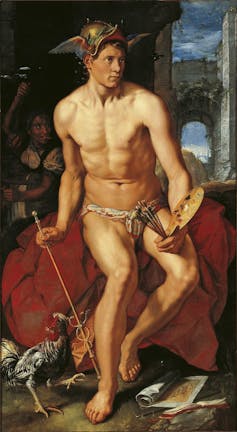
 The Latin names for the days of the week, and the Roman gods for which they were named, still live on in all the European Romance languages, like French, Spanish and Italian. Think of French lundi, mardi, mercredi, jeudi and vendredi, for example, and you will find the Latin Luna, Mars, Mercurius, Iovis and Venus hidden behind them.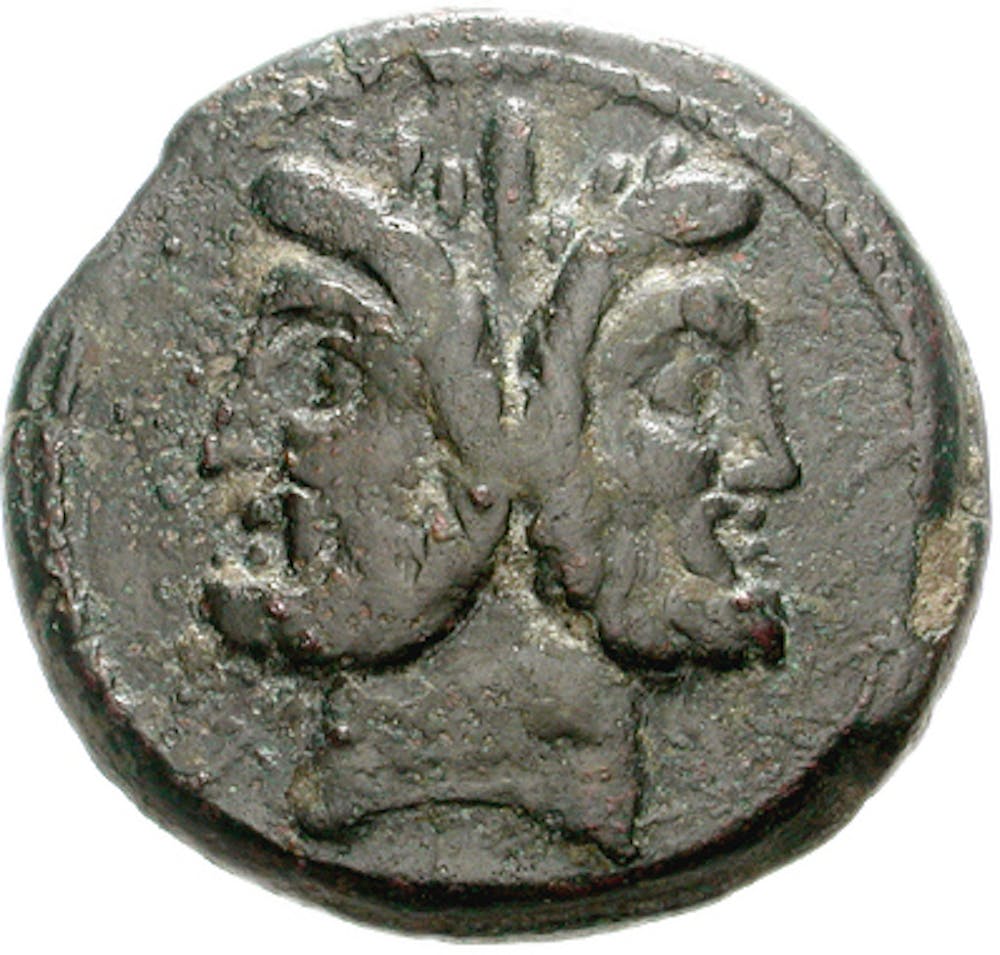
 Tomorrow: Explainer:


