Showing posts with label holidays. Show all posts

Saturday, April 20, 2019

Guest post: Easter – a Christian festival that feels pagan


Jane Stevenson, University of Oxford

There’s a lot of confusion about Easter – not least because this most important of all Christian festivals moves around so much from year to year, decided by a complex set of calculations based on the vernal equinox and the phase of the moon. Easter symbols – eggs, bunnies, lambs and the rest – give the festivities an air of pre-Christian paganism.

happy easter chocolate candy crossSo where do the origins of Easter and the rituals observed by so many – whether Christian or not – really lie?

The first mention of Eostre is in the eighth century, in The Venerable Bede’s frustratingly cryptic account of the native Anglo-Saxon calendar in De Temporum Ratione (On the Reckoning of Time). The Anglo-Saxon equivalent of April called Eostremonath is named for the goddess Eostre – but we only know about Eostre via Bede’s writings and the only thing he tells us about her is that “feasts were celebrated” in her honour. So, if modern Easter is frequently a festival of overeating, this has tradition on its side.

But Eostre was evidently significant enough for the Anglo-Saxons to later transfer her name to the Christian festival of the resurrection rather than adopting the Latin name “Pascha”.

Similarly, Easter is “Ostern” in German – which implies she must have been known outside England. Confusingly, the great 19th-century folklorist and philologist, Jacob Grimm, invented a German goddess called Ostara – “the divinity of the radiant dawn, upspringing light, a spectacle that brings joy and blessing” – on purely etymological grounds: the name is derived from a proto-Indo-European root meaning “to shine”. But Grimm didn’t present a shred of supporting evidence that such a deity had ever been worshipped in Germany, leaving us with just Bede to go on.

Easter roughly coincides with the spring equinox – so there is a good deal of lore attached to the season which is not actually Christian. Easter is preceded by Lent – a period of fasting in memory of Christ’s 40 days in the wilderness. But it is also a season when, in pre-modern Europe, food would have been running low. Winter supplies would have been coming to an end and there was not enough sun and spring growth yet for hens to start laying and cows to give milk. In a sense, therefore, Easter is a natural feast – to celebrate passing out of that hardship.

Easter and Passover


The association of lamb with Easter is something we have borrowed from Jewish tradition and Passover – which was also the festival that Jesus and his disciples celebrated with their Last Supper.

At least as far back as the 15th century, Easter was also marked in England by eating “tansies” – a kind of custardy pudding made with the bitter (and poisonous) herb tansy and sometimes with other bitter greens such as nettles. The 17th-century antiquarian John Aubrey adds a further detail:

Our tansies at Easter have reference to the bitter Herbs [eaten at Passover by Jews] though at the same time ’twas always the Fashion for a man to have a gammon of Bacon, to shew himself to be no Jew.


Eggs are an ancient and natural symbol of returning life in many parts of Europe, but the Easter egg may also derive from Passover – which includes, among various symbolic foods, a roasted egg: the beitzah. Until at least the mid-20th century, more people marked Easter with decorated, hard-boiled hen’s eggs than chocolate ones.

The earliest documented mention in England of decorated eggs comes in 1290, from the household accounts of King Edward I for 1290, which records the purchase and decoration of 450 eggs , some gilded, some dyed. These eggs were presented to the royal household at Easter, and cost 18 pence.

In many parts of Britain the custom was for people, children especially, to play with their “pace-eggs” by rolling them down a chosen slope before eating them. In Iona and Peter Opie’s 1959 study The Lore and Language of Schoolchildren, a child reports that: “In Cumberland we take more notice of the pace eggs than chocolate eggs.” Easter eggs as also rolled on the lawn of the US White House, a custom going back to 1878.

Bunny business


The association of hares with Easter also considerably predates foil-wrapped chocolate bunnies. As early as 1682, Georg Franck von Franckenau’s essay De ovis paschalibus (About Easter Eggs) speaks of a German tradition of an Easter hare bringing coloured Easter eggs for the children.

In southern Germany, children used to be told that a hare laid the pace-eggs and they would make a nest for the creature to lay them in. The Easter hare was also known in parts of the British Isles and was particularly associated with having to hunt out eggs hidden in the garden, where the hare was supposed to have put them.

A curious entry in the Calendar of State Papers for April 2 1620, suggests that hares were also often eaten at Easter:

Thos. Fulnety solicits the permission of Lord Zouch, Lord Warden of the Cinque Ports, to kill a hare on Good Friday, as huntsmen say that those who have not a hare against Easter must eat a red herring.

Hares were also ritually hunted at Easter in England – there is a note in the Chamberlains’ Accounts for the year 1574 that twelvepence was “given to the hare-finders at Whetston Court”.

An Easter hare hunt survived as part of Leicester’s ritual year as late as the 18th century, though by then a dead cat was substituted for an actual hare. Jacob Grimm, looking at this evidence for an association of ritual activity involving hares with the Easter season, conjectured that the hare was sacred to the goddess Ostara, piling one conjecture on top of another.

So the truth is that Easter rituals as we know them today represent an untidy collection of customs connected with celebrating spring growth and the end of austerity – a time for new clothes and rich food. Any connection with pre-Christian paganism is entirely coincidental.The Conversation

Jane Stevenson, Senior Research Fellow at Campion Hall, University of Oxford

This article is republished from The Conversation under a Creative Commons license. Read the original article.
Wednesday, December 12, 2018

Guest Post: An archaeological dig in Israel suggests how feasting became an important ritual


Natalie Munro, University of Connecticut

This holiday season millions of families will come together to celebrate their respective festivals and engage in myriad rituals. These may include exchanging gifts, singing songs, giving thanks, and most importantly, preparing and consuming the holiday feast.


Archaeological evidence shows that such communally shared meals have long been vital components of human rituals. My colleague Leore Grosman and I discovered the earliest evidence of a ritual feast at a 12,000-year-old archaeological site in northern Israel and learned how feasts came to be integral components of modern-day ritual practice.


First, what are rituals?


Rituals involve meaningful, often repeated actions. In modern-day practices they are expressed through rites such as the hooding of a doctoral student, birthdays, weddings or even sipping wine at Holy Communion or lighting Hanukkah candles.


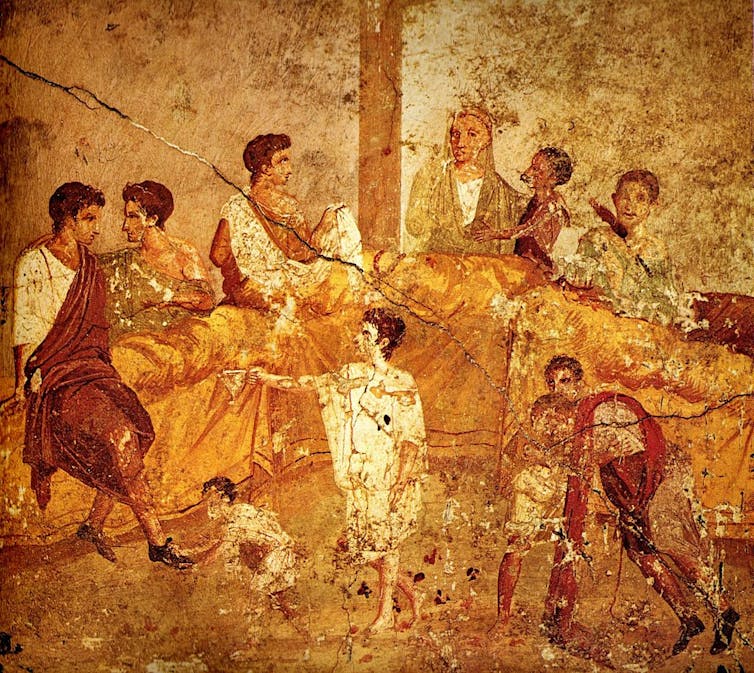
Pompeii family feast painting Naples

Pompeii family feast painting, Naples.
Unknown painter before 79 AD, via Wikimedia Commons


Ritual practice may have emerged along with other early modern human behaviors more than 100,000 years ago. However, proving this with material evidence is a challenge. For example, researchers have found that both Neanderthals and early modern humans buried their dead, but scholars weren’t certain whether this was for spiritual or symbolic reasons and not for something more mundane like maintaining site hygiene. Likewise, the discovery of 100,000-year-old symbolic artifacts like pierced shell ornaments and decorated chunks of red ochre in caves in South Africa, was not sufficient to prove that they were part of any ritual activities.

It was only when archaeologists found these artifacts, placed in graves going back 40,000-20,000 years, that it was confirmed they were part of ritual practice.

The first feasts


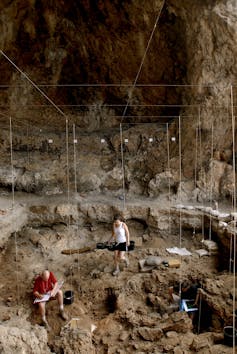
We had a similar experience during our research. When Leore Grosman and I first embarked on the excavations at Hilazon Tachtit in the late 1990s, we were only hoping to document the activities of the last hunter-gatherers in Israel, at what appeared to be a small campsite. It was only over several seasons of excavation that it slowly became clear to us that this was not a site where people had lived. Rather it was a site for rituals.


Hilazon Tachtit cave interior. Naftali Hilger

Hilazon Tachtit cave interior.
Naftali Hilger, CC BY-NC-ND


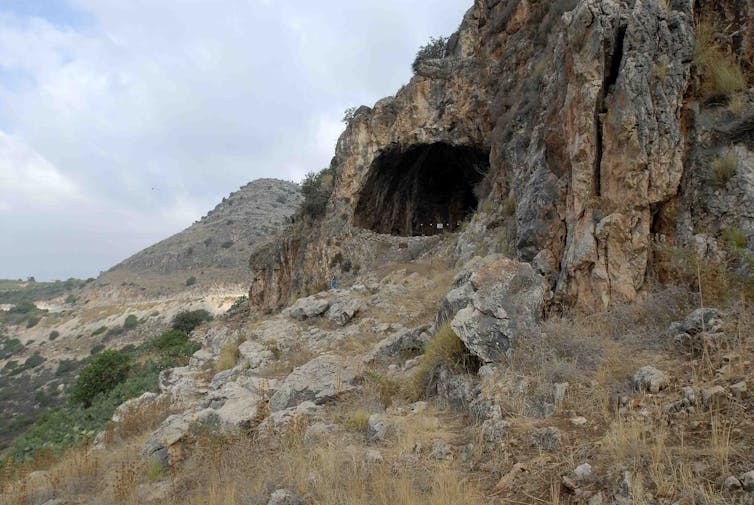
No houses, fireplaces or cooking areas were recovered. Instead the cave yielded the skeletal remains of at least 28 individuals interred in three pits and two small structures.

One of these structures contained the complete skeleton of an older woman, who we interpreted as a shaman based on her special treatment at death. Her grave stood apart due to its fine construction – the walls were plastered with clay and inset with flat stone slabs. Even more remarkable was the eclectic array of animal body parts buried alongside of her. The pelvis of a leopard, the wing tip of an eagle, the skulls of two martens and many other unusual body parts surrounded her skeleton.

The butchered remnants of more than 90 tortoises buried in the grave and the leftovers of at least three wild cattle deposited in a second adjacent depression excavated in the cave floor represent the remains of a funeral feast.


Hilazon Tachtit cave. Naftali Hilger

Hilazon Tachtit cave.
Naftali Hilger, CC BY-NC-ND


The outstanding preservation of the grave enabled us to detect multiple phases of a ritual performance that included the consumption of the feast, the burial of the woman, and the filling of the grave in several stages, including the intentional deposition of garbage from the feast.

Feasting at the beginning of agriculture


Archaeologists have found other sites that show evidence of ritual feasting. Many of these date to the time when humans were beginning to farm.


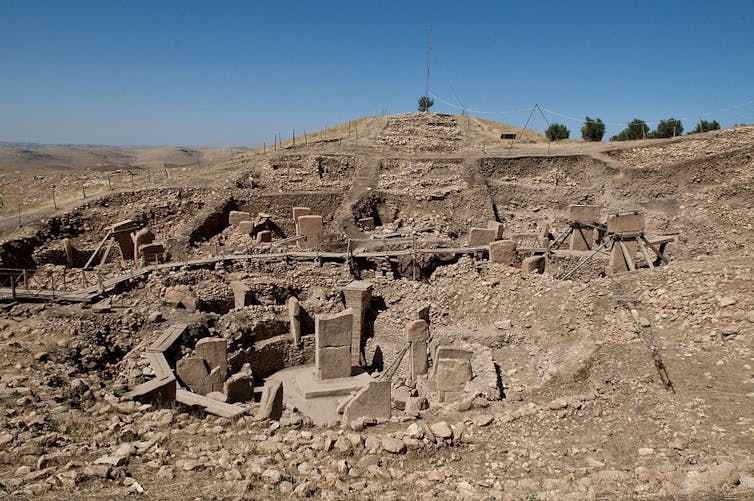
Site of Göbekli Tepe. Teomancimit

Site of Göbekli Tepe.
Teomancimit (Own work) , via Wikimedia Commons, CC BY-SA


One of the most striking is the site of Göbekli Tepe in southeastern Turkey, dating slightly later than Hilazon Tachtit. It includes multiple large structures adorned with benches and giant stone slab carved with exquisite animal depictions in relief dating to 11-12,000 years ago. Perhaps, these were very early communal buildings. The archaeologists who excavated Göbekli Tepe argue that massive quantities of animal bones associated with the structures represent the remains of feasts.

Twelve thousand years ago humans were still hunter-gatherers, subsisting entirely on wild foods. Nevertheless, these people differed from those who went before – they were sitting on the brink of the transition to agriculture, one of the most significant economic, social and ideological transformations in human history.

Sickle blades and grinding stones used to harvest and process cereal grains are found at Hilazon Tachtit and other contemporary archaeological sites. These findings indicate that these ritual feasts started around the same time that people adopted agriculture. When people began to rely more heavily on wild cereals like wheat and barley, they became increasingly tethered to landscapes that were ever more crowded and began to settle into more permanent communities. In other words, feasting became a part of their life, once they moved away from nomadic life.

Rituals that bind


These feasts had an important role to play. Adapting to village life after hundreds of millennia on the move was no simple act. Research on modern hunter-gatherer societies shows that closer contact between neighbors dramatically increased social tensions. New solutions to avoid and repair conflict were critical.

The simultaneous appearance of feasting, communal structures and specialized ritual sites suggest that humans were seeking to solve this problem by engaging the community in ritual practice.

One of the central functions of ritual in these communities was to provide a kind of social glue that bound community members by promoting social cohesion and solidarity. Feasts generate loyalty and commitment to the community’s success. Sharing food is intimate and it builds trust.

Communal rituals would have provided a shared sense of identity at a time when social circles were increasing in scale and permanence. They reinforced new ideologies that emerged out of a dramatic reorganization of economic and social life.

Role of feasts today

Feasting plays the same essential role today. Like the earliest feasts, our holiday celebrations are replete with actions that are repeated year after year.

The holiday feast today builds family traditions. By cooking and sharing food together, telling stories of past holidays and exchanging intergenerational wisdom, holiday rituals bond extended families and give them a shared identity.The Conversation

Natalie Munro, Professor, University of Connecticut

This article is republished from The Conversation under a Creative Commons license. Read the original article.


Monday, December 10, 2018

Guest Post: How to survive annoying relatives this holiday season

Jamie Gruman, University of Guelph

Social allergies are a lot like seasonal allergies. They’re annoying, exhausting and hard to avoid. They’re also especially common around the holidays. That’s because the holidays put you at a high risk of exposure. Swap the dander and flourishing ragweed for your not-so-favourite acquaintances and intolerable relatives and there you have it — a full-blown case of social allergies.

Merry Christmas Polish Poland ornamentsSocial allergens are the revolting, repetitive habits of our friends and family members that rub us the wrong way and drive us crazy.

Maybe it’s the way your aunt constantly complains about frivolous things. Or perhaps it’s how your father-in-law smacks his lips and wipes his mouth with the back of his hand when he eats. Or could it be the way your cousin can’t have a conversation without droning on about himself?

All of us have allergies to people whose seemingly inconsequential behaviour repulses us. The emotional and physical symptoms these social allergens produce arise within minutes of exposure, making us want to immediately evacuate the toxic environment.

The holiday season social allergy


Like seasonal allergies, social allergies are sometimes inescapable. Triggers include the many obligatory get-togethers that come with the holidays. For many, the season, beginning with American Thanksgiving, is supposed to be a time to recharge our batteries: recover from the unreasonable deadlines, numerous pressures and other demands we face on a daily basis. Social allergies can interfere with that plan.

During the holiday season, we are faced with numerous social commitments and in some cases this means spending time with people who grate on our nerves and hinder us from refuelling. Rather than having a few days off to decompress, we spend our time away from work filled with dread, anxiety and exasperation because we have to endure people we are allergic to.

Although we can get out of some noxious social situations, there are others that are almost mandatory.

So, what are the social antihistamines that will help us cope?

Limit exposure


One effective way to prevent a social allergic reaction is to limit your exposure. In the same way a person allergic to cats should avoid snuggling up in bed with a pride of domestic felines, a person with social allergies should avoid staying in an environment full of social allergens.

By minimizing the amount of time you are in contact with the allergens, you attack the problem directly, fostering resilience and recovery by reducing your exposure to a hazardous situation.

This means leave early or come late. Have a strategy to restrict the amount of time you spend surrounded by your social allergens. While you are at the gathering, be strategic about the social situations you place yourself in. When finding a spot at the dinner table, don’t sit next to Cousin So-and-so or Aunt M and definitely don’t sit in full view of your lip-smacking father-in-law. Find a place setting that allows you to have a break from your social allergens.


Validate


We have the power to exert some control over many social allergens.

For example, when speaking with a self-centred toxic relative, she’s looking for a certain type of reaction from you. In many cases, the wanted reaction is simple: it’s support and validation.

While you may want to shut off the stream coming out of auntie’s mouth, this will not actually help calm your allergic reaction. But if you spend some time to first provide the validation she seeks, you could potentially satisfy her craving and extinguish the behaviour you find repellent.

Give feedback


If you can no longer tolerate seeing scraps of food on the back of your father-in-law’s hand, consider speaking to him about his eating habits. But remember that conversations not only convey information, they also have implications for relationships and identities.

Make it clear that you want to help him avoid embarrassing himself and that you’re speaking to him about this because you love him. And see if you can bring up the topic indirectly so that you don’t come across as intrusive. Giving feedback to people often fails to change their behaviour if we’re not sensitive about how it might be received.

Mindfulness


If giving feedback to your father-in-law doesn’t seem like the best idea, you can instead try practising mindfulness. Mindfulness is a non-judgmental state of present moment awareness.

When social allergens start bothering you, pay attention to your own internal irritation without evaluating it. Don’t cling to it and don’t push it away. Just follow it. Watching the ebbs and flows of your experience has a way of putting distance between you and your reactions through a process called reperceiving.

Mindfulness won’t necessarily prevent the allergen from bothering you, but it will help you control how much it annoys you and how quickly you recover from its effects.

Social allergies can burn you out and change a relaxing holiday into a stressful test of endurance. To get a boost during holiday time, you need to make sure that you spend your time with people who recharge and revitalize you.

Also, mitigate your averse reaction to people’s annoying habits. A few simple steps can transform your holiday into one that lets you enjoy a happy, healthy break, instead of having to contend with social allergies.

The author thanks Deirdre Healey’s assistance with this article.The Conversation

Jamie Gruman, Professor of Organizational Behaviour, University of Guelph

This article is republished from The Conversation under a Creative Commons license. Read the original article.


Wednesday, December 05, 2018

Guest Post: How Hanukkah came to America


Dianne Ashton, Rowan University

Hanukkah may be the best known Jewish holiday in the United States. But despite its popularity in the U.S., Hanukkah is ranked one of Judaism’s minor festivals, and nowhere else does it garner such attention. The holiday is mostly a domestic celebration, although special holiday prayers also expand synagogue worship.

So how did Hanukkah attain its special place in America?

Hanukkah’s back story


The word “Hanukkah” means dedication. It commemorates the rededicating of the ancient Temple in Jerusalem in 165 B.C. when Jews – led by a band of brothers called the Maccabees – tossed out statues of Hellenic gods that had been placed there by King Antiochus IV when he conquered Judea. Antiochus aimed to plant Hellenic culture throughout his kingdom, and that included worshipping its gods.

Legend has it that during the dedication, as people prepared to light the Temple’s large oil lamps to signify the presence of God, only a tiny bit of holy oil could be found. Yet, that little bit of oil remained alight for eight days until more could be prepared. Thus, each Hanukkah evening, for eight nights, Jews light a candle, adding an additional one as the holiday progresses throughout the festival.

Hanukkah’s American story


Dianne Ashton Hanukkah in America Chanukah historyToday, America is home to almost 7 million Jews. But Jews did not always find it easy to be Jewish in America. Until the late 19th century, America’s Jewish population was very small and grew to only as many as 250,000 in 1880. The basic goods of Jewish religious life – such as kosher meat and candles, Torah scrolls, and Jewish calendars – were often hard to find.

In those early days, major Jewish religious events took special planning and effort, and minor festivals like Hanukkah often slipped by unnoticed.

My own study of American Jewish history has recently focused on Hanukkah’s development.

It began with a simple holiday hymn written in 1840 by Penina Moise, a Jewish Sunday school teacher in Charleston, South Carolina. Her evangelical Christian neighbors worked hard to bring the local Jews into the Christian fold. They urged Jews to agree that only by becoming Christian could they attain God’s love and ultimately reach Heaven.

Moise, a famed poet, saw the holiday celebrating dedication to Judaism as an occasion to inspire Jewish dedication despite Christian challenges. Her congregation, Beth Elohim, publicized the hymn by including it in their hymnbook.

This English language hymn expressed a feeling common to many American Jews living as a tiny minority. “Great Arbiter of human fate whose glory ne'er decays,” Moise began the hymn, “To Thee alone we dedicate the song and soul of praise.”

It became a favorite among American Jews and could be heard in congregations around the country for another century.

Shortly after the Civil War, Cincinnati Rabbi Max Lilienthal learned about special Christmas events for children held in some local churches. To adapt them for children in his own congregation, he created a Hanukkah assembly where the holiday’s story was told, blessings and hymns were sung, candles were lighted and sweets were distributed to the children.

His friend, Rabbi Isaac M. Wise, created a similar event for his own congregation. Wise and Lilienthal edited national Jewish magazines where they publicized these innovative Hanukkah assemblies, encouraging other congregations to establish their own.

Lilienthal and Wise also aimed to reform Judaism, streamlining it and emphasizing the rabbi’s role as teacher. Because they felt their changes would help Judaism survive in the modern age, they called themselves “Modern Maccabees.” Through their efforts, special Hanukkah events for children became standard in American synagogues.

20th-century expansion


By 1900, industrial America produced the abundance of goods exchanged each Dec. 25. Christmas’ domestic celebrations and gifts to children provided a shared religious experience to American Christians otherwise separated by denominational divisions. As a home celebration, it sidestepped the theological and institutional loyalties voiced in churches.

For the 2.3 million Jewish immigrants who entered the U.S. between 1881 and 1924, providing their children with gifts in December proved they were becoming American and obtaining a better life.

But by giving those gifts at Hanukkah, instead of adopting Christmas, they also expressed their own ideals of American religious freedom, as well as their own dedication to Judaism.

After World War II, many Jews relocated from urban centers. Suburban Jewish children often comprised small minorities in public schools and found themselves coerced to participate in Christmas assemblies. Teachers, administrators and peers often pressured them to sing Christian hymns and assert statements of Christian faith.

From the 1950s through the 1980s, as Jewish parents argued for their children’s right to freedom from religious coercion, they also embellished Hanukkah. Suburban synagogues expanded their Hanukkah programming.

As I detail in my book, Jewish families embellished domestic Hanukkah celebrations with decorations, nightly gifts and holiday parties to enhance Hanukkah’s impact. In suburbia, Hanukkah’s theme of dedication to Judaism shone with special meaning. Rabbinical associations, national Jewish clubs and advertisers of Hanukkah goods carried the ideas for expanded Hanukkah festivities nationwide.

In the 21st century, Hanukkah accomplishes many tasks. Amid Christmas, it reminds Jews of Jewish dedication. Its domestic celebration enhances Jewish family life. In its similarity to Christmas domestic gift-giving, Hanukkah makes Judaism attractive to children and – according to my college students – relatable to Jews’ Christian neighbors. In many interfaith families, this shared festivity furthers domestic tranquility.

In America, this minor festival has attained major significance.The Conversation

Dianne Ashton, Professor of Religion, Rowan University

This article is republished from The Conversation under a Creative Commons license. Read the original article.

Friday, November 23, 2018

Guest Post: Why the Pilgrims were actually able to survive


Peter C. Mancall, University of Southern California – Dornsife College of Letters, Arts and Sciences

Sometime in the autumn of 1621, a group of English Pilgrims who had crossed the Atlantic Ocean and created a colony called New Plymouth celebrated their first harvest.

They hosted a group of about 90 Wampanoags, their Algonquian-speaking neighbors. Together, migrants and Natives feasted for three days on corn, venison and fowl.

In their bountiful yield, the Pilgrims likely saw a divine hand at work.

As Gov. William Bradford wrote in 1623, “Instead of famine now God gave them plenty, and the face of things was changed, to the rejoicing of the hearts of many, for which they blessed God.”

But my recent research on the ways Europeans understood the Western Hemisphere shows that – despite the Pilgrims’ version of events – their survival largely hinged on two unrelated developments: an epidemic that swept through the region and a repository of advice from earlier explorers.

A ‘desolate wilderness’ or ‘Paradise of all parts’?


Bradford’s “Of Plymouth Plantation,” which he began to write in 1630 and finished two decades later, traces the history of the Pilgrims from their persecution in England to their new home along the shores of modern Boston Harbor.


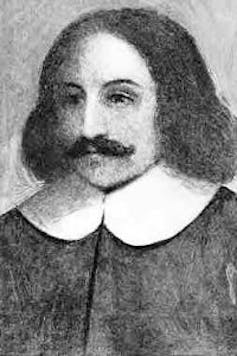
William Bradford Plymouth Plantation

William Bradford’s writings depicted a harrowing, desolate environment.


Bradford and other Pilgrims believed in predestination. Every event in their lives marked a stage in the unfolding of a divine plan, which often echoed the experiences of the ancient Israelites.

Throughout his account, Bradford probed Scripture for signs. He wrote that the Puritans arrived in “a hideous and desolate wilderness, full of wild beasts and wild men.” They were surrounded by forests “full of woods and thickets,” and they lacked the kind of view Moses had on Mount Pisgah, after successfully leading the Israelites to Canaan.

Drawing on chapter 26 of the Book of Deuteronomy, Bradford declared that the English “were ready to perish in this wilderness,” but God had heard their cries and helped them. Bradford paraphrased from Psalm 107 when he wrote that the settlers should “praise the Lord” who had “delivered them from the hand of the oppressor.”

If you were reading Bradford’s version of events, you might think that the survival of the Pilgrims’ settlements was often in danger. But the situation on the ground wasn’t as dire as Bradford claimed.


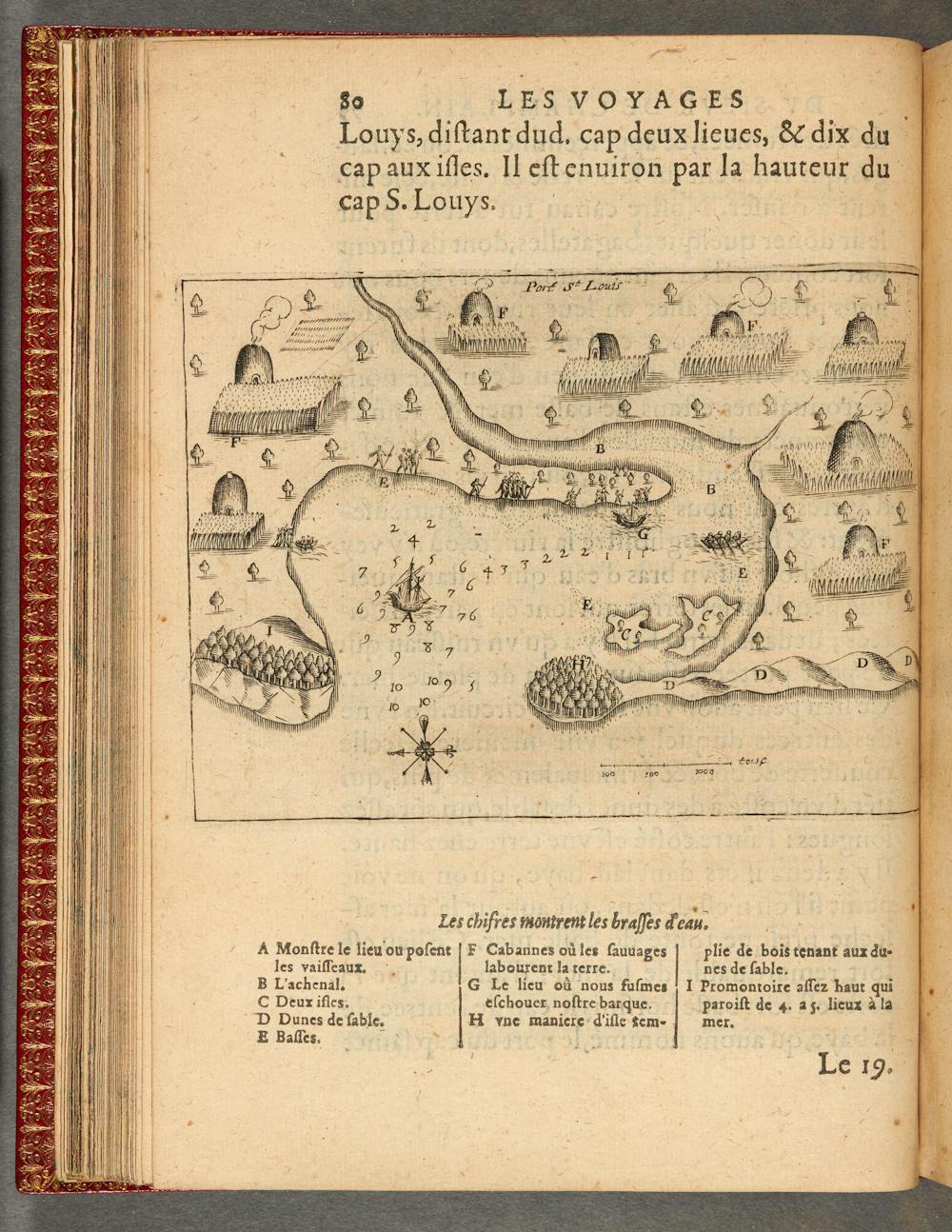
The French explorer Samuel de Champlain depicted Plymouth as a region that was eminently inhabitable.
Source., Author provided


Earlier European visitors had described pleasant shorelines and prosperous indigenous communities. In 1605, the French explorer Samuel de Champlain sailed past the site the Pilgrims would later colonize and noted that there were “a great many cabins and gardens.” He even provided a drawing of the region, which depicted small Native towns surrounded by fields.

About a decade later Captain John Smith, who coined the term “New England,” wrote that the Massachusetts, a nearby indigenous group, inhabited what he described as “the Paradise of all those parts.”

‘A wonderful plague’


Champlain and Smith understood that any Europeans who wanted to establish communities in this region would need either to compete with Natives or find ways to extract resources with their support.

But after Champlain and Smith visited, a terrible illness spread through the region. Modern scholars have argued that indigenous communities were devastated by leptospirosis, a disease caused by Old World bacteria that had likely reached New England through the feces of rats that arrived on European ships.

The absence of accurate statistics makes it impossible to know the ultimate toll, but perhaps up to 90 percent of the regional population perished between 1617 to 1619.

To the English, divine intervention had paved the way.

“By God’s visitation, reigned a wonderful plague,” King James’ patent for the region noted in 1620, “that had led to the utter Destruction, Devastacion, and Depopulation of that whole territory.”

The epidemic benefited the Pilgrims, who arrived soon thereafter: The best land had fewer residents and there was less competition for local resources, while the Natives who had survived proved eager trading partners.

The wisdom of those who came before


Just as important, the Pilgrims understood what to do with the land.

By the time that these English planned their communities, knowledge of the Atlantic coast of North America was widely available.

Those hoping to create new settlements had read accounts of earlier European migrants who had established European-style villages near the water, notably along the shores of Chesapeake Bay, where the English had founded Jamestown in 1607.

These first English migrants to Jamestown endured terrible disease and arrived during a period of drought and colder-than-normal winters. The migrants to Roanoke on the outer banks of Carolina, where the English had gone in the 1580s, disappeared. And a brief effort to settle the coast of Maine in 1607 and 1608 failed because of an unusually bitter winter.

Many of these migrants died or gave up. But none disappeared without record, and their stories circulated in books printed in London. Every English effort before 1620 had produced accounts useful to would-be colonizers.

The most famous account, by the English mathematician Thomas Harriot, enumerated the commodities that the English could extract from America’s fields and forests in a report he first published in 1588.

The artist John White, who was on the same mission to modern Carolina, painted a watercolor depicting the wide assortment of marine life that could be harvested, another of large fish on a grill, and a third showing the fertility of fields at the town of Secotan. By the mid-1610s, actual commodities had started to arrive in England too, providing support for those who had claimed that North American colonies could be profitable. The most important of these imports was tobacco, which many Europeans considered a wonder drug capable of curing a wide range of human ailments.

These reports (and imports) encouraged many English promoters to lay plans for colonization as a way to increase their wealth. But those who thought about going to New England, especially the Pilgrims who were kindred souls of Bradford, believed that there were higher rewards to be reaped.

Bradford and the other Puritans who arrived in Massachusetts often wrote about their experience through the lens of suffering and salvation.

But the Pilgrims were better equipped to survive than they let on.The Conversation

Peter C. Mancall, Andrew W. Mellon Professor of the Humanities, University of Southern California – Dornsife College of Letters, Arts and Sciences

This article is republished from The Conversation under a Creative Commons license. Read the original article.

Thursday, November 22, 2018

Guest Post: Sweet potatoes, Donald Trump – and the Special Relationship


Rebecca Earle, University of Warwick

Two days after the US presidential election, The Independent reported that “Donald Trump has spoken with nine world leaders but has yet to call Theresa May, throwing her claim of a ‘special relationship’ into tatters.”

Eventually, the phone call was made. “Concerns over ‘special relationship’ allayed as Trump calls May,” read the headline in The Guardian a few days later. Time magazine reassured US readers that “Donald Trump and Britain’s Theresa May Affirm ‘Special Relationship’.”

It seems especially apt, as people in the US gather to celebrate Thanksgiving, to ponder the nature of the relationship between the two countries. After all, Thanksgiving forms part of an origin myth about how English settlers began the slow process of transforming themselves into Americans. The holiday commemorates the 1621 celebrations held at the Puritan settlement in Plymouth, which included, apparently, a large meal, some parading and a short religious service.

Scholars (and cartoonists) have deconstructed the holiday comprehensively, noting the invented nature of many of its core elements, its sporadic celebration before the 20th century, its erasure of European violence towards Native Americans and many other aspects. Overall, it’s clear that this holiday, like all national holidays, is an invented tradition based not only on collective remembering but also collective forgetting.

At the same time, while Thanksgiving masks a range of troubling and enduring aspects of US history, one feature merits some serious celebration: the sweet potato. Sweet potatoes in some form or another are now a structural element in the canonical Thanksgiving menu.

The authoritative New York Times cookery section recommends 14 different sweet potato side dishes, from classic maple-candied sweet potatoes to less traditional takes such as roasted sweet potatoes with horseradish butter. And that’s not even starting on sweet potato pies and puddings. This year, I plan to bake Paul Prudhomme’s sweet potato pecan pie. (After that, I will hibernate for an entire year while my digestive system processes the 4m calories it has ingested.)


A tart that is courage


The sweet potato is in fact part of a transatlantic food alliance that predates the original Thanksgiving feast. Sweet potatoes originated in the Americas, and formed a staple of the diets of Caribbean islanders. Columbus had never seen anything like them when he landed in the Bahamas in 1492. He compared them to African yams; others thought they tasted like turnips or chestnuts.

Once introduced into Europe, however, sweet potatoes quickly spread. By the late 16th century, they were grown on a commercial scale in the area around Malaga, Spain, and were considered “a good thing to eat” – in the words of one Spanish Jesuit.

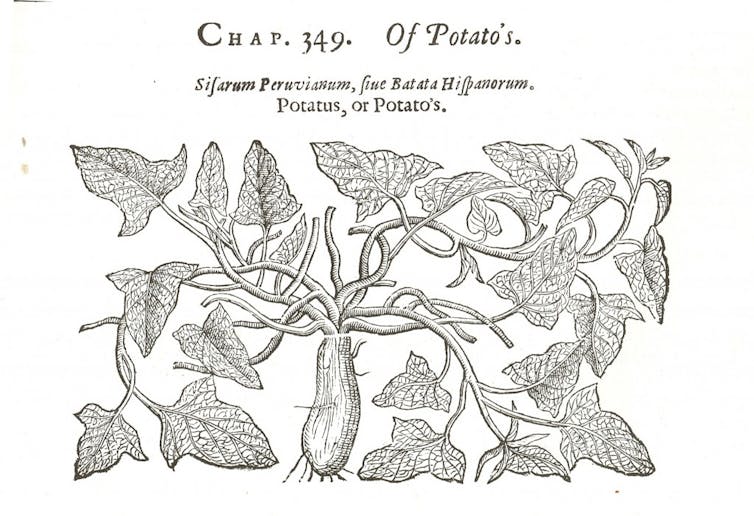
But when did the sweet potato reach the British Isles? The English herbalist John Gerard included an illustration in his 1597 Herball. “Howsoever they bee dressed, they comfort, nourish, and strengthen the body”, he reported enthusiastically. Sweet potatoes quickly became popular in England, and many of the earliest recipes for “potatoes” may in fact refer to sweet potatoes. They were even grown at Hampton Court, for the delectation of Henry VIII, who reportedly learned to enjoy their honeyed delights from the ill-fated Catherine of Aragon.


 Sweet potatoes: ‘they comfort, nourish, and strengthen the body’. John Gerard's 'Herball' (1596)

Sweet potatoes: ‘they comfort, nourish, and strengthen the body’.
John Gerard's 'Herball' (1596)


After their marriage disintegrated, Henry had to rely on home-grown sweet potatoes, rather than Spanish imports. Gardeners at Hampton Court have recently demonstrated that sweet potatoes grow perfectly well in our scarcely tropical climate. The first printed recipe containing sweet potato is probably the description of how to make “a tart that is a courage to a man or woman”, which appeared in the Good Huswife’s Jewell, a cookbook published in London in 1596.

Before NATO … the sweet potato


Ironically, while Henry VIII enjoyed sweet potatoes in Tudor England, pilgrims in 1621 New England almost certainly did not feast on maple-candied sweet potatoes, or any sweet potatoes at all. Early records of the settlement make no mention of them and they were not native to the chilly shores of the north Atlantic. The oldest documents in the US that refer to sweet potatoes are actually from England.

Washington’s Folger Library, which holds a major collection of Shakespeariana, has recently unearthed an early recipe for sweet potato pudding from … Warwickshire! The pudding calls for potatoes (sweet or ordinary), eggs, sugar and a good dose of sherry. So new world sweet potatoes have been criss-crossing the Atlantic since the 16th century, forming a special relationship of eaters and growers that long predates NATO.

But what about Donald Trump? Does he have anything to do with this long history? Not really, although the internet is replete with images of sweet potatoes that resemble the president-elect and critics have called him a “xenophobic sweet potato”. Will Trump tuck into a traditional sweet potato pie or candied sweet potatoes for his Thanksgiving dinner? I don’t know and I certainly don’t care. But the sweet potato, unlike Trump, is unquestionably one of the new world’s gifts to Britain – and the world.

A recipe for sweet potato tart from Charles Carter, The Complete Practical Cook (London, 1730).

POTATOE TORT.

TAKE a Pound and half Spanish Potatoes [sweet potatoes]; boil them and blanch them, and cut them in Slices, not thin; sheet a Dish with Puff-paste, lay some Citron in the Bottom, lay over your Potatoes, and season them with Ginger, Cinnamon, Nutmeg, and Sugar; then take the Marrow of two Bones, cut it into Pieces as big as Walnuts, roll it in Yolks of Eggs, and season it as the Potatoes; lay it on them, and between the Lumps of Marrow lay Citron and Dates slic’d, and Eringoe Roots [I’d use candied angelica], sprinkle over some Sack and Orange-flower Water; then draw up a Quart of Cream boil’d with the Yolks of ten Eggs, and pour all over, bake it, and stick over some Citron, and serve it.
The Conversation

Rebecca Earle, Professor of HIstory, University of Warwick

This article is republished from The Conversation under a Creative Commons license. Read the original article.

Guest Post: How advertising shaped Thanksgiving as we know it

Samantha N. N. Cross, Iowa State University

I have always been intrigued by Thanksgiving – the traditions, the meal, the idea of a holiday that is simply about being thankful.

For my family, Thanksgiving is all about the food. Some foods, like turkey and mashed potatoes, may be familiar. But there are a few twists. Since I grew up in the Caribbean, I’m allowed a Caribbean dish or two. The reliability of the menu – with a little flexibility sprinkled in – seems to unite us as a family while acknowledging our different cultural backgrounds.


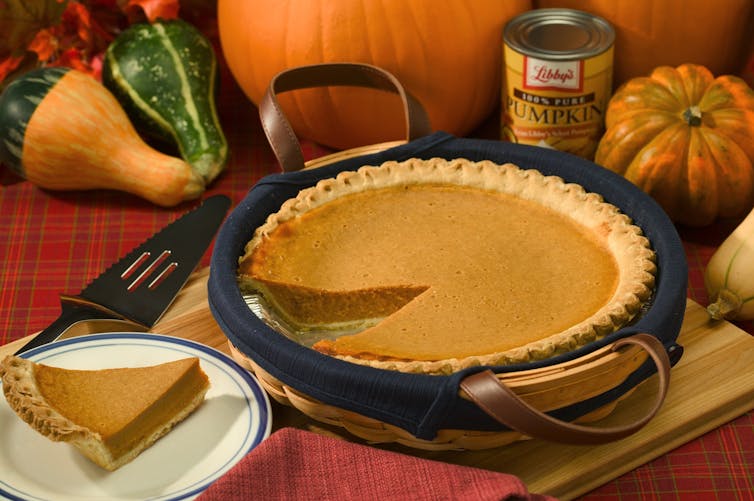
Pumpkin pie Thanksgiving

Libby’s continues to fiercely compete with pumpkin pie peddlers Borden’s, Snowdrift and Mrs. Smith’s for a place on the Thanksgiving table.
Jean Beaufort


Chances are you and your family have similar traditions. Filipino-American families might include pancit. Russian-American families might serve a side dish of borscht. That’s what makes Thanksgiving unique. It’s a holiday embraced by people regardless of their religion or ethnicity.

Yet despite this adaptability, there’s a core part of the meal that almost everyone embraces. How did this come to be? Although few appreciate it, advertisers have shaped the meal as much as family tradition.

A uniquely broad appeal


When Sarah Josepha Hale, the editor of Godey’s Lady’s Book, first advocated for Thanksgiving as a national holiday in 1846, she argued that it would unify the country. In our research, my colleagues and I have been able to show that Hale’s vision for the holiday has been largely fulfilled: Inclusivity of people and traditions has been Thanksgiving’s hallmark quality.

A reason for its broad appeal is that it lacks any association with an institutionalized religion. As one interviewee told us, “There is no other purpose than to sit down with your family and be thankful.” And after interviewing a range of people – from those born in the U.S. to immigrants from countries like South Africa, Australia and China – it became obvious that the principles and rituals they embraced during the holiday were universal no matter the culture: family, food and gratitude.

But as a relatively new holiday – one not tied to a religious or patriotic tradition – a shared understanding of the celebration and the meal is crucial to ensure its long-term survival.

While there might be subtle variations, the Thanksgiving meal is the lodestone of the holiday, the magnet that brings people together. Today, familiar items constitute the meal: turkey, cranberry sauce, stuffing, gravy, alcohol, salad, apple pie and pumpkin pie. Many of our interviewees tended to serve some version of this list.

But why these items and not others? What makes turkey, cranberry sauce and pumpkin pie so special? My colleagues and I studied 99 years of Thanksgiving ads in Good Housekeeping magazine to find out.

Marketing a ritual


Starting with Thanksgiving’s early champion, Sarah Josepha Hale, the history of Thanksgiving is rooted in marketing. Marketers not only helped create many of the rituals and cultural myths associated with the Thanksgiving meal, but they also legitimized and maintained them.


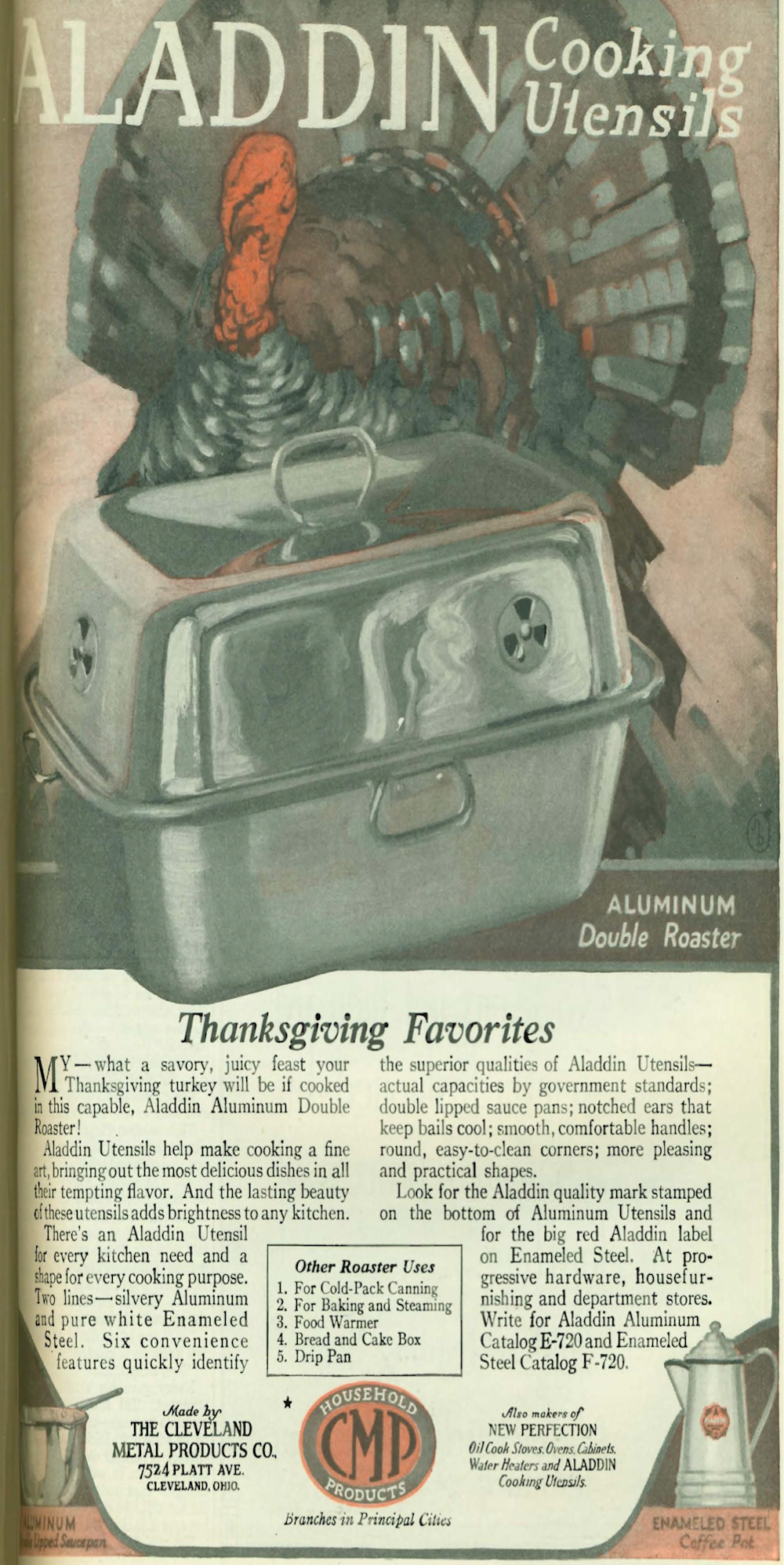
Aladdin Cooking Utensils advertises its double roaster in a 1920 issue of Good Housekeeping.

Aladdin Cooking Utensils advertises its double roaster in a 1920 issue of Good Housekeeping.
Good Housekeeping


Initially, the Thanksgiving turkey competed with other meats, like duck, chicken and goose, for centerpiece at the Thanksgiving table.

But by the 1920s, turkey had become the only meat advertised. Early ads would focus on how to prepare and present the perfect bird, promoting branded tools like roasters, ranges, pop-up thermometers and oven-cooking bags.

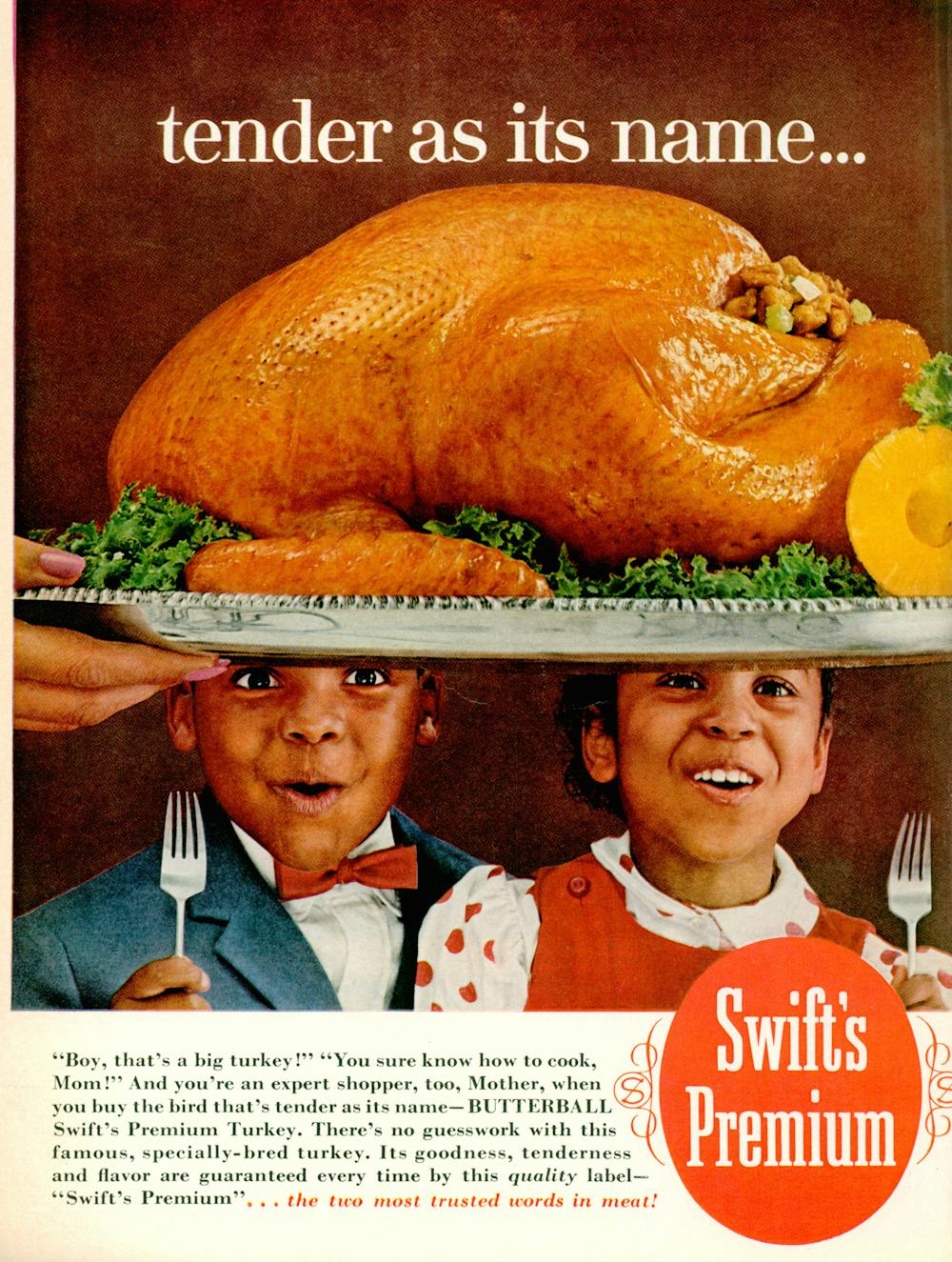
Iconic Swift’s Premium turkey ads focused on the sacredness of the meal by featuring families at prayer, giving thanks before the meal begins. The importance of the turkey to the Thanksgiving celebration dominates, helping to perpetuate the Thanksgiving turkey tradition.

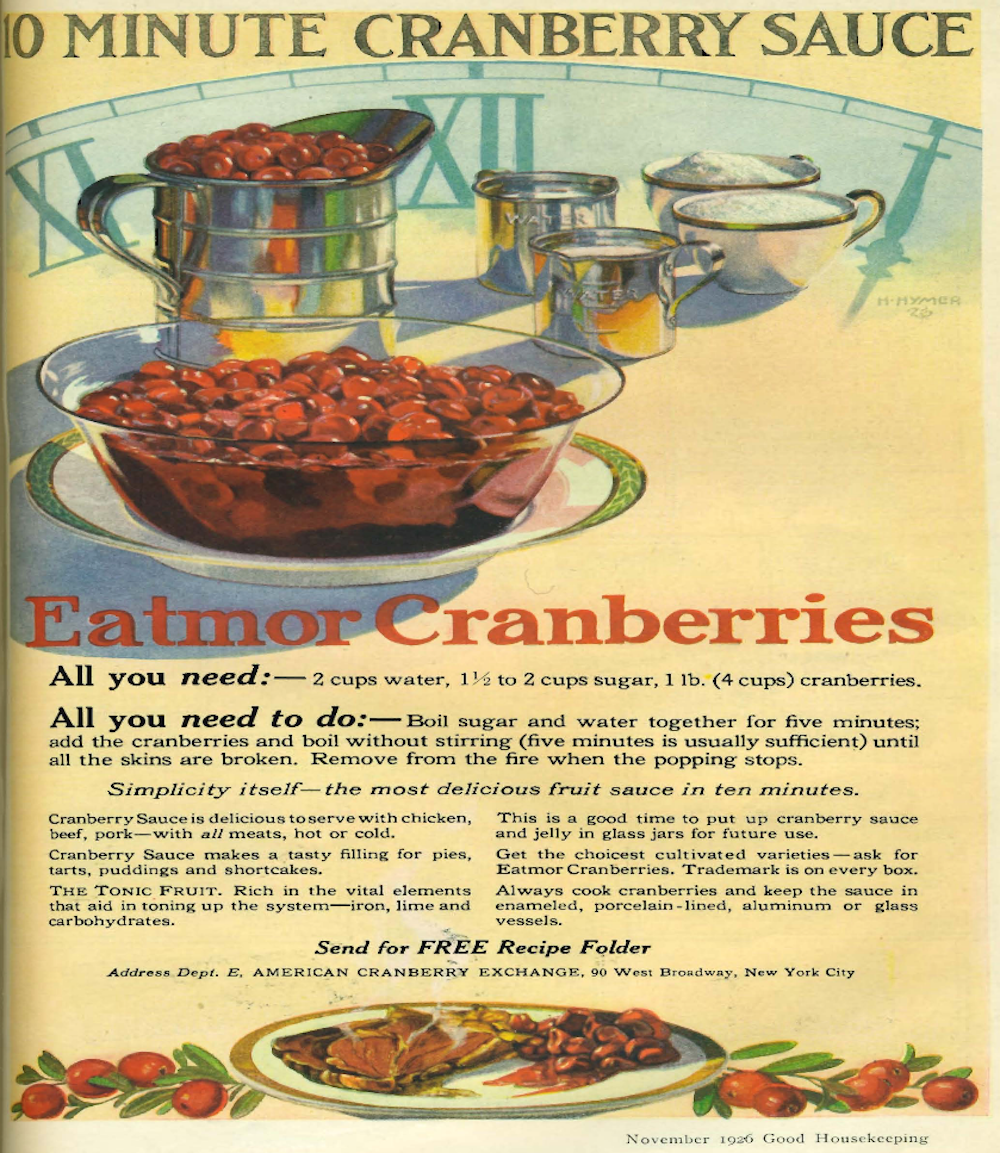
Meanwhile, early ads for the Eatmor Cranberry Company positioned their whole cranberries as a perfect complement to any and all Thanksgiving meat dishes. This brand dominated until the 1930s when another brand, Ocean Spray, entered with its canned gelatin cranberry sauce.


Eatmor Cranberries Thanksgiving advertising

Eatmor Cranberries – which used to be the king of Thanksgiving cranberry sauce – advertises in a November 1926 issue of Good Housekeeping.
Good Housekeeping


Ads for both brands implied that cranberry sauce has been around since the first Thanksgiving dinner, which was highly unlikely. However, the brand positioning war successfully promoted cranberry sauce as the natural condiment for the Thanksgiving turkey. Ocean Spray would triumph and, to this day, promotes whole cranberries and canned gelatin.

Considered by many to be the quintessential Thanksgiving dessert, pumpkin pie also wasn’t present at the first Thanksgiving meal. (The Pilgrims lacked the butter, wheat flour and sugar to make the pastry.) Nonetheless, beginning as early as 1925, a range of brands – for example, Borden’s, Snowdrift, Mrs. Smith’s and Libby’s – have competed fiercely to connect pumpkin pie to the season, the holiday and the meal. It’s a rivalry that continues to this day.

The role of the consumer


Not every product category or brand succeeded in becoming a core part of the Thanksgiving meal.


A Swift’s Premium Turkey ad from 1964.

A Swift’s Premium Turkey ad from 1964.
Wishbook


A Welch’s ad from the 1960s implies that the first Thanksgiving meal included juice made from grapes. In 1928, Diamond marketed their walnuts as an accessory to dress up Thanksgiving dishes. Despite vociferous ad campaigns, few associate Welch’s grape juice or Diamond walnuts with Thanksgiving today.

But those early 20th-century ads for turkey clearly resonated: Today, nearly 88 percent of U.S. households have turkey on Thanksgiving, and approximately 20 percent of the turkeys consumed in any given year are consumed at Thanksgiving. This is a testament to the enduring influence of marketing on the holiday. For brands like Butterball (formerly Swift’s Premium), Thanksgiving is big business.

Whether you’re a turkey fan or not, prefer apple pie to pumpkin pie, enjoy canned gelatin over whole cranberry sauce, by celebrating Thanksgiving, you play a role as well. Marketers may have shaped many of the rituals of the holiday. But all Americans – from all backgrounds – certainly do their part to maintain them.

The ConversationAfter all, brands need customers to survive.

Samantha N. N. Cross, Associate Professor of Marketing, Iowa State University

This article was originally published on The Conversation. Read the original article.

Monday, November 19, 2018

Guest Post: How Communism Almost Ruined The First Thanksgiving

The Plymouth Pilgrims progressed from the false dream of communism to the sound realism of capitalism.

by Richard M. Ebeling

This time of the year, whether in good economic times or bad, Americans gather with their families and friends and enjoy a Thanksgiving meal together. It marks a remembrance of those early Pilgrim Fathers who crossed the uncharted ocean from Europe to make a new start in Plymouth, Massachusetts. What is less appreciated is that Thanksgiving is also a celebration of the birth of free enterprise in America.

The English Puritans, who left Great Britain and sailed across the Atlantic on the Mayflower in 1620, were not only escaping from religious persecution in their homeland. They also wanted to turn their back on what they viewed as the materialistic and greedy corruption of the Old World.

Plymouth Colony Planned as Collectivist Utopia
thanksgiving table food turkeyIn the New World, they wanted to erect a New Jerusalem that would not only be religiously devout but be built on a new foundation of communal sharing and social altruism. Their goal was the communism of Plato’s Republic, in which all would work and share in common, knowing neither private property nor self-interested acquisitiveness.

What resulted is recorded in the diary of Governor William Bradford, the head of the colony. The colonists collectively cleared and worked the land, but they brought forth neither the bountiful harvest they hoped for, nor did it create a spirit of shared and cheerful brotherhood.

The less industrious members of the colony came late to their work in the fields and were slow and easy in their labors. Knowing that they and their families were to receive an equal share of whatever the group produced, they saw little reason to be more diligent in their efforts. The harder working among the colonists became resentful that their efforts would be redistributed to the more malingering members of the colony. Soon they, too, were coming late to work and were less energetic in the fields.

Collective Work Equaled Individual Resentment
As Governor Bradford of the Plymouth Colony explained in his old English (though with the spelling modernized):

For the young men that were able and fit for labor and service did repine that they should spend their time and strength to work for other men’s wives and children, without recompense. The strong, or men of parts, had no more division of food, clothes, etc. than he that was weak and not able to do a quarter the other could; this was thought injustice. The aged and graver men to be ranked and equalized in labor, and food, clothes, etc. with the meaner and younger sort, thought it some indignant and disrespect unto them. And for men’s wives to be commanded to do service for other men, as dressing their meat, washing their clothes, etc. they deemed it a kind of slavery, neither could husbands brook it.”
Because of the disincentives and resentments that spread among the population, crops were sparse and the rationed equal shares from the collective harvest were not enough to ward off starvation and death. Two years of communism in practice left alive only a fraction of the original number of the Plymouth colonists.

Private Property as Incentive to Industry
Realizing that another season like those that had just passed would mean the extinction of the entire community, the elders of the colony decided to try something radically different: the introduction of private property rights and the right of the individual families to keep the fruits of their own labor.

As Governor Bradford put it:
And so assigned to every family a parcel of land, according to the proportion of their number for that end . . . This had a very good success; for it made all hands very industrious, so as much more corn was planted then otherwise would have been by any means the Governor or any other could use, and saved him a great deal of trouble, and gave far better content. The women now went willingly into the field, and took their little-ones with them to set corn, which before would a ledge weakness, and inability; whom to have compelled would have been thought great tyranny and oppression.”
The Plymouth Colony experienced a great bounty of food. Private ownership meant that there was now a close link between work and reward. Industry became the order of the day as the men and women in each family went to the fields on their separate private farms. When the harvest time came, not only did many families produce enough for their own needs, but also they had surpluses that they could freely exchange with their neighbors for mutual benefit and improvement.

In Governor Bradford’s words:
By this time harvest was come, and instead of famine, now God gave them plenty, and the face of things was changed, to the rejoicing of the hearts of many, for which they blessed God. And the effect of their planting was well seen, for all had, one way or other, pretty well to bring the year about, and some of the abler sort and more industrious had to spare, and sell to others, so as any general want or famine hath not been amongst them since to this day.”

Rejecting Collectivism for Individualism
Hard experience taught the Plymouth colonists the fallacy and error in the ideas that since the time of the ancient Greeks had promised paradise through collectivism rather than individualism. As Governor Bradford expressed it:
The experience that was had in this common course and condition, tried sundry years, and that amongst the Godly and sober men, may well convince of the vanity and conceit of Plato’s and other ancients; -- that the taking away of property, and bringing into a common wealth, would make them happy and flourishing; as if they were wiser than God. For this community (so far as it was) was found to breed confusion and discontent, and retard much employment that would have been to their benefit and comfort.”
Was this realization that communism was incompatible with human nature and the prosperity of humanity to be despaired or be a cause for guilt? Not in Governor Bradford’s eyes. It was simply a matter of accepting that altruism and collectivism were inconsistent with the nature of man and that human institutions should reflect the reality of man’s nature if he is to prosper. Said Governor Bradford:
Let none object this is man’s corruption, and nothing to the curse itself. I answer, seeing all men have this corruption in them, God in his wisdom saw another course fitter for them."
The desire to “spread the wealth” and for government to plan and regulate people’s lives is as old as the utopian fantasy in Plato’s Republic. The Pilgrim Fathers tried and soon realized its bankruptcy and failure as a way for men to live together in society.

They, instead, accepted man as he is: hardworking, productive, and innovative when allowed the liberty to follow his own interests in improving his own circumstances and that of his family. And even more, out of his industry result the quantities of useful goods that enable men to trade to their mutual benefit.

Giving Thanks for the Triumph of Freedom
Thanksgiving traditionsIn the wilderness of the New World, the Plymouth Pilgrims progressed from the false dream of communism to the sound realism of capitalism. At a time of economic uncertainty and growing political paternalism, it is worthwhile recalling this beginning of the American experiment and experience with economic freedom.

This is the lesson of the First Thanksgiving. This year, when we, Americans sit around our dining table with family and friends, we should also remember that what we are really celebrating is the birth of free men and free enterprise in that New World of America.

The true meaning of Thanksgiving, in other words, is the triumph of Capitalism over the failure of Collectivism in all its forms.

Richard M. Ebeling


Richard M. Ebeling is BB&T Distinguished Professor of Ethics and Free Enterprise Leadership at The Citadel in Charleston, South Carolina. He was president of the Foundation for Economic Education (FEE) from 2003 to 2008.


This article was originally published on FEE.org. Read the original article.