Showing posts with label Easter. Show all posts

Saturday, April 20, 2019

Guest post: Easter – a Christian festival that feels pagan


Jane Stevenson, University of Oxford

There’s a lot of confusion about Easter – not least because this most important of all Christian festivals moves around so much from year to year, decided by a complex set of calculations based on the vernal equinox and the phase of the moon. Easter symbols – eggs, bunnies, lambs and the rest – give the festivities an air of pre-Christian paganism.

happy easter chocolate candy crossSo where do the origins of Easter and the rituals observed by so many – whether Christian or not – really lie?

The first mention of Eostre is in the eighth century, in The Venerable Bede’s frustratingly cryptic account of the native Anglo-Saxon calendar in De Temporum Ratione (On the Reckoning of Time). The Anglo-Saxon equivalent of April called Eostremonath is named for the goddess Eostre – but we only know about Eostre via Bede’s writings and the only thing he tells us about her is that “feasts were celebrated” in her honour. So, if modern Easter is frequently a festival of overeating, this has tradition on its side.

But Eostre was evidently significant enough for the Anglo-Saxons to later transfer her name to the Christian festival of the resurrection rather than adopting the Latin name “Pascha”.

Similarly, Easter is “Ostern” in German – which implies she must have been known outside England. Confusingly, the great 19th-century folklorist and philologist, Jacob Grimm, invented a German goddess called Ostara – “the divinity of the radiant dawn, upspringing light, a spectacle that brings joy and blessing” – on purely etymological grounds: the name is derived from a proto-Indo-European root meaning “to shine”. But Grimm didn’t present a shred of supporting evidence that such a deity had ever been worshipped in Germany, leaving us with just Bede to go on.

Easter roughly coincides with the spring equinox – so there is a good deal of lore attached to the season which is not actually Christian. Easter is preceded by Lent – a period of fasting in memory of Christ’s 40 days in the wilderness. But it is also a season when, in pre-modern Europe, food would have been running low. Winter supplies would have been coming to an end and there was not enough sun and spring growth yet for hens to start laying and cows to give milk. In a sense, therefore, Easter is a natural feast – to celebrate passing out of that hardship.

Easter and Passover


The association of lamb with Easter is something we have borrowed from Jewish tradition and Passover – which was also the festival that Jesus and his disciples celebrated with their Last Supper.

At least as far back as the 15th century, Easter was also marked in England by eating “tansies” – a kind of custardy pudding made with the bitter (and poisonous) herb tansy and sometimes with other bitter greens such as nettles. The 17th-century antiquarian John Aubrey adds a further detail:

Our tansies at Easter have reference to the bitter Herbs [eaten at Passover by Jews] though at the same time ’twas always the Fashion for a man to have a gammon of Bacon, to shew himself to be no Jew.


Eggs are an ancient and natural symbol of returning life in many parts of Europe, but the Easter egg may also derive from Passover – which includes, among various symbolic foods, a roasted egg: the beitzah. Until at least the mid-20th century, more people marked Easter with decorated, hard-boiled hen’s eggs than chocolate ones.

The earliest documented mention in England of decorated eggs comes in 1290, from the household accounts of King Edward I for 1290, which records the purchase and decoration of 450 eggs , some gilded, some dyed. These eggs were presented to the royal household at Easter, and cost 18 pence.

In many parts of Britain the custom was for people, children especially, to play with their “pace-eggs” by rolling them down a chosen slope before eating them. In Iona and Peter Opie’s 1959 study The Lore and Language of Schoolchildren, a child reports that: “In Cumberland we take more notice of the pace eggs than chocolate eggs.” Easter eggs as also rolled on the lawn of the US White House, a custom going back to 1878.

Bunny business


The association of hares with Easter also considerably predates foil-wrapped chocolate bunnies. As early as 1682, Georg Franck von Franckenau’s essay De ovis paschalibus (About Easter Eggs) speaks of a German tradition of an Easter hare bringing coloured Easter eggs for the children.

In southern Germany, children used to be told that a hare laid the pace-eggs and they would make a nest for the creature to lay them in. The Easter hare was also known in parts of the British Isles and was particularly associated with having to hunt out eggs hidden in the garden, where the hare was supposed to have put them.

A curious entry in the Calendar of State Papers for April 2 1620, suggests that hares were also often eaten at Easter:

Thos. Fulnety solicits the permission of Lord Zouch, Lord Warden of the Cinque Ports, to kill a hare on Good Friday, as huntsmen say that those who have not a hare against Easter must eat a red herring.

Hares were also ritually hunted at Easter in England – there is a note in the Chamberlains’ Accounts for the year 1574 that twelvepence was “given to the hare-finders at Whetston Court”.

An Easter hare hunt survived as part of Leicester’s ritual year as late as the 18th century, though by then a dead cat was substituted for an actual hare. Jacob Grimm, looking at this evidence for an association of ritual activity involving hares with the Easter season, conjectured that the hare was sacred to the goddess Ostara, piling one conjecture on top of another.

So the truth is that Easter rituals as we know them today represent an untidy collection of customs connected with celebrating spring growth and the end of austerity – a time for new clothes and rich food. Any connection with pre-Christian paganism is entirely coincidental.The Conversation

Jane Stevenson, Senior Research Fellow at Campion Hall, University of Oxford

This article is republished from The Conversation under a Creative Commons license. Read the original article.


Thursday, March 15, 2018

Guest Post: Who was Mary Magdalene? Debunking the myth of the penitent prostitute

Dorothy Ann Lee, University of Divinity

Who was Mary Magdalene? What do we know about her? And how do we know it? These questions resurface with the release of a new movie, Mary Magdalene, starring Rooney Mara in the titular role.

Mary Magdalene Yvonne de CarloThe question of how we know about her is a relatively simple one. She appears in a number of early Christian texts associated with the ministry of Jesus.
These texts comprise Gospels written in the first and second century of the Common Era (CE). The earliest of them are included in the New Testament, where Magdalene plays a significant role. She also appears in later Gospels, which were not included in the Bible and come from a later period in early Christianity.

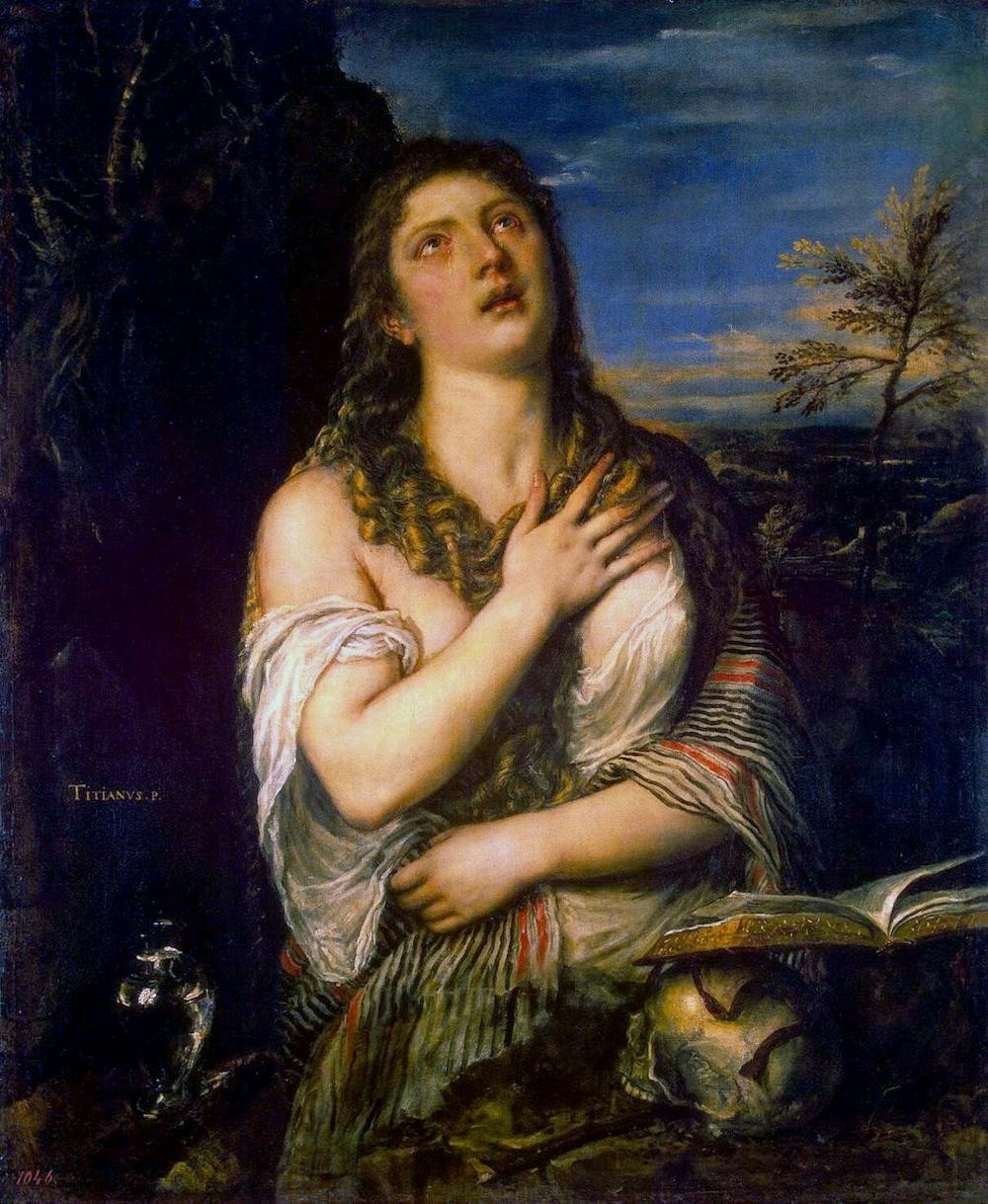
The answer about who she was and what we know of her is more complex. In Western art, literature and theology, Mary Magdalene is portrayed as a prostitute who meets Jesus, repents of her sins, and pours oil on his feet in a gesture of humility, penitence and gratitude. She is sometimes depicted kneeling at the foot of the cross, hair unbound, emphasising the sinful past from which she can never quite escape, despite being declared a saint.

The tradition of the penitent prostitute has persisted in the Western tradition. Institutions that cared for prostitutes from the 18th century onwards were called “Magdalenes” to encourage amendment of life in the women who took refuge in them. The word came into English as “maudlin”, meaning a tearful sentimentality. It is not a flattering description.


Titian Penitent Magdalene, circa 1565

Titian’s Penitent Magdalene, circa 1565.
Wikimedia Commons


Artistic depictions continued to emphasise Magadelene’s sexuality in various ways, under a facade of piety. In another twist on the same theme, she is presented as the wife of Jesus, most notably in Dan Brown’s The Da Vinci Code (2003).

The tradition of Mary Magdalene as the archetypal penitent whore, whose sexuality somehow manages to persist beyond her conversion, can be dated to a sermon preached by Gregory the Great in the sixth century CE.


Read more:
Weighing up the evidence for the 'Historical Jesus'


Admittedly, there are a confusing number of women called “Mary” in the Gospels and we might assume Pope Gregory was tired of distinguishing between them. He reduced them to two: on the one hand, Mary, the mother of Jesus, perpetual virgin, symbol of purity and goodness, and, on the other, Mary Magdalene, promiscuous whore, symbol of feminine evil from which the world must be redeemed.

A disciple of Jesus


Yet nowhere in the Gospels is Mary Magdalene associated either overtly or covertly with sexuality. The four Gospels of the New Testament present her in two significant roles.

In the first place, she is a disciple of Jesus: one among a band of women and men from Galilee who believed in his message of love and justice and followed him in his ministry.

Secondly, Magdalene is a primary witness in the Gospels to the resurrection of Jesus from the dead. Unlike many of the other disciples, she does not flee when Jesus is arrested. She remains at the cross when he dies and later visits his tomb to find it empty, with a vision of angels declaring his resurrection.

Mark’s Gospel, which we now know to be the earliest Gospel to be written, speaks of Magdalene as a disciple of Jesus who has followed him from Galilee along with other women, but it does not mention her until the crucifixion. These women disciples now stand near the cross, despite the danger in being present at the execution of a dissident.

Three of them, including Magdalene, visit the tomb on Easter morning where they meet an angel who informs them that Jesus has risen from the dead (Mark 16:1-8). The women’s subsequent departure from the tomb is ambiguous, and they leave in fear and silence, which is where the manuscript of Mark’s Gospel abruptly ends. An ending added later makes mention of the risen Jesus making an appearance first to Magdalene.

In Matthew’s Gospel, Magdalene meets the risen Christ as she leaves the tomb, this time with only one other female companion, who is also called “Mary” (Matt 28:1-10). In Luke’s account, Magdalene appears at the cross and at the empty tomb to hear the angel’s words, but she and her female companions are not believed when they convey the message of the resurrection to the apostles (Luke 24:1-11).


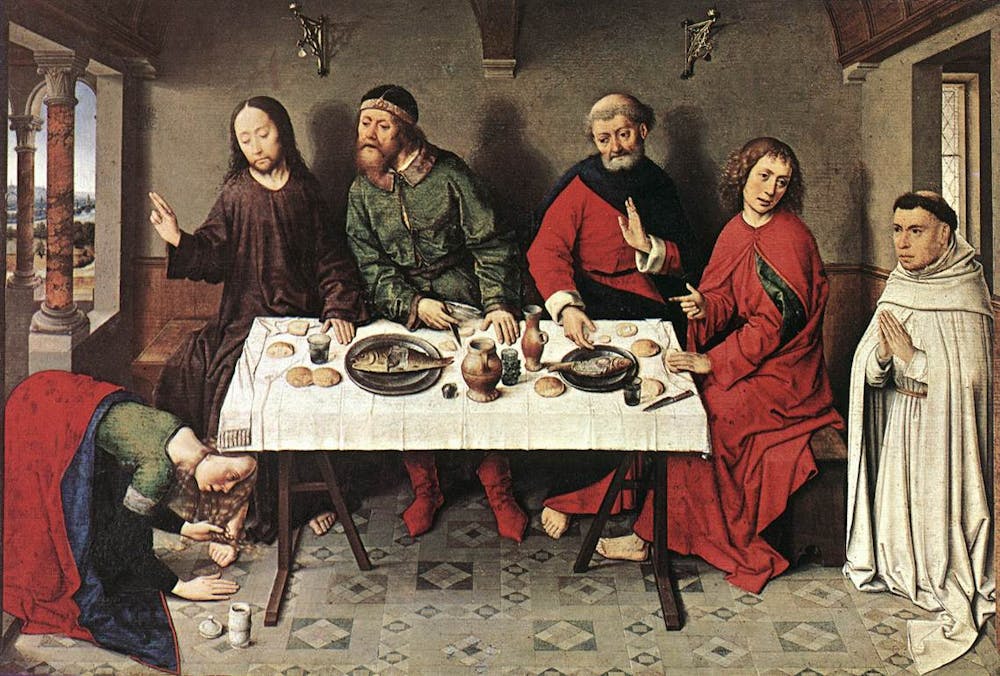
 Mary Magdalene anoints Christ’s feet in Dieric Bouts’ Christ in the House of Simon

Mary Magdalene anoints Christ’s feet in Dieric Bouts’ Christ in the House of Simon (circa 1420–1475).
Wikimedia Commons


In Luke, there is an earlier mention of Magdalene in Jesus’s ministry where she is present, along with other women, as a disciple and supporter of Jesus (Luke 8:1-3). She is described as having had seven demons cast from her. This description might lead to the conclusion, in some minds, that the many “demons” refer to her unfettered sexuality.

But that would be erroneous. Exorcisms — the casting out of evil spirits — are common in the first three Gospels. Those suffering demonic possession are never described as sinful but rather are victims of external evil.

These days, we would associate their symptoms with physical maladies such as epilepsy or mental illness. Magdalene, in other words, has been the victim of a serious illness and Jesus has healed her.


Read more:
How the Bible shapes contemporary attitudes to rape and sexual assault


Furthermore, the description is unusual here in that she is not described in relation to a male figure, as other women at the time generally were: father, husband, brother. She is simply referred to as “the Magdalene”, that is, the woman from Magdala, a Jewish village in Galilee.

We might well assume, from Luke’s description, that she is an independent woman of some means, who is well able to fund, as well as participate in, the movement around Jesus.

Her most significant role


John’s Gospel, however, gives Magdalene her most significant role. Once again, she does not appear until the crucifixion. In the narrative that follows, she comes alone to the tomb on Easter morning, finds it empty, tries unsuccessfully to gain help from two other prominent disciples, and eventually meets the risen Christ himself in the garden (20:1-18). He is alive and commissions her to proclaim the message of his resurrection.

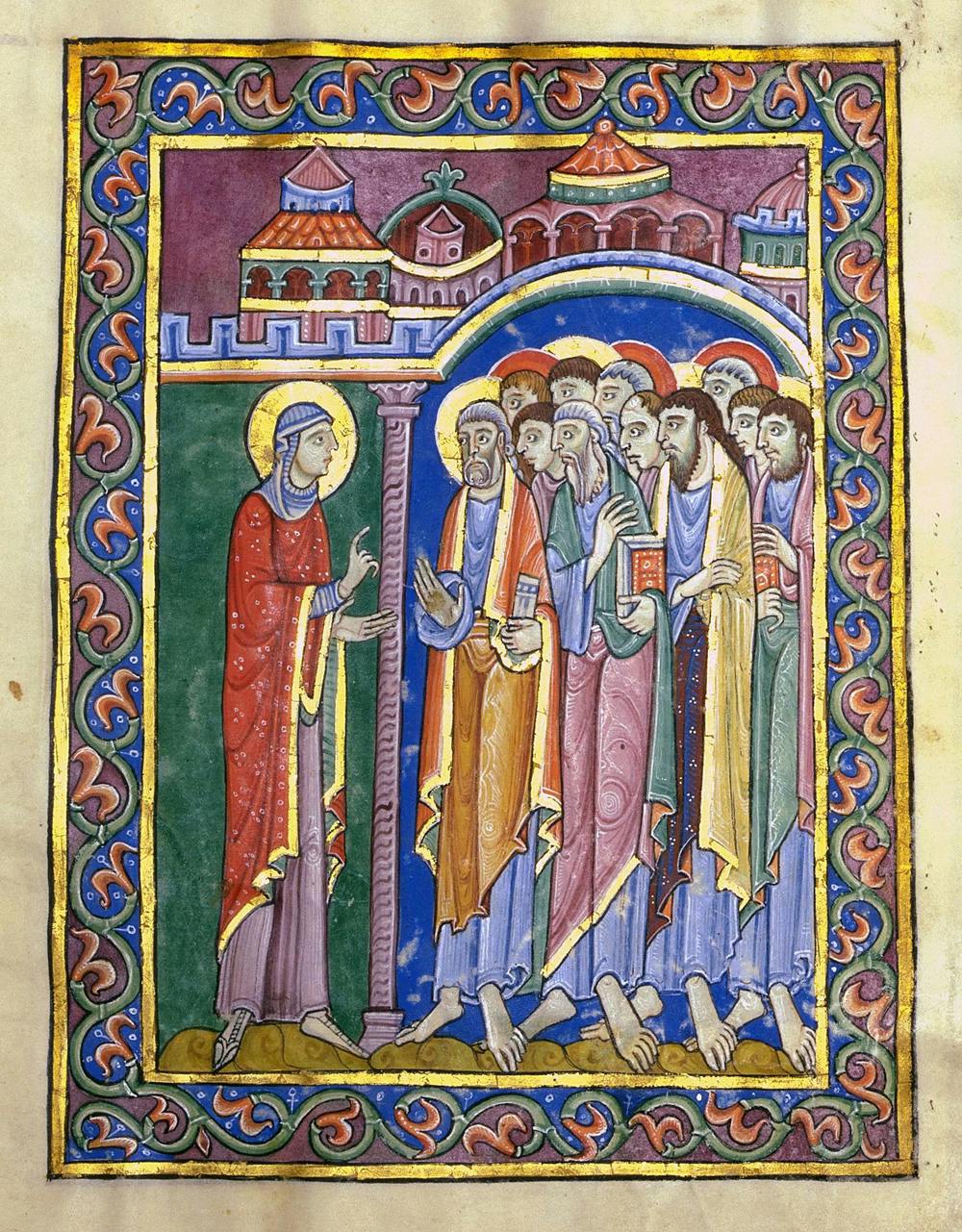
On the basis of John’s story, later tradition gave Magdalene the title of “apostle to the apostles” and recognised something of her significance for Christian faith, witness and leadership. A tragic consequence is that her role as witness to the resurrection was later overshadowed by the apparently more alluring but inaccurate picture of her as the penitent whore.


Mary Magdalene St Albans Psalter

A more accurate portrayal of Mary Magdalene announcing the risen Christ from the 12th-century English illuminated manuscript St Albans Psalter.
Wikimedia Commons


The later Gospels, beyond the New Testament, also emphasise Magdalene’s importance as a disciple of Jesus and witness to the resurrection. The manuscript of the Gospel of Mary, which describes her discussions with the risen Christ, is unfortunately damaged and the central section is missing. In this and other similar Gospels, however, Magdalene is presented as the favoured disciple. This situation leads to some tension with the other disciples, who are jealous of her closeness to Jesus and the teaching she alone is given.

One Gospel speaks of Jesus kissing her, but the imagery in the Gospel of Philip is metaphorical and refers to a spiritual union with Christ. In response to the objection by the other disciples, Jesus asks why he does not kiss them in the same way, implying that they do not as yet possess the same degree of spiritual knowledge.

No evidence of Magdalene anointing Jesus


There is no evidence, incidentally, that Magdalene ever anointed Jesus.

There are three anointing traditions in the Gospels. In one, an unnamed woman anoints Jesus’s head in prophetic recognition of his identity (Gospels of Mark & Matthew). In another, a named and known disciple, Mary of Bethany, who is a model disciple, anoints Jesus’s feet in gratitude for his raising her brother Lazarus from the dead (Gospel of John). In the third, a “sinful woman”, who is not explicitly identified as a prostitute, anoints Jesus’s feet in a gesture of repentance, gratitude and hospitality. None of these three figures is associated in any way with Mary Magdalene in the texts.

The movie Mary Magdalene, directed by Garth Davis, is a significant portrayal of this early Christian figure in the light of evidence from the earliest texts. The screenwriters, Helen Edmundson and Philippa Goslett, are quite clear that Mary is not to be associated with Jesus through her sexuality, either as harlot or wife. On the contrary, she is depicted as a faithful and deeply insightful disciple of Jesus, on whom he draws for his message of love, mercy and forgiveness.


Magdalene is beautifully portrayed in the movie, which draws on traditions from the earlier and later Gospels. She possesses an intense and compelling presence, which does much to restore her character from its later distortions.

It is true that the film makes somewhat erratic use of the New Testament, both in its presentation of Magdalene and of other characters in the story. Towards the end, for example, there is an implication that Magdalene and the church stand on opposite sides, the one in sympathy with Jesus’s teaching and the other anxious to build a self-glorifying edifice on his assumed identity.

This is unfortunate, as the New Testament itself is quite clear about the priority and identity of Magdalene as a key disciple, witness and leader in the early church, without seeing her in opposition to others.

Indeed, those who campaigned in a number of Christian churches for the ordination of women in the 20th century used precisely the example of Mary Magdalene from the New Testament as “apostle to the apostles” to support their case for women’s equality and leadership.

The recent installation of Kay Goldsworthy as Archbishop of the Anglican Diocese of Perth — the first woman in this country and across the world to be given this title — is the true heir of Magdalene as she is portrayed in the earliest Christian writings.


The ConversationThe film Mary Magdalene opens in Australian cinemas on March 22.
Dorothy Ann Lee, Frank Woods Professor of New Testament, Trinity College, University of Divinity

This article was originally published on The Conversation. Read the original article.

Wednesday, February 14, 2018

Guest Post: Why do Christians wear ashes on Ash Wednesday?


Michael Laver, Rochester Institute of Technology

This coming Wednesday many Christians will arrive at work with a black cross smudged on their foreheads; countless more will slip into a church or a chapel during their lunch break or after work to receive the sign that tells the arrival of Ash Wednesday, the traditional start of the Christian season of Lent.

As both a priest in the Episcopal Church as well as a historian of Christianity, I’ve come to appreciate many of the liturgies and practices that characterize the modern church and have their roots in ancient traditions. The practice of donning ashes is one of them.

Ashes in Bible stories


In the Bible we are told that when the prophet Jonah pronounced God’s wrath on the city of Nineveh for its “wickedness,” likely because of the worship of idols or “false” gods, the king, in an act of sincere penitence, put on sackcloth and sat in ashes.

God was moved by this genuine act of repentance and spared the city from destruction. This story was meant to demonstrate that God is merciful and heeds true remorse.

This spiritual dimension of ashes is emphasized all through the Bible. In the Gospel of Matthew, Jesus deplores the lack of concern for the poor and marginalized on the part of the establishment of the day, as he passes through some towns.

He called out the hypocrisy of religious leaders who taught righteousness on the one hand, but lived lives of luxury and wealth at the expense of the poor on the other. At one point Jesus condemned the religious leaders as “whitewashed tombs, which on the outside look beautiful, but inside they are full of the bones of the dead and of all kinds of filth.”

When pronouncing these judgments, Jesus makes reference to sackcloth and ashes as a form of penitence.

How the practice evolved


As early as the ninth century the church started to use ashes as a public demonstration of repentance for sins.


Pope Urban II by Artaud de Montor (1772–1849).

Pope Urban II.
Artaud de Montor (1772–1849).


It was only in 1091, however, that their use was ritualized. Pope Urban II decreed the use of ashes to mark the beginning of a 40-day season of Lent, a time when Christians imitate Christ’s 40-day period of fasting. This period is said to have prepared Christ for his three-year ministry that would culminate in his arrest, crucifixion and resurrection.

With the Protestant Reformation of the 16th century, the use of ashes generally fell out of favor in non-Catholic denominations. However, it returned in the 19th century when many Protestant churches entered into intentional dialogue with each other and with the Catholic Church, a phenomenon that is called the “ecumenical movement.”

Today most “mainline” denominations, including Catholics, Baptists, Episcopalians, Methodists, Presbyterians and others allow for the “imposition” (as called in Catholic and Episcopalian prayer books) of ashes during an Ash Wednesday service. In some churches, the ashes are obtained by burning the palms blessed in the previous year’s Palm Sunday service – a time for Christians to remember Christ’s triumphal entry into Jerusalem days before he was crucified. The resultant ash, depending on local practice, might then be mixed with oil to make them adhere more easily to the forehead.

Modern-day practice


In recent years several churches have put a new spin on the traditional Ash Wednesday service by providing what has been called “ashes to go.” In this new take on an ancient practice, a pastor stands in a very public, often busy, place and offers the ashes to any passersby who wishes to receive them, whether or not the person is Christian.

Stories abound of pastors providing “drive-through ashes” in which the penitent does not even have to get out of the car. A website called “ashes to go” provides not only a list of global sites at which one can receive ashes in this way, but also has an FAQ section containing advice for churches contemplating such a service.

For a supremely ironic twist on Ash Wednesday, one only has to observe that the Gospel reading appointed for the day is from Matthew, chapter 6. Here Jesus rails against religious hypocrisy by criticizing those whose religious piety is done mainly for show:

“Whenever you fast, do not look dismal, like the hypocrites, for they disfigure their faces so as to show others that they are fasting. Truly I tell you, they have received their reward. But when you fast, put oil on your head and wash your face, so that your fasting may be seen not by others but by your Father who is in secret; and your Father who sees in secret will reward you.”

The ConversationChristians bearing the sign of the cross on their forehead this Wednesday will be sharing a formal practice that dates back over a thousand years, and more than that – in a tradition that goes back much earlier.

Michael Laver, Department Chair, Associate professor, Rochester Institute of Technology

This article was originally published on The Conversation. Read the original article.

Sunday, April 16, 2017

Guest Post: Why Easter is called Easter

by Brent Landau, University of Texas at Austin

This Sunday, April 16, Christians will be celebrating Easter, the day on which the resurrection of Jesus is said to have taken place. The date of celebration changes from year to year. The Conversation

The reason for this variation is that Easter always falls on the first Sunday after the first full moon following the spring equinox. So, in 2018, Easter will be celebrated on April 1, and on April 21 in 2019.

I am a religious studies scholar specializing in early Christianity, and my research shows that this dating of Easter goes back to the complicated origins of this holiday and how it has evolved over the centuries.

Easter is quite similar to other major holidays like Christmas and Halloween, which have evolved over the last 200 years or so. In all of these holidays, Christian and non-Christian (pagan) elements have continued to blend together.

Easter as a rite of spring


Most major holidays have some connection to the changing of seasons. This is especially obvious in the case of Christmas. The New Testament gives no information about what time of year Jesus was born. Many scholars believe, however, that the main reason Jesus’ birth came to be celebrated on December 25 is because that was the date of the winter solstice according to the Roman calendar.


Easter eggs Easter bunny religious traditions spring festival

What is the origin of Easter eggs?
Katie Morrow, CC BY-NC-ND


Since the days following the winter solstice gradually become longer and less dark, it was ideal symbolism for the birth of “the light of the world” as stated in the New Testament’s Gospel of John.

Similar was the case with Easter, which falls in close proximity to another key point in the solar year: the vernal equinox (around March 20), when there are equal periods of light and darkness. For those in northern latitudes, the coming of spring is often met with excitement, as it means an end to the cold days of winter.

Spring also means the coming back to life of plants and trees that have been dormant for winter, as well as the birth of new life in the animal world. Given the symbolism of new life and rebirth, it was only natural to celebrate the resurrection of Jesus at this time of the year.

The naming of the celebration as “Easter” seems to go back to the name of a pre-Christian goddess in England, Eostre, who was celebrated at beginning of spring. The only reference to this goddess comes from the writings of the Venerable Bede, a British monk who lived in the late seventh and early eighth century. As religious studies scholar Bruce Forbes summarizes:

“Bede wrote that the month in which English Christians were celebrating the resurrection of Jesus had been called Eosturmonath in Old English, referring to a goddess named Eostre. And even though Christians had begun affirming the Christian meaning of the celebration, they continued to use the name of the goddess to designate the season.”

Bede was so influential for later Christians that the name stuck, and hence Easter remains the name by which the English, Germans and Americans refer to the festival of Jesus’ resurrection.

The connection with Jewish Passover


It is important to point out that while the name “Easter” is used in the English-speaking world, many more cultures refer to it by terms best translated as “Passover” (for instance, “Pascha” in Greek) – a reference, indeed, to the Jewish festival of Passover.

In the Hebrew Bible, Passover is a festival that commemorates the liberation of the Jewish people from slavery in Egypt, as narrated in the Book of Exodus. It was and continues to be the most important Jewish seasonal festival, celebrated on the first full moon after the vernal equinox.

At the time of Jesus, Passover had special significance, as the Jewish people were again under the dominance of foreign powers (namely, the Romans). Jewish pilgrims streamed into Jerusalem every year in the hope that God’s chosen people (as they believed themselves to be) would soon be liberated once more.

On one Passover, Jesus traveled to Jerusalem with his disciples to celebrate the festival. He entered Jerusalem in a triumphal procession and created a disturbance in the Jerusalem Temple. It seems that both of these actions attracted the attention of the Romans, and that as a result Jesus was executed around the year A.D. 30.

Some of Jesus’ followers, however, believed that they saw him alive after his death, experiences that gave birth to the Christian religion. As Jesus died during the Passover festival and his followers believed he was resurrected from the dead three days later, it was logical to commemorate these events in close proximity.


stained glass window resurrection Easter Sunday

Resurrection.
Fr Lawrence Lew, O.P., CC BY-NC-ND


Some early Christians chose to celebrate the resurrection of Christ on the same date as the Jewish Passover, which fell around day 14 of the month of Nisan, in March or April. These Christians were known as Quartodecimans (the name means “Fourteeners”).

By choosing this date, they put the focus on when Jesus died and also emphasized continuity with the Judaism out of which Christianity emerged. Some others instead preferred to hold the festival on a Sunday, since that was when Jesus’ tomb was believed to have been found.

In A.D. 325, the Emperor Constantine, who favored Christianity, convened a meeting of Christian leaders to resolve important disputes at the Council of Nicaea. The most fateful of its decisions was about the status of Christ, whom the council recognized as “fully human and fully divine.” This council also resolved that Easter should be fixed on a Sunday, not on day 14 of Nisan. As a result, Easter is now celebrated on the first Sunday after the first full moon of the vernal equinox.

The Easter bunny and Easter eggs


In early America, the Easter festival was far more popular among Catholics than Protestants. For instance, the New England Puritans regarded both Easter and Christmas as too tainted by non-Christian influences to be appropriate to celebrate. Such festivals also tended to be opportunities for heavy drinking and merrymaking.

The fortunes of both holidays changed in the 19th century, when they became occasions to be spent with one’s family. This was done partly out of a desire to make the celebration of these holidays less rowdy.


Easter egg hunt spring children

Children on an egg hunt.
Susan Bassett, CC BY-NC-ND


But Easter and Christmas also became reshaped as domestic holidays because understandings of children were changing. Prior to the 17th century, children were rarely the center of attention. As historian Stephen Nissenbaum writes,

“…children were lumped together with other members of the lower orders in general, especially servants and apprentices – who, not coincidentally, were generally young people themselves.”

From the 17th century onward, there was an increasing recognition of childhood as as time of life that should be joyous, not simply as preparatory for adulthood. This “discovery of childhood” and the doting upon children had profound effects on how Easter was celebrated.

It is at this point in the holiday’s development that Easter eggs and the Easter bunny become especially important. Decorated eggs had been part of the Easter festival at least since medieval times, given the obvious symbolism of new life. A vast amount of folklore surrounds Easter eggs, and in a number of Eastern European countries, the process of decorating them is extremely elaborate. Several Eastern European legends describe eggs turning red (a favorite color for Easter eggs) in connection with the events surrounding Jesus’ death and resurrection.

Yet it was only in the 17th century that a German tradition of an “Easter hare” bringing eggs to good children came to be known. Hares and rabbits had a long association with spring seasonal rituals because of their amazing powers of fertility.

When German immigrants settled in Pennsylvania in the 18th and 19th centuries, they brought this tradition with them. The wild hare also became supplanted by the more docile and domestic rabbit, in another indication of how the focus moved toward children.

As Christians celebrate the festival this spring in commemoration of Jesus’ resurrection, the familiar sights of the Easter bunny and Easter eggs serve as a reminder of the holiday’s very ancient origins outside of the Christian tradition.

Brent Landau, Lecturer in Religious Studies, University of Texas at Austin

This article was originally published on The Conversation. Read the original article.


Saturday, April 15, 2017

Guest Post: Easter Symbolizes a New Hope for Life and Liberty


by Jeffrey A. Tucker

Easter morning is filled with delight: bright colors, delicious foods, happy scenes of bunnies, and egg hunts. Above all, for those who are Christian, we are called to celebrate the joy of the resurrection of Christ from death to new life. The contrast between Good Friday and Easter could not be starker: with the quick turn of the calendar, we move from desperate sadness to unmitigated celebration.

It was not this way in the ancient Christian liturgy. Easter was the beginning of a process of discerning a new reality in the world. It was an entire season lasting five weeks, during which time the dramatic realization of what happened and what it implies for the world unfolds in stages, like spring itself. You can see it in the texts of liturgy and hear it in the chanted music from the first millennium. 

Spring Dawns Slowly
Initially, on Easter morning, there is not unmitigated joy, but rather an awe that approaches a kind of fear: the man who was dead is said to be alive again, which seems to lend credibility to those who said he was not a false prophet but rather the son of God. 

Listen to the melody of the Easter morning entrance song from the old liturgy, which isn’t celebratory but awe-struck and slightly frightened. 


What does this imply about the crucifixion itself, and what does this ask of those who stood aside as Jesus was put to death at the bloody hands of the civic authorities? 

In the second week after Easter, the ancient liturgy observes people’s dawning realization of the truth they have witnessed, and are thereby drawn by a sense of awe to a new faith, brought into the community of believers one person at a time. In the third week, you experience the first cries of joy, and in the fourth, the celebrations consist of new songs, songs that depart from tradition and introduce a new age. By the fifth, the experience of elation is completely unleashed and proclaimed to all the world. 

Life Moves Fast
But in modern times, the entire experience is put on fast-forward. Traditionalists regret this, but it is a defensible change that keeps track of the dramatic cultural shifts between the first millennium and the second. In the first, very few people experienced anything like what we call material progress today. The population barely grew and life was characterized by an unchanging tedium of survival. 

In the second millennium, over the course of hundreds of years, humanity experienced the first signs of the possibility of life improvement, longer and better lives even within a single generation, and modernity dawned with the gradual unfolding of freedom and the accumulation of material capital. Sickness and death gave way to health and life as a reasonable expectation. 

So, in this sense, it makes sense that stories about ourselves and even the past would speed up as well. Whatever it is today, we want it now and in the most time-efficient form of delivery possible. A website that sticks is abandoned. A book that is too long is not read. Even a sermon in church that drags on tempts people to leave their pews and find a better way to spend the hour. 

We have come to believe that life is about more than preparing our souls for eternity; it is about finding great experiences within the structure of time itself. Hardly anyone even questions this notion today. We carry it with us constantly. Our impatience with tedium is palpable.

This is a cultural change in us wrought by capitalism, and it is nothing to regret. The existence of “time preferences” – that we want to have what we desire sooner than later – is what might be called a Kantian category of action. It is baked into our choices as human beings. The material world either accommodates us or it does not. With the advent of capitalism, humanity experienced a realization of dreams that had been materially inaccessible throughout most of history. We are today surrounded by its blessings in ways we don’t fully appreciate.

It Needs to Happen Now
Let me just relay a story from this morning, which you might find trivial but is actually glorious.
I woke this morning determined to get my oil changed. Now, when my father was my age, he had to do it himself. There were no places where you can go and be in and out in 10 minutes. I, on the other hand, know that this is possible now, without fuss and without an appointment.

So I started driving, letting my mobile app guide me to the closest place and with full confidence that I could achieve my goal. I got my oil changed for $39 and they added fluid for my power steering, which fixed a whirling sound I’d been hearing. Then I got my car washed and the guy fixed my glove compartment that kept falling open. Somehow he just knew what to do, and he did it just to be nice.
Then I went to a car parts store and got some wipes that made my car smell great, and also some touch-up paint – yes, they happened to have the right color – that took away some scrapes on the paint. I did all this just by driving around and meeting nice people and engaging in beautiful commerce all designed to make my life better. I met fascinating, talented people and saw my life improve in real ways through human labor, courtesy, and commercial activity.

This is the way mornings should be. But of all the mornings in world history, it has only become possible to live this way in 0.00000009% percent of them (not scientific, but you get the point). But instead of celebrating how easy our lives are, what do most people do? They grumble about the traffic. They complain that they had to do this at all. They get upset that they are not otherwise at the office or languishing at home or huffing and puffing at the gym.

No matter how much we get, and however soon we get it, there is still something in us that aches for more. This too is a defensible impulse because it is that longing in us that causes us to act to make the world a better place through entrepreneurship, risk-taking, working hard, saving, and generally having the option as consumers to buy what it is that capitalists are selling us. So long as we are free in action and choice, our disgruntlement becomes a motivating force for improving the world. 

Politics Is a Different Matter
And yet, there is one space in life where wanting more sooner does not redound to our benefit. It is within the political sphere. We listen to candidates sell their nostrums and go to the voting booth to buy what they are selling. Then we are shocked when it turns out that they cannot and will not deliver on what they say. Then we do the same thing two years and four years later, never learning the lesson that the political marketplace doesn’t really exist to serve us but rather to serve an institution that, in so many ways, exists outside the sphere of social action. The state is different, radically different, from the marketplace. 

Because of this tendency to want more as soon as possible and to speed up life to accommodate our wishes, people tend to fall for charlatans in political life. Some dude comes along promising to make us great and we go for it, even if what he says makes no sense. Another person says he will deliver justice, equality, fairness, and goodness through taxing, regulating, spending, and war, and people figure that they will “spend” their vote and take the chance that it is true. 

Growing in Liberty
True maturity in political action requires two mental steps. First, we have to decide what it is we want. The burden of the liberal tradition has long been to convince people that the best possible world for us comes through voluntary action within a social setting we create for ourselves, and not from the imposition of someone else’s plan from the top down. Second, we have to cultivate patience that working for the long-term goal of humanity requires commitment, slow growth of intellectual communities, the persuasion of public intellectuals, and deep investment in an idea.

This is the only way it can work. Liberty is not something you can buy. It is something you must build through intellectual courage and hard work. It cannot be granted to you by a politician. It doesn’t even come from politics alone. The work of liberty is a cultural act, extended from the sphere you can control and working outwards to change the intellectual fabric of society. 

The work of liberty unfolds over time like the dawn of spring itself, or the unfolding of Easter in the ancient Christian liturgy. What is possible in this world is a slow realization, born first of awe, then turning to a new consciousness, unfolding in gradual celebration, and culminating in a message to the entire world. Liberty is what allows us all to cast off the old world of authority and imposition and sing a new song of freedom the world over.


Jeffrey A. Tucker FEE.org Easter liberty freedom
Jeffrey A. Tucker is Director of Content for the Foundation for Economic Education. He is also Chief Liberty Officer and founder of Liberty.me, Distinguished Honorary Member of Mises Brazil, research fellow at the Acton Institute, policy adviser of the Heartland Institute, founder of the CryptoCurrency Conference, member of the editorial board of the Molinari Review, an advisor to the blockchain application builder Factom, and author of five books. He has written 150 introductions to books and many thousands of articles appearing in the scholarly and popular press.


This article was originally published on FEE.org. Read the original article.


Guest Post: The very strange history of the Easter Bunny

by Katie Edwards, University of Sheffield

While you’re biting the heads off your chocolate bunnies this weekend, you might wonder how cartoon rabbits became so central to our Easter celebrations. It’s tempting to assume that because there’s no biblical basis for the Easter Bunny, rabbits and hares have no religious significance – but that’s just not the case. The Conversation


Easter bunny Easter eggs holiday traditions

Also available in chocolate.
Shutterstock


Leviticus 11:6 states that the hare is an unclean animal: “The hare, for even though it chews the cud, it does not have divided hoofs; it is unclean for you”“, but in Christian art, it is regularly associated with rebirth and resurrection.

In fact, the symbol of a circle of three hares joined by their ears has been found in a number of churches in Devon. Like much of our cultural "bunny” symbolism, the meaning of this image remains mysterious – and The Three Hares Project has been set up to research and document occurrences of the ancient symbol, examples of which have been found as far away as China.

Rabbits and hares have also been associated with Mary, mother of Jesus, for centuries. Their association with virgin birth comes from the fact that hares – often conflated mistakenly with rabbits – are able to produce a second litter of offspring while still pregnant with the first.

Virginity or fertility?


Titian’s painting The Madonna of the Rabbit depicts this relationship. Mary holds the rabbit in the foreground, signifying both her virginity and fertility. The rabbit is white to convey her purity and innocence.

Linking rabbits with purity and virginity is odd, however, since they’re also associated with prolific sexual activity, a reputation Hugh Hefner appropriated for his now infamous Playboy logo. Hefner claims that he chose a rabbit as the logo for his empire because the bunny is “a fresh animal, shy, vivacious, jumping – sexy. First it smells you, then it escapes, then it comes back, and you feel like caressing it, playing with it. A girl resembles a bunny. Joyful, joking.”


sexy easter bunny costume

Symbolic bunnies.
Shutterstock


Hefner’s striking sexism aside, rabbits’ reputation for fecundity has also meant that they’ve been used as a symbol of fertility for centuries and have become associated with spring.

Ye olde Saxon mythe


Indeed, some folklorists have suggested that the Easter Bunny derives from an ancient Anglo-Saxon myth, concerning the fertility goddess Ostara. The Encyclopedia Mythica explains that:

Ostara is the personification of the rising sun. In that capacity she is associated with the spring and is considered a fertility goddess. She is the friend of all children and to amuse them she changed her pet bird into a rabbit. This rabbit brought forth brightly coloured eggs, which the Greek goddess gave to children as gifts. From her name and rites the festival of Easter is derived.

Indeed, in his 1835 book Deutsche Mythologie, Jacob Grimm states that “the Easter Hare is unintelligible to me, but probably the hare was the sacred animal of Ostara … Ostara, Eástre seems therefore to have been the divinity of the radiant dawn, of upspringing light, a spectacle that brings joy and blessing, whose meaning could be easily adapted by the resurrection-day of the Christian’s God.”


Venerable Bede Easter Eostre Ostara

Nuremberg Chronicle’s depiction of the Venerable Bede.
Wikimedia Commons


The myth of Ostara, then, has become a popular theory for the derivation of the Easter Bunny – although it is a contested one. Either way, it seems that the association between the Easter Bunny and Ostara began with the 8th-century scholar the Venerable Bede in his work The Reckoning of Time. Bede said that our word “Easter” stems from “Eostre” (another version of the name “Ostara”). There is, however, no other historical evidence to support his statement.

Modern bunnies


The earliest reference to an egg-toting Easter Bunny can be found in a late 16th-century German text (1572). “Do not worry if the Easter Bunny escapes you; should we miss his eggs, we will cook the nest,” the text reads. A century later, a German text once again mentions the Easter Bunny, describing it as an “old fable”, and suggesting that the story had been around for a while before the book was written.


chocolate Easter bunny Germany candy holiday tradition

From Germany with love.
Shutterstock


In the 18th century, German immigrants took the custom of the Easter Bunny with them to the United States and, by the end of the 19th century, sweet shops in the eastern states were selling rabbit-shaped candies, prototypes of the chocolate bunnies we have today.

So whether bunnies are unclean, symbols of prolific sexual activity, or icons of virginity, the enigmatic Easter Bunny looks likely to remain a central part of Easter celebrations – recently, one was even involved in a surreal mass brawl in a New Jersey shopping centre. Just where they came from, however, will probably have to remain a mystery. At least for now.

Katie Edwards, Director, SIIBS , University of Sheffield

This article was originally published on The Conversation. Read the original article.


Sunday, April 20, 2014

It's 4/20: Time for a Marijuana News Round-up

Easter falls on 4/20 this year, which means in addition to bunnies and chocolate eggs, Americans are thinking about marijuana.

Here's a brief round-up of marijuana-related news in celebration of the dual holiday.

First, where did the "420" tradition come from?

An Phung offers this explanation on the NBC Los Angeles web site:
While there are no shortages of theories about how the “high" holiday came to be, several published reports give the credit for 4/20's creation to a group of Northern California high school students. The friends say they started using the term as code for pot-smoking in 1971, after planning to meet at 4:20 p.m. one day to smoke and search out a rumored pot crop.

The term spread, eventually reaching, through mutual acquaintances, members of the Greatful Dead [sic] rock band, the friends claim. The lingo was picked up by High Times magazine in 1990, according to BBC News, after an editor saw the term on a Grateful Dead concert flyer.

While others have also come forward to claim they are parents of the pot phrase, the friends, who call themselves the Waldos, say they have letters and other documents to back their story.
What about the weed business?

While he cautions that too much optimism may be premature, Andrew Bender reports in Forbes that Colorado is seeing a boom in the tourist industry since recreational pot was legalized earlier this year:
In the first quarter of the year, Denver International Airport saw record traffic, online searches for Denver hotels were up 25 percent, the real estate market has boomed, and the nation’s first cannabis-themed tour operator has sold out all its tours. That’s a lot to cheer about going into the 420 Rally this weekend, itself newly expanded and set to bring in record numbers of visitors.
Bender offers details such as this:
Cannabis tour operator My 420 Tours has sold out all six of its tours so far this year, at rates of $1,399 to $1,699 for 5 days. CEO and founder J. J. Walker says that the tours let visitors “see the industry from inside and out” with visits to dispensaries and growers, cannabis cooking classes, hashish-preparing lessons and plenty of product samples. Oh, yes, and snacks.
And this:
[Ricardo] Baca and [J.J.] Walker also credit pot with new real estate construction, sales and rentals. “There’s tons and tons of construction starting and apartments being built,” Walker says.

Baca has heard from apartment search services that there’s been a huge influx of people, especially those in their twenties, moving to the state for the marijuana. “They don’t want to have to be looking over their shoulder or for it to be illegal just to have some in their refrigerator.”

Meanwhile, Walker says, commercial rental rates for potential dispensaries or growers’ warehouses have skyrocketed.

“People are moving here for the industry and the opportunity and freedom it represents,” Walker says. Talk about all-American values.
Hunter Stuart offers these four statistics (and nine more equally compelling) at The Huffington Post:
$1.53 billion: The amount the national legal marijuana market is worth, according to a Nov. 2013 report from ArcView Market Research, a San Francisco-based investor group focused on the marijuana industry.

$10.2 billion:
The estimated amount the national legal marijuana market will be worth in five years, according to that same ArcView report.

$6.17 million: The amount of tax revenue collected in Colorado on legal marijuana sales in just the first two months of 2014.

$98 million: The total tax revenue that Colorado could reap in the fiscal year that begins in July, according to a recent budget proposal from Gov. John Hickenlooper.
Another economic benefit of pot legalization is that it is usually accompanied by the legalization of industrial hemp production. According to a report in the Post Independent:
“Hemp can fix every problem in the world if we just let it, so let’s get to work finding out the hundreds of thousands of uses for hemp,” said Sen. David Balmer, R-Centennial.

In 2011, the U.S. imported $11.5 million worth of hemp products, largely from China and Canada, compared to $1.4 million in imports in 2000. Most of that was hemp seed and hemp oil, used in granola bars, soaps, lotions and cooking oil.

Colorado authorized hemp cultivation in 2012 when it legalized marijuana for recreational use. Farmers must apply for permits with the state Department of Agriculture, which are being issued for the first time this year, though a few growers didn’t wait and brought in sparse and scraggly experimental crops last year.

Twelve other states have removed barriers to hemp production — California, Kentucky, Indiana, Maine, Montana, Nebraska, North Dakota, Oregon, Utah, Vermont, Washington and West Virginia, according to the Vote Hemp advocacy group.
As for those who worry that legalizing marijuana (for medical or recreational purposes) will lead to an increase in violent crime, Erin Delmore of MSNBC reports:
[E]ven after Colorado legalized the sale of small amounts of marijuana for recreational use on Jan. 1 of this year, violent and property crime rates in the city are actually falling.

According to data from the Denver Police Department, violent crime (including homicide, sexual assault, robbery, and aggravated assault) fell by 6.9% in the first quarter of 2014, compared with the same period in 2013. Property crime (including burglary, larceny, auto theft, theft from motor vehicle and arson) dropped by 11.1%.
Delmore cites a study, "The Effect of Medical Marijuana Laws on Crime: Evidence from State Panel Data, 1990-2006," by four criminologists at the University of Texas at Dallas ( Robert G. Morris, Michael TenEyck, J. C. Barnes, and Tomislav V. Kovandzic), which concludes (references omitted):
The central finding gleaned from the present study was that MML [medical marijuana legalization] is not predictive of higher crime rates and may be related to reductions in rates of homicide and assault. Interestingly, robbery and burglary rates were unaffected by medicinal marijuana legislation, which runs counter to the claim that dispensaries and grow houses lead to an increase in victimization due to the opportunity structures linked to the amount of drugs and cash that are present. Although, this is in line with prior research suggesting that medical marijuana dispensaries may actually reduce crime in the immediate vicinity.

In sum, these findings run counter to arguments suggesting the legalization of marijuana for medical purposes poses a danger to public health in terms of exposure to violent crime and property crimes. To be sure, medical marijuana laws were not found to have a crime exacerbating effect on any of the seven crime types. On the contrary, our findings indicated that MML precedes a reduction in homicide and assault. While it is important to remain cautious when interpreting these findings as evidence that MML reduces crime, these results do fall in line with recent evidence and they conform to the longstanding notion that marijuana legalization may lead to a reduction in alcohol use due to individuals substituting marijuana for alcohol. Given the relationship between alcohol and violent crime, it may turn out that substituting marijuana for alcohol leads to minor reductions in violent crimes that can be detected at the state level.
With these advantages -- reductions in crime, economic growth, increased tax revenues -- it should come as no surprise that Americans have become more open to the idea of marijuana legalization in recent years.

Writing in The Weed Blog earlier this month on a survey of Americans about pot laws, Paul Armentano of NORML reported:
Seventy-five percent of Americans believe that the sale and use of cannabis will eventually be legal for adults, according to national polling data released this week by the Pew Research Center. Pew pollsters have been surveying public opinion on the marijuana legalization issue since 1973, when only 12 percent of Americans supported regulating the substance.

Fifty-four percent of respondents say that marijuana ought to be legal now, according to the poll. The total is the highest percentage of support ever reported by Pew and marks an increase of 2 percent since 2013. Forty-two percent of respondents said that they opposed legalizing marijuana for non-therapeutic purposes. Only 16 percent of Americans said that the plant should not be legalized for any reason.
Pew reported its findings like this:
The survey by the Pew Research Center, conducted Feb. 14-23 among 1,821 adults, finds that support for the legalization of marijuana use continues to increase. And fully 75% of the public –including majorities of those who favor and oppose the legal use of marijuana – think that the sale and use of marijuana will eventually be legal nationwide.

By wide margins, the public views marijuana as less harmful than alcohol, both to personal health and to society more generally. Moreover, just as most Americans prefer a less punitive approach to the use of drugs such as heroin and cocaine, an even larger majority (76% of the public) – including 69% of Republicans and 79% of Democrats – think that people convicted of possessing small amounts of marijuana should not have to serve time in jail.
(The same survey also showed Americans' preference for medical treatment rather than criminal penalties for users of harder drugs like heroin and cocaine.)

However you slice it, the news is good for proponents of ending the drug war, at least as far as marijuana is concerned. People are beginning to understand that prohibition doesn't work, it is unable to overcome the economic laws of supply-and-demand, it encourages the growth of illegal enterprises, and it punishes -- sometimes with death -- otherwise innocent Americans.