Showing posts with label Live Arts. Show all posts

Wednesday, January 20, 2010

'Two Strangers, The Rain, and the River'

The cold, wet winter that we have endured since December 19 sent me looking for means to feel warm and dry. I found it in a review of two plays performed in Charlottesville during the summer of 2001, about eight and a half years ago. Here is what I wrote in The Metro Herald on July 27, 2001.  (This article has not previously appeared in an easily accessible on-line format.)


TWO STRANGERS, THE RAIN, AND THE RIVER:
THE DIVINERS AND THE RAINMAKER IN CHARLOTTESVILLE
Richard E. Sincere, Jr.
Special to The Metro Herald


It has been said that all dramatic literature fits into one of two categories: a person goes on a journey, or a stranger comes to town.

The archetype of the first category may be Huckleberry Finn in all its incarnations, including the musical Big River. But it also includes films as different as It Happened One Night and Some Like it Hot or plays like— if you take “journey” in a metaphorical sense—Pygmalion and its musical offspring, My Fair Lady, in which Eliza Doolittle journeys from flower girl to lady in three hours plus intermission. Waiting for Godot is about a journey that stands still.

In the second category, the presence of the stranger in town usually results in changes to the town itself, and its people. The town becomes physically or spiritually transformed. This is a common theme in musicals, from The Music Man to The Witches of Eastwick.

Two plays recently produced across town from each other in Charlottesville share this theme: The Diviners, by James Leonard, Jr., and The Rainmaker, by N. Richard Nash. Both plays are also related in that, on the surface, they are about the need for water.

The Rainmaker is a professional and an amateur theatre perennial, best known from the 1956 film version starring Burt Lancaster and Katharine Hepburn. It was also turned into a musical, 110 in the Shade, by Tom Jones and Harvey Schmidt (creators of The Fantasticks and I Do! I Do!) with a book by the playwright, N. Richard Nash (who also wrote the screenplay). Nash, who died last December at the age of 87, built his reputation largely on this single, oft-produced work. (He also wrote a teleplay of The Rainmaker that was produced in 1982.) As such, it fits in quite nicely with Heritage Repertory Theatre’s mission of bringing familiar works to a new audience each summer.

By contrast, The Diviners, by Jim Leonard, Jr., is a relatively new play, first developed and performed by the Hanover College Theater Group with the support of the American College Theatre Festival, and first produced professionally by the Circle Repertory Company in 1980. Still, it has become remarkably popular, especially among college theatre groups. A Web search turns up more than 560 hits, almost every one of them a reference to a college production of The Diviners in the past six years or so. While not particularly cutting edge or avant garde, its tight focus and emotional impact make it a natural for Live Arts Summer Theater Festival.

Both plays offer a slice of Americana. The Rainmaker is set on a ranch in some unspecified western state in the 1920s. (We know it’s not Kansas or Nebraska.) The ranch and its neighbors have been suffering from a drought. The Diviners is set more identifiably in the small town of Zion, Indiana, in the midst of the Great Depression. While there is no sense of dryness in the air, the search for water and the coming of rain are key elements in the plot.

The main characters in The Rainmaker are the Curry family – father H.C., sons Noah and Jim, and daughter Lizzie. Lizzie is what used to be called an “old maid,” and her father and brothers are anxious to get her married off. When the play opens, she has just returned from a trip to visit some relatives in another town, with the hope that one of her cousins might marry her. That having failed, H.C., Jim, and Noah pay a call on their town’s deputy sheriff, File, and invite him to dinner—essentially setting him up on a date with Lizzie. Into this mix arrives Bill Starbuck, a fast-talking conman who promises to produce a rainstorm within 24 hours, in return for $100 (at that time, a large amount of money).

In the second act, Starbuck intervenes in the Curry family’s quarrel about Lizzie’s future and takes Lizzie into hand romantically, assuring her that she is pretty as well as intelligent. With her confidence bolstered, she is able to make a choice between Starbuck the drifter and File the steadfast.

HRT’s production of The Rainmaker has some excellent performances, with some drawbacks: All the actors could have benefited from a dialect coach, since there is little consistency in the way they talk. The location of the play may be unspecified, but the Sheriff and File sound like they’re from Texas, while Lizzie seems to come from the Upper Midwest, and her brothers speak with the cadences of Generation X’ers from the mid-Atlantic region.

As Lizzie, Andrea Wollenberg is just a bit too pretty to convince us that she’s a hopeless case when it comes to marriage. She does stand taller than her siblings and presents a somewhat “mannish” appearance, but she’s not the “plain” (read: homely) spinster that her brother Noah makes her out to be. She does convince us that she’s a strong woman, however, in the tradition of Katharine Hepburn before her.

As the brooding Noah, Daniel Perez gives a quite different sort of performance than he did in Art earlier in HRT’s season. While Yvan was manic and neurotic, Noah walks around with a black cloud hanging over him. If he could salt that cloud, their ranch would have no problems with drought. His care for his sister comes out in a mean-spirited way, and when he bites, the audience reacts with horror.

Jonathan Walsh sparkles as Jim, the younger, more playful brother. He has a minor subplot involving a local girl, and his transformation, encouraged by the stranger Starbuck’s presence, is the most clear-cut among the characters. Walsh is the sort of actor who could easily be found in the pages of a teen fan magazine, with a countenance that belongs on a weekly TV sitcom. He exudes both confidence and energy.

Director David Shelton has done a good job in assembling the elements for a solid production of a familiar play. Yet The Rainmaker cries out to be done in musical form. Perhaps it would have been a better choice for HRT to present 110 in the Shade. It would be interesting to see the two versions of the same story for comparison.

The Diviners, as directed by Toby Emert, already has music, but not in the sense of a musical play. Instead, it is framed—bookended—by gospel songs performed by the entire cast as a choir. The songs do nothing to advance the action or create characters; instead, they set the scene for us: a small town in Indiana that for 10 years has been without church or pastor. Into this situation arrives C.C. Showers (Chris Estey), who has, for unstated reasons, quit his job as a preacher in his home state of Kentucky and hitchhiked into Zion looking for honest work.


What he finds when he gets there is Buddy Layman (Alex Davis), a 14-year-old idiot savant with a talent for finding water underground (“divining”) and for predicting rainstorms. Years earlier, Buddy’s mother had drowned (and he almost had done the same), and as a result, Buddy the Diviner has an incontrovertible aversion to water.

Th play consists of what seem to be unrelated sketches about the town and its people. Each scene, however, adds more to our knowledge of what came before, and what it might be that afflicts Buddy and gives him his “talent.”

In the key role of Buddy, Alex Davis gives the most remarkable performance I have seen by a juvenile on any stage in years. In a role that could give itself over to histrionics and eccentricities, Davis approaches his character with nuance and subtlety that one would think are beyond his years. (Davis is 15 years old himself.) He gives us an immature boy formed by the mind of a mature actor. He does this both vocally and physically. His wide eyes and bright smile tell us that Buddy is an innocent, and through small—not grand, not hysterical—gestures, like scratching his nose or blowing his hair away from his eyes, he demonstrates a unique understanding of a troubled yet, under the grime and the neuroticism, normal teenager. If this performance is any indication—and one would need to see him in another role to know if he has a broad range—Alex Davis has a great acting career ahead of him.

The acting in this production of The Diviners is competent and, in some cases, strikingly understated. Shawn Fisher, who plays Buddy’s father, Ferris, does not seem to be acting at all. His conversations are as I natural as anyone might have with the local garage owner (which Ferris is). He moves and talks as one would expect a single father in his mid-thirties to move and talk.
Thematically, The Diviners might be seen as either profoundly religious or deeply antireligious. The townspeople seem to have lived quiet yet moral lives in the absence of organized religion in the ten years since their church burned down and their minister left. Yet tragedy ensues when they become overly excited about the arrival of a new preacher, Showers, who resists the role they want to impose on him. Oddly enough, none of the citizens of Zion—is there significance in that name?—seems disturbed that their town lacks a physician. (Melvin [Michael Allenby], a farmer, provides folk diagnoses and folk remedies.) Yet the absence of a preacher strikes at their collective heart.

One of the lovely things about The Diviners is that the secondary characters are drawn with care and distinction. Individuals who in an- other play might just be undifferentiated “happy villagers” each have three dimensions such as Darlene (Deb Stockwell) a rebellious adolescent who down deep is still the “good girl” that her Aunt Norma (Jeannie Jones) wants her to be. Jennie Mae (Alice Reed), Buddy’s sister, bears a remarkable resemblance to Alex Davis, creating a certain tie between them that is re-emphasized by Reed’s sensitive attention to how a loving older Sister actually behaves toward what we would now call a “special needs” child.

How I have managed to go for more than 20 years without seeing The Diviners is a mystery to me, but this production really struck gold, and I plan to go back and see it again before its run ends. To give some indication as to the emotional impact of this play, at the closing of both the first and second acts, the audience, after giving appropriate applause, sat in silence, as though they were in church, rather than engage in the chatter one expects during intermission or as people exit a theatre. Their mood was contemplative. This, if nothing else, is a tribute to the director and his players and this play.


Be sure to visit my CafePress store for gifts and novelty items!
Read my blog on Kindle!
Follow my tweets on Twitter!

Wednesday, May 06, 2009

Two Degrees of Kevin Bacon

Live Arts, Charlottesville's best-known, semiprofessional, community theatre, has announced its 2009-10 season, which includes Glengarry Glen Ross and Gypsy (which will be directed by John Gibson, who is retiring as Live Arts' artistic director next January).

The season will be preceded by a summer musical, Footloose, which promises plenty of opportunities for aspiring young performers from the Charlottesville area to sing and dance.

I reviewed Footloose in its pre-Broadway run at the Kennedy Center in September 1998. While I never did see the show after it reached the Big Stem, I understand that there were some changes made that might have caused me to write a less negative review. (I don't often pan a new musical, but I did in this case.) Testing a show out of town is meant to get rid of some of the kinks and to respond to the criticisms of reviewers and audiences.

It turned out that Footloose received four Tony Award nominations: for actress in a musical, book of a musical, choreographer, and original musical score. Four nominations, but no wins. Still, despite mixed reviews, the show had a respectable run on Broadway of just under two years and 709 performances. It also provided the Broadway debuts of 16 of its 34 cast members, which might be some kind of record.

Here is my review, as it appeared in The Metro Herald more than ten years ago:

Footloose: All Sizzle and No Steak
Rick Sincere
Metro Herald Entertainment Editor

The choreography is excellent. The dancing is better. The sets are eye-catching. The songs are infectious. The costumes are colorful. So what makes Footloose, with its expectations of being a firecracker, such a dud?

The new musical at the Kennedy Center, based on the 1984 film of the same name and headed to a Broadway opening next month, simply does not live up to its promise. Despite individual aspects that are admirable, Footloose ends up being much less than the sum of its parts. It is flashy but ultimately empty. It is, to steal a phrase from advertising, all sizzle and no steak.

Footloose, the movie, produced a raft of hit songs, including the title number, "Almost Paradise," and "Let's Hear It for the Boy," which garnered an Academy Award nomination for composer Tom Snow and lyricist/librettist Dean Pitchford. It made Kevin Bacon a star. Its story about a small town in the Bible Belt where dancing is forbidden has become well-known.

Footloose, the play, fails on several levels, both in conception and execution.

One conceptual problem is present in both the movie and the play. The fundamental plot device is logically, if not dramatically, flawed. In both versions, newcomer Ren McCormack (Jeremy Kushnier), is told that the town of Bomont's ban on dancing was legislated after a car accident took the lives of four teenagers, at least one of whom was drinking, when they were driving home from a dance in neighboring Baylor County.

If the fatal dance was in Baylor County, why ban dancing in Bomont? It would make more sense either to prohibit dancing in Baylor County (an unlikely prospect for Bomont citizens) or to make sure that Bomont teenagers who want to dance and have a good time are able to stay close to home, supervised by caring adult chaperons, so that they will avoid the dangers of driving under the influence. This dancing ban makes as much sense as contemporary "zero tolerance" policies for alcohol use by the under-21 set, which is more likely to drive drinking underground (far from the moderating influence of adults) than to teach young people how to drink responsibly. (This may be a topic for another day.)

Moreover, the creative team -- Tony-winning director Walter Bobbie, whose smash hit Chicago revival played the National Theatre in Washington last year, songwriters Snow and Pitchford, and choreographer A.C. Ciulla -- seems to have been unable to make up its collective mind about Footloose's time-frame. Is it set in the ‘80s, like the movie? Most of the costumes suggest that. Or is it set in the ‘90s, today? At least one reference to the Internet indicates that. But perhaps it is set in the ‘70s? The formalwear in the final scene could be straight out of the new Fox TV comedy, "That '70s Show," and some of the stage sets could be straight out of a revival of Grease (which was, after all, a ‘70s phenomenon, despite its nostalgia for the 1950s). So there is this confusion.

Then there is the execution.

First, the plot and characters. For a show about dancing, with considerable "bells and whistles," as well as a score that's 50 percent rock-and-roll, Footloose lacks energy. There is nothing that drives it forward. Because the ending is predictable, the conflict that is meant to carry us along seems empty. The characters, as a consequence, seem shallow, two-dimensional. It is hard for us to care about them. Footloose is uncompelling.

Second, the songs: In addition to the songs from Footloose, the movie, Snow and Pitchford have produced nine new songs for this stage production. The movie songs are all written as Top 40 hits to be used as background music in a film soundtrack -- not that there's anything wrong with that. (As some have noted, Top 40 provides us, certainly in our teen years if not beyond, with the "soundtrack of our lives.") Yet in this context -- with the exception of "Almost Paradise," which fits well here -- the film's songs seem imposed from above on a structure that cannot support them. As a result, they feel uncomfortably disengaged from everything around them -- including the audience.

The nine new songs, however, are more "musical theatre" numbers. They fit snugly into their context and breathe life into the characters who sing them. They advance the plot and help the audience to understand what is going on. Especially good are "Learning to Be Silent," a duet for Vi Moore, the preacher's wife (Dee Hoty) and Ethel McCormack, Ren's mother (Catherine Cox), and "Can You Find It in Your Heart?," a solo number for Vi later reprised by her husband, the Reverend Shaw Moore (Martin Vidnovic). On the other hand, Ren's big number, "Dancing Is Not a Crime," his address to the town council pleading for the repeal of the dance ban -- what is it? Is it a patter song? Is it rap, is it hip-hop? Whatever it is, it doesn't work.

Despite this wealth of material -- unevenly distributed, to be sure -- the creative team seems to lack confidence in their product. One sign of this: The biggest hit from the movie, "Let's Hear It for the Boy" (ably sung by Stacy Francis, as Rusty, and the company), was greeted by applause from the audience within the first two measures of music -- a surefire crowd pleaser. One would anticipate a pre-written encore for this number. No such luck. Two scenes later, however, an amusing but unexceptional novelty number, "Mama Says" (sung by Tom Plotkin as Willard Hewitt, Ren, and three boys from the chorus), was given an encore, despite tepid applause after the first go-around. Go figure.

The biggest problem with the music, however, might simply be in its delivery. Songs sung by more than one person, especially full-company numbers, are almost incomprehensible. The sound was always muddy. This could be the fault of the sound designer, Tony Meola. Or it could be blamed on the vocal arrangements by Doug Katsaros.

More likely, the fault lies with electronic amplification itself. Electronic amplification -- especially the ubiquitous body microphones -- is the musical theatre equivalent of the aluminum baseball bat. It encourages laziness on the part of the performer, who should be using his or her full vocal faculties -- mouth, larynx, head, lungs, and body -- to project to the back of the house. To do otherwise actually damages the performer's voice. The size of the auditorium, even in a large space like the Kennedy Center Opera House, should be no excuse for over-reliance on electronic amplification devices. At best, microphones and speakers should be used as a minor enhancement for the sound from the stage, not as a substitute for vocal projection.

The contrast between the older and younger performers in this production is telling. Martin Vidnovic, who had his Broadway debut in 1976 in another failed musical, Home Sweet Homer, Dee Hoty, and Catherine Cox -- the principal adults in Footloose -- come through loud and clear. They know how to enunciate and how to project their voices properly. Their voices carry naturally through the auditorium so that electronic amplification supplements their natural talent rather than overpowers it. On the other hand, the younger cast members, including some of the principals, come across like a tea party of James Dean and Marlon Brando wannabes -- rhubarbing, mumbling, and swallowing their words.

What's the difference? Hoty, like Vidnovic and Cox (who played opposite each other as expectant parents in Baby, a short-lived 1983 musical whose cast album is now a cult favorite), grew up in the theatre in a pre-electronic era. The younger singers have grown to rely on microphones as a crutch. It shows.

Footloose is scheduled to open on Broadway in October, with a national tour planned for January 1999. If they want to draw audiences large enough to carry out their plans, the producers had better arrange multiple spots to plug the play on the "Rosie O'Donnell Show" and the "Late Show with David Letterman." In the meantime, Martin Vidnovic should start softening the blow for his enthusiastic young comrades, most of whom are making their Broadway debuts, by dusting off his anecdotes about working with Yul Brynner during the single Broadway performance of Home Sweet Homer.

Otherwise, the cast and crew should pray for the resurrection of Ed Sullivan, because only raw publicity of that magnitude can rescue Footloose from becoming a Broadway footnote.
Forgive me for liking my own work, but I love that reference to Home Sweet Homer. Like the legendary Moose Murders and the underrated Glory Days, it is notorious for having just one official performance on Broadway. I suspect this blogpost will show up on searches by people intrigued by Broadway trivia or those trying to settle a bar bet.


Read my blog on Kindle!

Tuesday, November 28, 2006

'Ain't Misbehavin'' Comes to Charlottesville

This news release from Live Arts crossed my desk yesterday. I'll be going to see the show on Friday.

LIVE ARTS PRESENTS: Ain’t Misbehavin’ The joint will be jumpin’!

Charlottesville, VA - Live Arts proudly presents Ain’t Misbehavin’, a Fats Waller musical show. Directed by John Owen, Ain’t Misbehavin’ runs in the DownStage theater December 1 -23, 3006. Show sponsors are R.E. Lee & Son, Inc., Elizabeth and Joe LeVaca and Nelson Byrd Woltz. Show community partner is Charlottesville Chapter of the LINKS, Inc. Season media sponsor is C-VILLE Weekly.


Join us in our DownStage as it will also resonate with the radiant and joyful energy of Thomas “Fats” Waller in Ain’t Misbehavin’. Featuring an 11-person ensemble of music and choreographed dance, this cabaret-style performance of 25 songs will showcase everything from “Honeysuckle Rose” to “I’m Going to Sit Right Down and Write Myself a Letter.” The walls will be thumping with the rhythmic notes of Fats’ memorable jive!

When asked about Ain’t Misbehavin’, director John Owen responded, “The work of Fats Waller is in all of our minds because his work lives at the very foundation of jazz. It is a tribute to an artist who brought us music that has been and will be re-interpreted forever. If someone says ‘I’ve never heard of Fats Waller,’ you can bet that if you hum a few bars they'll smile and say, ‘Oh sure, I KNOW THAT ONE!"

Born in 1904 in New York City to a Baptist minister father, Fats Wallers’ budding career began as a child under the instruction of the musical director at his Baptist church who taught him the classical organ compositions of J.S. Bach. During his 20s, he was then introduced to the stride style of piano by legendary Harlem pianist James P. Johnson, sparking his mastery of this musical form characterized by improvisation and swing rhythms. Early success in his five- or six-piece combo group “Fats Waller and his Rhythm” later developed into a burgeoning solo pianist career, composing more than 450 pieces, among which is the hit “Ain’t Misbehavin’!” Known for his larger than life exuberance and roguish stage presence, all 285 pounds of Fats maintained a ravenous appetite for life in every sense of the word. More than 60 years after his death, we pay homage to this American icon of jazz music.

Making its Broadway debut at the Longacre Theatre on May 9, 1978, Ain’t Misbehavin’ ran for a total of 1604 performances. It reaped critical acclaim by being nominated for five Tony Awards and winning three in its opening year including Best Director, Best Featured Actress and Best Musical. Ever since, Ain’t Misbehavin’ has been seen on stages across the world and it is with great pride that Live Arts brings this musical performance to our DownStage theater.

Tickets for Ain’t Misbehavin’ go on sale to the public Monday, November 13 and may be purchased in one of three ways. Tickets are sold via phone at the Live Arts Box Office, in person Monday through Friday from 10a.m. to 6p.m., or one hour before the performance. The preview performance of Ain’t Misbehavin’ is November 30 at 8 p.m. Free tickets to this Thursday preview are available in person at C-VILLE Weekly starting Wednesday November 22. This ticket giveaway will be available on a first come, first served basis, and will continue until gone. Limit is two tickets per person, and free admission is only via these tickets.
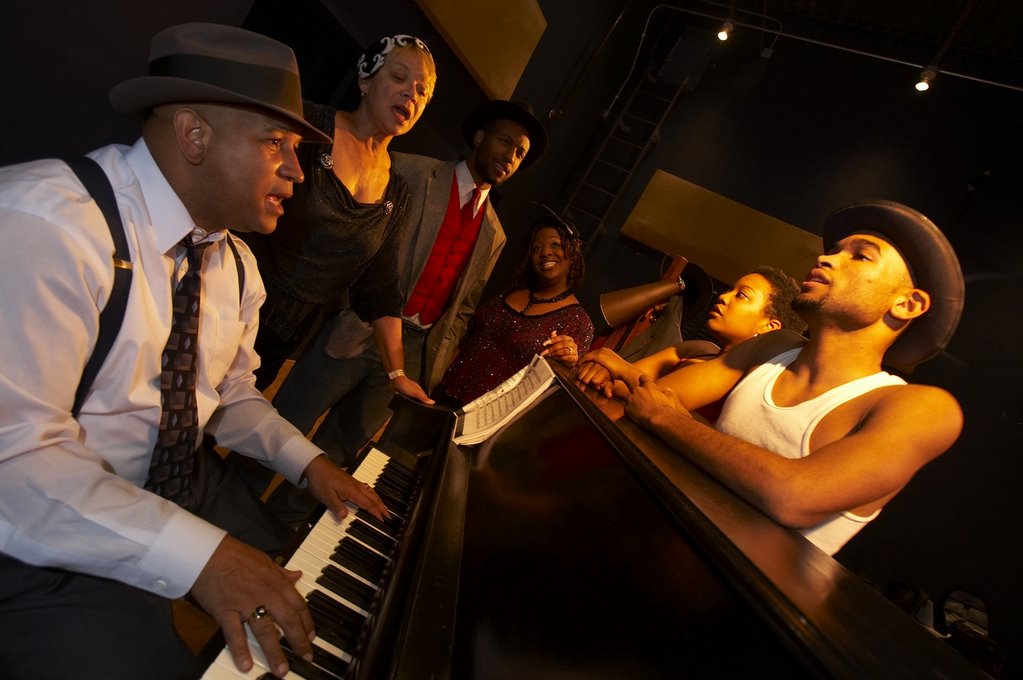
The photo at upper right shows the Charlottesville cast of Ain't Misbehavin' and is courtesy of Live Arts. The poster on the left from the national touring company of Ain't Misbehavin' has been hanging on my kitchen wall for more years than I care to remember.

Friday, February 24, 2006

Private Money for the Arts

Unlike the neighboring Paramount Theatre, which unashamedly sucks at the public teat (the Virginia General Assembly just appropriated another $50,000 in taxpayers' money to what is, in form and function, a commercial performing arts venue) the City Center for Contemporary Arts, which houses the Live Arts theatre group as well as Light House (a film and video educational organization) and the Second Street Gallery (which displays graphic arts) has prided itself on its refusal to take public money.

(I wrote about C3A about a year ago in an article on taxpayer subsidies for arts institutions.)

Today a news release crossed me desk, announcing that Bama Works, the charitable wing of the Dave Matthews Band, is giving C3A a booster shot of more than half a million dolllars.

Here's the news release in its entirety:

DAVE MATTHEWS BAND ANNOUNCES CHALLENGE GRANT TO CHARLOTTESVILLE ARTS COMPLEX

Bama Works Fund pledges $550,000 to City Center for Contemporary Arts


Charlottesville, Virginia (February 23, 2006) – Bama Works Fund, the charitable giving arm of the Dave Matthews Band, announced today a $550,000 pledge to Charlottesville’s City Center for Contemporary Arts.

The pledge represents half of the $1.1 million left to raise to complete the C3A Building Campaign. For the remainder, the band is challenging the local community to pitch in and finish the campaign by the end of the year.

“I believe strongly that everyone should have a chance to participate in the arts,” said DMB’s Carter Beauford. “We feel that there’s a role we can play to help people have access to creative opportunities – not just by funding the arts ourselves, but also by challenging everyone to continue to support the arts and nurture other artists.”

The result of a collaboration between three Charlottesville nonprofit arts organizations – Live Arts, Second Street Gallery and Light House – City Center for Contemporary Arts opened the doors to its partially completed facility in the fall of 2003. The award-winning arts complex houses theater, gallery and film education spaces run by each of the independent organizations.

The organizations hope to finalize their capital campaign, complete unfinished spaces in the building, and provide for long-term maintenance needs by raising funds to match the Bama Works pledge by December 31, 2006.

“Bama Works’ pledge to the completion campaign for City Center is a wonderful way of leading by example,” said organization Chair Thane Kerner. “Their commitment to the arts and philanthropy is without question, but they’re also encouraging our community by saying ‘meet us half way’--which makes their gift doubly powerful.”

Bama Works Fund was established as a part of the Charlottesville Area Community Foundation by the Dave Matthews Band to carry out the band's commitment to charitable works, both close to home and world wide. Bama Works has given to numerous nonprofit organizations, community programs and charities that work for environmental causes, human services, education, and the arts. Dave Matthews Band has also performed at a number of benefit concerts.

For more information about the campaign for City Center for Contemporary Arts, or to make a tax-deductible contribution, please call (434) 293-7552 or visit www.c3arts.org.

Wednesday, December 22, 2004

Folkskunde Returns! (at least temporarily)

Charlottesville has a quite vibrant music scene, whether one prefers classical, choral, jazz, rock, pop, bluegrass .... name your genre, Charlottesville has it.

One of the more interesting and talented young bands to emerge in recent years has been Folkskunde, which fits the classic definition of "garage band" -- in all the best senses of the term. Folkskunde originally came together to play in the fringe area of the Live Arts Summer Theatre Festival. Several of its members are also actors who have appeared in both Live Arts main stage productions and in LATTE productions (that's the Live Arts Teenage Theatre Ensemble, Live Arts' educational arm).

Because Folkskunde's members left high school and moved on to colleges around the country, the group disbanded. Yet an email arrived to say that Folkskunde is reuniting for two performances during Christmas break:


December 22
At the Gravity Lounge
"Song-Off With Folkskunde & Friends"
Each of the members of Folkskunde will be playing their solo repertoires (the songs they've been producing while apart) as they partner with each other and various musician friends.
Door opens at 7:00 PM
$5 Door
www.gravity-lounge.com

January 7
at Starr Hill
"Folkskunde Reunited!"
Back in full force and ready to rock the night away! A rare appearance before they have to head back to college for the next semester. You won't want to miss it!
Opening for Folkskunde: Body 4 Karate and TRMNSPRX
Door opens at 8:00 PM
$5 Advance/$7 Door
www.starrhill.com


Folkskunde consists of Adam Smith, Justin Wolf, Malcolm Perkins, Jacob Wolf, Conner Lacy and Tucker Duncan. Each member writes his own music, which the band performs, and the band as a whole shows a remarkable capacity for improvisation, whether playing on stage as Folkskunde-in-concert or simply backing up poetry readings at the monthly Poetry Lounge (also just ended after nearly two years of gracing the Charlottesville arts scene).

A review earlier this year in The Hook said: "Folkskunde is rarity in local recorded music. It's daring and most importantly, it's fun, a nice break from the monotony of all this hard core jazz that has gotten to be a little bit out of control."

You'll be hearing about Folkskunde again, whether from the band as a whole or from each individual member.


Be sure to visit my CafePress store for gifts and novelty items!
Read my blog on Kindle!