Showing posts with label religion. Show all posts

Wednesday, December 05, 2018

Guest Post: How Hanukkah came to America


Dianne Ashton, Rowan University

Hanukkah may be the best known Jewish holiday in the United States. But despite its popularity in the U.S., Hanukkah is ranked one of Judaism’s minor festivals, and nowhere else does it garner such attention. The holiday is mostly a domestic celebration, although special holiday prayers also expand synagogue worship.

So how did Hanukkah attain its special place in America?

Hanukkah’s back story


The word “Hanukkah” means dedication. It commemorates the rededicating of the ancient Temple in Jerusalem in 165 B.C. when Jews – led by a band of brothers called the Maccabees – tossed out statues of Hellenic gods that had been placed there by King Antiochus IV when he conquered Judea. Antiochus aimed to plant Hellenic culture throughout his kingdom, and that included worshipping its gods.

Legend has it that during the dedication, as people prepared to light the Temple’s large oil lamps to signify the presence of God, only a tiny bit of holy oil could be found. Yet, that little bit of oil remained alight for eight days until more could be prepared. Thus, each Hanukkah evening, for eight nights, Jews light a candle, adding an additional one as the holiday progresses throughout the festival.

Hanukkah’s American story


Dianne Ashton Hanukkah in America Chanukah historyToday, America is home to almost 7 million Jews. But Jews did not always find it easy to be Jewish in America. Until the late 19th century, America’s Jewish population was very small and grew to only as many as 250,000 in 1880. The basic goods of Jewish religious life – such as kosher meat and candles, Torah scrolls, and Jewish calendars – were often hard to find.

In those early days, major Jewish religious events took special planning and effort, and minor festivals like Hanukkah often slipped by unnoticed.

My own study of American Jewish history has recently focused on Hanukkah’s development.

It began with a simple holiday hymn written in 1840 by Penina Moise, a Jewish Sunday school teacher in Charleston, South Carolina. Her evangelical Christian neighbors worked hard to bring the local Jews into the Christian fold. They urged Jews to agree that only by becoming Christian could they attain God’s love and ultimately reach Heaven.

Moise, a famed poet, saw the holiday celebrating dedication to Judaism as an occasion to inspire Jewish dedication despite Christian challenges. Her congregation, Beth Elohim, publicized the hymn by including it in their hymnbook.

This English language hymn expressed a feeling common to many American Jews living as a tiny minority. “Great Arbiter of human fate whose glory ne'er decays,” Moise began the hymn, “To Thee alone we dedicate the song and soul of praise.”

It became a favorite among American Jews and could be heard in congregations around the country for another century.

Shortly after the Civil War, Cincinnati Rabbi Max Lilienthal learned about special Christmas events for children held in some local churches. To adapt them for children in his own congregation, he created a Hanukkah assembly where the holiday’s story was told, blessings and hymns were sung, candles were lighted and sweets were distributed to the children.

His friend, Rabbi Isaac M. Wise, created a similar event for his own congregation. Wise and Lilienthal edited national Jewish magazines where they publicized these innovative Hanukkah assemblies, encouraging other congregations to establish their own.

Lilienthal and Wise also aimed to reform Judaism, streamlining it and emphasizing the rabbi’s role as teacher. Because they felt their changes would help Judaism survive in the modern age, they called themselves “Modern Maccabees.” Through their efforts, special Hanukkah events for children became standard in American synagogues.

20th-century expansion


By 1900, industrial America produced the abundance of goods exchanged each Dec. 25. Christmas’ domestic celebrations and gifts to children provided a shared religious experience to American Christians otherwise separated by denominational divisions. As a home celebration, it sidestepped the theological and institutional loyalties voiced in churches.

For the 2.3 million Jewish immigrants who entered the U.S. between 1881 and 1924, providing their children with gifts in December proved they were becoming American and obtaining a better life.

But by giving those gifts at Hanukkah, instead of adopting Christmas, they also expressed their own ideals of American religious freedom, as well as their own dedication to Judaism.

After World War II, many Jews relocated from urban centers. Suburban Jewish children often comprised small minorities in public schools and found themselves coerced to participate in Christmas assemblies. Teachers, administrators and peers often pressured them to sing Christian hymns and assert statements of Christian faith.

From the 1950s through the 1980s, as Jewish parents argued for their children’s right to freedom from religious coercion, they also embellished Hanukkah. Suburban synagogues expanded their Hanukkah programming.

As I detail in my book, Jewish families embellished domestic Hanukkah celebrations with decorations, nightly gifts and holiday parties to enhance Hanukkah’s impact. In suburbia, Hanukkah’s theme of dedication to Judaism shone with special meaning. Rabbinical associations, national Jewish clubs and advertisers of Hanukkah goods carried the ideas for expanded Hanukkah festivities nationwide.

In the 21st century, Hanukkah accomplishes many tasks. Amid Christmas, it reminds Jews of Jewish dedication. Its domestic celebration enhances Jewish family life. In its similarity to Christmas domestic gift-giving, Hanukkah makes Judaism attractive to children and – according to my college students – relatable to Jews’ Christian neighbors. In many interfaith families, this shared festivity furthers domestic tranquility.

In America, this minor festival has attained major significance.The Conversation

Dianne Ashton, Professor of Religion, Rowan University

This article is republished from The Conversation under a Creative Commons license. Read the original article.

Thursday, March 15, 2018

Guest Post: Who was Mary Magdalene? Debunking the myth of the penitent prostitute

Dorothy Ann Lee, University of Divinity

Who was Mary Magdalene? What do we know about her? And how do we know it? These questions resurface with the release of a new movie, Mary Magdalene, starring Rooney Mara in the titular role.

Mary Magdalene Yvonne de CarloThe question of how we know about her is a relatively simple one. She appears in a number of early Christian texts associated with the ministry of Jesus.
These texts comprise Gospels written in the first and second century of the Common Era (CE). The earliest of them are included in the New Testament, where Magdalene plays a significant role. She also appears in later Gospels, which were not included in the Bible and come from a later period in early Christianity.

The answer about who she was and what we know of her is more complex. In Western art, literature and theology, Mary Magdalene is portrayed as a prostitute who meets Jesus, repents of her sins, and pours oil on his feet in a gesture of humility, penitence and gratitude. She is sometimes depicted kneeling at the foot of the cross, hair unbound, emphasising the sinful past from which she can never quite escape, despite being declared a saint.

The tradition of the penitent prostitute has persisted in the Western tradition. Institutions that cared for prostitutes from the 18th century onwards were called “Magdalenes” to encourage amendment of life in the women who took refuge in them. The word came into English as “maudlin”, meaning a tearful sentimentality. It is not a flattering description.


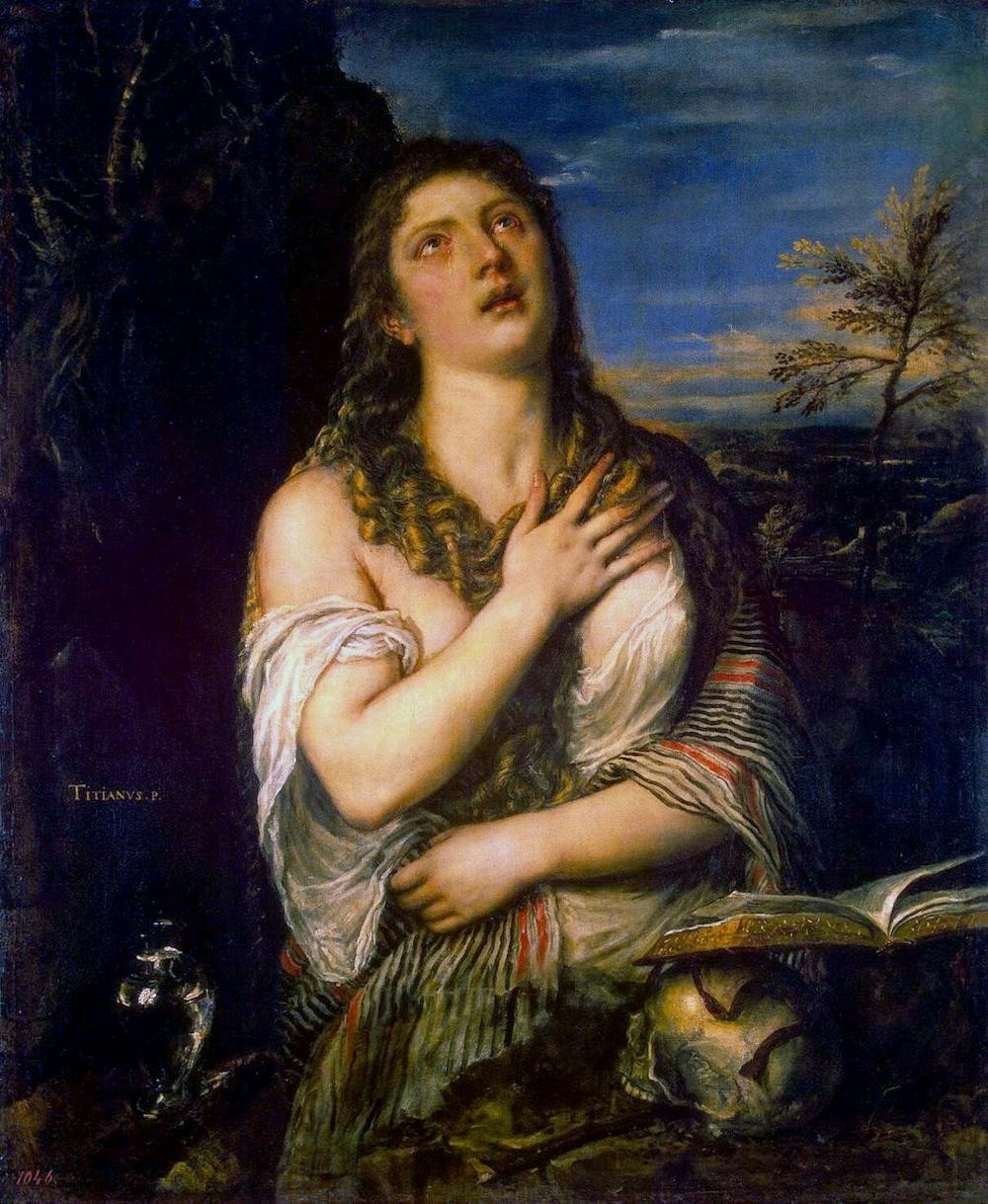
Titian Penitent Magdalene, circa 1565

Titian’s Penitent Magdalene, circa 1565.
Wikimedia Commons


Artistic depictions continued to emphasise Magadelene’s sexuality in various ways, under a facade of piety. In another twist on the same theme, she is presented as the wife of Jesus, most notably in Dan Brown’s The Da Vinci Code (2003).

The tradition of Mary Magdalene as the archetypal penitent whore, whose sexuality somehow manages to persist beyond her conversion, can be dated to a sermon preached by Gregory the Great in the sixth century CE.


Read more:
Weighing up the evidence for the 'Historical Jesus'


Admittedly, there are a confusing number of women called “Mary” in the Gospels and we might assume Pope Gregory was tired of distinguishing between them. He reduced them to two: on the one hand, Mary, the mother of Jesus, perpetual virgin, symbol of purity and goodness, and, on the other, Mary Magdalene, promiscuous whore, symbol of feminine evil from which the world must be redeemed.

A disciple of Jesus


Yet nowhere in the Gospels is Mary Magdalene associated either overtly or covertly with sexuality. The four Gospels of the New Testament present her in two significant roles.

In the first place, she is a disciple of Jesus: one among a band of women and men from Galilee who believed in his message of love and justice and followed him in his ministry.

Secondly, Magdalene is a primary witness in the Gospels to the resurrection of Jesus from the dead. Unlike many of the other disciples, she does not flee when Jesus is arrested. She remains at the cross when he dies and later visits his tomb to find it empty, with a vision of angels declaring his resurrection.

Mark’s Gospel, which we now know to be the earliest Gospel to be written, speaks of Magdalene as a disciple of Jesus who has followed him from Galilee along with other women, but it does not mention her until the crucifixion. These women disciples now stand near the cross, despite the danger in being present at the execution of a dissident.

Three of them, including Magdalene, visit the tomb on Easter morning where they meet an angel who informs them that Jesus has risen from the dead (Mark 16:1-8). The women’s subsequent departure from the tomb is ambiguous, and they leave in fear and silence, which is where the manuscript of Mark’s Gospel abruptly ends. An ending added later makes mention of the risen Jesus making an appearance first to Magdalene.

In Matthew’s Gospel, Magdalene meets the risen Christ as she leaves the tomb, this time with only one other female companion, who is also called “Mary” (Matt 28:1-10). In Luke’s account, Magdalene appears at the cross and at the empty tomb to hear the angel’s words, but she and her female companions are not believed when they convey the message of the resurrection to the apostles (Luke 24:1-11).


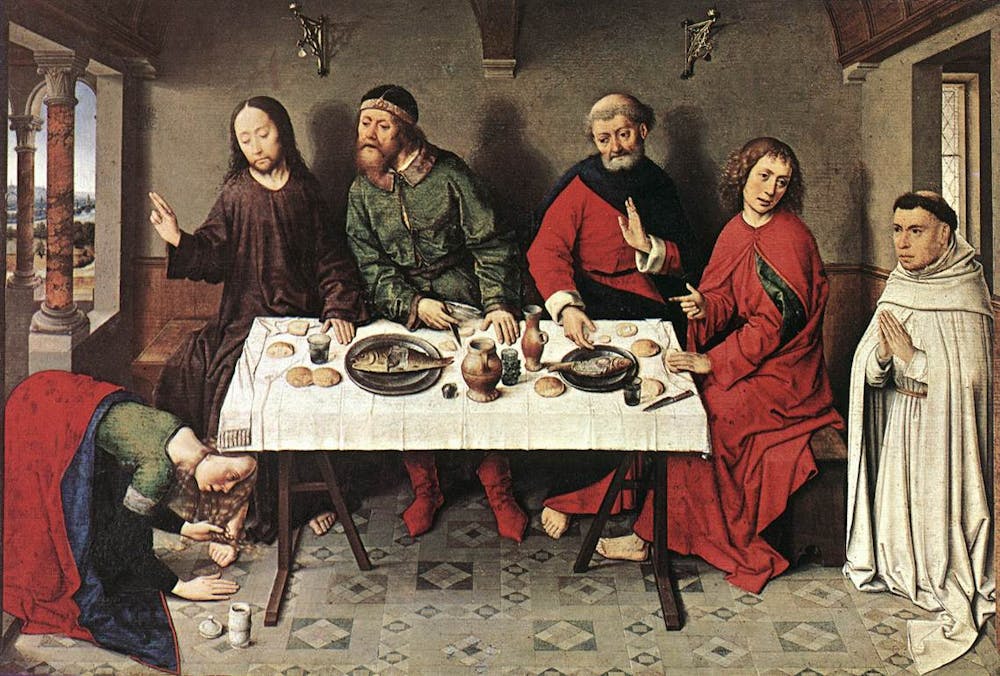
 Mary Magdalene anoints Christ’s feet in Dieric Bouts’ Christ in the House of Simon

Mary Magdalene anoints Christ’s feet in Dieric Bouts’ Christ in the House of Simon (circa 1420–1475).
Wikimedia Commons


In Luke, there is an earlier mention of Magdalene in Jesus’s ministry where she is present, along with other women, as a disciple and supporter of Jesus (Luke 8:1-3). She is described as having had seven demons cast from her. This description might lead to the conclusion, in some minds, that the many “demons” refer to her unfettered sexuality.

But that would be erroneous. Exorcisms — the casting out of evil spirits — are common in the first three Gospels. Those suffering demonic possession are never described as sinful but rather are victims of external evil.

These days, we would associate their symptoms with physical maladies such as epilepsy or mental illness. Magdalene, in other words, has been the victim of a serious illness and Jesus has healed her.


Read more:
How the Bible shapes contemporary attitudes to rape and sexual assault


Furthermore, the description is unusual here in that she is not described in relation to a male figure, as other women at the time generally were: father, husband, brother. She is simply referred to as “the Magdalene”, that is, the woman from Magdala, a Jewish village in Galilee.

We might well assume, from Luke’s description, that she is an independent woman of some means, who is well able to fund, as well as participate in, the movement around Jesus.

Her most significant role


John’s Gospel, however, gives Magdalene her most significant role. Once again, she does not appear until the crucifixion. In the narrative that follows, she comes alone to the tomb on Easter morning, finds it empty, tries unsuccessfully to gain help from two other prominent disciples, and eventually meets the risen Christ himself in the garden (20:1-18). He is alive and commissions her to proclaim the message of his resurrection.

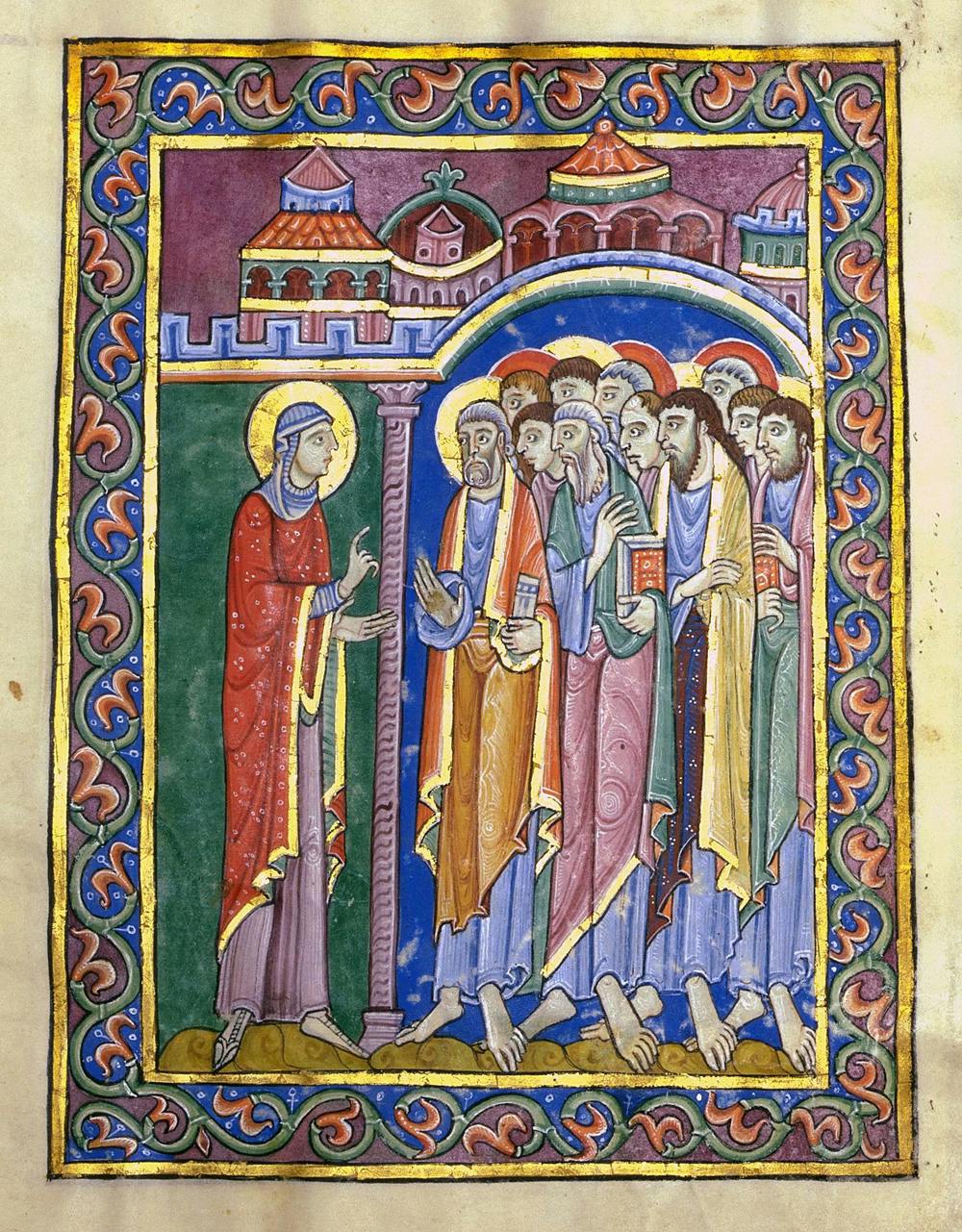
On the basis of John’s story, later tradition gave Magdalene the title of “apostle to the apostles” and recognised something of her significance for Christian faith, witness and leadership. A tragic consequence is that her role as witness to the resurrection was later overshadowed by the apparently more alluring but inaccurate picture of her as the penitent whore.


Mary Magdalene St Albans Psalter

A more accurate portrayal of Mary Magdalene announcing the risen Christ from the 12th-century English illuminated manuscript St Albans Psalter.
Wikimedia Commons


The later Gospels, beyond the New Testament, also emphasise Magdalene’s importance as a disciple of Jesus and witness to the resurrection. The manuscript of the Gospel of Mary, which describes her discussions with the risen Christ, is unfortunately damaged and the central section is missing. In this and other similar Gospels, however, Magdalene is presented as the favoured disciple. This situation leads to some tension with the other disciples, who are jealous of her closeness to Jesus and the teaching she alone is given.

One Gospel speaks of Jesus kissing her, but the imagery in the Gospel of Philip is metaphorical and refers to a spiritual union with Christ. In response to the objection by the other disciples, Jesus asks why he does not kiss them in the same way, implying that they do not as yet possess the same degree of spiritual knowledge.

No evidence of Magdalene anointing Jesus


There is no evidence, incidentally, that Magdalene ever anointed Jesus.

There are three anointing traditions in the Gospels. In one, an unnamed woman anoints Jesus’s head in prophetic recognition of his identity (Gospels of Mark & Matthew). In another, a named and known disciple, Mary of Bethany, who is a model disciple, anoints Jesus’s feet in gratitude for his raising her brother Lazarus from the dead (Gospel of John). In the third, a “sinful woman”, who is not explicitly identified as a prostitute, anoints Jesus’s feet in a gesture of repentance, gratitude and hospitality. None of these three figures is associated in any way with Mary Magdalene in the texts.

The movie Mary Magdalene, directed by Garth Davis, is a significant portrayal of this early Christian figure in the light of evidence from the earliest texts. The screenwriters, Helen Edmundson and Philippa Goslett, are quite clear that Mary is not to be associated with Jesus through her sexuality, either as harlot or wife. On the contrary, she is depicted as a faithful and deeply insightful disciple of Jesus, on whom he draws for his message of love, mercy and forgiveness.


Magdalene is beautifully portrayed in the movie, which draws on traditions from the earlier and later Gospels. She possesses an intense and compelling presence, which does much to restore her character from its later distortions.

It is true that the film makes somewhat erratic use of the New Testament, both in its presentation of Magdalene and of other characters in the story. Towards the end, for example, there is an implication that Magdalene and the church stand on opposite sides, the one in sympathy with Jesus’s teaching and the other anxious to build a self-glorifying edifice on his assumed identity.

This is unfortunate, as the New Testament itself is quite clear about the priority and identity of Magdalene as a key disciple, witness and leader in the early church, without seeing her in opposition to others.

Indeed, those who campaigned in a number of Christian churches for the ordination of women in the 20th century used precisely the example of Mary Magdalene from the New Testament as “apostle to the apostles” to support their case for women’s equality and leadership.

The recent installation of Kay Goldsworthy as Archbishop of the Anglican Diocese of Perth — the first woman in this country and across the world to be given this title — is the true heir of Magdalene as she is portrayed in the earliest Christian writings.


The ConversationThe film Mary Magdalene opens in Australian cinemas on March 22.

Dorothy Ann Lee, Frank Woods Professor of New Testament, Trinity College, University of Divinity

This article was originally published on The Conversation. Read the original article.

Wednesday, January 10, 2018

From the Archives: Wrestling with the 'Naked Truth' About Religion on TV (1996)

This article appeared in various newspapers, including The Metro Herald, in January 1996:

Wrestling with the "Naked Truth" About Religion on TV
Richard E. Sincere, Jr.

By most accounts, modern entertainment media seldom -- if ever -- treat religious belief and practice with the seriousness and respect they deserve. Gone are the days when religious commitment was portrayed in a positive light. Unlike the 1940s, when movies such as Going My Way and The Song of Bernadette won both crowds and awards, the 1990s are strangely bereft of authentic portrayals of religious life.

There have, indeed, been some attempts to use religious life as the basis for TV series. Remember The Flying Nun? The Father Dowling Mysteries featured a priest and a nun as crimesolvers -- a gimmick to dress up a ho-hum detective story in clerical garb. Amen, starring a post-Jeffersons Sherman Hemsley, was set in an urban, vaguely Baptist church. None of these, however, dealt with religious belief in a sustained, serious manner. Religion was simply a frame in which to project otherwise unexceptionable storylines.

Although Americans are about the most religious people in the world, those who produce and write television programs tend to be among the "non-believers." These media elite live the lives Thomas Carlyle had in mind when he suggested that "if Jesus Christ were to come today, people would not even crucify him. They would ask him to dinner, and hear what he had to say, and make fun of it."

Tea Leoni The Naked Truth TV Guide 1995Thus it was with some surprise that the January 10 episode of The Naked Truth, an ABC-TV sitcom, focused respectfully on religious belief.

For those unfamiliar with this series, its main character, Nora, is a professional photographer who, through bad luck and poor personal choices, has been forced to take a job with a supermarket tabloid, The Comet, which makes The National Enquirer look like The Wall Street Journal. Once nominated for a Pulitzer Prize, Nora has descended to the depths of taking snapshots of buxom model Anna Nicole Smith at her gynecologist's office, and of Tom Hanks with his hand stuck down the fly of his trousers.

On January 10, The Naked Truth found Nora improbably dating a young man who spent the past five years on Zarkon-B, a planet 7,000 light-years from Earth. (He was, it seems, abducted by aliens.) At the same time, trying to track down Drew Barrymore for a Comet story, Nora disguises herself as a nun and runs into an old college friend -- once known as "Luscious" -- who is now Sister Katherine.

Nora, who in each episode frantically defends herself against the slings and arrows of daily life, is impressed by Sister Katherine's serenity and inner peace. ("Why did you become a nun?" Nora asks. Replies Sister Katherine: "Somehow being a drunken slut was strangely unfulfilling.")

When all the world seems to be against her, Nora takes her troubles to a drinking buddy, who makes Nora confront her own lack of belief. She plaintively asks why Sister Katherine can be so serene, while her own life is consumed by one trouble after another. Nora's friend suggests that Sister Katherine has found the love of God to guide her. Nora responds by saying she can't buy into that God business. "I haven't prayed since I was in grade school," she says.

Her friend gets right to the point. You can believe that your boyfriend was abducted by aliens and came to Earth from another planet, he says, but you can't believe there's a superior being who loves us? "What made you too cool for God?" he asks.

Nora returns to the convent to tell Sister Katherine that she, too, would like to become a nun. Sister Katherine, appropriately skeptical, suggests that Nora feels a great thirst and wants "to drink the ocean." Perhaps it would be better, the sister says, to start with "one glass of water." Departing for vespers, Sister Katherine invites Nora to wait an hour for her return. "What will I do for an hour?" Nora asks. "You'll think of something," says Sister Katherine.

Indeed she does. The scene closes with Nora kneeling in a pew, facing the altar, saying out loud: "Hello, God, this is Nora. Long time no see."

Tea Leoni The Naked Truth This summary does little justice to this tightly-packed, amusing half-hour. The writers are to be commended for their ability to deal with serious philosophical issues in a light-hearted, yet respectful, manner. Sister Katherine shows that, even in a convent, she and the other nuns are part of this world, not some other ethereal one. Nora displays her heartfelt need to seek something beyond herself, something that can guide her decisionmaking. Not yet sure of what she needs, she approaches Sister Katherine for assistance.
All this, despite the humor, is done without mockery. What shocks is not the placement of religious topics in a situation comedy -- this has been done before (Buddy Sorrell's bar mitzvah on The Dick Van Dyke Show, or the presence of Father Mulcahy on M*A*S*H). What is startling is the respectful treatment, something one simply does not expect in the 1990s. The message is clear: Faith in God is something worth seeking; religious faith can help us define our identities and guide our actions.

If this episode of The Naked Truth is idiosyncratic, it means that the Hollywood elite are just as hostile toward -- or indifferent to -- the religious commitment of the vast majority of Americans as they have been over the past 40 years. If, however, it is not unique, we have reason to remain hopeful.

* * * * * * * * * *
Richard Sincere is entertainment editor of The Metro Herald, a weekly newspaper based in Alexandria, Virginia.


Saturday, December 16, 2017

Guest Post: Historically Religious Origins of Wine, Beer, and Liquor


Michael Foley, Baylor University

Each year the holidays bring with them an increase in both the consumption of alcohol and concern about drinking’s harmful effects.


Religious Origins of Wine, Beer, and Liquor

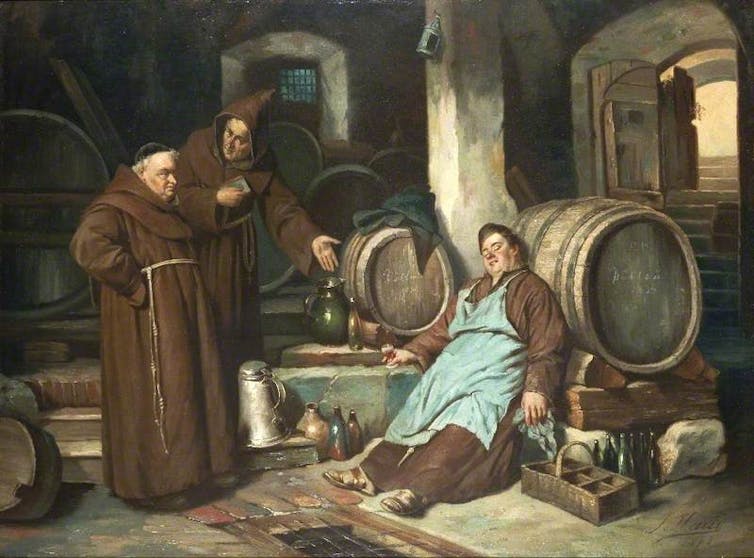
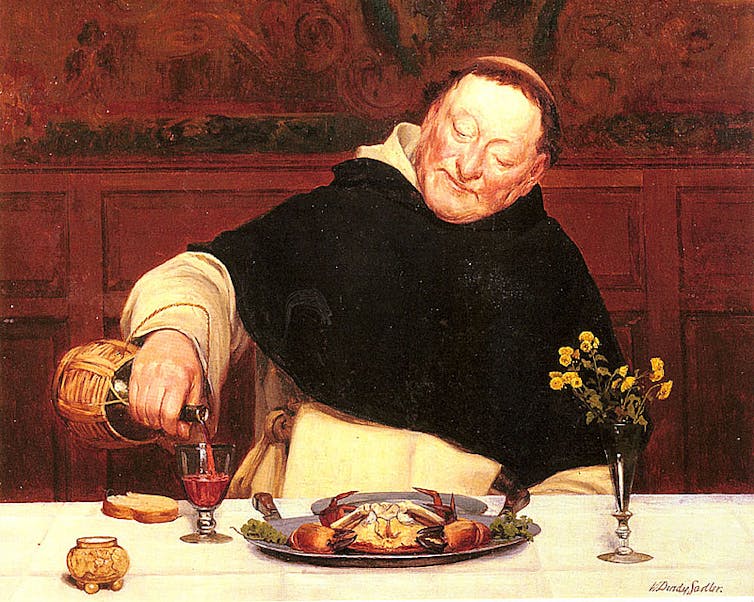
Pious drinking.
Walter Dendy Sadler via Wikimedia Commons


Alcohol abuse is no laughing matter, but is it sinful to drink and make merry, moderately and responsibly, during a holy season or at any other time?

As a historical theologian, I researched the role that pious Christians played in developing and producing alcohol. What I discovered was an astonishing history.

Religious orders and wine-making


Wine was invented 6,000 years before the birth of Christ, but it was monks who largely preserved viniculture in Europe. Religious orders such as the Benedictines and Jesuits became expert winemakers. They stopped only because their lands were confiscated in the 18th and 19th centuries by anti-Catholic governments such as the French Revolution’s Constituent Assembly and Germany’s Second Reich.

In order to celebrate the Eucharist, which requires the use of bread and wine, Catholic missionaries brought their knowledge of vine-growing with them to the New World. Wine grapes were first introduced to Alta California in 1779 by Saint Junipero Serra and his Franciscan brethren, laying the foundation for the California wine industry. A similar pattern emerged in Argentina, Chile and Australia.


Religious Origins of Wine, Beer, and Liquor alcoholic beverages

Monks in a cellar.
Joseph Haier 1816-1891, via Wikimedia Commons


Godly men not only preserved and promulgated oenology, or the study of wines; they also advanced it. One of the pioneers in the “méthode champenoise,” or the “traditional method” of making sparkling wine, was a Benedictine monk whose name now adorns one of the world’s finest champagnes: Dom Pérignon. According to a later legend, when he sampled his first batch in 1715, Pérignon cried out to his fellow monks:

“Brothers, come quickly. I am drinking stars!”

Monks and priests also found new uses for the grape. The Jesuits are credited with improving the process for making grappa in Italy and pisco in South America, both of which are grape brandies.

Beer in the cloister


And although beer may have been invented by the ancient Babylonians, it was perfected by the medieval monasteries that gave us brewing as we know it today. The oldest drawings of a modern brewery are from the Monastery of Saint Gall in Switzerland. The plans, which date back to A.D. 820, show three breweries – one for guests of the monastery, one for pilgrims and the poor, and one for the monks themselves.

One saint, Arnold of Soissons, who lived in the 11th century, has even been credited with inventing the filtration process. To this day and despite the proliferation of many outstanding microbreweries, the world’s finest beer is arguably still made within the cloister – specifically, within the cloister of a Trappist monastery.

Liquors and liqueurs


Equally impressive is the religious contribution to distilled spirits. Whiskey was invented by medieval Irish monks, who probably shared their knowledge with the Scots during their missions.


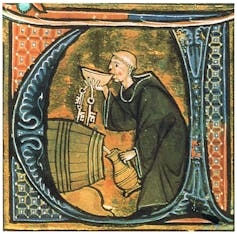
monk sneaking a drink monasteries liqueur beer wine

Monk sneaking a drink.
Scanned from Den medeltida kokboken, Swedish translation of The Medieval Cookbook by Maggie Black, via Wikimedia Commons.


Chartreuse is widely considered the world’s best liqueur because of its extraordinary spectrum of distinct flavors and even medicinal benefits. Perfected by the Carthusian order almost 300 years ago, the recipe is known by only two monks at a time. The herbal liqueur Bénédictine D.O.M. is reputed to have been invented in 1510 by an Italian Benedictine named Dom Bernardo Vincelli to fortify and restore weary monks. And the cherry brandy known as Maraska liqueur was invented by Dominican apothecaries in the early 16th century.

Nor was ingenuity in alcohol a male-only domain. Carmelite sisters once produced an extract called “Carmelite water” that was used as a herbal tonic. The nuns no longer make this elixir, but another concoction of the convent survived and went on to become one of Mexico’s most popular holiday liqueurs – Rompope.

Made from vanilla, milk and eggs, Rompope was invented by Clarist nuns from the Spanish colonial city of Puebla, located southeast of Mexico City. According to one account, the nuns used egg whites to give the sacred art in their chapel a protective coating. Not wishing the leftover yolks to go to waste, they developed the recipe for this festive refreshment.

Health and community


So why such an impressive record of alcoholic creativity among the religious? I believe there are two underlying reasons.

First, the conditions were right for it. Monastic communities and similar religious orders possessed all of the qualities necessary for producing fine alcoholic beverages. They had vast tracts of land for planting grapes or barley, a long institutional memory through which special knowledge could be handed down and perfected, a facility for teamwork and a commitment to excellence in even the smallest of chores as a means of glorifying God.


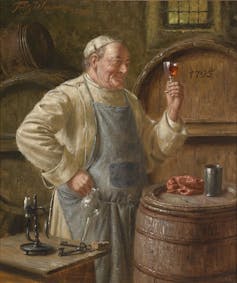
alcoholic beverages promote health

Historically, alcohol was seen to be promoting health.
Fritz Wagner (1896-1939) (Dorotheum) , via Wikimedia Commons


Second, it is easy to forget in our current age that for much of human history, alcohol was instrumental in promoting health. Water sources often carried dangerous pathogens, and so small amounts of alcohol would be mixed with water to kill the germs therein.

Roman soldiers, for example, were given a daily allowance of wine, not in order to get drunk but to purify whatever water they found on campaign. And two bishops, Saint Arnulf of Metz and Saint Arnold of Soissons, are credited with saving hundreds from a plague because they admonished their flock to drink beer instead of water. Whiskey, herbal liqueurs and even bitters were likewise invented for medicinal reasons.

And if beer can save souls from pestilence, no wonder the Church has a special blessing for it that begins:

The Conversation“O Lord, bless this creature beer, which by Your kindness and power has been produced from kernels of grain, and may it be a health-giving drink for mankind.”
Michael Foley, Associate Professor of Patristics, Baylor University

This article was originally published on The Conversation. Read the original article.

Friday, December 08, 2017

Guest Post: Did early Christians believe that Mary was a teenager?

Christopher A. Frilingos, Michigan State University

On Nov. 13, a fifth Alabama woman came forward to accuse Roy Moore, former judge and current GOP Senate candidate, of sexual assault when she was 16. Condemnation of Moore has been widespread, but Moore himself vehemently denies these allegations. He has backing from many in Alabama.

One of his most controversial statements of support came from Alabama State Auditor Jim Ziegler, who declared: “there’s nothing immoral or illegal here…Maybe just a little unusual.” Ziegler went on to appeal to the Christian story of Mary and Joseph:

“Take Joseph and Mary. Mary was a teenager and Joseph was an adult carpenter. They became parents of Jesus.”

I find the allegations against Moore repulsive. But, in addition, as a scholar of early Christianity, Ziegler’s remarks took my breath away. As most Christians would know, an important tenet of Christian theology is that Jesus was born of a virgin mother.


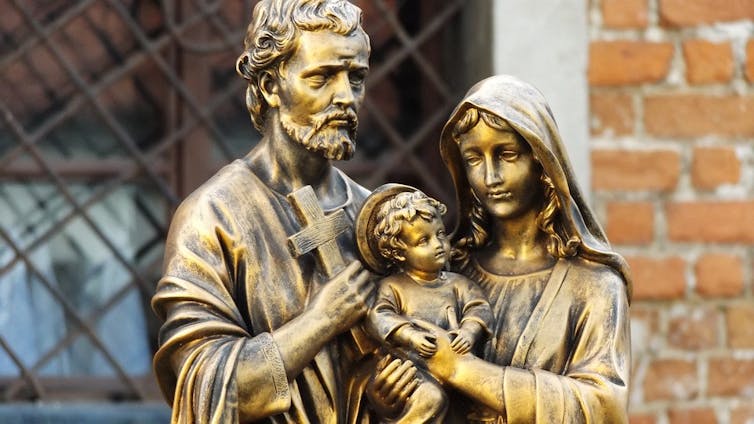
File 20171114 26420 1txgrhj.jpg?ixlib=rb 1.1

The holy family.
CC BY


However, there are many other little-known details in early Christian storytelling about the relationship between Mary and Joseph that I learned while researching my book, Jesus, Mary, and Joseph: Family Trouble in the Infancy Gospels. Early Christians believed that Mary and Joseph did not have sex, but there was much more that was worth learning from that relationship.

Listen up, Jim Ziegler.

The gospel narratives


The Christian Bible includes four gospels, or narratives, of the life of Jesus. Two of them, the Gospel of Matthew and the Gospel of Luke, include accounts of Jesus’s birth. These two versions of the “Christmas story” supply almost all of the details about Mary and Joseph that can be found in the Christian Bible.

In Matthew 1-2, readers learn about the birth of Jesus in Bethlehem, the visit of the Magi or “wise men” to see the newborn and the flight of the holy family to Egypt in order to escape King Herod’s killing of infants. Luke 1-2 describes the birth of John (the cousin of Jesus), an imperial census under the Roman Emperor Augustus and the appearance of angels celebrating the birth of Jesus in the skies above Bethlehem.

Both the gospels seem to agree that Mary conceived by supernatural means, not through sexual intercourse. Meanwhile, whatever Zeigler claims, neither the Gospel of Matthew nor the Gospel of Luke specifies the ages of Mary and Joseph.

The Proto-gospel of James


The earliest source to mention ages is another ancient Christian gospel: the Proto-gospel of James. This gospel is a prequel to the more familiar stories of the first Christmas found in the Christian Bible. It was written in the second century A.D., a hundred years or so after the gospels of the Christian New Testament. Critically, it is mostly unknown to Christians because it is not found in their Bibles.

Even so, the Proto-gospel of James is an important witness to the things that mattered to early Christians. The relationship of Mary and Joseph is one of them.

The Proto-gospel of James tends to fill in gaps left by the Gospels of Matthew and Luke. This, for example, is where readers can learn about the parents of Mary – Joachim and Anna – and about the divine intervention that leads to Anna’s conception of Mary.

This gospel also recounts the story of when Mary met Joseph, details absent from the Gospels of Matthew and Luke. In this telling, Joseph, an elderly widower, is chosen by lottery to take care of Mary, who is 12 years old at the time.

Like the Gospels of Matthew and Luke, the Proto-gospel of James reports that Mary does not conceive through sexual intercourse. She receives news from the angel Gabriel that she will become pregnant and bear a son, Jesus. But the Proto-gospel of James’s account adds a new wrinkle: Mary forgets about her encounter with the angel. When she realizes that she’s pregnant, she’s overcome with fear and confusion. Joseph is likewise confused by Mary’s pregnancy. He nevertheless remains loyal and protects the 12-year-old girl. He takes her to a cave outside of Bethlehem. Soon there is a blinding flash of light. As it recedes, a child appears.

Jesus has arrived.

Familiar and unfamiliar


Some of these details will be familiar to readers of the New Testament: the town of Bethlehem, for example, and the angelic announcement to Mary – the Annunciation – that she will become pregnant.

Other details, however, will come as a surprise: Wasn’t Jesus born in Bethlehem, and not, as the Proto-gospel of James reports, outside of Bethlehem in a cave? And what about the story of how Mary met Joseph? The Proto-gospel of James adds to and changes elements of the earlier accounts of Matthew and Luke.

And then there are details that some Christians know from their religion that other Christians do not. Most Orthodox and Roman Catholics, for example, know the names of Anna and Joachim, the parents of Mary, even though they do not include the Proto-gospel of James in their Bibles. Most Protestant Christians, by contrast, will be unfamiliar with these figures.

In fact, the Proto-gospel of James is just one example of a wide range of gospels and other early Christian writings that are not included in the Christian Bible. The storytelling about the holy family alone could fill a bookshelf: There is the Infancy Gospel of Thomas, the Gospel of Pseudo-Matthew and the History of Joseph the Carpenter. Written at different times in different places, these accounts reflect the early Christian fascination with the household of Jesus, Mary and Joseph.

Love is not predatory


One final observation that is relevant to Jim Ziegler’s comments: The Proto-gospel of James goes a step further than the Gospels of Matthew and Luke in making the point that there was no sexual contact between Mary and Joseph.


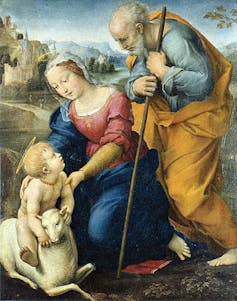
Holy family with the lamb.
Raphael via Wikimedia Commons


In the Gospel of Matthew, Joseph overcomes personal anxiety about Mary’s pregnancy. In the Proto-gospel of James, the pregnancy of Mary becomes a matter of public scrutiny: Both Mary and Joseph must drink the “water of refutation,” a life-and-death ordeal designed to test the truth of their claims of not having had sex with one another. Both pass the test.

But the Proto-gospel of James is not just a story about the virginity of Mary, nor is it just about Joseph’s lack of involvement in the conception of Jesus. Mostly, it is a story about two people being swept up in events that they do not understand.

Together, Mary and Joseph risk everything despite not knowing what it all means. Amid the chaos, they learn to lean on each other. While Mary and Joseph do not, according to the Proto-gospel of James, have a physical relationship, they do love one another.

The ConversationAnd love should not be compared to the predatory behavior alleged against Roy Moore.
Christopher A. Frilingos, Associate Professor in the Department of Religious Studies, Michigan State University

This article was originally published on The Conversation. Read the original article.


Tuesday, December 05, 2017

Guest Post: Jesus as a sausage roll echoes the Gospel of John

M J C Warren, University of Sheffield

With more than 1,000 outlets across the length and breadth of the United Kingdom, Greggs the baker is a national institution. It’s not uncommon for queues to form in some towns and cities as the daily doughnuts, cheese and onion pasties and steak bakes come out of the ovens. But it is the sausage roll that is the star turn.

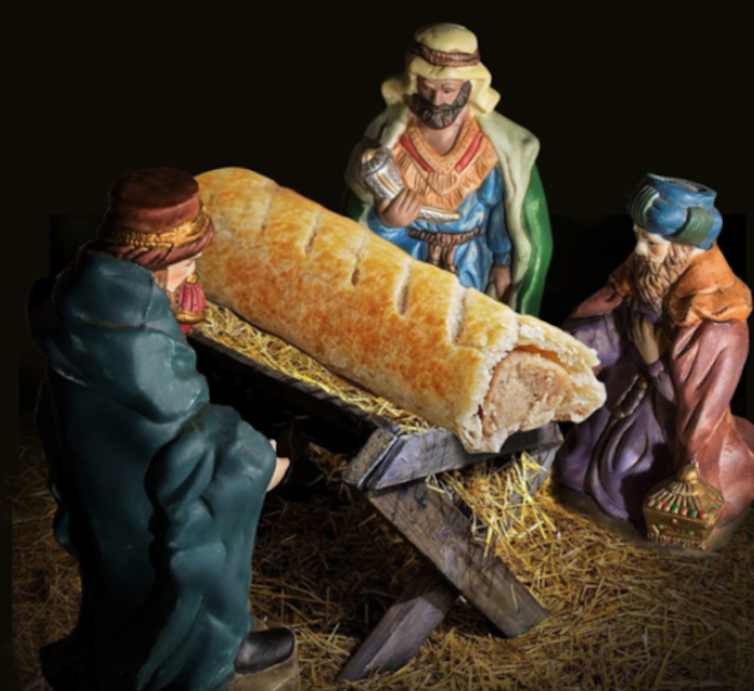
Now though, it seems it is the star that Greggs took too far. For Britain’s biggest bakery has had to apologise after it replaced the traditional baby Jesus in the manger with its famed product in a nativity scene. The image was used to promote its advent calendar and, the company says, wasn’t meant to cause offence.


File 20171116 15410 yqfi5r.png?ixlib=rb 1.1

It’s big, but it might not feed 5,000.
Greggs


Well, regardless of intentions, the image, with three wise men reverently surrounding a golden sausage roll in a manger, caused quite an uproar.

Many Christian Twitter users were at the forefront of this backlash against the image, tapping into the false narrative of the persecution of Christians in Western countries including the UK and US, and the idea that there is a “war on Christmas”.

While many of the “war on Christmas” debates focus on the secularisation of the winter holiday, in this instance the attention was on a private company supposedly making light of the baby Jesus for profit.

One organisation, the right-wing pressure group the Freedom Association, led by Simon Richards, called for a boycott of Greggs as a result of the image.


The viral growth of the hashtag #boycottGreggs has prompted the bakery to issue a formal apology. “We’re really sorry to have caused any offence, this was never our intention,” said a spokesperson.

My flesh is meat indeed


However, what might not be apparent at first glance is just how appropriate this debate about Jesus-as-sausage-roll is in light of the Gospels – and the Gospel of John in particular. Although the Gospel of John doesn’t describe the nativity scene that we find in Luke and Matthew, it is a Gospel intent on describing Jesus as a food.

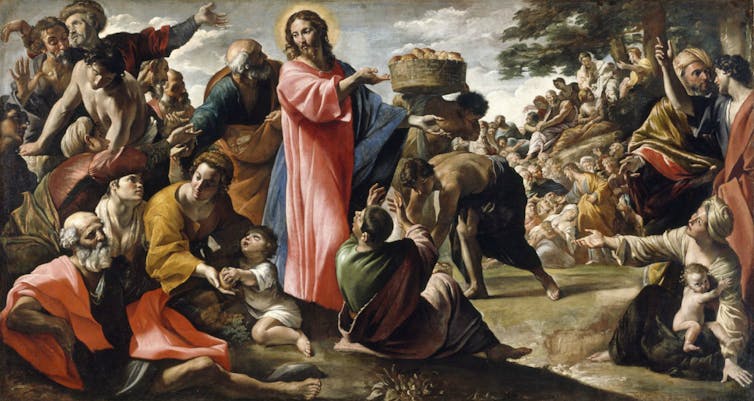
In one well-known scene, after he has fed the 5,000 on the shores of the Sea of Galilee, Jesus launches into a speech known as the “Bread of Life Discourse”. John’s Gospel uses several metaphors to describe Jesus here, including both bread and meat – and scholars have argued that Jesus means what he says.


Giovanni Lanfranco, Miracle of the Bread and Fish (1620-1623).
Wikimedia Commons


First Jesus declares: “I am the living bread.” Those listening to him are understandably confused, since they don’t see a loaf of bread in front of them but “Jesus, the son of Joseph, whose father and mother we know.” When Jesus hears them doubting his claims, he repeats his claim three times, finally stating explicitly that “the bread … is my flesh”.

After this conversation, Jesus makes a second claim about his body, this time that it is flesh to be eaten. In the King James Version, Jesus emphatically declares: “My flesh is meat indeed.” Even if we accept a metaphorical reading of Jesus’s words, there is no question that John the Evangelist understood Jesus in edible terms.

Offence and the Gospels


If Jesus as bread and meat is biblical in its origins, it might be surprising to see that the outrage over these claims is not unique to the current uproar around the Greggs advert.

The Gospel of John first describes people’s disbelief of what Jesus says – they doubt he is the bread he claims to be. But the real outrage comes when Jesus declares that he’s made of meat, and that people should be eating him. Even his followers, his disciples, have trouble with this: “When many of his disciples heard it, they said, ‘This teaching is difficult; who can accept it?’” Jesus, seeing that what he’s said has offended them, doubles down on his claims – and some of his (nameless) disciples decide to leave him.

Not unlike the current furore over Jesus the Sausage Roll, the Gospel of John depicts uproar and offence at Jesus being compared to food. It seems that comparing Jesus to food has a long history of causing outrage, then, but that doesn’t mean that it’s wrong – the Bible itself recognises both the comparison and the ensuing offence.

War on Christmas


Paradoxically, then, Greggs has actually provided a scripture-inspired vision of the nativity that Christians often complain is increasingly absent in the run-up to Christmas.


The ConversationWhile there is no real war on Christmas, those anxious about what they perceive as a lack of Jesus in the advent season should take another look at the Greggs ad, which places a biblical understanding of Jesus right in the centre.

M J C Warren, Lecturer in Biblical and Religious Studies, University of Sheffield

This article was originally published on The Conversation. Read the original article.

Saturday, June 17, 2017

Guest Post: The Qur’an, the Bible and homosexuality in Islam


Christopher van der Krogt, Massey University

Neither the Bible nor the Qur’an (Koran) has a lot to say about homosexuality, and what they do say relates only indirectly to contemporary discussions about gay rights and same-sex marriage. Like pre-modern scholars of law and ethics, these books assume heteronormativity.


Peter Paul Rubens, Lot and his family escaping from the doomed city guided by an angel, circa 1615.


Peter Paul Rubens, Lot and his family escaping from the doomed city guided by an angel, circa 1615.


As a concept, homosexuality is relatively recent, even if there is plenty of evidence for homoerotic pleasure in the past – albeit illicit in religious terms.

Scriptures and later writers usually referred only to particular sexual acts and did not raise the issue of personal sexual orientation. For religious conservatives, though, both Muslim and Christian, the occasional derogatory reference to same-sex acts is enough to prove their inherent sinfulness in all circumstances.

More liberal interpreters point to broader ethical considerations such as compassion and empathy. They argue that the condemnations of scripture do not apply to committed relationships founded on love.

Such a perspective, however, is inevitably more common among believers concerned with human rights, influenced by gender theory, and trained in contextual and holistic methods of interpretation.

Homosexuality in the Bible


Leviticus 20:13 (cf. 18:22) declares it abominable for a man to lie with another man as with a woman, and both partners are to be executed. The possibility that one party has been coerced is not discussed: both are defiled. However, the offence seems to be no worse than other capital crimes mentioned in the same context, such as adultery and incest.

Paul evidently regarded the prohibition of sexual acts between men or between women as violations of natural law known even to non-Jews – at least if their minds were not clouded by idolatry (Romans 1:18–32; 2:14–16).

He seems to have reflected contemporary views that men should be sexually assertive and women passive, and that sexual activity must be at least potentially procreative.

Sodom and sodomy


Lot fleeing with his family, by Peter Paul Rubens, 1615.

Lot fleeing with his family, by Peter Paul Rubens, 1615.
via Wikimedia Commons


For Jews, Christians, and Muslims alike, the story of Sodom is central to the traditional condemnation of male homosexuality. As recounted in Genesis 19, however, this is not a story about love or consensual sex between men: it is about rape and inhospitality.

The mob that gathers outside Lot’s house need not be exclusively male (the Hebrew plural anashim can include both genders), and the text says all ages were represented (Genesis 19:4, 11). When the crowd demands Lot’s visitors, he offers his two virgin daughters in their stead. Perhaps he considers the rape of his daughters a lesser evil than the rape of his guests.

The fact that the guests are male is not emphasised. After the visitors (angels in human form) rescue Lot and his family, God rains down fire and brimstone upon Sodom, Gomorrah, and other cities nearby.

Actually, he had already determined to punish all these towns and their inhabitants, male and female, young and old, before the angels’ visit and the attempted homosexual rape (Genesis 18:16–33). When the wickedness of Sodom is recalled in other parts of the Bible, homosexuality is not mentioned. Yet, despite this broader context, the story was often interpreted primarily as a condemnation of homosexual activity in any form.

In the Qur’an, the somewhat ineffectual Lot of Genesis becomes the Prophet Lut. The Arabic term for homosexual anal intercourse, liwat, comes from his name rather as English derived the term sodomy from the name of the town.

As in Genesis, Lut seems to argue with the men of Sodom over the relative propriety of abusing his daughters or his guests (11:78–79; 15:67–69). More often, though, the emphasis is on his condemnation of lusting after men instead of women (7:80–81; 26:165–66; 27:55; 29:29). In the Qur'an, Lut says:

Indeed, you approach men with desire, instead of women. Rather, you are a transgressing people.

Traditional Islamic perspectives


In the Hadith (thousands of stories reporting the words and deeds of Muhammad and his companions that are comparable in authority to the Qurʾan itself), there is some support for the notion that the principal offences of Sodom were idolatry and avarice. These led in turn to inhospitality and the rape of male visitors.


 Hadith Silsilat al Dhahab (Golden Chain Statue) in Nishapur, Iran.

Hadith Silsilat al Dhahab (Golden Chain Statue) in Nishapur, Iran.
Sonia Sevilla, CC BY


Nevertheless, the Hadith do unequivocally condemn male homosexual acts. The Qur’an (4:16) demands unspecified punishment for men guilty of lewdness together unless they repent.

Yet, the Prophet is supposed to have declared that both the active and the passive partner should be subject to the same penalty as for zina (illicit heterosexual sex, usually adultery), namely execution by stoning. Abu Dawud’s authoritative hadith collection records a report from Abdullah ibn Abbas:

The Prophet (peace be upon him) said: If you find anyone doing as Lot’s people did, kill the one who does it, and the one to whom it is done (38:4447).

It is doubtful whether any passage of the Qur’an refers to lesbian acts though the condemnation of women who commit indecency (4:15) is sometimes read this way. A few hadith warn women against seeing or touching each other when naked.

Traditional Islamic jurisprudence assumed strict gender roles. The 17th-century Muslim scholar Haskafi explicitly included “a male” in his list of those whom a man could not legally marry.

Marriage was understood in hierarchical terms, but although a man could have sexual relations with female slaves, he did not have the same rights over male slaves.

Pre-modern scholars who produced lists of “enormities” included liwat and sometimes tribadism (“rubbing”, that is, lesbian intercourse) after zina. Prescribed penalties for homosexual acts varied according to different schools and individual scholars. In any case, it was difficult to attain the required level of eye-witness testimony.

In practice, homosexual encounters, including with young male prostitutes, seem to have been quite common in Islamic societies. They were no more or less a cause for moralistic concern than other forms of illicit sex.

Reinterpreting the Islamic tradition


Without actually endorsing homosexuality, some Muslims in Western societies have recognised a parallel between the religious acceptance they demand and the acceptance demanded by gays and lesbians.

The New Zealand Muslim MP Ashraf Choudary (who did not realise that the Qur'an does not urge the stoning of homosexuals) observed that,

if the law allows one minority group in our society to be discriminated against then all minorities are vulnerable.

Some, such as Cambridge philosopher Abdal Hakim Murad (Timothy Winter), have accepted that a homosexual orientation may be innate but say that does not make homosexual sex permissible.

Deducing that it may therefore be legitimate remains a step too far for most.

Traditionally, if sins can be forgiven when repented, declaring forbidden acts not to be sinful has been regarded as heresy or even apostasy. Commentators such as Mehdi Hasan, after wrestling thoughtfully with the issues, have concluded that while they do not approve of homosexual acts, they cannot condone homophobia.

A similar message was offered by Tariq Ramadan, Professor of Contemporary Islamic Studies at Oxford, when he visited New Zealand: Muslims and others have to respect each other, which includes accepting that the law permits gay marriage.


Imam Daayiee Abdullah Reverend Dwayne Johnson

Imam Daayiee Abdullah, seen here with Reverend Dwayne Johnson discussing religion and LGBT rights in the U.S., is openly gay. He’s argued that ‘there is nothing wrong with Quran. The problem is with how people have interpreted it.’
East-West Center, CC BY-NC-SA


For Muslims generally, as for conservative Christians, homosexual acts are sinful. It is difficult to be openly gay or lesbian in predominantly Islamic countries, but in the West, there are even (a few) gay imams.

There are also support groups for gay and lesbian Muslims. Writers such as Scott Kugle (Siraj al-Haqq) try to reconcile Islamic identity with alternative sexual orientations. Like their Jewish and Christian counterparts, they seek the “original” meaning of scriptural texts obscured by generations of patriarchal, heteronormative interpreters.

They also question the authenticity of certain hadith – in the traditional manner by scrutinising their chains of transmission – and reopen past debates such as that concerning “temporary” marriage. The latter need not be short-term and may offer an alternative framework for co-habitation without formal marriage.

Christian gays and lesbians have had to work hard for a measure of recognition among fellow-believers; their Muslim counterparts are just beginning that struggle.


The ConversationAcknowledgement: The most useful source for this essay has been Kecia Ali, Sexual Ethics and Islam: Feminist Reflections on Qur'an, Hadith and Jurisprudence (Oneworld Publications, new edition, 2016).

Christopher van der Krogt, Lecturer in History, Massey University

This article was originally published on The Conversation. Read the original article.