Showing posts with label Paramount. Show all posts

Tuesday, January 24, 2017

From the Archives: Belafonte criticizes Barack Obama on civil liberties in Charlottesville

Publisher's note: This article was originally published on Examiner.com on January 24, 2012. The Examiner.com publishing platform was discontinued July 1, 2016, and its web site went dark on or about July 10, 2016. I am republishing this piece in an effort to preserve it and all my other contributions to Examiner.com since April 6, 2010. It is reposted here without most of the internal links that were in the original.

Belafonte criticizes Barack Obama on civil liberties in Charlottesville

Harry Belafonte in Charlottesville - January 2012
Harry Belafonte – actor, author, singer, and political activist – appeared in Charlottesville on January 24 at a screening of his autobiographical film, Sing Your Song, as part of a community celebration of the life of Martin Luther King, Jr., who was a close friend and colleague of Belafonte’s in the civil rights movement of the early 1960s.

In a discussion led by University of Virginia history professor Julian Bond at the historic Paramount Theatre, Belafonte reflected on his life and career, offered his thoughts on politics, culture, education, and other topics, and criticized President Barack Obama’s record on protecting civil liberties.

‘Critical of the president’

Replying to a question posed by a member of the audience, Belafonte prefaced his remarks by promising that he would vote for Barack Obama’s re-election and would campaign for him this year.

“But recent utterings,” he cautioned with a smile, “have unsharpened my dance card to come to the White House for the next ball.”

Turning more serious, he added, “I’ve been critical of the president and I’ve let that go public.”

Referring to the Universal Declaration of Human Rights, which had been drafted by his friend, Eleanor Roosevelt, in the 1940s, Belafonte pointed out that the human rights record of any country “becomes the first litmus test of how we create policy in relationship to the country under examination.”

That litmus test, he suggested, has to be applied to the United States as well as any other country.

‘Patriotic treason’

Paraphrasing Theodore Roosevelt, Belafonte argued that “if a citizen finds himself at the crossroads of a moment when the people, who have been invested with the power to lead this nation, begin to betray the Constitution of this country and betray the citizens of this country, it is not only the right but the responsibility of any citizen and all citizens to raise their voice against this evil, and anyone who does not do that should be charged with patriotic treason.”

In that context, he said, Barack Obama had “laid out his mission, not with complete clarity” but with enough substance “for us to linger with hope.” Obama had promised, upon taking office, that he would end the wars – yet they continue.

In addition to the wars in Iraq and Afghanistan, Belafonte identified something else of concern.

“More important,” he said, are “the homeland security laws, which were written to such extremes that they defied imagination that anyone could have thought of those laws.”

That those laws made their way through Congress and were signed by the President, he said, “was an absolutely stunning experience for all of us, and certainly for some of us who saw it in the depth of its villainy.”

Looking out over the audience, Belafonte painted a darkly dramatic picture of the effect of laws like the USA PATRIOT Act and the recently passed National Defense Authorization Act (NDAA), signed on December 31 by President Obama.

“Anyone who is sitting in this room tonight,” he said, “could walk out of that door and be whisked away by strangers, people who you’ve never met [and] don’t know, whose task it was to apprehend you and never tell you why you’re being apprehended, never tell you what you’re being charged with, never ever give you the right to make a phone call or get the benefit of a lawyer.”

‘Deeply wrong’

If someone is willing to surrender his rights, he said, or “willing to surrender all that is precious” under the framework of the Constitution, then “something’s wrong. Something is deeply wrong.”

Belafonte then explained the importance of the system of checks and balances found in the American constitutional system.

“The House watches the Senate, the Senate watches the House, both watch the Executive, the Executive watches the House and the Senate,” and the Supreme Court is “the final arbiter” for what becomes “the law of the land.”

When that system is out of balance, however, it needs “a leader who is made of such moral courage and strength to step into this frame and put himself on the line.”

By his tone of voice, Belafonte implied that Barack Obama lacks that courage and that strength.

“It is said by some,” the activist pointed out ruefully, “that Barack Obama’s second term as President will reveal all these mysteries [and] will reveal all these good deeds. He just needs to get the second term.”

Unfortunately, Belafonte added, “I’m not quite that optimistic. I’m not too sure that what we saw in the first term will not be” much different from “what we see in the second term.”

Even with that note of pessimism, he concluded, he is “infinitely more prone to devote all of my resources into his camp” than he would be willing to support any of the potential Republican candidates seeking to unseat Obama.

With that, Belafonte left the stage so he could autograph copies of his new book, My Song: A Memoir, for several dozen local fans.

Monday, December 01, 2014

'Big Stone Gap' Cast and Author Visit the Virginia Film Festival

Ashley Judd, Adriana Trigiani, and Terry McAuliffe
Last month in Charlottesville, the director and screenwriter of Big Stone Gap (based on her own novel), Adriana Trigiani, brought along several cast members to the Virginia Film Festival for a screening of the movie, which was produced in its namesake town in Wise County.

Just before the screening at the Paramount Theater on the downtown mall, Trigiani and the cast spoke at a press conference about the making of the film, the hospitality of the town's 5,600 residents, and the value of producing an independent film in Virginia.

The actors who participated in the press conference were Erika Coleman, Jenna Elfman, Bridget Gabbe, Jasmine Guy, Ashley Judd, Patrick Wilson, and Paul Wilson. Not present were additional cast members Whoopi Goldberg, John Benjamin Hickey, Judith Ivey, Jane Krakowski, Anthony LaPaglia, and Chris Sarandon, among others (including a large number of non-professional local actors from Southwest Virginia who appear in the film).

Virginia Governor Terry McAuliffe made a surprise appearance at the end of the presser and posed for photos with the cast.  He used the opportunity to tout Virginia's film industry and the tax credits and other subsidies available to film makers.  (McAuliffe's comments to local news media about the Virginia film industry are reported here.)

A video recording of the entire press conference, including Governor McAuliffe's interactions with the cast members, is below.


During the press conference, Trigiani reveals that she originally conceived of the story as a screenplay but decided first to put it in novel form and then adapt it as a film. She also notes that she has known actress Jasmine Guy since they both worked on the TV series, A Different World, a spinoff from The Cosby Show. (Guy played Whitley Gilbert on the show; Trigiani worked on the writing staff along with executive consultant Bill Cosby and Kadeem Hardison.)

My understanding is that Big Stone Gap did not have a distributor at the time of its world premiere at the 2014 Virginia Film Festival. 

The press conference and screening of Big Stone Gap took place on Thursday, November 6, 2014.


Friday, November 15, 2013

SNL Alumnus Will Forte Discusses 'Nebraska' at 2013 Virginia Film Festival

Will Forte at 2013 Virginia Film Festival
The new Alexander Payne film, Nebraska, opens in cinemas across the United States today. It has already won wide acclaim, including a best-actor award for leading player Bruce Dern at the Cannes Film Festival last May.

The movie is about an aging man's journey across the plains from Billings, Montana, to Lincoln, Nebraska, with his younger son, and a reunion with family members and friends in his long-ago hometown (location-shot in Plainview, Nebraska, represented as the fictional "Hawthorne").

Dern's turn as Woody Grant is getting plenty of Oscar buzz. The generally talkative (in real life) Bruce Dern plays a taciturn octogenarian who falls for a sweepstakes scam and insists on picking up his winnings.

Although Nebraska is set in the present day, the black-and-white cinematography by Phedon Papamichael recalls period pieces like Paper Moon (1930s) and The Last Picture Show (1950s), both directed by Peter Bogdanovich in the early 1970s.

Last week, co-star (and SNL alumnus) Will Forte came with Nebraska to the Virginia Film Festival.

Before the capacity screening at the Paramount Theater downtown, Forte bantered with local reporters about the film and his career. (You'll hear my voice asking him about his experience with animated comedies like The Cleveland Show and Bob's Burgers.)

After the screening, Forte was joined on stage by one of the film's producers, Ron Yerxa, for a question-and-answer session moderated by NYU film studies professor Harry Chotiner.
In addition to the Cannes and Virginia film festivals, Nebraska was also screened at the new Middleburg Film Festival in Northern Virginia, where Bruce Dern came to promote it, along with Ron Yerxa and his producing partner, Albert Berger.

At the 2009 Virginia Film Festival, actor Matthew Broderick discussed another Alexander Payne film set in Nebraska, Election.


Wednesday, October 30, 2013

Bill Clinton Came to Charlottesville

Terry McAuliffe, Bill Clinton
About one thousand supporters of gubernatorial candidate Terry McAuliffe gathered at the Paramount Theater in Charlottesville to see and hear former U.S. President Bill Clinton deliver a get-out-the-vote pep talk on behalf of his friend and former fundraiser.

While Clinton was the big draw, the program also included speeches by Democratic Party of Virginia chair Charniele Herring, House Minority Leader (and 57th District Delegate) David Toscano, Democratic lieutenant governor nominee Ralph Northam, former Fifth District Congressman Tom Perriello, and former University of Virginia climate scientist Michael Mann.

Here are pictures (on Examiner.com).

Here's the video:

More coverage from Aaron Richardson in the Daily Progress, NBC29, the Newsplex and Steve Szkotak of the AP (via Washington Post).

McAuliffe faces two opponents in the election for Virginia governor on November 5: Republican nominee Ken Cuccinelli and Libertarian candidate Robert Sarvis.


Sunday, October 27, 2013

Bill Clinton Coming to Charlottesville

Paramount Theatre, Charlottesville
After noting Hillary Rodham Clinton's birthday yesterday, I was reminded that her husband, former U.S. President Bill Clinton, will be in Charlottesville this week.

Clinton will take part in a campaign rally for Democratic gubernatorial candidate Terry McAuliffe at the Paramount Theatre on the downtown mall. 

The campaign stop is part of a series this week that included events in Dale City, Hampton, and Richmond earlier today, as well as events in Blacksburg, Herndon, and Norfolk and on Monday; Harrisonburg on Tuesday; and Roanoke as well as Charlottesville on Wednesday.

The Charlottesville event is scheduled for 10:45 a.m., with doors to the venue opening at 9:30 a.m.   Tickets have been made available on line and at local Democratic party headquarters on a "first-come, first-served" basis and NBC29 reports tonight that tickets are still available.

Washington Post reporters Ben Pershing and Laura Vozzella write that the Clinton-McAuliffe campaign tour serves a dual purpose:
Boosting turnout to put McAuliffe in the governor’s mansion is only part of the agenda for the longtime friends and political allies. The other is to hold up Clinton’s presidency, particularly his focus on creating jobs and reaching across the aisle, as a model for what McAuliffe hopes to accomplish as governor.
McAuliffe has stopped in Charlottesville several times while campaigning this year, including a visit to Piedmont Virginia Community College on May 6 as part of the official kick-off for his bid for governor.

In the election on November 5, McAuliffe faces two opponents: Republican nominee Ken Cuccinelli and Libertarian nominee Robert Sarvis. Polls will be open that day from 6:00 a.m. to 7:00 p.m.


Saturday, November 26, 2005

Kalinka


Although the show had been marked as "sold out," I took a chance on getting someone's canceled reservation at the Paramount Theatre in Charlottesville last night, and lucked out.

I walked into the box office and asked if there were any cancellations, only to be told no. There was, however, an elegantly dressed woman standing nearby who asked me if I needed just one ticket. When I answered in the affirmative, she said she had one ticket available and sold it to me at the advertised price of $30.

Thus it was that I was able to see the Moscow Boys Choir perform from the best seat in the house, Orchestra Row K, Seat 111 -- dead center.

The program was mostly familiar Christmas songs in English with some French, German, and Spanish thrown in. The Ukrainian song that is best-known in the West, "Carol of the Bells," was also performed, as one might expect.

Oddly, the boys (and six adults who sing bass and tenor) sing English with discernible Russian accents, while their French, German, and Latin are unaccented. I find it puzzling that a world-renowned choral group seems not to have an English diction coach on staff to remedy that problem.

That said, the Russian-accented English was a quaint dimple on the smiling performance of the choir, which was polished even if the overall discipline of the group was a bit lacking.

My point of comparison is with the Vienna Boys Choir, whom I have seen three or four times in concert, a choral group which appears strictly regimented in comparison to these boys from Moscow.
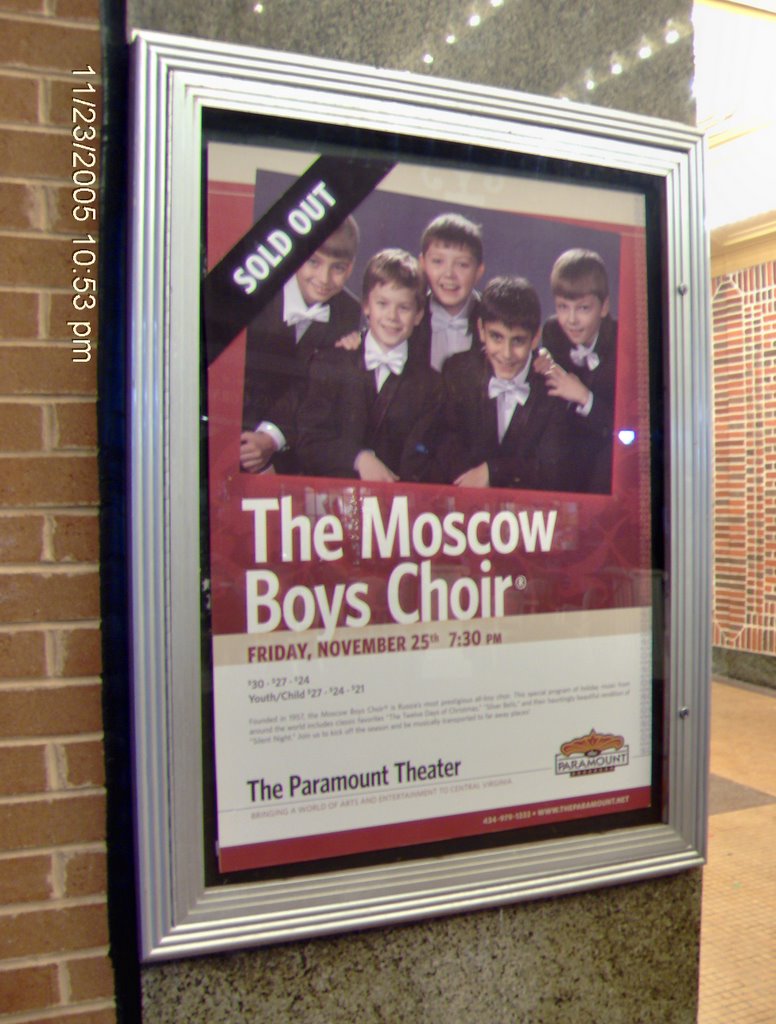
The Russian boys seemed more fidgety on stage than their Austrian counterparts, sometimes shifting from foot to foot, or touching themselves, scratching their noses, adjusting their hair. One blond boy with a bad haircut on the far right was clearly daydreaming or distracted; it looked like he was going through the motions while his mind was miles away. Another boy, who bore a passing resemblance to a young Frankie Muniz, looked like a deer caught in headlights during his first solo, although he appeared more relaxed later in the performance.

What's more, some of the boys were wearing ill-fitting suits (they were all dressed in matching tuxedo jackets and trousers, with white bow ties), and a good number of them wore shoes that were obviously too big for their feet.

I think this last observation has more to say about the state of the Russian economy than it does about Russian art and music, because there was nothing ill-fitting about the actual vocal performances.

The boys did their best work when singing Russian folk songs and classical music, especially an opening triplet of songs by Stepanov, Degtiarev, and Rachmaninoff. A second-act medley of Russian folk songs was punctuated with two outstanding solo turns, one (on "Evening Bells") by the choir's conductor, tenor Leonid Baklushin, the other (on "Ochi Tchiornya," "Black Eyes" or "Dark Eyes" ) by Il'ya Kanygin, a young operatic baritone who has real star quality.


Through the course of the evening, at least a dozen of the 30 boy sopranos, trebles, and altos were given their own chance to step forward and sing a solo, even if it was just one line in "The Twelve Days of Christmas." (Believe me, the Moscow Boys Choir's surprisingly animated rendition of this song can give the Virginia Glee Club a run for its money. Anyone who has seen the Glee Club sing "The Twelve Days of Christmas" knows precisely what I mean.)

The program had some unexpected portions, including the "Gloria Tibi" and "Kyrie" from Bernstein's Mass. The jazz-infused tarantella of this work was out of place here, though it must have been a challenge for the Moscow Boys Choir. As good as their performance was, it just served as a reminder of what a second-rate composition Bernstein's Mass is, and that these selections, in particular, would serve us better in a trunk kept in the Bernstein family attic, as rejected tunes from the score of Candide.

Conducter Baklushin brought the audience to its feet to sing along with "America the Beautiful," in infectious Russian-accented English, and again with a rousing finale, the familiar Russian folk song, "Kalinka."

All in all, seeing (and hearing) the Moscow Boys Choir was great fun. I hope to catch them on another American tour someday. Unfortunately, the group has only two CDs available for sale on Amazon.com, and both of them are Christmas collections. I would really like to own a recording of the Moscow Boys Choir singing Russian songs, which is simply what they do best. (A new recording, said to include some of those songs, is available on the choir's North American management's web site.)