Showing posts with label acting. Show all posts

Sunday, February 24, 2019

Guest Post: Oscars 2019: Roma, Yalitza Aparicio and the fascinating history of non-professional actors

Catherine O'Rawe, University of Bristol

The surprise nomination of non-professional indigenous woman Yalitza Aparicio for this year’s best actress Oscar for her role as a domestic servant in Alfonso Cuarón’s critically acclaimed Roma has been greeted as a “fairytale”.

Aparicio was training to be a teacher when she reluctantly went to an audition where Cuarón was immediately struck by her. Her presence and her similarity to his own childhood maid – on whom the film is based – secured her the role.


Propelled into the spotlight by her role, she has become the first indigenous woman to grace the cover of Mexican Vogue. She also endeared herself to her growing social media following by uploading to Twitter a video of her sobbing reaction to news of her nomination.


If Aparicio wins, she will be the first indigenous Latina Oscar winner and will join the small number of non-professional actors to win an Oscar in recent times. This number includes Anna Paquin for her role in The Piano (1993) and Haing S Ngor, a former doctor from Cambodia, who won the 1985 best supporting actor Oscar for his role in Roland Joffe’s The Killing Fields, in which his own traumatic experiences informed his outstanding performance as a local journalist.

In the same year as acclaimed indie hits such as Chloé Zhao’s The Rider, in which Brady Jandreau played a version of himself as an injured rodeo rider, and Crystal Moselle’s Skate Kitchen, featured an all-girl skate collective from New York, it seems that authenticity in casting and performance is all the rage.

But Aparicio also stands out as being typical of the non-professional’s experience throughout cinema history. Her “journey” from naïve provincial girl to the red carpet hits many familiar notes. Interviews emphasise how little she understood of cinema, and how she had never heard of Cuarón and feared the job offer might be a trafficking scam.

Authenticity


Aparicio’s unpolished and untrained authenticity is sharply juxtaposed with the glamorous world in which she now finds herself. Part of the non-professional’s effect is to throw into relief the extraordinariness of stars, as well as their proficiency, understood as a product of years of training and dedication to their craft. Aparicio’s novelty, spontaneity, and natural appearance are all singled out as antithetical to the professionalism of her co-star, experienced stage actress Marina De Tavira, who has also been nominated for an Oscar.

Her story mirrors the “discovery” of Barkhad Abdi, the untrained Somali-American who played a memorable co-lead to Tom Hanks in Captain Phillips. It also recalls the children recruited by Danny Boyle from the Mumbai slums for global hit Slumdog Millionaire.


In the latter case, ethical concerns around the effects of sudden fame on vulnerable children were recognised by Boyle. He set up a trust fund for them, though this didn’t prevent allegations that the father of one of the girls tried to sell her to capitalise on her fame.

Power imbalance


The non-professional child actor came to prominence in post-WWII Italian neorealism, which specialised in taking performers from the streets. Vittorio De Sica’s Oscar-winning 1948 classic Bicycle Thieves was particularly celebrated for its non-actors, chosen for their faces and bodies rather than any acting talent.


Lamberto Maggiorani, who played the tragic father, lost his factory job after the film and struggled to find work as an actor; he repeatedly begged De Sica to help him out. Meanwhile, nine-year-old Enzo Staiola made several further films and retired at the age of 15. However, accounts of his treatment on set , which included De Sica publicly humiliating him to make him cry, match other testimonies of neorealist directors extracting performances from non-professionals by insulting and even beating them.

This power differential, always implicit in the actor-director relationship, is obviously exacerbated when the actor is inexperienced and has no manager to guide them through the film industry. While Aparicio and Cuarón’s on-set relationship seems to have been affectionate, one anecdote about the film’s shooting is somewhat disturbing. In a central, traumatic scene for her character Cleo, Cuarón admitted that he deliberately withheld from Aparicio what would happen. Her anguished reaction is genuine – and presumably she could not be trusted to generate that response otherwise.

Aparicio has declared that she would like to continue to act, though she admits that Roma may be a one-off. French film critic André Bazin wrote of neorealist actors that the non-professional can be used only once because their effect can never be replicated. But non-professionals have gone on to career success – Paquin, obviously, as well as Sasha Lane, discovered by Andrea Arnold for her film American Honey, is continuing to work. So is Abdi, though in low-profile parts. Others, like the kids of Slumdog Millionaire, have returned to their old lives.

In all the press talk and interviews with Cuarón and Aparicio, one thing is never mentioned: pay. While one presumes that she received a fair salary for the part, non-professionals generally come cheap because it’s often assumed that part of the reward is the experience itself, the fairytale story. But when the magic finishes and the closing credits roll, they all too often find themselves alone.The Conversation

Catherine O'Rawe, Professor of Italian Film and Culture, University of Bristol

This article is republished from The Conversation under a Creative Commons license. Read the original article.

Thursday, December 04, 2014

Shaft: Richard Roundtree at the Virginia Film Festival

Richard Roundtree at UVA
After a screening of the 1971 Gordon Parks film, Shaft, at the 2014 Virginia Film Festival, actor Richard Roundtree (who created the role of detective John Shaft) was interviewed by University of Virginia historian John Mason, who also fielded questions for Roundtree from the audience.

Although Roundtree is rightly associated with Shaft -- he also starred in the sequels Shaft's Big Score and Shaft in Africa, as well as a TV series of the same name -- his TV credits include Roots, A Different World, Fresh Prince of Bel Air, and Desperate Housewives, while his film roles have included turns in Earthquake, Killpoint, Se7en (with Brad Pitt and Morgan Freeman), and Young Warriors, among others.

For those unfamiliar with the film -- which has been unfairly included as part of the 1970s' "Blaxploitation" genre -- one of the synopses on IMDB explains:
Private detective John Shaft is hired by Harlem mobster Bumpy Jonas to find his kidnapped daughter. Bumpy has no idea who might have taken her but isn't as forthcoming as he could be about his situation. When his first lead peters out - he thought it might be Black power advocates who took the girl - he acts on information from NYPD Lt. Vic Androzzi that outside mobsters are in town and might be trying to take over various illegal businesses in Harlem.
This conversation took place in UVA's Culbreth Theater on the opening night of this year's Virginia Film Festival, coincident with the November 6 world premiere of Big Stone Gap at the Paramount Theater downtown. 

The screening and ensuing discussion also coincided with an exhibition of Gordon Parks photographs at the University of Virginia's Fralin Museum of Art, which Mason and Roundtree viewed earlier in the day.


Roundtree talked about making the film in a wintry New York, the value of the film's music score (by Isaac Hayes, who won an Academy Award for the theme song), and advice for young actors getting their start in show business.

Sadly, my camera's battery died about five minutes before the discussion ended, but the bulk of it is preserved in this 35 minute video clip.


Friday, November 15, 2013

SNL Alumnus Will Forte Discusses 'Nebraska' at 2013 Virginia Film Festival

Will Forte at 2013 Virginia Film Festival
The new Alexander Payne film, Nebraska, opens in cinemas across the United States today. It has already won wide acclaim, including a best-actor award for leading player Bruce Dern at the Cannes Film Festival last May.

The movie is about an aging man's journey across the plains from Billings, Montana, to Lincoln, Nebraska, with his younger son, and a reunion with family members and friends in his long-ago hometown (location-shot in Plainview, Nebraska, represented as the fictional "Hawthorne").

Dern's turn as Woody Grant is getting plenty of Oscar buzz. The generally talkative (in real life) Bruce Dern plays a taciturn octogenarian who falls for a sweepstakes scam and insists on picking up his winnings.

Although Nebraska is set in the present day, the black-and-white cinematography by Phedon Papamichael recalls period pieces like Paper Moon (1930s) and The Last Picture Show (1950s), both directed by Peter Bogdanovich in the early 1970s.

Last week, co-star (and SNL alumnus) Will Forte came with Nebraska to the Virginia Film Festival.

Before the capacity screening at the Paramount Theater downtown, Forte bantered with local reporters about the film and his career. (You'll hear my voice asking him about his experience with animated comedies like The Cleveland Show and Bob's Burgers.)

After the screening, Forte was joined on stage by one of the film's producers, Ron Yerxa, for a question-and-answer session moderated by NYU film studies professor Harry Chotiner.
In addition to the Cannes and Virginia film festivals, Nebraska was also screened at the new Middleburg Film Festival in Northern Virginia, where Bruce Dern came to promote it, along with Ron Yerxa and his producing partner, Albert Berger.

At the 2009 Virginia Film Festival, actor Matthew Broderick discussed another Alexander Payne film set in Nebraska, Election.


Thursday, February 09, 2012

Interview with Actress Bethany Anne Lind

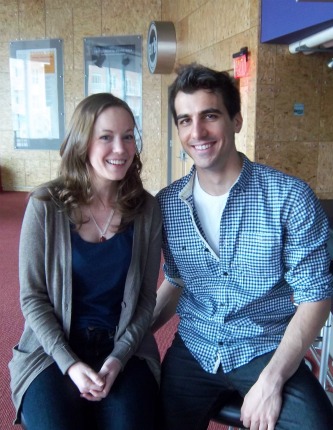
Bethany Anne Lind at Signature Theatre
Bethany Anne Lind is an Atlanta-based actress who plays the role of “Leigh” in Signature Theatre’s world premiere production of Really Really.

When asked in an interview to describe Leigh, Lind demurs by looking toward playwright Paul Downs Colaizzo and saying, “I don’t know what I’m allowed to say.”

The producers of Really Really, it seems, are trying to keep a lid on what the play is really, really about, though rumors have circulated that it is loosely based on the 2006 Duke lacrosse incident. Colaizzo himself prefers to talk about the theme of the play rather than the plot, although he grants permission to Lind to “talk about who she is.”

Leigh, she finally says, is “a person who has grown up with nothing and always has had to fight to get where she is, as opposed to most of the other characters who have been handed their educations and their places in life. She has had to work and fight to get there, so she has a very clear goal of what she wants out of life and she is going to do whatever she has to do to get it.”

Lind herself seems unusually demure to play a hardscrabble role like that, but her own life story indicates a determination to achieve, even if it was generated in a more genteel environment.

Homeschooled in North Carolina, Lind started acting in church plays and in the living room and backyard.

“I did a lot of making up plays with my siblings and my cousins and my neighbors,” she said, and her parents “fostered a very creative atmosphere, so we were always pretending and making stuff up.”

Eventually, she went to college at Campbell University, a small, liberal-arts school.

After she graduated, Lind moved to Atlanta “and did a couple of educational shows and the little things you’ve got to do to start out” in the acting business. She chose Atlanta instead of New York or Los Angeles because she did not want to “get lost in the sea of billions of actors who are already there.”

In Atlanta, she “found a great theatre community and artistic home.” She has lived there for about five years, getting film and television work in Atlanta and traveling to New York “every now and then” to audition for shows like Really Really.

Among Lind’s credits on stage are August: Osage County and Steel Magnolias. On screen, she has been in Mean Girls 2 and the forthcoming films Flight and Crackerjack, and the TV series, Army Wives.

The way she won the role of Leigh (described to me elsewhere as “pivotal”) hinged on a local connection.

“I have extended family in Northern Virginia,” she said, “and I check the Equity web site frequently for auditions for things and had seen a call for this particular role. I didn’t really know anything about the play. I just saw a character description and thought, ‘that sounds interesting.’”

Since she was going to be in Northern Virginia for Thanksgiving, she sent an email to Really Really’s director, Matthew Gardiner, even though she didn’t know him, and asked if she could read for him.

Bethany Anne Lind with Paul Downs Colaizzo
Lind hadn’t heard from him but, just before she was to return to Atlanta, she “just emailed him one more time just to see, and he said, ‘We’re actually having auditions in New York on Monday. We can see you there if you can come.’”

So, Lind explained, “I took the bus up to New York, read the script on the way there, just loved it and auditioned -- and here I am.”

Colaizzo, who wrote the play, interjected to point out that the character of Leigh was transformed once he and Gardiner saw Lind audition.

“We may have thought we knew who the character of Leigh was, before Bethany came in to audition,” the playwright said, “but she also taught us who the character was, in an audition that was magnetic.”

That magnetism, he explained, “has transferred into her work in this play.”

Lind appreciates being part of a world premiere.

“It’s always fun working on it with the playwright in the room,” she said. “I feel like we inform each other on the character. It’s just exciting to be part of that part of the development of the play and the character.”

Performances of Really Really run through March 25, 2012. Show times are Tuesdays and Wednesdays at 7:30 pm, Thursdays and Fridays at 8:00 pm, Saturdays at 2:00 pm and 8:00 pm, and Sundays at 2:00 pm and 7:00 pm.

Tickets range from $56 - $80 and are available by calling Ticketmaster at 703-573-SEAT (7328) or visiting www.signature-theatre.org. Student discount tickets are $30 and must be purchased the week of the performance. For more information please visit www.signature-theatre.org.
Be sure to visit my CafePress store for gifts and novelty items!
Read my blog on Kindle!
Follow my tweets on Twitter!