Showing posts with label parents. Show all posts

Saturday, December 23, 2017

Guest Post: Could lies about Santa be good for your child?

Kristen Dunfield, Concordia University

Christmas is a magical time of year, especially for children. Unfortunately, between elaborate Elf on the Shelf staging and fending off questions about Santa, parents are often left wondering how much of the magic depends on them.

Specifically, many parents worry about whether they should encourage their children’s belief in the physical reality of Santa, about the potential impact of lying to them and what to do when their children realize they’ve been duped.

Rest assured, parents, it’s not all up to you. In fact, the best approach involves supporting your kids while they figure it out on their own. They will, and it won’t be as bad as you expect.

As a developmental scientist, I spend most of my time researching children’s trust. I’m interested in how trust develops and what happens when it’s broken. During the holiday season, I spend a lot of time thinking about Santa.
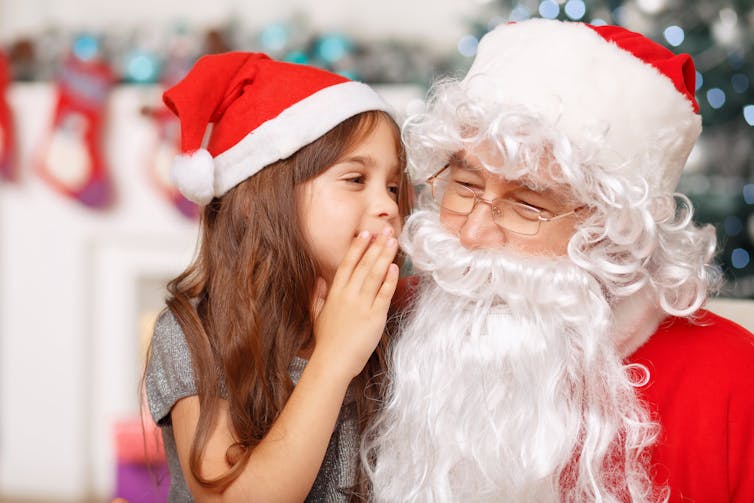


Santa Claus and child on lap

Developmental psychology suggests that fantastical beliefs in children are associated with positive developmental outcomes. And parents need not worry, children will bust the Santa myth themselves, when the time is right.
(Shutterstock)


As a proud auntie of three children under the age of four, my Santa musings have taken on a new significance. But, unlike many parents, I see the development of a belief in the physical reality of Santa, and the eventual myth-busting, as impressive achievements to be celebrated, not feared!

Research in the field of developmental psychology suggests that such fantastical beliefs are not actually harmful, but are associated with a number of positive developmental outcomes — from exercising the “counterfactual reasoning skills” needed for human innovation to boosting emotional development.

When kids question the magic


The vast majority of children will at some point believe in Santa. While many children learn these beliefs at home, the cultural support for Santa is so strong that children in households that don’t actively endorse the myth still sometimes believe.

Yet, despite Santa’s impressive marketing strategy, most children will abandon their belief by the age of eight. Though many parents fear this transition, it’s an inevitable part of growing up.


Santa is a mix of mundane and magical qualities. He is a jolly man dressed in red with a snowy beard. He also flies with the help of reindeer, visits all the world’s children in a single night and knows if you’ve been naughty or nice.

With age, a child’s thinking develops to the point where they start to notice Santa does magical things that physical objects can’t. This newfound knowledge is evident in the types of questions children are asking.

Younger children are often interested in general details about Santa, like: “Where does Santa live?” Older children are more likely to hone in on Santa’s extraordinary abilities: “How does Santa get around the whole world in a single night?”

Should you bust the myth?


Recognizing these challenging questions for what they are — cognitive development in action — may free some parents from the burden of belief.

If your goal is to extend your child’s belief in the physical reality of Santa, you can respond to the questions with plausible explanations or evidence. This is where NORAD, the online tracker that shows Santa’s progress around the globe on Christmas Eve, can come in handy.


If instead you want to let your child take the lead, you can simply direct the question back to them, allowing your child to come up with explanations for themselves: “I don’t know, how do you think the sleigh flies?”

Finally, if you think it’s time to usher your child into the common adult understanding of Santa as a beloved fantasy figure, you can provide different, disconfirming evidence and explanations.

My Santa myth was busted shortly after the discovery of Santa’s gift tags in my mother’s robe pocket. Regardless of which strategy you choose, it is inevitable that eventually the evidence against Santa will become overwhelming and the belief will become unsustainable.

Lies with good intentions


If you choose to extend your child’s belief in Santa, and your child realizes you have deceived them, how will they respond?


boy in Santa hat

If Santa’s elves make handmade toys, how does he deliver electronics? And what does this do to the magic of Christmas for children from poorer families?
(Shutterstock)


As it turns out, probably pretty well. In a study examining children’s reaction to discovering the truth about Santa, parents generally took the transition much harder than their children, who actually felt quite positive about the discovery.

And why wouldn’t they? Santa is one of countless things children learn through the testimony of others. Because we rely on others for so much of what we know, humans are surprisingly well-equipped for the task. They evaluate both the source and content of the information they have received in light of their existing knowledge and their memory of past interactions with the source.

This means that, when compared to all of the reliable information that parents share with their children over their lives, it is highly unlikely a single lie will cause irreparable damage.

Children are also discovering the truth about Santa at around the same time they are starting to understand that some lies, like Santa lies, are told with good intentions.

Why Santa is for small gifts


Believing in impossible beings such as Santa is a special kind of magic available only to children.

Research suggests that fantastical beliefs are associated with a number of positive developmental outcomes. So, if your child is still a believer, feel free to protect that belief.

As your child ages, especially if there are younger siblings in the house, there are creative ways to keep the Santa experience positive, even after their belief in the physical reality of Santa has been abandoned.

Finally, always remember, as children are figuring out how the world really works, that they are going to look to the people and things around them for evidence.

The ConversationIt might be a good idea to give modest gifts from Santa and save the big ones for parents, because no matter what your family income, every child deserves to feel loved by Santa on Christmas morning.

Kristen Dunfield, Assistant Professor of Psychology, Concordia University

This article was originally published on The Conversation. Read the original article.

Sunday, June 18, 2017

Guest Post: How families with 2 dads raise their kids

Andrew Leland, Rutgers University

Kentucky family court judge W. Mitchell Nance says he refuses to hold hearings on same-sex couples’ adoptions “as a matter of conscience.”

He’s not the only authority defying the 2015 Supreme Court ruling that made marriage equality the law of the land. So-called “religious freedom” bills in Texas, South Dakota and Alabama could let private adoption agencies discriminate against same-sex couples. When pressed on the question, Education Secretary Betsy DeVos recently refused to tell lawmakers whether she believes the federal government should deny government funds to schools that discriminate against the children of LGBT parents – or LGBT students.


How families with 2 dads raise their kids

The number of men married to each other who have children is rising following legal rulings about marriage equality.
Shutterstock


Maybe these officials, judges and lawmakers should check out the research on how gay parents differ from straight parents. So far, most of this scholarship has focused on the social, emotional and cognitive outcomes of children they raise. (Spoiler alert: These kids turn out fine.)

As a former teacher who now researches gay dads and their families while pursuing a doctorate in education, I am studying how the growing number of men married to other men are raising their children. So far, I’m finding few differences between them and their straight peers of similar socioeconomic status – especially regarding their children’s schooling.

A growing population


Since the Census Bureau estimates but does not count the number of households headed by two fathers, it’s hard to track them.

Plans were taking shape for the Census Bureau to begin counting same-sex-parented households in 2020. They seem unlikely to move forward due to recent budget cuts, the census director’s recent resignation and the political climate.

Nevertheless, The American Community Survey, the Census Bureau’s ongoing demographic survey of approximately three million households, already follows same-sex parenting. It estimates that in 2015, almost 40,000 two-dad households were raising children, compared to about 30,000 in 2010.


Actors Neil Patrick Harris Gideon Scott Burtka-Harris Smurfs

Actors Neil Patrick Harris and Gideon Scott Burtka-Harris, who are married to each other, brought their twins to the ‘Smurfs 2’ premiere in 2013.
John Shearer/Invision/AP


Parenting roles


How do parents in these families settle into specific roles? In short, just like heterosexual parents do.

Research suggests that affluent, white, two-father households adhere to traditional parenting roles. One is the primary breadwinner, while the other earns either less income or none at all and handles most of the caregiving and chores.

However, two-dad households can challenge the 1940s Norman Rockwell image of gendered parenting – just like heterosexual couples can.

Households with two fathers working full-time rely on daycare facilities, babysitters, housekeepers and nearby relatives for support. Some of these men even take on responsibilities based on skills and strengths, rather than who fits the socially and culturally constructed mold of being more “motherly” or “fatherly.”


two-dad households families children gay marriage
Research suggests that two-dad households may not differ that much from the parenting patterns of heterosexual couples.
www.shutterstock.com


Community and school engagement


And that’s where the parenting of gay dads may differ from a traditional heterosexual household, as my research and the work of other scholars suggests.

While interviewing and spending time with 20 two-dad families living in the Northeast for my current study, I have learned that they’re apt to step up. Many become involved as classroom parents, voluntarily assisting teachers, reading books or leading singalongs. Some take leadership roles by becoming active PTA members or organizing events that go beyond their children’s classes. In some cases, gay fathers become PTA presidents or serve on school boards.

Like all civically engaged parents, gay fathers support their local museums and libraries and enroll their kids in camps and extracurricular activities. They sometimes do additional volunteer work for social justice groups.

The largest-scale survey to date was conducted in 2008 by the Gay Lesbian Straight Education Network, an organization focused on the safety of LGBT students in schools. That study, which included 588 LGBT parents, suggested that gay fathers could be more likely to be involved in school-based activities than heterosexual dads.

Aside from the simple fact that they love their children just like all parents do, Abbie Goldberg, a Clark University researcher, and her colleagues have shown that increased presence may be due, in part, to fathers’ initiatives to counter bias and assert more same-sex visibility and inclusion in schools. My current study, indicates the same. Many of the men taking part have told me that being actively involved helps them preemptively counteract potential negative encounters with school personnel and other families.

The ConversationGay dads prefer schools and communities that are safe and inclusive. Beyond that, they want judges like Nance and lawmakers bent on barring them from fatherhood to see that two-dad families are for the most part just like any other family.

Andrew Leland, Ph.D. Candidate, Graduate School of Education, Rutgers University

This article was originally published on The Conversation. Read the original article.

Sunday, December 25, 2016

Guest Post: Why children believe (or not) that Santa Claus exists


by Jacqueline D. Woolley, University of Texas at Austin

The holiday season is upon us, and so are its attendant myths, most prominent of which is the Santa Claus story. This is the time that many children are told about a man who lives forever, resides at the North Pole, knows what every child in the world desires, drives a sleigh pulled by flying reindeer and enters one’s house through a chimney, which most children don’t even have.

Given the many absurdities and contradictions in this story, it’s surprising that even young children would believe it. Yet research from my lab shows that 83 percent of five-year-olds think that Santa Claus is real.

Why?

An evolutionary advantage?


At the root of this paradox is a very basic question regarding the nature of the young child as an inherently credulous being – that is, believing everything he or she is told – versus a rational one.

The noted author and ethologist Richard Dawkins, in a 1995 essay, proposed that children are inherently credulous, and prone to believing in just about anything. He even suggested that it was an evolutionary advantage for children to believe.

He illustrated that quite convincingly with an example of a young child living near an alligator-infested swamp. His point was that the child who is skeptical, and prone to critically evaluating his parents’ advice not to go swimming in that swamp, has much less chance of surviving than does the child who unthinkingly heeds his parents’ advice.

This view of young children who believe easily is shared by many, including 18th-century philosopher Thomas Reid, and developmental psychologists, who argue that children are strongly biased to trust what people tell them.

Not very different from adults?


Yet research from my lab shows that children actually are rational, thoughtful consumers of information. In fact, they use many of the same tools as adults to decide what to believe.

So, what are some of the tools that adults use to decide what to believe, and what evidence is there that children possess them?

I’ll focus on three: One is attention to the context in which new information is embedded. A second is the tendency to measure new information against one’s existing knowledge base. And the third is the ability to evaluate the expertise of other people.

Let’s look first at context.

Imagine reading an article about a new species of fish – let’s call them “surnits.” Then imagine you’re reading this article in two very different contexts – one in which your doctor is late and you’re in the waiting room reading the article in a copy of National Geographic, the official magazine of a scientific society.

In another context, you encounter a report of this discovery while waiting in line at the grocery store and perusing the National Enquirer, an American supermarket tabloid. My guess is that the context surrounding your introduction to this new information would guide your judgment about the reality status of this new fish.

We essentially did this with children. We told them about animals they’d never heard of, like surnits. Some children heard about them in a fantastical context, in which they were told that dragons or ghosts collect them. Other children learned about surnits in a scientific context, in which they were told that doctors or scientists use them.

Children as young as four were more likely to claim that surnits really existed when they heard about them in the scientific context versus in the fantastical context.

How children use knowledge and expertise


One of the primary ways we, as adults, learn about new things is by hearing about them from others. Imagine hearing about a new kind of fish from a marine biologist versus from your next-door neighbor who often regales you with reports of his alien abductions. Your evaluation of the expertise and trustworthiness of these sources presumably will guide your beliefs about the true existence of this fish.

In another research project, we presented young children with novel animals that were either possible (e.g., a fish that lives in the ocean), impossible (e.g., a fish that lives on the moon) or improbable (e.g., a fish as big as a car). Then we gave them the choice to figure out on their own whether the entity really existed or to ask someone. They also heard reports from either a zookeeper (an expert) or a chef (a nonexpert).

We found that children believed in the possible entities and rejected the impossible ones. Children made these decisions by comparing the new information to their existing knowledge. For the improbable animals – ones that could possibly exist but were rare or odd – children were significantly more likely to believe in them when the zookeeper claimed they were real than when the chef did.

In other words, children use expertise, just as adults do.

It’s the adults


If children are so smart, why do they believe in Santa?

The reason is simple: Parents and others go to great lengths to support the Santa myth. In a recent study we found that 84 percent of parents reported taking their child to visit more than two Santa impersonators during the Christmas season.

The Elf on the Shelf, originally a children’s picture book about elves who inform Santa about children’s behavior around Christmastime, is now a multi-million-dollar franchise. And the United States Postal Service now promotes a “Letters from Santa” program in which it provides personal replies to children’s letters to Santa.

Why do we feel compelled to go to such great lengths? Why does Uncle Jack insist on climbing onto the roof on Christmas Eve to stomp around and shake jingle bells?

The answer is simply this: Children are not unthinkingly credulous and do not believe everything we tell them. So, we adults must overwhelm them with evidence – the bells on the roof, the live Santas at the mall, the half-eaten carrot on Christmas morning.

How children evaluate


Given this effort, it essentially would be irrational for children not to believe. In believing in Santa Claus, children, in fact, exercise their scientific thinking skills.

First, they evaluate sources of information. As ongoing research in my lab indicates, they’re more likely to believe an adult than a child about what’s real.

Second, they use evidence (e.g., the empty glass of milk and half-eaten cookies on Christmas morning) to come to a conclusion about existence. Other research from my lab shows that children use similar evidence to guide their beliefs about a fantastical being, the Candy Witch, who visits children on Halloween night and leaves new toys in exchange for candy.

Third, research shows that, as children’s understanding becomes more sophisticated, they tend to engage more with the absurdities in the Santa Claus myth, like how a fat man can fit through a small chimney, or how animals could possibly fly.

Wondering what to tell your child?


Some parents wonder whether they are harming their children by engaging in the Santa myth. Philosophers and bloggers alike have mounted arguments against perpetuating the “Santa-lie,” some even claiming that it could lead to permanent distrust of parents and other authorities.

So, what should parents do?

There is no evidence that belief, and eventual disbelief in Santa, affects parental trust in any significant way. Furthermore, not only do children have the tools to ferret out the truth; but engaging with the Santa story may give them a chance to exercise these abilities.

So, if you think it would be fun for you and your family to invite Santa Claus into your home at Christmas time, you should do so. Your children will be fine. And they might even learn something.

The Conversation

Jacqueline D. Woolley, Professor and Department of Psychology Chair, University of Texas at Austin

This article was originally published on The Conversation. Read the original article.
Friday, June 19, 2015

A Grammar Quiz for Father's Day

Courtesy of grammarly.com/grammar-check and just in time for Father's Day, we have this test of grammar acumen. Check your skills and be sure to share the results on social media!


Remember, Father's Day is the third Sunday in June each year -- Sunday, June 21, in 2015!


Thursday, January 16, 2014

Does political affiliation affect our views of product and service brands?

How does political affiliation affect our perceptions of various brand-name products and services? Does ideology change the way we view brands? Or does it make no difference at all?

This is one of the questions explored by the market research firm YouGov in its annual Brand Index for 2013, which surveys consumers about their attitudes toward a wide range of brand names from Aflac and Amazon.com to V8 and Victoria's Secret.

Explaining the overall rankings, Lucia Moses wrote in Adweek:

Buoyed by strong sales of its e-readers and expansion of its free-shipping service, Amazon topped the list of best-perceived brands of 2013, as measured by YouGov's BrandIndex. Rounding out the top 5 were Ford, Subway, History Channel and Lowe's. Last year also was a good one for financial institutions, which began to earn consumers' forgiveness for their role in the economic meltdown: Four of the five best-improved brands in 2013 were banks.
In addition to its overall rankings, YouGov provides a breakdown of results by industry (e.g., airlines, hotels, and insurance) and by several demographic groups (LGBT, parents, Millennials, minorities).

YouGov explains its methodology like this:
These brands were rated using YouGov BrandIndex’s Buzz score which asks respondents, "If you've heard anything about the brand in the last two weeks, through advertising, news or word of mouth, was it positive or negative?"

The Buzz Rankings chart shows the brands with the highest average Buzz scores between January and December 2013. Scores are representative of this segment.

All Buzz scores listed have been rounded to a single decimal place, however, we have used additional precision to assign ranks.
In answering that primary question, for instance, the top brand for LGBT survey respondents was YouTube -- perhaps unduly weighted by followers of Tyler Oakley and  Davey Wavey.  For both African-Americans and Hispanic respondents, the top brand was Walgreen's. Parents' top brand was the same as the country as a whole, Amazon.com, while for Millennials the top choice was Google.

YouGov's Brand Index divides Americans up into three political affiliation categories: Democrats, Republicans, and independents.

Intriguingly, the three groups only have one brand in common among their top five rankings: Subway, which was the 2012 overall winner in consumer perceptions.

Here are the top five for each of the three political categories:

Source:  BrandIndex.com
It's noteworthy that the Republicans' scoring of Fox News at 42.1 blows away any competitors in any categories. (Top-ranked Amazon.com had an overall score of 30.6.)  At the same time, Fox News doesn't even show up in the top five of the "networks" category, where the History Channel tops out the category at 26.4. (Neither CNN nor MSNBC shows up in the national top five, for what it's worth.)  Republicans and independents also like the History Channel, at 31.9 and 27.8, respectively, although that network is not included in the Democrats' top five.

Republicans also like Chick-Fil-A, giving it a score of 31.8 and a rank of 5.  The same quick service restaurant (QSR) is ranked fifth overall in that category, but with a nationwide score of only 11.9,

Democrats and independents both like Amazon.com, ranking it first, but the online retailer does not turn up in the Republicans' top five.

Similarly, Republicans and independents like Ford, both ranking it second, but the car manufacturer fails to show up in the Democrats' top five.

There is no separate breakdown for Libertarians' top brands.  Perhaps the sample size was too small.  It would be interesting to learn whether libertarian views of providers of products and services differs from those of conservatives and liberals.


Sunday, April 15, 2012

How Squirrels Potty-Train

Did I really need to know this?

In his column ending "Squirrel Week" today, Washington Post Metro section columnist John Kelly reports on how baby squirrels learn to defecate.  It doesn't just come naturally, it seems:

This fascinating bit of information came from Don Moore, associate director of animal care sciences at the National Zoo. Earlier in his career, Don worked in Syracuse, N.Y., rehabilitating baby squirrels. Squirrels are among species — deer are another — where the mother uses her mouth to carry her offspring’s poo and pee away from the nest. This is to protect her litter from predators.
“Evolutionarily, that’s a great strategy,” Don said. “The mother’s removing the only thing that can give [the baby] a scent: the pee and poo.” With no scent to follow, predators can’t find the defenseless baby.
The mother’s selfless act is so hard-wired in a squirrel’s very being that babies can urinate and defecate only after being stimulated by the mother licking around . . . down there.
Orphaned squirrels raised by humans risk becoming constipated and bloated. “The gut stops moving,” Don said. “You don’t want that to happen, so you stimulate them. In fact, you have to start stimulating them just to get them to feed.”
Squirrel moms provide stimulation with their tongues. “We don’t recommend that,” Don said. “We would use a warm, damp washcloth.”
Baby squirrels must have their nether regions stimulated at every feeding from birth to about five weeks of age, when their eyes are open and their fur is coming in.
“It’s a wonderful day when they start doing it themselves,” Don said.
My life could have gone on without knowing that, but it's bound to be a conversation-starter. (Or -stopper?)