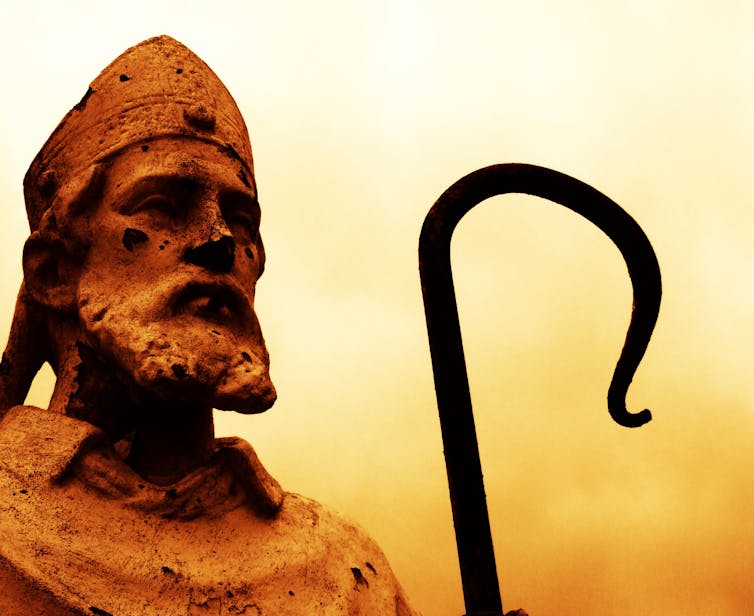
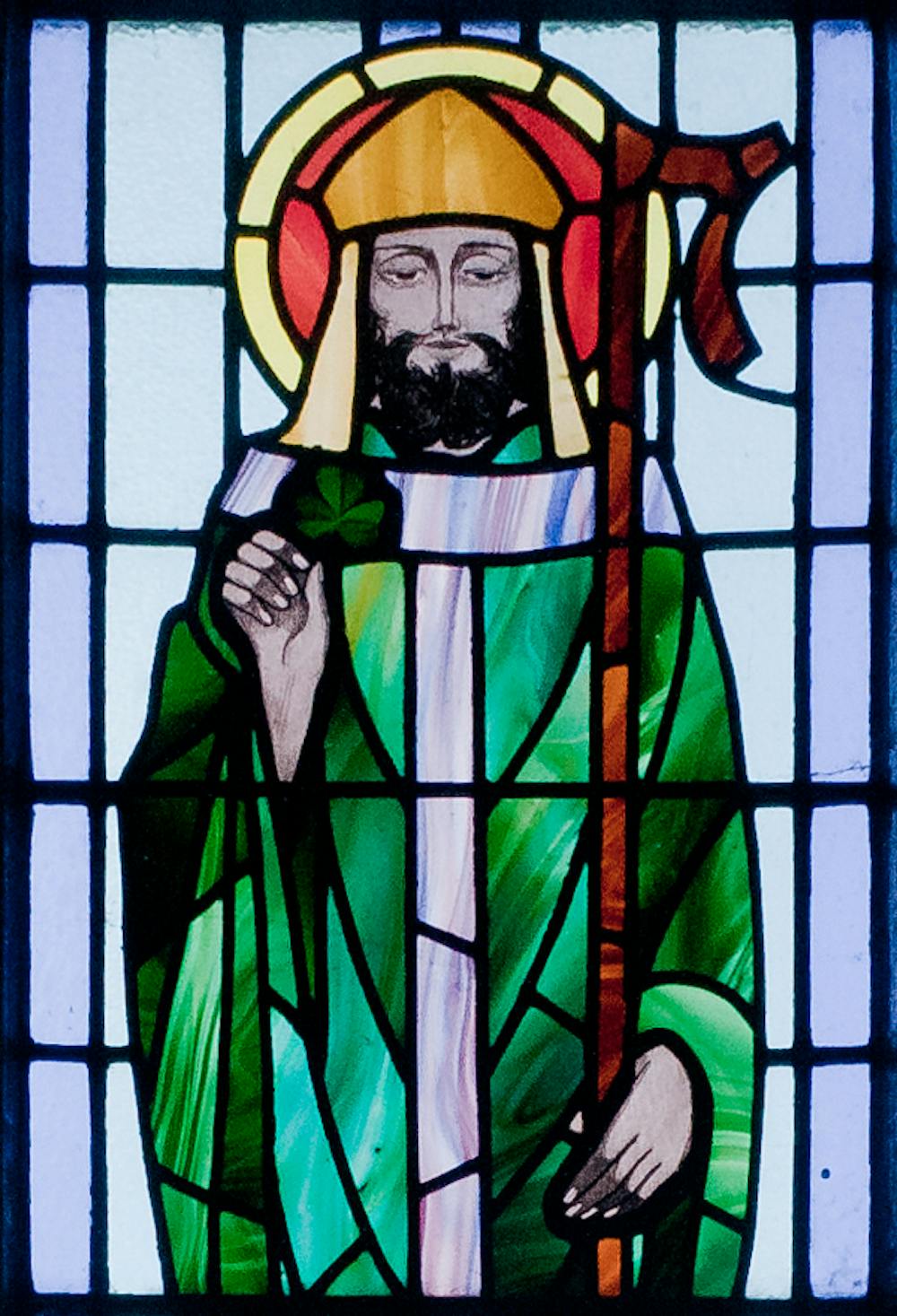
I wandered the streets of Galway, on St Patrick’s Day 2002, wearing a t-shirt which stated “St Patrick: he’s Welsh, you know”. It was intended, and received, as friendly banter, in the context of a resounding Irish victory over Wales in the Six Nations rugby tournament a fortnight previously. But is it true?
The answer should be pretty straightforward. After all, Patrick tells us, in one of the two Latin works of his that have survived, where he was from: a town named Banna Venta Berniae. Unfortunately, we don’t know where that was, except that it was somewhere in Britain. As he was captured there by Irish raiders, it must have been reasonably close to the west coast of Britain. So it is quite possibly, but by no means necessarily, somewhere in Wales.
Perhaps its precise location doesn’t really matter. In Patrick’s lifetime (some time in the fifth century AD), Wales, as we know it, did not exist. The inhabitants of the various kingdoms which made up the geographical area which we now call Wales called themselves “Britons”, as indeed did many other people in the part of Britain south of Hadrian’s Wall – the old Roman province of Britannia.
But those Britons who spoke the British Celtic language known as Brittonic (the ancestor of Welsh, Cornish and Breton) began, in the same century, to use another name for themselves?, Combrogī – “fellow countrymen”. This term is the ancestor of the English place name Cumbria, and of the word the Welsh use today to describe themselves: Cymry (in the Middle Ages, this term was also used for the country of Wales, which is now spelled Cymru). Whether or not this term was in use in the fifth century, however, is impossible to say.
By this time, Germanic-speaking kingdoms were forming in the south and east of the island of Britain. They were the forerunners of what historian, and later saint, Bede, in the eighth century would call the “gens Anglorum”, “the English people”. These people were not Britons, either to themselves, or to their neighbours to the west, who, then and now, called them “Saxons” (Welsh “Saeson”, Gaelic “Sasanaigh”). They, in turn, called the Britons, “Wealas”, the origin of the word “Welsh”. So from a contemporary English point of view at least, Patrick would have been Welsh.
Language and literature
It has been claimed, by scholars both medieval and modern, that St Patrick spoke Brittonic. We know that he could write good Latin, but he called it lingua aliena, “a foreign language”. It was not his native tongue, but, as a high status language with a venerable literary tradition, and the lingua franca of the church, it was the obvious choice for him to write in. Without any further evidence, we could quite confidently deduce that Brittonic would be his native tongue (Irish, English and Pictish are much less likely candidates for a native of western Britannia at this time). But perhaps we can go further than this.
In the seventh century, an Irish monk named Muirchú wrote a Life of St Patrick in Latin. In it, the few historical facts about Patrick recoverable from his own writings are almost completely obscured by the numerous miracles that were de rigeur in medieval writings on the lives of saints, and the blatant propaganda of the ambitious church of Armagh, which was in the process of appropriating Patrick for itself.
Nonetheless, Muirchú records verbatim two of Patrick’s sayings: “modebroth” and “gra(t)zacham”. Muirchú does not tell us what language these utterances are in, but both were interpreted as being in Brittonic by a ninth-century Irish lexicographer, Cormac mac Cúilennáin, the bishop-king of Cashel.
Modebroth, he claimed, is a corrupt form of the Welsh “myn duw brawd” – “by the god of judgement”. This could be right, but gra(t)zacham derives ultimately from the Latin “gratias agam” (“let me give thanks”), or gratias agamus (“let us give thanks”).
Cormac seems to have interpreted it as Brittonic on the eminently reasonable ground that Patrick was a Briton, and that anything he is reported to have said which was not obviously Irish or Latin must have been Brittonic. So if he was wrong about gra(t)zacham, he may have been wrong about modebroth, too, which may, in fact, have been an Irish phrase meaning “divine judgment”, subjected to the sort of modification common in religious oaths (see, for instance, the English “gosh” and “jeepers” instead of “God” and “Jesus”). At any rate, there is no very compelling reason to believe that Muirchú really did have access to the exact words which Patrick had uttered 200 years previously.
So what’s the verdict? Patrick may very well have been born in present-day Wales. He was certainly born in the west of Britain. He may have thought of himself as a Cymro, and the English would doubtless have classified him as Welsh. His first language was almost certainly the ancestor of Welsh. And yet, we know that he chose Ireland over the land of his birth. He is a footnote in the history of Wales, but utterly central to that of Ireland.
In the game of rugby which inspired my St Patrick’s Day t-shirt, one of the (many) try scorers for Ireland was a certain Ronán O’Gara, born San Diego, California. When it comes to identity, place of birth isn’t everything.
The idea that there is a common Anglo-Saxon ancestry based on biology is gaining currency among some right-wing and religious groups in the UK and US.
In the UK, the new leader of the UK Independence Party, Henry Bolton, suggested in a radio interview in October that “in certain communities the indigenous Anglo-Saxon population is nowhere to be seen.”
In August, a religious group called the Odinist Fellowship wrote to the Church of England demanding two churches as reparations for a “spiritual genocide” which it claims began in the seventh century AD.
The Odinists use old Icelandic texts to reconstruct the “indigenous” religion of the Anglo-Saxons which they claim was oppressed with the arrival of Christianity. The Anglo-Saxons are commonly believed to have migrated into Briton in the fifth and sixth century AD. Iceland by contrast was inhabited in the ninth century by Viking settlers. In the US, this mixed up medievalism is associated with the white supremacist alt-right who use Anglo-Saxon and Viking motifs.
But archaeological research, which examines ancient DNA and artefacts to explore who these “indigenous” Anglo-Saxons were, shows that the people of fifth and sixth century England had a mixed heritage and did not base their identity on a biological legacy. The very idea of the Anglo-Saxon ancestor is a more recent invention linked closely with the English establishment.
Listen: The Anthill podcast episode on myths includes a segment on myths about race
For decades, archaeologists and geneticists have sought to identify Anglo-Saxons in England. An early attempt in 2002 relied on modern DNA with a study of the male Y chromosome suggesting there had been a 95% population replacement of Britons by the Anglo-Saxons, comprised of different people from Northern Europe. But another study, based on mitochondrial DNA which is inherited from the mother, found no evidence of significant post-Roman migration into England. A third paper suggested that the genetic contribution of the Anglo-Saxons in south-eastern England was under 50%.
The discrepancies between the findings are because these three papers used modern DNA and worked backwards. Work my colleagues and I have undertaken looked at the question from the other direction – by working with ancient DNA.
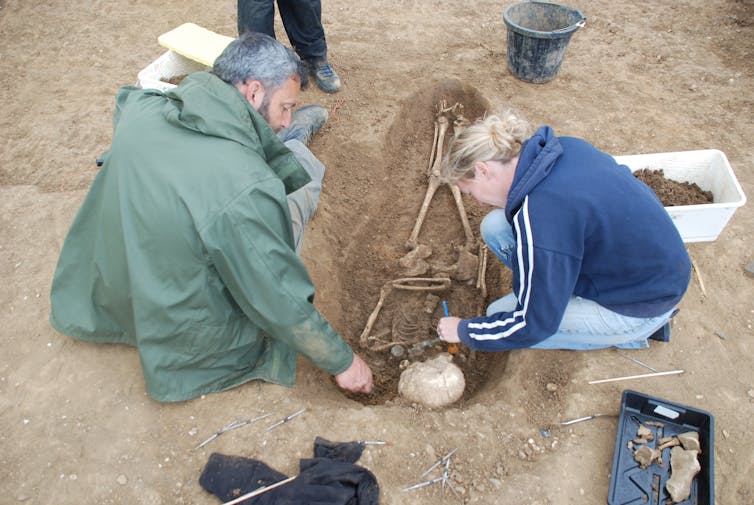
The results from our recent study were published in Nature Communications and included evidence from an Anglo-Saxon site I excavated in Oakington, Cambridgeshire. In total ten skeletons were investigated. These included seven early medieval graves dating to between the fifth and eighth century – four from Oakington and three from Hinxton – and three earlier Iron Age graves from Cambridgeshire, dating to between the second century BC and the first century AD, to provide the genome of the antecedent inhabitants of Briton.
We used a novel method called “rarecoal” to look at ancestry based on the sharing of rare alleles, which are the building blocks of genes. Our research concluded that migrants during what’s now thought of as the Anglo-Saxon period were most closely related to the modern Dutch and Danish – and that the modern East English population derived 38% of its ancestry from these incomers. The rest of Britain, including today’s Scottish and Welsh, share 30% of their DNA with these migrants.
Excavating at Oakington. Duncan Sayer, Author provided
The analysis of DNA of four individuals from the Oakington Anglo-Saxon cemetery identified that one of them was a match with the Iron Age genome, two were closest to modern Dutch genomes, and one was a hybrid of the two. Each of these burials was culturally Anglo-Saxon because they were buried in the same way, in the same cemetery. In fact, the richest assemblage of Anglo-Saxon artefacts came from the individual with the match for Iron Age genetic ancestry, and so was not a migrant at all.
It shows that these ancient people did not distinguish biological heritage from cultural association. In other words, someone who lived and died in the fifth or sixth century Anglo-Saxon village of Oakington could have been biologically related to an earlier inhabitant of England, a recent migrant from continental Europe or a descendent of either or both – they were all treated the same in death.
Writing Anglo-Saxons into history
Biologically then these people were a mixed group who shared what we consider Anglo-Saxon culture. But they did not think of themselves as Anglo-Saxons.
The idea of the Anglo-Saxon is a romanticised and heavily politicised notion. When Gildas, a sixth century Monk wrote De Excidio et Conquestu Britanniae (On the Ruin and Conquest of Britain) he referred only to Saxons. Writing 200 years later, the Venerable Bede used the word “Anglorum” in his ecclesiastical history to describe a people unified under the church. In the ninth century, Alfred the Great used the term Anglo-Saxon to describe the extent of his realm – but this description did not persist.
It was not until the 16th century that pre-Norman people were consistently described as Anglo-Saxons. Previously, stories like the 1485 Le Morte d'Arthur, by Thomas Malory, romanticised Arthurian antagonists who defended Britain from invading Saxons. This origin story was important enough to late medieval Englishness that Henry VIII installed a round table in Winchester castle.
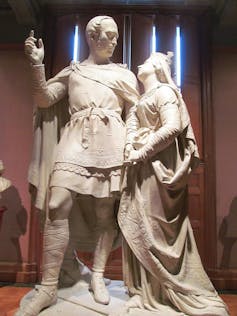
It was not until the 19th century that Anglo-Saxon poems such as Beowulf, the Seafarer and the Wanderer were translated into English as interest in Anglo-Saxons grew. In London’s National Portrait Gallery, there is a statue of Queen Victoria and Prince Albert of Saxe-Coburg and Gotha dressed as Anglo-Saxon monarchy – a commission that equated their Germanic descent with that of their subjects. This Anglo-Saxon origin story has its roots in politics, downplayed when anti-German sentiment during World War I prompted the royals to change their name from Saxe-Coburg-Gotha to Windsor in 1917.
A convenient, but inaccurate label
The people of the fifth, sixth and seventh century certainly did not think of themselves as Anglo-Saxons and would not have understood the description. Migration into the UK took place in deep prehistory, throughout the Roman and post-Roman periods – a fact which the Classicist Mary Beard was lambasted for defending on Twitter in August.
Migration then continued with Viking settlement in the ninth and eleventh centuries. Dutch and European migration into England was present throughout the middle ages and particularly pronounced in the 16th and 17th century as Flemish weavers fled religious persecution.
Today, the term Anglo-Saxon is a convenient label for those opposed to future immigration. While it collectively describes some post-Roman and early medieval culture, it has never accurately described a biological ethnicity nor an indigenous people. The DNA evidence points to an integrated people of mixed ancestry who lived side by side.
Anglo-Saxon ancestry is a modern English myth – the English are not descended from one group of people, but from many and that persists in our culture and in our genes.
To hear more on myths about race, listen to the December episode of The Anthill podcast on myths, featuring an interview with Duncan Sayer.
With more than 1,000 outlets across the length and breadth of the United Kingdom, Greggs the baker is a national institution. It’s not uncommon for queues to form in some towns and cities as the daily doughnuts, cheese and onion pasties and steak bakes come out of the ovens. But it is the sausage roll that is the star turn.
Now though, it seems it is the star that Greggs took too far. For Britain’s biggest bakery has had to apologise after it replaced the traditional baby Jesus in the manger with its famed product in a nativity scene. The image was used to promote its advent calendar and, the company says, wasn’t meant to cause offence.
It’s big, but it might not feed 5,000. Greggs
Well, regardless of intentions, the image, with three wise men reverently surrounding a golden sausage roll in a manger, caused quite an uproar.
Many Christian Twitter users were at the forefront of this backlash against the image, tapping into the false narrative of the persecution of Christians in Western countries including the UK and US, and the idea that there is a “war on Christmas”.
While many of the “war on Christmas” debates focus on the secularisation of the winter holiday, in this instance the attention was on a private company supposedly making light of the baby Jesus for profit.
One organisation, the right-wing pressure group the Freedom Association, led by Simon Richards, called for a boycott of Greggs as a result of the image.
The viral growth of the hashtag #boycottGreggs has prompted the bakery to issue a formal apology. “We’re really sorry to have caused any offence, this was never our intention,” said a spokesperson.
My flesh is meat indeed
However, what might not be apparent at first glance is just how appropriate this debate about Jesus-as-sausage-roll is in light of the Gospels – and the Gospel of John in particular. Although the Gospel of John doesn’t describe the nativity scene that we find in Luke and Matthew, it is a Gospel intent on describing Jesus as a food.
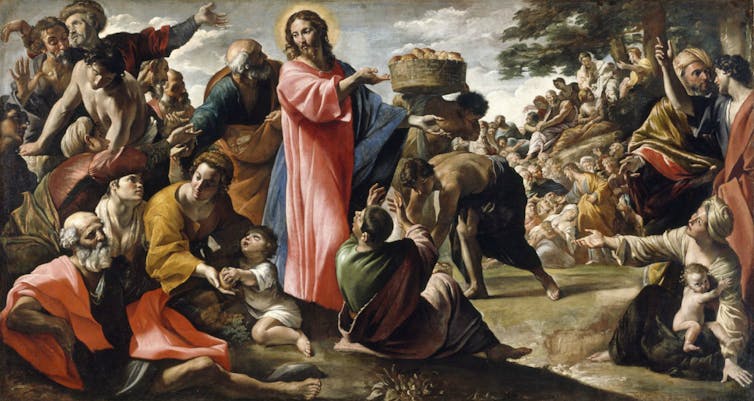
In one well-known scene, after he has fed the 5,000 on the shores of the Sea of Galilee, Jesus launches into a speech known as the “Bread of Life Discourse”. John’s Gospel uses several metaphors to describe Jesus here, including both bread and meat – and scholars have argued that Jesus means what he says.
Giovanni Lanfranco, Miracle of the Bread and Fish (1620-1623). Wikimedia Commons
First Jesus declares: “I am the living bread.” Those listening to him are understandably confused, since they don’t see a loaf of bread in front of them but “Jesus, the son of Joseph, whose father and mother we know.” When Jesus hears them doubting his claims, he repeats his claim three times, finally stating explicitly that “the bread … is my flesh”.
After this conversation, Jesus makes a second claim about his body, this time that it is flesh to be eaten. In the King James Version, Jesus emphatically declares: “My flesh is meat indeed.” Even if we accept a metaphorical reading of Jesus’s words, there is no question that John the Evangelist understood Jesus in edible terms.
Offence and the Gospels
If Jesus as bread and meat is biblical in its origins, it might be surprising to see that the outrage over these claims is not unique to the current uproar around the Greggs advert.
The Gospel of John first describes people’s disbelief of what Jesus says – they doubt he is the bread he claims to be. But the real outrage comes when Jesus declares that he’s made of meat, and that people should be eating him. Even his followers, his disciples, have trouble with this: “When many of his disciples heard it, they said, ‘This teaching is difficult; who can accept it?’” Jesus, seeing that what he’s said has offended them, doubles down on his claims – and some of his (nameless) disciples decide to leave him.
Not unlike the current furore over Jesus the Sausage Roll, the Gospel of John depicts uproar and offence at Jesus being compared to food. It seems that comparing Jesus to food has a long history of causing outrage, then, but that doesn’t mean that it’s wrong – the Bible itself recognises both the comparison and the ensuing offence.
War on Christmas
Paradoxically, then, Greggs has actually provided a scripture-inspired vision of the nativity that Christians often complain is increasingly absent in the run-up to Christmas.
While there is no real war on Christmas, those anxious about what they perceive as a lack of Jesus in the advent season should take another look at the Greggs ad, which places a biblical understanding of Jesus right in the centre.
The Orlando shooting was a hate crime against gay people – even if, once it emerged that the attacker had been a Muslim, many people claimed this as a terrorist attack rather than a hate crime. And, in an important sense, this was also a terror attack, since its aim was to spread fear in the LGBT community.
shutterstock. Nando Machado/Shutterstock.com
Since the massacre there has been a lot of speculation about Islam and homosexuality and there are fears that one man’s despicable act of terrorism could fan the flames of Islamophobia and other forms of social exclusion, leading to discord and unrest in an era of elevated Islamophobia.
It is difficult to define the “Islamic position” on homosexuality, as a monolithic phenomenon, simply because Islam is a very diverse faith group with some 1.6 billion followers on six continents. In most Muslim countries, homosexuality is illegal and in some countries, including Iran and Saudi Arabia, it is punishable by death. But in others, such as Jordan and Turkey, homosexuality is not considered a crime.
Most Islamic scholars are in agreement that homosexuality is incompatible with Islamic theology. They tend to draw on the story of Lot in the Koran (also in the Old Testament) which recounts the destruction of the tribe of Lot allegedly due to their engagement in homosexual acts as “evidence” for God’s condemnation of homosexuality. Many scholars also cite the Ahadith (statements attributed to the Prophet Muhammed) that are condemnatory of homosexuality. Theological and legal condemnations of homosexuality can engender perceptions at a social level that homosexuality is wrong and that it should not be permitted.
Muslims on homosexuality
In 2009, a Gallup survey revealed negative attitudes towards homosexuality among European Muslims. In France, 35% of Muslims viewed homosexuality as “morally acceptable” (versus 78% of the general public). In Germany, 19% of Muslims viewed it as morally acceptable (versus 68% of the general public). In the UK, none of the Muslim respondents viewed homosexuality as morally acceptable (versus 58% of the general public who did).
Earlier this year, a survey commissioned by Channel 4 was conducted among a random sample of 1,081 individuals who self-identified as Muslim. The results found that 18% of the British Muslim respondents agreed that homosexuality should be legal in Britain while the majority (52%) disagreed. Conversely, only 5% of the general public thought homosexuality should be illegal. Furthermore, 47% of the British Muslim respondents indicated that they did not believe that it was acceptable for a gay person to become a teacher. These data suggest that there are low levels of acceptance of homosexuality in Muslim communities in the UK.
However, qualitative interview data can provide more nuanced understandings of what Muslims think and why they might hold these views.
In my research into attitudes concerning homosexuality among samples of first and second-generation British Muslims of Pakistani descent, I found that attitudes tend to be largely negative. Although research into attitudes towards homosexuality in the general population points to demographic variables, such as age and level of education, as key determinants of the nature of attitudes, this has not been the case in my own work with British Muslims. Muslims of various ages, education levels and socio-economic backgrounds have participated in my studies and generally perceive homosexuality in negative terms. In substantiating these attitudes people often draw on holy scripture. As one 54-year-old woman said:
It says it in the Koran that it’s wrong and sorry I’m not the one who made it. It’s what the God revealed to the Prophet so it’s the truth and that’s my belief system.
Many interviewees draw upon holy scripture as the basis of their views regarding homosexuality. There appears to be a desire not to “re-interpret” holy scripture – to accommodate homosexuality – because of the divinity of its origin. Moreover, there was a fundamental rejection of essentialist arguments concerning the origins of sexual orientation – that people are born gay and that they do not “choose” to be gay – and interviewees often argued that people had “chosen” to be gay. One 28-year-old man said:
God doesn’t create gay people. It’s a path they’ve chosen and that’s an incorrect path according to our faith.
Indeed, previous research has shown that believing the essentialist argument regarding homosexuality is correlated with less discrimination and greater acceptance.
What does the Koran say about homosexuality? Lord Harris/BritishMuseum, CC BY
First-hand relationships
Although many British Muslims may disapprove of the concept of homosexuality, several individuals reported positive first-hand experiences of contact with LGBT people. A 45-year-old man said:
Homosexuality is wrong, I believe … I have a gay neighbour and he lives with his partner. He’s a very nice guy – both of them [are]. They are very respectful. We consider them friends.
Some people spoke fondly of their LGBT friends, neighbours and acquaintances, suggesting that first-hand contact may challenge homophobia which exists at an abstract, conceptual level. It is also vital to stress that the Muslim interviewees overwhelmingly rejected violence against LGBT people. As one woman put it:
Violence and hate crimes are un-Islamic. We are not supposed to kill or hurt others, as Muslims. No, they can’t have it both ways so they won’t be accepted in our community but it’s for God to punish, not us.
It was difficult for British Muslim interviewees to accept homosexuality given the overwhelming “evidence” of its prohibition in Islam. Individuals simply had no positive theological frame of reference given the absence of LGBT affirmative voices at an institutional level. This led some individuals to view endorsement of homosexuality as a violation of their religious faith and its norms:
Being gay is un-Islamic and so is encouraging it.
Put simply, the acceptance or endorsement of homosexuality was perceived as contravening key tenets of Islam.
Gay Muslims speak out
Clearly, the stigma attached to homosexuality in Islamic communities can have profound effects for those Muslims who also self-identify as gay. For almost a decade, I have been researching the social psychological aspects of being Muslim and gay. In view of the generally negative attitudes towards homosexuality in Muslim communities and the silence that can surround discussions of sexuality, most of my Muslim gay interviewees have manifested a poor self-image and low psychological well-being. Many view their sexual orientation as “wrong” and, thus, express a hope to change it in the future. One young gay Muslim man said:
It’s [being gay] wrong, really, isn’t it? … In the mosque we’re told that Shaitan [Satan] tries to tempt Muslims because he is evil and he makes us do evil things. I know that doing gay things is evil but I hope I’ll change my ways and take the right path soon … It’s all about temptation, really. Life is a big test.
Those gay Muslims who conceptualise their sexuality as immoral and wrong can understandably struggle to derive self-esteem, which is key to well-being. They may come to view their sexual orientation as “evil” and resist it. Some attempt to change their sexual orientation, sometimes by entering into marriages of convenience. This conceptualisation of homosexuality stems from their understanding of the Islamic stance on it. Said by a 28-year-old man:
What the Prophet said was right and that’s always going to stand, yeah. Men having sex with other men was wrong in his eyes. He hated it.
It is easy to see how belief in the negativity of homosexuality from the perspective of one’s faith (which, in countless studies has emerged as an important identity among British Asian Muslims) could cause some gay Muslims to develop internalised homophobia and, in some cases, to doubt the authenticity of their Muslim identity.
Gay Muslims may cope with this internal conflict in a number of ways. While some hope to change their sexual orientation and to “become” straight, others may deny that they are actually gay:
Maybe I’m not bisexual because I’ve never been with a woman but I can’t call myself gay either … I refuse to do that because I just don’t feel gay.
Crucially, in making sense of the “causes” underlying their sexual orientation, some gay Muslims were of the view that they had “become” gay as a result of their social environment and consequently blamed British society:
I’m gay because I was brought up here [in Britain] but I reckon if I’d been brought up in Pakistan then I would have turned out straight because this doesn’t happen that much there. Like I haven’t heard of any gays in our village. Here there are clubs and that and so I just kind of fell into the gay culture.
We tend to attribute aspects of our identity that we see as undesirable to external factors. This is a means of protecting one’s sense of self from threats. Some of the gay Muslim interviewees in my studies have identified British (or Western) culture as the reason for their sexual orientation.
Reconciling homosexuality and Islam
Many individuals of religious faith struggle to accept homosexuality given the centrality of heterosexuality to faith life, according to most faith groups. Muslims are no exception. Individuals use all sorts of strategies for protecting their sense of identity and some of these strategies can actually have poor social and psychological outcomes. Social psychologists have long argued that intergroup contact is a good starting-point for improving relations between different social groups.
Universities are obvious contexts in which different groups can come together – LGBT and Islamic student societies on university campuses could collaborate with the aim of increasing inter-group contact between Muslims and LGBT people (and indeed those who identify with both categories).
Of course, inter-group contact needs to be characterised by positive images of the outgroup. So there needs to be much more discussion of homosexuality in Muslim communities – which will admittedly be difficult given the cultural taboo around sexuality. Faith and community leaders should broach the topic. My view is that people need to be exposed to LGBT affirmative images. This has already happen to some extent.
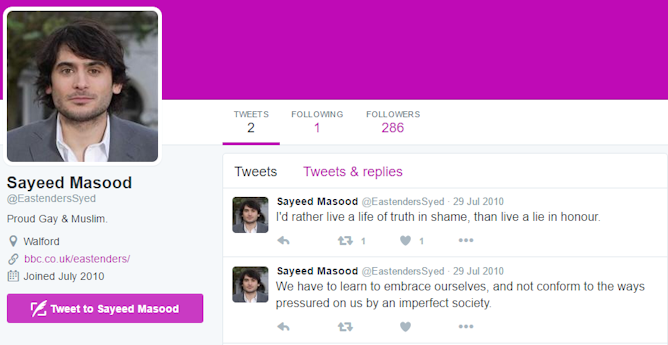
As I’ve written elsewhere, the Eastenders storyline concerning Syed Mehmood, a gay Muslim character who struggles to come out to his parents, generated some discussion in the British Muslim community and led some individuals to acknowledge the existence of homosexuality within their community.
Coming out: Syed from Eastenders on Twitter. Twitter
This is a positive step forward and one that can be built on. Similarly, there needs to be more acknowledgement and acceptance of faith groups in LGBT contexts which tend to be secular. In my research, I’ve also found that gay Muslims can face Islamophobia on the gay scene, which can hinder their sense of belonging in these spaces.
In addition to improving relations between groups, it is likely that this exercise will have positive outcomes for well-being among those individuals who self-identify as Muslim and gay. Growing up in an environment in which you are led to believe that your sexual orientation is wrong, sinful or symptomatic of mental illness can lead to profound social and psychological challenges, including internalised homophobia, low self-esteem, depression and, in some cases, suicidal thoughts.
The reasons underlying the horrendous attacks perpetrated by Omar Mateen in Orlando may never be fully understood. But if it is true that he was a closeted homosexual – it was reported that he had used gay dating applications and frequented gay bars, including the one that he attacked – he clearly had a very difficult relationship with this aspect of his identity. There is already some empirical evidence that homophobia is associated with homosexual arousal, which suggests that homophobia might be a means of distancing homosexuality from one’s sense of self.
Could it be that his actions were in part a result of his internalised homophobia? Did he attack the LGBT community in an attempt to distance his own sexuality from his sense of self?
In any case, we as a society have a responsibility to acknowledge diversity and to allow people the space and opportunity to self-identify in ways in which they choose. We have a responsibility to challenge prejudice (of all kinds) when it shows its ugly face. We have a responsibility to support and protect minorities who are vulnerable to marginalisation and exclusion. Sometimes this will be challenging particularly when it means that we have engage with sensitive issues such as religious norms and customs but we must persevere – for the sake of freedom, peace and well-being for all of society.
Joe Jackson’s 1982 hit Real Men was the first time I had heard gays referred to as faggots. I was just out of the closet and in my first gay relationship in London. Jackson’s lyrics about how only our friends and other gays could call us faggots was encouraging, coming as it did from a straight man singing a song just before AIDS hit.
Faggot, often-considered a slur, has been reclaimed many times over by gay men, including in a new play by Declan Greene, The Homosexuals, or “Faggots”, currently showing at the Malthouse in Melbourne. The play looks at gay male relationships and their politics, and is apt as middle-class gay men and lesbians struggle with acceptance all over again in the face of their call for marriage equality.
My friends and I called ourselves fags because it was a way of turning the abuse on its head and laughing at the straight bullies.
And in merry-old-England there was abuse: one night when leaving gay club Heaven, a bunch of lads called us and our female friends “pooh jabbers”. It was graphic and offensive (“bum bandit” being a similar, anal-fixated term from about the same time) and it occurred to me how deeply, viscerally they hated us.
Language defines who you are. But words used by others to define gay people can say a great deal more about them than us.
From prostitutes to gays
Let’s begin with the most common term, “gay”, which baby-boomer homosexuals appropriated for their liberationist cause in the late 1960s and early 1970s. Its pedigree is longer and according to Edmund White originally applied to women and meant loose or immoral, as in a prostitute. And “gay-house” was the term for a brothel. “In the past one asked if a woman was "gay,” much as today one might ask if she “swings,”“ wrote White.
“Faggot” has had different meanings according to where and when it was used. In eighteenth-century London it was first a term for prostitute then for homosexual. In 1920s New York, it described an effeminate homosexual who sought social/sexual relations with “normal men”, according to George Chauncey while a “flaming faggot” was an extremely obvious, flamboyant gay man.
In 1970s Australia, the ubiquitous “poofter” covered all forms of deviancy including men who had sex with other men, poor-performing sportsmen, politicians and motorists. Meanwhile, as the documentary Deep Water revealed, the literal bashing and killing of poofters caught at it in public parklands was something of a pastime.
“Cat” from “catamite” is ancient Roman with connotations of effeminacy, prostitution, and the passive role in a sexual encounter. “Fruit” was, like faggot, according to US historian Randolph Trumbach, a term first used in the 18th century for a prostitute and then a sodomite. “Fairy” and “queer” had similar origins between the world wars.
Why the fixation on prostitution? As Trumbach explains, there is a “long tradition in English usage” of words that are used to designate a prostitute being appropriated one generation later to describe sodomites.
This tendency for the words for prostitute to be later used for homosexual dates from 18th-century England when they often shared common social spaces, argues gay historian Rictor Norton.
Much later, historians such as Chad Heap and George Chauncey found similar intermingling in the underground bars that operated in New York and Chicago during Prohibition in the US.
The words gays use for themselves
Because of the sardonic nature of gayness, all of the above would have to be included also in the vocabulary of gay men and queers.
As well, there are community-specific terms, such as “clone”. Historically-specific, it connotes the style of gay men mid-1970 to mid-1980s (moustache, short hair, faded, baggy Levis and pocket and/or neck handkerchief) as exemplified by the lead singer of the Bronski Beat at the time of their hit single, Smalltown Boy.
More arcane terms include “ganymede” (a young male) which was used by Oscar Wilde and his contemporaries and “Marianne” and “Molly” from the earlier 18th century, again connoting an effeminate (or passive) male.
“Nance” and “nancy boy” as well as “Nelly” and “nellies” were terms used by both gays and straights also connoting effeminacy or youthfulness. According to one of writer Keith Vacha’s interviewees, nellies were “common queens” by which he meant: “ones with bleached blonde hair and plucked eyebrows”.
And finally, perhaps to the consternation of some of today’s toughs, there is “punk,” which according to Rudolph Trumbach was once the slang term for both prostitute and sodomite.
Terms of abuse and endearment
Terms of abuse are a way of distinguishing those whom we choose to marginalise because we do not like the look of them or because we were there first. In other words, they are the “outsiders” of sociologist Norbert Elias’s important work from the mid-1960s.
Humans have been doing this from the outset. Gangs and groups, them and us, and in the case of sexual preference, there are the straights, the “normals”, if you like, and the others, the sexual outcasts.
The terms I’ve illustrated were used by the majority to exclude prostitutes and homosexuals from “polite” society. While these terms were used to mark their difference, this did not prevent males from that same polite society from using the good services of prostitutes and homosexuals when it suited them. And as they did so then, they still do so now.
What is also interesting is the way in which sexual outcasts could adopt terms of abuse used for them and turn them into terms of endearment for each other — as my friends and I did in the 1980s when we called ourselves fags. And so, self mockery becomes a form of defence against the strictures of the priests and preachers.
It was literally the priests and the preachers, and later doctors and lawyers, who sought to demarcate “useful” sexual activity from wasted sexual activity. According to historian Michel Foucault the monogamous heterosexual couple produced new workers; those erotic and sexual activities that detracted from or weakened it were identified, categorised, and punished by law.
That young, gay men are now starting to reclaim these words is significant. It could mean that they are becoming interested in finding out where they have came from, that is, what are the origins of the culture they inhabit?
Twenty-one years ago, AIDS, which was then the dominant concern for gay men and culture, ceased to be a death sentence and instead became a manageable disease. Young men who have grown up since then could feel that other aspects of gay life can now be explored with greater freedom.
If this is so, it would suggest a strengthening of gay culture and community because people can only start exploring their past, warts and all, when they feel safe.
In early February, the Church of England College expressed regret that in an evening liturgy in Cambridge, God was referred to as the Duchess. The service had been advertised as a Polari evening prayer in anticipation of LGBT History Month, and was described as a liturgical experiment. So what was Polari and how did it end up in an evening prayer?
Polari is a secret language, which has now largely fallen out of use, but was historically spoken by gay men and female impersonators. My research has tracked how it grew out of the world of entertainment, stretching back from West End theatres, through to 19th-century music halls and beyond that to travelling entertainers and market-stall holders.
It developed from an earlier form of language called Parlyaree which had roots in Italian and rudimentary forms of language used for communication by sailors around the Mediterranean. Also associated with travellers, buskers, beggars and prostitutes, it found its way into Britain, especially London and port cities, and gradually became used by gay men and female impersonators, especially during the first half of the 20th century.
The Polari bible. Joe Richardson, Author provided
Polari itself had Parlyaree as a base, but once in Britain was supplemented with a wealth of slang terminology from different sources, including Cockney Rhyming Slang, backslang (pronouncing a word as if it was spelt backwards), French, Yiddish and American airforce slang.
In a period when homosexuality was illegal and heavily stigmatised, it was useful as a means of conducting conversations in public spaces, which would have alerted others to your sexuality. Many of the words allowed speakers to gossip about mutual friends or to critique the appearance of people who were in the immediate vicinity.
“Vada the naff strides on the omee ajax” meant look at the awful trousers on the man nearby. Inserting a Polari word – such as bona (good) or palone (woman) – into a sentence could act as a coded way of identifying other people who might be gay. The language itself, full of camp, irony, innuendo and sarcasm, also helped its speakers to form a resilient worldview in the face of arrest, blackmail and physical violence.
Polari speakers “christened” themselves with camp names like Scotch Flo or Diamond Lil, affording themselves alternative identities that reclaimed the representations of them as effeminate in positive ways.
Surplus to requirements
In the 1990s, I based my doctoral thesis around the study of Polari, examining its varied history and complicated etymology, the ways that it resembled a language, its social functions and the reasons for its eventual decline. I interviewed speakers of the language and analysed texts, including scripts of the 1960s comedy radio series Round the Horne, which had a regular sketch voiced by Kenneth Williams and Hugh Paddick, who played Polari-speaking actors.
The version of Polari that was used in Round the Horne was necessarily simplified and toned down for the British public, and by the 1960s, there was a feeling that Polari had already overstayed its welcome. Round the Horne spoiled the secret, rendering the language less attractive to its speakers. Meanwhile the decriminalisation of homosexuality in 1967 was round the corner, making it less necessary for a secret lingo in any case.
Some younger gay men were more interested in concepts like gay pride, gay liberation and coming out and viewed Polari as a naff byproduct of a more repressive time. In the 1970s, in an early gay magazine called Lunch, activists branded Polari as ghettoising and it gradually became surplus to requirements. When I carried out a survey of 800 gay men in the year 2000, about half the respondents had never heard of it.
Renewed interest
While few gay men today actively use Polari, in recent years it has gained a kind of latent respectability as an historic language – similar to the way Latin is seen by the Catholic faith. From a political standpoint, Polari is now recognised as historically important, an example of the perseverance of a reviled group of people who risked arrest and attack just for being true to who they were.
In 2012 a group of Manchester-based artists used Polari to highlight the lack of LGBT inclusivity in education. They created an exam in LGBT studies, getting volunteers to sit it under strict exam conditions. The language portion of the exam was about Polari.
Another group of activists called the Sisters of Perpetual Indulgence created a Polari Bible, running a Polari wordlist through a computer program on an English version of the Bible. The Bible was bound in leather and displayed in a glass case at the John Rylands Library in Manchester. This was not to mock religion but to highlight how religious practices are filtered through different cultures and societies, and that despite not always being treated well by mainstream religions, there should still be space for gay people to engage with religion.
In 2012, I participated in a group effort to carry out the longest ever Polari Bible reading which took place in a Manchester Art gallery. In a nice touch of high camp we had to wear white gloves while touching the Bible, to ensure the oils from our fingers didn’t ruin the paper. We took turns reading lines such as: “And the rib, which the Duchess Gloria had lelled from homie, made she a palone, and brought her unto the homie.” Translation: “And the rib which God had taken from man was made into a woman and brought to the man.”
The Polari Evensong at Cambridge, carried out by trainee priests, however, took place in a more official context and provoked a range of conflicting opinion. Some people think it is hilarious, some are concerned about Church of England rules being broken and disrespect for religious tradition, while others think that God should be prayed to in any language and that the Evensong was perfectly valid. As someone who has spent 20 years documenting the rise and fall of Polari, I find it fascinating that even now, it is finding new ways to cause controversy. Never has a dead language had such an interesting afterlife.
British members of Parliament have been debating whether shops should remain open on Boxing Day. Some 30 or 40 years years ago, shops stayed closed for longer during the holiday season – and on Boxing Day family time was the focus and leftover turkey the star of the show. But in recent years Boxing Day has fired the starting gun for the January sales, created (yet another) key moment in the British retail calendar and forced retail staff into work.
This growing commercialisation has created a backlash. In 2015, a petition on the government’s website to ban shops from opening on Boxing Day gathered a modest 27,525 signatures, but 2016 has seen the campaign gather greater momentum. Two similar petitions have been active this year. The first, also on the government’s official website, calls for all retailers to close on Boxing Day, claiming: “Some things are needed over the festive period, retail isn’t one of them.” It has received more than 140,000 signatures, easily meeting the required level of support to warrant the parliamentary debate. A similar petition on the website change.org claims has gathered more than 230,000 signatures.
So what is the historical background to Boxing Day and why are we so attached to it? Is it possible that this recent groundswell of support could begin to loosen the grip of consumerism during the Christmas break?
Pepys show
The Oxford English Dictionary claims the earliest use of the term “Boxing Day” is from 1830s England. It was “the first weekday after Christmas Day, observed as a holiday on which post-men, errand-boys, and servants of various kinds expect to receive a Christmas box”. This relates to a seasonal British custom for tradespeople to collect boxes of money or presents after Christmas as thanks for good service throughout the year.
This is actually linked to an even older English tradition, mentioned by Samuel Pepys’ in a diary entry from December 19, 1663, when servants of the wealthy, who would have to wait on their masters on Christmas Day, were allowed the next day to visit their families. Employers would give each servant a box to take home containing gifts, bonuses and sometimes leftover food.
The 2016 parliamentary debate about the modern nature of Boxing Day did not involve a vote and so there will be no immediate change in the law. However it was a chance for MPs to demonstrate whether it is an issue with much parliamentary support. In response to the petitions, the government has said:
We do not believe it is for central government to tell businesses how to run their shops or how best to serve their customers. Therefore we are not proposing to ban shops from opening on Boxing Day.
Even if there is general support in Parliament, I don’t believe the UK government will amend the current trading laws and so prevent large stores from opening on Boxing Day any time soon – for several reasons.
Ker-ching
First, and most importantly, the retail sector is a critical part of the UK economy – and in fragile economic times it would be a brave government indeed that took any action that might damage it. Sales in the sector were £339 billion in 2015 (generating 5% of the UK’s GDP) and, with almost 3m working in retail, it was the UK’s largest private-sector employer.
There is also an important international dimension. The UK’s in-store sales on Boxing Day are boosted by an influx of foreign shoppers.
The second key factor reflects the radical changes seen in consumer habits as a result of online shopping, a point also acknowledged by the government in its response to previous Boxing Day petitions:
Consumers are now used to the freedom to buy what they need at any time that suits them. The government believes that all businesses should be allowed flexibility to meet their customers’ needs and offer consumers choice about when and how they want to shop. This will help drive competition, productivity and the local economy, as well as helping create jobs
Unsurprisingly, this is a view echoed by the British Retail Consortium (BRC) the trade association whose members represent 70% of the turnover of the UK retail sector.
Sacred time
That leads onto a third factor behind the government’s decision making. According to the Guardian, shoppers last year were more willing than ever to interrupt Christmas Day itself for some online bargain hunting.
Online sales in the UK on Dec 25, 2015 were the highest ever, up 21% on 2014 according to web services group PCA Predict – whose founder Jamie Turner highlighted the “convenience of being able to browse online throughout the entire Christmas period to find deals and discounts”.
However, there is one thing that seems to remain sacred. Experian and online retail trade association IMRG reported a dip in online between 1pm and 4pm on Christmas Day as families enjoyed Christmas lunch together (and perhaps even watched the Queen’s speech), then rising again in the evening as people sat down to relax and watch television.
At the heart of this debate lies the fear of missing out. For the government, for retailers and their shareholders, and for millions of bargain-hunting consumers. According to the BRC, the UK retail market is the “most competitive in the world” and in that context it becomes almost unimaginable that any large retailers would now make a voluntary decision to close on Boxing Day and so lose sales and market share to rivals.
The British boom in online shopping – the UK has the highest level of penetration in the world – has also brought with it the “click-and-collect” phenomenon. In other words, both parts of the UK retail industry work hand-in-hand – there will be millions of UK consumers who want to order products online over the Christmas holiday period and collect from a store on Boxing Day. More, you have to conclude, than the 140,000 petition signatories who long for a Christmas free from the ringing of the nation’s cash registers (or the sound of clicking on the pay now button).
"One of the smarter blogs is the libertarian-leaning collection of Charlottesville posts put up by Rick Sincere..." -- Bob Gibson, The Daily Progress, May 8, 2005
 In the game of rugby which inspired my St Patrick’s Day t-shirt, one of the (many) try scorers for Ireland was a certain Ronán O’Gara, born San Diego, California. When it comes to identity, place of birth isn’t everything.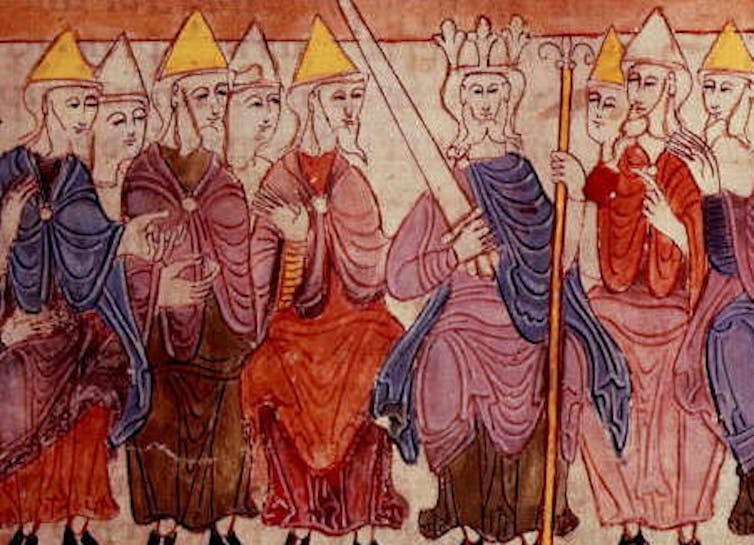
 To hear more on myths about race, listen to the December episode of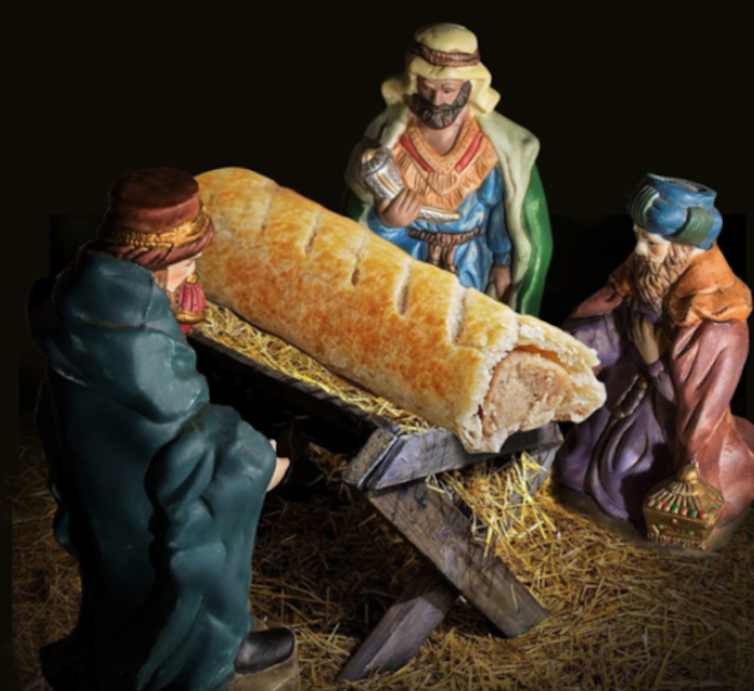
 While there is



 My friends and I called ourselves fags because it was a way of turning the abuse on its head and laughing at the straight bullies.
 Humans have been doing this from the outset. Gangs and groups, them and us, and in the case of sexual preference, there are the straights, the “normals”, if you like, and the others, the sexual outcasts.


 In 2012 a group of Manchester-based artists used Polari to highlight the lack of LGBT inclusivity in education. They created


