The main business of the convention was to elect party officers -- chairman, vice chair, secretary, and treasurer -- and to nominate a candidate for the U.S. Senate to represent the LP in November's general election.
Matt Waters, a political and non-profit fundraiser from Alexandria, won the nomination in an uncontested vote. Before the delegates cast their ballots, Waters addressed the assembly to talk about the issues that animate him and to describe his vision for running a campaign against incumbent Democratic Senator Tim Kaine and the eventual Republican nominee, who will be chosen in a primary election on the second Tuesday in June.
Three Libertarian nominees for the U.S. House of Representatives also addressed the convention delegates. They each spoke briefly about their campaigns and answered a few questions posed by audience members.
All of the Libertarian candidates for Congress must submit petition with a minimum of 1,000 signatures from registered voters who live in their congressional districts. The deadline for delivering the petitions is 7:00 p.m. on Tuesday, June 12 -- the same day that Democrats and Republicans hold their primary elections to nominate candidates. (Waters, as a statewide candidate, must submit 10,000 valid signatures, including 400 from each of Virginia's eleven congressional districts, by the same deadline.)
Joe Walton will challenge incumbent Republican Dave Brat in Virginia's seventh congressional district. Here are Walton's remarks:
Stevan Porter will challenge incumbent Democrat Gerry Connolly in Virginia's eleventh congressional district. Here are Porter's remarks:
Pete Wells will challenge incumbent Democrat Donald McEachin in Virginia's fourth congressional district. Here are Wells' remarks:
Before the official business of the convention began, LPVA members heard a presentation from Liberty University student Aaron Sobczak, who recently became vice chair of the Libertarian Youth Caucus. Here is Sobczak's address to the Libertarian Party of Virginia:
The LPVA also elected delegates to the Libertarian Party's midterm national convention, which will take place in New Orleans from June 30 through July 3. At that convention, delegates will elect members of the Libertarian National Committee and vote on changes to the party platform and its bylaws. A personal note regarding these videos:As of February 20, YouTube decertified my creator's channel for monetization (not just mine, but those of thousands or millions of video creators). In order to qualify again to earn money through my YouTube channel, I must have obtained 1,000 subscribers and 4,000 viewing hours over 12 months. So, if you are reading this article and like the videos embedded here, I encourage you to subscribe to my YouTube channel and watch more of the (to date) 823 videos posted there, which include reports on many Libertarian Party and other political events.
Fifth District Congressman Tom Garrett on Friday hosted several diplomats on a tour of Thomas Jefferson’s home at Monticello. After the tour, he and two of them – Ambassador Hamdullah Mohib from Afghanistan and Ambassador Hynek Kmonícek from the Czech Republic – answered questions from the local Charlottesville news media.
Garrett explained that even though, as a slaveholder, Thomas Jefferson was a flawed individual, the Declaration of Independence that he drafted was a “brilliant” document that led to freedom not only in the United States but around the world. Both Ambassador Mohib and Ambassador Kmonícek acknowledged that they learned things about U.S. history and Jefferson himself by taking the tour of Monticello, and that there are lessons they could convey to their compatriots back home.
(Ambassador Kmonícek joked that, where he comes from, a 200-year-old house is considered new.)
Congressman Garrett also answered questions about current domestic policy. Tyler Hawn of the Charlottesville Newsplex asked him about the budget bill that was passed late in the night and signed Friday morning by President Trump, and whether the process was frustrating. Garrett replied (starting at the 9:28 minute mark in the video):
It’s ironic that we stand at the home of Thomas Jefferson, who drafted the Declaration of Independence, which was signed by people who knew when they put their name on that paper that if they were captured they would be killed. We’ve devolved into a political class with the inability to say “no.”
I voted against the National Defense Authorization Act even though people would describe me as a hawk, because thirty-plus years ago department of defense agreed with other federal agencies to be audited – it’s never been audited.
To continue to spend and spend and spend is a symptom of a political class without the courage to do what they think is right when it’s too difficult and standing for reelection having done what you said, even when it was difficult or uncomfortable, is the hallmark of who we are supposed to be as a people.
I voted against that. I think President Trump was wrong to capitulate on heightened spending. He can spin it however he likes. We need to draw lines and assure that taxpayer dollars are being spent efficiently and on the core functions of government. We’re not doing that. It wasn’t OK when President Obama spent profligately. It’s not OK when President Trump does it. So, yes, I’m frustrated.
Garrett also answered a question (about 10:40 in the video) about pending immigration legislation and how it will affect participants in DACA (Deferred Action for Childhood Arrivals).
That’s going to start in the Senate, for sure, because that’s the chamber where I think they can get something out. I’ve spoken with dozens of DACA recipients – dozens may be low – they can prove it because they’ve filmed me. I’d love to have a solution for DACA. I don’t think deferred action is the proper long-term solution but I’m not going to vote for anything until we secure our southern border.
To do the same thing again and again and expect a different result is the definition of insanity. And I’ve said this to these people with whom I’ve spoken: I think border security should be this AND that, not a this THEN that. We tried this in ’86 with a this-then-that and it failed. And I haven’t had any of the people with whom I’ve spoken who are DACA recipients have a problem with that.
So, I think if we set aside some of the hyperbolic rhetoric that we can get something done but right now people need to step back from the rhetorical edge, acknowledge the existential reality to the young people who are DACA recipients, and also acknowledge that it makes no sense not to take action to secure our southern border.
There are plenty of other gems in the conversation, from both the ambassadors and from Congressman Garrett, who said he would like to do more programs like this, perhaps three or four times each year, bringing ambassadors from Washington to Charlottesville to visit both the University of Virginia and Monticello.
In addition to Tyler Hawn of the Newsplex, Pete DeLuca of NBC29 covered the press event in the Robert H. and Clarice Smith Gallery at Monticello's David M. Rubenstein Visitor Center.
This article was previously published, in slightly different form, on Bearing Drift.
Ken Cuccinelli clarifies remarks on marijuana legalization as federalism issue
February 9, 2013 1:16 PM MST
Replying to a question from a self-described former addict about marijuana legalization, Virginia Attorney General Ken Cuccinelli used the opportunity to explain his views on federalism to an audience of Republican activists in Albemarle County on February 9.
Cuccinelli, a candidate for governor in 2013 and author of a new book scheduled to be published on February 12, The Last Line of Defense: The New Fight for American Liberty (Crown Forum, 272 pages, $25), said that “one of the problems with the ever-layering on of federal regulations and commands about how we all run our governments, our local governments, our businesses, is this sort of maniacal drive that we all be the same.”
Diversity, Cuccinelli explained, “is a strength of this country. We shouldn't try to wring it out, including intellectual diversity and policy diversity, because we get these sorts of experiments and some of them don't work and some of them may work.”
Colorado and Washington
Earlier in the week, the Attorney General had told students at the University of Virginia that, with regard to the legalization of recreational use of marijuana by voters in Colorado and Washington state, “I and a lot of people are watching Colorado and Washington to see how it plays out.”
Cuccinelli used his appearance at the Albemarle GOP breakfast to clarify and expand on his remarks at UVA.
“What I expressed to [the students] was an openness to observe how things work there, both in terms of the drug side and the economics. One issue that is often discussed is how the war on drugs itself has played out. Have we done this the right way? It's been phenomenally expensive.”
If the government, he said, is “going to put people in jail and spend $25,000 [to] $30,000 a year for a prison bed, do we want it to be for someone who's pushing marijuana or pushing meth? I'll tell you what, that $30,000 for the meth pusher is well worth the deal.”
Different kinds of illicit drugs, he said, are “not the same” and policymakers have to set priorities in terms of law and of how the laws are enforced.
“We have limits on our budget and our ability to police this, so we've got to make these kinds of distinctions over time.”
'Simple federalism experiment'
The benefit of the legalization of cannabis in Colorado and Washington, he explained, is that “having data from a couple of states, whole states, that go down this path may not be good news but it will be interesting and it will be something we can learn from.”
The situation in those two Western states “is going to be interesting on several levels,” he said, including “as a simple federalism experiment.”
What, he asked, is “the federal government going to do? What are they going to do? How is this interaction between the states and federal government going to take place?”
Cuccinelli said he has no “problem watching that. It's a peculiar subject but I do think it's important that states try some things they think are appropriate and whether the federal government approves or not, the rest of us watch and learn.”
Undermining federalism
He explained he had told the UVA students, “I'm ready to watch and learn. I'm not ready to do it [legalize marijuana] but I don't want to just never ever say never to the possibility in the future.”
When the federal government forces all states to be uniform, he said, diversity and experimentation are undermined.
“We're not going to have any [experiments] if the federal government is just squashing all of us,” Cuccinelli said, adding: “That's something I have fought against as AG.”
At the same time, he continued, “I don't want you to think that I'm going to land in the governor's office and sign a legalization bill. I don't think you have to worry about it getting to the governor's desk but it's worth knowing what your candidate's saying.”
Publisher's note:This article was originally published on Examiner.com on February 9, 2013. The Examiner.com publishing platform was discontinued July 1, 2016, and its web site went dark on or about July 10, 2016. I am republishing this piece in an effort to preserve it and all my other contributions to Examiner.com since April 6, 2010. It is reposted here without most of the internal links that were in the original.
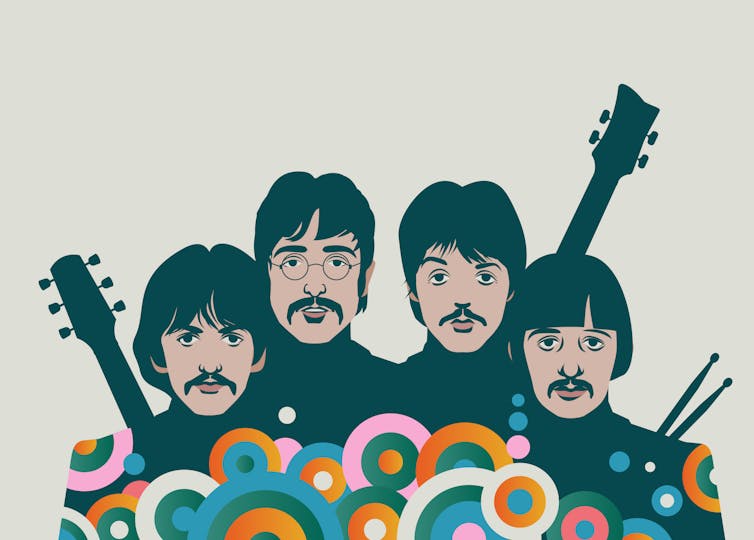
The 50th anniversary of Sergeant Pepper’s Lonely Hearts Club Band was much celebrated in 2017. But this Christmas also marks 50 years since the release of another Beatles production that received much less critical acclaim – the Magical Mystery Tour film.
Much of the music within it was produced during a particularly fecund period (even by the Beatles’ standards) and is, or course, peerless – from the music hall echoes of Your Mother Should Know through the plaintive, melodic Fool on the Hill to the boundary breaking I Am the Walrus.
Unfortunately the film itself fell far short of that artistic bar. First broadcast on Boxing Day 1967, it is, to put it mildly, seriously flawed. Incoherent, sexist, technically shaky and verging on boring, history hasn’t been kind to its cinematic qualities.
Contemporary reviews and audience responses were also so generally scathing that Paul McCartney was moved to issue an apology of sorts to the television broadcast’s 20m viewers. He said in a hastily convened interview:
We don’t say it was a good film. It was our first attempt. If we goofed, then we goofed. It was a challenge and it didn’t come off. We’ll know better next time.
Matters weren’t helped by the Beatles’ psychedelic, colourful exploration being broadcast in black and white on BBC1. A repeat on BBC2 (then the only colour TV service) a few days later did little to redress the situation, if only because there were fewer than 200,000 colour sets in the UK at the time.
Pushing institutional boundaries
For all the defensiveness of McCartney’s response (“You could hardly call the Queen’s speech a gasser”) they do point towards some retrospectively mitigating aspects of the Magical Mystery Tour film.
The film’s distinctly British surrealism and cavalcade of barking sergeant majors, fat aunts, dolly birds, wacky racers and midgets clearly prefigured Monty Python’s explosion of absurdity into mainstream television.
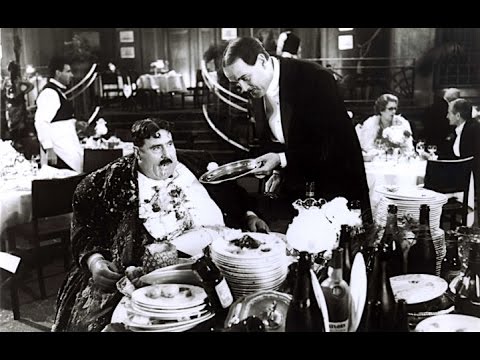
Indeed, George Harrison said later on that he saw Monty Python as a continuation of the spirit of the Beatles. He also funded some of their films, including The Meaning of Life – whose notorious Mr Creosote sketch has visual echoes of a scene in Magical Mystery Tour where John Lennon, dressed as a waiter, serves pasta to Ringo’s fictional Aunt Jessie by the spade full.
What the Pythons added to the mix were sharply honed scripts. Magical Mystery Tour, by contrast, was almost entirely ad-libbed from a one-page diagram. The Beatles’ skill as writers and arrangers was poured into their music instead.
Something else the Pythons had, and which the Beatles lacked, was the benefit of Oxbridge educations. Magical Mystery Tour’s sensibility was more rooted in working class entertainment and tropes than the Pythons’ Oxbridge-infused references.
The very concept of a coach journey – albeit one largely filmed at a decommissioned RAF base – was based on the “charabanc” trips (group bus excursions) of the band members’ childhoods.
The film evokes the past – both a British past in general and, more specifically, as filtered through the Beatles’ own histories. It certainly shows them pushing the boundaries of what a rock band of four Liverpudlians (whose post-school education essentially took place in the nightclubs of Hamburg) could attempt, both artistically and institutionally. Their commercial and creative clout allowed them to broadcast the film during a key annual peak slot for British television viewing.
Prime time
Magical Mystery Tour occupied a particular space in the history of mass entertainment – from the “end of the pier” shows, through the Donald McGill postcards that George Orwell defended against artistic snobbery, to the anarchic weirdness of the likes of Mr Blobby on Saturday night TV.
The Beatles infused that particular strand of entertainment with the forward looking experimentalism of their music, while retaining a characteristic, widely recognisable Britishness. It was this that paved the road for Python and others to follow.
That Magical Mystery Tour was their first real failure since breaking through into the mainstream was also partly a matter of practicalities. While still flowering creatively, they were logistically rudderless after the death earlier that year of their manager Brian Epstein.
But while the film may have overreached, it still demonstrates a clear broadening of mainstream creative boundaries. Popular music fans were certainly receptive to their successful experiments. And even if the broader television public was less ready for a caustic, psychedelic vision of Britain in prime time during the Christmas holidays, Magical Mystery Tour still stands as a useful cultural document.
The Beatles being what they ultimately became, there’s much to be gleaned from their falls as well as their flights.
In the run-up to Christmas, we’re subjected to a daily barrage of festive music – on the radio and television, in shops, train stations, restaurants, pubs and bars. In the UK, old favourites by bands such as Slade and Weezer are doing their regular rounds along with newer contenders from Kelly Clarkson and Justin Bieber. And, of course, Britain’s two most popular Christmas songs by Mariah Carey and The Pogues are getting their annual airing.
So are you humming "Jingle Bells" or "All I Want for Christmas" while you wrap your presents? Catchy music, “sticky tunes” or earworms, as they have become known, are songs that get stuck in our heads – and while about two-thirds are pleasant or neutral, some can become quite annoying. Earworms are common. Nearly 90% of Finnish adults reported having one earworm a week.
The best-selling Christmas song of all-time: White Christmas.
Musically, earworms seem to come more often from songs which have fairly conventional melodic patterns together with something unusual – a key change, or unexpected leaps or repetitions. Just like the well-known negative effects of actually heard background music on concentration and task performance, it seems that earworms can even impair our concentration on other tasks – whether those are songs with lyrics which could interfere with memory or even purely instrumental sequences like the Star Wars theme.
There’s a piece doing the rounds written by journalism professor Adam Ragusea, who claims to have identified an elusive “Christmas chord” (a diminished minor 7th flat 5) that might explain the popularity of Christmas songs and why they give us earworms, although not all commentators are entirely convinced. New York-based musician Adam Neely argues it’s more about context.
But research suggests that although there could be some common features, the specific songs that evoke earworms are different from person to person. This chimes with what we find when we look at how people listen to music in general. Even very similar types of listeners who live together choose different daily favourite pieces of music – and our music listening and preferences are highly individualised.
What’s different about Christmas music is we are all listening to a much smaller pool of musical options at this time of year. Because of the dominance of Christmas music in public settings such as shops and bars or on the radio, we all get a lot more exposure to the same songs than we do at other times of year. So we could argue that Christmas music helps bring us together – whether we love it or hate it.
Dreaming of a hit record
Among the cheesy sleigh bells-filled tunes, there are some great Christmas classics – and it’s interesting to note that "White Christmas" by Irving Berlin is not only consistently one of the most well-known Christmas songs but is the best-selling song of all time. It also has the characteristics of an earworm, with melodic shifts and slides around a simple rising and falling melodic shape, and it (like many other songs) contains that scrunchy “Christmas chord”. But how does a song like that maintain its popularity over the decades?
The pattern of liking for an individual song over time is held to fit an inverted U-shape curve. According to this, when we first hear a new piece of music we tend to not like it very much. But repetition breeds liking – and repetition both within a song and through repeated listening over days, weeks and months will usually increase our liking in a fairly rapid linear way.
There’s a limit to this repetition effect. Too much exposure sends liking down the other side of the curve, meaning that when we have heard something too much we eventually, and quickly, get quite fed up with it. In our research we find that people regulate their own exposure to their own music over very long periods of time, putting things to one side in favour of new music and constantly keeping their current music fresh.
Following this, coming back to music after a period of time away means it moves back up the liking curve and we can tolerate or enjoy it again. Most of us do this quite intuitively, filing songs away physically or figuratively for later, and we have labelled this kind of listening the “squirrel” approach.
That means a lot of Christmas music, whether we think it’s good or bad, will be more popular than it might deserve to be as it usually only gets aired a few months of the year. By the time we’re taking down the Christmas tree in January, we’ve all become thoroughly sick of Mariah and Weezer and so we put them away in the attic with the tree, to be dusted off and enjoyed again next year.
This movie review appeared in The Metro Herald in August 1996:
Cosmic Voyage: Ride of the New Millennium
Rick Sincere
Metro Herald Entertainment Editor
A new film in the tradition of To Fly and The Blue Planet has opened at the Langley Theatre at the National Air and Space Museum. Called Cosmic Voyage, this IMAX film will give you the ride of your life.
Morgan Freeman (c) 2006 Rick Sincere
Narrated by award-winning actor Morgan Freeman, Cosmic Voyage takes its audience from inside the smallest atom in a drop of water to the outer reaches of the known universe. Using the latest scientific calculations and most current computer animation technologies, Cosmic Voyage offers a seamless blend of live-action and animation.
Cosmic Voyage premiered on August 8 as part of the Smithsonian Institution's 150th anniversary celebrations. As Dennis O'Connor, the Smithsonian's provost, put it, Cosmic Voyage is the Air and Space Museum's "candle for the Smithsonian's 150th birthday cake."
Last month, the Air and Space Museum marked the 20th anniversary of To Fly, one of the most popular IMAX offerings. According to Don Engen, director of the museum, To Fly has been seen by 13 million people in the Langley Theatre. Like Destiny in Space, its predecessor film that opened two years ago, Cosmic Voyage is what astronauts like to call "the next best thing to doing it."
Engen added that Cosmic Voyage was made with an audience of middle- and high-school students in mind, a view echoed by Gary Tooker, president of the Motorola Foundation (which financed the making of the film). Tooker told the opening night audience that "our future depends on nurturing the young minds interested in science and engineering, because that's the future of our company." He said that he and his colleagues at Motorola hope "people will be stimulated to think about the universe and the role we play in it."
Anyone seeing this film will, in fact, be struck by our tininess in comparison to the vastness of the universe -- and how big we humans are in comparison to protozoa and the atoms, electrons, and quarks that are the building blocks of all matter. Bayley Silleck, director of Cosmic Voyage, noted that the film's creative process was a "two-year adventure" that instilled "a sense of humility about our place in the universe."
It may be difficult, during the summer tourist season, to see Cosmic Voyage. Lines will no doubt be very long. If you want to experience the adventure, however, clip this article and pull it out sometime in January or February. I can't imagine a better antidote to mid-winter blues than participating in Cosmic Voyage's 35-minute roller-coaster ride. (Actually, I can: George Lucas has announced that his Star Wars trilogy will be re-released over President's Day weekend -- all three films to be screened in one day, with added special effects and new scenes. But until then, Cosmic Voyage deserves a visit.)
Cosmic Voyage is that rare blend of short films -- both educational and entertaining. This is a family movie, appropriate for children and adults of all ages.
The complete Cosmic Voyage, directed by Bayley Silleck and narrated by Morgan Freeman, has been uploaded to YouTube:
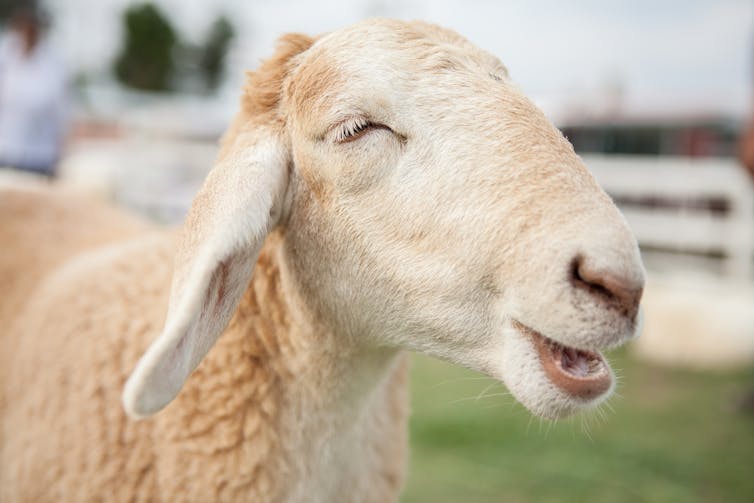
Sheep are surprisingly smart. New research from the University of Cambridge shows the animals can learn to recognise people from photographs, even people they’ve never seen in real life, such as celebrities.
The researchers tested the sheeps’ recognition abilities using images of famous people including Barack Obama, actors Emma Watson and Jake Gyllenhaal, and UK newsreader Fiona Bruce. While this is an amusing way to demonstrate what sheep can do, the research could actually have serious uses.
Shutterstock
For one thing, increasing our understanding of sheep’s perceptual abilities could be used to argue for improved animal welfare. But sheep are also being used as models for understanding brain disorders such as Huntingdon’s disease and Parkinson’s disease, along with psychiatric disorders such as autism and schizophrenia. So learning more about their cognitive capacities could aid the work in this field.
In 2001, the Cambridge team showed that sheep could discriminate between photos of familiar sheep and humans and respond to the emotions portrayed in these photos. But they wanted to see whether sheep could actually recognise the people rather than just memorise familiar photos.
They used a computer screen to show eight Welsh mountain sheep the celebrity pictures, and then used food rewards to train the animals to select these familiar faces from a wider selection of pictures of other people and objects. The sheep could recognise the celebrities even though they had never met them personally and had only been introduced to a face-on photo. Incidentally, the sheep didn’t appear to have a preference for Emma, Barack, Fiona or Jake.
To see if the sheep were actually recognising people, rather than just memorising certain images, the researchers showed them photos of the celebrities taken from different angles. The sheep were able to correctly identify the celebrity 80% of the time, dropping to 66% for photos taken at a different angle. This compares to rates of 90% and 76% in humans.
This is an enviable record for the sheep given that they are recognising the faces of another species. (How many humans could recognise different sheep from their photos?) This sound scientific set-up was also able to time the sheep’s responses, showing they appeared as confident whether looking at the face in the same position as the original photo or from a different angle.
There was one final surprise for the sheep. After proving they could recognise faces of people they’d never met from two-dimensional photos, the sheep were shown pictures of their regular human handler. Although they hadn’t been trained to recognise these images, they selected them over the unfamiliar photos anyway.
Smart sheep
I was asked if, as an Ig Nobel laureate myself, I thought this recent Cambridge sheep study would be a contender for an Ig Nobel award, the prize for science that “first makes you laugh, then makes you think”. Celebrity-spotting sheep might sound funny but the science involved in this study actually isn’t sniggerable.
First it makes an interesting contribution to animal science, showing sheep have much greater cognitive abilities than many people realise. This includes farmers, who often manage hundreds of animals with little actual contact, in the presence of dogs and during unpleasant experiences such as worming or shearing. This means sheep are usually at their least composed around humans, without the inclination to show off their impressive cognitive capacities.
My own work and that of colleagues in Scotland has found that ewes can identify pain in their lambs who have undergone tail docking or castration. Another recent study demonstrated that it is possible that sheep have a sense of self and can recognise themselves in a mirror – something we only know is possible in very few species, including chimpanzees, dolphins, elephants and magpies.
Learning more about sheep’s cognitive abilities could also feed into work on using their brains to study neurological conditions in humans. We know that the neural networks that sheep’s brains use for face perception are similar to those used by human brains. That means that we might be able to use sheep to test treatments for human diseases where patients lose the ability to recognise faces or emotions, such as Huntington’s disease.
If sheep were on the Ig Nobel judging panel, they would laugh at the idea that people are surprised at their abilities. (And we know that animals really can laugh. And they might also be interested to know that Ig Nobel prizes have been awarded for studies showing many human identical twins cannot tell themselves apart visually. Or that humans with an itch on the left side of their body, can relieve it by looking into a mirror and scratching their right side. This research suggests that actually humans aren’t as good at visual recognition as we perhaps think.
The manic nature of Black Friday has at times led shoppers to engage in fistfights and other misbehavior in their desperation to snatch up the last ultra-discounted television, computer or pair of pants.
What is it about the day after Thanksgiving – a day meant to celebrate togetherness and shared feasting – that inspires consumers to misbehave?
Fellow researchers Sharron Lennon, Minjeong Kim, Kim Johnson and I have in recent years been exploring the causes of consumer misbehavior on Black Friday, historically one of the busiest shopping days of the year. Our latest research shows how our emotions affect our likelihood to misbehave, as well as a significant difference between men and women.
A fight breaks out in a Walmart in 2016.
Black Friday mayhem
The term “Black Friday” first appeared in the journal Factory Management and Maintenance in 1951. It signals the beginning of the Christmas shopping season, when many retailers finally go “in the black” – that is, they become profitable for the year.
More recently, Black Friday has become a setting for consumer misbehavior as shoppers compete for deeply discounted products. Fighting, pepper-spraying, dumping merchandise, ransacking stores, robberies and shootings have all been reported on Black Friday. The Occupational Safety and Health Administration has even issued guidelines to retailers about how to avoid injuries and deaths.
In the U.S., the most shocking example of misbehavior occurred in 2008 when a Walmart worker was trampled and killed as shoppers rushed to enter the store.
So what causes some consumers to behave so badly?
It starts with the unique characteristics of Black Friday sales promotions and the frantic retail environment they create. Retailers heavily promote their most desirable items at deeply discounted prices in order to encourage more foot traffic. Demand for those precious few items naturally exceeds supply. That imbalance can lead to aggressive consumer behavior.
But another key ingredient is sleep deprivation, which results from the very timing of the sales, which may begin at midnight or early in the morning and require eager customers to camp outside a store all night. That means many Black Friday shoppers aren’t functioning at their best, resulting in grumpy moods and bad decisions.
Impact of crowded stores
Research my colleagues and I conducted in 2014 examined how two situational variables – large crowds and the rude, argumentative behavior of fellow shopper – affected the likelihood that otherwise jovial consumers would become Black Friday miscreants.
We created a questionnaire based on past research of the topic and asked several hundred students at four universities located in different regions of the country to fill them out. We analyzed only results from the 260 participants who reported to have shopped on Black Friday in the past and completed the survey.
On the whole, we found the large crowds that congregate on Black Friday actually had positive effects on consumer behavior, reducing dissatisfaction and aggression and thus errant activity as well. That is, as long as the shoppers were expecting to have to navigate very crowded stores.
All it takes is one bad seed, however, to ruin the experience for others. Being unable to purchase the advertised product seems unfair, leading to misbehavior and in turn making others more likely to follow suit.
Since an expectation of crowds seemed to make it less likely that shoppers would perceive inequities, posting signs at entrances or in advertisements reminding shoppers to bear with Black Friday’s crowded conditions may help keep customers civil.
Emotional shoppers
In our latest study, published in June, we examined how our emotions and personality traits influence consumers and whether there are differences between women and men.
Black Friday, Northern Virginia, 2013 (c) Rick Sincere
We designed an online survey in which participants – 411 students who indicated they had previously shopped on Black Friday – were randomly assigned to read one of three scenarios involving a customer trying to buy a discounted item the day after Thanksgiving.
In two of the scenarios, the customer went home empty-handed after not being able to make a desired purchase, either because the retailer ran out of the product or because the promotion had ended. In the third one, the participant read about a customer who managed to successfully snare the desired product – either a smartphone or clothing – at the greatly reduced price.
After reading the assigned scenario, participants completed a series of scales that assessed their emotions such as anger and thrill, their personality traits and their likelihood to misbehave on Black Friday.
Our findings showed that participants – both men and women – who had an emotional response to the scenarios, whether negative or positive, were more likely to be willing to engage in consumer misbehavior.
As for differences between the sexes, we found that men’s capacity for self-control was the primary trait that determined whether they were likely to behave badly on Black Friday.
In other words, possessing more self-control mitigated any anger that might lead to misbehavior. For women, self-control was irrelevant. What mattered for them was public self-consciousness – that is, how others viewed them. And surprisingly, women deemed to have a high degree of public self-consciousness were more likely to misbehave if they got angry.
Battle of the fittest
Black Friday creates a competitive environment since not all shoppers can get what they want. Thus, this competitive environment causes both positive and negative emotions. Consumers are thrilled when they get what they want and frustrated when they do not.
For retailers, Black Friday is meant explicitly to attract these large crowds in hopes of ringing in more sales. But besides leading to minor misbehavior, more people jostling over a small number of deeply discounted items can also lead to injuries or even wrongful death lawsuits. Retailers need to balance making more money and the safety of their customers and workers.
In general, reducing the number of unpleasant customers would improve the shopping experience for other shoppers as well as for store employees. Rather than ignoring or accommodating such shoppers, retailers should be proactive by clearly communicating store policies and quickly reacting to signs of aggression by removing the bad actors. Other steps retailers could take include adding checkout lanes to speed up traffic and putting more employees on the sales floor to improve responsiveness to shopper concerns.
Ultimately, customers are responsible for their own behavior. When shoppers behave responsibly, the Black Friday experience isn’t spoiled for their fellow customers and everyone is able to buy their digital goods and clothes in a safe and relatively stress-free environment.
This article incorporates elements of a piece written by the same author and published on Nov. 28, 2014.
Witness to 1963 Kennedy assassination speaks at Virginia Film Festival
November 10, 2013 12:19 PM MST
Tina Towner was the youngest person who photographed events at Dealey Plaza in Dallas, Texas, on November 22, 1963, as President John F. Kennedy's motorcade drove by. Seconds before the assassin's shots rang out, the 13-year-old's home movie camera ran out of film, but she captured the President and First Lady's car just as it turned the corner from Houston Street to Elm Street.
Now Tina Towner Pender, she spoke to the Charlottesville Libertarian Examiner at the Virginia Film Festival after a November 9 screening of a new documentary, The Kennedy Half-Century, co-produced by the Center for Politics at the University of Virginia. She had participated in a panel discussion along with UVA political scientist Larry Sabato and another witness to the Kennedy assassination, Wesley Buell Frazier, a co-worker of Lee Harvey Oswald at the Texas Book Depository.
The raw footage, she explained during the panel discussion, was processed by local law enforcement authorities, who had put out a call for any movies or still photographs that may have been taken by onlookers but had not been developed yet. Her family did not receive the reel back for several weeks.
Asked whether they thought it might have been tampered with, Pender said, “Not at the time.”
They did notice something anomalous right away, however.
The assassination footage “was on the end of a reel of home movies so we knew we were going to have to watch the whole reel,” which included, she said, her “sister going off to college,” before they got to the newsworthy section.
“When we got there, it ran out and there was no assassination film,” she explained, “and for a few seconds we thought we didn't have it, that they didn't send it back to us.” It turned out that “it had been cut from the rest of the film and it was there” on the reel but “it was just not spliced on to the end.”
Mysterious splice
About a decade later, Pender and her father took the film to a lab to be examined at the request of some investigators.
“My dad didn't let it out of our hands, so I went with him” to Jack White's lab in Fort Worth, Texas, she said.
“There were about three or four people there looking at it while I was there and they turned to me and they said, 'Did you know that there's a splice in your film?'”
Startled by the question, Pender asked them what they meant.
A technician replied that “'there's a jump in the film and there's a splice,'” and showed it to her. Just at the point where the limousine is turning the corner, “you see a jump in the film.”
That was not a surprise to her in itself, because “we knew that was there but we just figured it was some sort of a blip in the processing” but it was actually “spliced together. You could see where it was spliced and it was not using materials my dad would have [used]. It was more professionally done and it was hard to see this splice when you looked at it.”
Pender conceded that she did not know “who did that and I don't know when it was done, either,” because the film had been in the possession of law enforcement in 1963, and Life magazine had borrowed it, along with 35mm slides her father had shot, for a feature in 1967. Congressional inquiry
Later in the 1970s, Pender was questioned by investigators for the U.S. House Select Committee on Assassinations, which concluded that Kennedy's assassination was the result of a conspiracy and not the sole responsibility of Lee Harvey Oswald. She said her encounter with them seemed peremptory.
The meeting was “brief,” she explained.
“They called and said they wanted me to bring them the original film and the slides that my dad took,” but in the event the investigators came to her office, where she was working.
They questioned her “for about 15 or 20 minutes – maybe 30 -- but it didn't seem like that long. The questions were not very deep or probing. It almost was like they just wanted to get it done with and take the film and leave.”
Neither Pender nor any member of her family who witnessed the assassination was called to testify before the Warren Commission, which was established by President Lyndon B. Johnson to investigate the killing of John F. Kennedy.
Publisher's note:This article was originally published on Examiner.com on November 10, 2013. The Examiner.com publishing platform was discontinued July 1, 2016, and its web site went dark on or about July 10, 2016. I am republishing this piece in an effort to preserve it and all my other contributions to Examiner.com since April 6, 2010. It is reposted here without most of the internal links that were in the original.
Lee Harvey Oswald colleague recalls aftermath of Kennedy assassination
November 9, 2013 9:34 PM MST
Wesley Buell Frazier drove Lee Harvey Oswald to work at the Texas Book Depository on the morning of November 22, 1963. That was a day that changed his life, he said in an interview at the 2013 Virginia Film Festival on November 9. “That young boy who went to work that day, he has never come home.”
Frazier spoke to the Charlottesville Libertarian Examiner after a screening of a new documentary, The Kennedy Half-Century, co-produced by the Center for Politics at the University of Virginia. He had participated in a panel discussion along with UVA political scientist Larry Sabato and another witness to the Kennedy assassination, Tina Towner Pender.
Just 19 years old in November 1963, Frazier had to endure a brutal interrogation by the Dallas police, who accused him of being part of the assassination plot. 'Innocent until proven guilty'
The police interrogator, he said, “wanted me to admit to being part of the assassination and I told the guy, 'I'm not doing that.' I said, 'That's ridiculous.'”
He added: “In this country, you're supposed to be innocent until proven guilty but a lot of times you're guilty until proven innocent and our forefathers didn't intend for our country to be like that.”
During the panel discussion, Frazier explained that he had often driven Oswald from suburban Dallas to the book depository. Oswald's Russian-born wife, Marina, lived near Frazier's sister, while Oswald rented a room in the city. Normally, they carpooled only on Friday evenings and Monday mornings, and Frazier had pointed out to Oswald how it was odd he would need a ride on Friday morning.
That Friday turned out to be “a day like I've never seen before. I hope I never see one [like it] again,” Frazier said.
“It's a day that changed my life. I've never been the same. That young boy who went to work that day, he has never come home. For many years I wouldn't talk to anybody about any of it because I was so scared about what they might do to my family. There's some evil people in this country and when it comes to power and money they will do anything.”
The police interrogator handed Frazier a pre-typed confession and told him to sign it.
“I started reading it,” he explained. “It said I knew about and was part of the assassination, and I said, 'That's totally false. I'm not going to sign that.'”
Police brutality
That response made the police officer angry, Frazier recalled.
“When I wouldn't sign he drew back his hand to hit me. Matter of fact, he was standing just like you're standing there, and I put my arm up like this” – he raised his hand above his head – “to block, to keep him from striking me.”
The officer “got so mad when I told him, 'I'm not signing that,' and I told him, 'There's [another] policeman outside this door but before they get in here, you and I are going to have a hell of a fight. I'm going to get some good licks on you.'”
Reflecting on that moment, Frazier said, “For one time in my life, I think I scared the hell out of a man because I turned the tables on him – because that's what he did” as a matter of routine.
That policeman, he said, “badgered and beat on people to make them sign confessions and he found a kid who wasn't scared of him. I think it scared the hell out of him.”
Even though Frazier was “a young 19” at the time, that interrogating officer “didn't know what I had been through before I got there,” which heightened the tension in the room.
Publisher's note:This article was originally published on Examiner.com on November 9, 2013. The Examiner.com publishing platform was discontinued July 1, 2016, and its web site went dark on or about July 10, 2016. I am republishing this piece in an effort to preserve it and all my other contributions to Examiner.com since April 6, 2010. It is reposted here without most of the internal links that were in the original.
"One of the smarter blogs is the libertarian-leaning collection of Charlottesville posts put up by Rick Sincere..." -- Bob Gibson, The Daily Progress, May 8, 2005


 The Beatles being what they ultimately became, there’s much to be gleaned from their falls as well as their flights.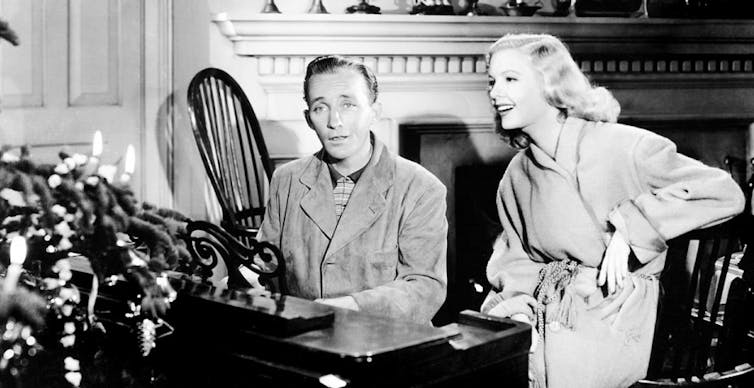
 That means a lot of Christmas music, whether we think it’s good or bad, will be more popular than it might deserve to be as it usually only gets aired a few months of the year. By the time we’re taking down the Christmas tree in January, we’ve all become thoroughly sick of Mariah and Weezer and so we put them away in the attic with the tree, to be dusted off and enjoyed again next year.
 If sheep were on the Ig Nobel judging panel, they would laugh at the idea that people are surprised at their abilities. (And we know that animals
 This article incorporates elements of a