Showing posts with label Australia. Show all posts

Thursday, December 06, 2018

Guest Post: Why adult video stars rely on camming

Sophie Pezzutto, Australian National University

With pirated and amateur pornography widely available online, porn no longer provides a steady income for many working in the adult industry. During my research interviewing transgender porn stars in Las Vegas, the overwhelming majority of those interviewed said that now, more than ever, they rely on a variety of other income streams beyond the traditional porno shoot with a studio.

Being a porn star today typically involves a range of sex work, from selling self-produced clips, to offering phone sex services, being an escort, taking care of “sugar daddies” (i.e. rich, usually older men), or “camming” on the internet. Previously regarded as not worth the time for many porn stars, using a webcam from the comfort of one’s home to broadcast oneself masturbating or having sex has emerged as a popular choice.

Indeed, while just 15 years ago, pre-recorded porn such as DVDs, pay sites, and clips generated twice as much revenue worldwide as camming, today that ratio has been reversed. In 2018, the camming industry is estimated to generate US$2 billion in annual revenue worldwide, according to Stephen Yagielowicz, a spokesperson for XBIZ, the adult industry’s leading business publication.

The daily life of a cam performer


porn star coming out “Camming” can be likened to an online strip show where the cam performer uses the webcam on their computer to put on a show for anyone in their chat room. The performer usually sets tipping goals and the more people tip by pledging tokens, the more happens on screen.

Typically, it involves numerous sex toys and ultimately orgasm, but many of the shows get very creative. They can feature anything from fortune wheels and costumes, to “couple shows” with partners and guest appearances from other cam performers.

During the show, viewers get to chat with the cam performer, often requesting sexual acts and sometimes simply asking them questions about their life. There are no fixed rules on length and format of a cam show, but it usually takes anywhere from one to four hours. Many of my informants in Las Vegas cam anywhere between two to six hours a day, multiple times a week.

Cam performers usually run sessions in intervals, timing them to coincide with office hours in big cities on the east coast such as New York and Chicago: one cam show in the morning just before offices open, one during lunch break, and one just before people head home to their families.

While not all cam models shoot studio porn, many porn performers are increasingly camming. Established trans porn stars can make anywhere around US $100 - $200 an hour through camming: “As porn performers we are able to leverage our already existing fan base”, one of my main informants explained to me. For last year’s Christmas special her chat room peaked at 30,000 viewers – the average size of a Mets baseball game.

The changing structure of porn


Porn performers in the industry are generally contracted and paid on a shoot by shoot basis. Trans women in porn generally make anywhere between US$800-1,200 for a sex scene that involves penetration (which is slightly higher than the average cisgender performer, but lower than the highest paid cisgender stars). The number of shoots however, fluctuate a lot. A performer can get booked up to six times a month (in some instances even more), but other months they might not get booked at all.


Read more:
Explainer: what does it mean to be 'cisgender'?


“After they’ve shot you a bunch of times, there usually is a month or two where you don’t get any shoots”, one research participant told me. As a consequence, performers may go several months without a single shoot, which makes budgeting extremely difficult.

In addition to this income insecurity, there are numerous expenses not covered by the companies hiring the performers, such as wardrobe, STI testing, transportation, and accommodation costs. “Factoring in all my expenses and the money I lose from not camming, porn does not really make me money”, said one of my informants. “I see porn mainly as a marketing tool for myself.”

Camming is booming and here to stay


Camming has proven itself more resilient to piracy than studio pornography primarily due to the personal nature of cam shows. “For many viewers it is a unique opportunity to interact with their favourite porn star on a regular basis,” one participant remarked. “That’s something they don’t get from regular porn”.

As a consequence the camming industry has boomed and income from it can make up most of even a well-known porn star’s earnings. Work is not only more consistent, but also much safer: “If I focus on making my money with solo shows then I don’t even have to worry anymore about HIV scares in the industry,” one of my participants pointed out after a recent incident.

At the same time however, camming can be very tough work. One informant told me: “some days I end up crying because people either don’t tip you for hours at a time or tip you just to say nasty things”. Further, cam companies, which host web cam performers, take incredibly high commissions of anywhere between 50 – 70% on every dollar earned by the cam performer.

These draw-backs notwithstanding, camming is set to grow with more and more porn stars relying on it to provide a regular income. Given the various risks of much other sex work, this might not necessarily be a bad thing.The Conversation

Sophie Pezzutto, PhD Candidate in Anthropology, Australian National University

This article is republished from The Conversation under a Creative Commons license. Read the original article.

Thursday, March 15, 2018

Guest Post: Who was Mary Magdalene? Debunking the myth of the penitent prostitute

Dorothy Ann Lee, University of Divinity

Who was Mary Magdalene? What do we know about her? And how do we know it? These questions resurface with the release of a new movie, Mary Magdalene, starring Rooney Mara in the titular role.

Mary Magdalene Yvonne de CarloThe question of how we know about her is a relatively simple one. She appears in a number of early Christian texts associated with the ministry of Jesus.
These texts comprise Gospels written in the first and second century of the Common Era (CE). The earliest of them are included in the New Testament, where Magdalene plays a significant role. She also appears in later Gospels, which were not included in the Bible and come from a later period in early Christianity.

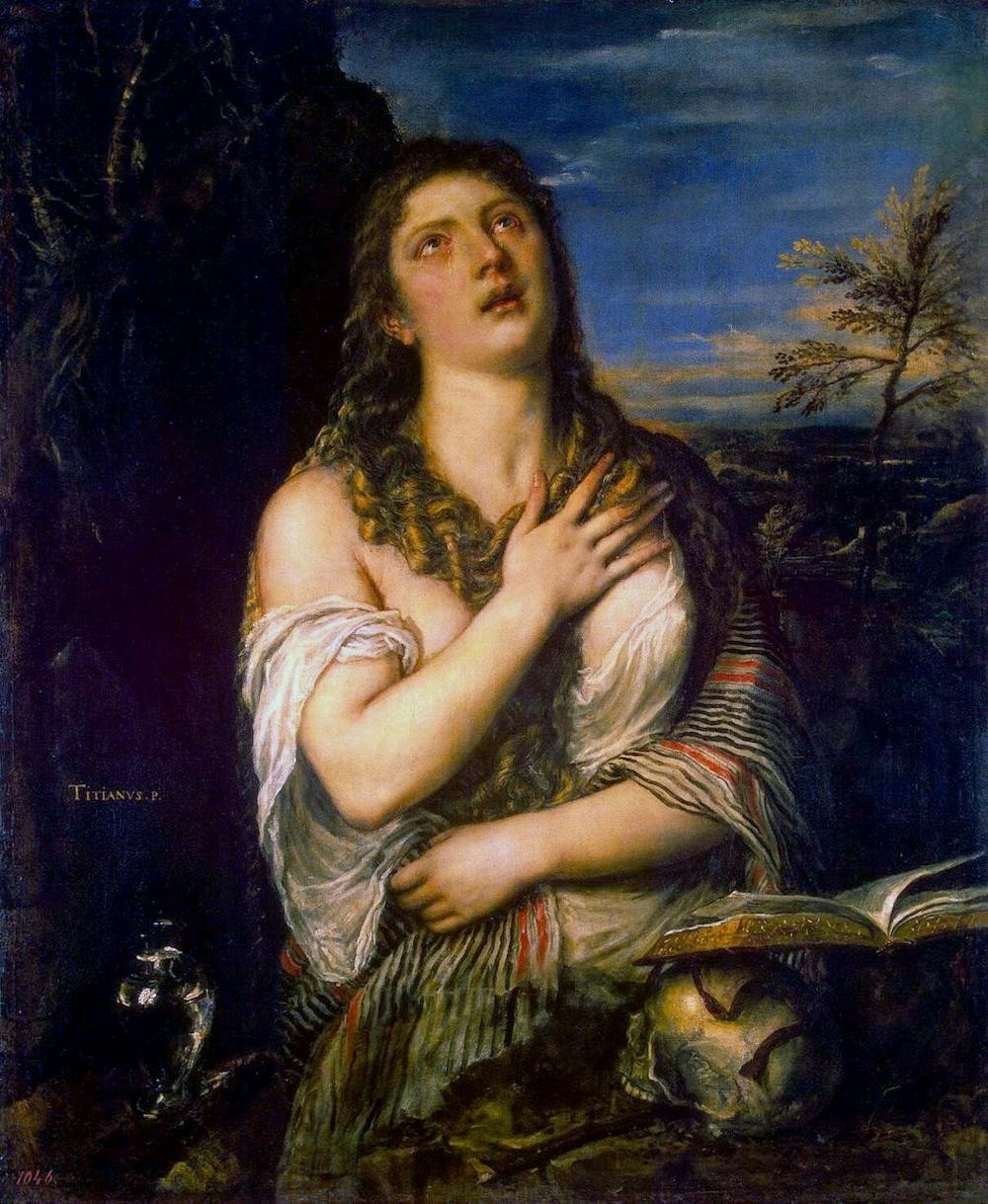
The answer about who she was and what we know of her is more complex. In Western art, literature and theology, Mary Magdalene is portrayed as a prostitute who meets Jesus, repents of her sins, and pours oil on his feet in a gesture of humility, penitence and gratitude. She is sometimes depicted kneeling at the foot of the cross, hair unbound, emphasising the sinful past from which she can never quite escape, despite being declared a saint.

The tradition of the penitent prostitute has persisted in the Western tradition. Institutions that cared for prostitutes from the 18th century onwards were called “Magdalenes” to encourage amendment of life in the women who took refuge in them. The word came into English as “maudlin”, meaning a tearful sentimentality. It is not a flattering description.


Titian Penitent Magdalene, circa 1565

Titian’s Penitent Magdalene, circa 1565.
Wikimedia Commons


Artistic depictions continued to emphasise Magadelene’s sexuality in various ways, under a facade of piety. In another twist on the same theme, she is presented as the wife of Jesus, most notably in Dan Brown’s The Da Vinci Code (2003).

The tradition of Mary Magdalene as the archetypal penitent whore, whose sexuality somehow manages to persist beyond her conversion, can be dated to a sermon preached by Gregory the Great in the sixth century CE.


Read more:
Weighing up the evidence for the 'Historical Jesus'


Admittedly, there are a confusing number of women called “Mary” in the Gospels and we might assume Pope Gregory was tired of distinguishing between them. He reduced them to two: on the one hand, Mary, the mother of Jesus, perpetual virgin, symbol of purity and goodness, and, on the other, Mary Magdalene, promiscuous whore, symbol of feminine evil from which the world must be redeemed.

A disciple of Jesus


Yet nowhere in the Gospels is Mary Magdalene associated either overtly or covertly with sexuality. The four Gospels of the New Testament present her in two significant roles.

In the first place, she is a disciple of Jesus: one among a band of women and men from Galilee who believed in his message of love and justice and followed him in his ministry.

Secondly, Magdalene is a primary witness in the Gospels to the resurrection of Jesus from the dead. Unlike many of the other disciples, she does not flee when Jesus is arrested. She remains at the cross when he dies and later visits his tomb to find it empty, with a vision of angels declaring his resurrection.

Mark’s Gospel, which we now know to be the earliest Gospel to be written, speaks of Magdalene as a disciple of Jesus who has followed him from Galilee along with other women, but it does not mention her until the crucifixion. These women disciples now stand near the cross, despite the danger in being present at the execution of a dissident.

Three of them, including Magdalene, visit the tomb on Easter morning where they meet an angel who informs them that Jesus has risen from the dead (Mark 16:1-8). The women’s subsequent departure from the tomb is ambiguous, and they leave in fear and silence, which is where the manuscript of Mark’s Gospel abruptly ends. An ending added later makes mention of the risen Jesus making an appearance first to Magdalene.

In Matthew’s Gospel, Magdalene meets the risen Christ as she leaves the tomb, this time with only one other female companion, who is also called “Mary” (Matt 28:1-10). In Luke’s account, Magdalene appears at the cross and at the empty tomb to hear the angel’s words, but she and her female companions are not believed when they convey the message of the resurrection to the apostles (Luke 24:1-11).


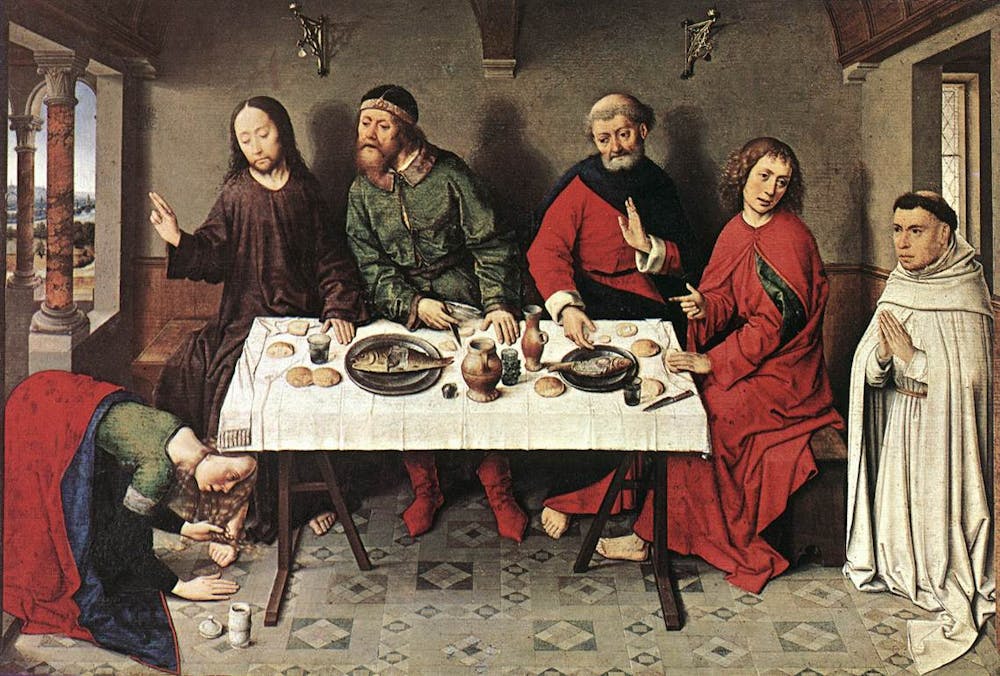
 Mary Magdalene anoints Christ’s feet in Dieric Bouts’ Christ in the House of Simon

Mary Magdalene anoints Christ’s feet in Dieric Bouts’ Christ in the House of Simon (circa 1420–1475).
Wikimedia Commons


In Luke, there is an earlier mention of Magdalene in Jesus’s ministry where she is present, along with other women, as a disciple and supporter of Jesus (Luke 8:1-3). She is described as having had seven demons cast from her. This description might lead to the conclusion, in some minds, that the many “demons” refer to her unfettered sexuality.

But that would be erroneous. Exorcisms — the casting out of evil spirits — are common in the first three Gospels. Those suffering demonic possession are never described as sinful but rather are victims of external evil.

These days, we would associate their symptoms with physical maladies such as epilepsy or mental illness. Magdalene, in other words, has been the victim of a serious illness and Jesus has healed her.


Read more:
How the Bible shapes contemporary attitudes to rape and sexual assault


Furthermore, the description is unusual here in that she is not described in relation to a male figure, as other women at the time generally were: father, husband, brother. She is simply referred to as “the Magdalene”, that is, the woman from Magdala, a Jewish village in Galilee.

We might well assume, from Luke’s description, that she is an independent woman of some means, who is well able to fund, as well as participate in, the movement around Jesus.

Her most significant role


John’s Gospel, however, gives Magdalene her most significant role. Once again, she does not appear until the crucifixion. In the narrative that follows, she comes alone to the tomb on Easter morning, finds it empty, tries unsuccessfully to gain help from two other prominent disciples, and eventually meets the risen Christ himself in the garden (20:1-18). He is alive and commissions her to proclaim the message of his resurrection.

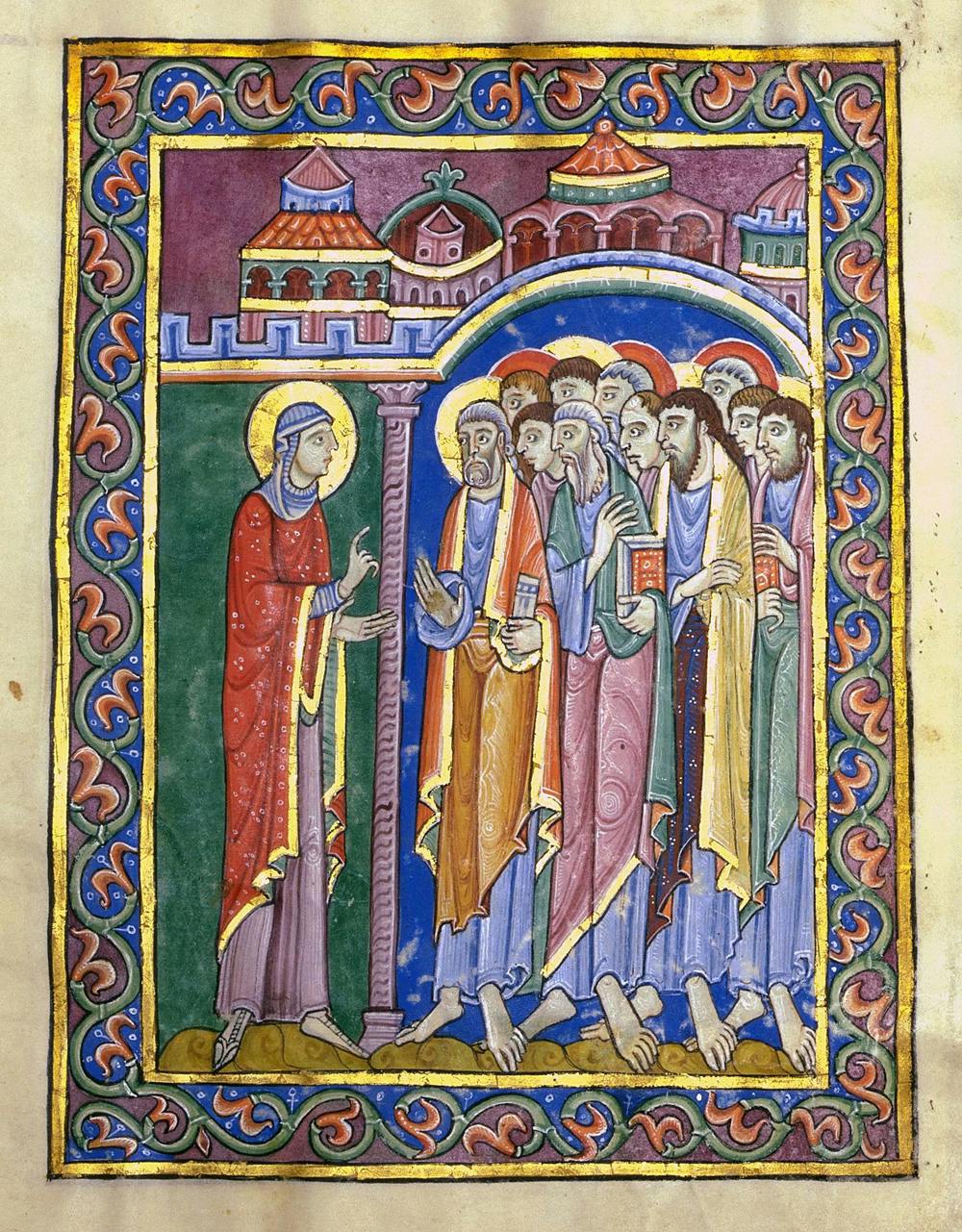
On the basis of John’s story, later tradition gave Magdalene the title of “apostle to the apostles” and recognised something of her significance for Christian faith, witness and leadership. A tragic consequence is that her role as witness to the resurrection was later overshadowed by the apparently more alluring but inaccurate picture of her as the penitent whore.


Mary Magdalene St Albans Psalter

A more accurate portrayal of Mary Magdalene announcing the risen Christ from the 12th-century English illuminated manuscript St Albans Psalter.
Wikimedia Commons


The later Gospels, beyond the New Testament, also emphasise Magdalene’s importance as a disciple of Jesus and witness to the resurrection. The manuscript of the Gospel of Mary, which describes her discussions with the risen Christ, is unfortunately damaged and the central section is missing. In this and other similar Gospels, however, Magdalene is presented as the favoured disciple. This situation leads to some tension with the other disciples, who are jealous of her closeness to Jesus and the teaching she alone is given.

One Gospel speaks of Jesus kissing her, but the imagery in the Gospel of Philip is metaphorical and refers to a spiritual union with Christ. In response to the objection by the other disciples, Jesus asks why he does not kiss them in the same way, implying that they do not as yet possess the same degree of spiritual knowledge.

No evidence of Magdalene anointing Jesus


There is no evidence, incidentally, that Magdalene ever anointed Jesus.

There are three anointing traditions in the Gospels. In one, an unnamed woman anoints Jesus’s head in prophetic recognition of his identity (Gospels of Mark & Matthew). In another, a named and known disciple, Mary of Bethany, who is a model disciple, anoints Jesus’s feet in gratitude for his raising her brother Lazarus from the dead (Gospel of John). In the third, a “sinful woman”, who is not explicitly identified as a prostitute, anoints Jesus’s feet in a gesture of repentance, gratitude and hospitality. None of these three figures is associated in any way with Mary Magdalene in the texts.

The movie Mary Magdalene, directed by Garth Davis, is a significant portrayal of this early Christian figure in the light of evidence from the earliest texts. The screenwriters, Helen Edmundson and Philippa Goslett, are quite clear that Mary is not to be associated with Jesus through her sexuality, either as harlot or wife. On the contrary, she is depicted as a faithful and deeply insightful disciple of Jesus, on whom he draws for his message of love, mercy and forgiveness.


Magdalene is beautifully portrayed in the movie, which draws on traditions from the earlier and later Gospels. She possesses an intense and compelling presence, which does much to restore her character from its later distortions.

It is true that the film makes somewhat erratic use of the New Testament, both in its presentation of Magdalene and of other characters in the story. Towards the end, for example, there is an implication that Magdalene and the church stand on opposite sides, the one in sympathy with Jesus’s teaching and the other anxious to build a self-glorifying edifice on his assumed identity.

This is unfortunate, as the New Testament itself is quite clear about the priority and identity of Magdalene as a key disciple, witness and leader in the early church, without seeing her in opposition to others.

Indeed, those who campaigned in a number of Christian churches for the ordination of women in the 20th century used precisely the example of Mary Magdalene from the New Testament as “apostle to the apostles” to support their case for women’s equality and leadership.

The recent installation of Kay Goldsworthy as Archbishop of the Anglican Diocese of Perth — the first woman in this country and across the world to be given this title — is the true heir of Magdalene as she is portrayed in the earliest Christian writings.


The ConversationThe film Mary Magdalene opens in Australian cinemas on March 22.

Dorothy Ann Lee, Frank Woods Professor of New Testament, Trinity College, University of Divinity

This article was originally published on The Conversation. Read the original article.

Sunday, December 10, 2017

Guest Post: Blocks are still the best present you can buy children for Christmas


Kym Simoncini, University of Canberra and Kevin Larkin, Griffith University

With Christmas looming, many people will be considering what present to buy for their children, nieces and nephews, grandchildren and friends. Soon, if not already, we will be reading lists of the top trending presents for 2017. These lists will no doubt include, and may even be totally dominated by, all the latest gadgets and devices.

The purpose of these lists is to attempt to persuade parents of young children if they want to give their child the best start in life, and all the advantages for doing well later at school, they need to purchase the latest technology.


Read more: ‘Digital play’ is here to stay … but don’t let go of real Lego yet


Missing from these Christmas lists, but what should actually be at the very top in terms of learning, are blocks. Blocks have been part of children’s play for a long time. But there’s still no other toy that compares in promoting all areas of children’s development. Any early childhood teacher can easily identify all the areas block play develops including fine motor, social, language and cognitive skills.

Blocks develop spatial reasoning skills


As children experiment by stacking, balancing, or building with blocks, they need to share, respect other children’s constructions, ask for desired blocks and describe what they are creating. Perhaps more importantly, children develop problem solving skills, creativity and imagination in creating their masterpieces. Finally, let’s not forget persistence where children try again and again to build the tallest tower or most elaborate castle.


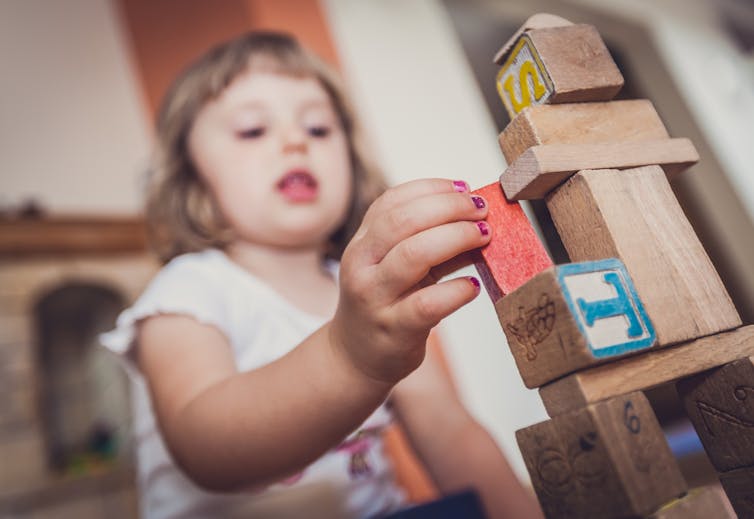
Kids learn to play and work together when using blocks.

Kids learn to play and work together when using blocks.
Shutterstock


Less well known is that blocks also foster spatial reasoning. Spatial reasoning is the ability to mentally manipulate objects or to think in a way that relates to space and the position, area, and size of things within it. We use spatial reasoning skills in everyday life when we read maps, pack the car for holidays, assemble flat pack furniture or cut cake into equal slices.

Spatial reasoning skills are linked to mathematics skills. Children who have good spatial skills tend to have better maths skills. Many people are unaware of the research, but early mathematics skills are a better predictor of later school success than either early reading or social-emotional skills. Block play helps children understand many mathematical concepts in number, measurement and geometry. During block play children count, measure, estimate, pattern, transform, and learn about symmetry.

Perhaps most surprising to readers will be the research that shows spatial reasoning skills are the best predictor of whether children will end up in a Science, Technology, Engineering and Mathematics (STEM) related career. Spatial skills are especially important in STEM related jobs where people are required, for example, to create or read X-ray and ultrasound imaging, engineering and architectural designs, or cross sections of heating and plumbing systems.


blocks are still the best toy you can buy your child.

Christmas lists usually suggest the latest and greatest technology, but blocks are still the best toy you can buy your child.
Shutterstock


Blocks also help develop spatial language


Block play also fosters spatial language. When children play with blocks they hear and produce more words related to spatial reasoning including things such as beneath, above, next to, behind, and so on.

One study showed block play elicited more spatial language than any other type of play. The other types of play included playing with puppets, playing house, shops, school, zoos, chefs and throwing a ball.

Other research that looked at spatial language showed the more spatial words children heard, the more spatial words they produced and the better they performed on spatial tasks. In this study, researchers looked at language relating to the spatial features and properties of objects such as the dimensions of objects (such as how big small, wide, tall), the forms of shapes (for example rectangle, circle, square) and other spatial properties (like bent, pointy, curved).

Different blocks for different ages and stages


kids playing with blocks

The best way to get your kids playing with blocks is to play along with them.
Shutterstock


There are a wide variety of choices for blocks for children including MegaBloks for really young children, Duplo, wooden blocks or waffle blocks for preschoolers, and Eco bricks and Lego for older children.

These age guidelines are suggestions only. My ten and fourteen year old daughters will still play with the wooden blocks. Much of the reason blocks are such enduring toys is due to the fact they’re “loose parts”. That is, they can be moved, arranged, combined, taken apart, and put together in any number of ways. Frobel, the father of kindergarten, created ten gifts for children of which six were blocks.

The best way to engage children in block play is to play alongside them and show your interest and enthusiasm in block building. My friend has a ritual of playing half an hour every afternoon with Duplo with her three young boys aged five, three and one. She says it’s her favourite time of day.


Read more: Can toys really be ‘educational’? Well that depends on the parents


The ConversationSo, when those lists appear in your inbox or on social media, just remember the best toy of all is likely to be missing.

Kym Simoncini, Assistant Professor in Early Childhood and Primary Education, University of Canberra and Kevin Larkin, Senior Lecturer in Mathematics Education, Griffith University

This article was originally published on The Conversation. Read the original article.

Monday, June 26, 2017

Guest Post: There's something queer about Tumblr


Paul Byron, Macquarie University and Brady Robards, Monash University

Tumblr is a site that can leave many adults confused. But for more than 330 million users worldwide it is a visual medium for self-expression where anything from politics to fan groups goes.

What makes Tumblr special is the mix of content you will find there. Think of it as the long-form, image-centric version of Twitter – but more personal. A blog can feature sentences that describe a user’s day, and this could be scattered among photo sets of refugees being rescued at sea, cat gifs, pornography, or complex paragraphs that analyse Donald Trump’s presidency. Above all, Tumblr characterises itself as a space of creative freedom.


Tumblr gay queer non-binary cisgender transgender keyboard fingers

More young people are turning online for peer support networks.
shutterstock


Like most other social media platforms, it is also ripe with peer networking, community building, and opportunities to explore gender and sexual identities. And despite the panic that often surrounds the perceived effects of social media on young people – such as fears about Facebook and privacy, Snapchat and sexting, and Instagram and narcissism – Tumblr is often left out of the debate.

Perhaps that’s because it mostly appeals to a niche audience, and can be seen as the “weird” cousin of these major platforms. This makes it a perfect venue for queer and questioning youth to hang out.

It’s a queer world


In 2016, we organised a research project called Scrolling Beyond Binaries to explore the ways young people of diverse genders and sexualities use social media. We looked particularly at how young lesbian, gay, bisexual, transgender, intersex, queer, and asexual (LGBTIQA+) people use the network. To do so, we surveyed over 1,300 people aged 16-35 who identified in these ways.

Compared to broader surveys of young people’s social media use, we found young LGBTIQA+ people are using Tumblr much more frequently.


Tumblr Internet usage statistics survey Australia LGBTIQ Pew Sensis

Queer and gender diverse youth in Australia are using Tumblr more than their straight and cisgender peers.


There are some issues in comparing these studies – the number of people surveyed, where they lived, and their ages – but that 64% of our respondents used Tumblr is noteworthy.

So why are this many young queer and gender diverse Australians using Tumblr? For many, it offers an intricate network that supports safe explorations of identity and a sense of self.

For instance, writer and Tumblr user Jonno Revanche said it provides social connections that are otherwise unavailable due to geographic isolation and social anxiety. Others have used Tumblr to foster mental health support, such as Mea Pearson, who took to the platform to chronicle her experience with borderline personality disorder.

While care must be taken when associating mental health with queer identity, these matters often intersect. Evidently, many young people’s everyday dealings with key social institutions like family, work and school can be uncomfortable or even traumatic.

The view from Tumblr


Many of our respondents said that Tumblr was crucial to nurturing their individual identity. One person said it helped them identify as agender (loosely defined as without gender).

I actually learnt about agender and all the other genders from Tumblr. (20, agender, bisexual, rural)

One participant described how Tumblr assisted them in coming to terms with their pansexuality (attraction to all genders), and finding a space where this was more accepted and not reduced to bisexuality:

I came out as Pan on Tumblr a few years ago, when being Pan was seen as just a fancy way of saying Bi. I felt very alone for a long time, but found other Pan people to talk to. (22, non-binary, pansexual, urban)

Other participants attributed Tumblr to broadening their overall understanding of identity:

I had no idea that lgbt+ people existed (my parents are quite homophobic and very strict, so you could say I was very sheltered), and by using Tumblr I was able to fully immerse myself within its very lgbt+ culture. It also brought up words … I had never heard before, and through this I was able to “find myself” within a safe environment. (17, female, lesbian, urban)

I would’ve never realised my real gender or sexual orientation without tumblr. (25, trans masculine, asexual, regional)

For many Tumblr users, the platform is a supportive place. Engaging with online peer networks can be easier, and less risky, than talking to close friends. Young people reported making friends on Tumblr too, and most of them felt safe in doing so, citing the ability to block and unfollow others if needed.

I’ve made a lot of friends through there, and Tumblr helped me working out my own sexuality when I was younger. Because when I was younger I didn’t know anything, I thought there was just gay and lesbian and when I didn’t fit into any of those categories I was like “what the hell do I do now.” It was honestly, like going on Tumblr and [finding] there’s this thing where you can like more then one, I was like “woah, that’s amazing.” (19, trans male, queer, urban)

Disconnecting from Tumblr


At the same time, these digital spaces come with their own challenges. Although Tumblr is often used daily, it also seems to have a limited lifespan – which is unsurprising, given the intensity of interaction and content that many users report. Some respondents discussed their need to disconnect from the site to avoid drama, to free up time, or to spend more time in other social media spaces.

I stopped [using Tumblr] because I often used it to talk about my problems and it got to be really upsetting to have such a negative space. I feel like it just fed my mental health issues. (18, non-binary, bisexual, rural)

In this sense, Tumblr can be productive for a time but it can also become overwhelming. Users manage this by moving between platforms and taking breaks.

Safe spaces


Brady Robards Youth culture AustraliaAt a time when young queer and gender diverse people are in the spotlight, with support programs coming under fire and human rights being trampled upon in political crossfires, they continue to find and build their own safe spaces.

LGBTIQA+ young people should feel safe and empowered in everyday physical spaces, and many do – often with support from a wider community of peers who share similar experiences.

The ConversationBut until the world becomes more friendly for queer and gender diverse people, we expect they’ll continue to find safety, community, identity, and friendship on Tumblr.

Paul Byron, Associate Lecturer, Macquarie University and Brady Robards, Lecturer in Sociology, Monash University

This article was originally published on The Conversation. Read the original article.

Sunday, June 04, 2017

Guest Post: Faggots, punks, and prostitutes: the evolving language of gay men


Peter Robinson, Swinburne University of Technology

Joe Jackson’s 1982 hit Real Men was the first time I had heard gays referred to as faggots. I was just out of the closet and in my first gay relationship in London. Jackson’s lyrics about how only our friends and other gays could call us faggots was encouraging, coming as it did from a straight man singing a song just before AIDS hit.


Faggot, often-considered a slur, has been reclaimed many times over by gay men, including in a new play by Declan Greene, The Homosexuals, or “Faggots”, currently showing at the Malthouse in Melbourne. The play looks at gay male relationships and their politics, and is apt as middle-class gay men and lesbians struggle with acceptance all over again in the face of their call for marriage equality.

Joe Jackson Real Men vinyl fags faggotsMy friends and I called ourselves fags because it was a way of turning the abuse on its head and laughing at the straight bullies.

And in merry-old-England there was abuse: one night when leaving gay club Heaven, a bunch of lads called us and our female friends “pooh jabbers”. It was graphic and offensive (“bum bandit” being a similar, anal-fixated term from about the same time) and it occurred to me how deeply, viscerally they hated us.

Language defines who you are. But words used by others to define gay people can say a great deal more about them than us.

From prostitutes to gays


Let’s begin with the most common term, “gay”, which baby-boomer homosexuals appropriated for their liberationist cause in the late 1960s and early 1970s. Its pedigree is longer and according to Edmund White originally applied to women and meant loose or immoral, as in a prostitute. And “gay-house” was the term for a brothel. “In the past one asked if a woman was "gay,” much as today one might ask if she “swings,”“ wrote White.

"Homosexual” (or “homosexualist”) has similar 19th-century origins and was originally coined in 1869 by a Hungarian doctor, Karoly Maria Benkert.

“Faggot” has had different meanings according to where and when it was used. In eighteenth-century London it was first a term for prostitute then for homosexual. In 1920s New York, it described an effeminate homosexual who sought social/sexual relations with “normal men”, according to George Chauncey while a “flaming faggot” was an extremely obvious, flamboyant gay man.

In 1970s Australia, the ubiquitous “poofter” covered all forms of deviancy including men who had sex with other men, poor-performing sportsmen, politicians and motorists. Meanwhile, as the documentary Deep Water revealed, the literal bashing and killing of poofters caught at it in public parklands was something of a pastime.

“Cat” from “catamite” is ancient Roman with connotations of effeminacy, prostitution, and the passive role in a sexual encounter. “Fruit” was, like faggot, according to US historian Randolph Trumbach, a term first used in the 18th century for a prostitute and then a sodomite. “Fairy” and “queer” had similar origins between the world wars.

Why the fixation on prostitution? As Trumbach explains, there is a “long tradition in English usage” of words that are used to designate a prostitute being appropriated one generation later to describe sodomites.

This tendency for the words for prostitute to be later used for homosexual dates from 18th-century England when they often shared common social spaces, argues gay historian Rictor Norton.

Much later, historians such as Chad Heap and George Chauncey found similar intermingling in the underground bars that operated in New York and Chicago during Prohibition in the US.

The words gays use for themselves


Because of the sardonic nature of gayness, all of the above would have to be included also in the vocabulary of gay men and queers.

As well, there are community-specific terms, such as “clone”. Historically-specific, it connotes the style of gay men mid-1970 to mid-1980s (moustache, short hair, faded, baggy Levis and pocket and/or neck handkerchief) as exemplified by the lead singer of the Bronski Beat at the time of their hit single, Smalltown Boy.


More arcane terms include “ganymede” (a young male) which was used by Oscar Wilde and his contemporaries and “Marianne” and “Molly” from the earlier 18th century, again connoting an effeminate (or passive) male.

“Nance” and “nancy boy” as well as “Nelly” and “nellies” were terms used by both gays and straights also connoting effeminacy or youthfulness. According to one of writer Keith Vacha’s interviewees, nellies were “common queens” by which he meant: “ones with bleached blonde hair and plucked eyebrows”.

And finally, perhaps to the consternation of some of today’s toughs, there is “punk,” which according to Rudolph Trumbach was once the slang term for both prostitute and sodomite.

Terms of abuse and endearment


Terms of abuse are a way of distinguishing those whom we choose to marginalise because we do not like the look of them or because we were there first. In other words, they are the “outsiders” of sociologist Norbert Elias’s important work from the mid-1960s.

Bronski Beat Smalltown Boy gay slang faggotHumans have been doing this from the outset. Gangs and groups, them and us, and in the case of sexual preference, there are the straights, the “normals”, if you like, and the others, the sexual outcasts.

The terms I’ve illustrated were used by the majority to exclude prostitutes and homosexuals from “polite” society. While these terms were used to mark their difference, this did not prevent males from that same polite society from using the good services of prostitutes and homosexuals when it suited them. And as they did so then, they still do so now.

What is also interesting is the way in which sexual outcasts could adopt terms of abuse used for them and turn them into terms of endearment for each other — as my friends and I did in the 1980s when we called ourselves fags. And so, self mockery becomes a form of defence against the strictures of the priests and preachers.

It was literally the priests and the preachers, and later doctors and lawyers, who sought to demarcate “useful” sexual activity from wasted sexual activity. According to historian Michel Foucault the monogamous heterosexual couple produced new workers; those erotic and sexual activities that detracted from or weakened it were identified, categorised, and punished by law.

That young, gay men are now starting to reclaim these words is significant. It could mean that they are becoming interested in finding out where they have came from, that is, what are the origins of the culture they inhabit?

Twenty-one years ago, AIDS, which was then the dominant concern for gay men and culture, ceased to be a death sentence and instead became a manageable disease. Young men who have grown up since then could feel that other aspects of gay life can now be explored with greater freedom.

If this is so, it would suggest a strengthening of gay culture and community because people can only start exploring their past, warts and all, when they feel safe.

The Homosexuals, or “Faggots” will be showing at Melbourne’s Malthouse Theatre until March 12.

Peter Robinson, Senior lecturer in History and Sociology, Swinburne University of Technology

This article was originally published on The Conversation. Read the original article.

Saturday, December 31, 2016

Guest Post: Is New Year the best time for resolutions?


by Simon Crisp, Monash University

For many of us, the start of a new year heralds a new beginning, and an important opportunity to commit to significant personal changes. But why does this single moment in the year hold almost superstitious significance as the optimal time for change?

As a psychologist who counsels people throughout the year, I believe there are several reasons. The end of a calendar year and simultaneous holiday break allows people to reflect on the previous year and take stock of things they’ve achieved – or not.

calendar new year resolutionsThis reflection can provide important information about how successes were achieved, or why desired changes were not: bad timing, lack of preparation, a need to change priorities, diminishing motivation, and so on.

Psychologically, the new year provides a “clean slate” where one can start afresh and leave behind the disappointments, frustrations and “old self” and start again.

So far that all sounds good but, as we all know, few people actually achieve their New Year’s resolutions. I believe there are several main reasons for this.

One of the most common is that resolutions are impulsive, often-drunken and fanciful fantasies. Caught up in the festive spirit, it may only occur to people to make a resolution during the New Year’s Eve celebrations – hardly an ideal place to select and plan behaviour change.

Afterwards we trivialise our choice of goal and commitment to it as not much more than a whim, not really believing we will actually achieve the goals we set. At this point it really doesn’t look too promising. By the time the hangover has worn off or we’re back from holidays, the resolutions you made might be forgotten, or at least treated as a holiday novelty.

By way of contrast, in my clinical work I see people throughout the year who are motivated to make changes in their lives. On the whole, my clients (thankfully) do make substantial changes in significant areas of their lives, but the difference here, in contrast to many people’s New Year’s resolutions, is that my clients are motivated to change for often very negative reasons, or due to devastating events.

That’s not to say we can’t make important changes for positive reasons with the aim of enhancing our lives, rather than just making ourselves less unhappy. What we can take from this clinical experience are the important elements that can lead to successful life-changes for any person.

It’s vitally important to find the right time for change – a time when you’re in the right mental space and perhaps financial situation to achieve your goal. Arguably, the most important step is putting in the hard work in preparation for the life change.

It’s also important to ensure your goal is realistic, meaningful, worthwhile, desirable, appropriate to your broader needs and, ultimately, whether it’s worth the sacrifices that may be required to achieve it.

Of course, the road to significant and lasting personal change is often fraught with challenges. It’s important to:

  • anticipate set-backs and use them as important learning opportunities
  • establish a team of genuine supporters
  • break larger goals into smaller achievable steps, including something that can be done each day
  • ensure you reward yourself for progress regularly – celebrate each step as it’s achieved.

While ridding yourself of a bad thing (such as excessive alcohol use) can be motivating and worthy, unless you balance such a goal with some positive gain it’s unlikely you’ll be motivated by the process. In fact, without positive gain, you’re likely to feel pessimistic about the significant change.

new year resolutionIn clinical psychology too, it’s essential to introduce “positive psychology”, even to the most troubling issues, including depression, entrenched negative behaviours, or destructive inter-personal relationships.

Positive psychology could include a focus on increased fitness and exercise, rather than simply aiming to lose weight, or increasing opportunities for fun and novelty, rather than simply drinking less.

Time and again, I see that we are more motivated to change if that change includes adding something of value to our lives. Importantly, this change in itself becomes self-rewarding and more likely to repeated – and with enthusiasm.

The pioneering researcher in positive psychology, Dr Martin Seligman at the University of Pennsylvania, argues that this leads to “learned optimism” and ultimately greater contentment and increased happiness.

So, while New Year’s day may not be the ideal moment to make a meaningful change, it could still be the first step along a productive and successful path toward important life changes.

The Conversation

Simon Crisp, Clinical Psychologist, Monash University

This article was originally published on The Conversation. Read the original article.

Friday, December 30, 2016

Guest Post: 2016 lasts a little longer thanks to a leap second


by Darryl Veitch, University of Technology Sydney

To the time-poor of the world: take heart, for 2016 is a generous year. Not only were you granted a leap day on 29 February, you will soon score a New Year’s Eve countdown bonus, a leap second, to hold off 2017 for a final sip or regret.

Whereas leap years add a day to align the calendar with the seasons, leap seconds align our everyday clocks with the Sun’s position in the sky, that is, with the Earth’s rotation.

clock leap second leap year 2016 timeCurrently our planet takes roughly 86,400.00183 seconds (on average) to turn, instead of the expected 86,400 seconds you get by multiplying 24 hours by 60 minutes by 60 seconds. This may not sound like a great difference, but it amounts to a full second every 18 months. If left unchecked, it would become noticeable over time, and ultimately become problematic.

How did we get into this awkward situation? Why not just define a second so that there are exactly the right number? This sensible idea was tried in 1874, but hit a snag: the Earth keeps changing.

In terms of today’s standard SI second (defined via atomic physics), the above discrepancy is due to the fact that the day is losing about 0.0015 seconds per century, due largely to tidal friction.

Not only that, it also changes quite erratically due to mass redistribution.
For example, it is slowed by oceanic thermal expansion due to global warming, just as a playground spinning seat slows, via the conservation of angular momentum, when you place your body farther from the centre.

Leap seconds are used to make sure our usual timekeeping system, Coordinated Universal Time (UTC), never gets more than 0.9 seconds away from the Earth-tracking alternative, Universal Time (UT1).

But unlike leap years, leap seconds cannot be calculated centuries in advance. Because the Earth moves erratically, it must be observed closely, and leap seconds scheduled on an as-needed basis.

In UT1, seconds actually vary in duration, being stretched and compressed to match the Earth’s variations. In UTC, all seconds are standard SI seconds, which is much simpler, but it means that if you want to slow down or speed up UTC, there is no alternative but to jump.

All the leap seconds so far have been “positive”, meaning that an extra second is inserted, corresponding to jumping the clock back, and so slowing it down.

Time’s up for the leap second?


The leap second system has been with us since 1972. It represents an important chapter in the entangled history of civilian timekeeping, and of the definition of the second itself. Its days, however, may well be numbered.

For a number of years, support has been growing within the International Telecommunications Union, the standards body governing leap seconds, to abolish it.

carousel new year carnival
The chief reason is complexity. Simply put, hardware and software can and do get things wrong. And the potential impacts are serious, from failures in navigation leading to collisions, to erroneous financial transactions, computer crashes and the inability to specify UTC times reliably into the future, because the leap second times are not yet known!

Because UTC jumps back at a leap second, effectively the second before the leap is repeated. Managing such “time travel” is inherently complex and error prone, so much so that in many cases the recommended action is to simply shutdown the system and restart it after the leap.

A dramatic illustration of the problem can be found in the internet. All computers have software clocks that generally rely on communication with time servers over the network to synchronise to UTC. Network timekeeping is a core internet service, and at its heart are the Stratum-1 servers, which have direct access to reference hardware such as atomic clocks.

We collected data from around 180 such servers around the world during the June 2015 leap second event, and assessed them from two points of view.

First, the clocks themselves: did they jump cleanly and sharply exactly as required?

Second, at the protocol level, that is with respect to the messages the servers send to the computers that rely on them: did they inform them properly of the upcoming leap?

Overall, we found that, at most, 61% of the servers were performing correctly. Many of the servers are well known and highly utilised, potentially impacting thousands of clients, possibly resulting in security vulnerabilities.

An expanded experiment is currently underway for the 2016 event, involving almost 500 servers, including from the widely used ntppool project.

This is part of a broader network timing project at UTS led by myself together with Dr Yi Cao, which aims to refashion the global system, and in particular to make it scale in a trusted way to the Internet of Things.

Finally, we must point out that leap seconds occur simultaneously across the globe, and it can’t be midnight everywhere.

Thus, as I confirmed with Dr Michael Wouters, responsible for Australia’s reference time at the National Measurement Institute, for us it will occur at 11am AEDT on January 1, 2017. Save the last sip till then.

The Conversation

Darryl Veitch, Professor of Computer Networking, University of Technology Sydney

This article was originally published on The Conversation. Read the original article.

Saturday, December 24, 2016

Guest Post: How did we come to celebrate Christmas?


by Bronwen Neil, Australian Catholic University

Christmas is literally “the mass for Christ”, the day on which Christians celebrate the birth of Jesus.

Pope Leo - Christmas
Pope Leo I
The western date for Jesus’ birth is quite arbitrary. It was chosen by Pope Leo I, bishop of Rome (440-461), to coincide with the Festival of the Saturnalia, when Romans worshipped Saturn, the sun god. This was the day of the solar equinox, the shortest day of the year in the northern hemisphere, which officially marked the halfway point of winter.

Leo thought it would distract his Roman congregation from sun worship by celebrating the feast of Christ’s birth on the same day. He described Jesus as the “new light”; an image of salvation, but timely in that the days began to lengthen from 25 December onwards.

The date of the feast varies within Christian denominations. Western Christians celebrate the Nativity on a fixed date, 25 December. Some Eastern Orthodox Christians celebrate it on 6 January together with Epiphany, the revelation of the infant Jesus to three wise men. The Greek and Russian Orthodox celebrate Christmas on 7 January and Epiphany on 19 January.

Where did Christmas traditions originate?


It is true to say that the western Christmas began as a Christianized pagan feast. The Christmas tree is also a pagan symbol of fertility.

In northern countries, when the nights are long and cold, the feast of Christmas traditionally gave Christian people something to look forward to: rich food (reindeer if you are in Sweden, pork and lamb if you are in Greece), lots of candles, Catholic Mass at midnight or Protestant services on Christmas morning. Fir trees were brought inside and lit with candles as a symbol of the hope that spring would return with new crops and plentiful food.


Fir trees were brought inside to symbolise the return of spring, new crops, and plentiful food. It’s also a pagan symbol of fertility.
Ievgenii Meyer/www.shutterstock.com


The early church also celebrated Christ’s Resurrection in spring, the season of new life, since it coincided with the Jewish Passover feast on 14 Nisan, a date that depended on when the first full moon occurred in March or April. Many of our Easter symbols, like the bunny and the egg, are ancient fertility symbols. No one knows how chocolate got dragged in!

It is also an interesting coincidence that the Jewish Festival of Lights, Hanukkah, falls in November or December each year, and is celebrated with the lighting of the candelabra (menorah), traditional foods, games and gifts.

Where did Santa Claus come from?


The Santa Claus myth (spoiler alert: don’t read any further if you are under 10!) came from the legend of Saint Nicholas. Nicholas was a bishop in the city of Myra (in modern Turkey), who wanted to help poor young women get husbands. He left bags of money of the doorsteps of their family homes in secret, an anonymous gift to the poor to be used as a dowry.

A 1950s Coca-Cola advertisement

For this he became known as the patron saint of virgins and children. Over time, his generosity was remembered by people giving gifts to children in secret on the feast of St Nicholas, celebrated on December 6 (in western Christian countries) and 19 December (in the eastern churches). His name in English became Clause, after the Dutch Sinterklaas. Dutch children and others in western Europe leave food out in a shoe or a clog for Nicholas’ horse on the eve of 6 December, and receive presents on the day of the feast.

Our modern image of Santa Claus as a rotund gentleman of a certain age dressed in a red-and-white suit and matching hat comes from an incredibly successful marketing campaign by Coca-Cola in the 1930s. Since then, suburban Santas always dress in the image created by the Coke brand.

But this image comes from an earlier depiction of Father Christmas who had nothing to do with the American Santa Claus until the 1850s.

Until the Victorian era, when childhood was recognised as a separate stage of life, and the Christmas feast came to centre around children, Father Christmas, or Lord Christmas as he was also known, was the personification of a mid-winter feast of merrymaking for adults – and he brought no presents. He was useful as a symbol for Catholic-sympathising writers in the early 17th century who wanted to defend Christmas from attacks by the Puritans, radical Protestants who intended to ban the feast.

(For a Jewish perspective on the Wars of Religion, see Stephen Feldman’s book, Please Don’t Wish Me a Merry Christmas: A Critical History of the Separation of Church and State (1997).)

Tuck Postcard, Photo Oilette Series, 1919.
From the 1850s onwards, the English Father Christmas was depicted as a bearded old man wearing a long red robe trimmed with white fur and a pointed red hat, who brought gifts to good children. This image can be seen on English postcards from the early 20th century.

Christmas in the modern era

A lot of the significance of the original feast is lost when we in the southern hemisphere celebrate it in the middle of summer. A family barbecue at the beach cannot really capture the atmosphere of a cold and dark mid-winter.

This seems to be the main reason for the emergence of the alternative “Christmas in July”. Today we give presents to adults as well as kids on the eve or day of 25 December, and usually not anonymously. It would be interesting to see what would change if none of our gifts had name tags attached – Secret Santa at the office is based on the same concept.

Our gifts are also reminiscent of the tributes that the three Magi – who symbolise, according to tradition, the non-Jewish peoples – gave to the infant Jesus.

Incidentally, according to two of the four Gospels, Jesus was born in Bethlehem, but given the lack of corroborating evidence for a census there that year, it is now thought that Jesus was more likely born in Galilee, where he grew up. Bethlehem was significant for the Gospel writers as being the birthplace of King David 1,000 years earlier, and a royal city for the Jews.

The Magi gave Jesus gold, frankincense and myrrh, when they understood that the baby they were looking at was both human and the son of God. That mystery at least remains intact.

The Conversation

Bronwen Neil, Associate professor, Australian Catholic University

This article was originally published on The Conversation. Read the original article.