Showing posts with label Canada. Show all posts

Monday, December 10, 2018

Guest Post: How to survive annoying relatives this holiday season

Jamie Gruman, University of Guelph

Social allergies are a lot like seasonal allergies. They’re annoying, exhausting and hard to avoid. They’re also especially common around the holidays. That’s because the holidays put you at a high risk of exposure. Swap the dander and flourishing ragweed for your not-so-favourite acquaintances and intolerable relatives and there you have it — a full-blown case of social allergies.

Merry Christmas Polish Poland ornamentsSocial allergens are the revolting, repetitive habits of our friends and family members that rub us the wrong way and drive us crazy.

Maybe it’s the way your aunt constantly complains about frivolous things. Or perhaps it’s how your father-in-law smacks his lips and wipes his mouth with the back of his hand when he eats. Or could it be the way your cousin can’t have a conversation without droning on about himself?

All of us have allergies to people whose seemingly inconsequential behaviour repulses us. The emotional and physical symptoms these social allergens produce arise within minutes of exposure, making us want to immediately evacuate the toxic environment.

The holiday season social allergy


Like seasonal allergies, social allergies are sometimes inescapable. Triggers include the many obligatory get-togethers that come with the holidays. For many, the season, beginning with American Thanksgiving, is supposed to be a time to recharge our batteries: recover from the unreasonable deadlines, numerous pressures and other demands we face on a daily basis. Social allergies can interfere with that plan.

During the holiday season, we are faced with numerous social commitments and in some cases this means spending time with people who grate on our nerves and hinder us from refuelling. Rather than having a few days off to decompress, we spend our time away from work filled with dread, anxiety and exasperation because we have to endure people we are allergic to.

Although we can get out of some noxious social situations, there are others that are almost mandatory.

So, what are the social antihistamines that will help us cope?

Limit exposure


One effective way to prevent a social allergic reaction is to limit your exposure. In the same way a person allergic to cats should avoid snuggling up in bed with a pride of domestic felines, a person with social allergies should avoid staying in an environment full of social allergens.

By minimizing the amount of time you are in contact with the allergens, you attack the problem directly, fostering resilience and recovery by reducing your exposure to a hazardous situation.

This means leave early or come late. Have a strategy to restrict the amount of time you spend surrounded by your social allergens. While you are at the gathering, be strategic about the social situations you place yourself in. When finding a spot at the dinner table, don’t sit next to Cousin So-and-so or Aunt M and definitely don’t sit in full view of your lip-smacking father-in-law. Find a place setting that allows you to have a break from your social allergens.


Validate


We have the power to exert some control over many social allergens.

For example, when speaking with a self-centred toxic relative, she’s looking for a certain type of reaction from you. In many cases, the wanted reaction is simple: it’s support and validation.

While you may want to shut off the stream coming out of auntie’s mouth, this will not actually help calm your allergic reaction. But if you spend some time to first provide the validation she seeks, you could potentially satisfy her craving and extinguish the behaviour you find repellent.

Give feedback


If you can no longer tolerate seeing scraps of food on the back of your father-in-law’s hand, consider speaking to him about his eating habits. But remember that conversations not only convey information, they also have implications for relationships and identities.

Make it clear that you want to help him avoid embarrassing himself and that you’re speaking to him about this because you love him. And see if you can bring up the topic indirectly so that you don’t come across as intrusive. Giving feedback to people often fails to change their behaviour if we’re not sensitive about how it might be received.

Mindfulness


If giving feedback to your father-in-law doesn’t seem like the best idea, you can instead try practising mindfulness. Mindfulness is a non-judgmental state of present moment awareness.

When social allergens start bothering you, pay attention to your own internal irritation without evaluating it. Don’t cling to it and don’t push it away. Just follow it. Watching the ebbs and flows of your experience has a way of putting distance between you and your reactions through a process called reperceiving.

Mindfulness won’t necessarily prevent the allergen from bothering you, but it will help you control how much it annoys you and how quickly you recover from its effects.

Social allergies can burn you out and change a relaxing holiday into a stressful test of endurance. To get a boost during holiday time, you need to make sure that you spend your time with people who recharge and revitalize you.

Also, mitigate your averse reaction to people’s annoying habits. A few simple steps can transform your holiday into one that lets you enjoy a happy, healthy break, instead of having to contend with social allergies.

The author thanks Deirdre Healey’s assistance with this article.The Conversation

Jamie Gruman, Professor of Organizational Behaviour, University of Guelph

This article is republished from The Conversation under a Creative Commons license. Read the original article.
Saturday, December 08, 2018

Guest Post: We found grizzly, black and polar bears together for the first time

Douglas Clark, University of Saskatchewan

North America’s three bear species — black bears, grizzly bears and polar bears — don’t typically live in the same place. But in Wapusk National Park, on the west coast of Hudson Bay, in northern Manitoba, we caught all three bears on camera — for the first time.

My colleagues and I began studying the bears in Wapusk in 2011, after more polar bears than expected began visiting new field camps in the park. We used remote cameras — a widespread, economical and non-invasive tool for studying wildlife — to find out why and when the polar bears were visiting these camps.

The cameras picked up more than 366 visits by polar bears to the camps in five years. They also detected other bears.

A bevy of bears


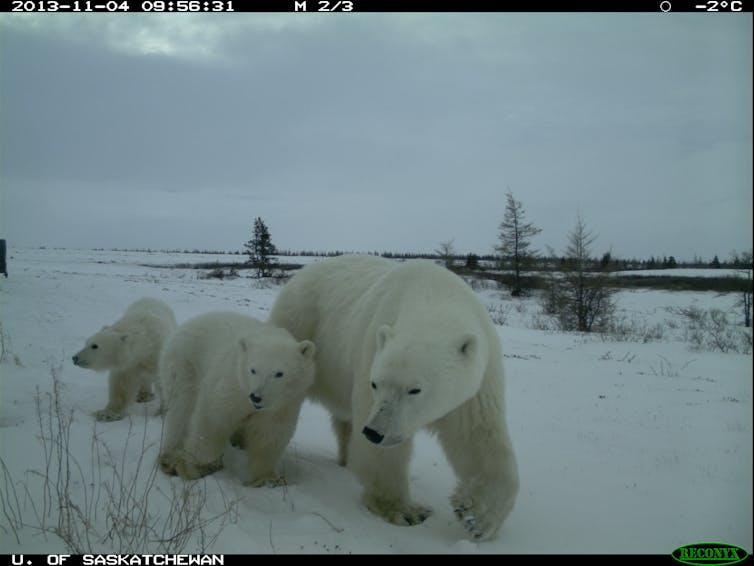
Wapusk is best known for its polar bears. They come ashore in the summer and autumn when the sea ice in Hudson Bay melts. Some stay for the winter to den in the permafrost where they give birth. What we see on the cameras reflects that pattern.

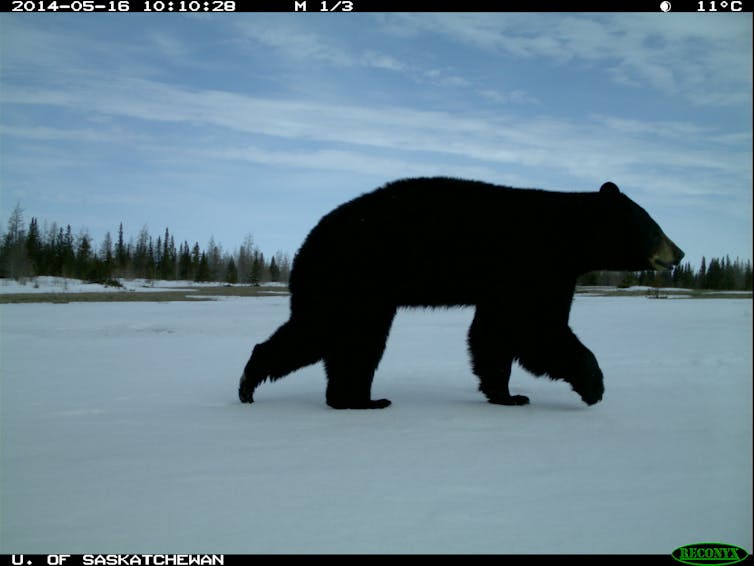
But Wapusk also lies along the northern edge of the boreal forest, where black bears are well established. We saw them too, but we were surprised that their visits to our most southerly cameras, on the Owl River, were almost as numerous as those by polar bears.


Grizzly bears Wapusk National Park.

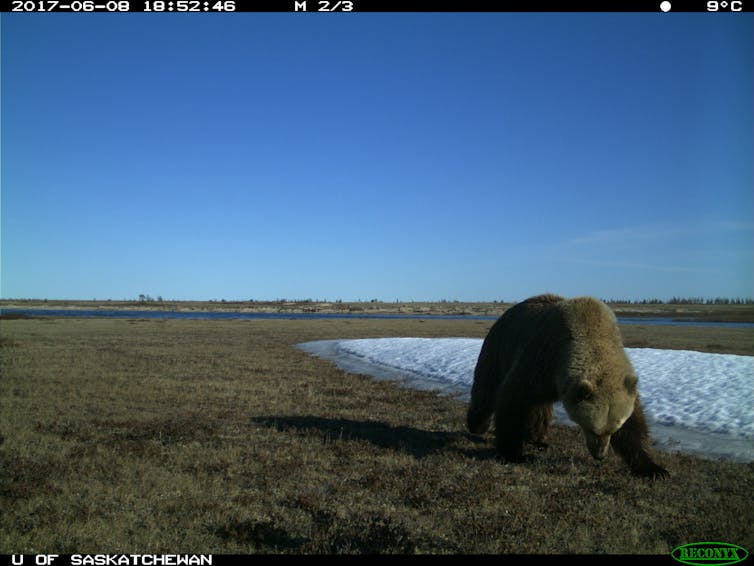
Grizzly bears visited all three study sites along the coast of Wapusk National Park.
(Douglas Clark), CC BY-ND


What was new to us were the grizzlies. It wasn’t just one or two transient bears, but several, and we suspect at least one of them may be denning there.

Barren-ground grizzly bears have been expanding their range across the Arctic in recent decades. In Wapusk, they’ve been increasingly frequent since the 1990s, and have even shown up in the nearby town of Churchill.

Ecosystem convergence


There’s much our observations don’t tell us, but they are significant for conservation efforts and, more fundamentally, for understanding what to do with these new ecological insights.

Three dynamic ecosystems — forest, tundra and ocean — converge at Wapusk, and all are changing quickly as the Arctic warms.

What we’ve seen in Wapusk is consistent with how researchers expect northern carnivore populations to respond to climate change. The waking life of all bear species is governed by their need to accumulate fat stores for the next hibernation, so this overlap is most likely a response to changes in the availability of bear foods. Which foods, however, we don’t yet know.


polar bears Wapusk National Park

Three polar bears walk past a camera trap in Wapusk National Park.
(Douglas Clark), CC BY-ND


We also don’t know how these species interact with each other, but we predict that grizzlies will benefit most since they dominate both other species elsewhere.

Grizzly bears have displaced and eaten black bears and polar bears in other places, and polar-grizzly hybrids have been documented in the Northwest Territories. It’s clear that the potential for hybridization exists in western Hudson Bay too.

Polar bears and grizzly bears face conservation challenges in many parts of Canada. Learning more about they way they interact with each other — and their surroundings — would probably tell us more about why they are now inhabiting the same place.

Controversial change


But how might we use this information?

When environmental changes occur in national parks, they often become controversial. People often assume the conditions present when the park was established, or the status quo, are “baselines” that must be protected, even though they may just be snapshots in ecological time.

Change has become increasingly central in ecological theory, and its implications have produced heated debate within the conservation community.


Black bears boreal forest Wapusk National Park.

Black bears are well established in the boreal forest of Wapusk National Park.
(Douglas Clark), CC BY-ND


This matters for the grizzly because its expansion into the Arctic has been portrayed as a threat to polar bears. Some argue such a threat should be removed.

In 1998, when I worked in Wapusk, I was told by a manager to get rid of the first grizzly we saw. (I didn’t.)

Such actions might not be wise since the long and complex evolutionary relationship between grizzlies and polar bears suggests their populations have, at times, benefited from the other.

Instead of looking at this new range overlap as a risk to any of the bears, my colleagues and I think it should be viewed as an ecological response to environmental change that needs to be better understood.

What’s at stake?


While locals may not be surprised by this scientific observation of the three bears, it is a novel situation that we can learn from — and one that matters beyond northern Manitoba.

Climate change will continue to move species around and create new combinations of them. It’s no easy task for wildlife or park managers to determine which environmental changes are desirable and which aren’t.

Wapusk, however, is a co-managed park that aims to integrate scientific and traditional knowledge with human values. It is equipped for addressing these hard questions. And the question of how to navigate increasing environmental variability more effectively — while recognizing the stakes local people have in these conservation decisions — is the biggest challenge environmental managers face today.

This particular story of the three bears isn’t over, and we don’t know how it will end. Consequently, we need to bring a heavy dose of humility to answering the scientific and societal questions the three bears have handed us.The Conversation

Douglas Clark, Centennial Chair in Human Dimensions of Environment & Sustainability, University of Saskatchewan

This article is republished from The Conversation under a Creative Commons license. Read the original article.

Tuesday, August 29, 2017

Guest Post: Anti-Trump backlash gags free expression at universities

James Turk, Ryerson University

We are living in difficult and worrisome times.

There has been a resurgence of racism, misogyny, anti-Semitism, Islamophobia and nativist nationalisms in many parts of the world — including Canada.

This renaissance of hate has been intensified by the actions of Donald Trump before and after his election. Fortunately, many have responded against the hate. For some, regrettably, part of that response has been to call for suppression of free speech.

As the director of the Centre for Free Expression at Ryerson University, I was deeply troubled when Ryerson recently decided to cancel a panel discussion whose topic, ironically, was to be “The Stifling of Free Speech on University Campuses.”

The panel discussion — scheduled to include University of Toronto psychologist Jordan Peterson and former Rebel Media journalist Faith Goldy — was not a march riddled with Klan and neo-Nazis. It was a group of three conservative academics and one right-wing journalist whose ideas are odious to many people, including me. But then, my ideas are likely odious to them.

The security excuse


free speech wall Charlottesville
Free speech wall in Charlottesville, Virginia
The university said it cancelled the event after a security review concluded it was “not equipped to provide the necessary level of public safety for the event to go forward.” The violent confrontation and deaths in Charlottesville may have both spooked Ryerson officials and made their decision seem prudent to many.

Opponents of the planned panel contributed to the fears — with their Facebook page headlined “No Fascists in Our City” adorned initially with a photo of a crossed-out swastika and a call for mass turnout to stop the panel. “This shit stops now. Either you’re with us or you’re not….”

In cancelling the event, Ryerson gave in to intimidation, prevented a panel discussion of difficult ideas and disagreement over deeply held views, and denied free speech rights to those with opposing views.

Part of freedom of expression is the right to dissent, protest and criticize, but that right does not extend to intimidation, harassment or violence that denies others their free speech rights.

Differences of views are the lifeblood of any university and essential to the mission of advancing knowledge and educating students. Most universities even have statements of principle that guarantee and support free expression.

Depriving views


Yale University’s statement says “to curtail free expression strikes twice at intellectual freedom, for whoever deprives another of the right to state unpopular views necessarily also deprives others of the right to listen to those views.”

The University of Toronto’s statement of purpose guarantees the “rights of freedom of speech, academic freedom, and freedom of research. And we affirm that these rights are meaningless unless they entail the right to raise deeply disturbing questions and provocative challenges to the cherished beliefs of society at large and of the university itself.”

Ryerson’s decision to cancel the event violates its own Freedom of Speech policy which states:

“Ryerson does not avoid controversies, difficult ideas, or disagreements over deeply held views. When such disagreements arise within the University or within a broader social context, the University’s primary responsibility is to protect free speech within a culture of mutual respect. The right to freedom of speech comes with the responsibility to exercise that right in an atmosphere free of intimidation and in an environment that supports the free speech rights of those with opposing views.”

This is not a new issue. During the anti-Communist hysteria of the McCarthy period in the 1940s and early ‘50s, many universities abandoned their commitments to academic freedom and freedom of expression. Loyalty oaths were imposed on faculty and many professors accused of being Communists were fired.

The then-president of Yale University, Charles Seymour, famously said in 1949: “There will be no witch hunts at Yale because there will be no witches. We do not intend to hire Communists.”

In her book No Ivory Tower, Ellen Schrecker summarized the role of the universities during this period: “In its collaboration with McCarthyism, the academic community behaved just like every other major institution in American life. Such a discovery is demoralizing … . Here, if anywhere, dissent should have found a sanctuary. Yet it did not.”

Cowardice and complicity


That harmful legacy of university cowardice and complicity took years to overcome. We need to remember this past if we do not want to relive it, albeit in the name of new passions and different ideologies and concerns.

Instead, it appears as if we are starting down a dark road that threatens the raison d’ĂȘtre of the university and the fundamental rights to freedom of expression guaranteed by Canada’s Charter of Rights and Freedoms.

If standing by its principles requires a university to make a greater investment in security personnel to protect freedom of expression, that must be seen as a proper cost of doing business.

If threats continue to blossom, then there needs to be discussions with governments to ensure universities have the additional financial resources to ensure free expression does not fall victim to intimidation.

Not only are censorship and suppression fatal to the purpose of the university, they undermine the foundation of democratic society.

When individual rights to freedom of expression are diminished or taken away for an allegedly good cause, they are necessarily invested in some higher authority that is given the right to determine what is acceptable.

The ConversationThe result is censorship from above — ultimately the state — with the likelihood that the champions of that censorship today are its vulnerable targets tomorrow.

James Turk, Director, Centre for Free Expression & Distinguished Visiting Professor, Ryerson University

This article was originally published on The Conversation. Read the original article.

Sunday, August 30, 2009

Reflections on an Election in Gabon

Today voters in the Central African country of Gabon will go to the polls to elect a successor to President El-Hadj Omar Bongo Ondimba, who died in May at the age of 73.

It is the first time in more than four decades that Omar Bongo will not be on the ballot -- though his son, 50-year-old Ali-Ben Bongo, is seeking the presidency himself, along with 22 other candidates.

The elder Bongo became president in 1967 upon the death of Leon Mba, Gabon's first post-independence head of state. At the time, Gabon's constitution provided for the succession of the presidency through the vice president and Bongo happened to have recently been elevated to the that office, after serving for a decade in a variety of bureaucratic positions. The Gabonese constitution now calls for a special election to fill the vacancy caused by the death or resignation of a president.

In his 42 years in office, Bongo presided over a remarkably stable country, by African standards. It is one of the few sub-Saharan countries that never had a violent change of government, and political unrest was rare in the Bongo years.

Bongo ruled, sometimes harshly, and, for the first 20 years or so, through a one-party state apparatus. When democratic changes began sweeping through Africa in the early 1990s (not coincidentally, following the fall of the Soviet Union and the end of Washington-Moscow machinations in Africa), Bongo saw the writing on the wall and oversaw the transition to a multi-party state.

A canny politician, Bongo understood well the adage, "Keep your friends close and your enemies closer." He co-opted opposition politicians by giving them cabinet positions and other perks. It's no accident that Gabon is said to have more cabinet officials per capita than any other country in the world. The CIA publication, World Leaders, lists 36 cabinet positions, including four deputy prime ministers and a "Min. of Social Affairs, National Solidarity, & the Protection of Widows & Orphans, in Charge of the Fights Against AIDS." The country's population is 1,514,993 -- you do the math.

In 1998, I was in Gabon during the presidential election and had the opportunity to interview two of the international election monitors who observed the process. The Metro Herald of Alexandria published my interview on March 19, 1999, and here it is:

REFLECTIONS ON AN ELECTION IN GABON

Richard Sincere
Exclusive to The Metro Herald

Last December The Metro Herald’s Richard Sincere went to Gabon, in. Central Africa, to observe that country’s second democratically-conducted presidential election since its new constitution took effect in 1991. In 1993, the incumbent president, El-Hadj Omar Bongo, won reelection with 51 percent of the vote against a field of 11 challengers. In 1998, Bongo was again reelected, this time with nearly 67 percent of the vote in a field of eight candidates.

According to GERDDES-Afrique, an international organization that works for the advancement of democracy in a Africa, “GERDDES-Afrique was pleased to coordinate election observation in Gabon by an experienced group of international monitors from Africa, Europe, and North America. Over 170 observers arrived in the days before the election to see for themselves the functioning of Gabon’s democracy. To this end, they attended campaign rallies sponsored by all the candidates; they spoke with members of the government and with officials of opposition parties; they were briefed by their own countries’ ambassadors stationed in Gabon; they visited polling places, monitored the news media, and listened to the concerns of voters.

“Monitors came to Gabon from West, Central, and Southern Africa and from as far away as Canada, Great Britain, and the United States. Observers included ambassadors and other diplomats, jurists, former heads of state, professors of law and political science, business executives, journalists, and political party officials.”

After some time to reflect on the election process, The Metro Herald (TMH) was able to talk to two of the international observers, Canada’s Troy Lanigan and Julian West. They were half of a a team that also included University of Sherbrooke Professor Charlotte Lemieux and former British Columbia legislator Nick Loenen. Following are their responses to The Metro Herald’s questions.

* * *

TMH: Please briefly describe yourself (place of residence, political affiliation, profession, relevant experience).

Lanigan: My background is in political advocacy. I have a degree in political science and economics, have traveled extensively throughout Europe and the former Soviet Bloc. I’ve worked professionally on campaigns and for various organizations in both Canada and the United States for the better part of 12 years. Currently, I reside in Victoria. British Columbia, and am employed full-time by the Canadian Taxpayers Federation by serving as National Communications Director and a spokesman in British Columbia. I also chair the Electoral Change Coalition of British Columbia (ECCO-BC), a multipartisan group of parties, groups, and individuals dedicated to changing the province’s first-past-the-post voting system through a referendum.

West: I live in Ladysmith, British Columbia (on Vancouver Island), where I am organizing chair and Elections BC delegate, Green Party of British Columbia, and Elections Canada delegate, Green Party of Canada. Professionally, I am a mathematician (Ph.D., MIT 1990), and since 1995 instructor at Malaspina University-College in Nanaimo, BC, and adjunct professor at the University of Victoria. In addition, I am a founding director of ECCO-BC and author of several documents on electoral reform.

TMH: What were your expectations before arriving in Gabon?

Lanigan: To tell you the truth, I really had no idea . . . Gabon would be hot/humid with a lot of black people speaking French in relatively poor conditions . . . that our job as observers was serious and that we would be trained and prepared to do a job.

West: From the limited information I was able to uncover about the country before the trip, I had the impression that it was sufficiently well-off to qualify as a “middle-income” country, virtually the only one in the whole of Africa which was not classified as “poor.” Perhaps naively, I assumed that this implied a certain level of social and political development as well, particularly having read about “relatively free” elections held there in the 1990s. (I’m not unaware that there were until recently a significant number of socialist countries classified as middle-income or higher—but these days I sort of assume that economic development and political development go hand-in-hand.)

TMH: Were these expectations accurate? if not, why not? (Feel free to elaborate.)

Lanigan: As far as Gabon went, our day trip to Lamberene [where Dr. Albert Schweitzer lived and worked] was the highlight … as far as the “observer” business went I had no idea how unorganized everything would be and even when something was half organized it was all [conducted] in French. If not for the books and manuals [we had received in advance], we would have had absolutely no background or grounding prior to the election.

Having said that, I’m glad we learned quickly to ignore scheduled meetings and took the opportunity to meet various campaign workers, attend rallies, and the like. Those encounters we interesting and valuable.

I should add that we got to see and do everything we imagined possible and that did exceed my expectations.

West: Yes and no. I would say that the general levels of education and social and political awareness among the Gabonese I encountered (admittedly a distorted sample, as it tended to be the sort of people one meets in luxury hotels, opposition radio stations, and so forth) were markedly higher than I expected. People seemed genuinely to know what was up with regard to the state of the country and the government. At the polling stations (more reflective of the general population) there was a frank enthusiasm for the democratic process and an air of seriousness about the whole project. This was refreshing.

On the down side, the general state of infrastructure and access to facilities in general was quite depressing once we left the bord de mer [seaside] in downtown Libreville [the capital city of Gabon]. Likewise, the social infrastructure was weak. I didn’t see the University myself but I had the sense it did not have much social impact on the capital. The media seemed underdeveloped. Perhaps this is what you’d expect in a country of only 1.3 million, but I think it would be desirable to see the emergence of a politically independent newspaper (and radio) rather than ones obsessed with the government and the opposition view of politics.

We saw a great many schools and although these were barren, they were clean, and I at least got the impression that schooling was available throughout the country. I also got the impression that this was true for girls as well as boys, and this is perhaps the most important social-development indicator for Third-World us countries.

TMH: How did you pursue your responsibilities as election observers? (For instance, did you attend political rallies, visit party headquarters, talk to voters, read local newspapers, etc.?)

Lanigan: It was never clear what our “responsibilities” were, so we made a lot of it up as we were going along. We did all these things: visited party headquarters, met candidates, attended rallies, spoke with foreign media. (I didn’t have a lot of one-on-one conversations with locals or read local papers because of language barriers, but our team certainly did.) We even had one of the Bucherons organizers come to our hotel to discuss list irregularities. We had a couple discussions with the Canadian Ambassador related to the election as well. I thought we used our time wisely and took in as much as we could.

West: We attended four rallies, although they were uniformly so late in starting that we really only stayed for the speeches at one. These were for the candidates Mba Abessole, Kombila, and Bongo. There was a fourth, but it was sparsely attended and we did not stay long. Following the Abessole rally, which was well attended and for which we were able to observe the entire rally from beginning to end, we were invited to visit the opposition radio station, Radio Soleil, which was being used as a party headquarters for the RNB.

I bought essentially every newspaper I could lay my hands on. Although I didn’t have time to read them all, I did go through all the headlines and read a number of the more relevant articles. I feel I got a general sense of the state of the media, which reminded me strongly of state-controlled publications I had seen elsewhere, such as the China Daily and the former Daily News in Hungary.

I wish I had been able to talk with more voters, but we did encounter quite a lot at the polls, and were able to talk briefly with cab drivers, hotel waiters, etc.

TMH: In your observations, did it appear that all candidates were able to put their case to the voters in a reasonably free and fair fashion?

Lanigan: In one sense yes. We attended a large Abessole rally in which there were military present. They were very friendly, the point of joking with the crowd and rally organizers. There was no intimidation by the military, only the intention to keep the event orderly. There was no restriction on materials distributed or what was said.

In another sense no. There is no question that the incumbent used the power of government to his advantage. On the first day we were there we heard a bunch of sirens and came out of the market to see what was up. It was the state police clearing the street to escort a bus load of Bongo supporters—just one of several examples including Bongo posters exclusively on government buildings, and money coming out the you-know-what, etc.

At one opposition rally they were complaining that the election commission had denied them a rally down by the water front even though Bongo was holding a rally in the same location.

So yes, there was openness, we saw several rallies and advertisements to suggest there was no harassment or intimidation but at the same time opponents of Bongo had the deck stacked against them.

West: Yes. I have no doubts at all about this aspect of the election. In fact, I would say that with regard to equal access to the electorate, this election far exceeded anything I have ever witnessed in Canada or the United States.

TMH: Did you observe any attempts by the government to inhibit or obstruct participation by political activists of an party? Did you see any examples of police or army intimidation of voters or activists?

Lanigan: Yes, I believe there was intimidation at voting stations. In areas of low support for Bongo, there would be a disproportionate amount of military (riot gear, gas canisters, the whole nine yards). One of these stations didn’t get around to opening until past 1:00PM [and] impatient voters left. Four hundred people registered to vote and only four ballots in the box! By “intimidation” it is not necessary to bust heads. We verified in conversation with people that they were intimidated by the military presence. In a couple of places I too was uncomfortable. Julian has more specifics on the different types of military present in different areas, which is important to understanding “intimidation.”

West: I saw a very heavy army presence at the polling station in Lalala which was the focus of an extended discussion in the British [observer team’s post-election] report. Late in the afternoon, I witnessed several ballot boxes containing fewer than 10 ballots from an electoral roll of 500, and one which was entirely empty. I put this down to the army presence—the ballot is not secret if yours is the only one in the box, so no one wants to cast one of the first ballots. In Canada, when a box contains few ballots it is mixed with another box before the count, to preserve the secrecy of the vote. I witnessed that this was not the case in Gabon—boxes were opened and counted in public with as few as half-a-dozen ballots in them. It would have been an easy matter to track which names were crossed off the list as having voted, and therefore to disprove a voter’s claim that he or she had voted a certain way.

The British team observed that another reason for the low turnout at this location was that the station had been moved with inadequate notice to the electors (likely in violation of the election law).

That both these things took place in a known opposition stronghold is a real cause for concern. After the close of polls, we encountered an angry mob who pointed to the situation in Lalala as evidence that the count was being rigged, conducted behind closed doors by army troops rather than openly. Half an hour later, we saw a truckload of riot troops headed south towards Lalala.

TMH: On election day itself did the polling stations operate at or below your expectations? Did it seem that the voter lists were accurate? Were any voters turned away from the polls without having an opportunity to vote? Did you see any voters attempt to vote more than once?

Lanigan: For the most part the polling stations exceeded my expectations I was really struck by the earnest and sincere conduct of the poll officials. Although some arguments broke out over rules and duties of various actors (especially party scrutineers) that was in my view more a function of education and not ill intent.

Yes, there was one outrageous example of a poll president refusing to allow a registered voter to vote because the man looked like he was from Mali. The military did not intervene even though a fight very nearly broke out. We reported the incident immediately. The man should not have been refused a vote. Also, several people were turned away because they were not on the list, they told us the election commission said it was not necessary to re-register if you were on the list in 1993. Apparently everyone had to reregister.

No one I saw attempted to vote more than once.

I have no idea if the voters’ lists were accurate. The opposition parties don’t think so. I really don’t know how we could know this despite our requirement of comparing lists posted outside to the lists held inside by the poll president.

West: In Libreville, I mostly saw disorder, with many stations which had not opened by late morning.

We heard numerous complaints about “doublants” and names missing from the electoral rolls. A person who had registered might be missing from the rolls, or missing a voter’s card, or both. One voter showed us two voting cards which he claimed were both issued to him, one under his French name and one under his African name. We also met polling-station officials who had similar documentary evidence of “doublants.” However, I am generally inclined to accept that this was due to bookkeeping errors rather than fraud. I say this for two reasons.

First, the fact that the recommendations of the advance observer teams that more care be taken around electors lists were not followed—this practically guaranteed that errors would occur. Second, the number of inaccuracies in the lists was not astonishing by Canadian standards—errors of this kind will simply occur when managing a database of hundreds of thousands of voters.

TMH: Were you able to observe the transport of ballot boxes from polling places to the electoral commission? Did they seem to be handled in a secure fashion? Were there any opportunities for fraud or mismanagement at this stage of the process?

Lanigan: No, I did not see the transport of boxes. We were al caught in a small riot immediately after some polls closed. A group of opposition supporters furious that some names were not on a list turned on us. (It frankly seemed to have more to do with a hatred of Bongo than it did any process irregularity. They got even angrier when they realized we didn’t speak French.) Anyway, we finally got back to the car when they surrounded it and started shaking it. To make a long story short, at that point in the evening we had things other than the transport of boxes on our minds.

However, the counts we did see appeared very genuine. We have asked the Ambassador to track down final poll results and we will verify against our own records before submitting our report.

West: No. I was not able to observe this. This is my major concern about the electoral process. Although I believe the campaign was fair and the vote was free, I have no personal evidence to inspire confidence in the count.

I was able to witness the count of half-a-dozen boxes. However, unless I can cross-check the numbers I witnessed with a published list, I have no way of knowing that the vote-totals were not simply fabricated.

I have asked the Canadian ambassador to help me obtain this list, but I have not had a response. In addition to the detailed poll-by-poll list, I would also need some reliable assurance that most of the ballots were dealt with in the way I observed—an open count subject to public scrutiny. If, on the other hand, most were counted behind closed doors, then I can say nothing about the fairness of the election. The exemplary openness and access to media would be beside the point.

TMH: Did you observe any irregularities or mismanagement that might have had an effect on the outcome of the election?

Lanigan: Yes, excessive military presence in what appeared to be select polling areas, either incompetent or corrupted election officials opening the polls at 1:30 in the afternoon (voters left).

West: See my earlier comments about rural areas where turnout was very high (probably above Canadian levels of 65-70 percent) contrasted with urban, opposition-dominated areas where turnout approached zero. Whether this was intimidation, fraud, or mismanagement, it surely had an effect.

TMH: if you were to make suggestions for improving the electoral process in Gabon, what would they be? (Please be as specific as possible.)

Lanigan: Work on ways to build public confidence surrounding the voters list. Just about everyone we spoke to had very little faith in it. Relax on the military already . . . Good question, see what the others say, and I’ll think some more on it.

West: Honestly, I endorse all the recommendations made by the advance team of observers. I was able to see that many of these were not followed, to the overall detriment of the process.

TMH: Would you be willing to serve as an election observer again, in Gabon or in any other country?

Lanigan: Absolutely . . . do you know of any other opportunities in Africa or elsewhere?

West: With the greatest pleasure, in any other country. (Well, at this point perhaps not in Yemen, or maybe Congo. But pretty well any other country.)

TMH: Do you have any other comments on your experience during the Gabonese presidential election?

Lanigan: Yes, “crab facie” is fantastic local dish. I don’t understand why everything is so expensive, even for the locals. Their electoral system (French run-off)—despite some of the pitfalls of process—is far more democratic than Canada’s. Thank you for this opportunity of a lifetime. 1 will never forget it.

West: I once spent four months in Hungary as an undergraduate student. After the program we were asked to write down some comments for the benefit of future participants. Any words I could find fell short of what I wanted to say, so I probably never completed the form at all. One of my buddies, David Wagner (now an associate professor at the University of Waterloo), simply wrote: “an incredible experience.” This became the quotation used on all the publicity posters for the program for the next decade.

Here is my comment on Gabon: “an incredible experience.”

The three photos featured above were taken by me and appeared in The Metro Herald in 1999, in black-and-white. The captions have been modified to reflect the year they were shot.


Be sure to visit my CafePress store for gifts and novelty items!
Read my blog on Kindle!

Wednesday, July 01, 2009

Happy Canada Day!

Let's take a few moments to wish our friends to the north a happy Canada Day.

It was on this day in 1867 that a brave band of Canadians ventured into the deepest, densest, darkest, most treacherous section of London, seeing to it that a bill passed the British Parliament to grant the provinces of North America a measure of autonomy. A hard-fought semi-independence, indeed!

In honor of the holiday, I have selected a few video clips for entertainment purposes only.

First, from Rose-Marie, Nelson Eddy and Jeanette MacDonald sing "Indian Love Call":


Next, Natalie Nevins performs the Big Band classic, "Canadian Sunset," on a 1966 episode of The Lawrence Welk Show. Ah-one, ah-two:

Third, Bob and Doug MacKenzie celebrate in the Great White North fashion(with beer):

Finally, Alanis Morrisette sings the Canadian national anthem, "O Canada," at -- naturally -- a Stanley Cup hockey match, in both English and French:

Célébrez, mes amis!


Be sure to visit my CafePress store for gifts and novelty items!
Read my blog on Kindle!

Sunday, June 07, 2009

Canadian Content

"What's good for the goose is good for the gander," goes the proverb.

Yet when it comes to economic protectionism, neither goose nor gander gets what's good. No matter who plays the protectionism game, everybody loses. (See Smoot/Hawley.)

Now Canadian municipal officials are biting back at the protectionism provisions of the Obama administration's economic stimulus package. Their argument is, if Canadian businesses are excluded from providing services to American states and cities under the stimulus rules, then American firms should be excluded from providing services to Canadian cities.

Thus the downward spiral begins.

Here's the beginning of the report from the CBC:

In response to the 'Buy American' provisions of the U.S. stimulus package, Canada's mayors narrowly passed a resolution Saturday that could potentially block U.S. companies from bidding on city contracts.

The resolution was passed at the Federation of Canadian Municipalities conference in Whistler, B.C., by a vote of 189-175.

The resolution says the federation should support cities that adopt policies that allow them to buy only from companies whose home countries do not impose trade restrictions against Canadian goods.

The Whistler Question (isn't that a great name for a newspaper?) noted how the vote was nearly split down the middle, and asked politicians who voted each way for their reasons:

Dianne Watts, the mayor of B.C.'s second-largest city, Surrey, voted in favour of the resolution because she said Canada needs to have a level playing field with its neighbour.

"We support free trade. We support open markets. But we've seen our local companies having to lay off workers because they've been hit directly by American policies," said Watts. "One company, their materials were on the site in the States and they sent them back."

But almost as many voted against it, fearing that it would just provoke Americans more and, worse, that it's un-Canadian.

"By lashing back, we're becoming more American," said Claude Elliott, the mayor of Gander, Nfld. "We need to take the high road and rise above that. We're negotiating with a U.S. company right now to set up in Gander and we don't need to put up any barriers."

In southeast Saskatchewan, where a booming oil industry attracts all kinds of American interests, Weyburn city councillor Bill Rudachyk didn't see anything to be gained by introducing protectionist policies or even threatening to.

"Two wrongs don't make a right," said Rudachyk, whose town recently hosted the second-biggest oil show in Canada, which attracted U.S. companies. "And we don't want retaliation."

An editorial in the Edmonton Journal is worth a read:
... other local leaders and organizations such as the Ottawa Chamber of Commerce are clamouring for our own "Buy Canadian" policy to combat the American move. After all, they contend, much of our stimulus package cash is designed for local projects, so why not mandate it that we look out for our own?

The answer is simple enough. While buying locally, regionally and nationally often makes a good deal of sense, enshrining that practice by law is ultimately self-defeating to the interests of a nation so dependent on other markets. Provinces, and especially municipalities, which have long drawn the short stick among the levels of government in Canada, must be free to make the most intelligent buying decisions for their citizens available. Tempting though it is to give our neighbours a taste of their own medicine and reward firms contacts simply because they are Canadian, it's a bad idea that will backfire. Like it or not, we must depend on our leaders to convince our customers to remember who their real friends are, and how grave the dangers are of backsliding into darkness.

Fortunately for Canada, its chief trade spokesman understands the basic economic principles that militate against protectionist policies. He argued against the mayors' resolution, although his views did not prevail in the final vote. Reports the Ottawa Citizen:

Trade Minister Stockwell Day is concerned about the second part of this motion and is urging delegates not to adopt it, as it could set off a retaliatory round of protectionist moves that experts say would ultimately damage the Canadian economy.

He said the federal government is aware that Canadian companies are being discriminated against by U.S. state and municipal governments on some water and sewage treatment projects funded by the stimulus bills, and they are working to correct the situation.

“If one country starts to build protectionist barriers that hurt businesses in another country, there will be an impulse to retaliate, and I would like to see this resolved at the executive level in the United States,” Day said.

Canada and the United States are each others' greatest trading partners. The commerce that crosses the U.S.-Canadian border keeps both economies vital. A trade war between the two North American giants would be devastating for both, and would have horrendous consequences for the rest of the global economy, as well.

The fact is, "Buy American" or "Buy Canadian" legal mandates are misguided and harmful. Let individuals and businesses choose what products and services they want to buy (and sell) regardless of source. That is what "free trade" and "free markets" really means. That is what "freedom" means.


Be sure to visit my CafePress store for gifts and novelty items!
Read my blog on Kindle!

Friday, November 14, 2008

Gay Conservatives Emerge in Canada

Word comes from the frozen north that gay conservatives are making their presence known in Canada, following the example of Log Cabin Republicans in the United States and TORCHE (gay and lesbian Tories) in the United Kingdom. (It goes without saying that there are also gay libertarian groups, such as Outright Libertarians and Gays and Lesbians for Individual Liberty.)

As reported on Western Standard:

Just in time for the Conservative party convention in Winnipeg, a new non-partisan organization called Gay Dominion has been launched to represent gay and lesbian conservatives.

Yes, they do exist. In fact, Western Standard readers have already come to know blogger Chris Reid, the Conservative candidate in Toronto who was forced to resign for being too conservative. Reid is also gay.
Gay Dominion states its mission(s) on its own web site:
We have two main missions. First, we want to end the isolation that many gay conservatives feel within their own community. Most of the gay media (newspapers, bloggers, websites, magazines, etc) are avowedly left-wing and do not allow for a diversity of political views. Gay Dominion would like to provide an alternative point of view on many issues that affect the gay community.

Secondly, we want the conservative community to understand that there are many gays amongst them, and that they need to welcome gays into their midst. We also want to work within the Conservative Party of Canada to ensure that gays are not left behind.
This non-partisan mission suggests that Gay Dominion hopes to play a role more similar to the Independent Gay Forum than any of the political activist groups I mentioned in the first paragraph, but it may have affinities in both directions.

There is something charmingly retro about the name "Gay Dominion," since Canada has not generally called itself a dominion since the 1950s, and in fact changed the name of its national holiday in 1982 from "Dominion Day" to "Canada Day."

Saturday, August 02, 2008

The United Nations' Speech Police

Here's a tricky question: Is criticism of attempts by Islamic nations to limit free speech around the world itself a form of defamation against religion, and therefore subject to laws that limit speech?

The head spins.

Yet that could, in fact, be the case if current proposals before the United Nations gain a foothold and criticism of religion (any religion, not just Islam, but especially Islam) becomes a global no-no.

Our friends to the North have more experience of these sorts of laws than we do in the United States, so it's no surprise that the Canadian news and opinion magazine, Maclean's, should be interested in reporting on this issue.

In an article headlined "Stifling free speech -- globally," Maclean's correspondent Luiza Ch. Savage writes:

Pakistan brought the first "defamation of religions" resolution to the UN Human Rights Council in 1999 — before the attacks of 9/11 and a resulting "backlash" against Muslims. That first resolution was entitled "Defamation of Islam." That title was later changed to include all religions, although the texts of all subsequent resolutions have continued to single out Islam. The resolutions have passed the UN Human Rights Council every year since the first was introduced. In 2005, the delegate from Yemen introduced a similar resolution to the UN General Assembly, and it passed, as it has every year since, with landslide votes. In March, the Islamic nations were successful in introducing a change to the mandate of the UN's special rapporteur on freedom of expression — an official who travels the world investigating and reporting on censorship and violations of free speech — to now "report on instances where the abuse of the right of freedom of expression constitutes an act of racial or religious discrimination." The issue is expected to be a focal point of the UN World Conference Against Racism next year in Geneva (a gathering Canada plans to boycott after the 2001 meeting in Durban devolved into acrimonious exchanges over Israel).

The trend has rights advocates worried for numerous reasons, beginning with the language used. If the notion of "defaming" a religion sounds a little unfamiliar, that's because it is a major departure from the traditional understanding of what defamation means. Defamation laws traditionally protect individual people from being materially harmed by the dissemination of falsehoods. But "defamation of religions" is not about protecting individual believers from damage to their reputations caused by false statements — but rather about protecting a religion, or some interpretation of it, or the feelings of the followers. While a traditional defence in a defamation lawsuit is that the accused was merely telling the truth, religions by definition present competing claims on the truth, and one person's religious truth is easily another's apostasy. "Truth" is no defence in such cases. The subjective perception of insult is what matters, and what puts the whole approach on a collision course with the human rights regime — especially in countries with an official state religion.

Savage cites an issues brief written by Angela Wu of the Becket Fund for Religious Liberty, an American non-profit whose mission is explained by its name. (I can imagine a number of mullahs exclaiming the equivalent of "Who will rid me of this meddlesome priest?" when confronted by expressions of religious freedom.)

The brief's "executive summary" explains:
The “defamation of religions” issue is fundamentally inconsistent with the principles outlined in the United Nations’ founding and legal documents, but more importantly, it violates the very foundations of the human rights tradition by protecting ideas rather than the individuals who hold ideas. Further, they force the state to determine which religious viewpoints may be expressed. The empowerment of the state (as opposed to protection of individuals against the state) through “defamation of religions” measures is thus unique in the human rights regime. “Defamation of religions” resolutions at the UN operate as international anti-blasphemy laws and provide international cover for domestic anti-blasphemy laws, which in practice empower ruling majorities against weak minorities and dissenters.

In its concluding "recommendations" section, the brief says:
Religious freedom is best preserved through protection of religious exercise of people of all faiths, not through restricting the speech of people of some faiths. “Defamation of religion” laws claim to protect vulnerable religious communities and the civil dialogue.31 However, there are already laws against assault, false imprisonment, fraud, and even defamation of persons. “Defamation of religion” laws in practice act as a form of thought control and work solely to the advantage of religious majorities that have the power to sanction which ideas should be permitted in the public square.
It is up to the Western liberal democracies to stand up to these attempts to constrain religious freedom and freedom of expression (freedom of speech and of the press). Nobody else will do it for us.

Tuesday, June 03, 2008

New York Gov't Encourages Growth of Organized Crime

The big news from New York today is that a new cigarette tax has become mandatory. As Paul Merrill reports for Albany TV station WXXA:

A statewide tax increase of $1.25 per pack of packaged cigarettes went into effect on Tuesday, bringing the total tax on a pack of cigarettes in New York State to $2.75.

The increase is estimated to bring the state's total tax revenue from cigarettes to approximately $1.3 billion.

That total is not increasing directly proportionally to the tax increase per pack because the state realizes many smokers will find other ways of getting their cigarettes or simply kick the habit altogether.

A pack of cigarettes in the Capital Region now costs about $6.

Additional taxes in New York City put the cost of a pack of cigarettes there closer to the $10 mark.

Some argue that this latest tax increase will push smokers to Native American stores, the Internet, or bootleggers who transport cigarettes across state lines.
We'll get back to that last point momentarily. But Jon Dougherty of WTVH-TV in Syracuse notes another effect (the grammatical error in the first sentence is his, not mine):
The average price of a pack of cigarettes is pushing $7.00, and independent smoke shop owners are seeing less customers because of it. Smokers buying cigarettes will have to pay up to $2.00 more per pack. At Tobacconist in Armory Square, a pack that cost $5.00 yesterday, will cost you over $6.50 today. The owner says that's going to hurt business.

A few blocks away, smokers were hesitant to buy cigarettes at the Downtown Smoke Shop in Syracuse today. The higher price left business slower than normal.

Smoke shop owners are afraid of losing customers to Indian Reservations, where there are no taxes on cigarettes. We spoke to the Onondaga Nation Smoke Shop. They say they've received more phone calls from customers wanting to know their price for cigarettes. The store sells pack $2.00 to $3.00 cheaper than in the city. For small smoke shops, that's hard to compete with.
While smoke shop owners off the reservation might be sad and smoke shop owners on the reservation might be glad, those laughing most heartily today are mobsters and terrorists who rely on cigarette smuggling for large portions of their tax-free, cash income.

It's not like this effect is unknown. I wrote about it more than a decade ago for The Metro Herald, which published the following article on April 17, 1998:
Higher Cigarette Taxes Set Stage for New Crime Wave
Richard E. Sincere, Jr.

(Arlington, Va.) --- The proposed federal settlement with the tobacco companies -- now in limbo as the tobacco companies have, at least for the moment, backed out -- includes a provision that federal excise taxes on cigarettes will rise from $1.10 (the congressional proposal) to $1.50 (the president's preference) a pack over the next several years. Experience in many states and foreign countries teaches us that such a tax increase will lead to more cigarette smuggling by organized criminals, with the likelihood of gang violence as various crime syndicates battle for "turf" in the contraband cigarette market.

In congressional testimony last December, Robert A. Robinson of the General Accounting Office (GAO) reported that "smuggling cigarettes from low- to high- tax states, or interstate smuggling, prominent in the 1970s, may now be a reemerging problem . . . In fact, recent estimates suggest that smuggling is responsible for states collectively losing hundreds of millions of dollars in annual tax revenues." The problem is also international in scope, as Robinson explained:

"International smuggling has occurred recently between Canada and the United States. According to the Canadian government, sharp increases in Canadian federal and provincial cigarette taxes in the late 1980s and early 1990s led to large-scale smuggling between the United States and Canada conducted almost entirely by organized crime. Violence increased, merchants suffered, and in one year alone, Canada and its provinces lost over $2 billion (in Canadian dollars) in tax revenues. Canada responded in 1994 by sharply reducing federal and provincial cigarette taxes . . . Since then, smuggling has declined considerably."

Writing in Reason magazine in 1995, Ed Carson explained how Canada's rising tobacco taxes set into motion the law of unintended consequences. "The result was an invitation to organized crime. Mohawk Indians from tribes along the U.S.-Canada border, biker gangs, and Asian Triads smuggled cigarettes across the border in boats, airplanes, trucks, legitimate courier companies, and snowmobiles. By the end of 1993, nearly one in three cigarettes was contraband."

In February of this year, Erin Schiller of the Pacific Research Institute noted the perverse, unexpected effects of Canada's cigarette tax. Despite the steep tax hike, Schiller wrote in the Washington Times, "youth smoking did not decrease and many officials ironically argued that high taxes made it more difficult to control youth smoking."

How could this be? Notes the GAO, "According to the Canadian Prime Minister, as the portion of the Canadian market supplied by smuggled tobacco increased, the average price paid for cigarettes dropped. Access to cheap contraband tobacco undermined the government's health policy objectives of reducing tobacco consumption, particularly among youth."

In perhaps the most delicious irony, U.S. college students living near the Canadian border made a practice of going on "drinking holidays" to Canada, where the drinking age is lower. To pay for their vacations, they would take carloads of low-priced U.S. cigarettes to sell or trade for liquor.

Canada is not alone. Washington Times correspondent Erik Kirschbaum reported in early 1996 that a similar smuggling problem was occurring in Germany. Cigarette smuggling led to "a surge in gangland-style executions and turf wars [that] made Berlin streets more dangerous than at any time since World War II," he wrote. "Authorities fear that cigarette trafficking is leading to crime empires dealing in extortion, prostitution, stolen cars, drugs, and weapons." Kirschbaum quoted a Berlin police detective as saying that "people are being executed in cold blood in their apartments and in broad daylight on the streets, on subway platforms, in front of hundreds of witnesses."

Weeks later, Paul Geitner reported in USA Today that "turf battles between the Vietnamese gangs that control street-level sales have been blamed for the deaths of 40 Vietnamese, 15 in Berlin alone [in 1996]." These killings, he said, are "the latest episode in a bloody gang war over Berlin's lucrative trade in smuggled cigarettes." The reason? Just one truck loaded with 50,000 cartons can net a smuggler $550,000 in profits.

According to former Treasury Department official Bruce Bartlett, all across Europe, high taxes are resulting in a bonanza for smugglers. "One-fourth of the world's cigarettes are now smuggled across national borders to evade taxes and tariffs," he wrote last August. "Governments are already losing $16 billion per year in tax revenues -- a figure likely to rise as organized crime becomes a larger player in the business of smuggling smokes. In Italy alone, organized crime is said to make $500 million per year smuggling cigarettes."

As long as tobacco remains a legal commodity, efforts to control its consumption through regulation or taxation are doomed to fail. This was the case during the blundering "noble experiment" of alcohol prohibition, when possession of alcohol was legal but the sale and importation of it were not. This created an instant black market for criminal kingpins like Al Capone and Joseph P. Kennedy, giving birth to organized crime in this country. With excessive cigarette tax rates, the Mob will have just one more outlet for criminal entrepreneurship.

It's obviously time to rethink the tobacco settlement -- particularly the misguided idea of raising cigarette taxes.

* * * * * * * * * * * * * * * *
Richard Sincere, a nonsmoker, chairs the Virginia chapter of the Republican Liberty Caucus (www.rlc.org).

If you think the link between cigarette smuggling and terrorism -- a more salient issue today than in 1998 -- is nebulous, consider what Jim Waters of the Bluegrass Institute, a think tank based in Kentucky, wrote in the Times-Tribune on May 9:
The notion that cigarette smuggling, driven by higher taxes, created a big-enough business to fund terrorists seemed goofy.

But the truth here is at least as strange as the fiction. A report released April 29 by New York Rep. Peter King shows how terrorists benefit from high cigarette taxes.

“In total, law enforcement officials in New York state estimate that well-organized cigarette smuggling networks generate between $200,000 (and) $300,000 per week,” the report stated. “A large percentage of the money is believed to be sent back to the Middle East, where it directly or indirectly finances groups such as Hezbollah, Hamas and al Qaeda.”

Two primary strategies used by these smugglers of terror involve either smuggling cigarettes from other states with much-lower taxes. Or they make peace with Indian reservations, where cigarettes aren’t taxed.

James Damask wrote for the Mackinac Center that “fully one-fourth of all cigarettes sold worldwide are now smuggled from low-tax areas to high-tax areas to reap the criminal’s reward for government intervention in matters best left to the private sector.”
These activities are not limited to North America, with funds going to the Middle East, either. Consider this story from Sunday's Moscow Times (that's Moscow, Russia, not Idaho):
Bulgaria, an EU newcomer under pressure from the bloc to clean up its act, said Friday that it had broken up on a criminal network suspected of financing rebel groups in Chechnya.

The gang of mainly Chechens was involved in racketeering, blackmail, arms deals, money laundering and cigarette smuggling, the national security agency said in a statement. "The group is suspected of financing terrorist formations in Chechnya," it said.
Cigarette smuggling has been a staple of organized crime activity in the Balkans for years, perhaps predating the fall of the Soviet Union and the break up of Yugoslavia. The Organized Crime and Corruption Reporting Project titled one of its recent reports "Cigarette Smugglers Trade in Murder" and began it by saying:
In the Balkans, death and cigarettes are closely related.But it's not always the carcinogens that are the problem.

The illegal tobacco trade takes its share of lives.

High-profile killings connected to illicit tobacco networks in the Balkans have claimed journalists, intelligence officers, politicians and the criminals themselves. In the fight to control this multi-billion dollar criminal enterprise, gangsters often use the most ruthless methods to assert their authority and send a reminder of their power to the public at large.

In one of the more chilling examples of cigarette smugglers' disregard for life, Dusko Jovanović was shot and killed outside the paper he worked at in Montenegro, a regional cigarette smuggling hub. The then editor-in-chief of Dan, the Montenegrin daily, was gunned down in 2004 shortly after publishing a series of articles on the illicit tobacco smuggling activities of underworld kingpins.

The killing was among the most vicious in a particularly bloody period in the recent history of Montenegrin cigarette smuggling. It followed the slaying on May 30th, 2000, of Goran Zurgić, a security advisor to then Montenegrin president Milo Đukanović. Zurgić, at the time cooperating with western intelligence agencies investigating Đukanović’s business dealings, was believed to be murdered by Darko Raspopović, then head of Montenegro’s anti-terrorism unit at its Interior Ministry. Raspopović himself was shot and killed in Podgorica the following January.
Those are just a few examples of how cigarette smuggling -- which is done almost entirely to avoid tariffs and taxes, since tobacco is a legal product in most countries -- benefits the mob.

Raising taxes on cigarettes may serve some short-term goals, such as increasing revenues for governments to misspend, but in the long run, it causes more harm than good.