Showing posts with label animals. Show all posts

Saturday, December 08, 2018

Guest Post: We found grizzly, black and polar bears together for the first time

Douglas Clark, University of Saskatchewan

North America’s three bear species — black bears, grizzly bears and polar bears — don’t typically live in the same place. But in Wapusk National Park, on the west coast of Hudson Bay, in northern Manitoba, we caught all three bears on camera — for the first time.

My colleagues and I began studying the bears in Wapusk in 2011, after more polar bears than expected began visiting new field camps in the park. We used remote cameras — a widespread, economical and non-invasive tool for studying wildlife — to find out why and when the polar bears were visiting these camps.

The cameras picked up more than 366 visits by polar bears to the camps in five years. They also detected other bears.

A bevy of bears


Wapusk is best known for its polar bears. They come ashore in the summer and autumn when the sea ice in Hudson Bay melts. Some stay for the winter to den in the permafrost where they give birth. What we see on the cameras reflects that pattern.

But Wapusk also lies along the northern edge of the boreal forest, where black bears are well established. We saw them too, but we were surprised that their visits to our most southerly cameras, on the Owl River, were almost as numerous as those by polar bears.
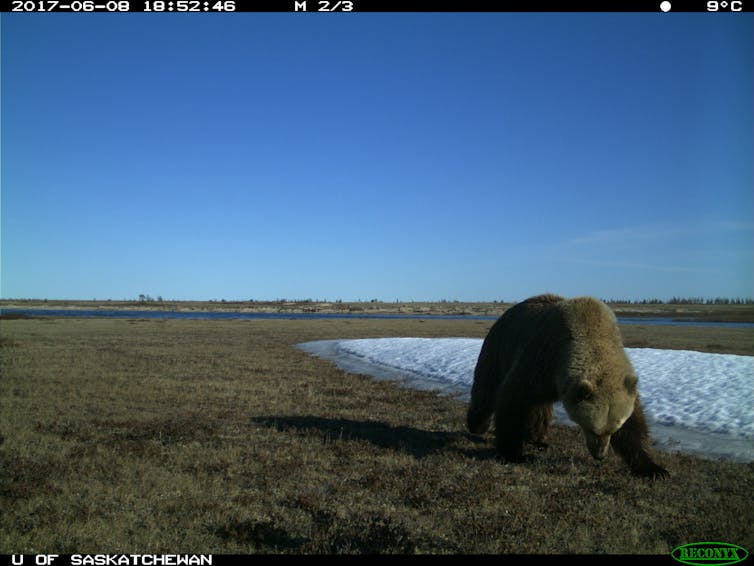


Grizzly bears Wapusk National Park.

Grizzly bears visited all three study sites along the coast of Wapusk National Park.
(Douglas Clark), CC BY-ND


What was new to us were the grizzlies. It wasn’t just one or two transient bears, but several, and we suspect at least one of them may be denning there.

Barren-ground grizzly bears have been expanding their range across the Arctic in recent decades. In Wapusk, they’ve been increasingly frequent since the 1990s, and have even shown up in the nearby town of Churchill.

Ecosystem convergence


There’s much our observations don’t tell us, but they are significant for conservation efforts and, more fundamentally, for understanding what to do with these new ecological insights.

Three dynamic ecosystems — forest, tundra and ocean — converge at Wapusk, and all are changing quickly as the Arctic warms.

What we’ve seen in Wapusk is consistent with how researchers expect northern carnivore populations to respond to climate change. The waking life of all bear species is governed by their need to accumulate fat stores for the next hibernation, so this overlap is most likely a response to changes in the availability of bear foods. Which foods, however, we don’t yet know.
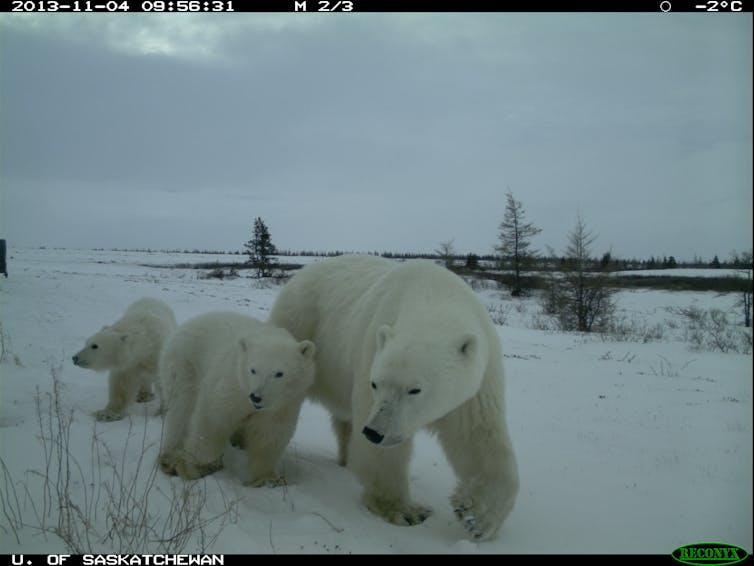


polar bears Wapusk National Park

Three polar bears walk past a camera trap in Wapusk National Park.
(Douglas Clark), CC BY-ND


We also don’t know how these species interact with each other, but we predict that grizzlies will benefit most since they dominate both other species elsewhere.

Grizzly bears have displaced and eaten black bears and polar bears in other places, and polar-grizzly hybrids have been documented in the Northwest Territories. It’s clear that the potential for hybridization exists in western Hudson Bay too.

Polar bears and grizzly bears face conservation challenges in many parts of Canada. Learning more about they way they interact with each other — and their surroundings — would probably tell us more about why they are now inhabiting the same place.

Controversial change


But how might we use this information?

When environmental changes occur in national parks, they often become controversial. People often assume the conditions present when the park was established, or the status quo, are “baselines” that must be protected, even though they may just be snapshots in ecological time.

Change has become increasingly central in ecological theory, and its implications have produced heated debate within the conservation community.
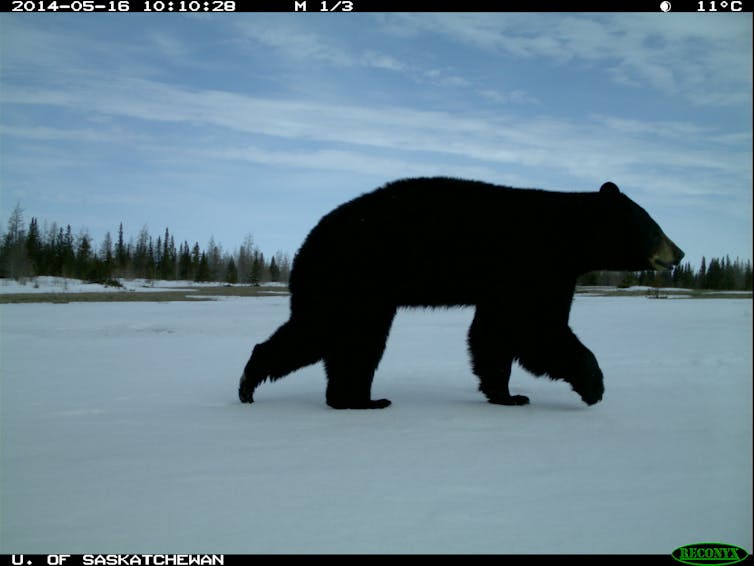


Black bears boreal forest Wapusk National Park.

Black bears are well established in the boreal forest of Wapusk National Park.
(Douglas Clark), CC BY-ND


This matters for the grizzly because its expansion into the Arctic has been portrayed as a threat to polar bears. Some argue such a threat should be removed.

In 1998, when I worked in Wapusk, I was told by a manager to get rid of the first grizzly we saw. (I didn’t.)

Such actions might not be wise since the long and complex evolutionary relationship between grizzlies and polar bears suggests their populations have, at times, benefited from the other.

Instead of looking at this new range overlap as a risk to any of the bears, my colleagues and I think it should be viewed as an ecological response to environmental change that needs to be better understood.

What’s at stake?


While locals may not be surprised by this scientific observation of the three bears, it is a novel situation that we can learn from — and one that matters beyond northern Manitoba.

Climate change will continue to move species around and create new combinations of them. It’s no easy task for wildlife or park managers to determine which environmental changes are desirable and which aren’t.

Wapusk, however, is a co-managed park that aims to integrate scientific and traditional knowledge with human values. It is equipped for addressing these hard questions. And the question of how to navigate increasing environmental variability more effectively — while recognizing the stakes local people have in these conservation decisions — is the biggest challenge environmental managers face today.

This particular story of the three bears isn’t over, and we don’t know how it will end. Consequently, we need to bring a heavy dose of humility to answering the scientific and societal questions the three bears have handed us.The Conversation

Douglas Clark, Centennial Chair in Human Dimensions of Environment & Sustainability, University of Saskatchewan

This article is republished from The Conversation under a Creative Commons license. Read the original article.
Sunday, November 26, 2017

Guest Post: Sheep can recognize celebrities from photographs

Catherine Douglas, Newcastle University

Sheep are surprisingly smart. New research from the University of Cambridge shows the animals can learn to recognise people from photographs, even people they’ve never seen in real life, such as celebrities.

The researchers tested the sheeps’ recognition abilities using images of famous people including Barack Obama, actors Emma Watson and Jake Gyllenhaal, and UK newsreader Fiona Bruce. While this is an amusing way to demonstrate what sheep can do, the research could actually have serious uses.


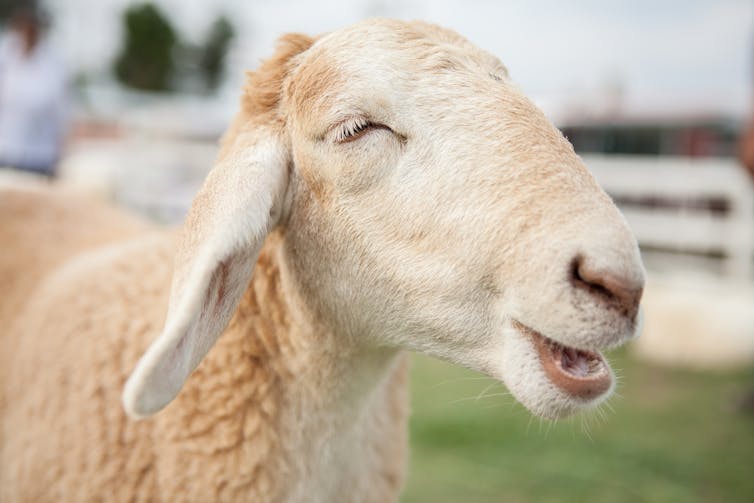
Sheep


Shutterstock


For one thing, increasing our understanding of sheep’s perceptual abilities could be used to argue for improved animal welfare. But sheep are also being used as models for understanding brain disorders such as Huntingdon’s disease and Parkinson’s disease, along with psychiatric disorders such as autism and schizophrenia. So learning more about their cognitive capacities could aid the work in this field.

In 2001, the Cambridge team showed that sheep could discriminate between photos of familiar sheep and humans and respond to the emotions portrayed in these photos. But they wanted to see whether sheep could actually recognise the people rather than just memorise familiar photos.

They used a computer screen to show eight Welsh mountain sheep the celebrity pictures, and then used food rewards to train the animals to select these familiar faces from a wider selection of pictures of other people and objects. The sheep could recognise the celebrities even though they had never met them personally and had only been introduced to a face-on photo. Incidentally, the sheep didn’t appear to have a preference for Emma, Barack, Fiona or Jake.


To see if the sheep were actually recognising people, rather than just memorising certain images, the researchers showed them photos of the celebrities taken from different angles. The sheep were able to correctly identify the celebrity 80% of the time, dropping to 66% for photos taken at a different angle. This compares to rates of 90% and 76% in humans.

This is an enviable record for the sheep given that they are recognising the faces of another species. (How many humans could recognise different sheep from their photos?) This sound scientific set-up was also able to time the sheep’s responses, showing they appeared as confident whether looking at the face in the same position as the original photo or from a different angle.

There was one final surprise for the sheep. After proving they could recognise faces of people they’d never met from two-dimensional photos, the sheep were shown pictures of their regular human handler. Although they hadn’t been trained to recognise these images, they selected them over the unfamiliar photos anyway.

Smart sheep


I was asked if, as an Ig Nobel laureate myself, I thought this recent Cambridge sheep study would be a contender for an Ig Nobel award, the prize for science that “first makes you laugh, then makes you think”. Celebrity-spotting sheep might sound funny but the science involved in this study actually isn’t sniggerable.

First it makes an interesting contribution to animal science, showing sheep have much greater cognitive abilities than many people realise. This includes farmers, who often manage hundreds of animals with little actual contact, in the presence of dogs and during unpleasant experiences such as worming or shearing. This means sheep are usually at their least composed around humans, without the inclination to show off their impressive cognitive capacities.

My own work and that of colleagues in Scotland has found that ewes can identify pain in their lambs who have undergone tail docking or castration. Another recent study demonstrated that it is possible that sheep have a sense of self and can recognise themselves in a mirror – something we only know is possible in very few species, including chimpanzees, dolphins, elephants and magpies.

Learning more about sheep’s cognitive abilities could also feed into work on using their brains to study neurological conditions in humans. We know that the neural networks that sheep’s brains use for face perception are similar to those used by human brains. That means that we might be able to use sheep to test treatments for human diseases where patients lose the ability to recognise faces or emotions, such as Huntington’s disease.

The ConversationIf sheep were on the Ig Nobel judging panel, they would laugh at the idea that people are surprised at their abilities. (And we know that animals really can laugh. And they might also be interested to know that Ig Nobel prizes have been awarded for studies showing many human identical twins cannot tell themselves apart visually. Or that humans with an itch on the left side of their body, can relieve it by looking into a mirror and scratching their right side. This research suggests that actually humans aren’t as good at visual recognition as we perhaps think.

Catherine Douglas, Lecturer in Animal Science, Newcastle University

This article was originally published on The Conversation. Read the original article.

Sunday, April 15, 2012

How Squirrels Potty-Train

Did I really need to know this?

In his column ending "Squirrel Week" today, Washington Post Metro section columnist John Kelly reports on how baby squirrels learn to defecate.  It doesn't just come naturally, it seems:

This fascinating bit of information came from Don Moore, associate director of animal care sciences at the National Zoo. Earlier in his career, Don worked in Syracuse, N.Y., rehabilitating baby squirrels. Squirrels are among species — deer are another — where the mother uses her mouth to carry her offspring’s poo and pee away from the nest. This is to protect her litter from predators.
“Evolutionarily, that’s a great strategy,” Don said. “The mother’s removing the only thing that can give [the baby] a scent: the pee and poo.” With no scent to follow, predators can’t find the defenseless baby.
The mother’s selfless act is so hard-wired in a squirrel’s very being that babies can urinate and defecate only after being stimulated by the mother licking around . . . down there.
Orphaned squirrels raised by humans risk becoming constipated and bloated. “The gut stops moving,” Don said. “You don’t want that to happen, so you stimulate them. In fact, you have to start stimulating them just to get them to feed.”
Squirrel moms provide stimulation with their tongues. “We don’t recommend that,” Don said. “We would use a warm, damp washcloth.”
Baby squirrels must have their nether regions stimulated at every feeding from birth to about five weeks of age, when their eyes are open and their fur is coming in.
“It’s a wonderful day when they start doing it themselves,” Don said.
My life could have gone on without knowing that, but it's bound to be a conversation-starter. (Or -stopper?)

Wednesday, November 04, 2009

Soylent Green Is Fido?

Thursday morning's Washington Times has an editorial about some New Zealand scientists who recommend something straight from the annals of science fiction (or SyFy):

Want to save the planet? Kill your pets. Or better yet, eat them. This radical new suggestion comes from New Zealand professors Brenda and Robert Vale, architects who specialize in sustainable living. Their research has found that pets create tremendous strains on the environment and that a truly green world would have no place for these carbon-emitting parasites.

The Vale duo found that a medium-size dog has a carbon "pawprint" equal to that of about two Toyota Land Cruisers. A cat has almost the same environmental impact as a Volkswagen Golf, and two hamsters somehow equal a plasma TV.
Could two hamsters be anywhere near as entertaining as a plasma TV?

No doubt any objections to eating house pets -- or companion animals, as they are now known -- will be dismissed as manifestations of Western, patriarchal oppression of the differently-cultured.

Will French restaurants now specialize in poodle cuisine? Or, using the example of acorn-fed pigs and grass-fed beef, will we be treated to menu items like "cheese-eating surrender monkeys"?

Or, as Conan O'Brien suggested on The Tonight Show, at the new Disney World in China, "the 101 Dalmatians exhibit will be called 'the food court.'"


Be sure to visit my CafePress store for gifts and novelty items!
Read my blog on Kindle!
Follow my tweets on Twitter!

Thursday, March 26, 2009

China Expands Pro-Abortion Policy

The shocking news from China, courtesy of the BBC:

Chinese authorities are using contraceptive pills to cut down the number of gerbils in a north-western province plagued by the rodents.

Forestry officials are leaving pills by the gerbils' burrows to try to cut back the rodents' exploding numbers....

Authorities are using the pellets - which prevent females getting pregnant and cause abortion in those already pregnant - disguised as bran feed, the state news agency Xinhua said.
There's sure to be more to this story. You don't have to be a Philadephia weatherman to know which way the wind blows.


Read my blog on Kindle!

Tuesday, March 24, 2009

Pearls, Swine, and Celluloid

Fans of the comic strip "Pearls Before Swine" (I am one) will be pleased to learn that their favorite animal characters -- Rat, Pig, Goat, Zebra, the Crocs, and others -- may be heading to the big screen.

According to the MediaBistro blog, GalleyCat:

In an exclusive interview, Stephan Pastis told GalleyCat that he is in negotiations with an unnamed studio to create an animated feature about his popular comic strip, Pearls Before Swine....

Pastis explained more about his upcoming projects: "We are currently beginning negotiations with a film studio (which I cannot yet name) for a Pearls animated feature. Also, this month, Aurora is releasing plush versions of Pig, Rat, Larry the Croc and Zebra."
While it may not be everyone's cup of tea, for me "Pearls Before Swine" is one of the funniest things in the funny pages. Pastis' strip is about the only comic that makes me laugh out loud. (For real, not just LOL; sometimes it's more like ROFL.)

I am eager to see how "Pearls Before Swine" makes the transition to cinema.


Read my blog on Kindle!

Sunday, September 21, 2008

Doubletake Headline of the Week


Lion Appointed To Detroit Zoological Society's Board


The article, from a publication called Zoo and Aquarium Visitor, explains:
At the annual meeting of the Detroit Zoological Society (DZS) held September 16, 2008, at the Detroit Zoo, the membership approved the following slate of candidates for a three-year term of board service: Tom Lewand, Albert L. Lorenzo and Victor Martin.

Lewand is in his 14th season with the Detroit Lions organization, currently serving as executive vice president and chief operating officer. He is the immediate past chairman of the Detroit Metro Convention and Visitors Bureau and serves on the boards of the Downtown Detroit Partnership, Detroit Economic Growth Corporation and Parade Company. Lewand has been recognized twice by Sports Business Journal as one of the top “40 Under 40” sports executives in the United States, and was also named to the Crain’s Detroit Business list of “40 Under 40” top business people in the Detroit area.
Whew! For a minute, I thought the inmates were running the asylum.