Showing posts with label Signature Theatre. Show all posts

Saturday, December 20, 2014

Director Barry Levinson Talks About Making 'The Natural'

Movie director and screenwriter Barry Levinson is in the entertainment news pages these days because he is making his debut as a musical theater writer. He is now adapting his 1982 film, Diner, into a musical play at Tony Award-winning Signature Theatre in Arlington.

Levinson's collaborators on this world-premiere musical version of Diner include Signature artistic director Eric Schaeffer and composer-lyricist Sheryl Crow, who is also writing her first score for a book musical.

In a feature by the Washington Post's Nelson Pressley, Levinson acknowledges that he's not a big fan of musicals but he's dived into the genre to create this new version of Diner for the stage.
Levinson’s been reading theatrical memoirs and marveling about great numbers written under the gun on the road, even though in his early days he met weekly deadlines as a TV writer for Marty Feldman and Carol Burnett. This was just after he studied broadcast journalism at American University and interned at a Washington TV station, working on the morning puppet show and eventually directing the evening news – just like the protagonist in “Sixty-Six.”

But he’s never been particularly crazy about musicals. He enjoyed “Book of Mormon” and laughed at “The Producers,” by his old mentor Mel Brooks – Levinson helped write “Silent Movie” and “High Anxiety” – but he rightly categorizes them as comedies first, with music. What he really admires is the sturdy melodic stuff, like “South Pacific.”

He can talk “Guys and Dolls” and “Carousel,” [director Kathleen] Marshall says, and Crow says he easily refers to everything from early rockabilly icon Eddie Cochran to “High Society.” But at the diner, he seems wary of the dark mark of the frivolous Broadway show.

“I’m not precious about the material,” he says. “But it does have to be a dramatic comedy. There are dilemmas. Shrevie and Beth don’t share common interests, and they’re desperately trying to connect. You can’t just pull that out and make it a fluffy piece.”
Last month in Charlottesville, Levinson came to the Virginia Film Festival, where he discussed the making of his 1984 baseball film, The Natural, with New York Times journalist Mike Tackett.  Over the same weekend, the director also presented his newest film, The Humbling, which features Al Pacino as a late-career actor in a panic.  The Humbling is based on a novel by Philip Roth.

Based on a novel by Bernard Malamud, Levinson's film version of The Natural starred Robert Redford as Roy Hobbs and a supporting cast that included Robert Duvall, Glenn Close, Barbara Hershey, Robert Prosky, Kim Basinger, Wilford Brimley, Richard Farnsworth, and Darren McGavin (uncredited).

Here is video of that conversation, recorded at the Paramount Theater on Charlottesville's downtown mall on Sunday, November 9:


Other celebrities who spoke at the Virginia Film Festival this year included actor Richard Roundtree (Shaft) and novelist Adriana Trigiani (Big Stone Gap), as well as political scions Barry Goldwater, Jr., and Skip Humphrey.


Wednesday, December 18, 2013

Signature Theatre to Resurrect Political Musical 'The Fix'

Welcome news arrived in the form of an emailed news release from Arlington's Signature Theatre this week.  To mark the end of its 25th anniversary season, Signature will be reviving The Fix, a musical play about political corruption that was produced there in 1998 in its first American outing.

For someone like me, whose interests in musical theatre and politics rarely overlap, this is a development worth celebrating.

As explained in the press release:

The revival, directed by Signature’s Artistic Director Eric Schaeffer, will round out an anniversary season chock-full of work by some of the Theatre’s brightest collaborators from the past 25 years.

“The Fix paints a picture of American politics that’s part fun-house, part haunted house,” said Schaeffer. “It’s twisted, and it pushes boundaries. It instantly became one of Signature’s favorite projects. And on top of that, it’s one of the shows most requested by our audiences. It’s only fitting that we close the season celebrating our first 25 years by bringing it back in an all-new production.”

With a rock-laced, eclectic score and scandalous lyrics, The Fix skewers the American bureaucratic machine. Reminiscent of Sondheim, with tinges of Kander and Ebb and a voice uniquely its own, it is a darkly brilliant, over-the-top, audaciously fun ride through the shenanigans of political elections.

When a popular presidential candidate dies in his mistress’s bed, his ambitious wife Violet thrusts their lackluster son Cal into the spotlight. With the help of her strategic brother-in-law, Violet transforms Cal into the perfect citizen. Together they create one of the most dysfunctional – and brutally entertaining – almost-first families ever.
(My original review of The Fix from April 1998 can be found here.)

Writing in the Washington Post Style section, Jessica Goldstein reports:
For its 25th anniversary season, Signature is bringing back “The Fix,” a production which, unless the political process somehow gets squeaky clean between press time and when you read this, is as relevant a show today as it ever was. “The Fix” will run in 2015, from May 12 to June 28.

“I say it’s ‘The Manchurian Candidate’ meets ‘Caligula,’ ” said Signature Artistic Director Eric Schaeffer, who directed the 1998 production and will helm 2015’s as well. For the young’uns, that basically means it’s like “Scandal” meets, well, “Scandal.”

The script will be getting some tweaks to allow for changes in “the communication things, sending this picture and that,” Schaeffer said. Even our fictional politicians don’t know that no one wants to catch them with their pants down on Twitter. “John [Dempsey, who wrote the book and lyrics] is looking to make it even more dangerous.”
Signature's current musical production is the classic Gypsy, with a book by Arthur Laurents, music by Jule Styne, and lyrics by Stephen Sondheim.  The show, directed by Joe Calarco, has been extended through January 26 and first reviews should appear early next week.


Friday, October 25, 2013

From the Archives: Review of a 1997 'Sunday in the Park with George'

Having previously thought that all of my theatre reviews from the late 1990s had been posted here for archival access, just this week I uncovered a piece that had been inaccessible because it had somewhat mysteriously been converted into an old WordPerfect format.

Yesterday I found an online resource that will convert text documents from one format to another and -- ta-dah! -- I have a review of the 1997 joint production by Washington's Arena Stage and Arlington's Signature Theatre of Stephen Sondheim and James Lapine's Sunday in the Park with George.

So, for the first time on line, here is my May 1997 review, which appeared in the Metro Herald under the headline, "Sunday Sings!"

- - - - -


Washington audiences have an embarrassment of riches available this spring. Within a few days, Chicago, The King and I, and Sunday in the Park with George all opened. Together, these three plays offer examples of the best by the giants of American musical theatre: Bob Fosse, Rodgers & Hammerstein, and Stephen Sondheim.

In a historic collaboration, Arlington's Signature Theatre and Washington's Arena Stage have joined forces to present a play that neither could produce on its own: the Pulitzer-prize-winning Sunday in the Park with George, by Stephen Sondheim and James Lapine. This production is directed by Signature's Eric D. Schaeffer, whose work at the tiny but innovative Signature Theatre has earned him a national reputation, and produced by Arena's outgoing artistic director, Douglas C. Wager.

Like most Sondheim musicals, Sunday is not for everyone. For Sondheim fans, however, it is bedazzling. The intimate setting of Arena's Kreeger Theater is far superior to the larger auditoriums in which earlier Sunday productions have been staged. Sondheim's sophisticated lyrics and intricate melodies and counterpoints are far more easily heard in such a venue.

Perhaps the most valuable aspect of the smaller auditorium is the ability of the audience to see more closely Patricia Zipprodt's costumes. Because of the foresight of Schaeffer, the costumes used in this production of Sunday are the same ones used originally on Broadway (and since used by the Arlington Players a few years back). Zipprodt has successfully simulated the pointillist style of painting invented by Sunday's protagonist, neo impressionist Georges Seurat, for his masterpiece (now hanging in the Art Institute of Chicago) Sunday Afternoon on the Island of La Grand Jatte.

Seurat's work and style of work is the focus of the first act. George (played by Sal Viviano) is obsessed by light, color, balance, design. He has discovered that it is possible to create the illusion of mixed colors by setting discrete points or dots of color side by side, in juxtaposition to each other. He is fully absorbed by his work, ignoring and therefore losing his mistress, appropriately named Dot (Viviano's real-life spouse, Liz Larsen). We meet the characters whom we see in the final painting, but whether they are real people or the imaginings of George is hard to say.

The second act focuses on another artist, also named George, who may be the great grandson of the first act's George. At least his grandmother, Marie, insists that this is so. Act II's George also works in a new medium, but his primary challenge is raising the money to pursue his art. Tired of criticism that he has lost his way, that his work is no longer new or creative, he travels to France to visit the island of La Grand Jatte. There, he encounters his (perhaps?) great grandmother, Dot, who counsels him to "move on."

This synopsis cannot do the play justice. Sunday in the Park with George is not a typical musical. This is not a simple boy meets girl, boy loses girl scenario. Indeed, there is no conventional plot at all. Through the integration of music, lyrics, movement, lighting, and costumes, composer and playwright raise important issues about artistic integrity, personal relationships, and the importance of family.

Viviano plays the two Georges in contrast. Act I George is cold, obsessive. At first Viviano's stiffness in the first act is off putting, but soon it becomes apparent that this is what drives Dot away, into the arms of the more caring Louis, the baker who takes her to America. Highly rational and highly intellectual, focused laser-like on his creative endeavors, this George will be all too familiar to Washingtonians, who encounter this type every day. Act II George is more well rounded, though still devoted to his work. He seems more able to connect to his fellow human beings, particularly his grandmother, and has a deeper understanding of his own faults and shortcomings.

As Dot and Marie, Liz Larsen is astonishing. Her voice is as clear as a bell, her emotions sincere and convincing. We know she genuinely loves George, but cannot spend her life with him because he has another love his art. Her warmth contrasts suitably with George's chilliness, and the comparison helps us better understand the central character. Singing "Children and Art" in the second act, we begin to understand what really counts in life. And her rendition of "Move On" to and with George in Act II makes it hard to believe that Sondheim has written anything more, well, moving.

The rest of the cast is uniformly excellent. Drawn from the professional ranks of New York, regional, and Washington theatre, this cast includes a number of Arena and Signature veterans.

Anyone who works in the non profit world or, for that matter, anyone who is engaged in campaign fundraising will be captivated by the action, lyrics, and dialogue of the Act II number, "Putting It Together," which describes the schmoozing and bootlicking that are necessary to keep one's head above water in these situations.

Schaeffer has done well in bringing Sunday in the Park with George up to date. The modern art in Act II is now computer generated graphics and music, rather than the laser light show that was so cutting edge in 1984. One quibble, however, may be necessary as future productions are planned. The script requires that Marie be born in 1885. With the second act set in 1984, this was not hard to believe many people live to be 98 or 99 years old. Now that the second act has been brought forward to 1996, however, it stretches our credulity to have Marie, now 111 years old, as the grandmother of a 32 year old grandson. Will a revival in 2007 have a 122 year old Marie?

The Arena/Signature Sunday in the Park with George is breathtaking. I hope it will have an extended run that will allow multiple visits for those of us who are truly moved by Sondheim's best work.

- - - - -

As I dig through paper and virtual files, more surprises may turn up.  Please stay tuned!


Friday, August 03, 2012

Review of Ash Lawn Opera's 'The Music Man'

If you fear that Ash Lawn Opera’s summer production of Meredith Willson’s The Music Man will offer surprises or innovations, be not afraid. This is just about as conventional a version of the classic 1957 musical comedy that you’re likely to see in this or any other season.

Having just reread Willson’s own account of the trials and tribulations that resulted in the original production (But He Doesn’t Know the Territory,’ published in 1959), I understand how his book (co-authored with Franklin Lacey) became ironclad. Only complete incompetency could breach that armor. That would explain, in part, why The Music Man is such a favorite of community and high school theatre troupes with limited resources.

Director Cate Caplin’s mounting at the Paramount Theatre in Charlottesville is more than competent despite some static and clunky blocking (due, perhaps, to the Paramount’s shallow stage area crowded with a large cast of 50 players) and a low energy level – neither of which seem to have bothered the near sell-out crowd in the audience, which thoroughly enjoyed the performance from start to finish.

Helping keep the balls in the air was conductor Jon Kalbfleisch, visiting from Signature Theatre in Arlington, who had the pleasure of directing a musical ensemble collected from around the country, including representatives from the Miami Symphony, Orlando Philharmonic, Florida Grand Opera, and Sarasota Orchestra. (Don’t they do music in Florida in the summer?) Sad to say, it was a nearly unique pleasure to hear a pit orchestra that was on pitch from the very first note of the overture to the last note of the bows. “Sad to say” because such discipline is all too rare in productions like this, and a greater pleasure on account of that.

It was a bit jarring, at first, to hear the principals’ operatic voices singing songs intended for musical-comedy actors. One could detect baritone Trevor Scheunemann (as Professor Harold Hill) fighting the urge to put full voice behind the patter songs that Willson so conscientiously wrote for the character (and not, as some might imagine, for the vocally-limited Robert Preston, who first played the role on Broadway).

Emily Albrink’s soprano is heavier than one might imagine Marion Paroo’s voice, suggesting a greater maturity than the 26-year-old character should possess. Still, her renditions of “Good Night, My Someone,” “Till There Was You,” “My White Knight,” and “Will I Ever Tell You” are lovely throughout.

(The maturity question comes into play in a couple of dubious casting choices. Sarah Kraus, who plays Marian’s mother, is about Albrink’s age and is simply unconvincing as an Irish immigrant in her mid- to late 40s. And baritone Christiaan Smith-Kotlarek is way too old to be playing teenager Tommy Djilas. Since that is largely a non-singing role, director Caplin could easily have given it to an additional young local actor, such as an older brother of those who fill out the hefty ensemble.)

Local actor Pat Owen – not an opera singer, but with a number of musical plays under his belt – is a blustery, curmudgeonly, grumpy, spooneristic Mayor Shinn. Paul Ford and David Burns would be proud to have him follow in their footsteps.

If any of the principals stood out, it had to be Meredith Arwady as Eulalie Mackecknie Shinn, the mayor’s wife. Chewing scenery shamelessly, Arwady had the audience eating it up with her and licking their fingers so as not to miss a bit. Every time she walked – or waltzed – on stage, the energy level in the theatre rose by several degrees. Obviously happy to have a role she could have fun with, Arwady played with it to the limit.

Speaking of limits, Ash Lawn Opera has long been known as short on dance and long on music, which makes sense given its mission. Consequently, the choreography in this production was simple – staged movement in most cases, some marching here and there. The dance break in “Marian the Librarian” was cut substantially, and the footbridge ballet was also circumscribed. (Why the soft-shoe encore of “Gary, Indiana,” a guaranteed applause getter, was also cut mystifies me.)

What dance there was, was executed mostly competently and effectively, although a few missteps could be detected -- not, as one might expect, from the youngest and most amateur members of the cast, but rather by the young opera artists, who seemed outside their element.

To be fair, The Music Man has never been a demanding dance show. The original production’s producers were confident enough to entrust the choreography to a first-timer, Onna White, in recognition of this fact. (White was rewarded with a Tony nomination, as it happens.)

The set design by Evan A. Bartoletti and Lisa D. Lechuga (billed together as Lechetti Design) evoked a 1912-ish Fourth of July in small-town Iowa without being too naturalistic. The dark tones might have been more at home on a Ragtime stage, but that did not detract too much from the atmosphere.

For his part, Stevie Agnew’s lighting design made ample use of a favorite technique of Morton Da Costa, the director of the original stage production and 1962 film of The Music Man – a tightly focused iris effect, isolating one or two actors at a critical moment of the play. Da Costa used it in Auntie Mame, as well, but the two plays had different lighting designers (Howard Bay on The Music Man, Peggy Clark on Auntie Mame), so the conceit seems to belong to the director. Bay, as it happens, was the first member of the creative team to sign up for The Music Man once Kermit Bloomgarden agreed to produce it; Da Costa joined up shortly afterward.

Special praise is due to costume designer Shon LeBlanc, if nothing else than for sheer output. There have to be 100 or more costumes in this show, and each one is true to the era and to the character it represents.

People today sometimes react with bewilderment when they learn that The Music Man beat out West Side Story for the best new musical Tony Award in 1958. They think that West Side Story, after all, was the edgier show and the one with a collaborative team of Revered Giants Of The Theatre – Bernstein, Laurents, Robbins, and Sondheim – plus it was “socially relevant.”

Yet even 55 years later, it’s clear that The Music Man is the better musical play: a more solid book, a more innovative score, more colorful characters, better-constructed and -integrated. West Side Story remains flawed at several levels (some flaws tracing back to Shakespeare) while The Music Man is still more fully formed, even in a strictly conventional production like the one Ash Lawn Opera is presenting in Charlottesville.

Note:  The Music Man holds a special place in my heart.  It was the first show I appeared in (post-high school), at St. Bernard's Studio Theatre in Wauwatosa, Wisconsin.  That show was 35 years ago this summer -- a 20th anniversary production of The Music Man that will always be remembered.

Ash Lawn Opera’s The Music Man has three more performances at the Paramount: August 4 at 7:30 p.m.; August 5 at 2:00 p.m.; and August 7 at 7:30 p.m. Each performance is preceded by a lecture that begins 45 minutes before curtain time. For ticket information, consult www.theparamount.net.

Be sure to visit my CafePress store for gifts and novelty items!
Read my blog on Kindle!
Follow my tweets on Twitter! 
 

Monday, February 13, 2012

Ambiguity Reigns in Signature Theatre’s New Play, 'Really Really'

When Haley, the sister of the protagonist in Signature Theatre’s new drama, Really Really, first arrives at the beginning of the second act, it’s as if a window has been opened to allow fresh air to blow across the stage.

No: A more accurate analogy is that a cork has been popped on a bottle of soda that was all shook up, because Haley, plainspoken to the point of being (really, really) offensive, stands in stark contrast to the other characters, who are each tightly wound and waspish, even the ostensible slacker of the group. Haley relieves the pressure that has been building for the first hour.

Even the names of the guys on the rugby team suggest old-moneyed uptightness. Cooper (Evan Casey), Davis (Jake Odmark), and Johnson (Paul James) are either surnames, or last names used as first names, but in any case seem to be WASP-y prep-school holdovers. Only Leigh’s boyfriend, Jimmy (Danny Gavigan), has an unmistakable first name. (Suffice it to say that Grace [Lauren Culpepper] turns out to lack it.)

After Haley (played by Kim Rosen) blows in, we find it hard to believe that she and Leigh (Bethany Anne Lind) are sisters. Despite Haley’s claims to the contrary, the two look nothing alike: Haley dark and buxom, Leigh willowy and flaxen.

Neither, it seems, do they have much in common in terms of character traits. Leigh, we gather, is a diligently studious college student who has distanced herself from a dysfunctional and poor family, while Haley embraces the trailer-trash lifestyle. (She’s living, she says, in a Super 8 motel outside Waterbury, Connecticut, with a guy named “Rico” and all that implies.)

Bethany Anne Lind (Photo: Scott Suchman)
Leigh prefers to keep tight control over her circumstances while sister Haley likes to snoop around and interfere, as long as her own aims can be advanced in the process.

As events unfold, however, we find that the two are not so different as they wish to appear.

Haley’s cubic zirconium entrance into a diamond-studded, ivy-covered world breathes life into the story, which up to that point has been merely a conventional he said/she said exposition of the two sides of a story about what might or might not have been a date rape at an off-campus party.

By coincidence, Really Really, written by first-time playwright and New York University graduate Paul Downs Colaizzo, had its premiere in the same week that New York University law professor Richard Epstein wrote about how the U.S. Department of Education has issued rules that skew the due process rights of college students accused of sexual assault.

Writing in reference to the recent case of Yale University football star Patrick Witt, who seems to have withdrawn from consideration for a Rhodes Scholarship because of anonymous accusations of sexual assault, Epstein notes of recent rules promulgated by the Office of Civil Rights in the Department of Education:

“The entire matter is shrouded in secrecy; the internal investigation cannot be postponed until the criminal charges, if any, are resolved; and the question of proof of guilt or innocence should be decided by the ‘preponderance of evidence’ standard. That standard puts a far lower burden on the complainant than the 'beyond a reasonable doubt' standard used in criminal cases or the 'clear and convincing evidence' standard used in many legal disputes (including defamation cases brought against the press by public officials) where some important constitutional right is at stake.”

Considering that the playwright began the first draft of Really Really in 2007, it is mere coincidence that the world premiere occurred even as the very real topic of sexual assault on campus, and the presence or absence of due process for the accused, was in the headlines. It means that Really Really is not just an entertaining and provocative dramatic work, but also a cultural artifact of contemporary relevance.

Jake Odmark, Evan Casey. Photo: Scott Suchman.
Comparisons of Colaizzo’s new play will be made with John Patrick Shanley’s Doubt, David Mamet’s Oleanna, and Rebecca Gilman’s Spinning Into Butter. Each comparison is apt, though, despite some similarities in subject matter and stylistics, there is no direct parallel for any of them with Really Really.  What they all have in common is an ambiguous answer to the question, Who is guilty?

Colaizzo, 26 years old, has a sharp ear and a knack for writing dialogue. He recognizes, and hence expresses, how 20-somethings in 2012 actually talk. While each of his characters starts off superficially as little more than party boys (and girls) with few distinguishing characteristics, by the final tableau we realize that each of them is siloed into his or her own, distinct personality – for better or for worse.

It’s difficult to describe what happens in Really Really because so much turns on what we learn in the last ten or so minutes of the play. To reveal too many details of the plot would be like telling a friend that Haley Joel Osment sees dead people and that’s why he can see Bruce Willis.

Suffice it to say that, within a running time of two hours, Colaizzo stuffs his play with highly charged accusations of sexual assault (already noted), class warfare, sibling rivalry, manipulative behavior, homophobic banter, unrequited lesbian lust, drunkenness, hangovers, and the potential for McCarthy-like guilt by association. It’s enough to fill a full day of Lifetime movies.

Director Matthew Gardiner keeps the action at a steady pace and he is ably served by a set, designed by Misha Kachman, divided into two living rooms that represent feminine order and masculine chaos.

There is nothing black or white about Really Really. It thrives on shades of grey and is built on uncertainty.

Audiences will find plenty to talk about during the ride home from the theatre, and there is enough disagreement on offer that couples may find themselves not talking about it at the breakfast table the next morning.

Performances of Really Really continue through March 25 in the ARK at Signature Theatre, with show times at 7:30 p.m. on Tuesdays and Wednesdays, 8:00 p.m. on Thursdays and Fridays, and Saturdays at 2:00 and 8:00 p.m. and Sundays at 2:00 and 7:00 p.m. Ticket prices range from $56 to $80 and are available by calling Ticketmaster at 703-573-7328 or visiting www.signature-theatre.org.

Really Really contains strong language and explicit situations and is recommended for mature audiences.


Be sure to visit my CafePress store for gifts and novelty items!
Read my blog on Kindle!
Follow my tweets on Twitter! 

Thursday, February 09, 2012

Interview with Actress Bethany Anne Lind

Bethany Anne Lind at Signature Theatre
Bethany Anne Lind is an Atlanta-based actress who plays the role of “Leigh” in Signature Theatre’s world premiere production of Really Really.

When asked in an interview to describe Leigh, Lind demurs by looking toward playwright Paul Downs Colaizzo and saying, “I don’t know what I’m allowed to say.”

The producers of Really Really, it seems, are trying to keep a lid on what the play is really, really about, though rumors have circulated that it is loosely based on the 2006 Duke lacrosse incident. Colaizzo himself prefers to talk about the theme of the play rather than the plot, although he grants permission to Lind to “talk about who she is.”

Leigh, she finally says, is “a person who has grown up with nothing and always has had to fight to get where she is, as opposed to most of the other characters who have been handed their educations and their places in life. She has had to work and fight to get there, so she has a very clear goal of what she wants out of life and she is going to do whatever she has to do to get it.”

Lind herself seems unusually demure to play a hardscrabble role like that, but her own life story indicates a determination to achieve, even if it was generated in a more genteel environment.

Homeschooled in North Carolina, Lind started acting in church plays and in the living room and backyard.

“I did a lot of making up plays with my siblings and my cousins and my neighbors,” she said, and her parents “fostered a very creative atmosphere, so we were always pretending and making stuff up.”

Eventually, she went to college at Campbell University, a small, liberal-arts school.

After she graduated, Lind moved to Atlanta “and did a couple of educational shows and the little things you’ve got to do to start out” in the acting business. She chose Atlanta instead of New York or Los Angeles because she did not want to “get lost in the sea of billions of actors who are already there.”

In Atlanta, she “found a great theatre community and artistic home.” She has lived there for about five years, getting film and television work in Atlanta and traveling to New York “every now and then” to audition for shows like Really Really.

Among Lind’s credits on stage are August: Osage County and Steel Magnolias. On screen, she has been in Mean Girls 2 and the forthcoming films Flight and Crackerjack, and the TV series, Army Wives.

The way she won the role of Leigh (described to me elsewhere as “pivotal”) hinged on a local connection.

“I have extended family in Northern Virginia,” she said, “and I check the Equity web site frequently for auditions for things and had seen a call for this particular role. I didn’t really know anything about the play. I just saw a character description and thought, ‘that sounds interesting.’”

Since she was going to be in Northern Virginia for Thanksgiving, she sent an email to Really Really’s director, Matthew Gardiner, even though she didn’t know him, and asked if she could read for him.

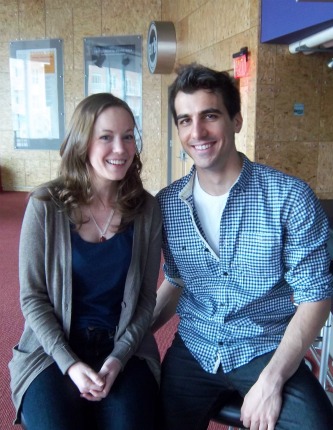
Bethany Anne Lind with Paul Downs Colaizzo
Lind hadn’t heard from him but, just before she was to return to Atlanta, she “just emailed him one more time just to see, and he said, ‘We’re actually having auditions in New York on Monday. We can see you there if you can come.’”

So, Lind explained, “I took the bus up to New York, read the script on the way there, just loved it and auditioned -- and here I am.”

Colaizzo, who wrote the play, interjected to point out that the character of Leigh was transformed once he and Gardiner saw Lind audition.

“We may have thought we knew who the character of Leigh was, before Bethany came in to audition,” the playwright said, “but she also taught us who the character was, in an audition that was magnetic.”

That magnetism, he explained, “has transferred into her work in this play.”

Lind appreciates being part of a world premiere.

“It’s always fun working on it with the playwright in the room,” she said. “I feel like we inform each other on the character. It’s just exciting to be part of that part of the development of the play and the character.”

Performances of Really Really run through March 25, 2012. Show times are Tuesdays and Wednesdays at 7:30 pm, Thursdays and Fridays at 8:00 pm, Saturdays at 2:00 pm and 8:00 pm, and Sundays at 2:00 pm and 7:00 pm.

Tickets range from $56 - $80 and are available by calling Ticketmaster at 703-573-SEAT (7328) or visiting www.signature-theatre.org. Student discount tickets are $30 and must be purchased the week of the performance. For more information please visit www.signature-theatre.org.
Be sure to visit my CafePress store for gifts and novelty items!
Read my blog on Kindle!
Follow my tweets on Twitter! 

Interview with Playwright Paul Downs Colaizzo

Signature Theatre’s press release announcing its next production, Really Really, begins like this:

“An elite university. A not-to-be-missed party. A startling accusation.”

Rumors have circulated that Really Really is loosely based on the Duke lacrosse case of 2006, but playwright Paul Downs Colaizzo is reticent about the plot.

When posed what The Metro Herald characterized as “a basic question: What’s your play about?,” Colaizzo hesitates.

“That’s actually not a basic question,” he replies.

“That’s actually proved to be a very hard question,” he explains. “When people ask me these questions, I tend to answer thematically because that, to me, is what the play is about but usually that’s not what people are looking for.”

Playwright Paul Downs Colaizzo at Signature Theatre
The reticence – or intrigue, depending on how one looks at it – extends to members of the cast, as well. During an interview with actress Bethany Anne Lind, she responds to a question about her character, Leigh, by looking over to Colaizzo shyly and saying, “I don’t know what I’m allowed to say.”

The intrigue may be uncovered after Really Really has its official opening on February 12, but in the meantime we will have to remain satisfied with the thematic background information that the playwright is willing to discuss.

Really Really is Colaizzo’s first professionally produced play, at the age of 26. He found his inspiration for the play, he says, in what he calls the “post-abortion generation” of people born since the U.S. Supreme Court’s 1973 decision in Roe v. Wade.

The post-abortion generation, he says, is “the most wanted generation in American history, because there was the option not to have us.”

The conscientious desire of that generation’s mothers and fathers to have offspring led to a lot of what is called helicopter parenting and the inculcation of self-esteem in children without regard to actual achievement or, as Colaizzo puts it, the idea that “everybody gets a trophy.” This, in turn, resulted in “an incredibly entitled and narcissistic generation that is sort of an anomaly in American life.”

Colaizzo describes “this period of time,” in which is own generation was brought up, as one that saw every child as “wanted and loved” and told that every one of them is “amazing, just for being them.”

When that generation reached young adulthood after being pampered during a period of economic abundance, they suddenly faced the economic crisis of 2008 and the recession and slowdown that followed. College graduates who expected a job immediately after graduation were sorely disappointed. Failure and the necessity to cope were new to them.

This situation, Colaizzo explained, led to a “divide” between those who really were resilient in the face of the challenge” of the economic downturn despite the “entitlement teachings” they grew up with, and “those who went the other way,” the ones “who live in their parents’ basements” and who accept the poor job market as a given and have given up looking for something better to do with their lives.

This is the background of Really Really but, Colaizzo asks rhetorically, “Will you see any of that in the play?” The answer is no.

The cast of Signature Theatre's 'Really Really'
The closest Colaizzo gets to describing what happens in his play is to say it “is about a rugby team. It takes place after a party on campus, the morning of the return from the party, and [during] the next two days that follow.”

In the course of the play, “the truth of what happened at the party comes into question. It becomes every man for himself,” in that “there’s suddenly a risk to each character’s future.”

The question is, Colaizzo concedes, “at what level will these characters and members of this generation go to protect [their futures] in an unpromising world [of] these days?”

In his own life, Colaizzo was born in Pittsburgh but his family moved around a lot as he was growing up. They lived in New Jersey and Florida and he went to high school in Georgia. When it was time for college, his parents moved to California while he went to New York University, where he studied drama.

After graduation with a BFA from the Tisch School of the Arts, he acted for two years but “wasn’t happy enough,” and that is when he “decided to switch my path to writing.”

His interest in “exploring social ideas in a dramatic way” was sparked by his encounter with Alan Ball’s work while he was in high-school. (Ball is the Oscar-winning screenwriter of American Beauty and creator of the TV series, Six Feet Under.)

Ball, he said, was writing about “the dark side of American life that wasn’t painted in this glittering-gold way that my conservative upbringing had led me to believe” was the normal way that people lived.

As a high-school student in Georgia, Colaizzo found that point of view “fascinating.”

That informs what Colaizzo enjoys about playwriting.

“My favorite thing about working on plays is,” he says, the way that he can “try to explore dichotomies in contemporary American life without pretension.”

He likes to hold “a mirror to the audience and say, What are you terrified of? What part did you relate to?”

He also likes to “explore unanswered questions or things that are a little scary to confront.”

Colaizzo compares his role as a playwright to that of a pet owner with a sick pet who needs medicine but refuses to swallow it.

“I call it the pill in the peanut butter,” he says, “because when you feed a dog a pill, you have to put it in peanut butter because the dog’s not stupid enough to just take the pill. So I have the pill that I really want to sell, but I have to put it in peanut butter,” so the audience will swallow it.

“The trickiest, and probably also the most fun part,” he explains, “is figuring out a way to explore these real human emotions and parts of our culture that are incredibly terrifying and put it in peanut butter so the audience can digest it and [be] willing to take it while also secretly getting the medicine.”

Colaizzo wrote the first draft of Really Really in 2007 and friends of his sent a copy to Matthew Gardiner, who is directing the production at Signature Theatre. In 2009, it had a reading as a work-in-progress at the Kennedy Center, where Gardiner saw it and recommended it to Signature’s founder and artistic director, Eric Schaeffer.

Schaeffer decided he wanted to produce the play but Colaizzo was skeptical. He asked, “Are you sure?” but, as Colaizzo reports it, Schaeffer replied: “Everyone is afraid of this play, and that’s why I want to do it.”

Colaizzo has nothing but praise for the way he has been treated at Signature. Schaeffer, Gardiner, and managing director Maggie Boland, he said, “have been so incredibly supportive,” urging him to make changes in the script only when the play demands them for artistic reasons and not simply to please audiences and make it more commercially acceptable.

He calls their attitude “unbelievably liberating” and “so I admire everything that they’ve done so far.”

Performances of Really Really run through March 25, 2012. Show times are Tuesdays and Wednesdays at 7:30 pm, Thursdays and Fridays at 8:00 pm, Saturdays at 2:00 pm and 8:00 pm, and Sundays at 2:00 pm and 7:00 pm.

Tickets range from $56 - $80 and are available by calling Ticketmaster at 703-573-SEAT (7328) or visiting www.signature-theatre.org. Student discount tickets are $30 and must be purchased the week of the performance. For more information please visit www.signature-theatre.org.

Be sure to visit my CafePress store for gifts and novelty items!
Read my blog on Kindle!
Follow my tweets on Twitter! 

Sunday, September 18, 2011

Twin Review: 'The Hollow' and 'The Boy Detective Fails'

On September 10, Tim Hulsey and I saw two world-premiere musicals at Signature Theatre in Arlington. Here is my review.


‘The Hollow’ Is Hollow; ‘The Boy Detective’ Not-Quite ‘Fails’
Rick Sincere
Metro Herald Entertainment Editor

Two world premiere musical plays at Arlington’s Signature Theatre are not only being presented in rotating repertory, they are virtually mirror images of each other in tone, theme, and interpretation of the material on which they are based.

The Boy Detective Fails, based upon a novel of the same name, takes dark themes – murder, suicide, mental illness – and presents them in cartoonish colors and bright lights at odds with the underlying source.

The Hollow, a reimagining of Washington Irving’s comic short story, “The Legend of Sleepy Hollow,” takes a well-known gothic satire and nearly empties it of its comedic base, with a dark, brooding set to match its new dark, brooding mood.

* * *
Ichabod Crane (Sam Ludwig). Photo: Scott Suchman. 
It is a stretch to say that The Hollow is little more than a musical retelling of the familiar Irving story. While the program says the play is "based on” the familiar story, it is more accurate to say that it was suggested (loosely) by characters and situations created by Washington Irving, because the end result bears little resemblance to Irving’s telling of the tale. (Irving’s story, set in 1820s Hudson Valley, New York, has no book burnings, no mute preachers, no rapes, no distant abandoned spouses – all elements invented for this stage production.)

The Hollow borrows a few familiar aspects of Irving’s original – a schoolteacher named Ichabod Crane, a mysterious “headless horseman,” and quirky Dutch-speaking villagers – but transforms them into a modern-day, period-costumed morality play about an American Taliban (or perhaps the Westboro Baptist Church) of intolerant ignoramuses who reject any knowledge not derived directly from the Bible. This sets up a clash with cheerful outsider Crane (he’s from Boston by way of Connecticut) who, like Socrates before him, corrupts the minds of Sleepy Hollow’s youth with such radical books as Gulliver’s Travels, Candide, and Thomas Paine’s The Rights of Man. Needless to say, Irving wrote nothing like this.

Despite the play’s fundamental flaws, there are solid performances by Sam Ludwig as Ichabod Crane, Whitney Bashor as his love interest, Katrina Van Tassel, Harry Winter as Katrina’s father, Baltus, and Noah Chiet as 10-year-old Pieter Claassen. The rest of the cast, unfortunately, plays into the overwrought script and offers little more than two-dimensional caricatures of religious zealots who would sooner burn down the village schoolhouse than allow their children to learn.

Composer-lyricist Matt Conner’s score includes two excellent musical numbers: Katrina’s song of yearning about “Boston” and a trio called “Perhaps” for Ichabod, Katrina, and Pieter, in which they permit their imaginations to run wild. (Something, it seems, that is forbidden in Sleepy Hollow.)

The agitprop tone of Hunter Foster’s deeply flawed book is matched by Matthew Gardiner’s direction while the sets by Derek McLane and costumes by Kathleen Geldard almost make this ill-begotten enterprise worth watching.

* * *

The Boy Detective Fails, though still flawed, succeeds where The Hollow falls short. Even though the main character (Billy Argo, played by Signature regular Stephen Gregory Smith) suffers from OCD or ADHD or Asperger’s Syndrome – it’s never made clear what, exactly, is wrong with him – he comes across as a likable fellow whom the audience wants to cheer on.

Thomas Adrian Simpson & Stephen Gregory Smith.  Photo: Scott Suchman.
Not being familiar with the original source material, it seems that the opening numbers, “Prologue” and “Billy Argo, Boy Detective,” condense what must be about a third of the original novel into a 12-minute expository musical scene. While composer-lyricist Adam Gwon tries to follow the dictum of “show, don’t tell,” the scene has too much “show and tell” – where the Greek chorus describes what the principal characters are doing, as they do it.

If anyone steals the show, it has to be Thomas Adrian Simpson as Professor Von Golum, Billy’s longtime adversary. Von Golum gets three novelty numbers that are quite the highlights of the show: “Old Friends” and “No Such Thing,” both duets with Billy, as well as “Evil,” a scenery-chewing delight he shares with the ensemble.

Billy also gets two affectionate songs with his equally shy romantic partner, Penny Maple (Anika Larsen), “I Like (The Secret Song)” and “Little Mysteries.”

The colorful physical environment created by scenic designer McLane, costume designer Geldard, and lighting designer Chris Lee helps to overcome any of the show’s minor shortcomings. They take full advantage of the expansive stage available to them.

If The Boy Detective Fails has any fundamental flaw, it is that at the end of the show, there is no sense of resolution. The problem is, this is precisely what the librettist – Joe Meno, who also wrote the original novel – seems to intend. That the audience leaves the theatre feeling unsettled and alienated may provide some artistic satisfaction to the creators is really no consolation to the people who bought tickets expecting to see the various plot strands arrive at a logical terminus.

That said, director Joe Calarco’s staging for The Boy Detective Fails – lightheartedly at odds with the central themes of the piece – works precisely because of the juxtaposition. Gardiner’s direction of The Hollow, in contrast, is too earnest by half. Their choices explain the general success of The Boy Detective Fails and the ultimate hollowness of The Hollow.

With a few tweaks to the script (perhaps including some judicious cuts of about 20 minutes of its playing time), as well as a more definitive ending, The Boy Detective Fails might have a life beyond this debut production at Signature Theatre. To salvage The Hollow, however, will require a total overhaul. As currently conceived, the play has little worth saving.

The Hollow and The Boy Detective Fails were commissioned through Signature Theatre’s American Musical Voices Project (AMVP). Both shows continue in rotating repertory through October 16 in The MAX, Signature’s larger performance space, at 4200 Campbell Avenue (Shirlington Village) in Arlington, Virginia. For ticket information, visit the theatre’s web site at www.signature-theatre.org or call the box office at 703-820-9771.


Be sure to visit my CafePress store for gifts and novelty items!
Read my blog on Kindle!
Follow my tweets on Twitter! 

Wednesday, April 06, 2011

Guest Blogger: Tim Hulsey Reviews 'And the Curtain Rises'

Tim Hulsey, who recently completed a quest to see all of Shakespeare's plays performed on stage over a five-year period, accompanied me to the press performance of Signature Theatre's new production, And the Curtain Rises, the third in a series of original musicals commissioned by the American Musical Voices Project.

Here is Tim's review of And the Curtain Rises for The Metro Herald:


Signature Premieres ‘And the Curtain Rises’:
An Honorable Failure with Breathtaking Music
Tim Hulsey
Special to The Metro Herald

The world-premiere musical And the Curtain Rises, playing through April 10 at Signature Theatre in Arlington, is far from a great – or even a good – show. At the moment, it's an immensely promising rough draft, with some amusing knockabout comedy, a sweetly predictable central romance, and an uncommonly good musical score.

Unfortunately, the show also has a leaden, unfocused first act that sinks the story before it can properly begin. Many shows have “second-act trouble,” but And the Curtain Rises may be the only show I've ever seen with “first-act trouble.”

Playwright Michael Slade, composer Joseph Thalken, and lyricist Mark Campbell have combined forces – with varying degrees of success – to tell the story of The Black Crook, the 1866 song-and-dance spectacular that many scholars believe was the forerunner of American musical comedy.

Slade has clearly done his homework researching the period, cramming the book with references to 19th-century cultural arcana. Yet he seems uncertain about the story he wishes to tell. Campbell's lyrics are frequently marred by banality and triteness, as he invokes tried-and-true sentiments that showbiz folks are “family.”

Thalken, however, emerges from this show as a major new presence in American musical theater, providing an innovative, emotionally resonant musical score that invokes the best Broadway traditions while forging ahead with fresh-sounding melodies and compelling harmonies. (It doesn't hurt that Signature Theatre has graced this score with a lush fourteen-piece orchestra, which director Kristin Hanggi shows off at every possible opportunity.)

Thalken's score, glorious as it is, is yoked to the most clichéd of inside-showbiz plots: First-time producer William Wheatley (Nick Dalton) attempting to stage a hopelessly hackneyed drama written by pretentious Civil War army buddy Charles Barras (Sean Thompson). With the help of his over-the-hill leading lady Millicent Cavendish (Rebecca Watson), a ragtag group of actors, and a stranded crew of French ballerinas, Wheatley has less than two weeks to turn a surefire flop into the toast of New York. Anyone who doubts the outcome for even a split second has probably never heard of Mickey, Judy, or the old phrase “let's put on a show.”

This story has been told once before as a musical, in the 1954 Sigmund Romberg flop The Girl in Pink Tights. (The title comes from a theater legend in which French ballet dancers turned The Black Crook into a full-blown succès de scandale by dancing in pink tights that resembled bare skin under the limelight.) Perhaps in an effort to avoid cliché, the creators of And the Curtain Rises have chosen to present the genesis of The Black Crook as an ensemble piece, with several possible storylines vying for attention and no clear protagonist.

The entire first act feels diffuse and unsettled, rather like a Robert Altman film, though without Altman's subtle technique for bringing different scenes and stories into a narrative framework. A gay subplot between an underemployed composer (Brian Sutherland) and an elderly aspiring classical actor (Erick Devine) feels both extraneous and wrong for the period, as do the various entanglements of a scheming, manipulative, sexually promiscuous ballerina (Anna Kate Bocknek).

Although the second act is clearly focused and much tighter than the first, unresolved strands from the first act frequently intrude and distract from the main story. And, as one might expect, budgetary constraints prevent Signature Theatre from displaying Wheatley's most extravagant scenic effects, such as live flames and a waterfall. Even the infamous pink tights get short shrift, as a sort of coda that winks at the earlier musical that told the same story.

As William Wheatley, Nick Dalton is disappointingly bland. His second-act solos “Think ...” and “Stay“ allow him to show off his pleasant baritone, but for the most part, Dalton reacts to more colorful supporting characters instead of steering the action. Rebecca Watson makes a firmer impression as Wheatley's leading lady, and Thalken gives her a doozy of an eleven-o'-clock number with “Enter Love.”

No backstage drama would be complete without a mustache-twirling ham to play the villain, and although And the Curtain Rises breaks with tradition somewhat by assigning the role to a playwright, Sean Thompson fills it marvelously. His comic solo “The Words” is one of the few bright spots in a dismal first act. But supporting actress Alma Cuervo, as the headmistress of a French ballet troupe, seems to find the show's true heart, with her winningly low-key rendition of the show's inspirational anthem, “A Little Pretend.”

At a time when American theaters are overrun with jukebox shows and kitschy spectaculars, any attempt to revive or rejuvenate the Broadway musical is welcome, and a story about the origins of musical comedy might not be such a bad place to begin anew. Unfortunately, And the Curtain Rises is not the right story, nor indeed is it much of a story at all. Although the show must be judged a failure, it is at least an honorable one, with lofty ambitions and some breathtakingly beautiful music.

And the Curtain Rises (directed by Kristin Hanggi; book by Michael Slade; music by Joseph Thalken; lyrics by Mark Campbell) began previews on March 17, with an official opening on March 29. Performances continue through April 10. Show times are Tuesdays and Wednesdays at 7:30 pm, Thursdays and Fridays at 8:00 pm, Saturdays at 2:00 pm and 8:00 pm, and Sundays at 2:00 pm and 7:00 pm.

Tickets range from $55 - $81 and are available by calling Ticketmaster at (703) 573-SEAT (7328) or visiting www.signature-theatre.org. Group discounts are available for parties of ten or more by contacting Bethany Shannon at shannonb@signature-theatre.org or by calling (571) 527-1831. For more information please visit www.signature-theatre.org.
Photographs:

Top left - Erik Altemus (as George C. Boniface) appeals to Rebecca Watson (as Millicent Cavendish) in And the Curtain Rises. At Virginia's Signature Theatre through April 10, 2011.

Center right - Nick Dalton (as William Wheatley) shows his theatre company how to ward off evil demons in And the Curtain Rises. At Virginia's Signature Theatre through April 10, 2011.

Bottom left - Alma Cuervo (as Mme. Grimaud) speaks on behalf of her French Ballet Troupe in And the Curtain Rises. At Virginia's Signature Theatre through April 10, 2011.

All photos by Scott Suchman; courtesy of Signature Theatre: www.signature-theatre.org.
Be sure to visit my CafePress store for gifts and novelty items!
Read my blog on Kindle!
Follow my tweets on Twitter! 

Sunday, March 27, 2011

An Interview with ‘And the Curtain Rises’ Playwright Michael Slade

Tonight is the press preview of And the Curtain Rises, a new musical at Signature Theatre in Arlington, Virginia. Here is an interview with the show's playwright, Michael Slade, which I wrote for The Metro Herald.

Recreating the Birth of the American Musical Theatre:
An Interview with ‘And the Curtain Rises’ Playwright Michael Slade
Rick Sincere
Metro Herald Entertainment Editor

The curtain rises officially on And the Curtain Rises, a new musical at Signature Theatre in Arlington, on Tuesday, March 29.

The play tells the story of The Black Crook, a spectacular originally produced in 1866 that is often identified as the first American musical play. At a time when a run of two or three weeks was considered exceptionally long, The Black Crook was such a sensation that it had 475 performances in its first run, plus two revivals in 1870-71 and 1871-72 totaling 193 performances, according to the Internet Broadway Database (ibdb.com).  It also toured the country for years.

The story of The Black Crook has been told once before on the musical stage, in The Girl in Pink Tights by composer Sigmund Romberg, lyricist Leo Robin, and librettists Jerome Chodorov and Joseph Fields. The Girl in Pink Tights took its title from the phenomenon that made The Black Crook so racy: under the sharp limelight, the pink tights on the dancing girls made their legs look nude, a shocking sight in the 1860s.

The Girl in Pink Tights had a tepid run of 115 performances over three months in 1954, but it marked the Broadway debuts of Maurice and Gregory Hines, who were then 11 and 9 years old, respectively, and featured in its cast Marni Nixon, later known for her dubbing the silver-screen singing voices of Deborah Kerr in The King and I, Natalie Wood in West Side Story, and Audrey Hepburn in My Fair Lady.

Signature’s take on The Black Crook is part of its American Musical Voices Project, which has previously commissioned the new musicals Giant (by Michael John LaChiusa and Sybille Pearson) and Sycamore Trees (by Ricky Ian Gordon and Nina Mankin).

The creative team behind And the Curtain Rises consists of director Kristin Hanggi, composer Joseph Thalken, lyricist Mark Campbell, and playwright Michael Slade, who spoke at length with The Metro Herald about the project, its origins, and the production process.


From actor to playwright
Slade is a New Yorker by birth, having grown up in Syosset, Long Island, and earning a BFA in theatre from Ithaca College. Although he always had a love of writing dating from his childhood, he began his career as an actor, appearing in “hundreds of commercials, a couple of TV pilots, a couple of national tours, and a couple of off-Broadway plays,” he said.

'And the Curtain Rises' playwright Michael Slade / Photo courtesy Signature Theatre
Growing tired of the business of acting – with the many cattle-call auditions, quickly-disappearing jobs, and all the stresses and strains of the profession – Slade, with the encouragement of friends, turned increasingly to writing even though his “agents were disappointed.”

His first play, a one-act called Thanksgiving, was produced by the Manhattan Class Company (now the MCC Theater at The Lucille Lortel Theatre) in New York about 20 years ago.

“It was a wonderful, wonderful production and I got a lot of notice from it from people and that was a great experience,” he explained.

“That was validation for me,” he said, because until a play is performed on stage by actors, “it’s not fully finished.” This is unlike a novel or short story, which can be read in any form even if they are not published. “Production and performance are the components of a finished piece” of theatre, however.

After the success of his first play, Slade went on to write about ten “family musicals” for Theatreworks/USA including Superfudge, Lyle, Lyle Crocodile, The Great Brain, The Three Pigs, as well as a Radio City Music Hall production of Pokemon Live!. In addition, he has written teleplays for the long-running soap opera, Days of Our Lives, and was nominated for an Emmy Award for writing episodes of One Life to Live.

The idea of basing a musical on the making of The Black Crook originated with Joseph Thalken, whom Slade had met in New York. The two of them had been discussing possible projects to work on together for some time.

“It felt like a great match,” Slade said. “We both were intrigued with each others’ way of working. We started kicking around ideas.”

He reacted favorably to Thalken’s idea in part because, he explained, he had had “a theatre history professor who was obsessed with The Black Crook. I don’t know how many weeks of the semester he spent talking about the show.”

When Thalken received the commission from the American Musical Voices Project, they brought on Mark Campbell as lyricist and poured themselves into researching the story, the principal characters, and the era (post-Civil War New York City).

Campbell and Thalken had collaborated on some songs together, but not an entire score. “That felt like a really right third component in terms of personality,” Slade noted. “We jumped into the pool together.”


Beginning in the library
Since And the Curtain Rises is basically a piece of historical fiction, the writing process began with research trips to the library.

“I love the process of researching,” Slade said.

“I was not the best student in school, but afterwards I discovered how much fun research was. One can do almost everything on line these days but there’s something about going places and handling real books and articles.”

To find those “real books and articles,” Slade said he “spent a good deal of time at the New York Public Library for the Performing Arts at Lincoln Center. I read first person accounts by people who were involved in original production. No two told the same story,” which added a twist to the creative process.

“We really didn’t want to write a docudrama. We were more interested in fictionalizing the story and using elements from it but really telling the story we wanted to tell about collaboration and how the theatre builds audiences and artists,” he explained.

“We decided very early on that what we would be doing is taking a lot of the facts and using our own imaginations to create and imagine what was going on at the time.”

Slade found more documents and artifacts at the New York Historical Society, which he calls “amazing.”

He found out less there about The Black Crook itself “than about the times,” the 1860s and ‘70s.

The historical society has “a whole collection of menus from restaurants of those years. There were accounts in newspaper articles about those immediate post-Civil War years in New York -- what people did, where they went, how they interacted.”

Slade was not unfamiliar with the era, having previously written about Ned Buntline, the creator of the dime novel and inventor of a gun known as the Buntline Special.

Buntline, Slade explained, had been involved in the Astor Place riots, a now-obscure episode in American history in which fans of rival actors (one British, one American) each playing Macbeth, showed their support through violent demonstrations. “There were literally riots as Americans stormed the theatre” where the British actor was performing, riots stimulated by xenophobia. There were, according to Slade, “cannons in the streets” brought out to quell the demonstrators.

A lot of “the passion about theatre at the time,” Slade said, “was stirred up by Know Nothing Party. The public perception is that it was all about the passion about who was starring in shows in New York,” but as in the culture wars today, politics was not far beneath the surface.

In addition to what he found in libraries, at the historical society, and the Museum of the City of New York, Slade discovered “a wonderful online site about 19th century actors and actresses and about what their lives were like.”


The collaborative process
Early in the process, all three collaborators did research individually and got together to talk. At about the same time, Campbell had been working on a song cycle set in the Civil War.

“I don’t think we started to put anything on paper for the first six months,” Slade said, immersing themselves in the material, and asking themselves “who were the characters, and what were we trying to say?”

After this initial period, “we started writing,” Slade said, explaining that “the way I like to work is, having hashed things out together, I came out with a fairly strong treatment, where we’d already talked about certain places where there’d be songs. Then I wrote a messy first draft of the script where there might be long monologues or overwritten scenes that could be turned into songs.”

Eventually, he said, came the tailoring and incorporating the two.

Working with his collaborators, Slade said, has “been really fearless. It’s been a really terrific collaboration. There’s been great respect between the three of us since day one. We all have been willing to really listen and take it to heart. Sometimes we have an argument but it’s been a healthy and positive collaboration that has continually made the piece better and better.”

While Thalken decided to listen to the score of the earlier musical, The Girl in Pink Tights, Slade chose to stay away from it.

“I made a distinct choice not to listen because I didn’t think it would help. I didn’t want something to unconsciously come into this play.”

In contrast to The Girl in Pink Tights, “our piece is much bigger” and more ambitious.

“I really think about this piece as a Robert Altman movie. We’ve got 16 characters with lives on stage and off. We tell our story through all of them.” And besides, Slade noted, The Girl in Pink Tights “was not a big hit” – something not desired, naturally, for And the Curtain Rises.


Historic but ‘unproducible’
For all of its legendary status, The Black Crook could not be produced today.

It was, Slade discovered, “scheduled for a third revival within the past 50 years. But they realized it’s unproducible. The original production was back in the day when you could have hundreds of people on stage because you weren’t necessarily paying them all.”

What’s more, the original production’s stagecraft was unprecedented.

“British designers came in and brought on scenic events like nothing before seen on stage. There were fires of hell, a waterfall, and a lake with boats floating on it -- not to mention the March of the Amazons.” It would, Slade pointed out, “be cost prohibitive today.”

Yet despite all the special effects, the crew consisted of “a bunch of ex-sailors pulling ropes.”

Neither was The Black Crook a very good play.

Instead, Slade noted wryly, “it’s almost deliciously bad. It borrows from melodrama and Shakespeare and Faust, all thrown into one. What made it its enormous success was the spectacle and the girls’ legs” in those notorious pink tights.

While Slade and his partners were developing the show, a staged reading of what became And the Curtain Rises was put on at the Human Race Theatre Company in Dayton, Ohio. By coincidence, “there’s an old theatre in Dayton that had been a stop on The Black Crook tour,” which traveled around the country “for decades.” While the tour did not have all of the amazing special effects of the original production, “it was a fair approximation of what had played in New York.”

Coming upon that old Dayton theatre was amazing in itself, Slade said, because the 19th century “was a perilous time for theatres, since they were wood structures using flames as lights.”

As a matter of fact, the legend goes, the way The Black Crook came together was when a theatre hosting a troupe of Parisian ballet dancers burned down and its manager lent them to William Wheatley, The Black Crook’s producer.


Changing the name
Wheatley’s pivotal involvement explains the originally announced title of And the Curtain Rises: “Wheatley’s Folly.”

This was, Slade noted, “a working title but we weren’t in love with it. It always felt like it took a lot of explaining.”

Change came when Kristin Hanggi was added on to the team as director. She asked if they could come up with a better title, so they considered alternatives.

“’And the Curtain Rises’ is the name of the finale in our show,” Slade continued, “and one day we said, ‘How about that? It talks to everything we’re doing here.’”

They took the proposed change to the leadership at Signature, who “graciously” agreed to it, even though the company had “printed quite a bit of promotional material with they other title. They said: ‘We’ll take care of it,’” and they did.

Slade is effusive with his praise of Signature Theatre itself.

“Signature and Maggie Boland and particularly Eric Schaeffer have been incredible with this,” he said.

“They’ve also been incredible in that we did two readings of it with Eric as director in New York. At one point, he said, it needs another character, it needs a stagehand.

“‘Eric,’ I said, ‘I completely agree, but we’ve already got 15 actors. It costs money.’”

But Schaeffer replied, “‘It’s right for the show. Don’t worry about it.’”

Slade explained: “You so seldom hear that. More often it’s, ‘Can you cut three of the characters?’” Yet Signature is going full-bore with this production.

“We have a fourteen piece orchestra,” Slade gushed. “I’m told that the revival of How to Succeed, with Daniel Radcliffe, doesn’t have 14 pieces. I’ve heard it has just 12, For Signature to give us a fourteen-piece [musical ensemble] is amazing and --because of the intimacy of the space -- it’s just terrific.”

And the Curtain Rises (directed by Kristin Hanggi; book by Michael Slade; music by Joseph Thalken; lyrics by Mark Campbell) began previews on March 17, with an official opening scheduled for March 29. Performances continue through April 10. Show times are Tuesdays and Wednesdays at 7:30 pm, Thursdays and Fridays at 8:00 pm, Saturdays at 2:00 pm and 8:00 pm, and Sundays at 2:00 pm and 7:00 pm.

Tickets range from $55 - $81 and are available by calling Ticketmaster at (703) 573-SEAT (7328) or visiting www.signature-theatre.org. Group discounts are available for parties of ten or more by contacting Bethany Shannon at shannonb@signature-theatre.org or by calling (571) 527-1831. For more information please visit www.signature-theatre.org.


Be sure to visit my CafePress store for gifts and novelty items!
Read my blog on Kindle!
Follow my tweets on Twitter!