This movie review appeared in The Metro Herald in August 1996:
Cosmic Voyage: Ride of the New Millennium
Rick Sincere
Metro Herald Entertainment Editor
A new film in the tradition of To Fly and The Blue Planet has opened at the Langley Theatre at the National Air and Space Museum. Called Cosmic Voyage, this IMAX film will give you the ride of your life.
Morgan Freeman (c) 2006 Rick Sincere
Narrated by award-winning actor Morgan Freeman, Cosmic Voyage takes its audience from inside the smallest atom in a drop of water to the outer reaches of the known universe. Using the latest scientific calculations and most current computer animation technologies, Cosmic Voyage offers a seamless blend of live-action and animation.
Cosmic Voyage premiered on August 8 as part of the Smithsonian Institution's 150th anniversary celebrations. As Dennis O'Connor, the Smithsonian's provost, put it, Cosmic Voyage is the Air and Space Museum's "candle for the Smithsonian's 150th birthday cake."
Last month, the Air and Space Museum marked the 20th anniversary of To Fly, one of the most popular IMAX offerings. According to Don Engen, director of the museum, To Fly has been seen by 13 million people in the Langley Theatre. Like Destiny in Space, its predecessor film that opened two years ago, Cosmic Voyage is what astronauts like to call "the next best thing to doing it."
Engen added that Cosmic Voyage was made with an audience of middle- and high-school students in mind, a view echoed by Gary Tooker, president of the Motorola Foundation (which financed the making of the film). Tooker told the opening night audience that "our future depends on nurturing the young minds interested in science and engineering, because that's the future of our company." He said that he and his colleagues at Motorola hope "people will be stimulated to think about the universe and the role we play in it."
Anyone seeing this film will, in fact, be struck by our tininess in comparison to the vastness of the universe -- and how big we humans are in comparison to protozoa and the atoms, electrons, and quarks that are the building blocks of all matter. Bayley Silleck, director of Cosmic Voyage, noted that the film's creative process was a "two-year adventure" that instilled "a sense of humility about our place in the universe."
It may be difficult, during the summer tourist season, to see Cosmic Voyage. Lines will no doubt be very long. If you want to experience the adventure, however, clip this article and pull it out sometime in January or February. I can't imagine a better antidote to mid-winter blues than participating in Cosmic Voyage's 35-minute roller-coaster ride. (Actually, I can: George Lucas has announced that his Star Wars trilogy will be re-released over President's Day weekend -- all three films to be screened in one day, with added special effects and new scenes. But until then, Cosmic Voyage deserves a visit.)
Cosmic Voyage is that rare blend of short films -- both educational and entertaining. This is a family movie, appropriate for children and adults of all ages.
The complete Cosmic Voyage, directed by Bayley Silleck and narrated by Morgan Freeman, has been uploaded to YouTube:
Sheep are surprisingly smart. New research from the University of Cambridge shows the animals can learn to recognise people from photographs, even people they’ve never seen in real life, such as celebrities.
The researchers tested the sheeps’ recognition abilities using images of famous people including Barack Obama, actors Emma Watson and Jake Gyllenhaal, and UK newsreader Fiona Bruce. While this is an amusing way to demonstrate what sheep can do, the research could actually have serious uses.
Shutterstock
For one thing, increasing our understanding of sheep’s perceptual abilities could be used to argue for improved animal welfare. But sheep are also being used as models for understanding brain disorders such as Huntingdon’s disease and Parkinson’s disease, along with psychiatric disorders such as autism and schizophrenia. So learning more about their cognitive capacities could aid the work in this field.
In 2001, the Cambridge team showed that sheep could discriminate between photos of familiar sheep and humans and respond to the emotions portrayed in these photos. But they wanted to see whether sheep could actually recognise the people rather than just memorise familiar photos.
They used a computer screen to show eight Welsh mountain sheep the celebrity pictures, and then used food rewards to train the animals to select these familiar faces from a wider selection of pictures of other people and objects. The sheep could recognise the celebrities even though they had never met them personally and had only been introduced to a face-on photo. Incidentally, the sheep didn’t appear to have a preference for Emma, Barack, Fiona or Jake.
To see if the sheep were actually recognising people, rather than just memorising certain images, the researchers showed them photos of the celebrities taken from different angles. The sheep were able to correctly identify the celebrity 80% of the time, dropping to 66% for photos taken at a different angle. This compares to rates of 90% and 76% in humans.
This is an enviable record for the sheep given that they are recognising the faces of another species. (How many humans could recognise different sheep from their photos?) This sound scientific set-up was also able to time the sheep’s responses, showing they appeared as confident whether looking at the face in the same position as the original photo or from a different angle.
There was one final surprise for the sheep. After proving they could recognise faces of people they’d never met from two-dimensional photos, the sheep were shown pictures of their regular human handler. Although they hadn’t been trained to recognise these images, they selected them over the unfamiliar photos anyway.
Smart sheep
I was asked if, as an Ig Nobel laureate myself, I thought this recent Cambridge sheep study would be a contender for an Ig Nobel award, the prize for science that “first makes you laugh, then makes you think”. Celebrity-spotting sheep might sound funny but the science involved in this study actually isn’t sniggerable.
First it makes an interesting contribution to animal science, showing sheep have much greater cognitive abilities than many people realise. This includes farmers, who often manage hundreds of animals with little actual contact, in the presence of dogs and during unpleasant experiences such as worming or shearing. This means sheep are usually at their least composed around humans, without the inclination to show off their impressive cognitive capacities.
My own work and that of colleagues in Scotland has found that ewes can identify pain in their lambs who have undergone tail docking or castration. Another recent study demonstrated that it is possible that sheep have a sense of self and can recognise themselves in a mirror – something we only know is possible in very few species, including chimpanzees, dolphins, elephants and magpies.
Learning more about sheep’s cognitive abilities could also feed into work on using their brains to study neurological conditions in humans. We know that the neural networks that sheep’s brains use for face perception are similar to those used by human brains. That means that we might be able to use sheep to test treatments for human diseases where patients lose the ability to recognise faces or emotions, such as Huntington’s disease.
If sheep were on the Ig Nobel judging panel, they would laugh at the idea that people are surprised at their abilities. (And we know that animals really can laugh. And they might also be interested to know that Ig Nobel prizes have been awarded for studies showing many human identical twins cannot tell themselves apart visually. Or that humans with an itch on the left side of their body, can relieve it by looking into a mirror and scratching their right side. This research suggests that actually humans aren’t as good at visual recognition as we perhaps think.
Kids are often told that you can’t judge a book by its cover.
Even so, people often believe they can rely on their gut to intuit things about other people. Stereotypes often influence these impressions, whether it’s that a black man is dangerous, a woman won’t be a good leader or a fashionable man is gay.
Stereotypes related to gay men and lesbians often operate under the guise of “gaydar” rather than stereotyping. “Gaydar” (a portmanteau of “gay” and “radar”) is a term that first appeared in the 1980s and refers to a “sixth sense” for identifying who is gay. Like many purported intuitions, however, gaydar often relies on stereotypes.
While many people believe stereotyping is wrong, calling it “gaydar” merely provides a cover for using stereotypical traits – like someone’s fashion sense, profession or hairstyle – to jump to conclusions about someone being gay. Nonetheless, some researchers have published studies that, at first glance, appear to show that people have accurate gaydar.
In some recent work, my colleagues and I have been able to demonstrate how the perpetuation of the gaydar myth has unintended negative consequences. We’ve also identified a mathematical flaw in some previous gaydar research, calling into question the results.
Stereotyping in disguise
My colleagues and I suspected that even people who would normally try to refrain from stereotyping might be more likely to use gay stereotypes if they are led to believe they have gaydar.
To test this idea, we conducted an experiment. We told some participants that scientific evidence says gaydar was a real ability, led others to believe that gaydar is just another term for stereotyping and said nothing about gaydar to a third group (the control).
Participants then judged whether men were gay or straight based on information ostensibly taken from social media profiles. Some of the men had interests (or “likes”) that related to gay stereotypes, like fashion, shopping or theater. Others had interests related to straight stereotypes, like sports, hunting or cars, or “neutral” interests unrelated to stereotypes, like reading or movies. This design allowed us to assess how often people jumped to the conclusion that men were gay based on stereotypically gay interests. Those who were told gaydar is real stereotyped much more than the control group, and participants stereotyped much less when they had been told that gaydar is just another term for stereotyping.
These patterns provided strong support for the idea that belief in gaydar encourages stereotyping by simply disguising it under a different label.
What’s the big deal?
In some ways, the idea of gaydar – even if it’s just stereotyping – seems useful at best and harmless at worst. But the very fact that it seems harmless may actually be responsible for its most pernicious effects. Using gaydar as a way to talk innocuously or jokingly about stereotyping – “Oh, that guy sets off my gaydar” – trivializes stereotyping and makes it seem like no big deal.
But we know that stereotypes have many negative consequences, so we shouldn’t be encouraging it on any level.
First, stereotyping can facilitate prejudice. In a study on prejudice-based aggression, we had participants play a game that involved administering electric shocks to a subject in the other room. Participants learned only one thing about this other person, either that he was gay or simply liked shopping (people tend to assume men who like shopping are gay).
In one condition, therefore, the participants knew that the man was gay and in the other they might have privately inferred that he was gay though it wasn’t confirmed, but that wasn’t known to anyone else (who might have accused them of being prejudiced).
These conditions are especially important for a subset of people who are covertly prejudiced: They’re aware that they’re prejudiced and ok with it, but don’t want others to know. We can identify these people with some well-established questionnaire measures, and we know that they express prejudice only when they’re able to get away with it.
As we predicted, these covertly prejudiced people tended to refrain from shocking the man who was confirmed as gay, but delivered extremely high levels of shocks to the man who liked shopping. If they had shocked the first man, people could accuse them of prejudice (“You shocked him because he was gay!”). But if others accused participants of prejudice in the second condition, it could be plausibly denied (“I didn’t think he was gay!”). In other words, stereotyping can give people opportunities to express prejudices without fear of reprisal.
Second, stereotypes – even innocuous ones – are troublesome for a number of reasons: They lead us to think narrowly about people before we get to know them, they can justify discrimination and oppression, and, for members of stereotyped groups, they can even lead to depression and other mental health problems. Encouraging stereotyping under the guise of gaydar contributes – directly or indirectly – to stereotyping’s downstream consequences.
But what if gaydar is actually accurate?
Some researchers say that stereotypes about gay people possess a grain of truth, which could lend credence to the idea of having accurate gaydar.
In these studies, researchers presented pictures, sound clips and videos of real gay and straight people to the participants, who then categorized them as gay or straight.
Half of the people in the pictures, clips and videos were gay and half were straight, which meant that the participants would demonstrate an accurate gaydar if their accuracy rate were significantly higher than 50 percent. Indeed, participants tended to have about 60 percent accuracy, and the researchers concluded that people really do possess an accurate gaydar. Many studies have replicated these results, with their authors – and the media – touting them as evidence that gaydar exists.
Not so fast…
But as we’ve been able to show in two recentpapers, all of these previous studies fall prey to a mathematical error that, when corrected, actually leads to the opposite conclusion: Most of the time, gaydar will be highly inaccurate.
How can this be, if people in these studies are accurate at rates significantly higher than 50 percent?
There’s a problem in the basic premise of these studies: Namely, having a pool of people in which 50 percent of the targets are gay. In the real world, only around 3 to 8 percent of adults identify as gay, lesbian or bisexual.
What does this mean for interpreting the 60 percent accuracy rate? Think about what the 60 percent accuracy means for the straight targets in these studies. If people have 60 percent accuracy in identifying who is straight, it means that 40 percent of the time, straight people are incorrectly categorized. In a world where 95 percent of people are straight, 60 percent accuracy means that for every 100 people, there will be 38 straight people incorrectly assumed to be gay, but only three gay people correctly categorized.
Therefore, the 60 percent accuracy in the lab studies translates to 93 percent inaccuracy for identifying who is gay in the real world (38 / [38 + 3] = 92.7 percent). Even when people seem gay – and set off all the alarms on your gaydar – it’s far more likely that they’re straight. More straight people will seem to be gay than there are actual gay people in total.
If you’re disappointed to learn that your gaydar might not operate as well as you think it does, there’s a quick fix: Rather than coming to a snap judgment about people based on what they wear or how they talk, you’re probably better off just asking them.
The year 2017 marks the 50th anniversary of the home microwave oven. The ovens were first sold for home use by Amana corporation in 1967, but they had actually been used for commercial food preparation since the 1950s. It wasn’t until 1967, however, that technology miniaturization and cost reductions in manufacturing made the ovens small enough and cheap enough (a still steep US$495; US$3,575 in 2017 dollars) for use in the kitchens of the American middle class. Now, it would be hard to find a U.S. home without a microwave.
Amana, a subsidiary of Raytheon corporation, actually called their first model the “Radarange” – a contraction of radar and range (as in stove). What do microwave ovens have to do with radar?
Radar is an acronym for “radio detection and ranging.” Developed prior to World War II, the technology is based on the principle that radio waves can bounce off the surfaces of large objects. So if you point a radio wave beam in a certain direction, some of the radio waves will come bouncing back to you, if they encounter an obstruction in their path.
By measuring the bounced-back radio waves, distant objects or objects hidden from view by clouds or fog can be detected. Radar can detect planes and ships, but early on it was also found that rainstorms caused interference with radar detection. It wasn’t long before the presence of such interference was actually utilized to track the movement of rainstorms across the landscape, and the age of modern radar-based weather forecasting began.
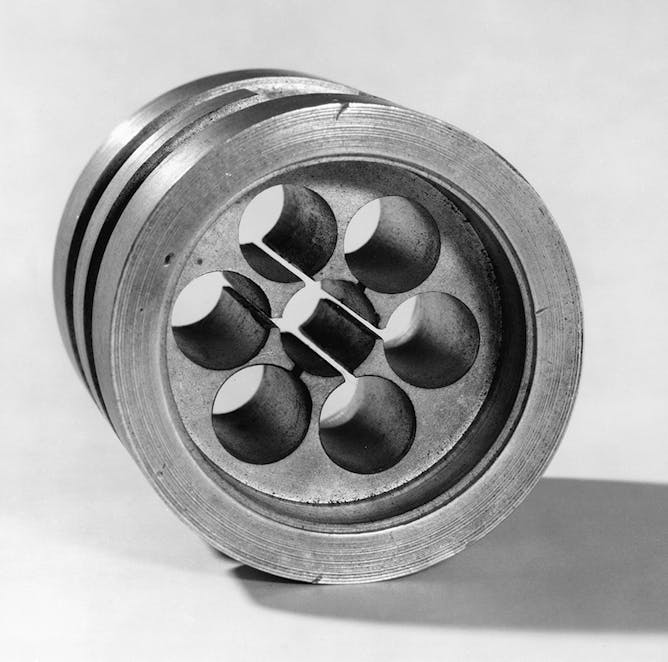
At the heart of radar technology is the “magnetron,” the device that produces the radio waves. During World War II, the American military couldn’t get enough magnetrons to satisfy their radar needs. So Percy Spencer, an engineer at Raytheon, was tasked with ramping up magnetron production. He soon redesigned the magnetron so that its components could be punched out from sheet metal – like sugar cookies are cut from dough – rather than each part needing to be individually machined. This allowed mass production of magnetrons, raising wartime production from just 17 to 2,600 per day.
One day, while Spencer was working with a live magnetron, he noticed that a candy bar in his pocket had started to melt. Suspecting that the radio waves from the magnetron were the cause, he decided to try an experiment with an egg. He took a raw egg and pointed the radar beam at it. The egg exploded from rapid heating. Another experiment with corn kernels showed that radio waves could quickly make popcorn. This was a remarkably lucky find. Raytheon soon filed for a patent on the use of radar technology for cooking, and the Radarange was born.
Amana Radarange commercial from 1976.
As time passed and other companies got into the business, the trademarked Radarange gave way to more generic terminology and people started calling them “microwave ovens,” or even just “microwaves.” Why microwaves? Because the radio waves that are used for cooking have relatively short wavelengths. While the radio waves used for telecommunications can be as long as a football field, the ovens rely on radio waves with wavelengths measured in inches (or centimeters); so they are considered “micro” (Latin for small), as far as radio waves go.
Microwaves are able to heat food but not the paper plate holding it because the frequency of the microwaves is set such that they specifically agitate water molecules, causing them to vibrate rapidly. It is this vibration that causes the heat production. No water, no heat. So objects that don’t contain water, like a paper plate or ceramic dish, are not heated by microwaves. All the heating takes place in the food itself, not its container.
Microwaves have never completely replaced conventional ovens, despite their rapid speed of cooking, nor will they ever. Fast heating is not useful for certain types of cooking like bread-baking, where slow heating is required for the yeast to make the dough rise; and a microwaved steak is no taste match for a broiled one. Nevertheless, as the fast-paced American lifestyle becomes increasingly dependent upon processed foods, reheating is sometimes the only “cooking” that’s required to make a meal. Microwave ovens’ uniform and rapid heating make them ideal for this purpose.
Over the years, there have been many myths associated with microwave cooking. But the truth is that, no, they don’t destroy the food’s nutrients. And, as I explain in my book “Strange Glow: The Story of Radiation,” you don’t get cancer from either cooking with a microwave oven or eating microwaved food. In fact, the leakage standards for modern microwave ovens are so stringent that your candy bar is safe from melting, even if you tape it to the outside of the oven’s door.
What’s the deal with metal in the microwave?
Nevertheless, you should be careful about microwaving food in plastic containers, because some chemicals from the plastic can leach into the food. And, yes, you shouldn’t put any metal in the microwave, because metallic objects with pointed edges can interact with the microwaves from the magnetron in a way that can cause electrical sparking (arcing) and consequently damage the oven or cause a fire.
The microwave oven has definitely transformed the way most of us cook. So let’s all celebrate the 50th anniversary of the home microwave and the many hours of kitchen drudgery it has saved us from. But if you want to mark the date with an anniversary cake, best not to cook it in your microwave – you’d likely end up with just a very hot and unappetizing bowl of sweet mush.
Picturesque and exotic, with their crowns and camels, the three kings regularly appear on Christmas cards and in nativity scenes. But how much is original, and how much is later addition for the sake of a good story?
All we know is what Matthew’s gospel tells us, and that does not include their number. They brought gifts of gold, frankincense and myrrh, but to suppose that three gifts means three givers is no more than a guess. More importantly, they were not kings. In his account Matthew consistently describes the visitors as magoi which is the same as the English word “mage”. It’s an unusual word and is often translated as “wise men”.
The early church upgraded them to royal status, perhaps because of descriptions in Isaiah 60 and Psalm 72 of kings worshipping the messiah – but Matthew himself, whose gospel is full of references back to the psalms and prophets, does not make this link, and he would never have let such an opportunity drop.
What they saw
They had seen a star, which shows they were astronomers – or astrologers as there was no difference back then. What was this star? Some scholars have posited that in 7BC there was a triple conjunction (when the planets catch up and overtake each other: quite a dramatic sight) of Jupiter and Saturn, in the constellation of Pisces. These three elements were linked in astrology to royalty, the messiah and the Jews respectively.
Some astronomers, for example Patrick Moore, are unhappy with this theory and suggest that the star the wise men followed was a nova, a comet, or meteors. But there is no firm evidence for any of these. They point out that conjunctions are rare but not unique, and ask why were there no emissaries to Israel on other occasions. Perhaps there were – we only have this single record because of its link to the larger story.
I think what really worries them is that if you accept this interpretation it implies accepting the validity of astrology, and today’s astronomers really hate astrologers (never ask an astronomer what their star sign is). But you don’t have to. Even the sceptical can accept that a visit to Jerusalem and Bethlehem by foreigners looking for the messiah would have made a good story which would be told and retold – and eventually get attached to the birth of Jesus. Matthew wrote his gospel for a Jewish readership, and the Jewish religion then was hostile to astrology, so the suggestion that he just made up the story as propaganda is implausible.
A familiar approach
We can imagine the situation. The star was not a surprise: conjunctions are predictable – today lists of upcoming ones are available on the internet – and even if this was not available 2,000 years ago, astronomers then made careful observations on which they could make predictions using geocentric theories which were fundamentally wrong but which nevertheless seemed to work.
Stonehenge astronomical observatory
For months and years beforehand the “wise men” will have discussed and organised the expedition: the practicalities, the funding. We know how they must have felt, planning a project, looking for money to pay for it, arguing whether their theory’s predictions were really firm or could have some other interpretation.
At this point we realise that we have a better word to translate magoi – a word not available to the translators of the Authorised Version of the Bible in King James’ reign, as it was only invented in 1833.
The word is scientists.
Looking back 2,000 years, they and we are not so different. They used their understanding of the universe to predict what would happen in the world – and, working as a group, they investigated their predictions, despite the cost and trouble and hardships. This is something any scientist today can recognise and identify with. Their understanding of the universe is crude and primitive in our eyes – but what will today’s scientific theories look like in 2,000 years time?
So, when we see pictures of the three kings at Christmas, we should spare them a thought, as colleagues who believed in their theories and followed through the consequences, despite the trouble and expense and personal effort involved. The strength of their conviction and their resolution to follow it, 2,000 years ago, can be an example to us today.
To the time-poor of the world: take heart, for 2016 is a generous year. Not only were you granted a leap day on 29 February, you will soon score a New Year’s Eve countdown bonus, a leap second, to hold off 2017 for a final sip or regret.
Whereas leap years add a day to align the calendar with the seasons, leap seconds align our everyday clocks with the Sun’s position in the sky, that is, with the Earth’s rotation.
Currently our planet takes roughly 86,400.00183 seconds (on average) to turn, instead of the expected 86,400 seconds you get by multiplying 24 hours by 60 minutes by 60 seconds. This may not sound like a great difference, but it amounts to a full second every 18 months. If left unchecked, it would become noticeable over time, and ultimately become problematic.
How did we get into this awkward situation? Why not just define a second so that there are exactly the right number? This sensible idea was tried in 1874, but hit a snag: the Earth keeps changing.
In terms of today’s standard SI second (defined via atomic physics), the above discrepancy is due to the fact that the day is losing about 0.0015 seconds per century, due largely to tidal friction.
Not only that, it also changes quite erratically due to mass redistribution.
For example, it is slowed by oceanic thermal expansion due to global warming, just as a playground spinning seat slows, via the conservation of angular momentum, when you place your body farther from the centre.
Leap seconds are used to make sure our usual timekeeping system, Coordinated Universal Time (UTC), never gets more than 0.9 seconds away from the Earth-tracking alternative, Universal Time (UT1).
But unlike leap years, leap seconds cannot be calculated centuries in advance. Because the Earth moves erratically, it must be observed closely, and leap seconds scheduled on an as-needed basis.
In UT1, seconds actually vary in duration, being stretched and compressed to match the Earth’s variations. In UTC, all seconds are standard SI seconds, which is much simpler, but it means that if you want to slow down or speed up UTC, there is no alternative but to jump.
All the leap seconds so far have been “positive”, meaning that an extra second is inserted, corresponding to jumping the clock back, and so slowing it down.
Time’s up for the leap second?
The leap second system has been with us since 1972. It represents an important chapter in the entangled history of civilian timekeeping, and of the definition of the second itself. Its days, however, may well be numbered.
For a number of years, support has been growing within the International Telecommunications Union, the standards body governing leap seconds, to abolish it.
The chief reason is complexity. Simply put, hardware and software can and do get things wrong. And the potential impacts are serious, from failures in navigation leading to collisions, to erroneous financial transactions, computer crashes and the inability to specify UTC times reliably into the future, because the leap second times are not yet known!
Because UTC jumps back at a leap second, effectively the second before the leap is repeated. Managing such “time travel” is inherently complex and error prone, so much so that in many cases the recommended action is to simply shutdown the system and restart it after the leap.
A dramatic illustration of the problem can be found in the internet. All computers have software clocks that generally rely on communication with time servers over the network to synchronise to UTC. Network timekeeping is a core internet service, and at its heart are the Stratum-1 servers, which have direct access to reference hardware such as atomic clocks.
We collected data from around 180 such servers around the world during the June 2015 leap second event, and assessed them from two points of view.
First, the clocks themselves: did they jump cleanly and sharply exactly as required?
Second, at the protocol level, that is with respect to the messages the servers send to the computers that rely on them: did they inform them properly of the upcoming leap?
Overall, we found that, at most, 61% of the servers were performing correctly. Many of the servers are well known and highly utilised, potentially impacting thousands of clients, possibly resulting in security vulnerabilities.
An expanded experiment is currently underway for the 2016 event, involving almost 500 servers, including from the widely used ntppool project.
This is part of a broader network timing project at UTS led by myself together with Dr Yi Cao, which aims to refashion the global system, and in particular to make it scale in a trusted way to the Internet of Things.
Finally, we must point out that leap seconds occur simultaneously across the globe, and it can’t be midnight everywhere.
Thus, as I confirmed with Dr Michael Wouters, responsible for Australia’s reference time at the National Measurement Institute, for us it will occur at 11am AEDT on January 1, 2017. Save the last sip till then.
Global policies to control illegal drug use tend to ignore scientific evidence and can undermine development efforts, global experts warn.
Repressive policies meant to protect people from the damage caused by drugs have caused disease, deadly violence and discrimination, says the Johns Hopkins-Lancet Commission on Drug Policy and Health, drawing on decades of research.
They say that efforts to clamp down on drug use have helped spread HIV and other infectious diseases, as users are forced to take drugs in secret and struggle to access sterile equipment such as syringe needles.
The report also highlights a spike of homicides in countries where governments use military forces against drug traffickers, which, in turn, causes drug gangs to arm themselves.
“Alternative development programmes really haven’t addressed the underlying factors that lead people to cultivate drugs.”
Rebecca Schleifer, Yale University
Ahead of a special UN meeting on the subject in New York, United States, on 19-21 April, the commission urges governments to focus on reducing harm from drug use rather than on punishment.
“The war on drugs and zero-tolerance policies that grew out of the prohibitionist consensus are now being challenged on multiple fronts, including their health, human rights and development impact,” the researchers explain in a paper published in medical journal The Lancet on 2 April.
The report highlights “aggressive and harmful practices” against farmers who grow drug crops such as coca, cannabis and opium poppies. This includes the forcible destruction of coca fields in the Andes through large-scale herbicide spraying, which causes health problems and environmental damage among affected communities and can force farmers to abandon their land.
Meanwhile, “alternative development” programmes to encourage farmers to switch to other crops have largely failed through poor design, says an appendix to the report.
“Alternative development programmes really haven’t addressed the underlying factors that lead people to cultivate drugs,” says Rebecca Schleifer, who studies drugs and human rights issues and is a fellow at Yale University in the United States. For example, she says, some programmes require farmers to destroy their crops before they can get aid.
“But if you do that before alternatives [are in place] you just undermine these farmers’ livelihoods,” Schleifer says.
The Lancet paper argues that minor, non-violent drug offences should be decriminalised. It recommends focusing on harm reduction services, such as providing supervised injection sites and prescribing replacement drugs for those addicted to opioids such as heroin, instead of aggressive drug policing.
The authors also endorse a gradual move towards regulated legal drug markets — as Uruguay has done with cannabis, for example — and for this change to be assessed scientifically.
In addition, they “call to broaden the research agenda around drug use [beyond] brain pathology” to include economic and social science, says commission co-chair Adeeba Kamarulzaman, an infectious disease specialist at the University of Malaya in Malaysia.
On a practical level, the indicators used to evaluate drug policies should change, the paper suggests. “Success has been measured in hectares [of drug crops] eradicated, in kilos [seized], numbers of people arrested, convicted, incarcerated,” Schleifer explains. “These don’t really measure anything apart from scale of effort.”
The paper references the Sustainable Development Goals (SDGs) and related promises for governments “to rely on the best scientific evidence” as they seek to ensure the “wellbeing of all people”.
But drug policy discussions are still far from adopting the language of SDGs, says Kamarulzaman. “Most countries are still stuck on criminalisation and zero tolerance,” she says.
Schleifer is more optimistic. While drug control policies and development efforts used to be completely separate, links between the two have been increasing in recent years, she says.
The same people who adopted the SDGs last September are returning later this month for the high-level UN meeting on drugs, she says. “It’s a tough road ahead, but even controversial subjects such as decriminalisation are on the table.”
This past July, I had the pleasurable opportunity to sit in for radio host Coy Barefoot on WCHV-FM 107.5 in Charlottesville, while he was on vacation.
More recently, Coy left the show to pursue other fascinating opportunities, making the host's chair vacant. WCHV program director Joe Thomas announced he was looking for a permanent host for the afternoon drive time show (it runs from 5 p.m. to 7 p.m. each Monday through Friday). I put my name in the hopper.
Over on SoundCloud, Monticello Media is hosting an "American Idol"-like contest among the three contenders for the WCHV gig. The "votes" consist not only of direct emails to the program director, but numbers of plays, downloads, and "likes" on each of the three audition hours.
In addition to those radio interviews, I have also posted audio of my recent interview with political scientist Larry Sabato about a new documentary from the UVa Center for Politics about the 1968 presidential election, called "Ball of Confusion" (after The Temptations' song of the same name).
Remember to go to the auditions page to vote yes for Rick Sincere to host the still nameless afternoon talk show on WCHV-AM and FM.
Although he voted against a budget amendment designed to circumscribe federal interference in the production and distribution of medical marijuana in states that have legalized it, U.S. Representative Morgan Griffith (R-VA9) has introduced his own legislation to address implications for federalism and individual liberty by reforming the nation's drug laws.
Griffith's bill, the “Legitimate Use of Medicinal Marijuana Act” or the “LUMMA,” would allow physicians to prescribe marijuana for various ailments and provide for experimentation and research by universities and pharmaceutical companies. Prescription of cannabis is currently prohibited under federal law and research is severely limited.
Congressman Griffith explained the aims of his bill in an interview with me on the sidelines of the Republican Party of Virginia's state convention in Roanoke on June 7.
Most of the states that have legalized medicinal marijuana “haven't adopted a policy that I would advocate,” Griffith said. “That is a policy that says that you have doctors involved with a prescription, not just a note that says it might be good for you but a prescription so that we can actually see what we're doing.”
'Loosey-goosey'
Griffith's bill “would also allow for universities and pharmaceutical companies and whomever to start doing experiments with the levels of the THC,” he explained, “because one of the problems you have is, even where people want to use it for medical reasons, whether it be epilepsy or glaucoma and cancer – which is authorized [by law] in Virginia – we don't really know what the right mix of THC and cannabinoid oils are to make the most effective for particular patients.”
Currently, he continued, “because it's a Schedule One drug and the DEA won't reduce it to Schedule Two, you really can't get the research that you need to use it for real medicinal purposes.”
Griffith was critical of the way medical marijuana is regulated in those states where it's legal.
“A lot of the states have a loosey-goosey plan,” he said.
“What we need is to have marijuana treated like any other serious drug, like we treat hydrocodone, like we treat barbiturates, like we treat morphine – treat it seriously, [because] it's a serious medication.”
Once the law treats it that way, he said, then the federal government should “step back and let the states decide whether their doctors can make the prescription. Right now they can't because it's against the federal law and you lose your DEA license to prescribe any drug if you do it.”
Now there are “22 states where the federal government looks the other way and doesn't enforce the law [while] we have a federal law that actually makes it a felony for a hospital or a doctor to actually use it in any kind of an efficacious way.”
Rescheduling
Under the terms of Griffith's bill, the Drug Enforcement Administration (DEA) would reschedule marijuana from Schedule One to Schedule Two. “Some would argue it ought to be Schedule Three, or maybe even lower but Schedule Two gets us the research and allows doctors to use it,” he explained.
While Dana Rohrabacher's amendment to a budget bill last month would have ended DEA and Department of Justice interference in states with legal medical marijuana, that approach does not go far enough for Griffith.
“I think a lot of folks feel that voting for these budget amendments is solving the problem,” he said, adding that it “actually makes the problem more complex because then you have a patchwork set of rules across the nation and it's still a violation of federal law.”
As a result, “whenever a new president comes in, they say to the DEA, 'Go get those people, they're in violation of federal law.' I don't want to do that. I want there to be a respect for the law but let's get the law right.”
The right way to reform the law, he explained, is to “have our doctors, our trained medical professionals, prescribing it, and have our universities and our pharmaceutical companies testing it to get the dosage right.”
Griffith's bill, designated HR 4498, currently has two cosponsors: Rep. James Moran (D-VA8) and Rep. Alan Lowenthal (D-CA47). It has been referred to the House Committee on Energy and Commerce, chaired by Michigan Republican Fred Upton, where it awaits action.
Reason magazine this month posted two informative articles about legalize marijuana. In "Weed Isn't All That Scary," syndicated columnist Steve Chapman reports on his experience visiting legal pot shops in Colorado. Elizabeth Nolan Brown published "FAQ: All About Legal Pot," to answer readers' burning questions.
(This article appeared in slightly different form on Examiner.com.)
This afternoon I was listening to Science Friday on NPR, which was featuring its annual April Fools' Day jokes show. A good number of the jokes were amusing enough to make me smile, but I keep thinking about this one and laugh out loud each time I remember it:
Schrödinger is driving with Heisenberg in a car when Heisenberg says, "I think we just ran over a cat."
"Is it dead?" asks Schrödinger.
Heisenberg replies: "I can't be certain."
Why does that make me LOL so much? Even as I typed it, I had to stifle a chuckle.
Thursday morning's Washington Timeshas an editorial about some New Zealand scientists who recommend something straight from the annals of science fiction (or SyFy):
Want to save the planet? Kill your pets. Or better yet, eat them. This radical new suggestion comes from New Zealand professors Brenda and Robert Vale, architects who specialize in sustainable living. Their research has found that pets create tremendous strains on the environment and that a truly green world would have no place for these carbon-emitting parasites.
The Vale duo found that a medium-size dog has a carbon "pawprint" equal to that of about two Toyota Land Cruisers. A cat has almost the same environmental impact as a Volkswagen Golf, and two hamsters somehow equal a plasma TV.
Could two hamsters be anywhere near as entertaining as a plasma TV?
No doubt any objections to eating house pets -- or companion animals, as they are now known -- will be dismissed as manifestations of Western, patriarchal oppression of the differently-cultured.
Will French restaurants now specialize in poodle cuisine? Or, using the example of acorn-fed pigs and grass-fed beef, will we be treated to menu items like "cheese-eating surrender monkeys"?
Or, as Conan O'Brien suggested on The Tonight Show, at the new Disney World in China, "the 101 Dalmatians exhibit will be called 'the food court.'"
The National Museum of Natural History announced Wednesday that it is dedicating a new hall to the story of human evolution, giving emphasis not only to how we became humans but how changes in the natural world affected human development.
The Hall of Human Origins, tracing a 6 million-year history, is scheduled to open March 17 -- 100 years to the day that the museum opened.
A news release from the Smithsonian Institution states:
The $20.7 million exhibition hall will be complemented by ongoing human origins research and education programs, which are all key components of the museum’s broader initiative, “Human Origins: What Does It Mean to Be Human?” The initiative focuses on the epic story of human evolution and how the defining characteristics of the species have evolved over 6 million years as its ancestors adapted to a changing world. The museum will launch a compelling new Smithsonian Human Origins Web site and a revolutionary virtual experience hosted on the Blue Mars 2150 virtual Web site. It will include a complete reproduction of the physical exhibition plus additional features visitors can only experience on the Web....
More than 50 U.S. and international scientific research and education organizations, such as the U.S. National Academies of Science, the American Association for the Advancement of Science, the National Museum of Kenya and the Chinese Academy of Sciences, and more than 70 distinguished scientists and educators are collaborating with the Human Origins Initiative’s research, education and outreach programs.
Visitors to the 15,000-square-foot Hall of Human Origins will be immersed in a unique, interactive museum experience illuminating the major milestones in the origin of human beings and the drama of climate change, survival and extinction that have characterized humans’ ancient past. On entering the exhibition from the Sant Ocean Hall, visitors will travel through a dramatic time tunnel depicting life and environments over the past 6 million years. Visitors will also engage with life-size forensically reconstructed faces of early human species, all designed to provide visitors with a sense of personal connection as they look into the eyes and faces of their distant ancestors.
Other key features in the exhibition include interactive snapshots in time using the actual field sites where research is being conducted, a display of more than 75 skulls (cast reproductions) and an interactive human family tree showcasing 6 million years of evolutionary evidence from around the world, a “One Species Living Worldwide” amphitheater show and a special “Changing the World” gallery, in which visitors can address pressing questions and issues surrounding climate change and humans’ impact on the Earth.
It turns out that the new exhibition is being funded, in large part, with a donation from libertarian philanthropist David Koch -- the same David Koch who was Ed Clark's running mate on the LP presidential ticket in 1980. Trescott continues:
The 15,000-square-foot space will be named for David H. Koch, a chemical engineer and executive vice president of Koch Industries who gave $15 million for the hall's construction. The other primary donor to the project is Peter Buck, a physicist and co-founder of Subway restaurants, who gave $15 million to an endowment for research and accompanying education programs.
The total cost of the hall is $20.7 million, with $3.5 million from other private sources and $2.2 million from the Smithsonian's federal funds.
In a statement, Koch saluted the Human Origins Program, saying, it "has the power to influence the way we view our identity as humans, not only today, but for generations to come." Koch, an MIT-educated engineer, has given generously to many educational, cultural and medical institutions, as well as to conservative political groups. He was the 1980 Libertarian vice presidential candidate.
The article doesn't mention that in 1995, Koch purchased the apartment that once belonged to Jacqueline Kennedy Onassis when she lived in New York City. Koch sold the flat in 2006. (File that under "real estate trivia.")
No doubt there will be some complaints that the exhibition -- whose displays will trace back human evolution some four million years and include the recently discovered "Ardi" -- is the work of godless libertarians.
Such complaints might come from the Creation Museum in Petersburg, Kentucky. Those behind the Creation Museum believe -- and offer as scientific fact -- that the Earth is only about 10,000 years old, or younger, and that men and dinosaurs co-existed. Though the Answers in Genesis Creation Museum boasts that it is within a 650-mile drive for two-thirds of the U.S. population, it only attracted some 750,000 visitors in the two years after it opened in May 2007.
In contrast, the National Museum of Natural History has drawn about 6 million visitors already this year, as well as 7 million in 2008, 7.1 million in 2007, and 5.8 million in 2006.
"One of the smarter blogs is the libertarian-leaning collection of Charlottesville posts put up by Rick Sincere..." -- Bob Gibson, The Daily Progress, May 8, 2005


 If sheep were on the Ig Nobel judging panel, they would laugh at the idea that people are surprised at their abilities. (And we know that animals
 If you’re disappointed to learn that your gaydar might not operate as well as you think it does, there’s a quick fix: Rather than coming to a snap judgment about people based on what they wear or how they talk, you’re probably better off just asking them.


 Picturesque and exotic, with their crowns and camels, the three kings regularly appear on Christmas cards and in nativity scenes. But how much is original, and how much is later addition for the sake of a good story?


 Currently our planet takes roughly 86,400.00183 seconds (on average) to turn, instead of the expected 86,400 seconds you get by multiplying 24 hours by 60 minutes by 60 seconds. This may not sound like a great difference, but it amounts to a full second every 18 months. If left unchecked, it would become noticeable over time, and ultimately become problematic.


 Currently, he continued, “because it's a Schedule One drug and the DEA won't reduce it to Schedule Two, you really can't get the research that you need to use it for real medicinal purposes.”
 While Dana Rohrabacher's amendment to a budget bill last month would have ended DEA and Department of Justice interference in states with legal
  ?
? exhibit will be called 'the food court.'"


.jpg)