Showing posts with label drinking. Show all posts

Saturday, December 16, 2017

Guest Post: Historically Religious Origins of Wine, Beer, and Liquor


Michael Foley, Baylor University

Each year the holidays bring with them an increase in both the consumption of alcohol and concern about drinking’s harmful effects.
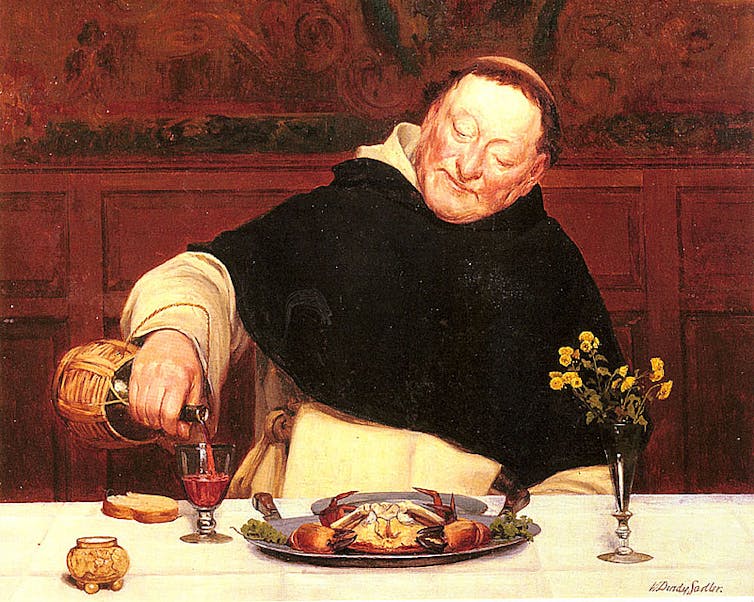


Religious Origins of Wine, Beer, and Liquor

Pious drinking.
Walter Dendy Sadler via Wikimedia Commons


Alcohol abuse is no laughing matter, but is it sinful to drink and make merry, moderately and responsibly, during a holy season or at any other time?

As a historical theologian, I researched the role that pious Christians played in developing and producing alcohol. What I discovered was an astonishing history.

Religious orders and wine-making


Wine was invented 6,000 years before the birth of Christ, but it was monks who largely preserved viniculture in Europe. Religious orders such as the Benedictines and Jesuits became expert winemakers. They stopped only because their lands were confiscated in the 18th and 19th centuries by anti-Catholic governments such as the French Revolution’s Constituent Assembly and Germany’s Second Reich.

In order to celebrate the Eucharist, which requires the use of bread and wine, Catholic missionaries brought their knowledge of vine-growing with them to the New World. Wine grapes were first introduced to Alta California in 1779 by Saint Junipero Serra and his Franciscan brethren, laying the foundation for the California wine industry. A similar pattern emerged in Argentina, Chile and Australia.
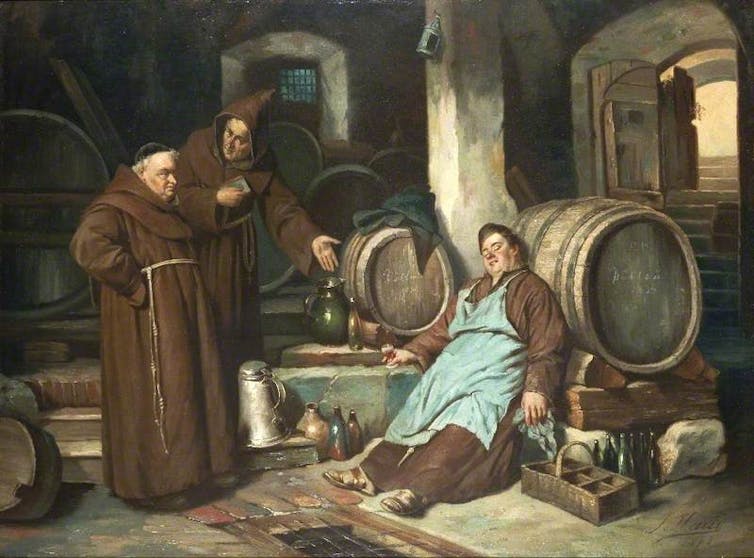


Religious Origins of Wine, Beer, and Liquor alcoholic beverages

Monks in a cellar.
Joseph Haier 1816-1891, via Wikimedia Commons


Godly men not only preserved and promulgated oenology, or the study of wines; they also advanced it. One of the pioneers in the “méthode champenoise,” or the “traditional method” of making sparkling wine, was a Benedictine monk whose name now adorns one of the world’s finest champagnes: Dom Pérignon. According to a later legend, when he sampled his first batch in 1715, Pérignon cried out to his fellow monks:

“Brothers, come quickly. I am drinking stars!”

Monks and priests also found new uses for the grape. The Jesuits are credited with improving the process for making grappa in Italy and pisco in South America, both of which are grape brandies.

Beer in the cloister


And although beer may have been invented by the ancient Babylonians, it was perfected by the medieval monasteries that gave us brewing as we know it today. The oldest drawings of a modern brewery are from the Monastery of Saint Gall in Switzerland. The plans, which date back to A.D. 820, show three breweries – one for guests of the monastery, one for pilgrims and the poor, and one for the monks themselves.

One saint, Arnold of Soissons, who lived in the 11th century, has even been credited with inventing the filtration process. To this day and despite the proliferation of many outstanding microbreweries, the world’s finest beer is arguably still made within the cloister – specifically, within the cloister of a Trappist monastery.

Liquors and liqueurs


Equally impressive is the religious contribution to distilled spirits. Whiskey was invented by medieval Irish monks, who probably shared their knowledge with the Scots during their missions.


monk sneaking a drink monasteries liqueur beer wine

Monk sneaking a drink.
Scanned from Den medeltida kokboken, Swedish translation of The Medieval Cookbook by Maggie Black, via Wikimedia Commons.


Chartreuse is widely considered the world’s best liqueur because of its extraordinary spectrum of distinct flavors and even medicinal benefits. Perfected by the Carthusian order almost 300 years ago, the recipe is known by only two monks at a time. The herbal liqueur Bénédictine D.O.M. is reputed to have been invented in 1510 by an Italian Benedictine named Dom Bernardo Vincelli to fortify and restore weary monks. And the cherry brandy known as Maraska liqueur was invented by Dominican apothecaries in the early 16th century.

Nor was ingenuity in alcohol a male-only domain. Carmelite sisters once produced an extract called “Carmelite water” that was used as a herbal tonic. The nuns no longer make this elixir, but another concoction of the convent survived and went on to become one of Mexico’s most popular holiday liqueurs – Rompope.

Made from vanilla, milk and eggs, Rompope was invented by Clarist nuns from the Spanish colonial city of Puebla, located southeast of Mexico City. According to one account, the nuns used egg whites to give the sacred art in their chapel a protective coating. Not wishing the leftover yolks to go to waste, they developed the recipe for this festive refreshment.

Health and community


So why such an impressive record of alcoholic creativity among the religious? I believe there are two underlying reasons.

First, the conditions were right for it. Monastic communities and similar religious orders possessed all of the qualities necessary for producing fine alcoholic beverages. They had vast tracts of land for planting grapes or barley, a long institutional memory through which special knowledge could be handed down and perfected, a facility for teamwork and a commitment to excellence in even the smallest of chores as a means of glorifying God.
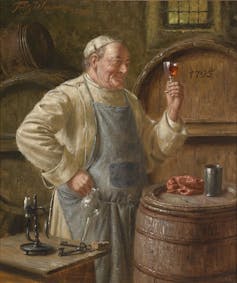


alcoholic beverages promote health

Historically, alcohol was seen to be promoting health.
Fritz Wagner (1896-1939) (Dorotheum) , via Wikimedia Commons


Second, it is easy to forget in our current age that for much of human history, alcohol was instrumental in promoting health. Water sources often carried dangerous pathogens, and so small amounts of alcohol would be mixed with water to kill the germs therein.

Roman soldiers, for example, were given a daily allowance of wine, not in order to get drunk but to purify whatever water they found on campaign. And two bishops, Saint Arnulf of Metz and Saint Arnold of Soissons, are credited with saving hundreds from a plague because they admonished their flock to drink beer instead of water. Whiskey, herbal liqueurs and even bitters were likewise invented for medicinal reasons.

And if beer can save souls from pestilence, no wonder the Church has a special blessing for it that begins:

The Conversation“O Lord, bless this creature beer, which by Your kindness and power has been produced from kernels of grain, and may it be a health-giving drink for mankind.”

Michael Foley, Associate Professor of Patristics, Baylor University

This article was originally published on The Conversation. Read the original article.

Thursday, December 05, 2013

Today Is Repeal Day - Let's Celebrate!

Today, across the country, Americans are celebrating "Repeal Day." As David Boaz of the Cato Institute put it, "Today is a great day for freedom."

What's the celebration about? We are commemorating the 80th anniversary of the 21st Amendment, which was ratified on December 5, 1933, and took effect ten days later (coinciding with Bill of Rights Day). Ratification was confirmed by a vote of the Utah legislature to repeal the 18th Amendment that prohibited the manufacture, distribution, and sale of alcoholic beverages within the boundaries of the United States.

While it would be easy to attribute the celebration to nothing more than the desire of Americans to imbibe a shot and a beer without bribing a police officer or paying a mobster, the repeal of the Prohibition amendment represents something far more fundamental: It means that, despite Ronald Reagan's quip that "the nearest thing to eternal life we will ever see on this earth is a government program," it is indeed possible to end programs that fail miserably, are counterproductive, increase the size and scope of government, and intrude in the private lives of citizens.

In other words, the 21st Amendment should offer a lesson for everyone who wants to repeal Obamacare (or, for that matter, marijuana prohibition and NSA domestic spying).

Although recent history may give more reason for pessimism, it is not impossible to reverse a bad government program. The effort may take hard work, extend over a long time (Prohibition lasted almost 14 years and its effects are still with us -- such as Virginia's socialist liquor monopoly), and encounter setbacks, but success can happen.

With that in mind, to quote Franklin D. Roosevelt, "What America needs now is a drink!" Toast now; legislate later.

(Cross-posted from Bearing Drift)


Saturday, October 05, 2013

Combating Drunk Driving Without Compromising Liberty and Safety

(This article originally appeared on Virginia Politics on Demand on May 28, 2013.)

This past Memorial Day weekend marked the start of the summer driving season, and with it came warnings about drunk driving and other traffic hazards.  As Hoai-Tran Bui reported for WTOP radio in Washington:
Memorial Day weekend is one of the most dangerous holidays of the year for drivers.

Kurt Erickson, with the Washington Regional Alcohol Program, says there's a significant increase in drunken driving deaths during Memorial Day weekend.

In 2011 (the latest year that data is available), 406 people lost their lives nationwide during the three-day weekend, according to the National Highway Traffic Safety Administration (NHTSA).

"Forty percent of all traffic fatalities that happen in this country over Memorial Day were actually caused by drunk drivers," Erickson says. "That compares to 31 percent during the other parts of the year."
The good news in Virginia is that, overall, Memorial Day traffic accidents declined this year, according to Doris Taylor at WTKR-TV in Hampton Roads:
Officials say the state of Virginia had a major decline in fatalities on Memorial Day Weekend this year. They investigated about 620 crashes that resulted in 141 injuries and 7 deaths.

The number of deaths dropped into the single digits this year, the first time since 2009.

Preliminary reports show that seven people lost their lives this weekend in traffic accidents all over the state including one in Newport News, Carroll County and Southampton.

Police also stopped 11, 9900 [sic] speeders and 2,609 reckless drivers. Officers were able to arrest 137 drunk drivers.
These statistics arrive in the context of a recent call by the National Transportation Safety Board (NTSB) to revise the definition of drunkenness for purposes of arresting drivers who are "under the influence."

With the utopian goal of "reaching zero" drunk-driving fatalities, the NTSB recognizes in a report released May 14 that
the number of lives lost annually in alcohol-impaired-driver-related crashes declined 53 percent, from 21,113 in 1982 to 9,878 in 2011; and the percentage of highway fatalities resulting from alcohol-involved crashes is down from 48 percent in 1982 to about 31 percent today.
Despite this notable record of success over the past three decades, however, the NTSB recommends that, although "the majority of alcohol-impaired drivers in fatal crashes have BAC levels well over 0.08,"
the 50 states, the Commonwealth of Puerto Rico, and the District of Columbia establish a per se BAC limit of 0.05 or lower for all drivers who are not already required to adhere to lower BAC limits.
The Chicago Tribune's Steve Chapman explains the practical effect of adopting this recommendation:
From the standpoint of individual behavior, that would be a significant change. A 180-lb. man could be legally impaired if he had three drinks in an hour (versus four drinks today) while a 140-lb. woman could earn a set of handcuffs with just two drinks in an hour (compared to three under the current rule).
Some 20 years ago, when the Virginia General Assembly was considering a bill to lower the blood alcohol concentration threshold for drunk driving from 0.10 to 0.08, I testified before the Senate Courts of Justice Committee (then chaired by Arlington Democrat Edward Holland) alongside Candy Lightner, the founder of Mothers Against Drunk Driving.

We both argued against a change in the law, pointing out that revising the technical definition of impairment downward would simply redistribute law enforcement resources without actually preventing any drunk-driving incidents. Lightner said that educational efforts and changes in the culture -- that is, changing people's attitudes about the acceptability of driving while intoxicated -- would be more effective.

Lightner also said:
Half of the drinking drivers involved in fatal crashes have a BAC of 0.17 or greater. Even among young people aged 16 to 24, the great majority of deaths involve drinkers with a BAC of at least 0.15 percent. Lowering the blood alcohol content won't make a difference to these offenders.
I drew on research that probably still holds true:
Minnesota Judge Dennis Challeen, who over the past 30 years has sentenced hundreds of people for DWI violations, agrees with Lightner. "Most drunk driver fatalities," he notes, "have BAC levels close to 0.20, twice the legal limit. If lawmakers reduce the limit to 0.08, they are simply catching more of the wrong people, the people who are not the problem."

Judge Challeen further argues that stricter laws will be ineffective because those who do not need to be sanctioned -- law-abiding citizens and responsible drinkers -- are most likely to be "self-correcting," while chronic drunks and scofflaws are least likely to respond to harsher penalties.

The fact is, by changing the definition of drunkenness, we enable the police to arrest more people. That may seem tough, but the effect is clogging the courts with people who are not really the problem, creating conditions whereby truly dangerous people are let off without punishment so that we can make room for the minor offender.

The author of Confronting Drunk Driving, Professor H. Laurence Ross, estimates a potential increase of 60 percent of DWI arrests under the new definition with the possibility of no decrease in fatalities. "Adoption of 0.08 percent BAC has not to date been accompanied by any comparable new investments in police resources," Dr. Ross reports, "thus diluting an already inadequate control system. The effect may well be to reduce the chances of any impaired drivers being arrested."
Candy Lightner argued then that
Rather than put our limited resources into laws that fail to address the real problem, we need better enforcement of existing laws and proven policies that have demonstrated a significant impact... If we really want to save lives, let's go after the most dangerous drivers on the road. Putting our trust in new laws and regulations that only address the tip of the iceberg will not make our highways safer.
That point is echoed by Steve Chapman in his reaction to the NTSB's most recent recommendations:
Under a tighter BAC, the same number of cops will be chasing a lot more offenders. An officer who is busy arresting someone with a .05 level, who poses a small danger, will not be able to arrest someone with a .10 or .15 level, who poses a huge danger....

It may come as a surprise to hear that the organization that deserves much of the credit for raising public awareness of the problem, Mothers Against Drunk Driving, has declined to endorse this proposal. It prefers to focus on greater efforts to enforce existing laws, while requiring ignition interlocks for every DUI offender.

NTSB acknowledges this last policy would save some 1,100 lives per year -- far more than a lower BAC would save. It also has the virtue of disabling the few guilty without inconveniencing the many innocent.

In a free society, trying to reach zero carries too high a cost. Better to settle for making progress.
Utah was the first state to change its BAC definition to 0.08 in 1983. Other states followed slowly on their own initiative, but it was federal carrot-and-stick incentives that eventually forced the rest of the country into uniformity, regardless of the effectiveness of the legislation on solving the problem it purported to address.

While we will hear protests from state capitals -- including Richmond -- against the NTSB's most recent recommendations, it won't be long before Congress acts and threatens to withhold federal highway funding from any state that does not go along with the proposal. It's only a matter of time, and it won't save any lives or property.