Showing posts with label beer. Show all posts

Saturday, December 16, 2017

Guest Post: Historically Religious Origins of Wine, Beer, and Liquor


Michael Foley, Baylor University

Each year the holidays bring with them an increase in both the consumption of alcohol and concern about drinking’s harmful effects.
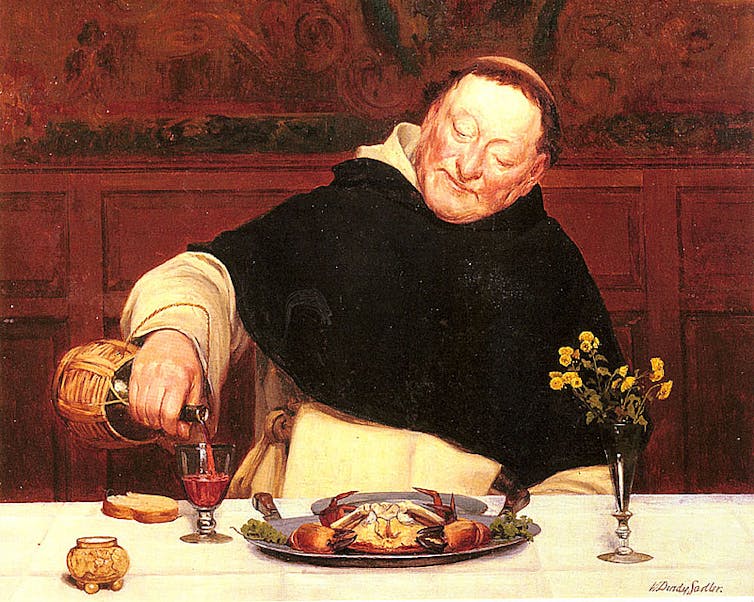


Religious Origins of Wine, Beer, and Liquor

Pious drinking.
Walter Dendy Sadler via Wikimedia Commons


Alcohol abuse is no laughing matter, but is it sinful to drink and make merry, moderately and responsibly, during a holy season or at any other time?

As a historical theologian, I researched the role that pious Christians played in developing and producing alcohol. What I discovered was an astonishing history.

Religious orders and wine-making


Wine was invented 6,000 years before the birth of Christ, but it was monks who largely preserved viniculture in Europe. Religious orders such as the Benedictines and Jesuits became expert winemakers. They stopped only because their lands were confiscated in the 18th and 19th centuries by anti-Catholic governments such as the French Revolution’s Constituent Assembly and Germany’s Second Reich.

In order to celebrate the Eucharist, which requires the use of bread and wine, Catholic missionaries brought their knowledge of vine-growing with them to the New World. Wine grapes were first introduced to Alta California in 1779 by Saint Junipero Serra and his Franciscan brethren, laying the foundation for the California wine industry. A similar pattern emerged in Argentina, Chile and Australia.
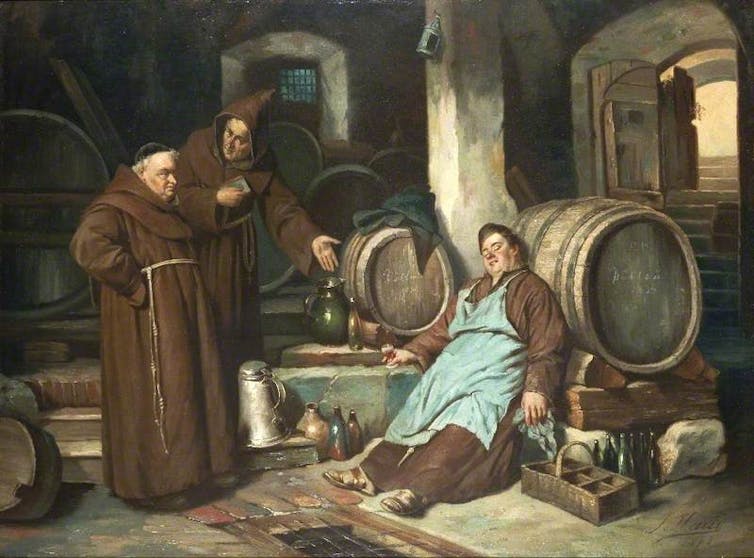


Religious Origins of Wine, Beer, and Liquor alcoholic beverages

Monks in a cellar.
Joseph Haier 1816-1891, via Wikimedia Commons


Godly men not only preserved and promulgated oenology, or the study of wines; they also advanced it. One of the pioneers in the “méthode champenoise,” or the “traditional method” of making sparkling wine, was a Benedictine monk whose name now adorns one of the world’s finest champagnes: Dom Pérignon. According to a later legend, when he sampled his first batch in 1715, Pérignon cried out to his fellow monks:

“Brothers, come quickly. I am drinking stars!”

Monks and priests also found new uses for the grape. The Jesuits are credited with improving the process for making grappa in Italy and pisco in South America, both of which are grape brandies.

Beer in the cloister


And although beer may have been invented by the ancient Babylonians, it was perfected by the medieval monasteries that gave us brewing as we know it today. The oldest drawings of a modern brewery are from the Monastery of Saint Gall in Switzerland. The plans, which date back to A.D. 820, show three breweries – one for guests of the monastery, one for pilgrims and the poor, and one for the monks themselves.

One saint, Arnold of Soissons, who lived in the 11th century, has even been credited with inventing the filtration process. To this day and despite the proliferation of many outstanding microbreweries, the world’s finest beer is arguably still made within the cloister – specifically, within the cloister of a Trappist monastery.

Liquors and liqueurs


Equally impressive is the religious contribution to distilled spirits. Whiskey was invented by medieval Irish monks, who probably shared their knowledge with the Scots during their missions.


monk sneaking a drink monasteries liqueur beer wine

Monk sneaking a drink.
Scanned from Den medeltida kokboken, Swedish translation of The Medieval Cookbook by Maggie Black, via Wikimedia Commons.


Chartreuse is widely considered the world’s best liqueur because of its extraordinary spectrum of distinct flavors and even medicinal benefits. Perfected by the Carthusian order almost 300 years ago, the recipe is known by only two monks at a time. The herbal liqueur Bénédictine D.O.M. is reputed to have been invented in 1510 by an Italian Benedictine named Dom Bernardo Vincelli to fortify and restore weary monks. And the cherry brandy known as Maraska liqueur was invented by Dominican apothecaries in the early 16th century.

Nor was ingenuity in alcohol a male-only domain. Carmelite sisters once produced an extract called “Carmelite water” that was used as a herbal tonic. The nuns no longer make this elixir, but another concoction of the convent survived and went on to become one of Mexico’s most popular holiday liqueurs – Rompope.

Made from vanilla, milk and eggs, Rompope was invented by Clarist nuns from the Spanish colonial city of Puebla, located southeast of Mexico City. According to one account, the nuns used egg whites to give the sacred art in their chapel a protective coating. Not wishing the leftover yolks to go to waste, they developed the recipe for this festive refreshment.

Health and community


So why such an impressive record of alcoholic creativity among the religious? I believe there are two underlying reasons.

First, the conditions were right for it. Monastic communities and similar religious orders possessed all of the qualities necessary for producing fine alcoholic beverages. They had vast tracts of land for planting grapes or barley, a long institutional memory through which special knowledge could be handed down and perfected, a facility for teamwork and a commitment to excellence in even the smallest of chores as a means of glorifying God.
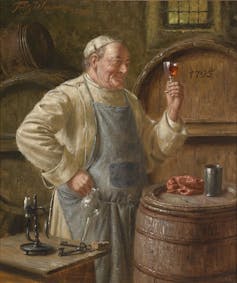


alcoholic beverages promote health

Historically, alcohol was seen to be promoting health.
Fritz Wagner (1896-1939) (Dorotheum) , via Wikimedia Commons


Second, it is easy to forget in our current age that for much of human history, alcohol was instrumental in promoting health. Water sources often carried dangerous pathogens, and so small amounts of alcohol would be mixed with water to kill the germs therein.

Roman soldiers, for example, were given a daily allowance of wine, not in order to get drunk but to purify whatever water they found on campaign. And two bishops, Saint Arnulf of Metz and Saint Arnold of Soissons, are credited with saving hundreds from a plague because they admonished their flock to drink beer instead of water. Whiskey, herbal liqueurs and even bitters were likewise invented for medicinal reasons.

And if beer can save souls from pestilence, no wonder the Church has a special blessing for it that begins:

The Conversation“O Lord, bless this creature beer, which by Your kindness and power has been produced from kernels of grain, and may it be a health-giving drink for mankind.”

Michael Foley, Associate Professor of Patristics, Baylor University

This article was originally published on The Conversation. Read the original article.

Saturday, February 01, 2014

America asks: What time is the Super Bowl?

Friday evening's edition of the public radio show, Marketplace, ended with this squib by host Kai Ryssdal:

This final note which comes to us courtesy of the letters SEO. As in search engine optimization. So here you go: What time is the Super Bowl? (It starts at 6:30 p.m. ET, by the way.) Turns out most people, don't know how to spell Superbowl. Helpful hint: It's actually two words, both capitalized. A couple years back the Huffington Post published a story titled, "What time does the superbowl start?," just to game the web traffic. And, of course, it blew up. The rest of the Internet keeps trying to get a piece of that Super Bowl traffic. This year's version... the search words of choice … Superb owls.
That set me to thinking: What other questions are Americans asking the Google gods about the Super Bowl (or the "Big Game," as any unlicensed advertiser says to avoid trademark litigation)?

For instance, some people wonder, What is the best snack food for Super Bowl Sunday?

The Food Network has a hefty answer: "50 Super Bowl Snacks," from chunky guacamole to mini veggie pockets.

You might want to know, What is the best beer to drink during the Super Bowl?

Matt Rudnitzky of Sports Grid offers more than one choice in "Super Bowl BEER POWER RANKINGS: Buy These 9 Delicious Beers, Be Your Party’s Hero." His number one answer: "A German hefeweizen from Heaven, Germany."

If you want to combine those two questions, I recommend this article by my sister, who blogs as the Bierlady, called (naturally) "Cooking with Beer." There are some good recipes there.

Another question that comes to mind: What are the best Super Bowl commercials?

CNN is on top of that story already. Correspondent Breeanna Hare recommends "Seven Commercials to Watch" during the 2014 Super Bowl,including spots featuring Anna Kendrick, the Muppets, Noah's ark, and puppies.

Speaking of puppies, some people may want to know: "What time is the Puppy Bowl?" It turns out that the tenth addition of the adorability classic kicks off at 3:00 o'clock p.m. Eastern Standard Time on Sunday, February 2, on Animal Planet.

Here's a query you might not have thought about. What's the best book about the Super Bowl?

I know nothing about football, and therefore even less about football literature, but I'll go out on a limb and recommend The Ultimate Super Bowl Book: A Complete Reference to the Stats, Stars, and Stories Behind Football's Biggest Game - and Why the Best Team Won, a 2009 volume by Bob McGinn. At least it looks comprehensive.

Is there a "best movie about the Super Bowl"?

Again, I don't have a good base of knowledge from which to make a judgment, but Chris Eggertsen, Daniel Fienberg, Josh Lasser, Drew McWeeny, Melinda Newman, and Alan Sepinwall have created a list of the "10 greatest football films of all time" on HitFix.

Their choices include The Marx Brothers' Horse Feathers from 1932, which I have actually seen, as well as the tearjerker 1971 TV movie, Brian's Song. Also on the list is Harold Lloyd's silent classic, The Freshman, and Sean Astin's 1993 star turn in Rudy.

Tom Cruise's follow-up to Risky Business, All the Right Moves, is listed, along with Heaven Can Wait, the 1978 Warren Beatty-Buck Henry remake of Here Comes Mr. Jordan, and the Burt Reynolds' prison comedy, The Longest Yard (but not the 2005 remake with Chris Rock and Adam Sandler).


The last three on the HitFix list are Oliver Stone's Any Given Sunday, Peter Berg's Friday Night Lights (which became a TV series), and another Tom Cruise vehicle, Jerry Maguire,which won an Academy Award for Cuba Gooding, Jr.


Somehow the 1977 John Frankenheimer thriller, Black Sunday, did not make the list. Maybe the plot about a deranged Vietnam veteran facilitating a terrorist attack on a football stadium from the Goodyear Blimp was too distasteful to merit its inclusion.  (That movie starred one of this year's Oscar nominees, Nebraska leading actor Bruce Dern.)

Given that this is the tenth anniversary of "Nipplegate," the half-time show that gave the world the term "wardrobe malfunction," there may be a few people who wonder who this year's Super Bowl half-time entertainers will be.

It's a good bet not to be Justin Timberlake and Janet Jackson.  Or Justin Bieber.

No, this year the musical performers will be Bruno Mars and the Red Hot Chili Peppers. I'm guessing the former is meant to attract younger viewers and the latter group aims to satisfy the older crowd.

By the way, do you know who the most frequent Super Bowl half time performers have been?

According to The First Book of Seconds by Matthew Murrie & Steve Murrie,  the Grambling State University marching band played at the first two Super Bowl games (in 1967 and 1968) and four more times after that.  The squeaky-clean choral group, Up with People, has played the Big Game five times.

Finally, in answer to the question that started this whole discussion, the broadcast of the NFL's Super Bowl XLVIII between the Seattle Seahawks and Denver Broncos will begin on Fox at 6:30 p.m. EST.  Check your local listings.

As for "superb owls"? I have no idea. Maybe there's an ornithology blog that can point you in the right direction.


Friday, April 08, 2011

Lookin' Forward to the Weekend with Legal News About Beer

As the ubiquitous song goes:

It's Friday, Friday
Gotta get down on Friday
Everybody's lookin' forward to the weekend, weekend
Friday, Friday
Gettin' down on Friday
Everybody's lookin' forward to the weekend
Although Rebecca Black and her teenage friends may look forward to "kickin' in the front seat" and "sittin' in the back seat" and "partyin'" as Saturday approaches (followed, of course, by Sunday, which "comes after ... wards") with age-appropriate soft drinks, those a bit older might be mulling over what kinds of adult beverages they'll be consuming this weekend.

Thus it is that a couple of legal cases involving beer come to our attention.

Reported by the law firm of Shook, Hardy, & Bacon (bacon is everywhere nowadays, even in ice cream dishes at Denny's) in its on-line newsletter, Food & Beverage Litigation Update, one case comes from Europe and one from the United States.

The European case involves the use of "Bud" as a brand name for beer, and it is a new ruling on an old dispute.
Czech and U.S. brewers seeking to market their beers under the name “Bud,” have apparently been at odds since the early 1900s. In the latest installment of the dispute, the Court of Justice of the European Communities has set aside a decision of the Court of First Instance which allowed the Czech brewer to oppose Anheuser-Busch’s registration of “Bud” in Europe.  Anheuser-Busch Inc. v. Budějovický Budvar, No. C-96-09 (E.C.J., decided March 29, 2011). While the Court of Justice upheld some of the lower court’s rulings, it determined that the lower court erred (i) in the factors it relied on to decide if a “sign,” or trademark, in opposition to a new registration was used in a sufficiently significant manner, and (ii) in holding that the use of the sign in opposition does not necessarily have to occur before the date of the application for new
registration.
The language may be dry, but the beverage is still just as wet as you might expect.

The American case a bit more racy and it involves a microbrewery. Microbrewers, by their nature, are always more interesting and adventurous.
Flying Dog Brewery has filed a lawsuit under the First Amendment, alleging that the Michigan Liquor Control Commission and its individual members violated its free speech rights by prohibiting the company from selling Raging Bitch Twentieth Anniversary Belgian-Style India Pale Ale. Flying Dog Brewery, LLP v. Mich. Liquor Control Comm’n, No. n/a (U.S. Dist. Ct., W.D. Mich., filed March 25, 2011). According to the complaint, a British artist, who once worked with journalist Hunter S. Thompson, designed Flying Dog’s beer labels, including the one at issue. The defendants rejected Flying Dog’s application for a license to sell the pale ale in the state, allegedly finding “that the proposed label which includes the brand name ‘Raging Bitch’ contains such language deemed detrimental to the health, safety, or welfare of the general public.”
If I can find a six-pack of Raging Bitch, I may drink one or two this weekend while reading a new book that arrived from Amazon.com this week: Prohibition in Washington, D.C.: How Dry We Weren't, by my friend, Garrett Peck. If anything shows the residuum of Prohibition remaining in U.S. law, it's a ruling by a regulatory body that says the name of a beer -- even if it's "Raging Bitch" can be "detrimental to the health, safety, or welfare" of anybody.

Be sure to visit my CafePress store for gifts and novelty items!
Read my blog on Kindle!
Follow my tweets on Twitter!