Showing posts with label Jesuits. Show all posts

Saturday, December 16, 2017

Guest Post: Historically Religious Origins of Wine, Beer, and Liquor


Michael Foley, Baylor University

Each year the holidays bring with them an increase in both the consumption of alcohol and concern about drinking’s harmful effects.


Religious Origins of Wine, Beer, and Liquor

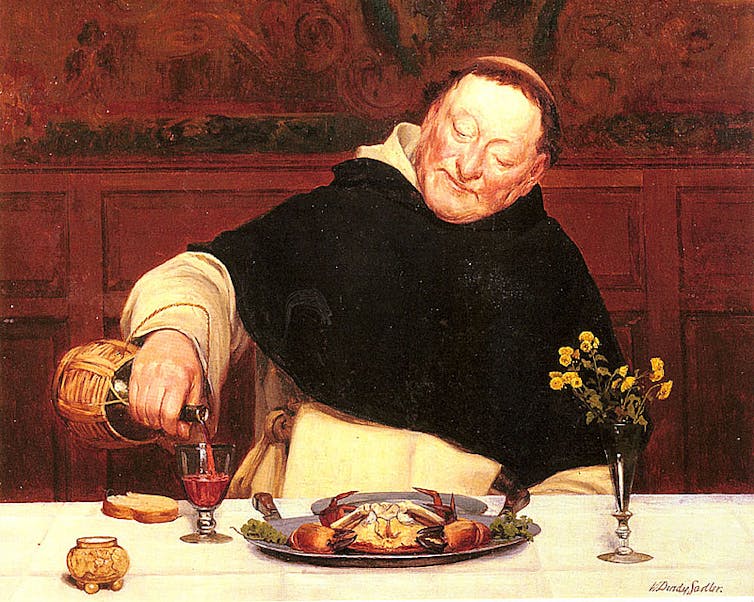
Pious drinking.
Walter Dendy Sadler via Wikimedia Commons


Alcohol abuse is no laughing matter, but is it sinful to drink and make merry, moderately and responsibly, during a holy season or at any other time?

As a historical theologian, I researched the role that pious Christians played in developing and producing alcohol. What I discovered was an astonishing history.

Religious orders and wine-making


Wine was invented 6,000 years before the birth of Christ, but it was monks who largely preserved viniculture in Europe. Religious orders such as the Benedictines and Jesuits became expert winemakers. They stopped only because their lands were confiscated in the 18th and 19th centuries by anti-Catholic governments such as the French Revolution’s Constituent Assembly and Germany’s Second Reich.

In order to celebrate the Eucharist, which requires the use of bread and wine, Catholic missionaries brought their knowledge of vine-growing with them to the New World. Wine grapes were first introduced to Alta California in 1779 by Saint Junipero Serra and his Franciscan brethren, laying the foundation for the California wine industry. A similar pattern emerged in Argentina, Chile and Australia.


Religious Origins of Wine, Beer, and Liquor alcoholic beverages

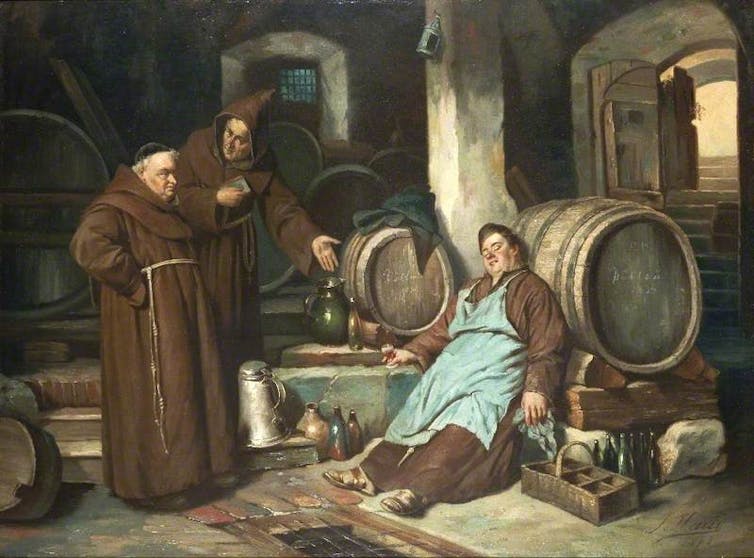
Monks in a cellar.
Joseph Haier 1816-1891, via Wikimedia Commons


Godly men not only preserved and promulgated oenology, or the study of wines; they also advanced it. One of the pioneers in the “méthode champenoise,” or the “traditional method” of making sparkling wine, was a Benedictine monk whose name now adorns one of the world’s finest champagnes: Dom Pérignon. According to a later legend, when he sampled his first batch in 1715, Pérignon cried out to his fellow monks:

“Brothers, come quickly. I am drinking stars!”

Monks and priests also found new uses for the grape. The Jesuits are credited with improving the process for making grappa in Italy and pisco in South America, both of which are grape brandies.

Beer in the cloister


And although beer may have been invented by the ancient Babylonians, it was perfected by the medieval monasteries that gave us brewing as we know it today. The oldest drawings of a modern brewery are from the Monastery of Saint Gall in Switzerland. The plans, which date back to A.D. 820, show three breweries – one for guests of the monastery, one for pilgrims and the poor, and one for the monks themselves.

One saint, Arnold of Soissons, who lived in the 11th century, has even been credited with inventing the filtration process. To this day and despite the proliferation of many outstanding microbreweries, the world’s finest beer is arguably still made within the cloister – specifically, within the cloister of a Trappist monastery.

Liquors and liqueurs


Equally impressive is the religious contribution to distilled spirits. Whiskey was invented by medieval Irish monks, who probably shared their knowledge with the Scots during their missions.


monk sneaking a drink monasteries liqueur beer wine

Monk sneaking a drink.
Scanned from Den medeltida kokboken, Swedish translation of The Medieval Cookbook by Maggie Black, via Wikimedia Commons.


Chartreuse is widely considered the world’s best liqueur because of its extraordinary spectrum of distinct flavors and even medicinal benefits. Perfected by the Carthusian order almost 300 years ago, the recipe is known by only two monks at a time. The herbal liqueur Bénédictine D.O.M. is reputed to have been invented in 1510 by an Italian Benedictine named Dom Bernardo Vincelli to fortify and restore weary monks. And the cherry brandy known as Maraska liqueur was invented by Dominican apothecaries in the early 16th century.

Nor was ingenuity in alcohol a male-only domain. Carmelite sisters once produced an extract called “Carmelite water” that was used as a herbal tonic. The nuns no longer make this elixir, but another concoction of the convent survived and went on to become one of Mexico’s most popular holiday liqueurs – Rompope.

Made from vanilla, milk and eggs, Rompope was invented by Clarist nuns from the Spanish colonial city of Puebla, located southeast of Mexico City. According to one account, the nuns used egg whites to give the sacred art in their chapel a protective coating. Not wishing the leftover yolks to go to waste, they developed the recipe for this festive refreshment.

Health and community


So why such an impressive record of alcoholic creativity among the religious? I believe there are two underlying reasons.

First, the conditions were right for it. Monastic communities and similar religious orders possessed all of the qualities necessary for producing fine alcoholic beverages. They had vast tracts of land for planting grapes or barley, a long institutional memory through which special knowledge could be handed down and perfected, a facility for teamwork and a commitment to excellence in even the smallest of chores as a means of glorifying God.


alcoholic beverages promote health

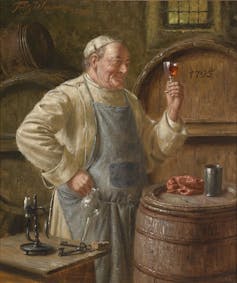
Historically, alcohol was seen to be promoting health.
Fritz Wagner (1896-1939) (Dorotheum) , via Wikimedia Commons


Second, it is easy to forget in our current age that for much of human history, alcohol was instrumental in promoting health. Water sources often carried dangerous pathogens, and so small amounts of alcohol would be mixed with water to kill the germs therein.

Roman soldiers, for example, were given a daily allowance of wine, not in order to get drunk but to purify whatever water they found on campaign. And two bishops, Saint Arnulf of Metz and Saint Arnold of Soissons, are credited with saving hundreds from a plague because they admonished their flock to drink beer instead of water. Whiskey, herbal liqueurs and even bitters were likewise invented for medicinal reasons.

And if beer can save souls from pestilence, no wonder the Church has a special blessing for it that begins:

The Conversation“O Lord, bless this creature beer, which by Your kindness and power has been produced from kernels of grain, and may it be a health-giving drink for mankind.”

Michael Foley, Associate Professor of Patristics, Baylor University

This article was originally published on The Conversation. Read the original article.

Tuesday, May 09, 2017

Guest Post: Don Quijote, Man of Free Markets

by Eric Clifford Graf

Economists from the Austrian School have long argued that the free-market mindset, which reached its pinnacle during the classical liberal period of the 18th and 19th centuries, traces its own origins back to the early modern period, especially the ideas of the neo-scholastic thinkers of 16th and 17th century Spain known as the School of Salamanca.

Eric Graf Cervantes Modernity Don QuixoteJust to name a few, men like Domingo de Soto (1494-1560), Martín de Azpilcueta (1491-1586), Diego de Covarrubias (1512-77), Luis Saravia de la Calle (1500s), Tomás de Mercado (1525-75), Luis de Molina (1535-1600), Juan de Mariana (1536-1624), and Felipe de la Cruz Vasconcillos (1500s) were keen to define, analyze, debate, and explain things like interest rates, the pricing of goods and services, the causes and effects of inflation, the advisability of different monetary policies, and the relation between supply and demand.

Miguel de Cervantes (1547-1616), author of the first modern novel, Don Quijote de la Mancha (part one, 1605; part two, 1615), was familiar with the School of Salamanca. As evidence, here are five major ideas at the core of free-market thinking which are also at the core of Don Quijote:

Subjective Value
Salamancan and Austrian economists embrace the notion that free and voluntary exchange implies that even two wrongs can make a right. If both of us leave happy, the “true” value of things we exchange matters less than the fact that we exchange them. Tastes, wants, and needs are subjective. Indeed, such differences are precisely why we produce stuff and trade it. Without them we would all be poor, starving brutes.

Examples of subjective value theory abound in Cervantes. For example, in Don Quijote Part 1 Chapter 21, Don Quijote, the eccentric hidalgo (gentleman) asks Sancho, “Do you not see that knight coming toward us, mounted on a dappled gray and wearing on his head a helmet of gold?” The squire is unconvinced: “What I see and can make out ... is just a man riding on a donkey that’s gray like mine, and wearing something shiny on his head.”


The Time Value of Money
In the Protestant world, men like John Calvin and Henry VIII began eroding usury laws around 1550. In Spain, the Salamancans debated. Saravia’s Instrución de mercaderes (1544) marked a transition between different ways of thinking about business; Mercado’s Suma de tratos y contratos (1569) advanced a liberal view of charging interest; Vasconcillos’s Tratado único de intereses (1637) indicated the basic injustice of borrowing money for free.

Cervantes’s critique of usury laws appears in Don Quijote Part 1 Chapter 4’s dialogue between the hero and Juan Haldudo regarding the back pay the peasant owes a shepherd. Don Quijote calculates that “nine months, at seven reales a month” comes to “73 reales,” which includes an interest of 10 reales. It’s a game of perspectives. If we laugh at Don Quijote, we endorse the official policy against interest; if we accept his calculation, we think like rational market participants.

By the way, a surcharge of 10 reales for the use of 63 reales for nine months, or 21% annually, was a reasonable rate around 1600.


Free-Labor Markets
Karl Marx and Friedrich Engels credited Thomas Hobbes as an originator of their materialist assessment of how the world works. They liked Hobbes’s critique of metaphysical thinking but also his understanding of labor as a commodity subject to the law of supply and demand. A fundamental aspect of the transition from feudalism to bourgeois capitalism involved an awareness that we should compensate people for their property or services.

Hobbes was a serious reader of Don Quijote. Throughout the book, squire and hidalgo negotiate Sancho’s salary. In Part 1 Chapter 20, Sancho presses his master: “I would like to know ... just how much a squire made from a knight-errant in those days, and if they were paid on a monthly basis or daily, like bricklayers.” When Sancho threatens to go on strike in Part 2 Chapter 7, Sansón Carrasco, also known as “perpetual diversion and delight of the courtyards of the schools of Salamanca,” offers his services. Don Quijote perceives a market: “Did I not tell you, Sancho, that I would have plenty of squires from whom to choose?”

Stable Currency 

John Maynard Keynes observed that only one man in a million perceives the destructive effects of inflation. Hoping likewise, the Habsburg kings of early 17th-century Spain undertook the first modern industrialized production of fiat money to finance their wars, corruption, and extravagance. The results correlate well with the fall of the Spanish Empire marked by the Treaty of Westphalia in 1648 (see figure below). Artificially induced inflation was criticized by members of the School of Salamanca, especially Mariana. Philip III burned Mariana’s books and the Inquisition charged him with lèse-majesté – insulting the monarch, which was treason.

Purchasing power of the billon cuarto coin reverting to the market value of copper, 1597-1659. The maravedí was one of the era’s units of account. Source: Federal Reserve Bank of Chicago.


In Don Quijote Part 1 Chapter 1, the first metaphor in this greatest work of fiction involves a comparison between Rocinante’s hooves and the decayed purchasing power of the era’s quarter coins. Later, in Part 2 Chapter 17, Cervantes has his hero attack what is first described as the king’s money cart. It’s really a cart carrying the King’s lions, which refuse to fight with Don Quijote. But when he uses gold coins to tip the driver and the lion tamer, bribing them to say he vanquished the beasts, it’s symbolic: gold is a store of value against Philip III’s money. The narrator reports that the lion tamer “promised to relate that valiant deed to the King himself when he arrived at court.”

Sweet Commerce
Montesquieu’s notion of “doux-commerce,” a vision of the positive effects of trade, anticipated Adam Smith, James Madison, David Ricardo, Norbert Elias, Steven Pinker, and Niall Ferguson. Anticipating Montesquieu was Mariana, who said, “There’s nothing more excellent in human life than that good faith by which commercial relations are established and society among men is constituted.”

Don Quijote also concerns this lesson. The protagonist’s madness dissipates as he comes to terms with bourgeois virtues. In Part 1 Chapter 1, he is mismanaging his domestic economy such that not even Aristotle could help him. Just one chapter later, he learns that, unlike chivalric novels, the real world requires payment for goods and services. Fittingly, the innkeeper knights him by pretending to read Latin from an accounting ledger. By Part 1 Chapter 7, our hero grasps that he must finance his adventures: “Hawking one thing and pawning another, all for less than he should have, he came up with a reasonable amount.” Don Quijote is perhaps most bourgeois in Part 1 Chapter 44, where he quietly resolves, without his usual recourse to violence, a payment dispute between the innkeeper and two guests.

The greatest irony involving commerce in Don Quijote is that the marketplace rescues the novel from its own violence against itself. In Part 1 Chapter 9, the narrator explains how he acquired the continuation of the text that ended in the middle of the knight’s battle with the Basque in Part 1 Chapter 8. Asymmetrical information about bundles of paper the narrator finds in Toledo’s marketplace results in their purchase and then the employment of a local Morisco to translate them. Think about this: we couldn’t read the novel past Part 1 Chapter 8 were it not for the miracle of a multiethnic marketplace for goods and services.

Cervantes was a capitalist? An Austrian? A free-market Randian? A libertarian? An English liberal? I hedge by saying he was a precursor.

Nevertheless, when it comes to thinking about economics, there’s a tangible intellectual feedback mechanism amplifying the influence of the first modern novel: Salamancan thoughts on political economy influenced Cervantes; later, proto and classical liberals who also read Salamancans often validated their ideas while reading Don Quijote. John Locke, Thomas Jefferson, and Frédéric Bastiat were also intense fans. But that is another story.
Republished from PanAm Post.


Eric Clifford Graf Don Quixote economics Salamanca
Eric Clifford Graf (PhD, Virginia) is director, writer, and host of Universidad Francisco Marroquín’s Discover Don Quijote de la Mancha, a MOOC (“massive open online course”) available in both English and Spanish.

This article was originally published on FEE.org. Read the original article.


Friday, February 06, 2009

Jesuit Heritage Week at Georgetown

The news arrived too late for me to participate in the various events on offer, but it's still noteworthy that students and faculty at my alma mater, Georgetown University, are celebrating Jesuit Heritage Week through Sunday evening. (The celebration began on Monday, February 2.)

A brief history lesson: Georgetown University is the oldest Catholic institution of higher learning in the United States, founded in 1789 (the same year that the U.S. Constitution was ratified and George Washington became the first president). The founder was Archbishop John Carroll (see photo, left), himself a former Jesuit, and the University has been operated by members of the Society of Jesus since the end of the Jesuit Suppression in 1805. It received the first federal university charter from the U.S. Congress in 1815. Given the historical nature of the recent U.S. presidential election, it is noteworthy that Georgetown was led by an African-American president, the Reverend Patrick Healy, S.J., from 1873 through 1882. The most prominent structure on Georgetown's campus, Healy Hall with its Flemish Romanesque towers, is named for him.

Jesuit Heritage Week has become a tradition over the past eight years:

Stephen Feiler (C’02) helped organize the first Heritage Week in 2001. He had overheard some students trying to downplay Georgetown’s Jesuit roots and wanted to change the perception that being Catholic was somehow a negative. He says the idea for Heritage Week stemmed from a similar event at the Catholic high school he attended in New York. “We had an Ignatian Awareness Day at my high school,” he says. He hoped to create something similar in order to “foster a greater understanding and appreciation of the university’s distinctive religious character.”

Eight years later, that mission continues. Feiler says the event has gotten better each year because of the creativity of the student leaders. “Each group has put their own twist on the week, to keep it relevant and fresh,” he says. “I certainly never imagined I’d see ‘Spike a Jesuit!’” he adds, referring to the now-annual volleyball match between Jesuits and students.

Boroughs says that the match is an example of how the events of Jesuit Heritage Week are not only reflective and stimulating, but also fun. “It should be noted,” he points out, “that for the past six years the Jesuits have beaten the student team.”

Gregory, searching for an answer to the string of victories by the Jesuits, does not credit divine intervention. “They all play together all the time,” he says. “They know their group dynamic. The students just show up and get schooled.”
The events of Jesuit Heritage Week are an eclectic mix, to say the least.

In addition to the student-Jesuit volleyball match, mentioned above, there are two Protestant worship services with Jesuit preachers scheduled for this coming Sunday (as well as a Mass to mark the end of the week); a lecture entitled "Avoiding Religion or Confessing It: Research and Study in a Post-Secular Academy"; several sessions on Jesuit spirituality; a tour of the Georgetown campus with an emphasis on finding Jesuit iconography; a Jesuit Shabbat this evening cosponsored by the Jewish Student Association; a discussion on the "Jesuit Commitment to Interreligious Dialogue"; and "Theology on Tap!," with (naturally) drinks as well as conversation.

There are some Jesuit-oriented items available at my Cafe Press store under the heading "Saints & Sinners."

Saturday, October 13, 2007

From Toledo to Putnam County

As I have previously done with Tonye Patano and Caroline Stefanie Clay, yesterday morning I interviewed (by telephone) an actor who will be performing in a play at the National Theatre in Washington. In this case, the actor was Kevin Smith Kirkwood, who is -- like me -- the product of eight years of Jesuit education. (He attended St. John's Jesuit High School in Toledo and Fordham University in the Bronx, while I attended Marquette University High School in Milwaukee and Georgetown University in Washington.) So we immediately had something in common to drive the conversation.

What follows is the article, based on our interview, which I have submitted to The Metro Herald for publication in next week's issue. The play Kevin is performing in, The 25th Annual Putnam County Spelling Bee, opens in Washington on October 23.


From Toledo to Putnam County:
An Actor’s Journey
Rick Sincere
Metro Herald Entertainment Editor


(WASHINGTON) --- A Catholic priest was the catalyst that led Kevin Smith Kirkwood from Toledo, Ohio, to the Broadway stage and, this month, to the National Theatre in Washington in a Tony Award®-winning musical comedy, The 25th Annual Putnam County Spelling Bee.

Arriving as a new student at St. John’s Jesuit High School in Toledo, Kirkwood “had never done a play.” Then the late Father Ron Torina, S.J., persuaded the freshman to join the chorus of Hello, Dolly!, and his life has not been the same since.

Speaking to The Metro Herald by telephone from Detroit, where “Spelling Bee” is on tour, Kirkwood said that “the Jesuits were instrumental in getting me into the theatre.” Father Torina, he explained, “was the one who pointed me in the direction of New York and said I should consider theatre as a career.” (Kirkwood also attended a Jesuit college, Fordham University, which landed him in New York City.)

“I give [Father Torina] all the credit for being in this business at all,” Kirkwood said, adding with a chuckle: “I wanted to be a lawyer.”

The 25th Annual Putnam County Spelling Bee, in which Kirkwood plays Mitch Mahoney, was his Broadway debut, but the musical theatre veteran already had several major productions under his belt, including a European tour of Jesus Christ Superstar and a national tour of Godspell.

Kirkwood has also appeared at the Weathervane Theatre in New Hampshire, the Actor’s Playhouse in Miami, and the Engeman Theatre on Long Island. “Spelling Bee” marks his first appearance in Washington.

For those unfamiliar with The 25th Annual Putnam County Spelling Bee, Kirkwood offered this summary: “The show takes place at a spelling bee – the 25th anniversary, of course -- and it's a qualifying round for nationals. There are six spellers who are regular characters,” played by professional actors. There are also four volunteers from the audience, which “makes things more spontaneous.”

“That's a big selling point for the show,” Kirkwood noted. “Thirty minutes before the show, members of the audience can sign up. It gives the audience someone to root for.” The audience participation also, he said, “keeps it fun and fresh for us every night.”

The character he plays, Kirkwood said, “is a young, African-American, urban guy who's probably in his early 20s. He’s definitely an adult, and he comes from a different side of the tracks than all of the spellers” in the show. Mitch, he said, “brings a different perspective on life to the Bee. He probably has had some issues with the law and he comes with a chip on his shoulder; but he also grows up and learns some things about himself over the course of the show.”

With regard to Mitch and the others, he continued, “all of the characters are archetypes; it would be easy to slip into stereotypes. I know guys like Mitch. I knew them growing up in Toledo. I portray him with as much humanity as I can, but he has an edge to him.”

Kirkwood added, for emphasis: “I'm serious when I say I know this guy. He's definitely real to me and he has a definite [character] arc throughout the show.”

Over the course of the play, he said, “we learn about the lives of the six characters through flashbacks and vignettes, and through great quirky melodies by William Finn.”

Asked if he had any final words for Metro Herald readers, Kirkwood replied;

“The show has something in it for everyone. It has a lot of heart that you sometimes don't expect because it's so funny. Definitely prepare to laugh.”

“Spelling Bee” is directed by James Lapine, the Tony Award® and Pulitzer Prize-winner (Sunday in the Park with George, Into the Woods) who also directed the Broadway production. The musical, conceived by Rebecca Feldman, with additional material written by Jay Reiss, features music and lyrics by Tony Award®-winner William Finn (Falsettos, Elegies, A New Brain) and a Tony Award®-winning book by Rachel Sheinkin. “Spelling Bee” features scenic design by Beowulf Boritt, costume design by Jennifer Caprio, lighting design by Natasha Katz, sound design by Dan Moses Schreier and choreography by Dan Knechtges.

In addition to Kevin Smith Kirkwood, the cast includes Katie Boren, James Kall, Andew Keenan-Bolger, Justin Keyes, Vanessa Ray, Eric Roediger, Dana Steingold, and Sally Wilfert.

The 25th Annual Putnam County Spelling Bee opens at the National Theatre on October 23 and runs through November 4. Tickets are priced $41.50 to $86.50, with a limited number of premium seats at $151.50 (all plus applicable service charges). Tickets are available through Telecharge at (800) 447-7400 and online at www.telecharge.com. Tickets are also available at The National Theatre box office. For groups of 20 or more, call (866) 276-2947. For additional information, call (202) 628-6161 or visit www.nationaltheatre.org.

-30-

(Photo of Kevin Smith Kirkwood as Mitch Mahoney by Joan Marcus; courtesy of the National Theatre)

Thursday, September 13, 2007

MUHS 150th Anniversary Mass


While it has been nearly two months since the occasion, I have to say that "better late than never" applies in this case.

On July 21, 2007, Marquette University High School in Milwaukee celebrated its 150th anniversary with a full day of events, including a "Great Homecoming" on the school's campus and a buffet dinner with entertainment (including fireworks!) at Discovery World at Pier Wisconsin on Lake Michigan.

The centerpiece of the celebration was a festive Mass at the Al McGuire Center on the campus of Marquette University (which evolved from the same series of educational institutions as MUHS did). Over 50 priests concelebrated, many of them Marquette High alumni and others former and current faculty members. Milwaukee Archbishop Timothy Dolan was present and Father Warren Sazama, S.J. (known as "Saz" to generations of students), the president of MUHS, was the principal celebrant and homilist. A chalice purported to have belonged to Father Jacques Marquette, who explored the upper Mississippi and was among the first Europeans to set foot on the land that is now the city of Milwaukee, was used during the ceremony.

From my vantage point on the bleachers to the left of the dais that supported the altar, ambo, and clergy, I was able to videotape a good portion of the Mass. After some minor editing, I was able to post the video (in seven segments) to YouTube a few days ago (where it has already had some viewers) and now here today.

In this first segment, a choir composed of current students and alumni rehearses a few songs and checks out the sound system before the start of the Mass. The singers and musicians were directed by Mrs. Susan Sajdak.


In the second segment, the chair of Marquette High's board of directors, Janine Geske, offers some words of welcome. Geske is a former justice of the Wisconsin Supreme Court and now teaches at Marquette University Law School.


The third segment is the procession, with a gathering song by James J. Chepponis, "Go Up to the Altar of God."


The fourth segment consists of the Liturgy of the Word (except for the homily). This includes a reading from Genesis 18, a responsorial psalm by Jeffrey Roscoe ("Thank God for He Is Good") based on Psalm 118, a reading from the first chapter of the letter to the Colossians, the familiar "Celtic Alleluia" by Fintan O'Carroll and Christopher Walker as the gospel acclamation, and a gospel reading from chapter 10 of Luke.


In his homily, Father Sazama spoke briefly about the beginnings of Marquette High School but focused more on the school's mission and the successes it has seen in alumni who have served the larger community in various roles. He said, in part:

We’re celebrating 150 years of Jesuit secondary education here in Milwaukee. It’s been a wonderful 150 years! We have so much to be grateful for and to celebrate. With humble beginnings back in 1857 with 2 Jesuits from St. Louis – Fr. Stanislaus Lalumiere, SJ and a Jesuit scholastic (seminarian) Mr. Cornelius O’Brien – starting St. Aloysius Academy on 3rd and Michigan – a rag tag operation in a leaky former rectory with only 50 students, which continued to grow over time to the outstanding Catholic, Jesuit – still urban – college prep school it is today.

I’m proud to say that MUHS has stayed consistently true to its Jesuit, Catholic Mission over these 150 years and is committed to do so for the next 150 years! We can humbly and gratefully say that God has worked through Marquette High to educate people in the service of Christ's Mission here on earth.

What is Marquette High's Mission? Succinctly put, it is to form Christ-like leaders for the world: people of conscience and integrity, people of faith, people passionately in love with Jesus Christ and on fire with the Holy Spirit, people committed to developing their God-given talents to serve others and make the world a better place, people who work for peace and justice in our world and make the world a more humane, Christ-like place where people share the goods of the earth as God’s sons and daughters as God intended, people who are loving, religious, open to growth, seeking excellence for the Greater Honor and Glory of God (AMDG), and committed to justice, in the words of our former Jesuit Superior General, Fr. Pedro Arrupe, Christ-like Persons for Others.
After relating the day's celebration to the story of Martha and Mary in the gospel reading, and mentioning a few distinguished alumni, Saz concluded:
We are a much more diverse school now than ever before with our student body including a wide-ranging socio-economic diversity as well as a much richer ethnic and racial mix with 21% of our students being racial minorities. Our retreat programs are stronger now than ever with the introduction of the eye-opening sophomore retreat in the early '70s, the powerful Kairos Retreat in 1989 that over 90% of our seniors elect to take, and the wonderful freshman retreat that the seniors give to the freshman being introduced in 1992. Our service programs have expanded from the Senior Shared Life Project on which our seniors do service work in the community for two weeks in the spring which started in 1973, to our Junior Christian Discipleship classes tutoring at St. Rose Catholic Urban Academy and forming wonderful bonds with the students there, and the overseas service trips such as Somos Amigos trips to the Dominican Republic, Ecuador, and Mexico, and the new trips to Africa starting soon as well.

So we have an awful lot to celebrate and be grateful for! We have a great history, tradition, and Mission. God is with us, and may God continue to bless us by using us as His instrument here on earth in service of Christ's Mission. May we all – students, alumni, parents, teachers, administrators, support staff – live this Mission to be Christ-like Persons for Others working to make the world a better place for all of God's children. Let us stay faithful to our Mission for the Greater Honor and Glory of God (AMDG)!

The fifth segment is the offertory procession, featuring an arrangement of "For the Beauty of the Earth" sung by the choir. (Note a rather shaky close-up of Father Marquette's chalice.)


Skipping over the Eucharistic Prayer, the sixth segment shows the distribution of communion and features "Envia Tu Espiritu" by Bob Hurd; "O Taste and See," by Marty Haugen; and a post-communion meditation song commissioned especially for the Mass, "Prayer for Generosity," by Gwyneth Walker.


The final segment consists of the recessional and song of sending forth, "Sing, O Sing," by one of the original St. Louis Jesuits (and MUHS alumnus, Class of 1966), Dan Schutte.


Celebrations like this, sadly, take place only once every several decades. Their spirit, however, lives on day by day.

Tuesday, May 22, 2007

May 22, 1977


On Sunday, May 22, 1977, the world was three days away from the premiere of Star Wars (later known as Episode IV - A New Hope), a movie that changed popular culture and political discourse.

On May 22, 1977, actor Paul Winfield, Harvard theologian Peter Gomes, publisher Sasha Alyson, musician Morrissey, and San Francisco politician Harvey Milk all celebrated their birthdays.

The number one song on the Billboard pop charts was "Sir Duke," by Stevie Wonder. On the country charts, it was "Luckenbach, Texas (Back to the Basics of Love)," by Waylon Jennings and Willie Nelson.

Laverne & Shirley, set in Milwaukee, was just finishing up its first season on ABC-TV. Milwaukee-born Tom Snyder was hosting The Tomorrow Show late nights on NBC.

Jimmy Carter was President of the United States. Queen Elizabeth II was celebrating the Jubilee Year of her reign (with an Underground line to mark it). Patrick Lucey was governor of Wisconsin, but was soon to accept the post of U.S. Ambassador to Mexico, to be succeeded in July by Martin Schreiber. Henry Maier was 17 years into his 28 year ride as Milwaukee's second "singing mayor." William Proxmire and Gaylord Nelson were Wisconsin's two U.S. Senators.

And in Milwaukee, the seniors at Marquette University High School were graduated.

Run with military precision by the Reverend John Crowley, S.J., the commencement exercises began promptly at 8:15 p.m. and were finished an hour later, with a student address by Dan Barboriak and a faculty address by Greg Meuler in between, as well as the bestowing of diplomas, one by one, to each of the graduates, by Principal Frank Majka, S.J., and President William Doran, S.J.

To give you a sense of how close-knit the Marquette High community was (and, one would hope, is), by the time Father Majka had finished reading off the names of the 238 new alumni, there were only three people listed whose names were unfamiliar to me. It was difficult to hide in the shadows at MUHS in the 1970s.

Much of this sense of community could be attributed to common action -- the little things we did together.

For instance, the year began with the annual production of Senior Follies, that year called "Blazing Seniors" (based on a class vote; the title had little to do with the show itself). Work on the show actually began late in our junior year, and continued through the summer. (I was privileged to be on the writers' committee that created the script for the revue, which was built on the premise that each scene represented a period in the school day -- homeroom, Latin class, lunch, gym, etc.) Here is some rare film of that production, including rehearsals (this is in two parts, to satisfy YouTube's 10-minute maximum requirement):


Sharp-eyed readers may spot me as Mr. Greenwald, the Latin teacher and astronomy club advisor, who lamented to his class that he had seen a UFO but nobody believed him. (His/my song: "Hey, Has Anybody Seen My Neat UFO?", a parody of the Tony Orlando pop ditty, "Say, Has Anybody Seen My Sweet Gypsy Rose?")

It was for this show -- the one that caused me to fall in love with the smell of the greasepaint and the roar of the crowd -- that I memorized the world's most lethal joke, in Latin:
Erant duo homines.
Primus vir dixit, "Meus canis habet nullam nasem."
Alius vir rogavit, "Quomodo olfacit?"
Primus vir respondit, "Atrociter!"
Later, a number of seniors (as well as members of other classes and girls from other schools) joined together under the able direction of the Reverend Thomas N. Brennan, S.J., in a production of Frank Loesser's Guys & Dolls. Some of the backstage antics seen in this video may seem incomprehensible to today's high schoolers.


In early May, just a few weeks before graduation, juniors and seniors held their prom and post-prom party. I hosted a pre-prom party at my house. Again, 21st-century sensibilities may be offended by the sight of high-school students smoking and drinking openly. (I wrote about my prom experience earlier in this blog.)


Finally came the big day: Graduation, 1977. Sorry for the poor quality of the video. I did not have the camera in my hands that evening:


It didn't take much digging, but I was able to find the program from the commencement exercises, which includes a list of all the graduates and the various awards and scholarships they received (click to embiggen):


This year, Marquette University High School is marking its 150th anniversary, and the Class of 1977 is gathering for its 30-year reunion. This morning I made a reservation online to attend the festivities on the weekend of July 20-21 in Milwaukee. I hope to see many of my classmates there. One hundred fifty years is a milestone worth celebrating!

Tuesday, January 30, 2007

Chillier Near the Lake

In an action that has a touch of irony, the administration at Marquette University has refused to grant recognition to an organization called "Students for Academic Freedom." As reported by Lindsay Fiori in today's Marquette Tribune:

Students for Academic Freedom has been denied recognition as a student organization on campus because of objections from the Office of Student Development about the group's constitution and proposed activities....

The university "objected to types of programming and activities the group proposed as some of their functions," [dean of student development Mark] McCarthy said. "Such activities include reading lists, academic conferences and classroom speakers, all of which are curricular decisions within the purview of faculty.

"There were concerns in terms of having this organization be the monitoring group for these types of things," McCarthy said. "This issue has a lot to do with the rights of faculty members."
Needless to say, the proposed group was one that represented a conservative viewpoint and wanted to criticize liberal faculty members, although the group's leader pointed out that it had a non-partisan purpose:
"This decision clearly shows that the administration appears to be taking the position that academic freedom at Marquette is inconsistent with allowing the criticism of Marquette's liberal bias by conservatives," said John McAdams, associate professor of political science and the faculty adviser for SAF. "Academia protects women and minorities from offensive comments but does not want to do the same for conservative students."

However, according to [head of SAF Chuck] Rickert, "SAF is a nonpartisan group that both political views could have and would have supported. Its goal is to empower students to have more control of their lives in the academic sphere...to advocate a student bill of rights, or contract from the administration to the students and vice versa."
Marquette recently was in the news when the Foundation for Individual Rights in Education (FIRE) called it out for censoring a graduate student's office door/bulletin board and generally constricting free speech on campus. According to a FIRE news release from last October:
Writer and humorist Dave Barry probably never expected that one of his jokes would spark a university free speech dispute. But in early September, a Marquette University administrator removed a Barry quote about the federal government from Ph.D. student Stuart Ditsler’s office door because the quote was “patently offensive.” Facing this arbitrary exercise of political censorship, Ditsler contacted the Foundation for Individual Rights in Education (FIRE) for help.

“There have been several high-profile free speech controversies on campuses recently, such as at Columbia this month. But incidents like this one at Marquette and on other campuses illustrate how even innocuous expression is under ongoing assault at our colleges and universities,” FIRE President Greg Lukianoff said.

In late August, Ditsler posted a quote by Dave Barry on his office door in the philosophy department. The quote read, “As Americans we must always remember that we all have a common enemy, an enemy that is dangerous, powerful, and relentless. I refer, of course, to the federal government.” On September 5, Philosophy Department Chair James South sent Ditsler an e-mail stating that he had received several complaints and therefore removed the quote. He wrote, “While I am a strong supporter of academic freedom, I’m afraid that hallways and office doors are not ‘free-speech zones.’ If material is patently offensive and has no obvious academic import or university sanction, I have little choice but to take note.”

“This incident at Marquette is part of a truly disturbing trend,” Lukianoff said. “Administrators seem willing to ban speech across the board and to designate increasingly tiny ‘free speech zones’ rather than risk any student or faculty member being offended.”

Ditsler reports that other members of the philosophy department have posted materials on their doors in the past without receiving reprimand or sanctions. FIRE wrote to Marquette University President Robert A. Wild on September 27 stating that Marquette’s policy against “offensive” materials is completely discretionary and therefore subject to abuse. FIRE also reminded Wild that Marquette’s Student Handbook protects the “right of the members of the university community freely to communicate, by lawful demonstration and protest, the positions that they conscientiously espouse on vital issues of the day.” Wild has not responded to FIRE’s letter.
I don't know enough about SAF's constitution or by-laws to comment on whether those would have served as an impediment to academic freedom (though I doubt it). I find it hard to agree with the Marquette Tribune's editorial stance that the decision to deny recognition was warranted. The rather tepid and poorly-reasoned editorial concludes:
We believe existing academic freedom is adequate, but the university needs to continue and improve efforts towards educating students on the proper channels for issuing complaints.
Is there a college or university on the planet that needs fewer, rather than more, checks and balances to assure that all viewpoints are respected and given space? If some people are discomfited by certain statements or viewpoints, the response should not be to restrict speech, but to expand it so that dialogue and true argument can take place.

SAF's faculty advisor John McAdams had the better point when he wrote on his blog yesterday. Referring to the official explanation from the university administration for Students for Academic Freedom's rejection, McAdams noted:
This statement, which appears to echo arguments fed to Miller by the Office of Student Development, is close to bizarre.

Just reading it, one might gather that Students For Academic Freedom was asking for the right to censor class reading lists at Marquette. One might gather that the organization was asking for the right to veto particular speakers or cancel conferences they don’t like.

In reality, all they asked for is the right to criticize the University, faculty and administrators on any of these issues.

Thus, “academic freedom” to these people means not merely that they get to make the relevant educational decisions. It means they cannot be criticized for decisions they make.
To paraphrase last year's Academy Award-winning song, in a university setting, "it's hard out here for a conservative." Living in a college town, I frequently hear stories that confirm that lament. Groups like FIRE exist to protect viewpoint diversity at both public and private institutions. (The First Amendment cannot be invoked when disputes like this arise on private campuses, but moral suasion can -- and must -- be used instead.)

I have a soft spot in my heart for Marquette University. It is just down the street from Marquette University High School, with which it shares a history. (Both schools celebrate their sesquicentenery this year.) For many years, the university and the high school also shared faculty members and had a unified Jesuit community.

Marquette was also my "safety school" when I was applying to college. Many of my high school classmates went on to MU for college and grad school. And of course I landed at another Jesuit institution, Georgetown University, so a certain fraternalism is expected. (I even interviewed for a job at MU, with the Office of Campus Ministry, just before I graduated from Georgetown, but nothing came of it.) So it is sad for me to see a campus rumpus about academic freedom and free speech there. I hope it is resolved to the benefit of all concerned.

Wednesday, December 13, 2006

J. Donald Freeze, S.J.: R.I.P.

Sad news comes to Georgetown University alumni from Philadelphia, where Father J. Donald Freeze, S.J., passed away on Sunday, December 10. He was 74 years old.

Father Freeze was provost of Georgetown University during my undergraduate years and through the 198os. (I believe he retired in 1991, though I am open to correction.)

Although the provost's job is to oversee the teaching faculty of a university, Father Freeze was always accessible to students. He lived in a student residence hall as a campus minister, his door always metaphorically open.

Ironically, despite the many academic accomplishments that Georgetown could claim during his tenure, he will probably best be remembered for "Freeze's Breeze," the Mass he celebrated at 10:00 p.m. each Sunday in Copley Hall's St. William's Chapel. It came with a guarantee to students who participated -- that it would last no longer than 20 minutes. Anything that was optional (such as a homily) was left out. There are a lot of Georgetown alums who probably would have forsaken their weekly obligation had the option of Freeze's Breeze not been available late on Sunday evenings.

There will be a viewing on Friday, December 15, from 2:30 to 4:00 p.m. at Saint Joseph's University Chapel, 5600 City Avenue in Philadelphia, and another on Saturday, December 16, from 9:30 to 11:00 a.m. at Loyola College Alumni Memorial Chapel, 4501 N. Charles Street in Baltimore. The funeral will follow at 11:00 a.m., also at the Loyola Chapel.

Father Freeze will be missed.

Update: Here is more information, as it appears on the Georgetown alumni web site:

J. Donald Freeze, S.J., longtime provost of Georgetown, passed away on Dec. 10, at Manresa Hall Jesuit Community, St. Joseph's University, Philadelphia.

Freeze first came to the Hilltop in 1971 as assistant dean for Georgetown College, and was named assistant vice president for academic affairs to Rev. Aloysius Kelley in 1974. He served in that post until being appointed provost by then-President Timothy S. Healy, S.J., in 1979. After his resignation in June 1991, Freeze served as the academic director of Georgetown's Villa le Balze in Florence, Italy, for the following academic year. Under his leadership, the gift of the Villa and its use as a Georgetown study abroad program was developed. Subsequently, he was appointed rector of Loyola Retreat House in Faulkner, Md., and then treasurer of the Maryland Province of the Society of Jesus.

During his tenure at Georgetown, Freeze addressed a wide range of issues facing the university, such as undergraduate curriculum revision and the physical renewal of campus facilities. He was a valued senior administrator and often acted as the president's closest assistant. "His hallmark was his concern for students and faculty," says Georgetown Provost James J. O' Donnell. "He was accessible, responsive and effective. Father Freeze's Christian concern and saving humor were rich gifts."

A Mass of Christian burial will be celebrated by Rev. Aloysius Kelly, S.J., on Dec. 16, at 11:00 a.m. in the Loyola College Alumni Memorial Chapel, 4501 N. Charles Street in Baltmore. There will be a wake at the chapel preceding the Mass from 9:30 to 11:00 a.m.

Arrangements are being made for a memorial Mass to be celebrated on the Georgetown campus in January 2007.

Monday, October 03, 2005

What Wonder Doth His Work Reveal

I came across a disturbing article in the Outlook section of Sunday's Washington Post. Written by Scott Keeter, director of survey research at the Pew Research Center, it bears the headline "What's Not Evolving Is Public Opinion" and its topic is the number of Americans who reject modern science in favor of a religious explanation for the origin of life and the universe.

The number is astounding -- astoundingly high. Keeter writes:

Regardless of how questions are posed, polls consistently find that 40 to nearly 50 percent of the public accepts a biblical creationist account of life's origins, while slightly more accept the idea of evolution. For example, in a recent Pew poll, 42 percent agreed that "humans and other living things have existed in their present form since the beginning of time," while 48 percent believe that "humans and other living things have evolved over time."

Even though it used different wording, a Gallup Poll last year found virtually the same split: 45 percent agreed that "God created human beings pretty much in the present form at one time within the last 10,000 years or so," while 51 percent thought that "humans developed over millions of years from less advanced forms of life." Gallup first asked that question in 1982, and found 44 percent choosing the creationist option and 47 percent endorsing evolution.
That's right: A large plurality of Americans believe, against all evidence, that the earth was created ex nihilo within the last ten millenia.

Are these people willfully ignorant or just plain stupid?

I had thought that these beliefs were limited to a small number of eccentrics. Instead, I discover, through articles like this, that government schools are failing miserably at conveying the discoveries of science that have taken place over the past 200 years. I'm surprised that there aren't Advanced Placement tests being offered in astrology and alchemy.

Spencer Tracy Inherit the Wind Evolution Monkey TrialOf course, I was educated in private, Catholic schools. In my first theology class as a freshman at Marquette University High School in Milwaukee, our initial unit was on Genesis. We learned the four literary sources -- Elohist, Yahwist, Priestly, and (later) Deuteronomic -- of the first five books of the Bible (the Torah, that is, or Pentateuch), and we learned that the first chapter of Genesis ("In the beginning ...") is a hymn of praise for God's creation written in the Elohist tradition, while the second creation story -- yes, there are two -- about Adam and Eve is in the Yahwist tradition. (In the first creation story, man is the last thing God creates. In the second creation story, man is the first thing God creates.) We also studied Jerome Lawrence and Robert E. Lee's play, Inherit the Wind, a fictional portrayal of the Scopes Monkey Trial, so we could better understand how rational thought might sometimes come into conflict with religious belief.

To this day I am grateful to Father Chuck Burns, S.J., for starting us off on a path that appreciates rather than denigrates human intellect. (Of course, down the hall, in a separate unit of the same introductory theology course, another priest used a slide show to demonstrate graphically the difference between circumcised and uncircumcised penises. But that topic comes up in a later chapter of Genesis, so it may not be relevant here.)

In college, including in courses called "Judaism" and "Introduction to Biblical Literature," these lessons were confirmed and expanded upon. I didn't need to take evolutionary biology to understand the mythological nature of the Biblical creation story; theology was sufficient.

Naif that I am, I thought most people learned these things in school. That's why I could be amused reading about the self-appointed docent in Denver, for instance, who does "biblically correct" tours of a natural history museum there. According to an article in the Denver Post:
God made dinosaurs on the sixth day of Creation, the same day he made people, according to Rusty Carter's interpretation of the Bible.

"The word 'dinosaur' was not invented back then, but in Job 38, there's two large creatures, behemoth and leviathan," said Carter, director of the Littleton-based Biblically Correct Tours, as he prepared to give his first tour of the school year.

Either or both creatures were probably dinosaurs, he said.

Nineteen kids trailed behind Carter on Saturday morning at the Denver Museum of Nature & Science, most of them nodding knowingly as their tour guide pointed out flaws in exhibits.

"What do you guys think? Is the world really 4.5 billion years old?" Carter asked. "Nonsense!" one girl called out. The adults in the group smiled....

Biblically Correct's tours cost $5 a person plus entrance fees, and most of Carter's clients are from Christian schools, churches or home schools.
P. T. Barnum would be proud. There really is a sucker born every minute.

But Denver is not alone, and there are a lot of suckers out there. The Washington Post reported last month ("In Evolution Debate, Creationists Are Breaking New Ground," September 25) on a full-fledged museum near Cincinnati, being built at a cost of $25 million and dedicated to passing off the creation myth as scientific fact:
The guide, a soft-spoken fellow with a scholarly aspect, walks through the halls of this handsome, half-finished museum and points to the sculpture of a young velociraptor.

"We're placing this one in the hall that explains the post-Flood world," explains the guide. "When dinosaurs lived with man."

A reporter has a question or two about this dinosaur-man business, but Mark Looy -- the guide and a vice president at the museum -- already has walked over to the lifelike head of a T. rex, with its three-inch teeth and carnivore's grin.

"We call him our 'missionary lizard,' " Looy says. "When people realize the T. rex lived in Eden, it will lead us to a discussion of the gospel. The T. rex once was a vegetarian, too."
"Dinosaurs lived with man"? These are people whose idea of an instructional video is an episode of The Flintstones.

It would all be laughable if it weren't all so frightening. That upwards of 40 percent of Americans are ignorant of -- or choose to ignore -- everything learned since the Enlightenment about geology, paleontology, genetics, biology, and astrophysics is astonishing.

It's like they've never opened a book, never seen a documentary on the Discovery Channel, never paid attention to the annual Nobel prizes in physiology or chemistry. Do they also hold to a Ptolemaic, pre-Copernican view that posits the sun moves around the earth along with the moon and the stars? What do they make of the discovery of the tenth planet in our solar system (if they know what the "solar system" is), Xena and her moon, Gabrielle? (Is that the first planet-moon combination named for a lesbian couple?)

Lest anyone think this is a conservative/liberal debate or religious-believer/non-believer debate, I think just a few references will disarm that notion.

John Derbyshire is a Burkean conservative who writes for National Review. He is as disturbed as I am at the prospect of teaching myth as science in our schools. Reacting to this summer's off-hand comment by President George W. Bush that so-called "intelligent design" theory should be taught in science classrooms, Derbyshire wrote:
This is Bush at his muddle-headed worst, conferring all the authority of the presidency on the teaching of pseudoscience in science classes. Why stop with Intelligent Design (the theory that life on earth has developed by a series of supernatural miracles performed by the God of the Christian Bible, for which it is pointless to seek any naturalistic explanation)? Why not teach the little ones astrology? Lysenkoism? Orgonomy? Dianetics? Reflexology? Dowsing and radiesthesia? Forteanism? Velikovskianism? Lawsonomy? Secrets of the Great Pyramid? ESP and psychokinesis? Atlantis and Lemuria? The Hollow Earth Theory? Does the President have any idea, does he have any idea, how many varieties of pseudoscientific flapdoodle there are in the world? If you are going to teach one, why not teach the rest? Shouldn’t all sides be “properly taught”? To give our kids, you know, a rounded picture? Has the President scrutinized Velikovsky’s theories? Can he refute them? Can you?

And every buncombe theory — every one of those species of twaddle that I listed — has, or at some point had, as many adherents as Intelligent Design.
Derbyshire continues:
I think intelligent teenagers should also be given some acquaintance with pseudoscience, just so that they might learn to spot it when they see it. A copy of that excellent magazine Skeptical Inquirer ought to be available in any good high school library, along with books like Gardner’s [ Fads and Fallacies in the Name of Science]. I am not sure that either pseudoscience or its refutation has any place in the science classroom, though. These things properly belong in Social Studies, if anywhere outside the library.

And what should we teach our kids in biology classes, concerning the development of living things on earth? We should teach them Darwinism, on exactly the same arguments. There is no doubt this is consensus science. When the Intelligent Design people flourished a list of 400 scientists who were skeptical of the Theory of Evolution, the National Center for Science Education launched “Project Steve,” in which they asked for affirmation of the contrary view, but only from scientists named Steve. (Which they estimate to be about one percent of all U.S. scientists.) The Steve-O-Meter stands at 577 as of this July 8, implying around 57,000 scientists on the orthodox side. That’s consensus science. When the I.D. support roster has 57,000 names on it, drop me a line.

And Darwinism ought to be taught conservatively, without skepticism or equivocation, which will only confuse young minds. Darwinism is the essential foundation for all of modern biology and genomics, and offers a convincing explanation for all the phenomena we can observe in the life sciences. It may be that, as we get to finer levels of detail, we shall find gaps and discrepancies in Darwinism that need new theories to explain them. This is a normal thing in science, and new theories will be worked out to plug the gaps, as happened with Newtonism a hundred years ago. If this happens, nobody — no responsible scientist — will be running round tearing his hair, howling “Darwinism is a theory in crisis!” any more than the publication of Einstein’s great papers a hundred years ago caused physicists to make bonfires of the Principia. The new theories, once tested and validated, will be welcomed and incorporated, as Einstein’s and Planck’s were. And very likely our high schools will just go on teaching Darwinism, as mine taught me Newtonism fifty years after Einstein’s revolution. They will be right to do so, in my opinion, just as my schoolmasters were right.
On the religious question, I have already indicated how, through my own experience, I learned that the Catholic church teaches there is no contradiction between the church's doctrine and scientific teaching about evolution. As explained by Mark Brumley, editor of Catholic Dossier, in a 1996 article about Pope John Paul II and evolution:
To paraphrase Santayana: Newspapers ignorant of history are condemned to reprint it. How else should we interpret the recent headline, describing Pope John Paul II's address to the Pontifical Academy of Sciences, "Pope Says Evolution Compatible with Faith"?

There's not much "news" there. Fifty years ago Pope Pius XII said almost the same thing in the encyclical Humani generis: "The Teaching Authority of the Church does not forbid that, in conformity with the present state of human sciences and sacred theology, research and discussions, on the part of men experienced in both fields, take place with regard to the doctrine of evolution, insofar as it inquiries into the origin of the human body as coming from pre-existent and living matter."
Pope John Paul, Brumley wrote,
said that evolution, so far as it concerns man's bodily origins, is really a theological non-issue. With certain qualifications such as God's ultimate role in man's creation, the direct creation of the human soul by God and man's inherent dignity as a person, the theory of evolution needn't be seen as contrary to Christian revelation.
And it's not like Catholics are alone among Christians -- or religious believers in general -- in holding that the scientific body of knowledge related to evolution is not contrary to religious faith. Washington Post blogger Joel Achenbach points to an article by Presbyterian minister Henry Brinton:
He believes religion and science ask different questions (why and how, respectively), and he has no troubled [sic] reconciling evolution with his deep faith in the guidance of God. He believes that creationism (aka Intelligent Design) has no place in a science curriculum. This is obviously a high-stakes issue for the pastor of a Christian church, and his article strikes me as not only lucid but courageous.
Achenbach quotes Brinton's article as saying:
It's a tenet of my faith that there is divine intelligence at work in every aspect of the universe. Where I differ from some Christians is in my acceptance of evolution as a part of God's creative plan. I think natural selection fits very nicely with the Ten Commandments, for instance: Break the rule about adultery, and you will find your longevity threatened by a sexually transmitted disease or a jealous husband; and, on the positive side, it appears to me that love and altruistic actions generally enhance a life, rather than diminish it. There's an elegant simplicity to natural selection that fits very well with the concept of a God who's willing to take His time with us, and let us face the logical consequences of our actions, both bad and good.
Getting back to my original point, should we see the results of the Pew and Gallup polls as evidence that government schools are abject failures when it comes to teaching science?

The Associated Press reported in December 2000:
American high school 12th graders scored near the bottom of all nations - out performing only Cyprus and South Africa. A comparison of the high-school elite - those who took physics and advanced math - showed American tied for the bottom. William Schmidt of Michigan State University said, "for sometime now, Americans have comforted themselves when confronted with such bad news about their education system by believing that our better students compare favorably with the better students in other nations - but, this test again bursts another myth."
Writing for the American Society for Clinical Investigation in 2002, Alan Dove noted:
For years, tests and surveys have highlighted a paradox in American science education: the nation that leads the world in research brings up the rear in public understanding of science. How can this be?

The Third International Mathematics and Science Study, begun in 1995, yielded an important insight. Comparing the educational systems of 50 countries, the study found that US students scored near the top of the group at the fourth-grade level. Unfortunately, it’s all downhill after that. By the eighth grade, the American students drop into the average group, and they almost reach the global bottom by the time they finish high school.

The US research enterprise compensates for this nosedive by focusing on undergraduate and graduate student training. This approach explains the paradox in which an ample pool of highly qualified scientists drives competitive research while the general public remains largely ignorant.
Dove seems to think that one solution to the problem would be more federal funding for, and interference in, local education. I think the opposite: We need to get rid of the federal Department of Education, promote more private schooling (which, because it is better at engaging parents, students, and teachers in a joint enterprise, always engenders higher standards and higher expectations and, consequently, better results), and urge families to abandon government schools that are more interested in feeding the bureaucratic maw than in educating pupils.

Whatever choices we make, we have to overcome this woeful ignorance that manifests itself in calls for teaching creation "science" in schools instead of real science. Especially since it's pretty clear that the teaching of real science is dismally lacking as it is.

My final question is: Why do the believers in a literal view of the biblical story creation have such little respect for the greatest of God's creations, the human intellect? There is no contradiction between religious belief and the scientific search for knowledge. None.