Showing posts with label graduation. Show all posts

Sunday, May 15, 2011

PVCC's 2011 Commencement Exercises at UVA's JPJ

After a fast-moving thunderstorm drenched the afterparty of last year's outdoor commencement ceremonies at Piedmont Virginia Community College, a new, indoor venue was sought and found.

It turns out, however, that the first choice -- University Hall -- became unavailable two weeks before the scheduled May 13 (that's Friday the 13th,, by the way) and a back-up plan became necessary.  Fortunately, the John Paul Jones Arena had no bookings that night, and PVCC officials worked quickly to adapt their seating and platform arrangements to the JPJ space.

Strategically placed black curtains set off most of the JPJ, permitting PVCC's 38th annual commencement exercises to be held indoors but without getting lost in the cavernous basketball arena's vastness.

About 400 students were awarded degrees of certificates, cheered on by family, friends, and teachers.  They heard speeches from Fifth District Congressman Robert Hurt (R-Chatham) and from graduating student Shagun Adhikari, who came here from Nepal to earn two degrees, one in computer science and the other in engineering, with plans to continue his studies at the University of Virginia.

PVCC president Frank Friedman, board chair Suzanne Morse Moomaw, and vice presidents John Donnelly and William Jackameit also offered brief remarks, as did Sasha Gong, a member of the State Board for Community Colleges.  Voice student James Tubbs sang the national anthem, as he did last year, and the Charlottesville Municipal Band offered a musical prelude and accompaniment to the processional and recessional.  (Elgar's "Pomp and Circumstance" for the former, naturally.)

After the ceremony, I was able to interview Congressman Hurt for Examiner.com.  His answers to my questions resulted in two articles, "U.S. Representative Robert Hurt discusses eminent domain and redistricting" and "Robert Hurt answers questions on pending legislation and the Constitution."

After I finished, Hurt faced the cameras from Jessica Jaglois of the Newsplex and Derick Waller of NBC29.

The Daily Progress also has a report on the commencement ceremony.

Here are video highlights of the occasion, in four parts.

Part I features the procession of faculty and graduates, plus the singing of "The Star-Spangled Banner."

Part II has PVCC President Frank Friedman's welcome and demographic topology of the graduating class, and Sasha Gong's brief words.

In Part III
, Congressman Robert Hurt delivers his commencement address, after an introduction by Suzanne Morse Moomaw.
Part IV starts with vice president for instruction and student services John Donnelly's introduction of student speaker Shagun Adhikari, followed by closing comments by vice president for finance and administrative services William Jackameit, and a final benediction done call-and-repeat style by Mr. Adhikari.

Note:  After last year's ceremony, I interviewed Virginia Secretary of Education Gerard Robinson and Delegate Rob Bell.


Be sure to visit my CafePress store for gifts and novelty items!
Read my blog on Kindle!
Follow my tweets on Twitter! 

Wednesday, May 20, 2009

Graduation Weekend 2009

Colleges and universities across the region held their commencement exercises over the weekend of May 15-17, including George Mason University in Fairfax and Virginia Commonwealth University in Richmond.

As noted by former Congressman Tom Davis, the featured speaker at the undergraduate convocation of the College of Humanities and Social Sciences at George Mason University, “This is a very, very challenging time to be graduating. In our country and across the world, we have the highest unemployment rate in a generation. We have a world full of ethnic and religious tensions and an unprecedented threat of global terrorism. We have a national debt that is so high that, just in the last few months, if you were to stack up thousand-dollar bills, the stack is 60 miles high.”

Davis, who represented Virginia’s 11th congressional district for 14 years before retiring in January, now teaches part-time at GMU. He pointed out that the school has many accomplishments of which to be proud, including a faculty with two Nobel Prize winners and two Pulitzer Prize winners; a student body that produced a Final Four NCAA basketball team; and a rating by Princeton Review as one of the best bargains in higher education. He called GMU “America’s number one up-and-coming university.”

The College of Humanities and Social Sciences is the largest unit among George Mason’s several schools. The convocation on May 15 provided an opportunity for its more than 3,000 graduating seniors to be recognized in advance of the all-university commencement the next day. Davis – who before his election to Congress was chairman of the Fairfax County Board of Supervisors – took his speaking opportunity to present “Davis’ Five Rules for Moving on in Life after College.”

Those five rules were:

(1) “Follow your instincts. We all have a special talent or special gifts that make us, if not the best in something, at least a little better than the average bear… Take that instinct for whatever it is, and ride it… Take that talent, develop it, and go with it.”

(2) “Don’t give up easy. Set high standards for yourself and stay with it. It’s so easy to get discouraged, but as I tell my kids and I tell other people entering politics, ‘If you’re afraid of losing, you’re never going to be a winner.’”

(3) “Always give back to your community. No matter how bad things are or how good they are, give back to the community… Nothing is a better feeling than having accomplished something that helps somebody else.”

(4) “Once you leave college, don’t stop reading. Continue to be curious, continue to ask questions, continue to enrich your mind… Read and learn, think for yourself, form your own opinions.”

(5) “While you’re doing everything else, take some time out for yourself. Stop and smell the roses… As that great 20th century philosopher, Ferris Bueller, said on his day off, ‘Life moves pretty fast and if you don’t stop and look around, you can miss it.’”
The next day in Richmond, physician-geneticist Francis S. Collins received an honorary Doctor of Humane Letters degree from Virginia Commonwealth University and addressed the graduates there. According to university president Eugene P. Trani, some 3,800 students received their degrees that day, in addition to approximately 2,000 who received degrees in December, for a 2009 graduating class of nearly 6,000 members.

Collins, who from 1993 to 2008 was the director of the National Human Genome Research Institute at the National Institutes of Health, oversaw the sequencing of the human genome (DNA), which was accomplished in April 2003 – ahead of schedule and under budget.

Collins is the author of The Language of God: A Scientist Presents Evidence for Belief, and his commencement address was both edifying and entertaining.

Taking a cue from his own scientific endeavors, Collins told the graduates that they will be part of the first generation “where your lives will be profoundly affected by knowledge of your own DNA, the human genome. That human DNA sequence … our own instruction book, is three billion letters long. If you printed it out on standard paper with standard margins and reasonable font size and piled the pages on top of each other, they would be as high as the Washington Monument.”

“You have that information inside each cell of your body,” he continued. “If we decided to have a reading of the human genome… and we could pass it around and each graduate could read for a little bit, and then pass it along to the next one – probably not a good idea, because we would be here seven days a week, 24 hours a day, for 31 years.”

Although the Human Genome Project cost about $400 million, Collins said that “in the next five to ten years, each one of you will likely have your complete human genome -- if you’re interested -- sequenced at a cost for less than $1,000, and placed in your medical record where it might be pretty useful at some point where you need to know something about your own instruction booklet.”

Collins noted that he had listened to dozens of commencement addresses but only remembered one of them, from his high school graduation in Staunton, Virginia, where the speaker challenged the class to answer the most important questions in life. He chose to present four such similar questions to the VCU graduates.
(1) “What will be your profession, your life’s work? Some of you already know what that will be. Some of you don’t, but that’s ok. Some think you do, and will be surprised later on when your plan gets utterly revised.”

(2) “What are you going to do about faith? …We do all have to come face to face, sooner or later, with life’s profound questions: What’s the meaning of life? What’s the meaning of suffering? …What happens when we die?”

(3) “What role will love play in your life? Well, as much as possible, right?”

(4) “What’s the fourth? Fun! After all, life is full of sobering, tragic moments, so you’re going to need to exercise your sense of humor.”
At this point, Collins picked up a guitar with “a double helix on the fret board” to accompany himself on a song parody of “My Way,” having fun with academic stereotypes and the experiences of everyday student – and faculty – life. He called it “A Song of the Student Experience” and it was met with exuberant cheers and applause from the audience in the Richmond Coliseum, students, faculty, family, and friends alike.

Video of the speeches by Tom Davis at GMU and Francis Collins at VCU can be seen on YouTube and also right here, below.

First, some highlights of the convocation ceremony at GMU, held in the Patriot Center:

Then, in two parts, former Congressman Tom Davis addresses the graduates, faculty, friends, and family:


Here are some highlights of the VCU commencement ceremony on Saturday, May 16. Note how the orchestra begins with "Gaudeamus Igitur" (as one might expect) but also plays an arrangement of "For All the Saints," an odd choice for a secular institution's graduation exercises.

As the platform party took the stage, the orchestra played "Pomp & Circumstance," followed by the singing of "The Star Spangled Banner" by J. Chase Peak.

Dr. Francis Collins chose to speak for a few minutes longer than Congressman Davis did, so his address is divided here into three parts. The last section includes his musical number, a parody of Paul Anka's (or, if you insist, Frank Sinatra's) "My Way."


For more photos from the GMU College of Humanities and Social Sciences convocation, look here. For more photos from the VCU commencement, look here.


Read my blog on Kindle!

Tuesday, May 19, 2009

Presidents at Notre Dame - Now, and Then

In reaction to President Barack Obama's address to the graduates at the University of Notre Dame this past Sunday, I have an opinion article in the commentary section of the Washington Examiner today. (It's on page 19 of the print edition, for those of you in the D.C. metro area who would like to pick it up and see it in full color, with accompanying photographs.)

The article, headlined "Jimmy Carter and Barack Obama at Notre Dame," notes that when President Carter spoke at the Indiana university more than three decades ago, his speech (about a "new" approach to U.S. foreign policy) was given analytical treatment in a full-length book just a few months later.

The article begins:

When President Barack Obama addressed the graduates of the University of Notre Dame Sunday, it was the first time in 32 years that a Democratic president had done so.

On May 22, 1977, President Jimmy Carter delivered an address on foreign policy at Notre Dame. Carter’s appearance was not marked by the sort of controversy that accompanied President Obama this year, nor was it the subject of the 24-hour news cycle.

Carter’s speech, however, was seen as sufficiently significant that a whole book of responses was published a few months later by the Ethics and Public Policy Center. The book, Morality and Foreign Policy: A Symposium on President Carter's Stance, included such contributors as Jeane Kirkpatrick, Henry Kissinger, Irving Kristol, and Daniel Patrick Moynihan.
Limited space in the pages of the Examiner caused me to exclude some of the erudite, perspicacious, and even juicy comments made by the authors collected in Morality and Foreign Policy. Let me offer a few samples.

It has become something of a commonplace, and a jocular one at that, to make facile comparisons between the Carter and Obama administrations, especially with regard to foreign policy. (The comparisons were raised even before the 2008 election as a warning to voters about Candidate Obama.)

Thus it was somewhat jarring to read this paragraph in the essay by Charles Burton Marshall, author of The Limits of Foreign Policy and The Exercise of Sovereignty, in his essay entitled "The Valor of Ignorance." Substitute the word “Obama” for “Carter” and this reference to political messianism could have been written yesterday – or next week – rather than in 1977:
“Sooner or later events will demonstrate even to the tight inner circle that the Carter administration no more knows the secret for walking on water around the world than it has a formula for cleansing the public service or any other manifestation of the Old Adam The self-enthrallment then will cease.”
Another comment whose echoes we here today came from the legendary editorial page editor of The Wall Street Journal, Robert Bartley, whose essay was called "Reflecting the Eastern Establishment":
“Almost certainly it is a mistake to look to President Carter’s professed morality to explain our concerns about his foreign policy. His version of morality is not that sharp a departure, and on experience so far not that powerful a force in shaping his policies. We would do better to worry about sheer inexperience.”
John P. Roche, then dean of the Fletcher School of Law and Diplomacy at Tufts University, tried to set Carter’s speech in a wider context in his contribution, "A Lack of Ideological Roots":
“As a thirty-year veteran who long since reached the conviction that commencement addresses were drafted by computers, I am certain I have heard this one four times. Indeed, had I absorbed it without advance information on the source, I might have attributed it to Eleanor Roosevelt, Arthur Goldberg, Harold Stassen, or George McGovern. (At half an hour it was a bit brief for Hubert Humphrey, God bless him.) In short, it was standard commencement pap by an American ‘statesman’: ‘Speech 5c—American Policy, Morality, and the World (for use at a liberal religious school).’”
Roche went on to say:
“Part of Mr. Carter’s problem in world politics is the lack of any ideological roots, a weakness which has been buttressed by a McGovernite ‘issues staff’ which sincerely believes that the world began in January 1977, when they took office. In this state of historical amnesia it is hard to deal with the degrees on the scale between ‘good’ and ‘bad.’”
While generally content with the themes underlying President Carter’s remarks, Jeane Kirkpatrick -- at the time on leave from the Department of Government at Georgetown University and later to become Ronald Reagan's ambassador to the United Nations -- raised six questions demanding clarification or explication in her essay, "Selective Invocation of Universal Values." One was this:
“Why does the President think that ‘a peaceful world cannot exist one third rich and two thirds hungry’? The implication is that the frustration of poor nations causes war. In fact that the notion that poverty causes war doesn’t wash. Poverty causes hardship, suffering, and death … but there is little evidence to support the notion that it causes war… Poverty is abominable, not because it leads to war, but because it perpetuates human misery. We can approach problems of war and poverty more effectively if we are clear about the relationships between them.”
The two contributors most sharply critical of Carter’s speech were Michael Novak and Eugene V. Rostow. (One of Rostow's key points is featured in my Examiner piece.)

Novak, then a religion professor at Syracuse University and later author of the insightful book, The Spirit of Democratic Capitalism, said in his response ("The March of Defeat") that Carter's Notre Dame address
“is a profoundly embarrassing and disturbing speech…. [The] President’s vision is deficient. It is deficient both in realism and fact. It is deficient in its moral vision. The President uses the word moral and its cognates – values, principles, social justice, and the like – very heavily indeed. But he does not use them well.”
Later in his essay, he added:
“One of the best ways to create an immoral foreign policy is to try too hard for a moral one.”
Rostow, who served in the Johnson Administration’s State Department and, by the beginning of the Carter administration was chairman of the executive committee of the Committee on the Present Danger, wrote in "Ignoring Soviet Realities" that
“President Carter’s Notre Dame speech is his most ambitious attempt thus far to define the American national interest in its course. The speech is deeply flawed: inconsistent; incomplete; and excessive in its claims of novelty…. The speech lacks any conception of the relationship between power and morality in international affairs.”
Ronald Berman, once chairman of the National Endowment for the Humanities, parsed the language of Carter’s speech. In "Confusing Domestic and Foreign Policy," he wrote:
“Where the language of this speech is moralistic,” he said, “it tends to have an effect just about the opposite to that intended: By devaluing our past motives it makes our present ones suspicious. How reliable can policy be which is based upon the acceptance of our moral fallibility?”
In a paragraph that timelessly retains its relevance, Burt Marshall, pondering whether disappointment might follow the non-fulfillment of the president’s high-flying rhetoric, noted that the
“distinction [between cynicism and skepticism] is important. A cynic shrugs off differences between right and wrong as merely conventional – a sham, as it were. A skeptic acknowledges such differences as real, but regards them to be often complex and subtle, and refuses to arrive at judgments on the basis of declaratory evidence only. Cynicism goes hand in hand with ennui. Skepticism kindles the critical spirit. Every one of us should be skeptical about foreign policy, because that attitude is what helps exact proper performance from those conducting it.”
Re-reading this book after some 30 years -- I began working at the Ethics and Public Policy Center in September 1979, and the Center's publications were readily available to read and absorb -- what struck me was how, despite their later affiliations and identifications, so many of the authors were (at least in 1977) firmly identified as Democrats, even if they later became more associated with the neo-conservative movement of the 1980s and, directly or indirectly, with the Reagan administration.

The book's editor, Ernest W. Lefever, had been a foreign policy advisor to Vice President Hubert Humphrey. Rostow, as was noted, worked in the State Department under Dean Rusk. John P. Roche had been an advisor to President Lyndon Johnson. Although he served Republican presidents, Daniel Patrick Moynihan served in the U.S Senate as a Democrat from New York. Michael Novak had been a speechwriter for George McGovern. Jeane Kirkpatrick held on to her affiliation with the Democratic Party even through her tenure as UN Ambassador, up till (and perhaps including) when she icily invoked the "San Francisco Democrats" at the 1984 Republican National Convention. Irving Kristol, of course, is famous for coining the definition of a neo-conservative as "a liberal who was mugged by reality."

Except for Bartley, Berman, and Kissinger, I could not put my finger on another contributor to Morality and Foreign Policy who might be Republican. (I am not aware of any partisan affiliation of Roger L. Shinn, the last of the contributors, who at the time was Reinhold Niebuhr Professor of Social Ethics at Union Theological Seminary.)

It is hard to imagine a collection of Democratic scholars or activists today, coming together in an edited volume of essays criticizing Barack Obama for the policies he outlined in his speech at Notre Dame on May 17. Partisans of both Republican and Democratic stripes treat their top leaders with kid gloves. Just as Republicans -- with a few exceptions, such as Ron Paul -- were loathe to criticize George W. Bush even as he was abandoning conservative principles on issues like the economy, education, and foreign interventionism, so too are Democrats today unlikely to say an unkind word about President Obama's initiatives. (Disgruntled borborygmi in the blogosphere don't really count, do they?) It may not just be nostalgia that suggests that "in the olden days" policy debates were conducted more civilly and with less of a bipolar division than we see today. We may be remembering the past accurately when we say that.

Despite its being nearly 32 years old, Morality and Foreign Policy's essays are remarkably fresh. (The fact that President Carter in his address and several of the respondants speak at length about U.S. policy toward Iran and of the Israeli-Palestinian conflict makes it eerily relevant, too.) While some references might be dated -- South Korea is now a thriving democracy, not an authoritarian dictatorship, for instance -- the foundational analysis of the contributors remains strong and applicable to the 21st century's international environment.

Morality and Foreign Policy is a slim volume (just 76 pages) but it is densely packed with insight. Look for it in a used book store or order it through Amazon.com. It will be worth the effort.


Read my blog on Kindle!

Tuesday, May 22, 2007

May 22, 1977


On Sunday, May 22, 1977, the world was three days away from the premiere of Star Wars (later known as Episode IV - A New Hope), a movie that changed popular culture and political discourse.

On May 22, 1977, actor Paul Winfield, Harvard theologian Peter Gomes, publisher Sasha Alyson, musician Morrissey, and San Francisco politician Harvey Milk all celebrated their birthdays.

The number one song on the Billboard pop charts was "Sir Duke," by Stevie Wonder. On the country charts, it was "Luckenbach, Texas (Back to the Basics of Love)," by Waylon Jennings and Willie Nelson.

Laverne & Shirley, set in Milwaukee, was just finishing up its first season on ABC-TV. Milwaukee-born Tom Snyder was hosting The Tomorrow Show late nights on NBC.

Jimmy Carter was President of the United States. Queen Elizabeth II was celebrating the Jubilee Year of her reign (with an Underground line to mark it). Patrick Lucey was governor of Wisconsin, but was soon to accept the post of U.S. Ambassador to Mexico, to be succeeded in July by Martin Schreiber. Henry Maier was 17 years into his 28 year ride as Milwaukee's second "singing mayor." William Proxmire and Gaylord Nelson were Wisconsin's two U.S. Senators.

And in Milwaukee, the seniors at Marquette University High School were graduated.

Run with military precision by the Reverend John Crowley, S.J., the commencement exercises began promptly at 8:15 p.m. and were finished an hour later, with a student address by Dan Barboriak and a faculty address by Greg Meuler in between, as well as the bestowing of diplomas, one by one, to each of the graduates, by Principal Frank Majka, S.J., and President William Doran, S.J.

To give you a sense of how close-knit the Marquette High community was (and, one would hope, is), by the time Father Majka had finished reading off the names of the 238 new alumni, there were only three people listed whose names were unfamiliar to me. It was difficult to hide in the shadows at MUHS in the 1970s.

Much of this sense of community could be attributed to common action -- the little things we did together.

For instance, the year began with the annual production of Senior Follies, that year called "Blazing Seniors" (based on a class vote; the title had little to do with the show itself). Work on the show actually began late in our junior year, and continued through the summer. (I was privileged to be on the writers' committee that created the script for the revue, which was built on the premise that each scene represented a period in the school day -- homeroom, Latin class, lunch, gym, etc.) Here is some rare film of that production, including rehearsals (this is in two parts, to satisfy YouTube's 10-minute maximum requirement):


Sharp-eyed readers may spot me as Mr. Greenwald, the Latin teacher and astronomy club advisor, who lamented to his class that he had seen a UFO but nobody believed him. (His/my song: "Hey, Has Anybody Seen My Neat UFO?", a parody of the Tony Orlando pop ditty, "Say, Has Anybody Seen My Sweet Gypsy Rose?")

It was for this show -- the one that caused me to fall in love with the smell of the greasepaint and the roar of the crowd -- that I memorized the world's most lethal joke, in Latin:
Erant duo homines.
Primus vir dixit, "Meus canis habet nullam nasem."
Alius vir rogavit, "Quomodo olfacit?"
Primus vir respondit, "Atrociter!"
Later, a number of seniors (as well as members of other classes and girls from other schools) joined together under the able direction of the Reverend Thomas N. Brennan, S.J., in a production of Frank Loesser's Guys & Dolls. Some of the backstage antics seen in this video may seem incomprehensible to today's high schoolers.


In early May, just a few weeks before graduation, juniors and seniors held their prom and post-prom party. I hosted a pre-prom party at my house. Again, 21st-century sensibilities may be offended by the sight of high-school students smoking and drinking openly. (I wrote about my prom experience earlier in this blog.)


Finally came the big day: Graduation, 1977. Sorry for the poor quality of the video. I did not have the camera in my hands that evening:


It didn't take much digging, but I was able to find the program from the commencement exercises, which includes a list of all the graduates and the various awards and scholarships they received (click to embiggen):


This year, Marquette University High School is marking its 150th anniversary, and the Class of 1977 is gathering for its 30-year reunion. This morning I made a reservation online to attend the festivities on the weekend of July 20-21 in Milwaukee. I hope to see many of my classmates there. One hundred fifty years is a milestone worth celebrating!

Monday, July 03, 2006

Mask & Bauble at the Georgetown Reunion


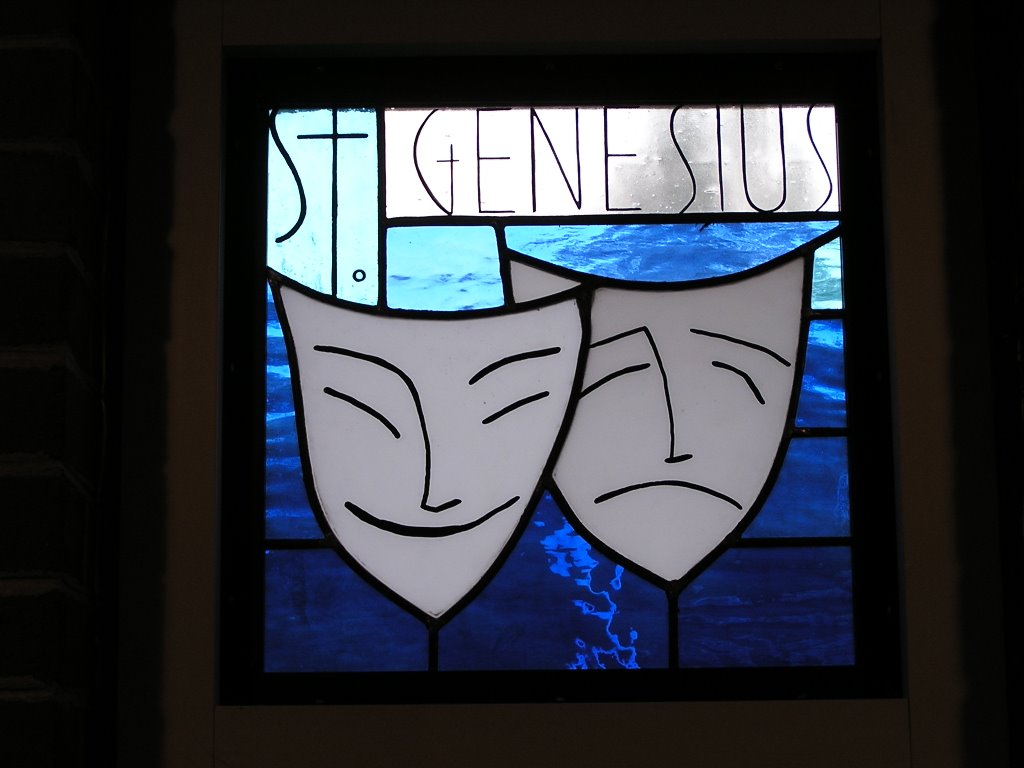
The image to your left is a stained-glass window in St. Thomas Aquinas Church in Charlottesville, Virginia, which serves the students of the University of Virginia as well as the wider community. (The parish is so large that it has to hold its Easter Sunday service at University Hall, the former basketball arena.)

Why, you may ask, does a window dedicated to St. Genesius begin a post entitled "Mask & Bauble at the Georgetown Reunion"? It's really rather simple. I took that picture some time ago because, as a Mask & Bauble alumnus, I remembered that our annual Jenny Awards -- the M&B equivalent of the Tonys or Oliviers -- were named for St. Genesius, the patron saint of actors. I knew that eventually I'd be able to put that photograph to use.

According to legend, as found in the Catholic Encylopedia, St Genesius was:

A comedian at Rome, martyred under Diocletian in 286 or 303. Feast, 25 August. He is invoked against epilepsy, and is honoured as patron of theatrical performers and of musicians. The legend (Acta SS., Aug., V, 119) relates: Genesius, the leader of a theatrical troupe in Rome, performing one day before the Emperor Diocletian, and wishing to expose Christian rites to the ridicule of his audience, pretended to receive the Sacrament of Baptism. When the water had been poured upon him he proclaimed himself a Christian. Diocletian at first enjoyed the realistic play, but, finding Genesius to be in earnest, ordered him to be tortured and then beheaded. He was buried on the Via Tiburtina. His relics are said to be partly in San Giovanni della Pigna, partly in S. Susanna di Termini and in the chapel of St. Lawrence. The legend was dramatized in the fifteenth century; embodied in later years in the oratorio "Polus Atella" of Löwe (d. 1869), and still more recently in a work by Weingartner (Berlinn 1892). The historic value of the Acts, dating from the seventh century, is very doubtful, though defended by Tillemont (Mémoires, IV s. v. Genesius). The very existence of Genesius is called into question, and he is held to be a Roman counterpart of St. Gelasius (or Gelasinus) of Hierapolis (d. 297). He was venerated, however, at Rome in the fourth century: a church was built in his honour very early, and was repaired and beautified by Gregory III in 741.
This post is long overdue. Persistent computer problems early in the month delayed it unmercifully. At one point, I had completed the entire composition, only to lose it due to faulty equipment (or a bad internet connection) at FedEx Kinko's. (The manager kindly returned the money I had paid for the hour-long session.) So, I am trying one more time, in the hopes that I can get these photos on-line precisely one month after the event. So here goes.

During the Georgetown Reunion weekend of June 1-4, some 30 M&B alumni from the Class of 1981 (and chronologically close classes) met on the fringe of the official reunion activities. Early Saturday evening, Dave Lewis and his wife, Cheryl, hosted a cocktail party for us at the Four Seasons hotel in Georgetown before we went back up to the Hilltop for the official class party in O'Donovan Hall.

I snapped a few photos at the M&B party -- fewer than I should have, but we were all too busy having a good time and engaging in conversation (and drinking and reminiscing) to take pictures.

"Mingling with that old-time crowd..."


Joe Banno, Elizabeth Robelen, and Scott Pilarz


Marguerite Conrad, Pete Doragh, Todd Bernhardt


Our host, Dave Lewis, in the center, with Jim Hemelt partially obscured and Karin Hammer in the background; Carolyn Patterson's profile is in the foreground


Rick Lombardo makes a point


Not technically M&B: Later in the evening, I ran into some old friends from the Arts Hall Project -- Dawn Mancuso, Virginia McGrane (who had been at the M&B cocktail party, too), Vincent Santiago, and Victoria Robinson


Since I started with a stained-glass window from Charlottesville, I thought I'd end this piece with a couple of examples of stained glass from Georgetown.

On Saturday afternoon, the Class of 1981 gathered in St. William's Chapel in Copley Hall (once the home of the famed "Freeze's Breeze") for Mass. On the day we graduated in 1981, the homilist at our Baccalaureate Mass that day was the Reverend Otto Hentz, S.J. He concelebrated the Mass on June 3 this year with the Reverend Scott Pilarz, S.J. (see above, out of uniform). Music was provided by a group that Scott called "the Mask & Bauble Choir" consisting of Wendy Campagna, Marguerite Conrad, Trish Sullivan, and myself. After Mass, I snapped a few shots of some of the gothic-style decorations in the chapel, including this crucifix:


... and these stained-glass windows behind the altar:


Sunday, June 04, 2006

Georgetown Reunion 2006

As I mentioned previously, I spent this weekend in Washington for my Class of 1981 reunion at Georgetown University. It was a weekend of nostalgia, academic enrichment, and liquor. (Come to think of it, those three all belong in the same category.) It was also an opportunity to link up with old friends.

Here are a few images from the 2006 Georgetown University Reunion Weekend. (More to come, with captions.)


Monday, May 29, 2006

May 29, 1981

May 29, 1981 -- the Sunday before Memorial Day, hazy in the morning in the Nation's Capital and unseasonably hot (with temperatures eventually reaching the 90s). It was Bob Hope's 78th birthday, it would have been John F. Kennedy's 64th, and it was the anniversary of Wisconsin's 1848 admission as a state in the Union and Rhode Island's ratification of the Constitution.

A Chorus Line was in its seventh year of a record-breaking Broadway run, but Cats (which would eventually overtake that record) had opened in London but not yet in New York. "Bette Davis Eyes" by Kim Carnes was the Number 1 song hit. Jonny Lang was precisely four months old and Britney Spears would come along nearly six months later.

The Falklands War was a year away, John Belushi was still alive, and virtually no one had ever telephoned a friend to ask, "Where are you now?"
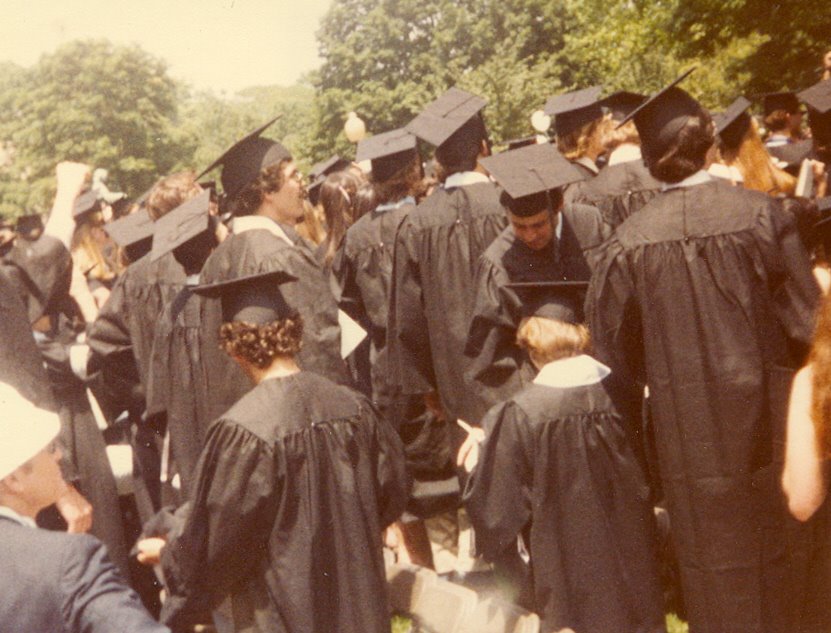
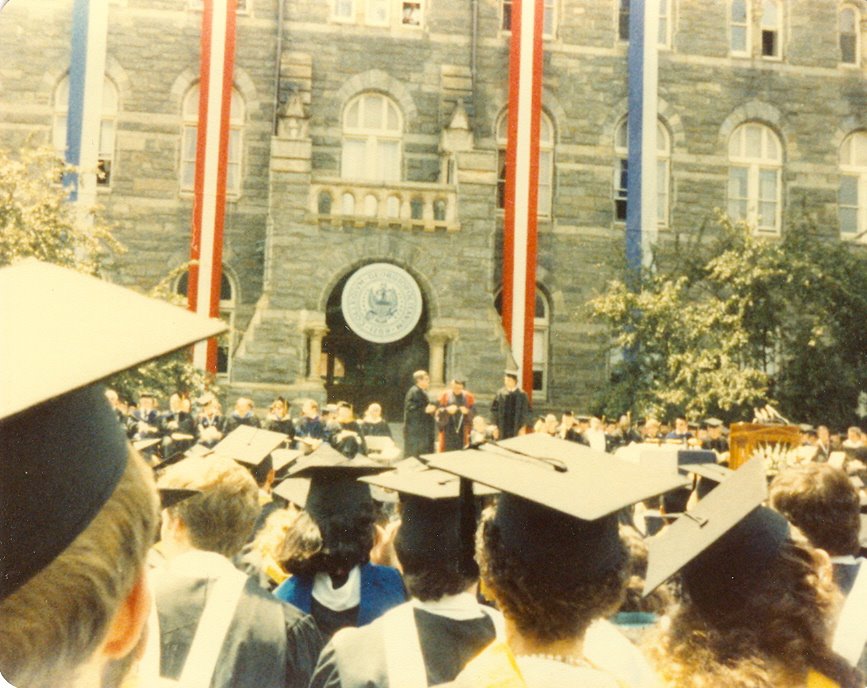
May 29, 1981, was also a day of significance for me. It was the day I was graduated from Georgetown University.

As graduation ceremonies go, it was something of a turning point for Georgetown, too, as it proved to be the last of the unified ceremonies for all the graduates of the University's main campus schools. (The Dental, Law, and Medical schools had long held separate ceremonies.) This meant that SFS, SLL, SBA, the College, and the Nursing schools all gathered together on Healy Lawn to have their several degrees conferred -- undergraduate and graduate degrees alike.

Our class, however, turned out to be unusually rambunctious and rowdy. As you can see from the accompanying photo, I was seated quite far from the podium. Yet my most distinct memory of the afternoon was a champagne cork that was launched behind me and shot right over the head of University President Timothy S. Healy, S.J. (He was, later reports indicated, furious, swearing never to allow such behavior again. If I recall correctly, the next year's graduation speaker was Mother Teresa, in a gambit to stifle rudeness with reverence.) I still have my cap and gown from that day, and my academic hood is splattered with red and pink dots from nearby champagne spills.
The day was also marked by a political protest by those who objected to the choice of commencement speaker, Georgetown government professor Jeane J. Kirkpatrick, who at the time was on leave serving as the U.S. Permanent Representative to the United Nations. Like our current Secretary of State Condoleezza Rice, who recently met a similar protest at another Jesuit school, Boston College, a number of graduates in the Class of 1981 chose to turn their backs on the speaker, and others wore white armbands to show their objections.

To put this in context, the Reagan Administration had been in office for about four months. One of its first diplomatic objectives was to stem the tide of Communist influence in the Western Hemisphere, particularly in Central America, where the Sandinistas had been ruling Nicaragua for two years and a civil war continued to rage in El Salvador. A few months earlier, during the waning months of the Carter Administration, four American Catholic missionaries, all women, had been murdered in El Salvador. A few weeks earlier, on May 3, an estimated 100,000 people marched in Washington to protest the administration's Salvador policy.

Kirkpatrick, as a member of the Cabinet and National Security Council, was a key decision maker in the Reagan Administration's foreign-policy apparatus. As Ambassador to the United Nations, she was also one of the administration's chief foreign-policy spokesmen. So it should be no surprise that she would be a target of protest aimed more generally at the administration.

In her speech, Kirkpatrick tried to deflect the political intensity of the occasion. She began by recounting her strong ties to the University community:

The pleasure I feel in addressing you today is of a very special sort. It is the kind of pleasure one feels upon being reunited with members of one's own family after a prolonged and perhaps traumatic separation. It is the kind of pleasure that Samuel Johnson called "the wine of life" and that St. Augustine said "rejoices the soul." It is, in short, the pleasure of homecoming.

Receiving an honorary degree is naturally gratifying, but sharing a graduation with some of one's own students is a very special pleasure. So is the opportunity to see once again my many friends in this university's faculty, student body, and administration.
Alluding to the objections that greeted the announcement that she would be the commencement speaker, Kirkpatrick recounted -- quite literally -- her travails as a Georgetown professor:
Although I am not in residence, I remain objectively and subjectively a member of this community. That is the reason why I could not possibly oblige the request that one member of this community made to me that I withdraw from this commencement because of some views I presumably hold. I have earned my right to membership in this community. It is my sober calculation that, in the past fifteen years, I have graded at least 10,000 examinations, at least 3,500 term papers, read at least 100 dissertations -- including one whose author is receiving a doctor's degree today -- given at least 3,000 lectures and 738 makeup exams, attended 4,714 committee meetings, and eaten 892 hotdogs from Wisemiller's. In the process, Georgetown University has become part of me. It is an identification I cherish.
The line, "I have earned my right to membership in this community," was met with scattered catcalls and jeers, but the rest of the passage was received with enthusiastic applause and cheers.

During the next few minutes, Kirkpatrick hearkened back to Georgetown's history and its place in U.S. history.
I cherish it because this university is, in my firm opinion -- an opinion based on detailed knowledge -- a serious and distinguished university.
(I'll second that.)
Moreover, I like it. I like the way its history is intricately intertwined with that of our nation. Born the same year as the nation's Constitution, situated on the river that George Washington walked beside, Georgetown has for two centuries embodied and communicated the moral and intellectual commitment and discipline that characterize our civilization at its best.

Of course, not everyone has always shared this benign view of the university and of its founders and owners and managers, the Society of Jesus. One of the nation's Founding Fathers, I discovered, wrote to another of the nation's Founding Fathers not long after the establishment of Georgetown: "I do not like the reappearance of the Jesuits. If ever there was a body of men who merited damnation on earth and in hell it is the Society of Loyola's. Nevertheless we are compelled by our own system of religious toleration to offer them an asylum." Thus wrote John Adams to Thomas Jefferson. Oh well, it's never been possible to please all the people all the time.
(She does not say how Mr. Jefferson replied.)

In the rest of her remarks, framed as a discussion of the quality of the students at Georgetown, Kirkpatrick proved unusually prescient.

Keep in mind that, at the beginning of the Reagan administration, the United States was still suffering from the stagflation of the 1970s, with accompanying high interest rates, record-high gasoline prices (and gas lines and gas shortages), and a major recession featuring huge swathes of unemployment. We were at the height of the Cold War and knew not who would win (or even if victory was possible). Even the Pope had recently been the victim of an assassination attempt by a Communist agent. It looked like the United States and the Soviet Union would be locked in a generations-long conflict, forever on the brink of nuclear war. This was the world in which we lived, and in which we expected to live for a long, long time. In short, we were feeling pinched by our circumstances, so pessimism would not have been unrealistic for many graduates at the time, who were uncertain of gaining employment even with a prestigious college degree.

The Reagan tax cuts and regulatory reforms had not yet taken effect, nor had they jumpstarted the economy to begin the longest uninterrupted, peacetime economic expansion in history. So Kirkpatrick's speech at the 1981 Georgetown commencement exercises showed both optimism and, it turned out, foresight.

"We come here today," she said
neither to praise nor to blame Georgetown but to talk about you, the graduates, and to a lesser extent your parents. I know rather more than the average commencement speaker about both of you. I have read the statistical profiles of your class since before you entered as freshmen. Moreover, I know a good deal firsthand about the anxieties and gratifications and the expenses of parents. I've been there -- indeed, I am there. But what do I know about your futures?

I know that students, all of you, are now and will for some time continue to be faced with more freedom and more choices than any other comparable generation in human history, in part but not only because this is an extraordinarily free society, one that permits us to live where we like, to read and write what we choose, to worship according to our conscience, to practice any profession we are able. Those freedoms were also enjoyed by Greeks in Athens' Golden Age providing they happened to be free and not slave, providing they happened to be citizens and not foreigners. But we, you and I, enjoy freedoms of which the Athenians never dreamed because contemporary technology has given us unprecedented powers and their attendant choices. You graduates are blessed and cursed with the freedom and the necessity to define yourself, to choose from among the dazzling array of attitudes, values, roles, your own -- what has come to be called -- life style.
(So true, so true indeed.)
Once your role would have been settled at birth. The son of a swineherd, you would have been a swineherd. The son of a merchant, you would have been a merchant. And the daughter of either, you would have ben the wife and mother of more swineherds and merchants.
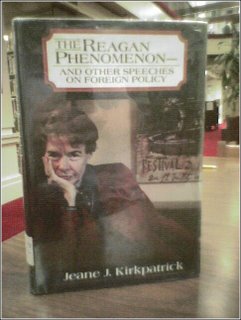
Just for the record, I am not quoting Ambassador Kirkpatrick's speech from memory. The text is found in her 1982 book, The Reagan Phenomenon and Other Speeches on Foreign Policy. Oddly enough, I had to find the book at the Jefferson-Madison Regional Library. I say "oddly" because I compiled the index for that book, as a favor to its editor (and for a reasonable fee), during the World Series of 1982 -- but I don't have it in my collection of books I have had a hand in. (Also strange: Although Kirkpatrick wrote a dozen or more books, this was the only one of hers in the library's entire collection. Luckily for me it was shelved at the Central Library branch in downtown Charlottesville.)

Next weekend my classmates and I will gather on the Hilltop to celebrate at our 25-year reunion. No doubt individuals have advanced to varying levels of success. Some will be doing exactly what they expected they would do upon graduation; many others will have taken their lives in totally unexpected directions.

Last Friday over dinner, a friend of mine who graduated from the University of Virginia asked me who was the most famous member of my own graduating class at Georgetown. He was fishing for names of Members of Congress or other political figures.

I could not think of any members of my class who have become successful Washington politicians. Perhaps there are a few. I suspect some may have been elected -- or tried to be elected -- as city councilors, mayors, even state legislators. I hope they show up at the reunion so we can trade campaign war stories.

I am sure that there are more than a few 1981 alumni who are well-known and well-respected in their professions (lawyers, doctors, scientists). At least one is a university president. I am unaware of any Oscar-, Tony-, Grammy-, or Emmy-winning 1981 Hoyas -- but I would be most pleased to learn of some.

But "most famous"? That actually turns out to be easy to answer, if by "fame" one means known to the largest number of people.

If that's the case, my classmate (and one-time Living-Learning Project floormate) Amy Dickinson is the "most famous member of the Georgetown Class of '81." Amy, as the successor to the Chicago Tribune's Ann Landers, is a syndicated advice columnist in at least 200 newspapers, including the Los Angeles Times and Washington Post. She is also heard as a sometime panelist on NPR's "Wait, Wait ... Don't Tell Me."

I'm looking forward to the reunion, in particular, for the opportunity to see again my fellow Mask & Bauble alumni. As anyone who has done college theatre can tell you, working together on shows is a uniquely, intensely bonding experience. (I sometimes estimate that I spent more hours in Stage III during my first three years of college than I did in the classroom. My fourth-year grades demonstrate the likely accuracy of that estimate.) A special cocktail reception for M&Bers is planned.

Next year I have a twofer -- or double whammy, depending on how you look at it -- 30 years since my graduation from Marquette University High School in Milwaukee and 20 years since receiving my master's degree from the London School of Economics and Political Science. I guess 2007 will be a big year for parties.

Addendum: Since posting this article, I came across an amusing compilation of excerpts from this year's crop of commencement addresses, in the Reliable Source column in Sunday's Washington Post Style section. Very funny on line, but best seen in the print edition for full effect.

Update and Correction, July 3: I just made an embarrassing discovery, and as a blogger I have an ethical obligation to correct it. (We talked about this sort of thing at length at the Sorensen Institute bloggers' summit.) It turns out my graduation from Georgetown was not on May 29, 1981, but rather on Sunday, May 24. (I found this date on the program for the "Baccalaureate Mass, 182nd Annual Commencement of Georgetown University" and confirmed it by looking at my diploma. D'oh!) This means, of course, that all that nifty trivia in the first two paragraphs is irrelevant. The rest, however, is accurate. I apologize for the error but have to ask -- why didn't anyone else catch it before now?