Showing posts with label Israel. Show all posts

Wednesday, December 12, 2018

Guest Post: An archaeological dig in Israel suggests how feasting became an important ritual


Natalie Munro, University of Connecticut

This holiday season millions of families will come together to celebrate their respective festivals and engage in myriad rituals. These may include exchanging gifts, singing songs, giving thanks, and most importantly, preparing and consuming the holiday feast.


Archaeological evidence shows that such communally shared meals have long been vital components of human rituals. My colleague Leore Grosman and I discovered the earliest evidence of a ritual feast at a 12,000-year-old archaeological site in northern Israel and learned how feasts came to be integral components of modern-day ritual practice.


First, what are rituals?


Rituals involve meaningful, often repeated actions. In modern-day practices they are expressed through rites such as the hooding of a doctoral student, birthdays, weddings or even sipping wine at Holy Communion or lighting Hanukkah candles.
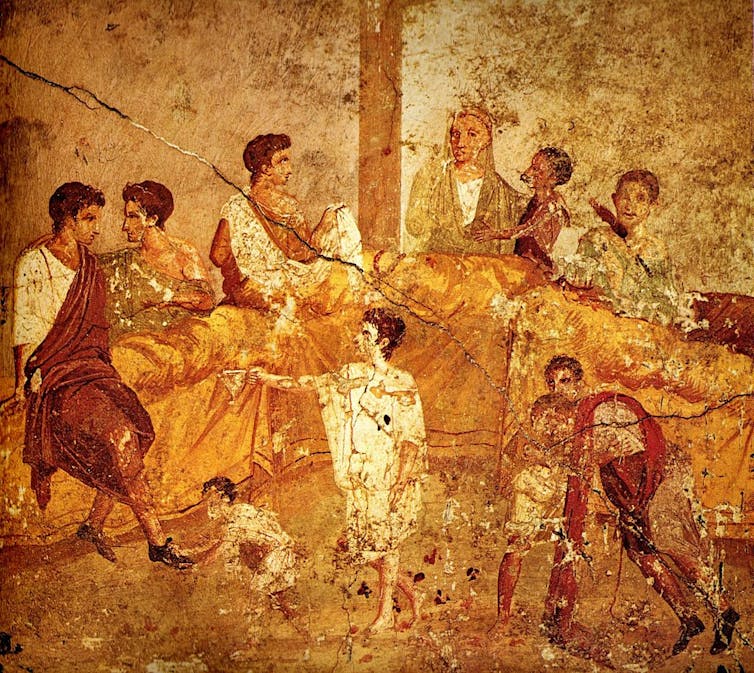


Pompeii family feast painting Naples

Pompeii family feast painting, Naples.
Unknown painter before 79 AD, via Wikimedia Commons


Ritual practice may have emerged along with other early modern human behaviors more than 100,000 years ago. However, proving this with material evidence is a challenge. For example, researchers have found that both Neanderthals and early modern humans buried their dead, but scholars weren’t certain whether this was for spiritual or symbolic reasons and not for something more mundane like maintaining site hygiene. Likewise, the discovery of 100,000-year-old symbolic artifacts like pierced shell ornaments and decorated chunks of red ochre in caves in South Africa, was not sufficient to prove that they were part of any ritual activities.

It was only when archaeologists found these artifacts, placed in graves going back 40,000-20,000 years, that it was confirmed they were part of ritual practice.

The first feasts


We had a similar experience during our research. When Leore Grosman and I first embarked on the excavations at Hilazon Tachtit in the late 1990s, we were only hoping to document the activities of the last hunter-gatherers in Israel, at what appeared to be a small campsite. It was only over several seasons of excavation that it slowly became clear to us that this was not a site where people had lived. Rather it was a site for rituals.
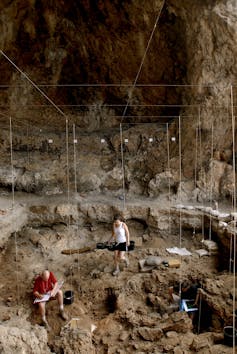


Hilazon Tachtit cave interior. Naftali Hilger

Hilazon Tachtit cave interior.
Naftali Hilger, CC BY-NC-ND


No houses, fireplaces or cooking areas were recovered. Instead the cave yielded the skeletal remains of at least 28 individuals interred in three pits and two small structures.

One of these structures contained the complete skeleton of an older woman, who we interpreted as a shaman based on her special treatment at death. Her grave stood apart due to its fine construction – the walls were plastered with clay and inset with flat stone slabs. Even more remarkable was the eclectic array of animal body parts buried alongside of her. The pelvis of a leopard, the wing tip of an eagle, the skulls of two martens and many other unusual body parts surrounded her skeleton.

The butchered remnants of more than 90 tortoises buried in the grave and the leftovers of at least three wild cattle deposited in a second adjacent depression excavated in the cave floor represent the remains of a funeral feast.
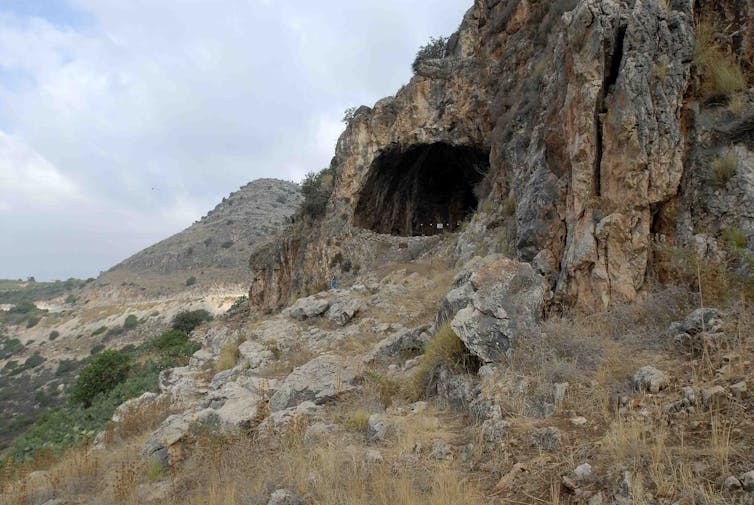


Hilazon Tachtit cave. Naftali Hilger

Hilazon Tachtit cave.
Naftali Hilger, CC BY-NC-ND


The outstanding preservation of the grave enabled us to detect multiple phases of a ritual performance that included the consumption of the feast, the burial of the woman, and the filling of the grave in several stages, including the intentional deposition of garbage from the feast.

Feasting at the beginning of agriculture


Archaeologists have found other sites that show evidence of ritual feasting. Many of these date to the time when humans were beginning to farm.
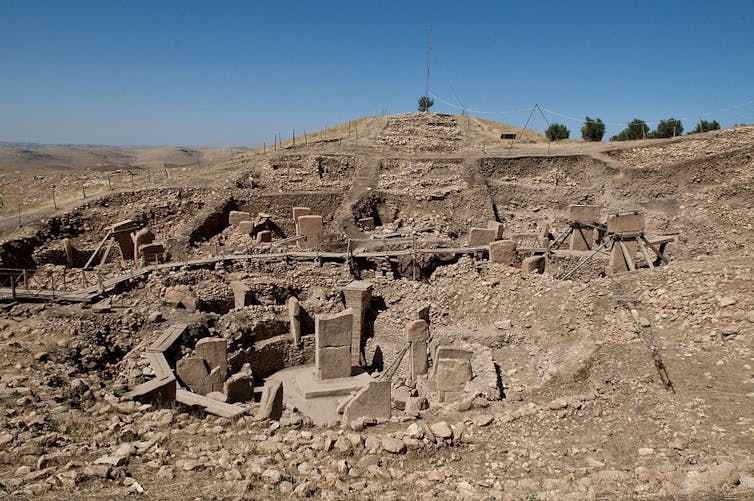


Site of Göbekli Tepe. Teomancimit

Site of Göbekli Tepe.
Teomancimit (Own work) , via Wikimedia Commons, CC BY-SA


One of the most striking is the site of Göbekli Tepe in southeastern Turkey, dating slightly later than Hilazon Tachtit. It includes multiple large structures adorned with benches and giant stone slab carved with exquisite animal depictions in relief dating to 11-12,000 years ago. Perhaps, these were very early communal buildings. The archaeologists who excavated Göbekli Tepe argue that massive quantities of animal bones associated with the structures represent the remains of feasts.

Twelve thousand years ago humans were still hunter-gatherers, subsisting entirely on wild foods. Nevertheless, these people differed from those who went before – they were sitting on the brink of the transition to agriculture, one of the most significant economic, social and ideological transformations in human history.

Sickle blades and grinding stones used to harvest and process cereal grains are found at Hilazon Tachtit and other contemporary archaeological sites. These findings indicate that these ritual feasts started around the same time that people adopted agriculture. When people began to rely more heavily on wild cereals like wheat and barley, they became increasingly tethered to landscapes that were ever more crowded and began to settle into more permanent communities. In other words, feasting became a part of their life, once they moved away from nomadic life.

Rituals that bind


These feasts had an important role to play. Adapting to village life after hundreds of millennia on the move was no simple act. Research on modern hunter-gatherer societies shows that closer contact between neighbors dramatically increased social tensions. New solutions to avoid and repair conflict were critical.

The simultaneous appearance of feasting, communal structures and specialized ritual sites suggest that humans were seeking to solve this problem by engaging the community in ritual practice.

One of the central functions of ritual in these communities was to provide a kind of social glue that bound community members by promoting social cohesion and solidarity. Feasts generate loyalty and commitment to the community’s success. Sharing food is intimate and it builds trust.

Communal rituals would have provided a shared sense of identity at a time when social circles were increasing in scale and permanence. They reinforced new ideologies that emerged out of a dramatic reorganization of economic and social life.

Role of feasts today

Feasting plays the same essential role today. Like the earliest feasts, our holiday celebrations are replete with actions that are repeated year after year.

The holiday feast today builds family traditions. By cooking and sharing food together, telling stories of past holidays and exchanging intergenerational wisdom, holiday rituals bond extended families and give them a shared identity.The Conversation

Natalie Munro, Professor, University of Connecticut

This article is republished from The Conversation under a Creative Commons license. Read the original article.


Friday, September 18, 2009

Porn for a Cause

Each week I look forward (pardon the pun) to an email from The Jewish Daily Forward, with a list of its most recent articles. I can always depend on The Forward for quirky, unexpected news and cultural commentary that simply can't be found anywhere else.

For instance...

This week there was a story on Russian-Jewish emigre Michael Lucas, who spent his childhood under Soviet Communism and who now lives an entrepreneurial American success story. Simply put, he's an adult movie producer -- in fact, he's an award-winning gay porn producer.

The article, headlined "Pornographic Stimulus Plan," by Michael Kaminer, highlights the latest offering by Lucas Entertainment, a video entitled Men of Israel.

Kaminer says that it is claimed that the film is "the first gay adult film made in Israel with an all-Israeli cast." (That cast includes Avi Dar, Matan Shalev, Jonathan Agassi, Guy Ronen, Morr-Foxx, Naor Tal, and Ninrod Gonen.)

What's more, the Forward article continues,

Lucas claims that his motivation behind “Men of Israel” was not just titillation, but also a counterbalance to lopsided portrayals of Israel in mainstream media. “It’s free PR for Israel, and it’s much better than the PR they’re getting on the news,” he said during a tour of the company’s expansive second-floor offices, with views of the New York Times building across the street. “The reality is that Israel has only one face to people on the street, and that’s the West Bank and Gaza. All people see in the media is a country of disaster. They get images of a blown-up bus.”

By contrast, Lucas said, the images in “Men of Israel” — filmed in telegenic Tel Aviv, Haifa and desert locations by Israeli fashion photographer Ronen Akerman — amount to a pornographic stimulus campaign for gay tourism.

“Nobody goes to Israel for Golda Meir, I’m so sorry,” Lucas said in heavily Russian-accented English. “People don’t care that you have a great orchestra, and they’re not particularly interested in the Holocaust museum. Gay people, and straight people, want beautiful beaches, beautiful nature, beautiful men and women, good food, good hotels. Israel shouldn’t be mistaken about why people go there. They need me.
Will Men of Israel do for Israeli tourism what The Lord of the Rings did for New Zealand, or what Da Vinci Code author Dan Brown's new novel, The Lost Symbol, is expected to do to bring more tourists to Washington, D.C.? Michael Lucas seems confident that it will; Kaminer reports that Lucas recently became an Israeli citizen.


Be sure to visit my CafePress store for gifts and novelty items!
Read my blog on Kindle!

Tuesday, August 11, 2009

Israel's 'Tragic Paradox'

Somehow I missed commenting on the murders and mass assault in a gay youth center in Tel Aviv earlier this month.

Israelis have not let the incident slip by. A Jewish Telegraphic Agency report noted on Sunday:

Tens of thousands of Israelis demonstrated in solidarity with Israel's gay community at a rally in Tel Aviv.

Saturday night's rally also was a show of support for the victims of last week's shooting at a Tel Aviv community center for gay and lesbian youth in which two were killed and a dozen wounded.

Israeli President Shimon Peres addressed the crowd, which organizers put at 70,000 and police at 20,000.

"The bullets that hit the gay community at the beginning of the week struck us all as people, as Jews, as Israelis," Peres said.

"All people were created in God's image," he added, "and all citizens have equal rights. All men are born equal, and every citizen has the right to be who he is -- to be free and proud.
Prime Minister Benjamin Netanyahu made a personal visit to the gay community center at 28 Nachmani Street in Tel Aviv. According to Ha'aretz:
Netanyahu told leaders of Israel's gay and lesbian community that he would do more to root out manifestations of hate within Israeli society. The premier also promised community leaders that his government would work to address their needs.

"I realize that the gay community has special needs," Netanyahu said. "I want to assure you that we are open and receptive and that I as well as the ministers in my government will advance these important issues, some of which became known to me today."

Netanyahu added that he believed "that the labeling and negation of human beings is wrong in and of itself. We were all made in God's image, we all have basic rights, the first of which is to be respected by our fellow man and to respect others. Unfounded hatred is wrong. Anyone who had experienced that kind of hatred, as an individual or as part of a group, knows how painful and wrong it is. Its something we need to try as hard as we can to root it out of our society."
In an article in The Advocate published yesterday, commentator Jamie Kirchick notes a curious fact that emerges from the attack on a community center that catered to the social needs of gay and lesbian teenagers:
At a Washington vigil held last Monday evening to mourn the victims of the Tel Aviv gay youth center shooting, an official from the Israeli embassy made a keen observation. It was a “tragic paradox,” he said, for “this crime could only take place in Israel out of all the countries in the Middle East because there’s nowhere else in the Middle East where there could be a meeting house for gay young people, which is open and which everybody knows its address.”
Kirchick goes on to point out that
...if there is anything positive to be gleaned from this horrific incident, it has been the reaction of the Jewish state’s citizens. The country’s newspapers have published countless articles about the status of gay people in Israeli society and the persistent problem of homophobia. Even the country’s ultrareligious figures -- perhaps cognizant of how their own teachings may have created an environment in which such an attack could take place -- have condemned the murders.
Then he contrasts the situation in Israel with that in neighboring countries:
Throughout the Middle East, it is usually the governments themselves that are committing the violence against their own gay citizens.

In 2001, Egypt arrested 51 men aboard a gay cruise ship and subjected them to a show trial in which their faces were displayed on national television. Iran executes gays, whose existence its president denies. In Saudi Arabia the punishment for homosexuality is decapitation.
Kirchick reminds his readers for the reason that Israel and the United States have a close relationship: we share "a set of common liberal values, values which Israel’s neighbors simply do not share."

We sometimes forget that liberal values -- including, but not limited to, religious and philosophical tolerance, respect for freedom of speech and freedom of assembly, and adherence to the rule of (non-arbitrary) law -- are what animate societies like the United States and Israel, and what protect us against the predations of the power-hungry and intolerant. They also separate us from what might be called, perhaps infelicitously, barbarian societies.

Liberal values also include the openness and freedom that sometimes make us more vulnerable to mad acts of terrorism and criminality. These infrequent events are the price we pay for individual liberty.

Years before the U.S. Constitution and Bill of Rights incorporated the freedoms we challenge into our basic law, Benjamin Franklin wrote (in 1775):
They who can give up essential liberty to obtain a little temporary safety, deserve neither liberty nor safety.
Consider that the paradox of liberty. It's not just Israel's tragic paradox; it's ours, too.


Be sure to visit my CafePress store for gifts and novelty items!
Read my blog on Kindle!

Friday, February 15, 2008

Terrorist Bunny

If you think the only killer bunny is the one in Monty Python and the Holy Grail (or in its stage version, Monty Python's Spamalot), you're wrong.

The Forward reports on a bunny character featured on a children's TV program produced by Hamas. This bunny promises to kill Jews.

Here's Eli Rosenblatt's report from the Forward, originally published on February 13:

The creators of children’s television often focus their attention on improving their audience’s reading skills. Hamas’s Al-Aqsa TV station, however, seems concerned with teaching its younger viewers how to spell destruction. A new video shows a human being-sized rabbit named Assud who learns that his brother, a bee, has died after being denied passage to Egypt for medical treatment. In a venomous lilt, the rabbit tells a little girl, “I, Assud, will finish off the Jews and eat them!”

Assud the Rabbit is a new character on the kids show “Tomorrow’s Pioneers,” which broadcasts from Gaza and is spread by satellite throughout the Middle East. The show, according to translations by the Middle East Media Research Institute, meshes a saga of stuffed animals with lectures about key elements in Hamas ideology — the right of return, the re-conquest of Jerusalem and martyrdom in the name of Allah.

Recently, an Al-Aqsa video of Farfur, a Hamas mouse reminiscent of Mickey Mouse, was spread around the Internet. After the station met worldwide condemnation, Farfur was killed off the show and the mouse’s little fans were told that he was beaten to death by an Israeli interrogator.
And some people complain that Sesame Street is propaganda!

Tuesday, July 04, 2006

Idi Amin and the Raid on Entebbe

Aside from being the 230th anniversary of American independence, the Fourth of July this year marks the thirtieth anniversary of the raid on Entebbe airport by Israeli commandos, who rescued some 100 Jewish hostages from an Air France passenger jet that had been hijacked by Palestinian and German terrorists. The Ugandan government, then under the control of strongman Idi Amin, assisted the hijackers by allowing them to land the plane at the Entebbe airport, not far from Uganda’s capital city, Kampala, and offering the protection of the army.

In a pre-dawn operation, as recalled by the BBC, “Ugandan soldiers and the hijackers were taken completely by surprise when three Hercules transport planes landed after a 2,500-mile trip from Israel. About 200 elite troops ran out and stormed the airport building. During a 35-minute battle, 20 Ugandan soldiers and all seven hijackers died along with three hostages.”

Although at the time much of the attention focused on the drama of the lighting-quick raid, it also had long-term political implications, because the raid embarrassed and ultimately undermined the dictatorial regime of Idi Amin, who did not so much govern Uganda as reign over it through cruelty and terror. Ugandans had an expression in those days, saying that Amin “ruled by helicopter.” That is, whenever someone in a village somewhere in the country did something that displeased him, he sent helicopters to destroy the village and kill all those who lived in it. Over time, Amin murdered more than a million Ugandans, sent countless others into exile, and destroyed the country’s economic vitality and infrastructure.

The raid on Entebbe showed Idi Amin to be a sham as well as a coddler of terrorists. As Charles Onyango-Obbo wrote in a 1997 article in The East African newspaper, the “raid was a personal humiliation for Amin, and a defeat for his hated army. For a country which had resigned itself to Amin ruling as long as he wished, July 4, 1976, shattered his aura of invincibility. Nothing Amin did after that could rebuild his grip on the country.”

Ten years after Amin was finally deposed, I wrote a review of a book about him and two other African dictators who also lost their thrones in 1979. The review ran in the New York City Tribune, a now-defunct sister publication of the Washington Times. During the 1980s, I wrote a lot of articles for that paper. In fact, while I was in graduate school, weekly articles and book reviews provided me with a meager amount of pocket money that allowed me to continue to buy theatre tickets and restaurant meals as my stipend drained away.

I dug up a copy of that book review as I recalled today’s anniversary of the raid on Entebbe, because I thought its capsule summary of Amin’s reign of terror deserved a bit of remembrance.

From the New York City Tribune, March 6, 1989:

Tales of Three African Dictators That Spin a Cautionary Lesson

Psychoses of Power: African Personal Dictatorships, by Samuel Decalo, Westview Press, 197 pp., $29.95.

“Solitary, poor, nasty, brutish, and short,” were the words Thomas Hobbes used to describe life in the “state of nature,” which he also called a “war of all against all.” Hobbes, writing in the 17th century, was probably remembering the not-so-distant history of Europe in the Middle Ages. In the absence of strong central government, anarchy ruled the land. Feudal barons, ready to feed their own venal appetites, warred against each other, against the king, against the Church. Each generation experienced at least one war that, through battle or disease, cut down large fractions of the population.

That is all in the past. Or is it? Psychoses of Power, three frightening case studies by Samuel Decalo, currently visiting professor of comparative African government at the University of Natal, reveals that the 20th century does not lack Hobbesian anarchy. Neither are the subjects of his study – Francisco Macias Nguema of Equatorial Guinea, Idi Amin of Uganda, and Jean-Bedel Bokassa of the Central African Republic – necessarily anomalies. The germ of economic decay and political disarray that grew into their monstrous personal dictatorships exists in other African countries, ready to sprout under the right conditions.

These personal dictatorships differ substantially from merely authoritarian or autocratic regimes elsewhere in Africa (and elsewhere in the Third World, as well). Authoritarian dictators see fit to delegate power when necessary. Although they may be corrupt and dispense patronage for their own financial benefit, they do allow others to make policy decisions and exercise the authority granted them by the dictator. Personal dictators like Nguema, Amin, and Bokassa insist on excercising total authority, making all decisions, and dispensing all patronage. Chaos results.

In the case of Nguema and Amin, and partially in the case of Bokassa, men fundamentally unprepared to hold responsible public office became leaders of strife-ridden former colonies. Amin was totally illiterate and found policy discussions among Cabinet ministers boring and irrelevant. Nguema was a sycophant and drug addict who hated knowledge and success. Bokassa, although by all accounts a courageous and competent soldier, was greedy and lacked judiciousness.

Although the rise to power of these three men was largely accidental, the parallels are startling.

Amin started as a cook’s assistant in the Ugandan colonial army; the British, anxious to Africanize the services, on several occasions overlooked bad reviews of Amin’s suitability and promoted him. He eventually became chief of staff, the post that allowed him to lead the coup that ousted Milton Obote when Obote’s economic policies failed and he began to lose political legitimacy.

Nguema began as a petty local bureaucrat. The Spanish colonial rulers and Spanish expatriate businessmen liked him, because unlike his fellow Fang tribesmen, he supported Spanish interests. With the support of his relatives, he became the most bloodthirsty dictator in recent African history.

Bokassa, as noted, was a brave soldier. He fought in the French army in Vietnam and was decorated for valor. The French authorities respected Bokassa and named him to head the Central African Republic’s army upon independence. Economic and social confusion under the president of the CAR made it apparent that a new regime might sack Bokassa. To forestall that, he led a coup on New Year’s Eve in 1965, and installed himself as dictator.

Although the least known of the three, Nguema was probably the bloodiest. He exterminated all of his subjects who had better than a third-grade education. Refugees from Equatorial Guinea flooded neighboring countries. Nguema personally ruined the country’s economy, keeping all foreign (and much domestic) currency in suitcases in his bedroom. He retreated into sorcery, threatening any opposition that upon his death he would return as a vicious tiger to destroy them.

Amin’s story is better known, perhaps because he became an international joke. His buffoonery, however, resulted in genocide. Because he lacked interest in public policy, no genuine policies were made during his reign. One significant decision, however, did have substantial impact on Uganda’s future. In 1973, he expelled all Asians from the country. In one fell swoop, Uganda’s entrepreneurial class left. Shops, factories, and services ended, as did exports and imports. Although politically popular for racist reasons, this decision destroyed the Ugandan economy, and recovery is unlikely in our lifetimes.

Bokassa made world headlines in 1977 when he proclaimed himself emperor of the Central African Empire. Modeling his coronation after Napoleon’s, he crowned himself when the Pope declined to do the job. At first the French supported him, but even they could no longer be relied upon after Bokassa himself clubbed to death schoolchildren who in 1979 protested the mandatory wearing of school uniforms with Bokassa’s image on them. French paratroopers moved in, deposing Bokassa. Several thousand French troops remain today, making the Central African Republic a virtual French colony, despite the rhetoric of independence.

Life has not improved for the residents of these African countries since their dictators were deposed. In Equatorial Guinea and Uganda, new dictators came to power. In Equatorial Guinea, Nguema’s own henchmen ousted him when he became too unpredictable. They remain in power and continue the terror. In Uganda, Milton Obote returned and after presiding over the genocide of as many as 400,000 Ugandans, he was again overthrown. Tyranny has been tempered by the French presence in the CAR, but there is little hope for the future.

The lessons of these three case studies are not clear. Certainly the three dictators were idiosyncratic, maladjusted, and just plain mad. But other dictators remain in Africa, even if slightly more benign: Kenneth Kaunda in Zambia, Mobutu Sese Seko in Zaire, Kamuzu Banda in Malawi. Yet it is frightening to note that while heads of state, Nguema, Amin, and Bokassa each retained a measure of respectability within the international community.

Their crimes were ignored for raison d’etat. An eerily similar respectability was granted Hitler, Mussolini, and Stalin in their time, and the international community pays little attention to what goes on in places like Zambia, Zaire, and Malawi today.

Psychoses of Power deserves whatever attention it gets from policymakers, human rights activists, and international bureaucrats. I fear that too many readers will look at it as an interesting case study of political freaks with little to say about the present or future. They should look more carefully at current conditions in the Third World and ask themselves: Are these personal dictatorships really so strange?

Richard Sincere is a research associate at the Ethics and Public Policy Center in Washington, D.C.