Friday, November 18, 2005

No Complaints

I'm in Washington, D.C., at the moment, attending the annual meeting of the African Studies Association, but I was excited to find something in my email box late last night and wanted to bring it to the attention of my readers.

The Hugo Commission (formally known as the General Assembly's Joint Subcommittee to Study the Certification, Performance, and Deployment of Voting Equipment) will be meeting for the last time next Monday, November 21, when it is expected to make its recommendations regarding Virginia's voting equipment of the future.

I have written about the Hugo Commission's proceedings before (most notably on August 22, August 26, indirectly on August 30, and September 6), so this might be -- depending on the joint subcommittee's recommendations -- the last time I revisit this issue.

What I have to offer today is the result of a survey undertaken by the staff of the Charlottesville Electoral Board. And I think the survey speaks for itself, so I will reprint here, in full, the report that was submitted to the Hugo Commission in anticipation of Monday's meeting. (My formatting here is somewhat different than that of the printed report that the subcommittee received.)

For those who don't want to wade through the whole thing, here's how I read it: Virginia voters are, on the whole, satisfied with the electronic voting systems currently in use. Only a very few have issued any complaints to local election officials. Out of 2 million voters who went to the polls on November 8, only a few dozen, at most (based on the results of our survey), expressed reservations about the current machines to their local officials. Now that doesn't mean that others may not have complained to their friends, or that they didn't express their views to advocacy groups or political party officials -- it only means they took only a minuscule number of complaints, compared to the universe of active voters, to their General Registrars or other election officials.

Are the results of this survey dispositive? No, but I'd say they provide a strongly persuasive indication that Virginia voters are fundamentally satisfied with the electronic voting equipment their localities use.

If my arithmetic is correct, in voting jurisdictions constituting just over 50 percent of localities that use DREs (the rest use optical scan systems, except Highland County, which uses paper ballots, and Virginia Beach, which used its old-fashioned lever machines for the last time in this election), there were 26 complaints about DRE equipment and somewhat fewer complaints about, questions about, or requests for a VVPAT (voter-verifiable paper audit trail). (The latter category is a bit vague, since a couple of registrars responded to the survey question with "several complaints" or "several questions"; a more formal survey would have ferreted out firmer numbers.) The largest number of complaints came in Falls Church, which was using the Hart eSlate system for the first time in this election. I am certain this number will fall in subsequent elections in that small city.

This suggests that even if we surveyed all the DRE-using counties and cities in Virginia, the number of complaints would hover around 50 to 60 out of perhaps a million or more voters in last week's statewide elections. That's what I would call a vote of confidence (no pun intended) in the voting systems Virginia localities use.

I'd be interested in hearing responses from the people who did complain and ask: Should their minority opinion prevail in an issue that will require millions of dollars of investment in new voting equipment (should the General Assembly legislate such a requirement) in an era of government budget austerity?

The full report follows:

Report to Members of the Joint Subcommittee to Study the Certification, Performance, and Deployment of Voting Equipment

November 17, 2005

Results of a Survey of General Registrars Following the November 8, 2005 General Election, Regarding the Performance of Direct Recording Electronic (DRE) Voting Equipment


Beginning on November 14, 2005, the staff of the General Registrar and Electoral Board of the City of Charlottesville conducted an informal survey of the Registrars of the Commonwealth of Virginia regarding the performance of DRE voting equipment, and the nature of feedback from voters regarding the use of such equipment. In many localities across the state, this was the first major election in which such equipment had been utilized, due to the imminent January 1, 2006, deadline placed on localities by the Help America Vote Act (HAVA), by which time all voting equipment must meet federal guidelines.

The general level of feedback both from the electorate, and from registrars and election officials was overwhelmingly positive, with few serious complaints regarding the performance of DRE voting equipment or the lack of a Voter-Verifiable Paper Audit Trail (VVPAT) used in conjunction with such equipment. Across the state, disabled and elderly voters responded very positively regarding the DREs “ease of use,” and their capability to allow blind and other disabled voters to cast a secret ballot, for the first time in the case of many voters. Most of the complaints regarding the DRE machines were due to operator errors or to calibration errors in systems utilizing touch-screen technology. There were complaints regarding the lack of a paper “receipt” from voters after casting their votes electronically, but in nearly all cases these were quelled after the Officers of Election or staff of the Registrar’s Office explained the many redundancies built into DRE machines and their ability to print a paper record of each vote cast if necessary.

The following is a summary of the feedback from the 42 General Registrars who responded to the survey. Their responses are organized by region of the state, and they include information on the type of voting equipment in use and the number of registered voters in each locality. Each respondent was asked to provide feedback on the following three questions:

(1) Were there any voter complaints on or after Election Day 2005 regarding DRE equipment? If so, how many complaints were there?

(2) Were there any voter complaints on or after Election Day 2005 regarding DRE performance? If so, how many?

(3) Were there any voter requests on or after Election Day for adding a voter-verifiable paper audit trail (VVPAT) to current equipment?

Tidewater

Accomack County
Type: Rural
Registered Voters: 20,232
Voting Equipment: WinVote – Touch Screen DRE

Feedback on the Nov 8, 2005 Election:
No Complaints about DRE or Requests for VVPAT


Caroline County
Type: Rural
Registered Voters: 14,832
Voting Equipment: WinVote – Touch Screen DRE

Feedback on the Nov 8, 2005 Election:
No Complaints about DRE or Requests for VVPAT


Charles City County
Type: Rural
Registered Voters: 4,742
Voting Equipment: Edge – Touch Screen DRE

Feedback on the Nov 8, 2005 Election:
No Complaints about DRE or Requests for VVPAT


Essex County
Type: Rural
Registered Voters: 6,198
Voting Equipment: Sequoia Edge – Touch Screen DRE

Feedback on the Nov 8, 2005 Election:
No Complaints about DRE or Requests for VVPAT


Middlesex County
Type: Rural
Registered Voters: 7,111
Voting Equipment: WinVote – Touch Screen DRE

Feedback on the Nov 8, 2005 Election:
No Complaints about DRE or Requests for VVPAT

New Kent County
Type: Rural
Registered Voters: 10,269
Voting Equipment: iVotronic – Touch Screen DRE

Feedback on the Nov 8, 2005 Election:
1 Complaint about DRE
No Requests for VVPAT


Northampton County
Type: Rural
Registered Voters: 8,379
Voting Equipment: AVC – Touch Screen DRE

Feedback on the Nov 8, 2005 Election:
No Complaints about DRE or Requests for VVPAT


Suffolk City
Type: Urban
Registered Voters: 46,516
Voting Equipment: AVC – Touch Screen DRE

Feedback on the Nov 8, 2005 Election:
No Complaints about DRE or Requests for VVPAT


Sussex County
Type: Rural
Registered Voters: 6,569
Voting Equipment: Edge – Touch Screen DRE

Feedback on the Nov 8, 2005 Election:
No Complaints about DRE or Requests for VVPAT


Williamsburg City
Type: Urban
Registered Voters: 6,086
Voting Equipment: AVC – Touch Screen DRE

Feedback on the Nov 8, 2005 Election:
1 Complaint about DRE
No Requests for VVPAT

Central Virginia

Albemarle County
Type: Rural
Registered Voters: 59,167
Voting Equipment: AVC – Touch Screen DRE

Feedback on the Nov 8, 2005 Election:
No Complaints about DRE or Requests for VVPAT


Appomattox County
Type: Rural
Registered Voters: 9,234
Voting Equipment: WinVote – Touch Screen DRE

Feedback on the Nov 8, 2005 Election:
No Complaints about DRE or Requests for VVPAT


Bedford County
Type: Rural
Registered Voters: 41,975
Voting Equipment: AVC – Touch Screen DRE

Feedback on the Nov 8, 2005 Election:
4 Complaints about DRE
1 Request for VVPAT


Botetourt County
Type: Rural
Registered Voters: 21,074
Voting Equipment: WinVote – Touch Screen DRE

Feedback on the Nov 8, 2005 Election:
No Complaints about DRE or Requests for VVPAT


Campbell County
Type: Rural
Registered Voters: 31,002
Voting Equipment: Patriot – Touch Screen DRE

Feedback on the Nov 8, 2005 Election:
1 Complaint about DRE
Several Requests for VVPAT


Charlotte County
Type: Rural
Registered Voters: 8,143
Voting Equipment: Patriot – Touch Screen DRE

Feedback on the Nov 8, 2005 Election:
No Complaints about DRE or Requests for VVPAT


Dinwiddie County
Type: Rural
Registered Voters: 15,276
Voting Equipment: WinVote – Touch Screen DRE

Feedback on the Nov 8, 2005 Election:
1 Complaint about DRE
No Requests for VVPAT


Franklin County
Type: Rural
Registered Voters: 30,130
Voting Equipment: Sequoia – Touch Screen DRE

Feedback on the Nov 8, 2005 Election:
No Complaints about DRE or Requests for VVPAT


Henrico County
Type: Suburban
Registered Voters: 172,471
Voting Equipment: WinVote – Touch Screen DRE

Feedback on the Nov 8, 2005 Election:
No Complaints about DRE or Requests for VVPAT

Henry County
Type: Rural
Registered Voters: 34,113
Voting Equipment: WinVote – Touch Screen DRE

Feedback on the Nov 8, 2005 Election:
No Complaints about DRE or Requests for VVPAT


Lexington City
Type: Urban
Registered Voters: 3,295
Voting Equipment: Patriot – Touch Screen DRE

Feedback on the Nov 8, 2005 Election:
No Complaints about DRE
Several Questions about VVPAT


Louisa County
Type: Rural
Registered Voters: 17,492
Voting Equipment: AVC – Touch Screen DRE

Feedback on the Nov 8, 2005 Election:
1 Complaint about DRE
No Requests for VVPAT


Lunenburg County
Type: Rural
Registered Voters: 7,330
Voting Equipment: WinVote – Touch Screen DRE

Feedback on the Nov 8, 2005 Election:
No Complaints about DRE or Requests for VVPAT


Madison County
Type: Rural
Registered Voters: 7,975
Voting Equipment: Patriot – Touch Screen DRE

Feedback on the Nov 8, 2005 Election:
No Complaints about DRE or Requests for VVPAT

Richmond City
Type: Urban
Registered Voters: 100,989
Voting Equipment – WinVote – Touch Screen DRE

Feedback on the Nov 8, 2005 Election:
2 Complaints about DRE
No Requests for VVPAT


Waynesboro City
Type: Urban
Registered Voters: 11,280
Voting Equipment: AVC – Touch Screen DRE

Feedback on the Nov 8, 2005 Election:
No Complaints about DRE or Requests for VVPAT


Northern Virginia

Arlington County
Type: Suburban
Registered Voters: 125,296
Voting Equipment: WinVote – Touch Screen DRE

Feedback on the Nov 8, 2005 Election:
No Complaints about DRE
5 Requests for VVPAT


Fairfax City
Type: Urban
Registered Voters: 14,100
Voting Equipment: WinVote – Touch Screen DRE

Feedback on the Nov 8, 2005 Election:
No Complaints about DRE
1 Question about VVPAT

Falls Church City
Type: Urban
Registered Voters: 7,404
Voting Equipment: eSlate – Non-Touch Screen DRE

Feedback on the Nov 8, 2005 Election:
Approx. 5-10 Complaints about DRE equipment
3 Requests for VVPAT


Fauquier County
Type: Rural
Registered Voters: 39,186
Voting Equipment: Edge/Accuvote – Touch Screen DRE

Feedback on the Nov 8, 2005 Election:
No Complaints about DRE or Requests for VVPAT


Frederick County
Type: Rural
Registered Voters: 40,087
Voting Equipment: iVotronic – Touch Screen DRE

Feedback on the Nov 8, 2005 Election:
No Complaints about DRE or Requests for VVPAT


Manassas Park City
Type: Urban
Registered Voters: 5,272
Voting Equipment: Optech Edge – Touch Screen DRE

Feedback on the Nov 8, 2005 Election:
No Complaints about DRE or Requests for VVPAT


Prince William County
Type: Suburban
Registered Voters: 188,034
Voting Equipment: Optech Edge – Touch Screen DRE

Feedback on the Nov 8, 2005 Election:
No Complaints about DRE or Requests for VVPAT


Warren County
Type: Rural
Registered Voters: 20,595
Voting Equipment: WinVote – Touch Screen DRE

Feedback on the Nov 8, 2005 Election:
No Complaints about DRE or Requests for VVPAT


Winchester City
Type: Urban
Registered Voters: 13,847
Voting Equipment: iVotronic – Touch Screen DRE

Feedback on the Nov 8, 2005 Election:
No Complaints about DRE or Requests for VVPAT


Southwest Virginia

Bland County
Type: Rural
Registered Voters: 4,396
Voting Equipment: Patriot – Touch Screen DRE

Feedback on the Nov 8, 2005 Election:
No Complaints about DRE or Requests for VVPAT


Buchanan County
Type: Rural
Registered Voters: 16,936
Voting Equipment: AVC – Touch Screen DRE

Feedback on the Nov 8, 2005 Election:
No Complaints about DRE or Requests for VVPAT


Dickenson County
Type: Rural
Registered Voters: 11,505
Voting Equipment: Optech Edge – Touch Screen DRE

Feedback on the Nov 8, 2005 Election:
No Complaints about DRE or Requests for VVPAT

Lee County
Type: Rural
Registered Voters: 15,882
Voting Equipment: AVC – Touch Screen DRE

Feedback on the Nov 8, 2005 Election:
No Complaints about DRE or Requests for VVPAT


Montgomery County
Type: Rural
Registered Voters: 45,703
Voting Equipment: WINvote – Touch Screen DRE

Feedback on the Nov 8, 2005 Election:
4 Complaints about slowness of Audio ballot
No Complaints about VVPAT


Pulaski County
Type: Rural
Registered Voters: 20,256
Voting Equipment: iVotronic – Touch Screen DRE

Feedback on the Nov 8, 2005 Election:
No Complaints about DRE or Requests for VVPAT


Radford City
Type: Urban
Registered Voters: 7,442
Voting Equipment: Edge – Touch Screen DRE

Feedback on the Nov 8, 2005 Election:
1 Complaint about DRE touch screen calibration
No Requests for VVPAT


Roanoke City
Type: Urban
Registered Voters: 55,869
Voting Equipment: iVotronic – Touch Screen DRE

Feedback on the Nov 8, 2005 Election:
No Complaints about DRE or Requests for VVPAT
Unless I have something to say about the final meeting of the Hugo Commission next Monday, my next election-related blog posting will most likely be about the Deeds-McDonnell recount, which should begin around December 19.

Friday, November 11, 2005

The Rich

Not one but two blogger carnivals point this week to my article on Vanessa Redgrave's philosophically putrid film, The Fever.

Hans Mast at The (not so) Daily Me has the tenth Virginia Blog Carnival (rated "X", it seems -- or is that a roman numeral?), while The Unrepentant Individual is hosting the nineteenth Carnival of Liberty.

In blogger news, the Associated Press reports that blogging is becoming a new pastime for senior citizens:

Forget shuffleboard, needlepoint and bingo. Web logs, more often the domain of alienated adolescents and home to screeds by middle-aged pundits, are gaining a foothold as a new leisure-time option for senior citizens.
The article (published in the Washington Post as "Senior Citizen Bloggers Defy Stereotypes") continues:
Three percent of online U.S. seniors have created a blog and 17 percent have read someone else's blog, according to the Pew Internet & American Life Project. Compare that to online 18- to 29-year-olds: Thirteen percent have created blogs and 32 percent have read someone else's blog, according to Pew.

Joe Jenett, a Detroit-area Web designer who has been tracking the age of bloggers for a personal project called the Ageless Project, said he has noticed more older bloggers in the past two years.

"Isn't that phenomenal? And their writing is vibrant," Jenett said. He noted that sites such as Blogger.com give step-by-step instructions and free hosting, making it simpler to self-publish on the Web.
Among the popular blogs written by retirees, OAPs, and seniors are the Oldest Living Blogger, My Mom's Blog, Dogwalk Musings, and Dad's Tomato Garden Journal.

In last Sunday's Washington Times, British blogger and political commentator Clive Davis reviewed a new book, Blog! How the Newest Media Revolution Is Changing Politics, Business, and Culture, by David Kline and Dan Burstein. In his review, Davis notes:
So where are we heading? In one sense, it's impossible to say. The phenomenon has grown at such a headlong pace that only a fool would try to forecast what the next few years will bring. One of the most eye-catching statistics in Dan Burstein's and David Kline's book indicates that more than half of all bloggers are aged between 13 and 19. It is a fair bet that very few of them take much interest in Dan Rather, typewriter fonts or who spoke to whom in the Valerie Plame case. In their hands, the blog world could take a radically different turn to the one we have known. That celebrated line from William Goldman's "Adventures in the Screen Trade" comes to mind: Nobody knows anything.

It is quite possible, for instance, as one of the insiders interviewed in this book observes, that the word "blog" could fall out of our vocabulary just as suddenly as it appeared. As interactivity becomes a more and more common feature of daily life, as we shift further towards a multimedia existence, "weblog" may come to be seen as a bizarrely archaic term. By the same token, newspapers could end up being driven out of business by blogs, or they might just find a way of beating them at their own game.

All we can be sure about is that we are entering a period of profound upheaval. Big business has not yet shoved the free spirits aside; media titans such as Rupert Murdoch are still trying to work out how to tame the unpredictable new beast. Everything is in flux. As the publisher, journalist and blog evangelist Jeff Jarvis puts it in his interview: "Think about it: we in the so-called cathedral of journalism have owned the printing press (and later the broadcasting tower) for centuries. Now the people own the printing press."
I must admit, somewhat sheepishly, that I cribbed some of what Clive Davis wrote in his article for my comments on the panel in front of Larry Sabato's class last Monday evening. I knew I was repeating something I read; I just didn't remember where or when. Now that I've reviewed the Davis article, I know the source and credit it here.

Never Ending Story

The newest Republican candidate for governor, Bill Bolling, visited the campaign headquarters he will be using over the next four years on Thursday.

Of course, the sign on the door to that headquarters reads "Office of the Lieutenant Governor." But everyone knows that the only thing the Lieutenant Governor of Virginia does is to campaign to succeed the Governor, who must retire in four years.

And so the 2009 campaign begins.

Wednesday, November 09, 2005

Write Me In Care Of The Blues

The Charlottesville Electoral Board has completed its canvass of votes for the November 8 General and Special Election and submitted the results to the state. The numbers are posted on the State Board of Elections' web site.

What you won't see there are any of the names written in by voters who were not, for one reason or another, satisfied with the choices offered to them on the ballot.

The "certified" write-in candidate for Governor and Lieutenant Governor, L. Mills Moss, received no votes in either race. No surprise there.

Libertarian Party write-in candidates for those offices fared somewhat better. James W. Lark III received three votes for Governor and one for city Treasurer. Jeff Bowles received one vote for Lieutenant Governor.

Someone named "Bill D. Bypass" was popular enough to be named as an alternative for Governor, Lieutenant Governor, and the House of Delegates. Apparently at least one Charlottesville voter was persuaded by the relentless radio ads, calling for a western bypass, from Albemarle County Board of Supervisors candidate Gary Grant (who was unsuccessful in his race against David Slutzky).

Celebrities also made the list: Uma Karuna Thurman received a vote for Lieutenant Governor, while Harriet Miers was someone's choice (not George Bush's, though) for Attorney General. Jesus Christ and Donald Duck both received votes instead of David Toscano and Tom McCrystal in the House of Delegates race (Mr. Duck getting two).

The Commonwealth's Attorney (an uncontested race featuring only the incumbent, Dave Chapman, on the ballot) had the most write-in votes, 62, with Mr. Belvedere, George Bush, Ward Churchill, Thomas Jefferson, Madonna, Matlock, and favorite son Dave Mathews [sic] making the grade.

The race for Sheriff, in which incumbent Cornelia Johnson ran unopposed, offers a glimpse at how some voters view their hometown. Someone must think of Charlottesville as Dodge City, since he (or she) cast his vote for Matt Dillon, while another must envision Charlottesville as more like Mayberry, since that person's vote went to Andy Taylor. Madonna also got a vote for Sheriff, as did Charlottesville Police Chief Tim Longo and Sergeant Mike Farruggio.

One has to wonder how Bugs Bunny, Jerry Garcia, and James Madison all got votes for Commissioner of Revenue, as well as Johnny Depp, Kermit the Frog, and Alexander Hamilton for city Treasurer. (Hamilton makes a sort of sense, actually.)

Local politicians and political figures also turn up on the list of write-ins:

58th District Delegate Rob Bell was written in for Commonwealth's Attorney, Sheriff, Commissioner of Revenue, and Treasurer. Can he juggle the responsibilities for all those jobs?

In the House of Delegates race, voters also chose City Councilor Rob Schilling, former City Councilor Meredith Richards (2 votes), the 57th District incumbent, Mitch Van Yahres, and Rich Collins, who lost the Democratic nomination for that office to David Toscano in the June primary. (Collins got four write-in votes on Tuesday.)

Alternative choices for Commonwealth's Attorney included Charlottesville Republican Committee Chairman Bob Hodous, local Libertarian activist Arin Sime, and taxpayer advocate Buddy Weber, who also received a vote for Commissioner of Revenue.

Former School Board member Bill Igbani, blogger Waldo Jaquith, and former Fifth Congressional District Republican Party Chairman Randolph Byrd each received a vote for Treasurer.

Charlottesville attorney Tom Albro, who was the first candidate to face Mitch Van Yahres in a House of Delegates election, received votes for that same office once again, Commonwealth's Attorney, and Sheriff.

Quite common were expressions of dissatisfaction with the range of choices on the ballot. These included "None of the Above," which appears as a choice for Lieutenant Governor and Attorney General, and its acronym, NOTA, cast for Commonwealth's Attorney, Sheriff, and Commissioner of the Revenue.

Similar statements of frustration were Alternative, Anyone, Anyone But, Anyone Else, No Choice, No Vote, None, and Someone Honest.

Perhaps the most personal of these seemed to be directed at the sole candidate for Treasurer, incumbent Jennifer Brown: "I Hate You Jennifer."

An Election

I had thought in advance about photoblogging the election in Charlottesville, but in my rush to get ready at 4:20 a.m., I forgot my camera. So I had to resort to using my cellphone to take a handful of snapshots during the course of a very busy day. Here are the (somewhat satisfactory) results from Virginia Election Day 2005.

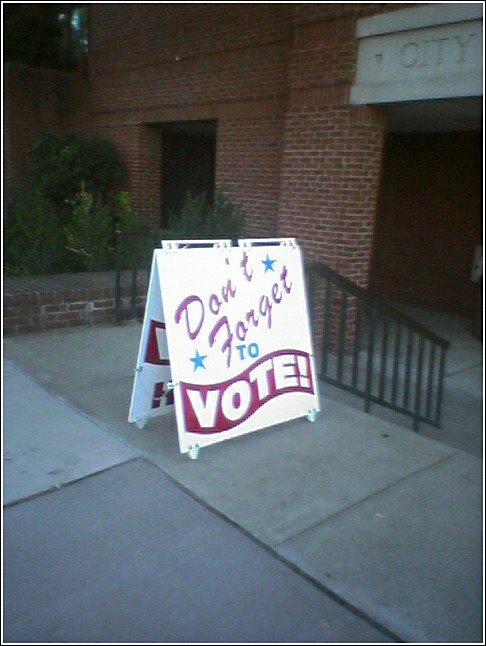
Passers-by near the Charlottesville City Hall Annex (where the Office of Voter Registration is located) were reminded to vote yesterday, November 8.


Outside Recreation Precinct, we found Joan Schilling campaigning for an elected school board. The referendum to switch from an appointed to an elected school board won overwhelmingly, approximately 73 percent to 27 percent, winning strong majorities in every precinct.


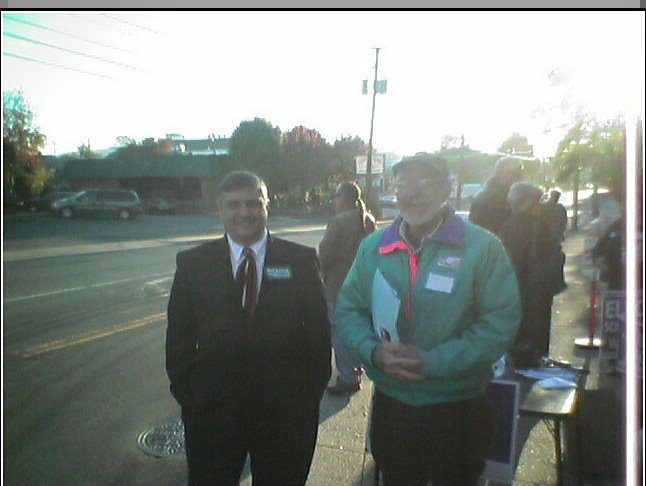
Recreation Precinct was a busy place. Tom McCrystal, here seen with civic activist Peter Kleeman, was campaigning at Recreation -- the largest of Charlottesville's eight precincts -- for the 57th District House of Delegates seat.


It wasn't much later that we found McCrystal's opponent, David Toscano (posing with former Electoral Board member Leroy Hamlett), also campaigning at Recreation Precinct. Toscano went on to win the race, 79 to 21 percent.


Up at Walker Precinct, City Councilor Rob Schilling was campaigning for an elected School Board. Tom McCrystal was apparently following me around from precinct to precinct, or maybe it was me following him. It was a long day, and the memory blurs.


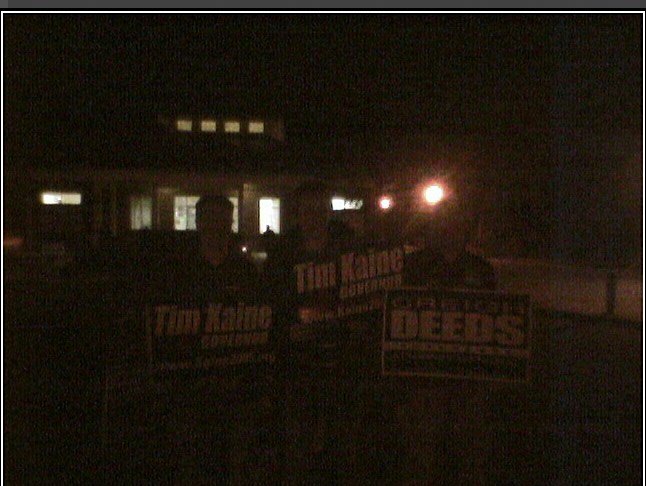
One of the hazards of cameraphone photography: a week flash. As night fell and we came close to the end of the voting day, I came upon these UVA students campaigning for the Democratic ticket outside Tonsler Precinct. Perhaps their efforts account for the fact that Democrats won every race in Tonsler by a margin of close to 10 to 1. (They may look clouded in mystery, but I'm sure these students will recognize themselves, even in shadow.)


Votes counted in Charlottesville, I headed up to Wolfie's for the local GOP election night party. The mood was mixed, with Jerry Kilgore losing to Tim Kaine and both Albemarle County Supervisor candidates failing to gain the seats they sought. But 58th District incumbent Delegate Rob Bell won a resounding victory, bringing him a third term in the General Assembly. Here he is with supporters, including his wife, Jessica (far left).

Today we do the canvass, and I expect with the closeness of the Deeds-McDonnell race for Attorney General we'll be getting considerable scrutiny. So I think I'd better get some sleep in preparation for a long, long day-after-election-day day.

Monday, November 07, 2005

Class Act

Waldo Jaquith, Norm Leahy, and I were the guest speakers tonight for Larry Sabato's class on campaigns and elections at the University of Virginia. But it was not Larry Sabato who introduced us and led the class. With tonight the eve of the Virginia statewide elections, Mr. Sabato was much in demand elsewhere, responding to questions from TV reporters in Richmond and other cities. In his place, his deputy at the Center for Politics, Ken Stroupe, conducted the discussion.

The three of us were invited to discuss the internet and bloggers and their impact on politics. Waldo, Norm, and I disagreed on little; if anything, our perspectives were remarkably the same, with a few nuances along the edges.

We tried to address the future of blogging, and all of us pretty much agreed that it is not possible to say where political bloggers will be in even just a few years. Norm suggested that we've already "jumped the shark" while Waldo related a self-deprecating story about his days as a teenage teacher of senior citizens. He was teaching this group about computers and the internet about ten years ago, and he told them "we can look at this WWW thing, but the real future is in Gopher. Believe me, in a few years, all you'll be doing is gophering." So much for Waldo's prescience.

Much of the discussion circled around the relationship of bloggers to the mainstream media: how are we like journalists, how are we unlike them? What do bloggers bring to the table that traditional journalists do not? Will newspapers be replaced by blogs?

We also talked about whether, and how, bloggers influence politics. Norm suggested that the biggest impact comes in intra-party discussions, trying to convince people to support one candidate over another in nomination contests, rather than in general elections. He pointed out that, judging from bloggers and commments on blogs in the weeks preceding the June Republican primary, Sean Connaughton and Steve Baril were going to win the GOP nominations for, respectively, lieutenant governor and attorney general. As we now know, both were blown out of the water by their opponents, Bill Bolling and Bob McDonnell.

Norm also said that blogs are a "grass-tops" phenomenon, read by party activists, campaign consultants, political journalists, and candidates. Blogs are not an outreach tool to bring average voters into a campaign's tent. He said there are about 7,000 people in Virginia who regularly read the state's political blogs.

The students of the class were engaged and engaging. They seemed genuinely interested in what we had to say -- and, in fact, in what we have previously written. One student proved that she did her homework when she asked about a specific posting of mine that referred to a bill introduced by Congressman Mike Pence, which would offer bloggers a legal shield for keeping their sources confidential. (She even noted the title of the blog post, "A Very Nice Man.")

Another student wanted to know what newspapers we read. (My answer: I subscribe to the Washington Post, which arrives in my front yard between 2:00 and 3:00 a.m. -- Waldo pointed out that I'm awake to hear it hit the lawn with a thud -- and the Daily Progress, which arrives around 7:00 a.m., and I buy the Washington Times at the store, though I'd subscribe if it had home delivery in Charlottesville.)

I always enjoy speaking to college classes. Years ago I was a regular guest lecturer for Mark Rozell's classes for the Washington Semester Program at the American University. (Mark is now at George Mason University.) I even spoke to that class -- which was made up of college students from around the country who came to Washington to intern on Capitol Hill and at various think tanks around town -- on the very morning that Bill Clinton wagged his finger at the camera and said, "I did not have sexual relations with that woman, Ms. Lewinsky." Talk about making internships sexy!

In those days, I was invited to talk about libertarianism and the Libertarian Party. Since I'm no longer active in the LP, invitations to speak about that party dried up, just as invitations to speak about nuclear weapons policy stopped coming when the Cold War ended, and invitations to give lectures or debate about South Africa disappeared when apartheid went the way of the dodo. (I've got to find myself a more permanent, long-lived topic of expertise.)

When I started this blog just before Christmas last year, I hardly expected that within eleven months I would be invited to speak at a prestigious university about blogging. That idea was simply unimaginable to me. Of course, in a decade, blogging may be as passé as civil defense against nuclear war and South African disinvestment.

After we left the class, I suggested to Waldo that we could turn this into a road show of sorts. We've already been guests on WINA-AM's "Charlottesville Live" program and now Larry Sabato's class. Still, in order to sell something like that, we've got to have more conflict to present. We're just too damn friendly to each other.

Now I must reluctantly get some sleep. My Election Day wake-up call is coming at 4:00 a.m., and a long day will begin. The question is, who will be getting a wake-up call the day after the election?

You Ought to Be in Pictures

For the past several years, Tim Hulsey and I have been covering the Virginia Film Festival for The Metro Herald, a 42,000-circulation weekly published in Alexandria.

Every year I take lots of pictures at the festival, which sometimes feels like Hollywood on the Rivanna. Some of the pictures get published in The Metro Herald to accompany stories and film reviews.

This year I have assembled a photo essay, which I hope will appear in next week's edition of the newspaper. Here's a preview, exclusive to my blog readers. (Other photos, taken by Tim Hulsey or provided by the Virginia Film Festival publicity team, have also been submitted to The Metro Herald.)

For my first impressions of the 2005 Virginia Film Festival, which took place during the last weekend of October, see my article, "Fever," below. As this is my first serious attempt at photoblogging, please bear with me if you encounter any glitches.

The newly renovated Paramount Theatre for the first time hosted Virginia Film Festival screenings: Rodrigo Garcia’s Nine Lives and Harold Ramis’ The Ice Harvest. (Metro Herald photo by Rick Sincere)

Richard Herskowitz, director of the Virginia Film Festival, introduces the world premiere of Mrs. Palfrey at the Claremont, on the final night of the 2005 festival. (Metro Herald photo by Rick Sincere)

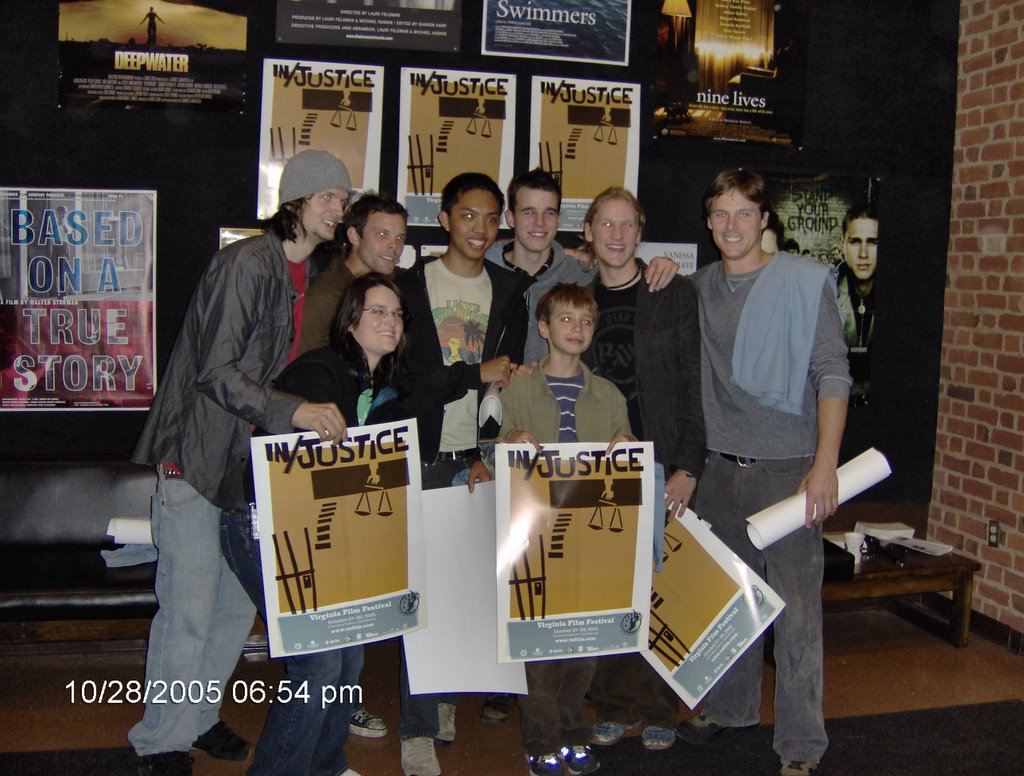
The cast and crew of “Dead Ringer,” the short film that won the Jury Award at the Virginia Film Festival’s second annual Adrenaline Film Project. “Dead Ringer” was produced by one of three high school teams that entered the competition. (Metro Herald photo by Rick Sincere)

The cast and crew of “Sweet Dreams,” the short film that won the Audience Award at the Virginia Film Festival’s second annual Adrenaline Film Project. (Metro Herald photo by Rick Sincere)

Filmmakers Jeff Wadlow and Beau Bauman, director and producer, respectively, of the recent feature Cry_Wolf, introduce the second annual Adrenaline Film Project at the 2005 Virginia Film Festival in Charlottesville, Wadlow’s hometown. (Metro Herald photo by Rick Sincere)

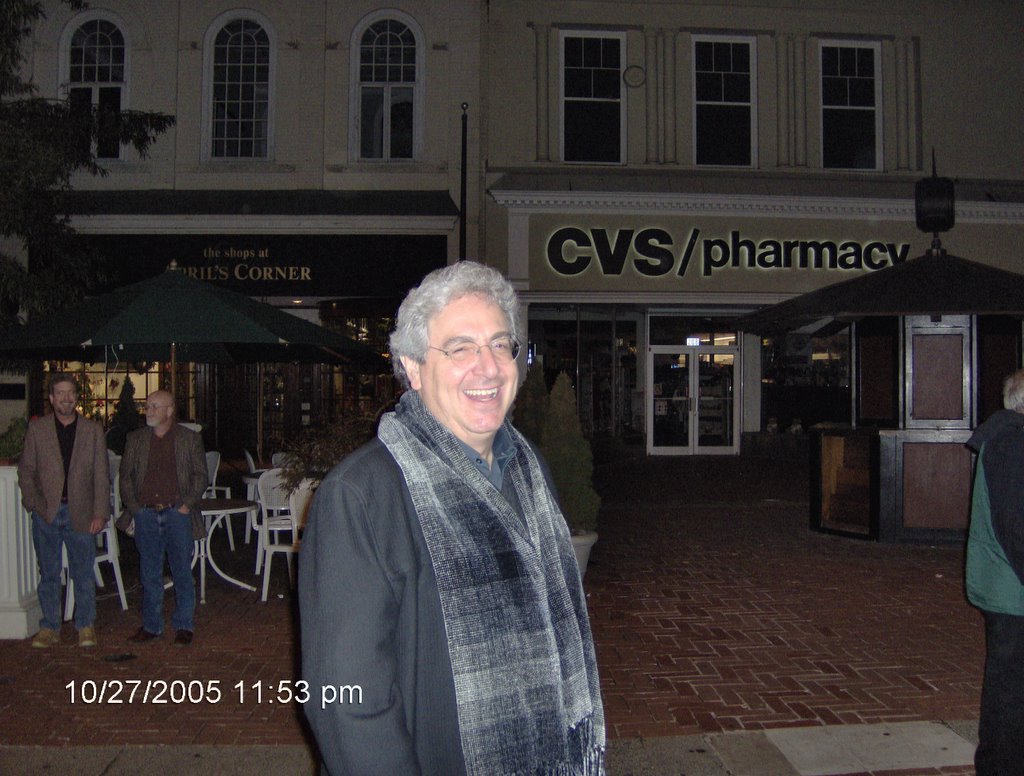
Veteran director Harold Ramis, on Charlottesville’s downtown mall after a screening of his new film, The Ice Harvest, at the 2005 Virginia Film Festival. (Metro Herald photo by Rick Sincere)


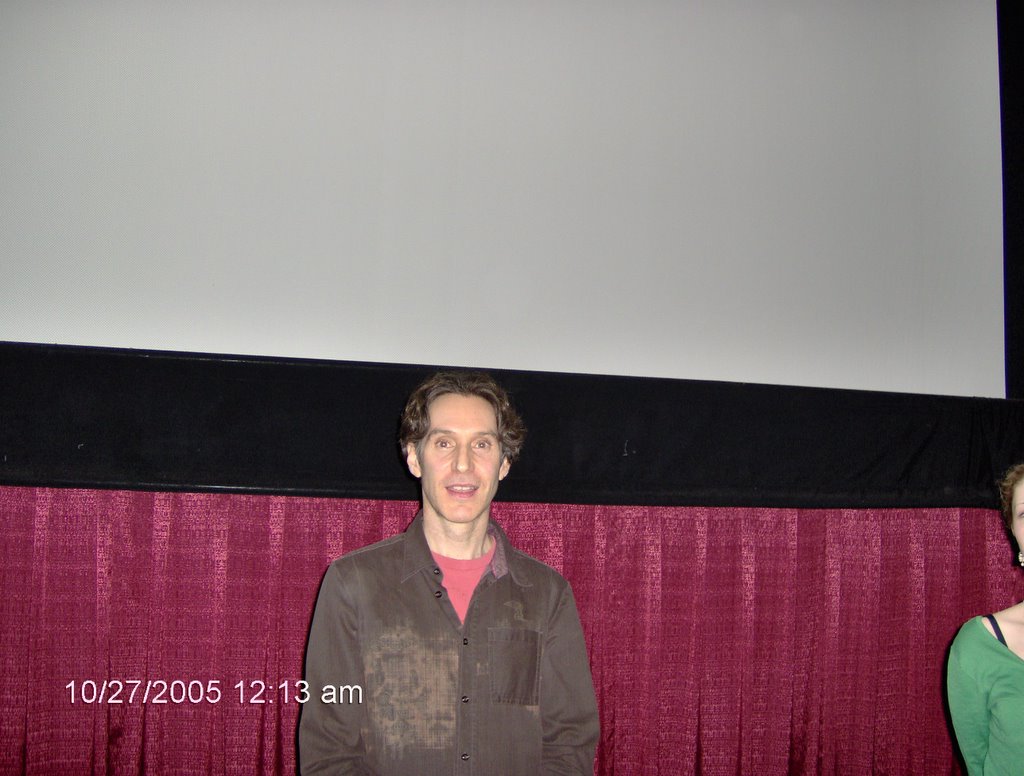
Actor, screenwriter, and director Robert Margolis, whose semi-autobiographical film The Definition of Insanity won both audience and jury awards at the 2005 Virginia Film festival. (Metro Herald photo by Rick Sincere)

David Marfield, screenwriter and director of the psychological thriller Deepwater, with Matthew Jones, the Charlottesville-based author of the novel used as the basis for the film. (Metro Herald photo by Rick Sincere)

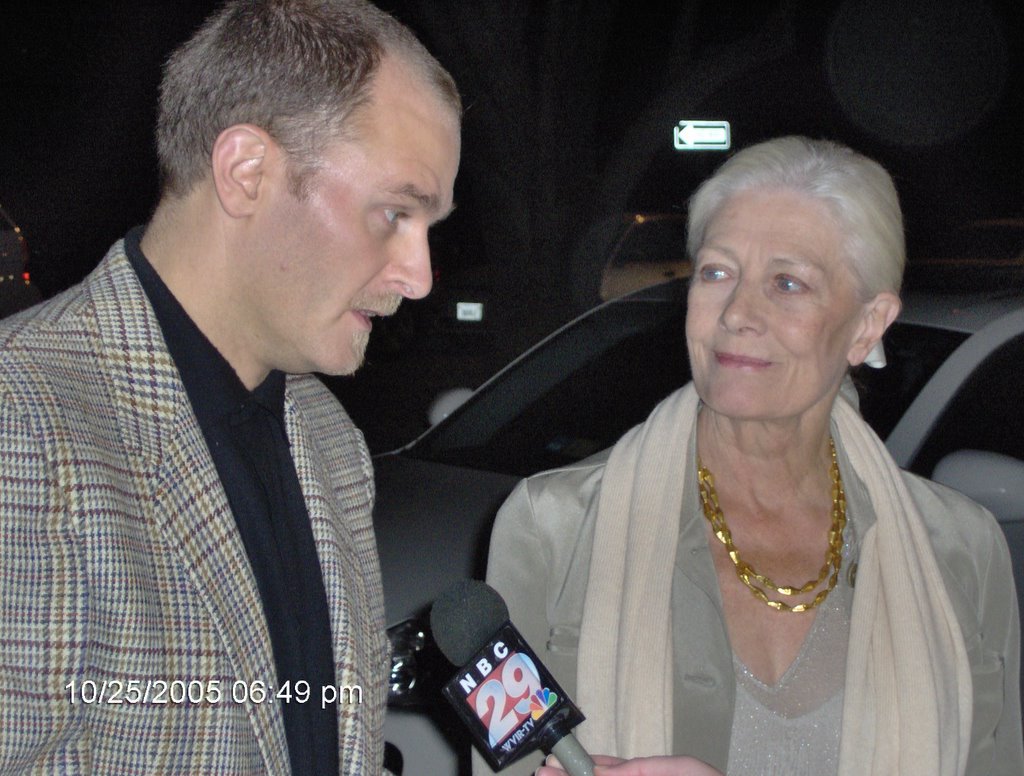
Film director Carlo Nero and his mother, Oscar-winning actress Vanessa Redgrave, are interviewed prior to a screening of their new HBO film, Fever, on the first night of the 18th Annual Virginia Film Festival. (Metro Herald photo by Rick Sincere)

“Fever”: Director Carlo Nero and his mother, Oscar-winning actress Vanessa Redgrave, are interviewed by WVIR-TV’s Stephanie Cornwell on the opening night of the 2005 Virginia Film Festival. (Metro Herald photo by Rick Sincere)

Three generations of filmmakers: Lee Caplin (left), producer of Mrs. Palfrey at the Claremont; his mother, Ruth Sacks Caplin, first-time screenwriter at age 85 for “Mrs. Palfrey;” and his son, actor Danny Alexander, who stars in the critically-acclaimed indie film, Steal Me. (Metro Herald photo by Rick Sincere)

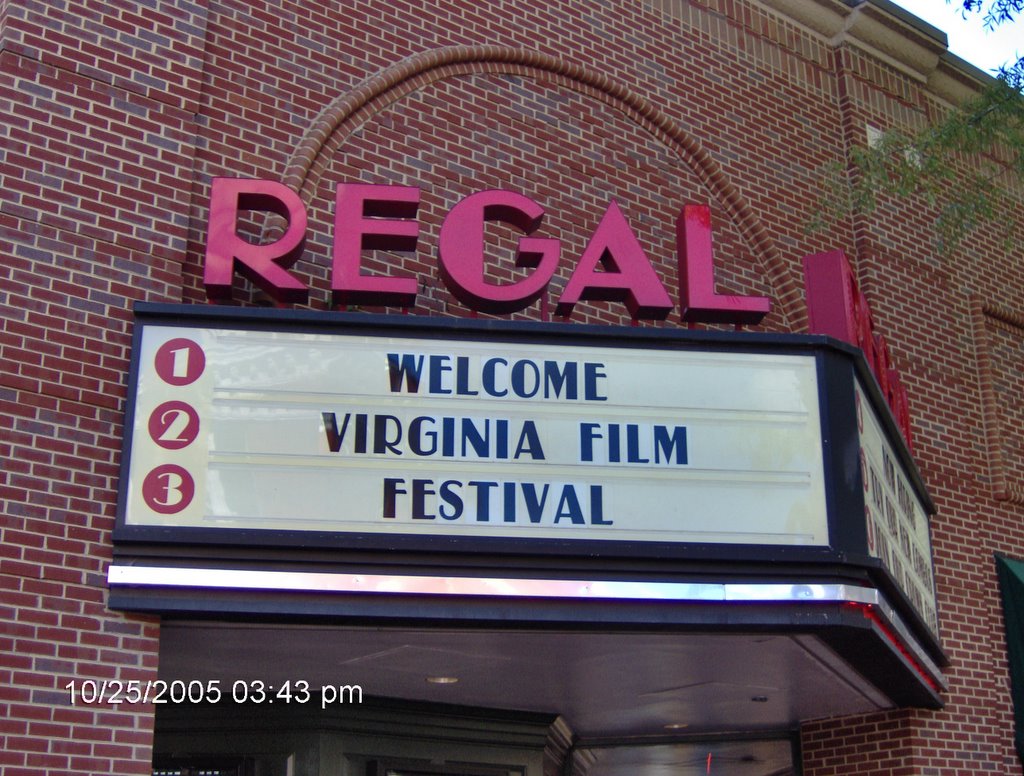
The Regal Cinemas in downtown Charlottesville was one of the venues for the 2005 Virginia Film Festival. (Metro Herald photo by Rick Sincere)

Thursday, November 03, 2005

Governor's Waltz

For Virginia voters who are dissatisfied with the choices they face next Tuesday of Jerry Kilgore, Tim Kaine, or Russ Potts for Governor, or of Bill Bolling or Leslie Byrne for Lieutenant Governor: there is another.

Surprised? So was I.

According to a memorandum from the State Board of Elections circulated today:

This is to advise you that Lowell Miles Moss of 8436 Sir Sagamore Court, Richmond, Virginia 23237 has filed with this Board two Certificates of Candidate Qualification. The first is as a write-in candidate for Governor while the second is as a write-in candidate for Lieutenant Governor in the November 8, 2005 General Election. He is conducting his write-in campaigns as L. Miles Moss.
There is not much more to report about Mr. Moss. He seems to be one of the unGoogled -- a web search using his name turns up nothing beyond his address as indicated in the SBE's memo. So his views on the issues are unknown to the wider world.

As a certified write-in candidate, any votes cast for L. Miles Moss (or approved variations of his name) will be reported to Richmond by local Electoral Boards at the conclusion of their post-election canvasses next Wednesday.

Related to this news, it is my understanding that the Libertarian Party of Virginia has asked its members to cast a write-in vote for former national LP chairman James W. Lark of Albemarle County in the race for Governor and Jeff Bowles of Botetourt County for Lieutenant Governor, as a means to gauge support for the party and its principles statewide.

The LP is also fielding four candidates on the ballot for the House of Delegates, including three in Northern Virginia -- Donny Ferguson in the 36th District, Scott McPherson in the 37th District, and Chuck Eby in the 67th District -- and one in suburban Richmond, Matthew Martin in the 73rd District.

Update and Correction: This brief note was received from the State Board of Elections on the morning of November 7, the day before the election: "Please note correction in middle name from Miles to Mills - for Write-In candidate for statewide offices. Thank you."

Wednesday, November 02, 2005

When I Found You, Part 5

The past month has brought an unusual number of weird search terms that tickled my fancy and brought readers to this blog. Let them speak for themselves:

2007 Academy Award predictions

antonin scalia dracula

charlottesville daily progress pedophile

did alan greenspan sleep with ayn rand

Dog caricatures for hire, Denver

eerie baby names

Jackie Gleason
- The Ku Klux Klan

marcusian jury

most famous things in gabon

nude charlottesville

pile of racial cat

post prom sex stories

real vs fake christmas trees blogs

sample lesbian pee clips

sponge bob first they came for tinky winky

teenage cook suckers (look twice at that one -- RS)

the faith that launched a thousand ships

underpants
waistband jpg
A few seemed to belong in clusters, such as these:
circumcised teens picture gallery

euan blair circumcised

moffatts circumcised

penis nullification thailand

And these:
male enhancement evita

viagra pills does it have any sing offices
And these:
Jerry Kilgore annoying automated phone calls

kaine
angst kaine angst film

Kilgore gay closet

spongebob and jerry kilgore
And these, too:
caged gay soldiers

corey clark
gay fantasy

gay men chat gay men chat world series winner in 1917

gay hampden-sydney men

gays going to hell

teenage gay boys
And some were just meandering:
a clever news paper title including a poet involved in a drink driving accident

what are the pros and cons for each apply might you approach this issue with your teenager?
Come back in December for more odd and odder search terms.

Tuesday, November 01, 2005

Fever


If you've been wondering about the paucity of posts in the past few days, here's at least a partial explanation: From last Thursday through Sunday, I was attending the Virginia Film Festival in Charlottesville. Over that four day period, I sat through 16 separate screenings of new and classic films, some of which included panel discussions with the filmmakers or experts on the movie or the period in which it was made.

As I mentioned to festival director Richard Herskowitz after the final screening -- the world premiere of Mrs. Palfrey at the Claremont, starring Dame Joan Plowright -- if someone watched 30 or 35 hours of television over four days, it wouldn't have much of an effect on him. But watching 30 or 35 hours of movies in a darkened theatre over the same period is far more intense and draining. Watching film requires far more attention, concentration, and focus than watching TV does. It is far more engaging intellectually and emotionally.

So it came as no surprise to me that, after the festival was over, I went straight to bed. What did surprise me is that I ended up sleeping all through Monday, finally waking up just before the 11:00 p.m. news. The whole day had gone by and I hadn't felt any time at all.

Now that I'm recovered sufficiently, I can write a few words about the festival, retaining the option to write more over the next few days. Some of what I write will later appear in The Metro Herald, through whose good graces Tim Hulsey and I obtained press credentials to cover the festival. (Thanks also to festival publicists John Kelly and Cara White, who could not have been more helpful during a weekend of much pressure and huge responsibilities.)

The weekend began with a screening of The Fever, a new film starring Vanessa Redgrave and featuring Michael Moore and Angelina Jolie in small supporting roles. The Fever was directed by Redgrave's son, Carlo Nero, and financed by HBO, which will broadcast it early next year.

The Fever is an unremitting, unveiled attack on Western democratic capitalism. In Redgrave's words, anyone who earns a middle-class income or more lives a life of unredeemable corruption. The Fever actually shows Redgrave's malaise-besieged character reading Karl Marx's Capital and being transformed by it the way a normal person might be transformed by reading Atlas Shrugged.

The movie was met with warm applause by the hundreds of academics, film lovers, and other guests at the Culbreth Theatre at the University of Virginia. Disgusted as I was by the leftist politics of The Fever, I could easily have left quietly. Quietude, however, is not in my nature.

So I stood up during the discussion period, moderated by Herskowitz and featuring Redgrave, Nero, and Jason Blum (rhymes with plum), the movie's primary producer, and asked:

"I don't want to be cheeky, but it seems to me that the underlying philosophy in this film represents an old-fashioned [I should have said anachronistic] and ahistorical view of economics as a zero-sum game. Have any of you ready any books about economics published after 1945?"

I wasn't really looking for an answer; I was trying to make a point. Redgrave did answer, however, saying she had read books by Jeffrey Sachs (meaning, I think, his new book The End of Poverty) and George Soros (who has done a wonderful job rebuilding civil society in the former Soviet empire but whose views on economics can best be summed up as "I've got mine, sorry you can't have any more yourself"), and the UNDP (United Nations Development Program) Report, which has "hundreds of sources." When I suggested, in return, "Friedrich Hayek?", I was met with blank stares by the panelists.

In reporting on my question, the Daily Progress said:

One audience member questioned Redgrave’s simplification, both as an actress and as a person, of the issue of poverty. He asked Redgrave if she had read any economics books published after 1945.

Redgrave responded by listing a handful of texts and said, "I don’t think it’s old-fashioned to care."
No one said caring is wrong, of course. Compassion is an important emotion-cum-virtue. Nevertheless, compassion, like any other emotion, should not be permitted to overwhelm rationality. (Perhaps I should have asked Redgrave if she's ever read Plato's Republic.)

It is "old-fashioned," in the sense of anachronistic, to think that for you to be rich, I must be poor, and vice versa.

My question caused quite a stir, since at events like this (I suppose) everyone is supposed to fawn over the celebrities.

While trying to leave the auditorium, I was approached by one man who thanked me for asking my question, and as we chatted, we drew a crowd around us. A young woman accused us both of being "middle class, white males" who couldn't get "outside [our] minds." Tim Hulsey asked how it is possible to be outside one's mind, and I suggested that possibility would be schizophrenia.

I thought it would end there, but Tim told me that at a screening the next morning, he overheard two other people talking about my question, and on Saturday night, while I was chatting with an on-line friend who asked if I had been attending the film festival, I indicated I had asked a "dissenting question" at the Redgrave event. He asked, "Did you ask if she had read any post-war books on economics?" I said yes, I had, and asked if he had been there. No, he said, but he had heard about it from someone who was there.

The Fever wasn't the end of my tiny battle with the left. On Sunday I saw an excellent new German film called Sophie Scholl: The Final Days, which tells the story of a courageous young woman who was executed by the Nazi regime for daring to dissent. This is a great movie and I recommend it highly, both for its content and for its dramatic structure.

In the audience discussion afterwards, I brought up the point that the movie has relevance for today because "things like this happen every day in places like North Korea, China, and Cuba," to which the moderator -- an academic whose name I did not write down -- replied, "You mean Guantanamo."

"No," I said, "I mean Havana."

"Guantanamo," he insisted.

"There are no guillotines in Guantanamo," I added (a reference to the final scene in the movie).

"I know something about the Caribbean," the academic said, "and I guess we'll have to agree to disagree."

I can only imagine the dinner-table conversation that night, when that "scholar" said to his wife and kids, "You can't believe what I heard today: Some crazy guy compared Hitler to Castro and the Cuban government to Nazi Germany!"

Well, yes.

Thursday update: The Hook, like the Daily Progress, has reported on my "cheeky" question posed to Vanessa Redgrave. Here's how Lisa Provence reports it in today's edition:
"Have any of you read a book about economics since 1945?" Local Richard Sincere, an alum of the London School of Economics, causes a stir after the screening when he poses that question to Redgrave and Nero. To which Redgrave responds, "I don't think it's old-fashioned to care as much as ever." Insert audience applause here.
It's not exactly what I said, but close enough to catch the flavor of the moment.

Thursday, October 27, 2005

Disclosure

For those who care about these things, the Commonwealth of Virginia has won praise by a nationwide group that monitors campaign contribution disclosure laws and practices.

According to a report by the Campaign Disclosure Project (described as a joint effort of the California Voter Foundation, the Center for Governmental Studies and the UCLA School of Law, with financial support from The Pew Charitable Trusts),

States across the country provided better access to candidates’ campaign disclosure records in 2005 and particularly improved the usability of their official disclosure web sites, according to Grading State Disclosure 2005, a comprehensive, comparative study of candidate campaign finance disclosure laws and practices in the 50 states. Grading State Disclosure 2005 follows two prior annual reports, and is online at: www.campaigndisclosure.org
Virginia was singled out in a news release from the project, in addition to being ranked in the top ten:
Of the 34 passing states, eleven received grades in the A or B range, up from eight in 2004 and only two in 2003. Washington received the highest grade (A-) and rank, Florida ranked second with a B+, and California came in third, also with a B+. Overall, the study found that 13 states’ grades improved, while seven declined. Among the study's significant findings:

-- States with the best overall campaign disclosure programs, in rank order from one to ten, are: Washington (A-); Florida (B+); California (B+); Hawaii (B); Georgia and Illinois (B, tied for 5th); Virginia (B); Michigan and Texas (B-, tied for 8th); Rhode Island (B-); and Ohio (B-).

-- States with the weakest overall campaign disclosure programs, all receiving Fs and in rank order from 40 to 50, are: Delaware, Nevada and New Mexico (tied for 40th); North Dakota; Vermont; New Hampshire; Montana; Alabama; South Dakota; South Carolina; and Wyoming.

-- Virginia was the most-improved state, climbing from a D+ to a B and from 22nd to 7th place, followed by Iowa, which moved from 38th to 31st place, and Hawaii, which improved from 12th to 4th.
In the report's section on Virginia, it explains:
Virginia’s disclosure law is strong and ranks 8th in the nation. Candidates are required to disclose detailed information, including occupation and employer, about contributors giving over $100. Contributions made just before Election Day are reported before the election. Expenditure disclosure is excellent and candidates must report vendor name, subvendor details, and accrued expenses. Disclosure of independent expenditures is required, but last-minute independent expenditures are not reported until after the election. The state’s enforcement provisions could be improved, particularly in the area of auditing. Electronic filing is mandatory for statewide office candidates and voluntary for legislative candidates, though the Board of Elections estimates that 85 percent of legislative candidates participate in the program.

The State Board of Elections web site now features a comprehensive, searchable database of itemized contributions and expenditures, which is the reason for the huge jump in Virginia’s Disclosure Content Accessibility grade from an F to a B. The new system greatly improves access to campaign records, but is a bit cumbersome—for example, to view the names of all individuals making contributions in 2005 from a particular zip code requires looking at 18 different search results screens (three screens each for six different committees). To improve further in this area, the agency could add the ability to search by a contributor’s employer (data which is already included in the search results), and consolidate the search results screens.
Before I became aware of the Campaign Disclosure Project's report, just last night at the fundraiser for House of Delegates candidate Tom McCrystal, I had a conversation with Charlottesville Republican Chairman Bob Hodous in which we both agreed that Virginia's campaign finance laws should be a model for the rest of the country, and for federal law, as well: No contribution limits, no limits on who may give to candidates, but full disclosure readily available for any interested party to examine. As long as everything is done in the open, the possibility of corruption, real or alleged or imagined, is minimized.

What a wonderful alternative to the First Amendment-emasculating McCain-Feingold Act!

Political Medley

Last night I had an opportunity to speak with three current members and one potential member of the Virginia General Assembly.

Delegates Rob Bell (R-58), Bill Janis (R-56), and Ed Scott (R-30) were all on hand to cheer on the efforts of Tom McCrystal in his campaign to succeed retiring Delegate Mitch Van Yahres (D-57). McCrystal faces token opposition from former Charlottesville City Council member David Toscano. (What Toscano has in the form of a campaign treasury, McCrystal has in grit and determination -- or, as one Democratic voter told him as he was walking through a hard-scrabble Charlottesville neighborhood, "Man, you've got balls!")

The occasion was a Virginia's Future - McCrystal 2005 fundraiser at Fellini's, a long-shuttered but legendary downtown Charlottesville restaurant that has recently been resurrected by new management. Judging from the size of the crowd, which included former Fifth Congressional District GOP chair Randolph Byrd, 57th District co-chair Patricia Earle, and current Charlottesville GOP unit chair Bob Hodous, among other activists and FOTs ("Friends of Tom"), the event raised several thousand dollars for the McCrystal campaign. The money will likely be used for direct-mail outreach to voters in the last few days of the campaign, which ends November 8, the day Virginia voters go to the polls.

In remarks to the crowd, Bell said that Republicans in the area had been looking for a long time for a good candidate to run in the 57th District. He said that the choice of McCrystal was particularly good, because Tom knows the district and he is a particularly apt fit, in terms of temperament and his views on key issues, to his constituency.

For his part, McCrystal emphasized how he sees his role as a member of the House of Delegates as a representative of the people who will elect him. Taking a shot at his opponent's recent press conference announcing ambitious environmental initiatives, McCrystal said that "David Toscano wants to save the world; I want to take care of the problems at the Ivy landfill."

Referring to his experience on a General Assembly advisory panel on information technology issues, McCrystal said that the three Delegates present last night -- Bell, Janis, and Scott -- had been mentors for him and he knew that, because of their help and his experience in Richmond, he would be able "to hit the ground running" when he arrives at the state Capitol in January.

On that particular issue, McCrystal said that he would work on privacy issues, with special attention to the way new technologies threaten people's privacy through identity theft and other forms of fraud. "Twenty years ago," he said, "an invasion of privacy might have been a neighborhood kid looking in your mailbox to see what your electric bill says. Now it's some kid in Romania who hacks into your bank account and steals your savings." He told the crowd of supporters that he would bring his long experience as a computer consultant to bear in working with other members of the General Assembly to promote policies that will protect personal privacy. "As a member of the minority party in Richmond," he said, "my opponent will not have the connections and cooperation he needs to be effective for his constituents in Charlottesville and Albemarle County. I will."

In conversations with the sitting legislators, I was able to discuss some issues close to my heart. Bill Janis thanked me for my blog posting on the Virginia Piglet Book, and we talked about the culture of spending in Richmond and Washington. I said I was disappointed that the mainstream media, besides Bob Gibson in the Daily Progress, had largely ignored the release of the Piglet Book, but he noted that the story was covered extensively on local Richmond TV news programs, and that his wife dragged him out of bed so he could watch himself on the 11:00 o'clock news.

Prompted by a question from local GOP activist Joe Bishop, Ed Scott predicted that one of the first acts of the General Assembly next year will be to pass legislation to make it illegal for local or state governments to use eminent domain authority to transfer private property from one private owner to another, under the pretext of indirect public benefit rather than the clear constitutional requirement of public use. This would be the General Assembly's proper reaction to the Supreme Court's shameful decision in Kelo v. City of New London. (I also congratulated Delegate Scott for winning his primary election -- although I tempered my praise by saying I was disappointed that he had no general election opponent -- over that wacko theocrat, Mark Jarvis.) I also asked him if he had endorsed the Freedom & Prosperity Agenda, and he said he had talked to John Taylor about it but was otherwise non-committal.

I also spoke briefly to Rob Bell about his campaign commercials, which seem to be on TV every three minutes or so. I complimented him on how he was able to use the ads to highlight his legislative successes. (Most of his ads focus on the bill he shepherded through the General Assembly last session, which aims to combat bullying in government schools.) He said he felt it was important to accentuate the positive and avoid negative campaigning.

To my surprise, Scott said he recognized my name "from the Internet" and both Bell and Janis introduced me to bystanders as a prominent Virginia blogger. I blush at the compliment, and I think I have to work harder to live up to it.

I left the fundraising reception about 20 minutes past the announced end-time, yet there were still about a dozen or more supporters still milling about, talking with the candidate and the legislators. For all I know, especially given the presence of UVA College Republicans, it might still be going strong.

Tuesday, October 25, 2005

A Very Nice Man

The eighth in a series of weekly Virginia Bloggers Carnivals is up at Sophistpundit.

Next week's Virginia Bloggers Carnival will be hosted by River City Rapids.

Meanwhile in blogging news, one of the few Republicans in Congress who actually works to shrink the size and scope of government, Representative Mike Pence, is promoting a bill that will protect the First Amendment rights of bloggers -- or at least some of us. According to an article in Editor & Publisher,

Bloggers who actually gather news would be protected under the proposed federal shield law, the legislation's first author, U.S. Rep. Mike Pence, R-Ind., told the Inland Press Association Monday.

Pence's view of who would qualify as a journalist under the Free Flow of Information Act differed from the assessment of the bill's co-sponsor in the Senate, Indiana Richard Lugar.

Exactly two weeks before speaking at the Inter American Press Association, Lugar said bloggers would "probably not" be considered journalists eligible for the act's protections.

Pence said bloggers would likely have to be considered on a "blog-by-blog" basis.

"Frankly, there are some that are out there gathering news," Spence said at Inland's 120th annual meeting. "There are many people though, who just link to your newspapers. It would be hard to argue to anyone that privilege applies to those people just because they have a Web site."

Pence asked the Inland publishers to rally their readers around the Free Flow of Information Act. "I believe we have an historic opportunity to close this hole in the First Amendment."
Echoing Thomas Jefferson's view that "were it left to me to decide whether we should have a government without newspapers, or newspapers without a government, I should not hesitate a moment to prefer the latter," Pence explained his motivation in filing the bill:
"As a conservative, I believe the only real check on government is a free press," Pence said. "And as someone who believes in limited government, I believe nothing is more conservative than promoting and protecting the principle of a free press."

Pence said he frankly believes much of the news media is liberal, and he joked that he reads The New York Times every Sunday morning and then goes to church to "so I know what both sides are up to."

"This isn't about protecting reporters," he said of the proposed shield law. "This is about protecting the peoples’ right to know."
Blogs are also getting more attention from readers -- perhaps even from readers who should be doing something else. Reporting on an Advertising Age study, Adam Gosling of Australia's Smart Office News writes:
US Blog readers waste more than half a million work years goofing off reading blogs in 2005 according to research by Advertising Age.

About 25 per cent of the US workforce, or about 35 million workers spend an average of 3.5 hours, or 9 per cent of the work week engaged with them, according to Advertising Age's analysis.
Gosling adds:
With estimates that 25 per cent of blog visits are directly connect to the job. The remaining 4.8 billion US work hours will be spent reading blogs not related to work.
So the question is: Does your boss know you're reading this?

Sunday, October 23, 2005

Company

Last month, the University of Michigan Press released a new scholarly examination of the work of Stephen Sondheim, How Sondheim Found His Sound, by Steve Swayne, an associate professor of music at Dartmouth College.

Several years ago I interviewed Swayne (who I know through email correspondence, though we have never met) for The Metro Herald. At the time, he was writing How Sondheim Found His Sound and I had just reviewed a production of Company that Signature Theatre had mounted in an Arlington County park. I was curious about how the creators of Company, Sondheim and his collaborator, George Furth, had made changes in the book and the score over the years.

Here is that interview, which appeared in The Metro Herald on June 29, 2001:

The Evolution of Company:
An Interview with Dartmouth’s Steven Swayne
Richard E. Sincere, Jr.
Special to The Metro Herald

Seeing Company in concert at the Lubber Run amphitheatre in Arlington last week, it became apparent that the show has changed – evolved – since it was first produced in 1970. To explore this evolution more thoroughly, The Metro Herald sought out a scholar who specializes in the works of Stephen Sondheim. We found Dr. Steven Swayne of Dartmouth College in New Hampshire, who agreed to answer a few questions for us. The interview, conducted by e-mail, follows.

TMH: Let’s start with some basics. Could you describe your professional position, and how you became interested in the works of Stephen Sondheim?

SS: I am an assistant professor of music at Dartmouth College, where I teach a class on American musical theater, among other things. My doctoral thesis is entitled, “Hearing Sondheim’s Voices” (University of California, Berkeley, 1999). I had written on Sondheim from an academic perspective as early as 1988, but I entered Berkeley with the idea of doing a Russian music dissertation. Early on, one of my faculty mentors suggested that I work on Sondheim; he liked my earlier work on him, and the American musical has by and large been ignored by musicologists. So here I am, still working on Sondheim’s music and influence. Right now, I’m working on a book, tentatively entitled How Sondheim Found His Sound.

TMH: Most musical theatre “classics” are set in stone after their first run on Broadway or in the West End. Their creators seldom make changes after that point. One exception is the 1946 revival of Show Boat, which includes revisions by Oscar Hammerstein II and Jerome Kern, and which became the”authorized version” until Harold Prince’s revival a few years ago. Now Company has become another exception: George Furth, the author, and Stephen Sondheim, the composer-lyricist, made substantial revisions for revivals in New York and London some 25 years after the Broadway premiere. Why do you think they did so?

SS: First, I would have to disagree with you that these classics are “set in stone” from the first run forward. While it is true tht the creators often don’t have a hand in making changes after the initial run – more times than not, they’ve passed on by the time a revival comes around– so many variables have gone into getting to the opening night that it is not sacrilegious to continue playing with some of these variables after opening night.

The transition of many of these “golden age” musicals from stage to film also shows that the creators were far more plastic in their conceptions of “final versions” than we may be accustomed to accepting. Some may want to treat these musicals as unchangeable works of art, but in fact they are commercial works as well, and as such they may be adjusted to changes in the marketplace.

I see Sondheim’s and Furth’s changes in this way; the audience of 1995 is different than the audience of 1970, and the revival gave them a chance to revisit and update their material. And remember: Sondheim has revised several of his musicals: Follies, the film version of A Little Night Music, Merrily We Roll Along, and Assassins today have interpolations that come from rethinking the original versions.

TMH: The most significant – or most apparent – change in the score of Company is the addition of “Marry Me a Little” at the end of Act I. This was originally, in an early draft, the finale for Act II. What do you think of this addition? Does it enhance the score, or do you think it’s redundant?

SS: “Marry Me a Little” is one of the happier additions to the revival, I feel. Bobby is our central character, so it makes sense for him to close out Act I. “Getting Married Today” used to be the last full song for Act I, and then there was dialogue after that (and the “Bobby baby” music), so giving Robert center stage makes dramatic sense. It also frames both the act and the entire musical, with “Company,” “Marry Me a Little,” and “Being Alive” being the songs that carry the message of Company.

As for the song being redundant, in a musical where the same birthday party happens three times, can anything truly be redundant? While the song carries some of the same ideas as “Being Alive,” “Marry Me a Little” is far more tentative, far more skittish. If one wants to see progression in Robert, one can argue that “Being Alive” is much more decisive than “Marry Me.” As it is, I hear all of the songs as co-existing in time: sometimes Bobby is determined to make a go at a relationship, and those times usually occur simultaneously with Robert.

TMH: Besides “Marry Me a Little,” there are minor changes in both the music and the lyrics in other songs. At first glance, they appear insignificant, but they must have meaning beyond the surface, otherwise Sondheim wouldn’t have inserted them. Here are a few I’ve picked out; please tell me what you think.

(A) In the opening number, “Company,” the last several measures have been changed from a very long “We lo-o-o-o-o-ve you” (sorry, I don’t have my original score in front of me to give you an exact beat count) to several successive “We love ... we love ... we love you”’s. Any explanation?

SS: In the score, it indicates, at this point, a pre-recorded tape takes over the vocal lines. I’ve always liked this idea, the notion that the note is held far longer than any human can hold a note. Were I directing this moment, I would have the actors on stage carrying on as though they can effortlessly sing this note forever! Perhaps Sondheim and Furth liked the insistence of the entrances in exchange for the interminability of the note. Perhaps they didn’t like the artificiality of the pre-recorded singing. I happen to prefer the former, and I would guess that you could still get permission to do it with tape. Either way, the moment conveys the oppressiveness of Bobby’s friends, so I don’t think it’s the significant a change.

(B) In “The Little Things You Do Together,” the couplet “It’s not so hard to be married/It’s much the simplest of crimes” has been changed to “It’s not so hard to be married/It’s much the cleanest of crimes.” Why?

SS: You’d have to ask Sondheim to get an answer as to why. “Cleanest” is easier to sing than “simplest,” and “cleanest” has some assonance with “crimes.” That would be my guess as to the change, but again, you’d have to ask Sondheim.

(C) In “You Could Drive a Person Crazy,” the sequence “I could understand a person/If it’s not a person’s bag ... I could understand a person/If a person was a fag” has been changed to “I could understand a person/If he said to go away ... I could understand a person/If he happened to be gay.” Is this just political correctness at play?

SS: To me, this is one of the less fortunate corrections. On the Sondheim Celebration at Carnegie Hall CD, you’ll hear the change there from “fag” to “drag,” and the audience all laughs, because they’re in on the joke. The concept of “a person’s bag” is so sixties that it truly dates that lyric, far more than “fag” would (w word that’s experiencing its own strange recrudescence). “If he said to go away” sounds rather pedestrian to my ears, but it does avoid positioning the lyric in the late 1960s. One could always write to the folks who hold the rights to the musical and ask if you could re-insert the older words.

TMH: This last question is just for fun: If you could choose just one song from Company to be recorded and stored in a time capsule to be opened 200 years from now, which one would it be, and why?

SS: “Sorry-Grateful,” without question. I marvel at how well Sondheim captures the ambiguity of marriage – and of relationships in general – in this song. The music seems at times to be indecisive, as if it cannot figure out how to go forward. And the lyrics, written by a gay man in his late thirties who hadn’t yet entered into a long-term relationship of his own, is so perceptive on the mixed blessings that marriage brings. It reminds me of an anecdote told of a man who was celebrating his fiftieth wedding anniversary. (My parents are celebrating theirs next month.) When someone asked him how he managed to stay married to the same woman for so long, he answered. “But you see, she’s not the same woman I married.” Nor was he the same man, and Sondheim captures that in his lyrics. “Everything’s different/Nothing’s changed/Only maybe slightly/Rearranged.” Even the notion of “rearrangement” carries with it the challenge of the “arrangement” called marriage. It’s a perfect song that describes the imperfect long-term relationships all of us – straight and gay – long for, find, sometimes leave, sometimes endure and (when we’re more grateful than sorry) ofttimes enjoy.
Dr. Swayne's book is primarily a musicological analysis of Sondheim's oeuvre, but it also contains some interesting biographical information, including a tracing of Sondheim's musical influences through a catalog of his record collection, and examinations of how Sondheim learned about dramatic structure, character, and theme from the movies and the theatre. (To be perfectly candid, the musicology in the book is a bit advanced for me, but the rest of the material is engaging enough that I can set aside the difficulties to enjoy the book as a whole.)