Showing posts with label Orlando. Show all posts

Friday, June 09, 2017

Guest Post: What it's like to be gay and a Muslim


Rusi Jaspal, De Montfort University

The Orlando shooting was a hate crime against gay people – even if, once it emerged that the attacker had been a Muslim, many people claimed this as a terrorist attack rather than a hate crime. And, in an important sense, this was also a terror attack, since its aim was to spread fear in the LGBT community. The Conversation


gay Islam muslims homosexual

shutterstock.
Nando Machado/Shutterstock.com


Since the massacre there has been a lot of speculation about Islam and homosexuality and there are fears that one man’s despicable act of terrorism could fan the flames of Islamophobia and other forms of social exclusion, leading to discord and unrest in an era of elevated Islamophobia.

It is difficult to define the “Islamic position” on homosexuality, as a monolithic phenomenon, simply because Islam is a very diverse faith group with some 1.6 billion followers on six continents. In most Muslim countries, homosexuality is illegal and in some countries, including Iran and Saudi Arabia, it is punishable by death. But in others, such as Jordan and Turkey, homosexuality is not considered a crime.

Most Islamic scholars are in agreement that homosexuality is incompatible with Islamic theology. They tend to draw on the story of Lot in the Koran (also in the Old Testament) which recounts the destruction of the tribe of Lot allegedly due to their engagement in homosexual acts as “evidence” for God’s condemnation of homosexuality. Many scholars also cite the Ahadith (statements attributed to the Prophet Muhammed) that are condemnatory of homosexuality. Theological and legal condemnations of homosexuality can engender perceptions at a social level that homosexuality is wrong and that it should not be permitted.

Muslims on homosexuality


In 2009, a Gallup survey revealed negative attitudes towards homosexuality among European Muslims. In France, 35% of Muslims viewed homosexuality as “morally acceptable” (versus 78% of the general public). In Germany, 19% of Muslims viewed it as morally acceptable (versus 68% of the general public). In the UK, none of the Muslim respondents viewed homosexuality as morally acceptable (versus 58% of the general public who did).

Earlier this year, a survey commissioned by Channel 4 was conducted among a random sample of 1,081 individuals who self-identified as Muslim. The results found that 18% of the British Muslim respondents agreed that homosexuality should be legal in Britain while the majority (52%) disagreed. Conversely, only 5% of the general public thought homosexuality should be illegal. Furthermore, 47% of the British Muslim respondents indicated that they did not believe that it was acceptable for a gay person to become a teacher. These data suggest that there are low levels of acceptance of homosexuality in Muslim communities in the UK.


However, qualitative interview data can provide more nuanced understandings of what Muslims think and why they might hold these views.

In my research into attitudes concerning homosexuality among samples of first and second-generation British Muslims of Pakistani descent, I found that attitudes tend to be largely negative. Although research into attitudes towards homosexuality in the general population points to demographic variables, such as age and level of education, as key determinants of the nature of attitudes, this has not been the case in my own work with British Muslims. Muslims of various ages, education levels and socio-economic backgrounds have participated in my studies and generally perceive homosexuality in negative terms. In substantiating these attitudes people often draw on holy scripture. As one 54-year-old woman said:

It says it in the Koran that it’s wrong and sorry I’m not the one who made it. It’s what the God revealed to the Prophet so it’s the truth and that’s my belief system.

Many interviewees draw upon holy scripture as the basis of their views regarding homosexuality. There appears to be a desire not to “re-interpret” holy scripture – to accommodate homosexuality – because of the divinity of its origin. Moreover, there was a fundamental rejection of essentialist arguments concerning the origins of sexual orientation – that people are born gay and that they do not “choose” to be gay – and interviewees often argued that people had “chosen” to be gay. One 28-year-old man said:

God doesn’t create gay people. It’s a path they’ve chosen and that’s an incorrect path according to our faith.

Indeed, previous research has shown that believing the essentialist argument regarding homosexuality is correlated with less discrimination and greater acceptance.


Koran homosexuality gay muslim Islam

What does the Koran say about homosexuality?
Lord Harris/BritishMuseum, CC BY


First-hand relationships


Although many British Muslims may disapprove of the concept of homosexuality, several individuals reported positive first-hand experiences of contact with LGBT people. A 45-year-old man said:

Homosexuality is wrong, I believe … I have a gay neighbour and he lives with his partner. He’s a very nice guy – both of them [are]. They are very respectful. We consider them friends.

Some people spoke fondly of their LGBT friends, neighbours and acquaintances, suggesting that first-hand contact may challenge homophobia which exists at an abstract, conceptual level. It is also vital to stress that the Muslim interviewees overwhelmingly rejected violence against LGBT people. As one woman put it:

Violence and hate crimes are un-Islamic. We are not supposed to kill or hurt others, as Muslims. No, they can’t have it both ways so they won’t be accepted in our community but it’s for God to punish, not us.

It was difficult for British Muslim interviewees to accept homosexuality given the overwhelming “evidence” of its prohibition in Islam. Individuals simply had no positive theological frame of reference given the absence of LGBT affirmative voices at an institutional level. This led some individuals to view endorsement of homosexuality as a violation of their religious faith and its norms:

Being gay is un-Islamic and so is encouraging it.

Put simply, the acceptance or endorsement of homosexuality was perceived as contravening key tenets of Islam.

Gay Muslims speak out


Clearly, the stigma attached to homosexuality in Islamic communities can have profound effects for those Muslims who also self-identify as gay. For almost a decade, I have been researching the social psychological aspects of being Muslim and gay. In view of the generally negative attitudes towards homosexuality in Muslim communities and the silence that can surround discussions of sexuality, most of my Muslim gay interviewees have manifested a poor self-image and low psychological well-being. Many view their sexual orientation as “wrong” and, thus, express a hope to change it in the future. One young gay Muslim man said:

It’s [being gay] wrong, really, isn’t it? … In the mosque we’re told that Shaitan [Satan] tries to tempt Muslims because he is evil and he makes us do evil things. I know that doing gay things is evil but I hope I’ll change my ways and take the right path soon … It’s all about temptation, really. Life is a big test.

Those gay Muslims who conceptualise their sexuality as immoral and wrong can understandably struggle to derive self-esteem, which is key to well-being. They may come to view their sexual orientation as “evil” and resist it. Some attempt to change their sexual orientation, sometimes by entering into marriages of convenience. This conceptualisation of homosexuality stems from their understanding of the Islamic stance on it. Said by a 28-year-old man:

What the Prophet said was right and that’s always going to stand, yeah. Men having sex with other men was wrong in his eyes. He hated it.

It is easy to see how belief in the negativity of homosexuality from the perspective of one’s faith (which, in countless studies has emerged as an important identity among British Asian Muslims) could cause some gay Muslims to develop internalised homophobia and, in some cases, to doubt the authenticity of their Muslim identity.

Gay Muslims may cope with this internal conflict in a number of ways. While some hope to change their sexual orientation and to “become” straight, others may deny that they are actually gay:

Maybe I’m not bisexual because I’ve never been with a woman but I can’t call myself gay either … I refuse to do that because I just don’t feel gay.

Crucially, in making sense of the “causes” underlying their sexual orientation, some gay Muslims were of the view that they had “become” gay as a result of their social environment and consequently blamed British society:

I’m gay because I was brought up here [in Britain] but I reckon if I’d been brought up in Pakistan then I would have turned out straight because this doesn’t happen that much there. Like I haven’t heard of any gays in our village. Here there are clubs and that and so I just kind of fell into the gay culture.

We tend to attribute aspects of our identity that we see as undesirable to external factors. This is a means of protecting one’s sense of self from threats. Some of the gay Muslim interviewees in my studies have identified British (or Western) culture as the reason for their sexual orientation.

Reconciling homosexuality and Islam


Many individuals of religious faith struggle to accept homosexuality given the centrality of heterosexuality to faith life, according to most faith groups. Muslims are no exception. Individuals use all sorts of strategies for protecting their sense of identity and some of these strategies can actually have poor social and psychological outcomes. Social psychologists have long argued that intergroup contact is a good starting-point for improving relations between different social groups.

Universities are obvious contexts in which different groups can come together – LGBT and Islamic student societies on university campuses could collaborate with the aim of increasing inter-group contact between Muslims and LGBT people (and indeed those who identify with both categories).

Of course, inter-group contact needs to be characterised by positive images of the outgroup. So there needs to be much more discussion of homosexuality in Muslim communities – which will admittedly be difficult given the cultural taboo around sexuality. Faith and community leaders should broach the topic. My view is that people need to be exposed to LGBT affirmative images. This has already happen to some extent.

As I’ve written elsewhere, the Eastenders storyline concerning Syed Mehmood, a gay Muslim character who struggles to come out to his parents, generated some discussion in the British Muslim community and led some individuals to acknowledge the existence of homosexuality within their community.
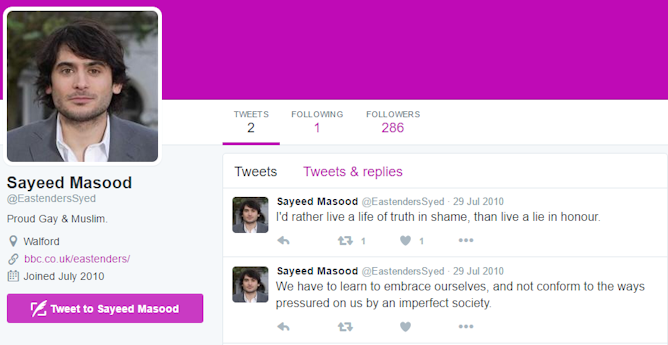


Syed Eastenders Twitter gay Muslim

Coming out: Syed from Eastenders on Twitter.
Twitter


This is a positive step forward and one that can be built on. Similarly, there needs to be more acknowledgement and acceptance of faith groups in LGBT contexts which tend to be secular. In my research, I’ve also found that gay Muslims can face Islamophobia on the gay scene, which can hinder their sense of belonging in these spaces.

In addition to improving relations between groups, it is likely that this exercise will have positive outcomes for well-being among those individuals who self-identify as Muslim and gay. Growing up in an environment in which you are led to believe that your sexual orientation is wrong, sinful or symptomatic of mental illness can lead to profound social and psychological challenges, including internalised homophobia, low self-esteem, depression and, in some cases, suicidal thoughts.

The reasons underlying the horrendous attacks perpetrated by Omar Mateen in Orlando may never be fully understood. But if it is true that he was a closeted homosexual – it was reported that he had used gay dating applications and frequented gay bars, including the one that he attacked – he clearly had a very difficult relationship with this aspect of his identity. There is already some empirical evidence that homophobia is associated with homosexual arousal, which suggests that homophobia might be a means of distancing homosexuality from one’s sense of self.

Could it be that his actions were in part a result of his internalised homophobia? Did he attack the LGBT community in an attempt to distance his own sexuality from his sense of self?

In any case, we as a society have a responsibility to acknowledge diversity and to allow people the space and opportunity to self-identify in ways in which they choose. We have a responsibility to challenge prejudice (of all kinds) when it shows its ugly face. We have a responsibility to support and protect minorities who are vulnerable to marginalisation and exclusion. Sometimes this will be challenging particularly when it means that we have engage with sensitive issues such as religious norms and customs but we must persevere – for the sake of freedom, peace and well-being for all of society.

Rusi Jaspal, Professor of Psychology & Sexual Health, De Montfort University

This article was originally published on The Conversation. Read the original article.


Tuesday, July 05, 2016

From the Archives: Gary Johnson presidential campaign racks up endorsements

Publisher's note: This article was originally published on Examiner.com on May 26, 2016, during the Libertarian Party's national convention in Orlando, Florida.  The Examiner.com publishing platform was discontinued Friday, July 1, 2016, and its web site is scheduled to go dark on or about July 10, 2016.  I am republishing this piece in an effort to preserve it and all my other contributions to Examiner.com since April 6, 2010. It is reposted here without most of the internal links that were in the original.

Gary Johnson presidential campaign racks up endorsements

In a bare-bones press release distributed on May 25, former New Mexico Governor Gary Johnson's campaign for the Libertarian Party presidential nomination unveiled a list of endorsements by celebrities, political activists, and Libertarian notables.

The list includes Nirvana bass guitarist Krist Novaselic, magician and TV personality Teller, professional football player Rudy Carpenter, podcaster Ben Kissel, and former CIA analyst John Kiriakou.

Other endorsers are 1980 Libertarian presidential nominee Ed Clark, Cato Institute founder and former president Ed Crane, 2014 Florida gubernatorial candidate Adrian Wyllie, 2012 Michigan congressional candidate Emily Salvette, and former Harris County (Texas) LP chairman Guy McLendon.

Duke University political scientist Mike Munger is also on the endorsement list, as is Tom Palmer, author of Realizing Freedom: Libertarian Theory, History, and Practice.

From Virginia, Robert Sarvis, who in 2013 earned more votes in his campaign for governor (against Ken Cuccinelli and Terry McAuliffe) than any other statewide Libertarian candidate, endorsed Johnson, as did former LP national chairman and 2008 Virginia U.S. Senate candidate Bill Redpath.

In his endorsement statement, Sarvis said:

"Only Gary Johnson has the resume, the experience, and the credibility to combine with our party’s inspiring message of peace, prosperity, and freedom."

Johnson, he continued, "has a fundamentally libertarian outlook and a track record of furthering libertarian goals in office. He has a realistic and likeable approach to politics that attracts open-minded voters to a libertarian message. And he has the kind of credibility that cannot be bought or faked, that can only be earned through admirable personal and professional achievements."

Redpath, who has also served as chairman of the Libertarian Party of Virginia, said in endorsing Johnson:

"2016 presents the greatest opportunity nationally for the Libertarian Party in many years. For us to seize this opportunity, it is essential that our presidential candidate be credible, serious and a widely-recognized champion of small government and greater freedom. We are fortunate to have such a candidate in Governor Johnson. I am proud to support him, and look forward to working with him toward historic success in November."

Redpath also added that he is "grateful for Governor Johnson’s work, often behind-the-scenes, to help ensure that Libertarian candidates are not unfairly denied ballot access. The fight against those who try to keep us off the ballot never ends, and Governor Johnson has been and continues to be a great supporter of our efforts."

In an interview with The Libertarian Vindicator, Richard Winger, editor of Ballot Access News, pointed out that a Johnson presidential candidacy would enhance the Libertarian Party's efforts at gaining ballot status in several states. "With 2%, we could be a qualified party for the first time in Iowa and Kentucky," Winger said, "and with 1% in Connecticut (but for president only for the 2020 election). We have never done that in any of those 3 states." (Winger had put himself on record as endorsing the Johnson campaign.)

With Gary Johnson's naming of former Massachusetts Governor William Weld as his running mate last week, the campaign has won unprecedented attention from the mainstream media, with interviews on CNN, ABC News, and MSNBC, and stories in POLITICO, The Hill, The Washington Post, New York Times, Boston Globe, and other news outlets.

(Full disclosure: Writing in a personal capacity, the Charlottesville Libertarian Examiner also endorsed Gary Johnson for President.)

Suggested Links

Examiner.com exclusive: Gary Johnson reflects on his first visit to Jefferson's Monticello
LP presidential hopeful Gary Johnson calls two-party debates a 'waste of time'
Presidential hopeful Gary Johnson on health care, marriage, and Colbert
Libertarian author Brian Doherty compares Ron Paul and Gary Johnson
LP gubernatorial hopeful Robert Sarvis aims for marriage equality in Virginia

Original URL:  http://www.examiner.com/article/gary-johnson-presidential-campaign-racks-up-endorsements


Monday, July 04, 2016

From the Archives: Libertarian Party chair Nicholas Sarwark predicts ‘epic’ national convention

Publisher's note: This article was originally published on Examiner.com on May 26, 2016, during the Libertarian Party's national convention in Orlando, Florida.  The Examiner.com publishing platform was discontinued Friday, July 1, and its web site is scheduled to go dark on or about July 10, 2016.  I am republishing this piece in an effort to preserve it and all my other contributions to Examiner.com since April 2010. It is reposted here without most of the internal links that were in the original.

Libertarian Party chair Nicholas Sarwark predicts ‘epic’ national convention

In an interview on the eve of the Libertarian Party’s presidential nominating convention in Orlando, Florida, today, the party’s national chairman, Nicholas Sarwark, predicted that the weekend is “going to be epic.”

Sarwark told the Charlottesville Libertarian Examiner in an exclusive interview at the Rosen Centre Hotel that “this may be the biggest Libertarian national convention that we’ve ever had. There are a couple, like 1979 in Los Angeles, that may be similar in size.”

Considering the space in the convention hall, he said, “we will be close to our theoretical maximum for delegates. For observers, we’re probably pushing 500.” The number of delegates, he said, will be more than 950 and possibly as many as 1,000.

As a result of the gathering – which has delegations from every state except Oregon, where the affiliate chose not to send delegates to the national convention – “ Orlando is the center of the American political landscape,” said Sarwark. “This is the eye of the storm. This is the biggest thing happening in politics right now, so I expect it’s going to be very exciting.”

‘Toughest and best choice’
Referring to the presidential contest, which includes former New Mexico Governor Gary Johnson, software entrepreneur John McAfee, and former Fox News producer Austin Petersen as well as about a dozen others – Sarwark said that the field includes “some of the best candidates that I’ve ever seen vie for our nomination and these delegates have probably the toughest and best choice in my memory.”

The Libertarian Party is also attracting a lot of attention from the news media, he said.

“I have not been off the phone with reporters for the last three weeks. Ever since Cruz dropped out after Indiana,” Sarwark explained, “it has been non-stop. I’ve talked to The Wall Street Journal, The New York Times, The Washington Post, The Hill, POLITICO, Reason.” He said he had an interview scheduled with C-SPAN and another with CNN later in the day.

“Every minute of my time at this convention that’s not at a business session is basically booked with interviews,” he added.

The attention is well-earned, he noted.

‘Our time to shine’
“It’s been 45 years that we’ve been waiting for this opportunity, doing the hard work of building the state parties, getting ballot access in all fifty states, and this is our time to shine.”

The party aims to have at least 1,000 candidates on the ballot across the United States in 2016, “including president, senate, congress, governor, state house, state senate, dog catcher.”

The LP, Sarwark said, has been trying “to fill the ballot every state, every election, all the time, because every American deserves to have a Libertarian option on their ballot.”

The “wasted vote” that some people warn about, is “when a person wakes up and says, ‘You know, I’m not going to vote for the two old parties anymore. I’m just done with it. I’m tired of them lying to me. I’m tired of the bullying, I’m tired of the fear tactics, I’m going to vote Libertarian’” but when they get into the voting booth and “there’s not a libertarian on their ballot – that’s a wasted vote. Those are the wasted votes that I want to catch.”

The Libertarian Party convention continues through Memorial Day. The presidential and vice presidential nominations will take place on Sunday morning, May 29, following a nationally televised debate on C-SPAN Saturday evening, May 28.

Suggested Links


Gary Johnson presidential campaign racks up endorsements
Charlottesville write-in voters honor former candidates, South Park characters
Former Senator George Allen 'stunned' by Donald Trump's popularity in GOP
Virginia Congressman Robert Hurt speaks out for free trade in Charlottesville
Presidential candidate Bernie Sanders stumps for support in Charlottesville

Original URL:  http://www.examiner.com/article/libertarian-party-chair-nicholas-sarwark-predicts-epic-national-convention


Sunday, July 03, 2016

From the Archives: Gary Johnson optimistic about Libertarian nomination prospects, praises Weld

Publisher's note: This article was originally published on Examiner.com on May 27, 2016, during the Libertarian Party's national convention in Orlando, Florida.  The Examiner.com publishing platform was discontinued Friday, July 1, and its web site is scheduled to go dark on or about July 10, 2016.  I am republishing this piece in an effort to preserve it and all my other contributions to Examiner.com since April 2010. It is reposted here without most of the internal links that were in the original.

Gary Johnson optimistic about Libertarian nomination prospects, praises Weld

Former New Mexico Governor Gary Johnson was the Libertarian Party’s presidential nominee in 2012 and he is looking to repeat that in 2016. In an exclusive interview today with the Charlottesville Libertarian Examiner at the Libertarian National Convention in Orlando, Johnson praised his proposed running mate, former Massachusetts Governor William Weld, and talked about his appeal to both conservatives and liberals, and raised the prospect of being invited to the presidential debates this fall.

Asked about his expectations for the convention this weekend, Johnson stated flatly: “I hope to be the Libertarian nominee for president, and I hope the Libertarian Party chooses Bill Weld as the vice presidential candidate. I really believe that we have an opportunity here to actually get elected.”

He explained that he and Weld came together based on a common bond forged in the 1990s, when both were serving as governors of their respective states.

'Smartest guy in the room'

“I connected with Bill Weld when I first became governor” of New Mexico, he said, explaining that they met at his first meeting of the National Governors Association.

At that time, he said, Weld had the reputation of being the smartest guy in the room. When he got to the NGA meeting, Johnson said, “Yeah, he was the smartest guy in the room but along with being the smartest guy in the room, he was classy, and classy was based on humility.”

Becoming ticket-mates for the Libertarian presidential campaign “didn’t involve a sales pitch on my part,” Johnson said, adding that Weld “was really enthusiastic. Thhe intention here is to actually be a team. He doesn’t want a staff as Vice President of the United States because staffs divide people. I think that speaks volumes about what the two of us can accomplish.”

Noting that the libertarian Cato Institute had rated both him and Weld highly on their “report cards” of the nation’s governors, Johnson said “That’s what we are carrying forward: I mean, genuine libertarian representation, fiscally conservative, socially liberal. These have been our careers, both of us.”

Remembering their years as governors of New Mexico and Massachusetts, he added that “for me, I always tried to emulate Bill Weld. Bill Weld was on a pedestal for me.”

It was, Johnson said, “Beyond my wildest dreams, [that] Bill Weld be a part of this ticket, running for President of the United States. I just hope we emerge from the weekend with this intact,” with the vote of the convention’s delegates approving the two as a ticket.

Asked what voters he and Weld will be aiming at in the general election campaign against Republican Donald Trump and Democrat Hillary Clinton, Johnson said that “by ‘aiming at,’ I think there will be enough attention given to us that, given the message, and given the experience, this is going to be more of a phenomenon of people just understanding what it is that we represent, and I think that it has absolutely broad-based appeal.”

Siding with Bernie
He pointed out that, when he takes the quiz at ISideWith.com, aside from the other candidates for the Libertarian nomination, he is closest to Vermont Senator Bernie Sanders.

“I side with Bernie 73 percent of the time,” Johnson said, pointing out that “those same Bernie Sanders supporters are going to find the reverse being true. They’re going to find themselves philosophically siding with me more than they do Hillary Clinton.” He conceded, however, that “when it comes to Bernie, look, we agree on so much but when it comes to economics we get to a ‘T’ in the road: he goes one way, I go the other.”

In response to attacks from National Review and other conservative outlets that have expressed fear that a vote for Gary Johnson is a vote for Hillary Clinton, Johnson acknowledged that it is a myth that Libertarians draw more votes away from Republican candidates than from Democrats.

“I think it’s an equal draw from both sides. I describe libertarian as being the best of both worlds. In the three national polls where my name has appeared, they have actually done an analysis and determined that I draw more from Hillary. At the end of the day,” he said, “I think it ends up being 50/50.”

A debate invitation?

Public opinion polls are fundamental as to whether Johnson and Weld get into the televised presidential and vice-presidential debates in the weeks before the November election. The Commission on Presidential Debates has set a 15 percent threshold in survey support for issuing invitations to participate in the forums.

“Rick,” Johnson said, “I don’t think there’s any question that we will be at 15 percent if we’re in the polls. That’s really the key, is being in the polls.”

What’s additionally significant to being in the polls, he said, “is that the Libertarian nominees, president and vice president, are going to be the only [third-party] candidates on the ballot in all fifty states,” which gives them more than a theoretical chance of winning electoral votes, or even the election.

Suggested Links

LP presidential hopeful Gary Johnson calls two-party debates a 'waste of time'
Belafonte criticizes Barack Obama on civil liberties in Charlottesville
Libertarian Party chair Nicholas Sarwark predicts ‘epic’ national convention
Scholar reflects on why Africa was absent from final presidential debate
Gary Johnson presidential campaign racks up endorsements

Original URL: http://www.examiner.com/article/gary-johnson-optimistic-about-libertarian-nomination-prospects-praises-weld


From the Archives: Gary Johnson optimistic about Libertarian nomination prospects, praises Weld

Publisher's note: This article was originally published on Examiner.com on May 27, 2016, during the Libertarian Party's national convention in Orlando, Florida.  The Examiner.com publishing platform was discontinued Friday, July 1, 2016, and its web site is scheduled to go dark on or about July 10, 2016.  I am republishing this piece in an effort to preserve it and all my other contributions to Examiner.com since April 2010. It is reposted here without most of the internal links that were in the original.

Gary Johnson optimistic about Libertarian nomination prospects, praises Weld

Former New Mexico Governor Gary Johnson was the Libertarian Party’s presidential nominee in 2012 and he is looking to repeat that in 2016. In an exclusive interview today with the Charlottesville Libertarian Examiner at the Libertarian National Convention in Orlando, Johnson praised his proposed running mate, former Massachusetts Governor William Weld, and talked about his appeal to both conservatives and liberals, and raised the prospect of being invited to the presidential debates this fall.

Asked about his expectations for the convention this weekend, Johnson stated flatly: “I hope to be the Libertarian nominee for president, and I hope the Libertarian Party chooses Bill Weld as the vice presidential candidate. I really believe that we have an opportunity here to actually get elected.”

He explained that he and Weld came together based on a common bond forged in the 1990s, when both were serving as governors of their respective states.

'Smartest guy in the room'

“I connected with Bill Weld when I first became governor” of New Mexico, he said, explaining that they met at his first meeting of the National Governors Association.

At that time, he said, Weld had the reputation of being the smartest guy in the room. When he got to the NGA meeting, Johnson said, “Yeah, he was the smartest guy in the room but along with being the smartest guy in the room, he was classy, and classy was based on humility.”

Becoming ticket-mates for the Libertarian presidential campaign “didn’t involve a sales pitch on my part,” Johnson said, adding that Weld “was really enthusiastic. Thhe intention here is to actually be a team. He doesn’t want a staff as Vice President of the United States because staffs divide people. I think that speaks volumes about what the two of us can accomplish.”

Noting that the libertarian Cato Institute had rated both him and Weld highly on their “report cards” of the nation’s governors, Johnson said “That’s what we are carrying forward: I mean, genuine libertarian representation, fiscally conservative, socially liberal. These have been our careers, both of us.”

Remembering their years as governors of New Mexico and Massachusetts, he added that “for me, I always tried to emulate Bill Weld. Bill Weld was on a pedestal for me.”

It was, Johnson said, “Beyond my wildest dreams, [that] Bill Weld be a part of this ticket, running for President of the United States. I just hope we emerge from the weekend with this intact,” with the vote of the convention’s delegates approving the two as a ticket.

Asked what voters he and Weld will be aiming at in the general election campaign against Republican Donald Trump and Democrat Hillary Clinton, Johnson said that “by ‘aiming at,’ I think there will be enough attention given to us that, given the message, and given the experience, this is going to be more of a phenomenon of people just understanding what it is that we represent, and I think that it has absolutely broad-based appeal.”

Siding with Bernie
He pointed out that, when he takes the quiz at ISideWith.com, aside from the other candidates for the Libertarian nomination, he is closest to Vermont Senator Bernie Sanders.

“I side with Bernie 73 percent of the time,” Johnson said, pointing out that “those same Bernie Sanders supporters are going to find the reverse being true. They’re going to find themselves philosophically siding with me more than they do Hillary Clinton.” He conceded, however, that “when it comes to Bernie, look, we agree on so much but when it comes to economics we get to a ‘T’ in the road: he goes one way, I go the other.”

In response to attacks from National Review and other conservative outlets that have expressed fear that a vote for Gary Johnson is a vote for Hillary Clinton, Johnson acknowledged that it is a myth that Libertarians draw more votes away from Republican candidates than from Democrats.

“I think it’s an equal draw from both sides. I describe libertarian as being the best of both worlds. In the three national polls where my name has appeared, they have actually done an analysis and determined that I draw more from Hillary. At the end of the day,” he said, “I think it ends up being 50/50.”

A debate invitation?

Public opinion polls are fundamental as to whether Johnson and Weld get into the televised presidential and vice-presidential debates in the weeks before the November election. The Commission on Presidential Debates has set a 15 percent threshold in survey support for issuing invitations to participate in the forums.

“Rick,” Johnson said, “I don’t think there’s any question that we will be at 15 percent if we’re in the polls. That’s really the key, is being in the polls.”

What’s additionally significant to being in the polls, he said, “is that the Libertarian nominees, president and vice president, are going to be the only [third-party] candidates on the ballot in all fifty states,” which gives them more than a theoretical chance of winning electoral votes, or even the election.

Suggested Links

LP presidential hopeful Gary Johnson calls two-party debates a 'waste of time'
Belafonte criticizes Barack Obama on civil liberties in Charlottesville
Libertarian Party chair Nicholas Sarwark predicts ‘epic’ national convention
Scholar reflects on why Africa was absent from final presidential debate
Gary Johnson presidential campaign racks up endorsements

Original URL: http://www.examiner.com/article/gary-johnson-optimistic-about-libertarian-nomination-prospects-praises-weld