Showing posts with label homosexuality. Show all posts

Saturday, June 17, 2017

Guest Post: The Qur’an, the Bible and homosexuality in Islam


Christopher van der Krogt, Massey University

Neither the Bible nor the Qur’an (Koran) has a lot to say about homosexuality, and what they do say relates only indirectly to contemporary discussions about gay rights and same-sex marriage. Like pre-modern scholars of law and ethics, these books assume heteronormativity.


Peter Paul Rubens, Lot and his family escaping from the doomed city guided by an angel, circa 1615.


Peter Paul Rubens, Lot and his family escaping from the doomed city guided by an angel, circa 1615.


As a concept, homosexuality is relatively recent, even if there is plenty of evidence for homoerotic pleasure in the past – albeit illicit in religious terms.

Scriptures and later writers usually referred only to particular sexual acts and did not raise the issue of personal sexual orientation. For religious conservatives, though, both Muslim and Christian, the occasional derogatory reference to same-sex acts is enough to prove their inherent sinfulness in all circumstances.

More liberal interpreters point to broader ethical considerations such as compassion and empathy. They argue that the condemnations of scripture do not apply to committed relationships founded on love.

Such a perspective, however, is inevitably more common among believers concerned with human rights, influenced by gender theory, and trained in contextual and holistic methods of interpretation.

Homosexuality in the Bible


Leviticus 20:13 (cf. 18:22) declares it abominable for a man to lie with another man as with a woman, and both partners are to be executed. The possibility that one party has been coerced is not discussed: both are defiled. However, the offence seems to be no worse than other capital crimes mentioned in the same context, such as adultery and incest.

Paul evidently regarded the prohibition of sexual acts between men or between women as violations of natural law known even to non-Jews – at least if their minds were not clouded by idolatry (Romans 1:18–32; 2:14–16).

He seems to have reflected contemporary views that men should be sexually assertive and women passive, and that sexual activity must be at least potentially procreative.

Sodom and sodomy


Lot fleeing with his family, by Peter Paul Rubens, 1615.

Lot fleeing with his family, by Peter Paul Rubens, 1615.
via Wikimedia Commons


For Jews, Christians, and Muslims alike, the story of Sodom is central to the traditional condemnation of male homosexuality. As recounted in Genesis 19, however, this is not a story about love or consensual sex between men: it is about rape and inhospitality.

The mob that gathers outside Lot’s house need not be exclusively male (the Hebrew plural anashim can include both genders), and the text says all ages were represented (Genesis 19:4, 11). When the crowd demands Lot’s visitors, he offers his two virgin daughters in their stead. Perhaps he considers the rape of his daughters a lesser evil than the rape of his guests.

The fact that the guests are male is not emphasised. After the visitors (angels in human form) rescue Lot and his family, God rains down fire and brimstone upon Sodom, Gomorrah, and other cities nearby.

Actually, he had already determined to punish all these towns and their inhabitants, male and female, young and old, before the angels’ visit and the attempted homosexual rape (Genesis 18:16–33). When the wickedness of Sodom is recalled in other parts of the Bible, homosexuality is not mentioned. Yet, despite this broader context, the story was often interpreted primarily as a condemnation of homosexual activity in any form.

In the Qur’an, the somewhat ineffectual Lot of Genesis becomes the Prophet Lut. The Arabic term for homosexual anal intercourse, liwat, comes from his name rather as English derived the term sodomy from the name of the town.

As in Genesis, Lut seems to argue with the men of Sodom over the relative propriety of abusing his daughters or his guests (11:78–79; 15:67–69). More often, though, the emphasis is on his condemnation of lusting after men instead of women (7:80–81; 26:165–66; 27:55; 29:29). In the Qur'an, Lut says:

Indeed, you approach men with desire, instead of women. Rather, you are a transgressing people.

Traditional Islamic perspectives


In the Hadith (thousands of stories reporting the words and deeds of Muhammad and his companions that are comparable in authority to the Qurʾan itself), there is some support for the notion that the principal offences of Sodom were idolatry and avarice. These led in turn to inhospitality and the rape of male visitors.


 Hadith Silsilat al Dhahab (Golden Chain Statue) in Nishapur, Iran.

Hadith Silsilat al Dhahab (Golden Chain Statue) in Nishapur, Iran.
Sonia Sevilla, CC BY


Nevertheless, the Hadith do unequivocally condemn male homosexual acts. The Qur’an (4:16) demands unspecified punishment for men guilty of lewdness together unless they repent.

Yet, the Prophet is supposed to have declared that both the active and the passive partner should be subject to the same penalty as for zina (illicit heterosexual sex, usually adultery), namely execution by stoning. Abu Dawud’s authoritative hadith collection records a report from Abdullah ibn Abbas:

The Prophet (peace be upon him) said: If you find anyone doing as Lot’s people did, kill the one who does it, and the one to whom it is done (38:4447).

It is doubtful whether any passage of the Qur’an refers to lesbian acts though the condemnation of women who commit indecency (4:15) is sometimes read this way. A few hadith warn women against seeing or touching each other when naked.

Traditional Islamic jurisprudence assumed strict gender roles. The 17th-century Muslim scholar Haskafi explicitly included “a male” in his list of those whom a man could not legally marry.

Marriage was understood in hierarchical terms, but although a man could have sexual relations with female slaves, he did not have the same rights over male slaves.

Pre-modern scholars who produced lists of “enormities” included liwat and sometimes tribadism (“rubbing”, that is, lesbian intercourse) after zina. Prescribed penalties for homosexual acts varied according to different schools and individual scholars. In any case, it was difficult to attain the required level of eye-witness testimony.

In practice, homosexual encounters, including with young male prostitutes, seem to have been quite common in Islamic societies. They were no more or less a cause for moralistic concern than other forms of illicit sex.

Reinterpreting the Islamic tradition


Without actually endorsing homosexuality, some Muslims in Western societies have recognised a parallel between the religious acceptance they demand and the acceptance demanded by gays and lesbians.

The New Zealand Muslim MP Ashraf Choudary (who did not realise that the Qur'an does not urge the stoning of homosexuals) observed that,

if the law allows one minority group in our society to be discriminated against then all minorities are vulnerable.

Some, such as Cambridge philosopher Abdal Hakim Murad (Timothy Winter), have accepted that a homosexual orientation may be innate but say that does not make homosexual sex permissible.

Deducing that it may therefore be legitimate remains a step too far for most.

Traditionally, if sins can be forgiven when repented, declaring forbidden acts not to be sinful has been regarded as heresy or even apostasy. Commentators such as Mehdi Hasan, after wrestling thoughtfully with the issues, have concluded that while they do not approve of homosexual acts, they cannot condone homophobia.

A similar message was offered by Tariq Ramadan, Professor of Contemporary Islamic Studies at Oxford, when he visited New Zealand: Muslims and others have to respect each other, which includes accepting that the law permits gay marriage.


Imam Daayiee Abdullah Reverend Dwayne Johnson

Imam Daayiee Abdullah, seen here with Reverend Dwayne Johnson discussing religion and LGBT rights in the U.S., is openly gay. He’s argued that ‘there is nothing wrong with Quran. The problem is with how people have interpreted it.’
East-West Center, CC BY-NC-SA


For Muslims generally, as for conservative Christians, homosexual acts are sinful. It is difficult to be openly gay or lesbian in predominantly Islamic countries, but in the West, there are even (a few) gay imams.

There are also support groups for gay and lesbian Muslims. Writers such as Scott Kugle (Siraj al-Haqq) try to reconcile Islamic identity with alternative sexual orientations. Like their Jewish and Christian counterparts, they seek the “original” meaning of scriptural texts obscured by generations of patriarchal, heteronormative interpreters.

They also question the authenticity of certain hadith – in the traditional manner by scrutinising their chains of transmission – and reopen past debates such as that concerning “temporary” marriage. The latter need not be short-term and may offer an alternative framework for co-habitation without formal marriage.

Christian gays and lesbians have had to work hard for a measure of recognition among fellow-believers; their Muslim counterparts are just beginning that struggle.


The ConversationAcknowledgement: The most useful source for this essay has been Kecia Ali, Sexual Ethics and Islam: Feminist Reflections on Qur'an, Hadith and Jurisprudence (Oneworld Publications, new edition, 2016).

Christopher van der Krogt, Lecturer in History, Massey University

This article was originally published on The Conversation. Read the original article.

Friday, June 09, 2017

Guest Post: What it's like to be gay and a Muslim


Rusi Jaspal, De Montfort University

The Orlando shooting was a hate crime against gay people – even if, once it emerged that the attacker had been a Muslim, many people claimed this as a terrorist attack rather than a hate crime. And, in an important sense, this was also a terror attack, since its aim was to spread fear in the LGBT community. The Conversation


gay Islam muslims homosexual

shutterstock.
Nando Machado/Shutterstock.com


Since the massacre there has been a lot of speculation about Islam and homosexuality and there are fears that one man’s despicable act of terrorism could fan the flames of Islamophobia and other forms of social exclusion, leading to discord and unrest in an era of elevated Islamophobia.

It is difficult to define the “Islamic position” on homosexuality, as a monolithic phenomenon, simply because Islam is a very diverse faith group with some 1.6 billion followers on six continents. In most Muslim countries, homosexuality is illegal and in some countries, including Iran and Saudi Arabia, it is punishable by death. But in others, such as Jordan and Turkey, homosexuality is not considered a crime.

Most Islamic scholars are in agreement that homosexuality is incompatible with Islamic theology. They tend to draw on the story of Lot in the Koran (also in the Old Testament) which recounts the destruction of the tribe of Lot allegedly due to their engagement in homosexual acts as “evidence” for God’s condemnation of homosexuality. Many scholars also cite the Ahadith (statements attributed to the Prophet Muhammed) that are condemnatory of homosexuality. Theological and legal condemnations of homosexuality can engender perceptions at a social level that homosexuality is wrong and that it should not be permitted.

Muslims on homosexuality


In 2009, a Gallup survey revealed negative attitudes towards homosexuality among European Muslims. In France, 35% of Muslims viewed homosexuality as “morally acceptable” (versus 78% of the general public). In Germany, 19% of Muslims viewed it as morally acceptable (versus 68% of the general public). In the UK, none of the Muslim respondents viewed homosexuality as morally acceptable (versus 58% of the general public who did).

Earlier this year, a survey commissioned by Channel 4 was conducted among a random sample of 1,081 individuals who self-identified as Muslim. The results found that 18% of the British Muslim respondents agreed that homosexuality should be legal in Britain while the majority (52%) disagreed. Conversely, only 5% of the general public thought homosexuality should be illegal. Furthermore, 47% of the British Muslim respondents indicated that they did not believe that it was acceptable for a gay person to become a teacher. These data suggest that there are low levels of acceptance of homosexuality in Muslim communities in the UK.


However, qualitative interview data can provide more nuanced understandings of what Muslims think and why they might hold these views.

In my research into attitudes concerning homosexuality among samples of first and second-generation British Muslims of Pakistani descent, I found that attitudes tend to be largely negative. Although research into attitudes towards homosexuality in the general population points to demographic variables, such as age and level of education, as key determinants of the nature of attitudes, this has not been the case in my own work with British Muslims. Muslims of various ages, education levels and socio-economic backgrounds have participated in my studies and generally perceive homosexuality in negative terms. In substantiating these attitudes people often draw on holy scripture. As one 54-year-old woman said:

It says it in the Koran that it’s wrong and sorry I’m not the one who made it. It’s what the God revealed to the Prophet so it’s the truth and that’s my belief system.

Many interviewees draw upon holy scripture as the basis of their views regarding homosexuality. There appears to be a desire not to “re-interpret” holy scripture – to accommodate homosexuality – because of the divinity of its origin. Moreover, there was a fundamental rejection of essentialist arguments concerning the origins of sexual orientation – that people are born gay and that they do not “choose” to be gay – and interviewees often argued that people had “chosen” to be gay. One 28-year-old man said:

God doesn’t create gay people. It’s a path they’ve chosen and that’s an incorrect path according to our faith.

Indeed, previous research has shown that believing the essentialist argument regarding homosexuality is correlated with less discrimination and greater acceptance.


Koran homosexuality gay muslim Islam

What does the Koran say about homosexuality?
Lord Harris/BritishMuseum, CC BY


First-hand relationships


Although many British Muslims may disapprove of the concept of homosexuality, several individuals reported positive first-hand experiences of contact with LGBT people. A 45-year-old man said:

Homosexuality is wrong, I believe … I have a gay neighbour and he lives with his partner. He’s a very nice guy – both of them [are]. They are very respectful. We consider them friends.

Some people spoke fondly of their LGBT friends, neighbours and acquaintances, suggesting that first-hand contact may challenge homophobia which exists at an abstract, conceptual level. It is also vital to stress that the Muslim interviewees overwhelmingly rejected violence against LGBT people. As one woman put it:

Violence and hate crimes are un-Islamic. We are not supposed to kill or hurt others, as Muslims. No, they can’t have it both ways so they won’t be accepted in our community but it’s for God to punish, not us.

It was difficult for British Muslim interviewees to accept homosexuality given the overwhelming “evidence” of its prohibition in Islam. Individuals simply had no positive theological frame of reference given the absence of LGBT affirmative voices at an institutional level. This led some individuals to view endorsement of homosexuality as a violation of their religious faith and its norms:

Being gay is un-Islamic and so is encouraging it.

Put simply, the acceptance or endorsement of homosexuality was perceived as contravening key tenets of Islam.

Gay Muslims speak out


Clearly, the stigma attached to homosexuality in Islamic communities can have profound effects for those Muslims who also self-identify as gay. For almost a decade, I have been researching the social psychological aspects of being Muslim and gay. In view of the generally negative attitudes towards homosexuality in Muslim communities and the silence that can surround discussions of sexuality, most of my Muslim gay interviewees have manifested a poor self-image and low psychological well-being. Many view their sexual orientation as “wrong” and, thus, express a hope to change it in the future. One young gay Muslim man said:

It’s [being gay] wrong, really, isn’t it? … In the mosque we’re told that Shaitan [Satan] tries to tempt Muslims because he is evil and he makes us do evil things. I know that doing gay things is evil but I hope I’ll change my ways and take the right path soon … It’s all about temptation, really. Life is a big test.

Those gay Muslims who conceptualise their sexuality as immoral and wrong can understandably struggle to derive self-esteem, which is key to well-being. They may come to view their sexual orientation as “evil” and resist it. Some attempt to change their sexual orientation, sometimes by entering into marriages of convenience. This conceptualisation of homosexuality stems from their understanding of the Islamic stance on it. Said by a 28-year-old man:

What the Prophet said was right and that’s always going to stand, yeah. Men having sex with other men was wrong in his eyes. He hated it.

It is easy to see how belief in the negativity of homosexuality from the perspective of one’s faith (which, in countless studies has emerged as an important identity among British Asian Muslims) could cause some gay Muslims to develop internalised homophobia and, in some cases, to doubt the authenticity of their Muslim identity.

Gay Muslims may cope with this internal conflict in a number of ways. While some hope to change their sexual orientation and to “become” straight, others may deny that they are actually gay:

Maybe I’m not bisexual because I’ve never been with a woman but I can’t call myself gay either … I refuse to do that because I just don’t feel gay.

Crucially, in making sense of the “causes” underlying their sexual orientation, some gay Muslims were of the view that they had “become” gay as a result of their social environment and consequently blamed British society:

I’m gay because I was brought up here [in Britain] but I reckon if I’d been brought up in Pakistan then I would have turned out straight because this doesn’t happen that much there. Like I haven’t heard of any gays in our village. Here there are clubs and that and so I just kind of fell into the gay culture.

We tend to attribute aspects of our identity that we see as undesirable to external factors. This is a means of protecting one’s sense of self from threats. Some of the gay Muslim interviewees in my studies have identified British (or Western) culture as the reason for their sexual orientation.

Reconciling homosexuality and Islam


Many individuals of religious faith struggle to accept homosexuality given the centrality of heterosexuality to faith life, according to most faith groups. Muslims are no exception. Individuals use all sorts of strategies for protecting their sense of identity and some of these strategies can actually have poor social and psychological outcomes. Social psychologists have long argued that intergroup contact is a good starting-point for improving relations between different social groups.

Universities are obvious contexts in which different groups can come together – LGBT and Islamic student societies on university campuses could collaborate with the aim of increasing inter-group contact between Muslims and LGBT people (and indeed those who identify with both categories).

Of course, inter-group contact needs to be characterised by positive images of the outgroup. So there needs to be much more discussion of homosexuality in Muslim communities – which will admittedly be difficult given the cultural taboo around sexuality. Faith and community leaders should broach the topic. My view is that people need to be exposed to LGBT affirmative images. This has already happen to some extent.

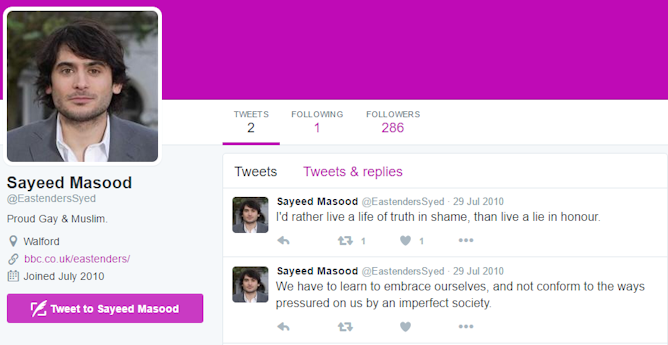
As I’ve written elsewhere, the Eastenders storyline concerning Syed Mehmood, a gay Muslim character who struggles to come out to his parents, generated some discussion in the British Muslim community and led some individuals to acknowledge the existence of homosexuality within their community.


Syed Eastenders Twitter gay Muslim

Coming out: Syed from Eastenders on Twitter.
Twitter


This is a positive step forward and one that can be built on. Similarly, there needs to be more acknowledgement and acceptance of faith groups in LGBT contexts which tend to be secular. In my research, I’ve also found that gay Muslims can face Islamophobia on the gay scene, which can hinder their sense of belonging in these spaces.

In addition to improving relations between groups, it is likely that this exercise will have positive outcomes for well-being among those individuals who self-identify as Muslim and gay. Growing up in an environment in which you are led to believe that your sexual orientation is wrong, sinful or symptomatic of mental illness can lead to profound social and psychological challenges, including internalised homophobia, low self-esteem, depression and, in some cases, suicidal thoughts.

The reasons underlying the horrendous attacks perpetrated by Omar Mateen in Orlando may never be fully understood. But if it is true that he was a closeted homosexual – it was reported that he had used gay dating applications and frequented gay bars, including the one that he attacked – he clearly had a very difficult relationship with this aspect of his identity. There is already some empirical evidence that homophobia is associated with homosexual arousal, which suggests that homophobia might be a means of distancing homosexuality from one’s sense of self.

Could it be that his actions were in part a result of his internalised homophobia? Did he attack the LGBT community in an attempt to distance his own sexuality from his sense of self?

In any case, we as a society have a responsibility to acknowledge diversity and to allow people the space and opportunity to self-identify in ways in which they choose. We have a responsibility to challenge prejudice (of all kinds) when it shows its ugly face. We have a responsibility to support and protect minorities who are vulnerable to marginalisation and exclusion. Sometimes this will be challenging particularly when it means that we have engage with sensitive issues such as religious norms and customs but we must persevere – for the sake of freedom, peace and well-being for all of society.

Rusi Jaspal, Professor of Psychology & Sexual Health, De Montfort University

This article was originally published on The Conversation. Read the original article.


Thursday, July 21, 2016

From the Archives: Former Senator Rick Santorum says homosexuals deserve protection

Publisher's note: This article was originally published on Examiner.com on March 8, 2015. The Examiner.com publishing platform was discontinued July 1, 2016, and its web site was scheduled to go dark on or about July 10, 2016.  I am republishing this piece in an effort to preserve it and all my other contributions to Examiner.com since April 6, 2010. It is reposted here without most of the internal links that were in the original.

Former Senator Rick Santorum says homosexuals deserve protection

Former Senator Rick Santorum (R-Penn.), who was a candidate for the Republican presidential nomination in 2012 and a likely candidate for the same job in 2016, placed sixth in the annual CPAC straw poll last month, behind Kentucky Sen. Rand Paul, Wisconsin Gov. Scott Walker, Texas Sen. Ted Cruz, Dr. Ben Carson, and former Florida Gov. Jeb Bush. Santorum also garnered sixth place in the 2014 CPAC straw poll.

Despite his poor poll showing, Santorum's still-unofficial presidential campaign had a visible presence at CPAC (the Conservative Political Action Conference), which took place in suburban Washington, D.C., and attracted more than 11,000 participants.

On February 27, after hosting a townhall-style meeting for about 250 supporters and potential supporters, Santorum spoke briefly with members of the news media. During the press gaggle, the Charlottesville Libertarian Examiner posed two questions to the former senator, both on foreign policy issues.

'Obligation to protect all people'

First, Santorum, who is well known for his socially conservative positions with regard to gay rights, was asked whether it is appropriate for the U.S. Department of State to defend the rights of homosexuals in foreign countries where their lives might be threatened by anti-gay governments.

“We have to defend human rights everywhere,” Santorum replied. “If someone's life is threatened because of race, sexual orientation, or other [reasons], I think we have an obligation to stand up and defend that human right. I don't have a problem at all, if people's lives are in jeopardy, then we have an obligation to protect all people and their freedoms.”

'A different threat'
Second, the former Pennsylvania senator was asked whether Middle Eastern or Islamic terrorism poses a greater threat to the United States today than the Soviet Union did during the Cold War.

“I think it's a different threat,” Santorum said.

Islamic terrorism, he explained, is “a threat that is in some respects is more difficult to understand and to respond to.”

Rick Santorum at CPAC 2015
In contrast, “the Soviet Union was in many respects a predictable animal. Remember, we had policies like Mutual Assured Destruction, and we did it because we knew how they would behave, how they would act.”

“In fact,” he added, the Soviets “were very predictable. That doesn't mean they weren't evil, that doesn't mean they weren't oppressive, that doesn't mean they weren't everything that Reagan and others said about them.”

Today, he explained, “the complexity of dealing with radical Islam – and the fact that there are 1.5 billion Muslims around the world – makes this a much more difficult issue and one that, if you look historically, [is] a more intransigent problem for the West than the 50 years of the Cold War.”

The “other war” against Islamic terrorism, he concluded, almost as an afterthought, has lasted “a thousand years.”

Video of this press gaggle with likely GOP presidential candidate Rick Santorum is available on YouTube.

SUGGESTED LINKS

Lamar Alexander honored for his work promoting civics, history education
Conservative icon Stan Evans dies at 80; remembered as 'present at the creation'
GOProud’s Jimmy LaSalvia talks about CPAC and gay conservatives
CPAC bars GOProud; presidential candidate Gary Johnson presciently weighs in
Gary Johnson wins RLC straw poll, places third in CPAC poll

Original URL: http://www.examiner.com/article/former-senator-rick-santorum-says-homosexuals-deserve-protection


Monday, May 21, 2012

Senate Candidate E.W. Jackson Contradicts Himself

E.W. Jackson (r) with George Allen
U.S. Senate candidate E.W. Jackson, a charismatic clergyman and fiery orator who has caught the attention of Virginia's political class, is clear on where he stands on the issues.  There is no question about what he is for and what he is against.

One thing he is against is gay marriage.  Another thing he is against is appointing openly gay judges, according to a report today in a blog at the Washington Post web site.

But in inveighing against gay people, Jackson has found himself caught up in a contradiction.

Per Laura Vozzella's report in the Post:
“Private sexual behavior, unless it is against the law, should remain private,” Jackson said.
Jackson does not follow his own admonition, however.

A look at the biography he has posted on his campaign web site reveals this statement:
He and his wife have been married for forty years, have 3 children and have resided in Chesapeake for 13 years.
The photograph accompanying that biography clearly shows Jackson wearing a prominent wedding ring.

It looks to me that, when it comes to not displaying sexual behavior in public, Jackson can talk the talk but not walk the walk.

If Jackson, as a candidate for the U.S. Senate, can openly talk about his spouse, than so can candidates for judicial positions -- even gay candidates.

For my interviews with E.W. Jackson, look here and here.

Finally, note that if one follows the logic of Jackson's statement -- "Unless it is against the law, private sexual behavior should remain private" -- then illegal sexual behavior should be made public, not private.  That is a bizarre position for a clergyman to take.


Be sure to visit my CafePress store for gifts and novelty items!
Read my blog on Kindle!
Follow my tweets on Twitter! 


Monday, October 04, 2010

From the Archives: 1988's 'The why of teen-age suicides'

The topic of suicide by gay teenagers is in the news again, illustrated most vividly by the death of a Rutgers University student, Tyler Clementi, who leapt from the George Washington Bridge last month.  (The circumstances of Clementi's suicide are fraught with questions and not a little hyperbole, so I will not be commenting directly on that particular case.)

Some gay activists have called four suicides by gay teenagers in the past month an "epidemic," although it does not appear that any of them were related to each other.  (They occurred in California, Indiana, and Texas, in addition to Clementi's death in New Jersey.)

David Link on the Independent Gay Forum and conservative columnist (and, as of today, Eliot Spitzer's sparring partner on CNN) Kathleen Parker in the Washington Post both draw attention to a new project on YouTube called "It Gets Better," initiated by advice columnist Dan Savage and supported by talk-show host Ellen DeGeneres.

The aim of the It Gets Better Project is to showcase the personal stories of gay men and lesbians who used to be gay and lesbian children or teenagers. In short video clips, today's young (and some not-so-young) adults explain, from their own perspective, that bullying, disrespect, alienation, and disorientation are temporary phenomena that can be overcome with time, patience, and effort. In a phrase, "it gets better" -- life gets better, and it's worthwhile to stick around to find out where it takes us.

Although it is not a topic I have followed closely in recent years, I first wrote about gay teen suicide in 1988 -- about two years before I came out to more than my close circle of friends and classmates.  The article appeared in the Pittsburgh Post-Gazette and, although the statistics cited may be different (and probably more accurate) today, the general theme remains solid.

I am grateful to an email correspondent (and old friend) who reminded me of this article and gave me a reason to repost it as an archival piece on this blog.  (I do not believe the article, given its age, is available in any easily accessible electronic format on-line.)

Here it is as it appeared in the Pittsburgh Post-Gazette on Saturday, December 10, 1988.


The why of teen-age suicides

WASHINGTON
The drama is played out again and again in towns and cities across the country.

A young man of 16 or 17, good-looking. personable, popular, intelligent, often the captain of the football team or president of his class, takes his own life.

This tragedy grips family and friends, who question: “Why?” There seems to be no explanation for this senseless act. “No warning signs,” “every reason to live,” “not even his girlfriend had a clue” — these phrases are numbly repeated, in vain.

Wherever you turn, the tragedy of teen suicide has attracted enormous attention. Each year 5,000 people between the ages of 15 and 24 kill themselves. The rate has tripled over the past 30 years and doubled since 1960, so that today suicide Is the third leading cause of death in this age group.

Why do so many of our young people consider suicide, attempt it, and sometimes succeed at it?

Multiple causes are likely. Certainly the familiar woes of adolescence are a part of it, as are parental and peer-group pressures toward often contradictory goals — the drive for high grades or a well-paying job and the abuse of drugs and alcohol. Yet one factor deserves special attention, perhaps most of all because fear and prejudice have prevented our taking it fully into account.

This factor has been illuminated by films that portray the suicide of adolescents with sexual problems. In "Another Country," an English schoolboy hangs himself in the chapel after a teacher catches him in the passionate embrace of a fellow student. In "Ode to Billy Joe," the title character leaps off the Tallahatchee Bridge, unable to deal with the fact that he had been seduced by an older man.

These gripping images may help explain the deaths of so many “handsome young men” with “every reason to live.”

Contemporary discussions of teen-age suicide generally neglect to touch on the contributing factor of adolescent homosexuality. Reasons for this are vague. Society’s taboos against discussing teen sexuality In general and homosexuality in particular have hindered full examinations of adolescent suicide. In fact, outside the medical literature, only publications with primarily gay and lesbian readers do the story justice.

In 1986, sociologist Joseph Harry of Northern Illinois University reported that young people who are homosexual are six times more likely to attempt suicide than their heterosexual peers. Dr. Harry’s research indicates that as many as half the males in the 15-24 age group who try to kill themselves are gay. His conclusions were partially confirmed in the prestigious Journal of the American Medical Association in July 1987.

Future studies of the teen-suicide problem must explore this factor more thoroughly. Shervert Frazier of the National Institute of Mental Health insists: “There’s no question that the issue of gay and lesbian adolescents who have suicidal behavior has to be considered.”

Statistics dictate such an examination: While only 3 percent of heterosexual men and 14 percent of heterosexual women attempt suicide, as many as 18 percent of gay men and 23 percent of lesbians do so. This is a striking comparison.

Considering that gay men constitute at most 10 percent of the male population, and lesbians an even smaller percentage of women, this attempted suicide rate is significantly out of proportion. It suggests that gay people encounter social pressures that undermine their sense of self-worth and undercut their basic human dignity unlike anything heterosexuals experience.

Our society continues to castigate and condemn gay and lesbian youth. In spite of the constant teaching of most religions that homosexuals should be treated with the same compassion as all other people, some Christians and Jews still ostracize gay men and women — teenagers, too — not so much for what they do but for who they are.

According to family counselor Wayne Pawlowski, young homosexuals have a lot of unique worries: “condemnation, rejection by family, friends, society at large; forced isolation from the family and/or peers; physical abuse; discrimination, legal problems; constraints on educational and career goals. In addition to these realistic fears, the same adolescents lack positive role models.”

As a result, he writes, gay teen-agers suffer “low self-esteem, poor self-image, guilt, loneliness, confusion, fear of being sick and different, depression, anxiety, suicidal thoughts.”

Society’s treatment of homosexual youth contributes to the high incidence of runaways and their prostitution, exploitation and drug abuse. Many families discard gay and lesbian teenagers when their sexual orientation surfaces. Directly or indirectly, these children are told by their families that they are unwanted and unloved — so they choose to run away or commit suicide. Either risk seems better than the real pain they encounter.

Coming to terms with one’s sexuality is always stressful. To return to Dr. Harry’s report, gay young people have experiences and characteristics that “may create special difficulties for them. And for some, suicide may seem preferable to other solutions.”

Suicide can be an escape from painful schoolyard taunts of “faggot” and “dyke” — and, worse than taunts, threats and assaults as well. Such intolerance is not limited to junior high or high school. It continues ever among “mature” college students.

Parents, friends, siblings and teachers who have had to face the suicide or attempted suicide of a young person should not be ashamed or afraid to consider the combination of homosexuality and homophobia (the irrational fear and hatred of homosexuals) as a motivation for this drastic act. There is much more to fear from covering it up, and much more shame in ignorance.

The captain of the football team or class president who kills himself is only the most visible and attractive example of a phenomenon that is much more far-reaching. Having hidden their sexual orientation for most of their lives from those closest to them, it was easy to hide the most recent troubles that have pushed them over the brink. That is why there were no clues. In almost every one of these cases, a little digging will reveal that the victim was either gay or thought he was or, sometimes, he had had an isolated homosexual experience — in either case, death appeared to be preferable to lifelong humiliation.

To combat this phenomenon, adults and teens alike must be more compassionate toward those who are or who think they may be gay. As one doctor urged in the Journal of the American Medical Association, we must all treat each other in a way “that promotes self-acceptance and tolerance of individual differences.” Only then can we fully grapple with the tragedy of teen suicide.

Richard Sincere is a Washington-based policy analyst and writer.


Be sure to visit my CafePress store for gifts and novelty items!
Read my blog on Kindle!
Follow my tweets on Twitter! 

See my articles on Examiner.com!

Monday, February 22, 2010

Obsessed with Sex

It's doubtful that I am alone in bringing up this question, but why, in debates about public policy or the place of gay men and lesbians in society (or in the conservative movement), are anti-gay conservatives always the first to bring up sex -- usually in a graphic and salacious manner?

I distinguish here between "anti-gay conservatives" and the bulk of conservative activists and normal Americans who believe that a person's private life is private and should not be talked about in public settings unless (or even if) he or she brings it up initially.

The dust-up involving Ryan Sorba, whose embarrassing tirade (his word) at last weekend's Conservative Political Action Conference (CPAC) led him to be booed off the stage, is only the latest example of this strange phenomenon of "conservatives" talking about their obsession with other people's sexual behavior.  The Sorba incident, including his off-stage encounter with my friend, Alex Knepper, brought the phenomenon into focus for me.

Sorba has written a "book" (for which he has been unable to find a publisher) called "The Born Gay Hoax." In its 95 pages, he uses the word "sodomy" 214 times.  He uses the word "sex" (sometimes in compounds like "same-sex") 153 times.  In contrast, the word "love" appears only 28 times and the word "affection" just once.  (He also uses "pederast" nine times and "pedophile" or "pedophilia" six times, for those keeping score.)

When gay men and lesbians speak in public about social or political issues that impinge on their lives, it is almost always in terms of "love," "affection," "marriage," "commitment," and "responsibility."

When anti-gay conservatives talk about those same issues, it is almost always about sex, genitalia, sodomy, fellatio, or other similar, graphic terms -- often with the clear intention to shock and chagrin their audiences.

For instance, a search of Peter LaBarbera's "Americans for Truth about Homosexuality" turns up 232 hits for "anal sex," 76 hits for "oral sex," 54 hits for "fellatio," and 16,179 (that is not a misprint) hits for "penis."

Just out of curiosity, I did a similar search on the web site of the liberal gay-rights organization, the Human Rights Campaign (HRC), and got only 15 hits for "penis" (two of which were quotations from the Bible), two for "fellatio" (both links to the same document about state legislation), 183 hits for "oral sex" (many also linking to articles about legislation), and 25 hits for "anal sex" (again, most links were to "Law Briefs" on topics like Lawrence v. Texas).

Who is most obsessed with male sex organs?.  The answer is not "gay rights groups."  It's Peter LaBarbera.

Coincident with Ryan Sorba's rant at CPAC, conservative journalist Cliff Kincaid wrote two pieces last week on gay issues, one in which he says he approves of the Ugandan bill that mandates the death penalty for homosexuals, and one in which he asserts that the gay conservative group, "GOProud's commitment to constitutionally protected homosexual sodomy (i.e., anal intercourse) is not a position that appears on the agenda of any conservative groups."

I had my own bizarre encounter with Cliff Kincaid, whom I knew casually from conservative circles in the 1980s.  We were on friendly terms and I know that he had quoted me in articles he wrote about defense and foreign policy issues on several occasions.

In December 1990, I was running for the Virginia House of Delegates in the 49th District (the seat now held by openly-gay Democrat Adam Ebbin), in a special election to be held on January 8, 1991.

Kincaid invited me to appear by telephone on his local radio talk show. He had seen an article about my candidacy in the Washington Post and wanted to talk about it.

I was thrilled to get the media exposure in an obscure, off-cycle election that most voters did not even know was taking place.

Kincaid began the interview, which was scheduled to last 30 minutes, politely. But then he began to emphasize the fact that I was running as an openly gay candidate and got off the track I expected -- namely, the libertarian issues that motivated me to run, like reducing business regulation and taxes -- and began to ask graphic questions about my sex life.

Seriously, he asked me, on live radio, whether I put my penis in another man's anus or mouth, or if I let another man put his penis in my mouth or anus. I was flabbergasted and refused to answer.

He repeated the question, and again I refused to answer. He was persistent and snarled, "Well, if that's not what you want to talk about, why do you think you're on this show?"

As sweetly as I could, I responded, "Cliff, I thought you wanted me here to talk about cutting taxes and spending in Richmond."

Shortly after that, the interview was cut short and I sat at my desk, stunned that a grown man could ask such personal questions in such a public fashion.

The best thing about that interview is that it has given me a great story with which to entertain my friends at dinner parties for the past two decades.

Getting back to my point about gay people being more concerned with love and affection than about genitalia, I've concluded that anti-gay conservatives (not the nice, rational conservatives) are largely clueless about what it means to be gay.  That's the only explanation for Ryan Sorba saying to Alex Knepper "you mean you think you're gay" in a timid attempt to cast doubt on the veracity of Alex's claim to be gay.

These people don't understand that when a high-school freshman realizes he's gay and that he has a crush on his best friend, the first thing to come to his mind is not "I want to have anal sex with him."  The first thing he thinks is, "I want to kiss him."

The fact that anti-gay conservatives can't make the distinction between affection and lust says more about them than about the people whose rights (and, in Sorba's case, whose existence) they seek to deny.

Perhaps some anti-gay conservative -- the sort who booed Alexander McCobin of Young Americans for Liberty and cheered Ryan Sorba -- can answer my question:  Why are you always the first to bring up sex in a conversation about gay rights?  Is it a personal obsession, a mask for your true feelings, or is it in some convoluted way connected with rational thought?


Be sure to visit my CafePress store for gifts and novelty items!
Read my blog on Kindle!
Follow my tweets on Twitter!

Monday, December 01, 2008

Crazy Homophobes to Picket Charlottesville

It was only a matter of time before it happened, given our town's reputation for tolerance, free inquiry, and intelligence, but the inmates of the insane asylum known as Westboro Baptist Church (motto of divine compassion:  "God Hates Fags") are coming to Charlottesville to picket the University of Virginia Hospital.


From the godhatesfags.com web site comes this announcement of their plan to be in Mr. Jefferson's city, demonstrating in front of one of the nation's most admired teaching hospitals, on Tuesday, December 2, from 3:00 to 4:00 p.m.:
University of Virginia - God Hates You W. Main St. & Jefferson Park Ave The mocking patriots of the whore monger, slave-raping, God-hater Thomas Jefferson shall get picketed while we are in the neighborhood. No problem, we're happy to visit. Someone needs to tell you self-important little brats some truth for once in your sad lives. You think you can thumb your nose at God by having that stinking pale of slime called "The Laramie Project". Then, when we tell you we will picket you - you threaten us, and come out with mob mentality to "get with" the servants of God?! You are in big trouble, WITH GOD! Stand by for the outpouring of His wrath, but in the meantime YOU WILL KNOW THAT THERE HAS BEEN A PROPHET IN YOUR MIDST! Eze 2:5 And they, whether they will hear, or whether they will forbear, (for they are a rebellious house,)yet shall know that there hath been a prophet among them. AMEN!
The group also plans to picket the Synchronicity Foundation in Afton beginning at 4:30 p.m.  (They obviously don't know much about traffic patterns or geography, if they expect to make it from downtown Charlottesville to Afton in half an hour.)  And, through some feat of bilocation, the fag-haters will be in Richmond at the same time, 4:30 to 5:30 p.m., this time picketing the VCU Medical Center (formerly known as the Medical College of Virginia) at 14th and Broad Streets.

Apparently, the Phred Phelps Klan has been in Virginia Beach today and will return there on Wednesday (Fort Story Army Post and Oceana Naval Air Station) , as well as Norfolk, Portsmouth, and Yorktown.  (God hates the fact that faggot Cornwallis surrendered to faggot Washington.  Real men don't wear powdered wigs!)

If you're interested in a sick sort of street theatre, the Westboro Baptist Church may turn out to be the most entertaining thing in Virginia this week.

Update: Just by coincidence, I found this hilarious video of the Westboro Baptist Church crowd getting Rick-rolled in Milwaukee. You'll laugh.


Update #2: C-VILLE reports that the WBC gang failed to show up.


Be sure to visit my CafePress store for gifts and novelty items!
Read my blog on Kindle!

Saturday, October 11, 2008

Come Out, Come Out, Wherever You Are

Today (October 11) is the annual observance of National Coming Out Day. It commemorates the date of the second march on Washington for lesbian and gay rights in 1987. (The first such march was held on October 14, 1979. Is there some kind of connection between gay rights and Columbus Day weekend?)

The larger purpose of National Coming Out Day is to encourage gay men and lesbians, as well as bisexuals and others of the LGBTQ alphabet-soup spectrum, to be honest with themselves and others about their sexual orientation. The holiday (such as it is) has spread to other countries, such as the Netherlands, where it gets two days (October 10 and 11!) and Britain, where it is celebrated on October 12. (This will be a busy weekend for jet-setters.) The Human Rights Campaign has a page on its web site with information about NCOD events around the United States, along with some videos of personal testimonials about the importance of coming out.

My friend, Paul Varnell, who writes for the Chicago Free Press and whose articles also appear on the Independent Gay Forum, usually devotes one of his columns each year to the subject of coming out, in general, and National Coming Out Day, in particular. (I pointed readers toward one of Paul's articles on this subject three years ago.)

This year, in a Chicago Free Press column headlined "Coming out more," Paul writes about the way National Coming Out Day is commemorated:

Some major urban gay community centers and gay groups on college campuses organize an event where lots of people announce that they are gay or lesbian. There seems to be something empowering (or protective) about coming out in the midst of a group or at a formal event.

Actually, I suspect that many of the people participating in those events are to some extent “out of the closet” already, but perhaps NCOD events encourage people to be a little more open in their lives as well as publicize the existence of a considerable number of gays—a fact of which most people remain oblivious. It probably has a similar educative effect on the closeted gays and lesbians who might be standing around on the periphery watching what is going on. Reaching our closeted fellow gays is as important as reaching heterosexuals.

If we are to make substantial political progress, we need to make ourselves ever more visible. People have to get to know us to find out that we don’t fit whatever stereotypes they hold about gays and that in many cases we are people they already know. And they need to be alerted to a greater awareness that in many cases we have partners we cannot legally marry, that the hard-pressed U.S. military rejects our skills and that AIDS research at the National Institutes of Health seems to have stalled.
Not every justification for coming out is political, however. Varnell continues:
And coming out is an act of community benevolence. Each person who comes out makes it slightly easier for the next man or woman by acquainting more people with gays. Remember that we all found it easier to come out because people had come out before us and made the path that much smoother....

Most people picking up a gay newspaper and reading this are probably already out to some people. The goal is to come out to more people—in your family, among your co-workers, your friends and your fellow church members.
He adds a few words of advice for those who choose to come out, on October 11 or any other day:
Avoid a big announcement. Treat any disclosure as casually as possible, as if the other person already knew you were gay and you are just mentioning it explicitly in some context or other. People will take a cue for their own attitude from your attitude.

Try to come out in connection with something positive about yourself, some accomplishment in connection with being gay, so you are inviting the other person to share your happiness.

Immunize yourself against moralistic disapproval. Fight back against it or laugh at it. If someone says they disapprove of homosexuality, simply tell them not to engage in it.
I would add that those of us who came out a long time ago should be more compassionate and understanding of those who have not yet made that step forward in their lives. We should remember what a difficult decision it was to be honest and to shed the shells in which we lived. Opening the closet door is even harder in real life than it is in a South Park episode. Just ask Larry Craig and Mark Foley.


Tuesday, May 06, 2008

Lexicographical History Lesson

Over at Box Turtle Bulletin, Jim Burroway notes that on this day in 1868 -- 140 years ago -- the word "homosexuality" was coined by Austro-Hungarian journalist and human rights activist Karl-Maria Kertbeny (sometimes rendered as KĂ¡roly MĂ¡ria Kertbeny).

The coinage occurred in a personal letter to the German gay-rights advocate Karl Heinrich Ulrichs.

Burroway reports that Kertbeny moved to Berlin in the 1860s, and

It was at around this time that Kertbeny coined the word Homosexualität — “of the same sex” — from the Greek prefix homo- (same) and the Latin root sexualis (sex). His first known usage of this word is documented in a letter he wrote to Ulrichs on May 6, 1868.
This is just a reminder to all those kids on the playground who use "homo" as a term of insult that they are just calling out "same, same." Or, as our grandmothers' might have admonished: "When you point your finger at somebody, four fingers are pointing back at you."

Jim Burroway's historical sketch of how the word "homosexuality" made its way into the English lexicon is well worth reading.

Thursday, November 29, 2007

Held in Low Esteem

For the former chairman of the House Armed Services Committee, Representative Duncan Hunter (R-California) has a remarkably low opinion of the men and women who serve in the U.S. military.

During the CNN/YouTube-sponsored Republican presidential candidates' debate in Florida Wednesday night, Hunter was asked by a retired Army general whether he believes "American men and women in uniform are not professional enough to serve with gays and lesbians." The point of Hunter's long-winded answer was essentially "yes, they are not professional enough."

Here is Hunter's full response:

General, thanks for your service, but I believe in what Colin Powell said when he said that having openly homosexual people serving in the ranks would be bad for unit cohesion.

The reason for that, even though people point to the Israelis and point to the Brits and point to other people as having homosexuals serve, is that most Americans, most kids who leave that breakfast table and go out and serve in the military and make that corporate decision with their family, most of them are conservatives.

They have conservative values, and they have Judeo-Christian values. To force those people to work in a small tight unit with somebody who is openly homosexual goes against what they believe to be their principles, and it is their principles, is I think a disservice to them. I agree with Colin Powell that it would be bad for unit cohesion.
Substitute "Negroes" for "homosexuals" in Hunter's statement and you have a near-duplicate of the argument used against desegregation of the military during the Truman administration.

At that time, Secretary of the Army Kenneth Royall wrote to Clark Clifford (then an advisor to President Truman, later Secretary of Defense under Lyndon Johnson), attaching a copy of testimony about the Army's "Negro problem," about which he explained to Clifford:
I am trying to give it no large circulation as it would be unwise to have it get to the press...
(Apparently, even in the 1940s, politicians knew that it would reflect badly on them to announce they favored policies based on bigotry.)

A portion of Royall's testimony about Negroes in the military in the 1940s (culled by Average Gay Joe at GayPatriot, who deserves a hat tip) has an uncanny resemblance to what politicians like Duncan Hunter have to say about gays in the military today:
At the outset I want to make it clear that in my opinion the policies which should be applied to the use of all Army personnel, regardless of race, are those policies which best promote a sound national defense. Our basic mission is to win battles and to establish an organization capable of winning battles.

Specifically the Army is not an instrument for social evolution. It is not the Army’s job either to favor or to impede the social doctrines, no matter how progressive they may be – it is not for us to lead or to lag behind the civilian procession except to the extent that the national defense is affected…

Another – and an important – factor to be considered on the question of segregation is the morale of the troops as a whole – their satisfaction with Army life, and the spirit with which they perform Army tasks. In war, when the chips are down, this morale factor may well be the difference between victory and defeat.

We must remember that soldiers are not mere bodies that can be moved and handled as trucks and guns. They are individuals who came from civilian life and often return thereto. They are subject to all the emotions, prejudices, ideals, ambitions and inhibitions that encumber our civil population throughout the country.

Solders live and work closely together. They are not only on the same drill field also in the same living and eating quarters. From the standpoint both of morale and of efficiency it is important in peace and in war that the barracks and the unit areas be so attractive to them that they will devote not only their duty time but a reasonable part of their optional time at the post – that they will not be watching the clock for a chance to get away.

In war it is even more important that they have confidence both in their leaders and in the men that are to fight by their sides. Effective comradeship in battle calls for a warm and close personal relationship within a unit…

In this connection we must remember that a large part of the volunteers in the Army are Southerners – usually a larger proportion than from any other part of the country. Whether properly or not, it is a well known fact that close personal association with Negroes is distasteful to large percentage of Southern whites.

A total abandonment of – or a substantial and sudden change in – the Army’s partial segregation policy would in my opinion adversely affect enlistments and reenlistments not only in the South but in many other parts of the country, probably making peacetime selective service necessary. And a change in our policy would adversely affect the morale of many Southern soldiers and other soldiers now serving…

[I]n my opinion – and I believe in the opinion of a great majority of the experienced Army men and officers – it would be most difficult – and unwise from the standpoint of national defense – to require any substantial proportion of white soldiers – whether from the South or from other sections of the country – to serve under Negro officers or particularly under Negro non-commissioned officers.
It's almost like Duncan Hunter does the same sort of "research" for his speeches that Joe Biden did during his 1988 presidential campaign.

While Hunter did not directly respond to the question posed to him, it is clear from his overall remarks that he thinks most men and women in the military are inbred yahoos who lack the capacity to live and work with people who might be different from them -- people who have different backgrounds or different values, different experiences and different aspirations.

Yet Hunter severely underestimates the capability of the average soldier, sailor, airman, or Marine to be tolerant of differences and to look beyond the surface, creating cohesion even within diversity. (What's that slogan? "E pluribus unum"?) Our men and women in uniform are far better people than Hunter thinks they are.

Zogby International conducted a poll of U.S. troops who had served in Iraq or Afghanistan, which was released in December 2006. Among its findings:
Three-quarters of those surveyed stated that they felt comfortable around gays and lesbians and four-in-five (78%) noted that they would join the military regardless of their open inclusion. Additionally, a majority (52%) reports having received some form of anti-gay harassment training, with Air Force personnel representing the highest level of training (62%) and the Marine Corps the lowest (34%)....

Of those who were certain that a member of their unit was gay or lesbian, two thirds did not believe that their presence created an impact on either their personal morale (66%) or the morale of their unit (64%). Approximately one-quarter of that group believed there to be a negative impact to both.

In contrast, of those who do not suspect the presence of gays or lesbians within their unit, only half (49%) perceive no impact on personal morale, and only less than one third (26%) feel there would be no impact on their unit’s morale. Regarding their unit’s morale, a majority of this group (58%) believes if there were gays or lesbians within their unit, there would be a negative impact.
Put another way, those soldiers who know someone gay also know there is no deleterious effect on morale or unit cohesion. Those who think they do not know someone gay think otherwise.

That is the price of ignorance.

In a separate answer to the same question, former Massachusetts Governor Mitt Romney said during the St. Petersburg debate that he thinks the current "don't ask, don't tell" (DADT) policy "seems to have worked." (Of course, Romney earlier opposed DADT, but he is such a weasel that it is impossible to know if what he says has any relationship to what he thinks -- or if he thinks at all.)

Has DADT worked? Has it worked for the thousands of men and women who were expelled from the military, having their careers disrupted? Has it worked for the taxpayers, who paid to train these men and women, only to lose their services? Has it worked for the highly-valued, scarce translators of languages like Arabic, Farsi, and Korean, who were forced to leave the armed forces simply because they were gay?

Those questions answer themselves.

I understand that Duncan Hunter is the only active GOP presidential candidate who will appear in person at the Straw Poll being held at the Republican Party of Virginia Advance this weekend in Arlington. I hope that someone there has an opportunity to ask him why he thinks American soldiers are such boobs.

Members of our armed forces deserve much more respect than what Congressman Hunter seems willing to accord them. He should be ashamed of himself.

Monday, September 24, 2007

No Gays in Iran, Prez Sez

Here, courtesy of the Arizona Daily Star, are some excerpts from the remarks of Iranian President Mahmoud Ahmadinejad at Columbia University today, when asked about gays and women.

MR. COATSWORTH: Let me just -- let me pursue this a bit further. It is difficult to have a scientific discussion if there isn't at least some basis -- some empirical basis, some agreement about what the facts are. So, calling for research into the facts when the facts are so well-established represents for many a challenging of the facts themselves and a denial that something terrible occurred in Europe in those years.

(Applause.)

Let me move on to -- (pause).

Mr. President, another student asks, Iranian women are now denied basic human rights, and your government has imposed draconian punishments, including execution on Iranian citizens who are homosexuals. Why are you doing those things?

PRESIDENT AHMADINEJAD: Those in Iran are genuine true freedoms. The Iranian people are free. Women in Iran enjoy the highest levels of freedoms. We have two deputy vice -- well, two vice presidents that are female at the highest levels of speciality; specialized (roles ?) in our parliament and our government and our universities, they are present in our biotechnological fields and our technological fields. There are hundreds of women scientists that are active in the political realm as well.

It's not -- it's wrong for some governments, when they disagree with another government, to sort of -- try to spread lies that distort the full truth. Our nation is free. It has the highest level of participation in elections. In Iran, 80 percent -- 90 percent of the people turn out for votes during the elections, half of which -- over half of which are women, so how can we say that women are not free? Is that the entire truth?

But as for the executions, I'd like to raise two questions. If someone comes and establishes a network for illicit drug trafficking that affects the (use ?) in Iran, Turkey, Europe, the United States by introducing these illicit drugs and destroys them, would you ever reward them? People who lead the lives -- cause the deterioration of the lives of hundreds of millions of youth around the world, including in Iran, can we have any sympathy to them? Don't you have capital punishment in the United States? You do, too. (Applause.)

In Iran, too, there's capital punishment for illicit drug traffickers, for people who violate the rights of people.

If somebody takes up a gun, goes into a house, kills a group of people there, and then tries to take ransom, how would you confront them in Iran with -- in the United States? Would you reward them? Can a physician allow microbes, symbolically speaking, to spread across a nation? We have laws. People who violate the public rights of the people by using guns, killing people, creating insecurity, sell drugs, distribute drugs at a high level are sentenced to execution in Iran, and some of these punishments -- very few are carried in the public eye, before the public eye. It's a law based on democratic principles. You use injections and microbes to kill these people, and they are executed or they're hung, but the end result is killing.

MR. COATSWORTH: (Off mike) -- and drug smugglers. The question was about sexual preference and women. (Applause.)

PRESIDENT AHMADINEJAD: In Iran, we don't have homosexuals like in your country. (Laughter.) We don't have that in our country. (Booing.) In Iran, we do not have this phenomenon. I don't know who's told you that we have it. (Laughter.)

But as for women, maybe you think that being a woman is a crime. It's not a crime to be a woman. Women are the best creatures created by God. They represent the kindness, the beauty that God instills in them. Women are respected in Iran. In Iran, every family who's given a girl is given -- in every Iranian family who has a girl, they're 10 times happier than having a son. Women are respected more than men are. They are exempt from many responsibilities. Many of the legal responsibilities rest on the shoulders of men in our society because of the respect culturally given to women, to the future mothers. In Iranian culture, men and sons and girls constantly kiss the hands of their mothers as a sign of respect, a respect for women, and we are proud of this culture.
And here, courtesy of a blog called "Hot Air," is a photo of two (non-existent?) gay Iranian teenagers moments before they were executed:


Here is another image, taken moments later, found on another website:


Perhaps the Iranian president was mistranslated. Rather than saying "we don't have homosexuals," he actually said, "we are trying to eliminate homosexuals."

That would be so much closer to the truth.