On 9/11, Muslim libertarian scholar Imad-ad-Dean Ahmad addresses religious freedom at Georgetown U
September 11, 2010 10:29 PM MST
At the invitation of Hoyas for Liberty, a libertarian student group at Georgetown University, Imad-ad-Dean Ahmad made a presentation on September 11, 2010, on the topic “Freedom of Religion and Speech: We can, but should we?”
Just before he took to the lectern, Dr. Ahmad, the president of the Minaret of Freedom Institute, spoke briefly with the Charlottesville Libertarian Examiner about the topic he was to address and the mission of his Maryland-based organization. Sensitive to Others
The topic, he said, poses “the question that, because America is unique in allowing any religion and any kind of speech, does that mean that we should always employ, should we not be sensitive to the feelings of others?”
He would also, he continued, “try to answer that question with regard to a number of topical issues going on right now.”
Ahmad used his presentation to “show how attempts to draw parallels in applying this question between, for example, the Manhattan Islamic center on the one hand and the burning of Qurans on the other, [are] rather misguided.” 'A provocative act'
Why is this? Because, he explained, “certainly the burning of Qurans” – such as the action threatened by Florida Pastor Terry Jones – “is a provocative act, deliberately intended to insult another people, whereas the building of the Islamic center in New York has as its intention to adopt the model of the Jewish community center there, which is to build a bridge between a minority community and the larger society.”
As for the Minaret of Freedom Institute, Ahmad noted that it “was founded in 1993 with a fourfold mission: to counter the distortions about Islam, to show the origin of certain modern values that came out of the Islamic civilization, to educate both Muslims and non-Muslims on the importance of liberty and free markets, and to advance the status of Muslims (whether they live in the east or the west).”
To advance this mission, he said, “we write papers for refereed academic journals, we do op-ed pieces for the mass press, we have educational programs, and we have a web site and a blog. On our web site, minaret.org, you’ll find virtually all our academic papers and links to about half of our op-ed pieces.”
Answering Skeptics
Acknowledging that there might be some skeptics who will say that as admirable as the mission of the Minaret of Freedom is, it’s an outlier and it’s not really representative of Islamic culture, politics, or economics, Ahmad said he would “first grant them a point in that, in the degree to which we are passionately devoted to the cause of liberty we are not in the mainstream, in the same way that the libertarian movement in America is not the mainstream of America.”
With that said, however, he added that, “if you look at the mainstream of the Muslim society, you will find that it is very compatible with our views, they’re just not as consistent as we are, in the same way as American society is very inclined towards liberty but just not consistent about it.”
Ahmad pointed out that he and his colleagues at the Minaret of Freedom Institute do not look for easy answers.
“The issues we deal with, we deal with in a nuanced manner,” he said. “We do not try to make things simple, bipolar, yes-or-no.”
Keeping that in mind, he concluded, he would encourage Examiner.com readers “to go to our web site and get an opportunity to study the nuances.”
Publisher's note:This article was originally published on Examiner.com on September 11, 2010. The Examiner.com publishing platform was discontinued July 1, 2016, and its web site went dark on or about July 10, 2016. I am republishing this piece in an effort to preserve it and all my other contributions to Examiner.com since April 6, 2010. It is reposted here without most of the internal links that were in the original.
Neither the Bible nor the Qur’an (Koran) has a lot to say about homosexuality, and what they do say relates only indirectly to contemporary discussions about gay rights and same-sex marriage. Like pre-modern scholars of law and ethics, these books assume heteronormativity.
Peter Paul Rubens, Lot and his family escaping from the doomed city guided by an angel, circa 1615.
As a concept, homosexuality is relatively recent, even if there is plenty of evidence for homoerotic pleasure in the past – albeit illicit in religious terms.
Scriptures and later writers usually referred only to particular sexual acts and did not raise the issue of personal sexual orientation. For religious conservatives, though, both Muslim and Christian, the occasional derogatory reference to same-sex acts is enough to prove their inherent sinfulness in all circumstances.
More liberal interpreters point to broader ethical considerations such as compassion and empathy. They argue that the condemnations of scripture do not apply to committed relationships founded on love.
Such a perspective, however, is inevitably more common among believers concerned with human rights, influenced by gender theory, and trained in contextual and holistic methods of interpretation.
Homosexuality in the Bible
Leviticus 20:13 (cf. 18:22) declares it abominable for a man to lie with another man as with a woman, and both partners are to be executed. The possibility that one party has been coerced is not discussed: both are defiled. However, the offence seems to be no worse than other capital crimes mentioned in the same context, such as adultery and incest.
Paul evidently regarded the prohibition of sexual acts between men or between women as violations of natural law known even to non-Jews – at least if their minds were not clouded by idolatry (Romans 1:18–32; 2:14–16).
He seems to have reflected contemporary views that men should be sexually assertive and women passive, and that sexual activity must be at least potentially procreative.
Sodom and sodomy
Lot fleeing with his family, by Peter Paul Rubens, 1615. via Wikimedia Commons
For Jews, Christians, and Muslims alike, the story of Sodom is central to the traditional condemnation of male homosexuality. As recounted in Genesis 19, however, this is not a story about love or consensual sex between men: it is about rape and inhospitality.
The mob that gathers outside Lot’s house need not be exclusively male (the Hebrew plural anashim can include both genders), and the text says all ages were represented (Genesis 19:4, 11). When the crowd demands Lot’s visitors, he offers his two virgin daughters in their stead. Perhaps he considers the rape of his daughters a lesser evil than the rape of his guests.
The fact that the guests are male is not emphasised. After the visitors (angels in human form) rescue Lot and his family, God rains down fire and brimstone upon Sodom, Gomorrah, and other cities nearby.
Actually, he had already determined to punish all these towns and their inhabitants, male and female, young and old, before the angels’ visit and the attempted homosexual rape (Genesis 18:16–33). When the wickedness of Sodom is recalled in other parts of the Bible, homosexuality is not mentioned. Yet, despite this broader context, the story was often interpreted primarily as a condemnation of homosexual activity in any form.
In the Qur’an, the somewhat ineffectual Lot of Genesis becomes the Prophet Lut. The Arabic term for homosexual anal intercourse, liwat, comes from his name rather as English derived the term sodomy from the name of the town.
As in Genesis, Lut seems to argue with the men of Sodom over the relative propriety of abusing his daughters or his guests (11:78–79; 15:67–69). More often, though, the emphasis is on his condemnation of lusting after men instead of women (7:80–81; 26:165–66; 27:55; 29:29). In the Qur'an, Lut says:
Indeed, you approach men with desire, instead of women. Rather, you are a transgressing people.
Traditional Islamic perspectives
In the Hadith (thousands of stories reporting the words and deeds of Muhammad and his companions that are comparable in authority to the Qurʾan itself), there is some support for the notion that the principal offences of Sodom were idolatry and avarice. These led in turn to inhospitality and the rape of male visitors.
Hadith Silsilat al Dhahab (Golden Chain Statue) in Nishapur, Iran. Sonia Sevilla, CC BY
Nevertheless, the Hadith do unequivocally condemn male homosexual acts. The Qur’an (4:16) demands unspecified punishment for men guilty of lewdness together unless they repent.
Yet, the Prophet is supposed to have declared that both the active and the passive partner should be subject to the same penalty as for zina (illicit heterosexual sex, usually adultery), namely execution by stoning. Abu Dawud’s authoritative hadith collection records a report from Abdullah ibn Abbas:
The Prophet (peace be upon him) said: If you find anyone doing as Lot’s people did, kill the one who does it, and the one to whom it is done (38:4447).
It is doubtful whether any passage of the Qur’an refers to lesbian acts though the condemnation of women who commit indecency (4:15) is sometimes read this way. A few hadith warn women against seeing or touching each other when naked.
Traditional Islamic jurisprudence assumed strict gender roles. The 17th-century Muslim scholar Haskafi explicitly included “a male” in his list of those whom a man could not legally marry.
Marriage was understood in hierarchical terms, but although a man could have sexual relations with female slaves, he did not have the same rights over male slaves.
Pre-modern scholars who produced lists of “enormities” included liwat and sometimes tribadism (“rubbing”, that is, lesbian intercourse) after zina. Prescribed penalties for homosexual acts varied according to different schools and individual scholars. In any case, it was difficult to attain the required level of eye-witness testimony.
In practice, homosexual encounters, including with young male prostitutes, seem to have been quite common in Islamic societies. They were no more or less a cause for moralistic concern than other forms of illicit sex.
Reinterpreting the Islamic tradition
Without actually endorsing homosexuality, some Muslims in Western societies have recognised a parallel between the religious acceptance they demand and the acceptance demanded by gays and lesbians.
The New Zealand Muslim MP Ashraf Choudary (who did not realise that the Qur'an does not urge the stoning of homosexuals) observed that,
if the law allows one minority group in our society to be discriminated against then all minorities are vulnerable.
Some, such as Cambridge philosopher Abdal Hakim Murad (Timothy Winter), have accepted that a homosexual orientation may be innate but say that does not make homosexual sex permissible.
Deducing that it may therefore be legitimate remains a step too far for most.
Traditionally, if sins can be forgiven when repented, declaring forbidden acts not to be sinful has been regarded as heresy or even apostasy. Commentators such as Mehdi Hasan, after wrestling thoughtfully with the issues, have concluded that while they do not approve of homosexual acts, they cannot condone homophobia.
A similar message was offered by Tariq Ramadan, Professor of Contemporary Islamic Studies at Oxford, when he visited New Zealand: Muslims and others have to respect each other, which includes accepting that the law permits gay marriage.
Imam Daayiee Abdullah, seen here with Reverend Dwayne Johnson discussing religion and LGBT rights in the U.S., is openly gay. He’s argued that ‘there is nothing wrong with Quran. The problem is with how people have interpreted it.’ East-West Center, CC BY-NC-SA
For Muslims generally, as for conservative Christians, homosexual acts are sinful. It is difficult to be openly gay or lesbian in predominantly Islamic countries, but in the West, there are even (a few) gay imams.
They also question the authenticity of certain hadith – in the traditional manner by scrutinising their chains of transmission – and reopen past debates such as that concerning “temporary” marriage. The latter need not be short-term and may offer an alternative framework for co-habitation without formal marriage.
Christian gays and lesbians have had to work hard for a measure of recognition among fellow-believers; their Muslim counterparts are just beginning that struggle.
Acknowledgement: The most useful source for this essay has been Kecia Ali, Sexual Ethics and Islam: Feminist Reflections on Qur'an, Hadith and Jurisprudence (Oneworld Publications, new edition, 2016).
The Orlando shooting was a hate crime against gay people – even if, once it emerged that the attacker had been a Muslim, many people claimed this as a terrorist attack rather than a hate crime. And, in an important sense, this was also a terror attack, since its aim was to spread fear in the LGBT community.
shutterstock. Nando Machado/Shutterstock.com
Since the massacre there has been a lot of speculation about Islam and homosexuality and there are fears that one man’s despicable act of terrorism could fan the flames of Islamophobia and other forms of social exclusion, leading to discord and unrest in an era of elevated Islamophobia.
It is difficult to define the “Islamic position” on homosexuality, as a monolithic phenomenon, simply because Islam is a very diverse faith group with some 1.6 billion followers on six continents. In most Muslim countries, homosexuality is illegal and in some countries, including Iran and Saudi Arabia, it is punishable by death. But in others, such as Jordan and Turkey, homosexuality is not considered a crime.
Most Islamic scholars are in agreement that homosexuality is incompatible with Islamic theology. They tend to draw on the story of Lot in the Koran (also in the Old Testament) which recounts the destruction of the tribe of Lot allegedly due to their engagement in homosexual acts as “evidence” for God’s condemnation of homosexuality. Many scholars also cite the Ahadith (statements attributed to the Prophet Muhammed) that are condemnatory of homosexuality. Theological and legal condemnations of homosexuality can engender perceptions at a social level that homosexuality is wrong and that it should not be permitted.
Muslims on homosexuality
In 2009, a Gallup survey revealed negative attitudes towards homosexuality among European Muslims. In France, 35% of Muslims viewed homosexuality as “morally acceptable” (versus 78% of the general public). In Germany, 19% of Muslims viewed it as morally acceptable (versus 68% of the general public). In the UK, none of the Muslim respondents viewed homosexuality as morally acceptable (versus 58% of the general public who did).
Earlier this year, a survey commissioned by Channel 4 was conducted among a random sample of 1,081 individuals who self-identified as Muslim. The results found that 18% of the British Muslim respondents agreed that homosexuality should be legal in Britain while the majority (52%) disagreed. Conversely, only 5% of the general public thought homosexuality should be illegal. Furthermore, 47% of the British Muslim respondents indicated that they did not believe that it was acceptable for a gay person to become a teacher. These data suggest that there are low levels of acceptance of homosexuality in Muslim communities in the UK.
However, qualitative interview data can provide more nuanced understandings of what Muslims think and why they might hold these views.
In my research into attitudes concerning homosexuality among samples of first and second-generation British Muslims of Pakistani descent, I found that attitudes tend to be largely negative. Although research into attitudes towards homosexuality in the general population points to demographic variables, such as age and level of education, as key determinants of the nature of attitudes, this has not been the case in my own work with British Muslims. Muslims of various ages, education levels and socio-economic backgrounds have participated in my studies and generally perceive homosexuality in negative terms. In substantiating these attitudes people often draw on holy scripture. As one 54-year-old woman said:
It says it in the Koran that it’s wrong and sorry I’m not the one who made it. It’s what the God revealed to the Prophet so it’s the truth and that’s my belief system.
Many interviewees draw upon holy scripture as the basis of their views regarding homosexuality. There appears to be a desire not to “re-interpret” holy scripture – to accommodate homosexuality – because of the divinity of its origin. Moreover, there was a fundamental rejection of essentialist arguments concerning the origins of sexual orientation – that people are born gay and that they do not “choose” to be gay – and interviewees often argued that people had “chosen” to be gay. One 28-year-old man said:
God doesn’t create gay people. It’s a path they’ve chosen and that’s an incorrect path according to our faith.
Indeed, previous research has shown that believing the essentialist argument regarding homosexuality is correlated with less discrimination and greater acceptance.
What does the Koran say about homosexuality? Lord Harris/BritishMuseum, CC BY
First-hand relationships
Although many British Muslims may disapprove of the concept of homosexuality, several individuals reported positive first-hand experiences of contact with LGBT people. A 45-year-old man said:
Homosexuality is wrong, I believe … I have a gay neighbour and he lives with his partner. He’s a very nice guy – both of them [are]. They are very respectful. We consider them friends.
Some people spoke fondly of their LGBT friends, neighbours and acquaintances, suggesting that first-hand contact may challenge homophobia which exists at an abstract, conceptual level. It is also vital to stress that the Muslim interviewees overwhelmingly rejected violence against LGBT people. As one woman put it:
Violence and hate crimes are un-Islamic. We are not supposed to kill or hurt others, as Muslims. No, they can’t have it both ways so they won’t be accepted in our community but it’s for God to punish, not us.
It was difficult for British Muslim interviewees to accept homosexuality given the overwhelming “evidence” of its prohibition in Islam. Individuals simply had no positive theological frame of reference given the absence of LGBT affirmative voices at an institutional level. This led some individuals to view endorsement of homosexuality as a violation of their religious faith and its norms:
Being gay is un-Islamic and so is encouraging it.
Put simply, the acceptance or endorsement of homosexuality was perceived as contravening key tenets of Islam.
Gay Muslims speak out
Clearly, the stigma attached to homosexuality in Islamic communities can have profound effects for those Muslims who also self-identify as gay. For almost a decade, I have been researching the social psychological aspects of being Muslim and gay. In view of the generally negative attitudes towards homosexuality in Muslim communities and the silence that can surround discussions of sexuality, most of my Muslim gay interviewees have manifested a poor self-image and low psychological well-being. Many view their sexual orientation as “wrong” and, thus, express a hope to change it in the future. One young gay Muslim man said:
It’s [being gay] wrong, really, isn’t it? … In the mosque we’re told that Shaitan [Satan] tries to tempt Muslims because he is evil and he makes us do evil things. I know that doing gay things is evil but I hope I’ll change my ways and take the right path soon … It’s all about temptation, really. Life is a big test.
Those gay Muslims who conceptualise their sexuality as immoral and wrong can understandably struggle to derive self-esteem, which is key to well-being. They may come to view their sexual orientation as “evil” and resist it. Some attempt to change their sexual orientation, sometimes by entering into marriages of convenience. This conceptualisation of homosexuality stems from their understanding of the Islamic stance on it. Said by a 28-year-old man:
What the Prophet said was right and that’s always going to stand, yeah. Men having sex with other men was wrong in his eyes. He hated it.
It is easy to see how belief in the negativity of homosexuality from the perspective of one’s faith (which, in countless studies has emerged as an important identity among British Asian Muslims) could cause some gay Muslims to develop internalised homophobia and, in some cases, to doubt the authenticity of their Muslim identity.
Gay Muslims may cope with this internal conflict in a number of ways. While some hope to change their sexual orientation and to “become” straight, others may deny that they are actually gay:
Maybe I’m not bisexual because I’ve never been with a woman but I can’t call myself gay either … I refuse to do that because I just don’t feel gay.
Crucially, in making sense of the “causes” underlying their sexual orientation, some gay Muslims were of the view that they had “become” gay as a result of their social environment and consequently blamed British society:
I’m gay because I was brought up here [in Britain] but I reckon if I’d been brought up in Pakistan then I would have turned out straight because this doesn’t happen that much there. Like I haven’t heard of any gays in our village. Here there are clubs and that and so I just kind of fell into the gay culture.
We tend to attribute aspects of our identity that we see as undesirable to external factors. This is a means of protecting one’s sense of self from threats. Some of the gay Muslim interviewees in my studies have identified British (or Western) culture as the reason for their sexual orientation.
Reconciling homosexuality and Islam
Many individuals of religious faith struggle to accept homosexuality given the centrality of heterosexuality to faith life, according to most faith groups. Muslims are no exception. Individuals use all sorts of strategies for protecting their sense of identity and some of these strategies can actually have poor social and psychological outcomes. Social psychologists have long argued that intergroup contact is a good starting-point for improving relations between different social groups.
Universities are obvious contexts in which different groups can come together – LGBT and Islamic student societies on university campuses could collaborate with the aim of increasing inter-group contact between Muslims and LGBT people (and indeed those who identify with both categories).
Of course, inter-group contact needs to be characterised by positive images of the outgroup. So there needs to be much more discussion of homosexuality in Muslim communities – which will admittedly be difficult given the cultural taboo around sexuality. Faith and community leaders should broach the topic. My view is that people need to be exposed to LGBT affirmative images. This has already happen to some extent.
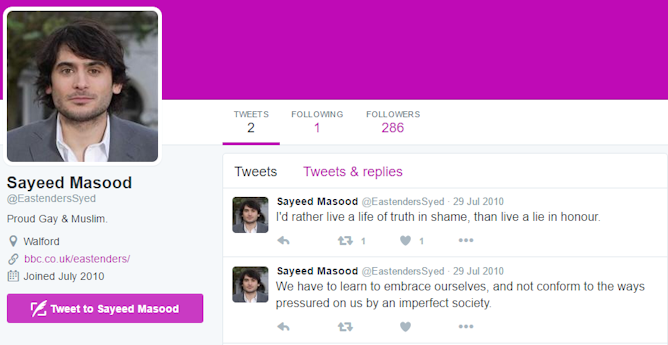
As I’ve written elsewhere, the Eastenders storyline concerning Syed Mehmood, a gay Muslim character who struggles to come out to his parents, generated some discussion in the British Muslim community and led some individuals to acknowledge the existence of homosexuality within their community.
Coming out: Syed from Eastenders on Twitter. Twitter
This is a positive step forward and one that can be built on. Similarly, there needs to be more acknowledgement and acceptance of faith groups in LGBT contexts which tend to be secular. In my research, I’ve also found that gay Muslims can face Islamophobia on the gay scene, which can hinder their sense of belonging in these spaces.
In addition to improving relations between groups, it is likely that this exercise will have positive outcomes for well-being among those individuals who self-identify as Muslim and gay. Growing up in an environment in which you are led to believe that your sexual orientation is wrong, sinful or symptomatic of mental illness can lead to profound social and psychological challenges, including internalised homophobia, low self-esteem, depression and, in some cases, suicidal thoughts.
The reasons underlying the horrendous attacks perpetrated by Omar Mateen in Orlando may never be fully understood. But if it is true that he was a closeted homosexual – it was reported that he had used gay dating applications and frequented gay bars, including the one that he attacked – he clearly had a very difficult relationship with this aspect of his identity. There is already some empirical evidence that homophobia is associated with homosexual arousal, which suggests that homophobia might be a means of distancing homosexuality from one’s sense of self.
Could it be that his actions were in part a result of his internalised homophobia? Did he attack the LGBT community in an attempt to distance his own sexuality from his sense of self?
In any case, we as a society have a responsibility to acknowledge diversity and to allow people the space and opportunity to self-identify in ways in which they choose. We have a responsibility to challenge prejudice (of all kinds) when it shows its ugly face. We have a responsibility to support and protect minorities who are vulnerable to marginalisation and exclusion. Sometimes this will be challenging particularly when it means that we have engage with sensitive issues such as religious norms and customs but we must persevere – for the sake of freedom, peace and well-being for all of society.
"One of the smarter blogs is the libertarian-leaning collection of Charlottesville posts put up by Rick Sincere..." -- Bob Gibson, The Daily Progress, May 8, 2005


 Acknowledgement: The most useful source for this essay has been Kecia Ali, Sexual Ethics and Islam: Feminist Reflections on Qur'an, Hadith and Jurisprudence (Oneworld Publications, new edition, 2016).