Showing posts with label popular culture. Show all posts

Friday, May 11, 2018

Guest Post: Question Authority - How Mad Magazine's ethos still matters


Michael J. Socolow, University of Maine

Mad Magazine is still hanging on. In April, it launched a reboot, jokingly calling it its “first issue.”

But in terms of cultural resonance and mass popularity, it’s largely lost its clout.

At its apex in the early 1970s, Mad’s circulation surpassed 2 million. As of 2017, it was 140,000.

As strange as it sounds, I believe the “usual gang of idiots” that produced Mad was performing a vital public service, teaching American adolescents that they shouldn’t believe everything they read in their textbooks or saw on TV.
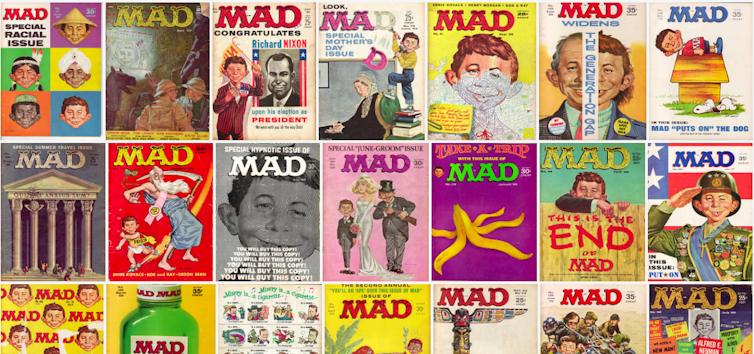


Mad Magazine comedy humor parody satire

The magazine taught its readers to never swallow what they’re served.
Nick Lehr/The Conversation via Jasperdo, CC BY-NC-ND


Mad preached subversion and unadulterated truth-telling when so-called objective journalism remained deferential to authority. While newscasters regularly parroted questionable government claims, Mad was calling politicians liars when they lied. Long before responsible organs of public opinion like The New York Times and the CBS Evening News discovered it, Mad told its readers all about the credibility gap. The periodical’s skeptical approach to advertisers and authority figures helped raise a less credulous and more critical generation in the 1960s and 1970s.

Today’s media environment differs considerably from the era in which Mad flourished. But it could be argued that consumers are dealing with many of the same issues, from devious advertising to mendacious propaganda.

While Mad’s satiric legacy endures, the question of whether its educational ethos - - its implicit media literacy efforts – remains part of our youth culture is less clear.

A merry-go-round of media panics


In my research on media, broadcasting and advertising history, I’ve noted the cyclical nature of media panics and media reform movements throughout American history.

The pattern goes something like this: A new medium gains popularity. Chagrined politicians and outraged citizens demand new restraints, claiming that opportunists are too easily able to exploit its persuasive power and dupe consumers, rendering their critical faculties useless. But the outrage is overblown. Eventually, audience members become more savvy and educated, rendering such criticism quaint and anachronistic.

During the penny press era of the 1830s, periodicals often fabricated sensational stories like the “Great Moon Hoax” to sell more copies. For a while, it worked, until accurate reporting became more valuable to readers.
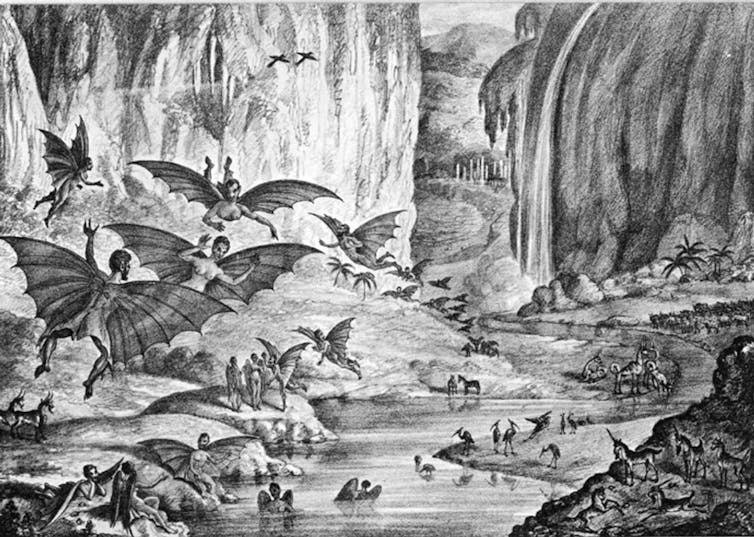


Great Moon Hoax New York Sun

During the ‘Great Moon Hoax,’ the New York Sun claimed to have discovered a colony of creatures on the moon.
Wikimedia Commons


When radios became more prevalent in the 1930s, Orson Welles perpetrated a similar extraterrestrial hoax with his infamous “War of the Worlds” program. This broadcast didn’t actually cause widespread fear of an alien invasion among listeners, as some have claimed. But it did spark a national conversation about radio’s power and audience gullibility.

Aside from the penny newspapers and radio, we’ve witnessed moral panics about dime novels, muckraking magazines, telephones, comic books, television, the VCR, and now the internet. Just as Congress went after Orson Welles, we see Mark Zuckerberg testifying about Facebook’s facilitation of Russian bots.

Holding up a mirror to our gullibility


But there’s another theme in the country’s media history that’s often overlooked. In response to each new medium’s persuasive power, a healthy popular response ridiculing the rubes falling for the spectacle has arisen.

For example, in “The Adventures of Huckleberry Finn,” Mark Twain gave us the duke and the dauphin, two con artists traveling from town to town exploiting ignorance with ridiculous theatrical performances and fabricated tall tales.

They were proto-purveyors of fake news, and Twain, the former journalist, knew all about selling buncombe. His classic short story “Journalism in Tennessee” excoriates crackpot editors and the ridiculous fiction often published as fact in American newspapers.

Then there’s the great P.T. Barnum, who ripped people off in marvelously inventive ways.

“This way to the egress,” read a series of signs inside his famous museum. Ignorant customers, assuming the egress was some sort of exotic animal, soon found themselves passing through the exit door and locked out.

They might have felt ripped off, but, in fact, Barnum had done them a great – and intended – service. His museum made its customers more wary of hyperbole. It employed humor and irony to teach skepticism. Like Twain, Barnum held up a funhouse mirror to America’s emerging mass culture in order to make people reflect on the excesses of commercial communication.

‘Think for yourself. Question authority’


Mad Magazine embodies this same spirit. Begun originally as a horror comic, the periodical evolved into a satirical humor outlet that skewered Madison Avenue, hypocritical politicians and mindless consumption.

Teaching its adolescent readers that governments lie – and only suckers fall for hucksters – Mad implicitly and explicitly subverted the sunny optimism of the Eisenhower and Kennedy years. Its writers and artists poked fun at everyone and everything that claimed a monopoly on truth and virtue.

“The editorial mission statement has always been the same: ‘Everyone is lying to you, including magazines. Think for yourself. Question authority,’” according to longtime editor John Ficarra.

That was a subversive message, especially in an era when the profusion of advertising and Cold War propaganda infected everything in American culture. At a time when American television only relayed three networks and consolidation limited alternative media options, Mad’s message stood out.

Just as intellectuals Daniel Boorstin, Marshall McLuhan and Guy Debord were starting to level critiques against this media environment, Mad was doing the same – but in a way that was widely accessible, proudly idiotic and surprisingly sophisticated.

For example, the implicit existentialism hidden beneath the chaos in every “Spy v. Spy” panel spoke directly to the insanity of Cold War brinksmanship. Conceived and drawn by Cuban exile Antonio Prohías, “Spy v. Spy” featured two spies who, like the United States and the Soviet Union, both observed the doctrine of Mutually Assured Destruction. Each spy was pledged to no one ideology, but rather the complete obliteration of the other – and every plan ultimately backfired in their arms race to nowhere.
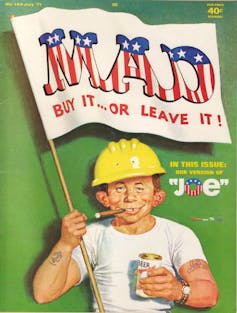


Mad Magazine question authority parody satire humor comedy

Mad skewered those who mindlessly supported the people who controlled the levers of power.
Jasperdo, CC BY-NC-SA


The cartoon highlighted the irrationality of mindless hatred and senseless violence. In an essay on the plight of the Vietnam War soldier, literary critic Paul Fussell once wrote that U.S. soldiers were “condemned to sadistic lunacy” by the monotony of violence without end. So too the “Spy v. Spy” guys.

As the credibility gap widened from the Johnson to Nixon administrations, the logic of Mad‘s Cold War critique became more relevant. Circulation soared. Sociologist Todd Gitlin – who had been a leader of the Students for a Democratic Society in the 1960s – credited Mad with serving an important educational function for his generation.

“In junior high and high school,” he wrote, “I devoured it.”

A step backward?


And yet that healthy skepticism seems to have evaporated in the ensuing decades. Both the run-up to the Iraq War and the acquiescence to the carnival-like coverage of our first reality TV star president seem to be evidence of a widespread failure of media literacy.

We’re still grappling with how to deal with the internet and the way it facilitates information overload, filter bubbles, propaganda and, yes, fake news.

But history has shown that while we can be stupid and credulous, we can also learn to identify irony, recognize hypocrisy and laugh at ourselves. And we’ll learn far more about employing our critical faculties when we’re disarmed by humor than when we’re lectured at by pedants. A direct thread skewering the gullibility of media consumers can be traced from Barnum to Twain to Mad to “South Park” to The Onion.

While Mad’s legacy lives on, today’s media environment is more polarized and diffuse. It also tends to be far more cynical and nihilistic. Mad humorously taught kids that adults hid truths from them, not that in a world of fake news, the very notion of truth was meaningless. Paradox informed the Mad ethos; at its best, Mad could be biting and gentle, humorous and tragic, and ruthless and endearing – all at the same time.

The ConversationThat’s the sensibility we’ve lost. And it’s why we need an outlet like Mad more than ever.

Michael J. Socolow, Associate Professor, Communication and Journalism, University of Maine

This article was originally published on The Conversation. Read the original article.

Wednesday, January 10, 2018

From the Archives: Wrestling with the 'Naked Truth' About Religion on TV (1996)

This article appeared in various newspapers, including The Metro Herald, in January 1996:

Wrestling with the "Naked Truth" About Religion on TV
Richard E. Sincere, Jr.

By most accounts, modern entertainment media seldom -- if ever -- treat religious belief and practice with the seriousness and respect they deserve. Gone are the days when religious commitment was portrayed in a positive light. Unlike the 1940s, when movies such as Going My Way and The Song of Bernadette won both crowds and awards, the 1990s are strangely bereft of authentic portrayals of religious life.

There have, indeed, been some attempts to use religious life as the basis for TV series. Remember The Flying Nun? The Father Dowling Mysteries featured a priest and a nun as crimesolvers -- a gimmick to dress up a ho-hum detective story in clerical garb. Amen, starring a post-Jeffersons Sherman Hemsley, was set in an urban, vaguely Baptist church. None of these, however, dealt with religious belief in a sustained, serious manner. Religion was simply a frame in which to project otherwise unexceptionable storylines.

Although Americans are about the most religious people in the world, those who produce and write television programs tend to be among the "non-believers." These media elite live the lives Thomas Carlyle had in mind when he suggested that "if Jesus Christ were to come today, people would not even crucify him. They would ask him to dinner, and hear what he had to say, and make fun of it."

Tea Leoni The Naked Truth TV Guide 1995Thus it was with some surprise that the January 10 episode of The Naked Truth, an ABC-TV sitcom, focused respectfully on religious belief.

For those unfamiliar with this series, its main character, Nora, is a professional photographer who, through bad luck and poor personal choices, has been forced to take a job with a supermarket tabloid, The Comet, which makes The National Enquirer look like The Wall Street Journal. Once nominated for a Pulitzer Prize, Nora has descended to the depths of taking snapshots of buxom model Anna Nicole Smith at her gynecologist's office, and of Tom Hanks with his hand stuck down the fly of his trousers.

On January 10, The Naked Truth found Nora improbably dating a young man who spent the past five years on Zarkon-B, a planet 7,000 light-years from Earth. (He was, it seems, abducted by aliens.) At the same time, trying to track down Drew Barrymore for a Comet story, Nora disguises herself as a nun and runs into an old college friend -- once known as "Luscious" -- who is now Sister Katherine.

Nora, who in each episode frantically defends herself against the slings and arrows of daily life, is impressed by Sister Katherine's serenity and inner peace. ("Why did you become a nun?" Nora asks. Replies Sister Katherine: "Somehow being a drunken slut was strangely unfulfilling.")

When all the world seems to be against her, Nora takes her troubles to a drinking buddy, who makes Nora confront her own lack of belief. She plaintively asks why Sister Katherine can be so serene, while her own life is consumed by one trouble after another. Nora's friend suggests that Sister Katherine has found the love of God to guide her. Nora responds by saying she can't buy into that God business. "I haven't prayed since I was in grade school," she says.

Her friend gets right to the point. You can believe that your boyfriend was abducted by aliens and came to Earth from another planet, he says, but you can't believe there's a superior being who loves us? "What made you too cool for God?" he asks.

Nora returns to the convent to tell Sister Katherine that she, too, would like to become a nun. Sister Katherine, appropriately skeptical, suggests that Nora feels a great thirst and wants "to drink the ocean." Perhaps it would be better, the sister says, to start with "one glass of water." Departing for vespers, Sister Katherine invites Nora to wait an hour for her return. "What will I do for an hour?" Nora asks. "You'll think of something," says Sister Katherine.

Indeed she does. The scene closes with Nora kneeling in a pew, facing the altar, saying out loud: "Hello, God, this is Nora. Long time no see."

Tea Leoni The Naked Truth This summary does little justice to this tightly-packed, amusing half-hour. The writers are to be commended for their ability to deal with serious philosophical issues in a light-hearted, yet respectful, manner. Sister Katherine shows that, even in a convent, she and the other nuns are part of this world, not some other ethereal one. Nora displays her heartfelt need to seek something beyond herself, something that can guide her decisionmaking. Not yet sure of what she needs, she approaches Sister Katherine for assistance.

All this, despite the humor, is done without mockery. What shocks is not the placement of religious topics in a situation comedy -- this has been done before (Buddy Sorrell's bar mitzvah on The Dick Van Dyke Show, or the presence of Father Mulcahy on M*A*S*H). What is startling is the respectful treatment, something one simply does not expect in the 1990s. The message is clear: Faith in God is something worth seeking; religious faith can help us define our identities and guide our actions.

If this episode of The Naked Truth is idiosyncratic, it means that the Hollywood elite are just as hostile toward -- or indifferent to -- the religious commitment of the vast majority of Americans as they have been over the past 40 years. If, however, it is not unique, we have reason to remain hopeful.

* * * * * * * * * *
Richard Sincere is entertainment editor of The Metro Herald, a weekly newspaper based in Alexandria, Virginia.


Saturday, December 31, 2016

From the Archives: Beloit College identifies political touchstones for 2012’s college freshmen

Publisher's note: This article was originally published on Examiner.com on August 21, 2012. The Examiner.com publishing platform was discontinued July 1, 2016, and its web site went dark on or about July 10, 2016. I am republishing this piece in an effort to preserve it and all my other contributions to Examiner.com since April 6, 2010. It is reposted here without most of the internal links that were in the original.

Beloit College identifies political touchstones for 2012’s college freshmen

Beloit College – not far from presumptive GOP vice-presidential nominee Paul Ryan’s hometown of Janesville – has released its latest “Mindset List” of cultural touchstones that are lost on the incoming college class this year, whose members intend to graduate in 2016.

The list includes pop-culture references – for instance, number 10, “On TV and in films, the ditzy dumb blonde female generally has been replaced by a couple of Dumb and Dumber males” – and sports references, such as number 19, “The Green Bay Packers have always celebrated with the Lambeau Leap.”

Daily life

The list also features items and activities from daily life that have changed since 1994, the year most freshman college students of 2012 were born.

Take number 9: “They have never seen an airplane ‘ticket.’” Or number 30: “There have always been blue M&Ms, but no tan ones.”

The 2012 Mindset List also contains several political notes that demonstrate how things have changed – or not – in the past 18 years.

Statesmen and -women

There’s number 8: “Bill Clinton is a senior statesman of whose presidency they have little knowledge.”

Or number 12: “For most of their lives, maintaining relations between the U.S. and the rest of the world has been a woman’s job in the State Department.”

Some references might seem obscure, like number 24: “White House security has never felt it necessary to wear rubber gloves when gay groups have visited.”

In the category of “the more things change, the more they remain the same,” Beloit College offers number 32: “Newt Gingrich has always been a key figure in politics, trying to change the way America thinks about everything.”

And, a thought that may be shared among many of there elders, there is number 66: “They have no recollection of when Arianna Huffington was a conservative.”

The introduction to this year’s list notes that “each August since 1998, Beloit College has released the Beloit College Mindset List, providing a look at the cultural touchstones that shape the lives of students entering college this fall. The creation of Beloit’s former Public Affairs Director Ron Nief and Keefer Professor of the Humanities Tom McBride, authors of The Mindset Lists of American History: From Typewriters to Text Messages, What Ten Generations of Americans Think Is Normal (John Wiley and Sons), it was originally created as a reminder to faculty to be aware of dated references. It quickly became an internationally monitored catalog of the changing worldview of each new college generation.”

Tuesday, December 20, 2016

From the Archives: UVA English professor Paul Cantor explores zombies and liberty in pop culture

Publisher's note: This article was originally published on Examiner.com on November 16, 2013. The Examiner.com publishing platform was discontinued July 1, 2016, and its web site went dark on or about July 10, 2016. I am republishing this piece in an effort to preserve it and all my other contributions to Examiner.com since April 6, 2010. It is reposted here without most of the internal links that were in the original.

UVA English professor Paul Cantor explores zombies and liberty in pop culture

Speaking at the Mercatus Center at George Mason University on November 14 on the topic, “The Economics of Apocalypse: Flying Saucers, Alien Invasions, and the Walking Dead,” UVA English professor Paul A. Cantor drew upon his research on popular culture to discuss opposing visions of individualism and collectivism in contemporary catastrophe narratives in film and television.

Cantor, a Shakespeare scholar, is author of a recent book, The Invisible Hand in Popular Culture: Liberty vs. Authority in American Film and TV, a follow-up to Gilligan Unbound: Pop Culture in the Age of Globalization, published in 2001. He is also co-editor, with Stephen Cox, of the 2010 volume, Literature and the Economics of Liberty. Cantor and Cox are among the most prominent libertarian thinkers working in the field of English literature today.

After his lecture and an audience discussion moderated by Reason magazine's Jesse Walker, Cantor explained to the Charlottesville Libertarian Examiner why he was looking into the presence of zombie themes in pop culture today.

'Self-reliance'

“These zombie stories are a very interesting way of exploring questions that Americans are interested in,” he said.

What he has noticed in zombie stories, he explained, is that “almost the first thing that results from the zombie apocalypse is the collapse of the federal government. These stories explore what life would be like in a world that was more like the American western, more like the frontier, in which people are forced to rely on their own resources.”

Sometimes, he said, those situations are “frightening but for many of the characters, particularly in The Walking Dead, the experience is empowering. They develop a sense of self-reliance, they face a a challenge, and they meet it.”

In his book, Cantor traces recurring themes in film and TV since the 1950s, a time when there were just three television channels available to most viewers, compared with the hundreds available through cable and satellite services today.

The proliferation of channels, he said, “has really opened up the creativity in television.”

Citing The Simpsons and The X-Files as pertinent examples, Cantor explained that “a lot of shows almost certainly wouldn't have made it onto television in the era of the three networks. It was the Fox Network, the fourth network, that really opened things up.”

'Greater quality'

Despite the increase in the number of networks and shows, he said, “there's a lot of continuity. Again, what I'm seeing in these contemporary zombie narratives is in many ways a reconstitution of what westerns were like in the Fifties. What we certainly have now is greater variety and, frankly, greater quality because people are able to take more creative chances.”

Cantor's new book, The Invisible Hand in Popular Culture, he said, “carries on some of the same issues” addressed in Gilligan Unbound.

One section of the more recent work “is devoted to globalization,” the primary theme of Gilligan Unbound, which was published the same week as the September 11, 2001, terrorist attacks on New York and Washington.

“This book has given me a chance to see how things have played out in popular culture” over the past decade, Cantor said.

Writing the book gave him an opportunity to ask “how shows like Fringe, V, Invasion, [and] Fallen Skies have reacted to developments since 9/11 and [a] world with a threat of terrorism but also the problems created by the war on terrorism.”

Flying saucers and totalitarianism

He was also able to compare and contrast pop culture during the Cold War and during the post-9/11 era.

“I look at flying saucer movies in the 1950s,” he noted.

In those days, Cantor said, “the invaders are an image of real foreigners. It's Soviet Communism that's showing up in the flying saucers.”

By contrast, he pointed out, “when you look at shows like V, The Event, Invasion, [and] especially Fringe, the people invading us are us. 'We've met the enemy and he is us.' These shows explore a disturbing image of the American government as having moved in totalitarian directions.”

With so many choices of movies and TV shows to watch, Cantor sometimes relies on serendipity to find what he's looking for.

“It's chancy,” he said.

“Sometimes I just like a show, often because I like the characters or the actors in it. Sometimes I force myself to watch a show because it's obvious it's raising the kind of questions I'm interested in. For example, The Walking Dead, I really just like. It's really well-made, well-done.”

On the other hand, he watches Revolution on NBC “even though I don't think it's such a good show because it fits into my thesis and I've got to consider the evidence” as he continues exploration of libertarian and apocalyptic themes in popular culture.

Monday, December 19, 2016

From the Archives: Cultural critic Paul Cantor assesses the politics of the new TV season

Publisher's note: This article was originally published on Examiner.com on September 30, 2010. The Examiner.com publishing platform was discontinued July 1, 2016, and its web site went dark on or about July 10, 2016. I am republishing this piece in an effort to preserve it and all my other contributions to Examiner.com since April 6, 2010. It is reposted here without most of the internal links that were in the original.

Cultural critic Paul Cantor assesses the politics of the new TV season

While best known in academic circles as a scholar of Shakespeare and of 19th-century English Romanticism, University of Virginia English Professor Paul Cantor is also a well-regarded critic of popular culture whose 2001 book, Gilligan Unbound, took a close look at TV staples from the 1960s through the 1990s, including Gilligan’s Island, Star Trek, The Simpsons, and The X-Files.

Cantor’s most recent book, co-edited with Stephen Cox, is Literature and the Economics of Liberty: Spontaneous Order in Culture, which applies concepts of Austrian economics to the analysis of literary works.

At an event hosted by Students for Individual Liberty on the UVA grounds on September 29, Professor Cantor was in the audience and, afterward, spoke to the Charlottesville Libertarian Examiner about the new television season.

'CSI' and Justin Bieber

His first thought was about the season opening episode of CSI: Crime Scene Investigation (the original franchise, set in Las Vegas).

Paul Cantor
“I read a description of” the episode in TV Guide, he said, and “was a little suspicious of it.”

After viewing the first episode, Cantor suggested that it may have been “first salvo in Hollywood’s attack on the Tea Party,” because, as he described the show, “it more or less treated Tea Party types as if they were some sort of 1960s-style militia, as if they were terrorists.”

He explained that, “on the one hand, it [showed] a gathering of dissident political figures [who] clearly were attacking -- though not by name -- the Obama administration. On the other hand, they were then connected with bombings and terrorist acts,” including exploding a policeman’s coffin at his funeral.

“I’m afraid,” Cantor said ruefully, that “this is the Hollywood take on the Tea Party. This is the beginning of a lot that we’ll be seeing on television.”

Cantor is not alone in his assessment: political commentator Alex Knepper made a similar point on Big Hollywood on Wednesday.

The fact that Canadian singer Justin Bieber made his debut as a dramatic actor in the season opener of CSI was not coincidental, Cantor said.

“They were certainly exploiting” the teen idol’s celebrity, he explained. “Clearly they were trying to get him to get more interest in this episode.”

The producers “probably got a lot of people to watch the show who might not have watched it” otherwise. Bieber “actually gave a surprisingly good performance. He was supposed to convey an aura of innocence and yet then turn out to be involved,” in the domestic terrorism. Moreover, the ending of first show is “setting him up as a returning character.”

'The Event'

Cantor said the new NBC mystery-thriller series, The Event, is “clearly a recycling of The X-Files. I don’t know where it’s headed but it does seem to be the first attempt to portray Obama on television.”

In terms of plot, The Event is “an allegory of the issue of shutting down Guantanamo, though in this case it’s a holding area for extraterrestrials in Alaska. (Don’t ask me to explain that.)”

Veteran TV actor Blair Underwood plays a Cuban-American president, who is also black, and, Cantor said, “he’s being portrayed as a sympathetic character.”

In the second episode, the Underwood character is shown “in charge of things,” Cantor explained, “but there was this amazing line where he was trying to get information out of one of the aliens and he said, ‘I hope I’m not being too narcissistic, I hope I’m not being too obsessed with my place in history.’”

For Cantor, that line “was very interesting because it’s such an accurate characterization of Obama.”

'X-Files,' 'Weeds,' 'Breaking Bad'

Today’s cultural climate, Cantor agreed, is “absolutely” open to conspiracy-type shows along the lines of the 1990s Fox cult hit, The X-Files.

Having written about The X-Files in his book, Gilligan Unbound, Cantor said he gets “annoyed when people treat The X-Files as dead and buried and said it was, ‘a show for the ‘90s.’”

Virtually “half the shows on television now are conspiracy shows,” Cantor said, naming Rubicon, Sons of Anarchy, Weeds, and Breaking Bad as examples.

Shows like Weeds and Breaking Bad, he added, are rather sympathetic to (in this case) drug dealers” and they also “portray DEA officials in a very negative light.”

That, he said, is “an interesting sign of what’s going on in popular culture.”

Cantor’s personal “must-see TV” is Breaking Bad on AMC. He notes that it is produced by X-Files alumnus Vince Gilligan and judges it to be “the most powerful show dramatically.”

As an aside, Cantor adds, Breaking Bad “has a strong libertarian element in it, so I can recommend it on political as well as on aesthetic grounds.”

Wednesday, May 04, 2016

From the Archives: May the Fourth Be With You - Part II

As I noted in my previous post, 17 years ago this month, I was one of hundreds of Star Wars fans who camped out in front of the Uptown Theatre in Washington, D.C., to be among the first to buy tickets and then to nab the best seats to see the long-awaited prequel to the epic trilogy, Episode 1: The Phantom Menace.

While my first report for The Metro Herald described the spontaneous community that emerged along the Connecticut Avenue sidewalks, my second report was a sort-of review of The Phantom Menace.

I just found this article in my archives and had not read it in many years.  The biggest surprise to me? Not a single mention, positive or negative, of Jar-Jar Binks.

The following article appeared originally in the Arts & Entertainment section of The Metro Herald in Alexandria, Virginia, on May 21, 1999:

Star Wars: Supernova or Firecracker?
Rick Sincere
Metro Herald Entertainment Editor

Raising more questions than it answers, The Phantom Menace, episode one of the Star Wars series, burst upon the nation this Wednesday, May 19.

Preceded by months of active anticipation and sixteen years of quiet waiting for fans and non-fans alike, the newest segment of the Star Wars phenomenon was accompanied by hype, hoopla, and hurrahs.

At the first showing at Washington’s Uptown Theatre on upper Connecticut Avenue, NW, the audience was on edge and playful. After more than 60 hours of sleeping, playing, and waiting patiently on the sidewalk outside, and taking their seats some 45 minutes before the program was scheduled to begin, members of the audience participated in mock light-saber battles in the area in front of the huge Cinerama screen. The slightest mention of Star Wars or its box-office champion nemesis, Titanic, elicited loud cheers or jeers.

And the moment the words “Lucasfilm, Ltd.” appeared on the screen, the auditorium was consumed by hoots, hollers, whistles, footstomping, and applause.

And how well-deserved this greeting was! The Phantom Menace is a tour de force of special effects. George Lucas, returning to the director’s chair for the first time since Episode 4: A New Hope of 1977, has given us a payoff for his long wait for technology to catch up to his imagination.
Drawing upon the mythological traditions of Europe, the Middle East, and East Asia, Lucas has created a story with universal appeal. Using archetypes that have been found throughout literature since before man learned to write, Lucas shows us, quite literally, the stuff that dreams are made of.

It is conventional in a review like this to resist revealing key plot developments and, in particular, the ending. So I will resist. But a few comments are in order.

Young Anikan Skywalker (played by nine-year-old Jake Lloyd) is intelligent, humble, and helpful beyond words. He is easy to love. Yet, at the same time, because we know what happens in Episodes 4-6, we also know that he will become the evil Darth Vader. Thus it is with some ambivalence that the audience applauds when things go well for young Anikan. Is Lucas trying to mess with our minds? Is he trying to personalize this Manichean struggle between good and evil? Is he helping us to demonstrate for ourselves that each of us has within us, as Jewish tradition would put it, a good yetzer and an evil yetzer?

Are we supposed to cheer and applaud, only to draw back and correct ourselves, saying, “Hey, this cute little kid is the bad guy! What am I doing?”

Some have faulted this episode of Star Wars with being big on special effects and short on characterization. This may be true, so far as it goes, but one should also keep in mind that this episode is meant as an exposition, setting up a situation for a payoff that will happen later. Half of the fun is to look for clues and links to events and characters we already know from Episodes 4-6. We can count on fuller character development in Episodes 2 and 3. Still, The Phantom Menace stands on its own as an entertaining whole. One need not have seen any of the previous (later?) Star Wars films to enjoy this movie.

The rest of the summer will no doubt be filled with Star Wars mania. Enjoy it while it lasts. The next film is not scheduled to be released until 2002.

My review of that 2002 release, Episode 2: The Attack of the Clones, is here. My look at Episode 3: Revenge of the Sith, is here, while memories of my first encounter with Star Wars in 1977 can be found in this group post on Bearing Drift.  My 2005 photo essay about "Dressing a Galaxy," an exhibit of Star Wars costumes, is here. (And just one mention of Jar-Jar Binks among them all.)


From the Archives: May the Fourth Be With You - Part I

Seventeen years ago this month, I was among the hundreds of Star Wars fans who camped out in front of the Uptown Theatre in Northwest Washington, D.C., to wait for an opportunity to be the first to buy tickets and, the next week, to see the first screening, of Episode 1: The Phantom Menace.

I also covered the gathering for The Metro Herald, which in succeeding weeks published my report on the sidewalk queue and my review of the movie.

Brought up from deep in the archives, this article ran on the Arts & Entertainment page of The Metro Herald in Alexandria, Virginia, on May 14, 1999:

ADVENTURES IN JEDI-LAND, DC
Rick Sincere
Metro Herald Entertainment Editor

Star Wars Episode 1: The Phantom Menace is, without a doubt, the most anticipated movie in a generation, perhaps since Gone With the Wind. Some would argue that it is more hype than substance, though that remains to be seen, since the vast majority of us have seen only tantalizing snippets in the form of trailers, commercials, music videos, and computer files that end in *.AVI or *.MOV.

For diehard Star Wars fans, however, this is a religious experience. They, like the rest of us, have been waiting for 16 years for the newest film in the series to be released. Yet their wait has not been casual. It has been intense, with the intensity growing in recent weeks as the magic date of May 19 approached.

Starting last Sunday evening with a handful of dedicated fans, growing as a trickle through Monday night, until by Wednesday morning some 325 or more devotees had gathered on the sidewalks outside the Uptown Theatre on upper Connecticut Avenue in Northwest Washington. The line snaked along from the south edge of the theatre, past Starbucks and Ireland’s Four Provinces, past the Cleveland Park Public Library, all the way to the end of the bridge that carries the avenue over Rock Creek Park.

There is no sense of crowdedness, certainly no rowdiness, but definitely a sense of hominess. The sidewalk is littered with sleeping bags, lawn chairs, coolers, pizza boxes, empty soda cans, knapsacks, and more. Some sit on inflatable furniture. (Inflatable Darth Maul chairs are available at Toys-R-Us for $21.95.) Some people have brought along radios and CD players. (The musical score from earlier Star Wars episodes floats through the air along with the chatter of fans.) For the overnight campers, there is the portable entertainment in the form of card games, Star Wars Trivial Pursuit sets, action figures, and plenty to read, from collections of “Bloom County” cartoon strips to J.R.R. Tolkien books to Douglas Adams’ Hitchhiker’s Guide to the Galaxy.

The crowd is mostly young, primarily college students but some people in their thirties and some in their teens. Some come dressed in Star Wars-inspired costumes, but most are dressed simply in shorts and t-shirts, jeans and sweatshirts. As the sun rises across Connecticut Avenue, they rub sleep out of their eyes, wrapped so tightly in their sleeping bags that an unwary observer might think this gathering is for a re-release of Cocoon or The Revenge of the Pod People. But soon they emerge from their protective covers and begin socializing amiably with their neighbors.
One 12-year-old boy is there alone and, in the middle of the night, his mother comes looking for him. Afraid to give away his location because she might be there to drag him home, nearby fans express their sense of hesitancy. “Oh, that’s not why I’m here,” Mom exclaims. “I just brought him some blankets and Three Musketeers bars.” She explains that when she was her son’s age, 22 years ago, she camped out to await the first Star Wars movie (Episode 4: A New Hope) and she felt it would be hypocritical of her not to let him do the same. From one generation to another…

Despite the discomfort of sleeping on concrete overnight, the queue of fans is remarkably chipper so early in the morning. A palpable friendliness permeates the atmosphere. For so many people, the situation is quite calm, peaceful, and orderly. It provides an excellent example of economist Friedrich von Hayek’s “spontaneous order” – particularly appropriate since Hayek’s 100th birthday was celebrated on Saturday, May 8. An ad hoc community has been formed here, where once and future strangers watch out for one another as friends. Need a drink? Does nature call? Leave your things behind; no one will allow them to be pilfered. Everyone seems to get along. Oh, there might be an occasional light-saber fight, but only on the friendliest terms. And in the middle of the night, the whole gang played an elaborate game of “telephone,” with whispering that starts at one end and finishes up three blocks and three hundred people later.

As people pull out their breakfasts – consisting of Mountain Dew, Doritos, potato chips, and chocolate bars – there is no hesitancy about sharing. Local businesses and radio stations have chipped in, too. They are passing out free doughnuts, and Ben & Jerry have brought a load of ice cream treats.

The local media are here, of course. Fox News has a crew on hand all morning long, doing periodic live broadcasts throughout the network’s morning news show. The perky Fox correspondent, Holly Morris, gets the fans to play Trivial Pursuit with her, share their yummy breakfasts, and sing along to the Star Wars theme song (using lyrics invented by Bill Murray on Saturday Night Live more than 20 years ago, in his character of a smarmy Vegas lounge singer). Local radio stations are here en masse: WPGC; WASH 97.1 FM; WHFS; 104.7; Mix 107.3. They’re all passing out promotional materials – free CDs, flyers, T-shirts, various Star Wars souvenirs. They recognize a captive audience when they see one – and they get the fans to play along, too, putting them on the radio, live via cell phone.

Cell phones are ubiquitous, too – a lifeline to home or work for those who have been absent for almost three days. Some troglodytes are still using the pay phones that dot the landscape, but these old-fashioned devices are far from necessary these days.

As the sun rises higher in the sky, shirts come off and the aroma of suntan lotion wafts through the air. The anticipation grows stronger as zero hour – 2:30 PM is when tickets go on sale – approaches. Each person in line will be limited to buying 12 tickets, and all of them must be for a single performance. The most eagerly sought tickets are those for the first showing at 10:00 AM on Wednesday, May 19. Those who are purchasing them are already planning to camp out for the three nights preceding the show, simply so they can have first choice of the choicest seats. It becomes a never-ending story.

Could such a gathering of people occur in the suburbs? It is hard to imagine hundreds of people camping out on the macadam outside a suburban multiplex for days at a time, with traffic zooming by on the surrounding four-lane highways. A barren parking lot lacks the vitality of a central city’s sidewalks. Star Wars fans, with their souls in another galaxy, far, far away, have their feet firmly on the ground in the most traditional of settings, the urban village.

Next week: Reactions to the movie.


Friday, January 24, 2014

Does Justin Bieber think he's Michael Jackson? What does this odd photo say?

Earlier this afternoon, Justin Bieber broke two days of silence on Instagram -- interrupted by his arrest in Miami Beach for drag racing, DUI, and resisting arrest -- to post this photograph of himself as he left the court house:

Justin Bieber and Michael Jackson: via Instagram

It's possible that the Canadian teen heartthrob has juxtaposed his photo with that of the former King of Pop is simply that he saw aesthetic similarites. The two photographs have similar composition and framing, and they both benefit from a certain black-and-white chiaroscuro.

I think, however, it is more likely an expression of the Biebs' feeling victimized by "The Man," just as MJ was before his grisly, drug-induced death.

After all, the caption Bieber put on his photo -- which has been "liked" more than 513,000 times -- was:  "What more can they say".

I'm not sure I could have put it better myself.


Sunday, May 22, 2011

May 24, 1981

Five years ago, in anticipation of my 25-year college reunion at Georgetown University, I wrote a blog post called "May 29, 1981," which began like this:

May 29, 1981 -- the Sunday before Memorial Day, hazy in the morning in the Nation's Capital and unseasonably hot (with temperatures eventually reaching the 90s). It was Bob Hope's 78th birthday, it would have been John F. Kennedy's 64th, and it was the anniversary of Wisconsin's 1848 admission as a state in the Union and Rhode Island's ratification of the Constitution.

A Chorus Line was in its seventh year of a record-breaking Broadway run, but Cats (which would eventually overtake that record) had opened in London but not yet in New York. "Bette Davis Eyes" by Kim Carnes was the Number 1 song hit. Jonny Lang was precisely four months old and Britney Spears would come along nearly six months later.

The Falklands War was a year away, John Belushi was still alive, and virtually no one had ever telephoned a friend to ask, "Where are you now?"

May 29, 1981, was also a day of significance for me. It was the day I was graduated from Georgetown University.
At the reunion a week or so later, I received a handful of compliments from classmates about the post, and gratitude that I had done the research to supplement their own memories.

Nobody noticed that the premise was wrong.

That is, I had the wrong date. May 29 was not the "Sunday before Memorial Day," because Memorial Day that year was on May 25. Our graduation, as a glance at my diploma on the wall would have told me, was on May 24, 1981.

I've waited five years to correct the record.

Sunday, May 24, 1981, was the birthday of documentary film maker Nic Hill (Truth in Numbers? Everything, According to Wikipedia and Ray Charles America) and of Czech model and actress Markéta Jánská (Swingtown). It was the day that the "Toastmaster General of the United States," George Jessel, passed away.

That weekend saw the opening of several new movies: Outland, with Sean Connery and Peter Boyle; Death Hunt, with Lee Marvin and Charles Bronson; The Legend of the Lone Ranger, with Klinton Spilsbury, Michael Horse and Christopher Lloyd; The Four Seasons, with Alan Alda, Carol Burnett, Sandy Dennis, and Len Cariou; and Bustin' Loose, with Richard Pryor and Cicely Tyson.  (Of those, the only one I remember seeing is The Four Seasons.  Maybe I thought it was a documentary about Vivaldi, or a concert film with Frankie Valli.)

The night before, Jill St. John and Jim Stafford guest starred on Fantasy Island, in an episode called "Paquito's Birthday."  Sunday evening's TV shows included the perennial 60 Minutes, as well as Archie Bunker's Place, One Day at a Time, Alice, and The Jeffersons (all on CBS); NBC offered Disney's Wonderful World, CHiPs, and The Big Event, while ABC had its Sunday night movie.  Fox did not yet exist, and cable was not nearly pervasive in American homes as it would be just a few years later.

The New York Times best-seller lists published that day had Noble House, by James Clavell, at the top of the fiction list, followed by Gorky Park, by Martin Cruz Smith, in second place.  The number one non-fiction best-seller was The Lord God Made Them All, but James Herriot, with George Gilder's influential Wealth and Poverty at number five.  (Number six was a biography of Maria Callas by Arianna Stassinopoulos.  You may know her as the founder of The Huffington Post under her married name.)

In the music world, the number one U.S. single, according to Billboard, was "Bette Davis Eyes," by Kim Carnes; according to Cashbox, it was "Being With You," by Smokey Robinson.  In Canada, the top hit was "Angel in the Morning," by Juice Newton.  In continental Europe, the number one single was "Making Your Mind Up," by Eurovision winner Bucks Fizz.  In the UK, however, the chart-topping single was "Stand and Deliver," by Adam and the Ants, and in Ireland, it was "You Drive Me Crazy," by Shakin' Stevens.

Not that many of us at graduation on the Hilltop were paying close attention to these statistics.  We had more monumental things on our mind.

Let me note that my original 2006 post, despite the wrong date, is still worth reading, if for nothing else than for the excerpts from Ambassador Jeane Kirkpatrick's commencement address.

At least I had the date for my high school graduation right, when I posted memories on the occasion of its thirtieth anniversary a year later than my misdirected college reunion reminiscence.


Be sure to visit my CafePress store for gifts and novelty items!
Read my blog on Kindle!
Follow my tweets on Twitter! 

Saturday, May 21, 2011

Four Music Videos for the Rapture that Didn't Happen

Reports from beyond the International Dateline suggest that Harold Camping was wrong again.  There were no earthquakes or tsunamis or asteroid crashes that led to the end of the world, time zone by time zone.

Not that anyone of sound mind took Camping's predictions seriously.  He had been wrong before, and he'll no doubt make another inaccurate prediction again.  (I hope nobody is taking stock market advice from this crackpot.)

Still, unlike in 1994, the last time the Family Radio mogul made his wild-eyed prediction that the Rapture was imminent, for some reason the "end-is-near-and-it's-May 21" meme caught the popular imagination. 

People were having fun with it.  There actually may be some disappointment among those who planned to be Left Behind that there will be no post-Rapture parties (raves? barn dances? orgies? pig-outs at Hooters?) to celebrate the departure of the prigs and the prudes.

In the spirit of post-Rapture bacchanalia, however, I present four examples of the kind of music that might have been played at those non-stop dance parties.  Enjoy!

First, here's Skeeter Davis singing her hit country song, "Don't They Know It's the End of the World?," from "The Star Route Show" on television in 1963:


There has long been a rumor among high school debaters that Michael Stipe wrote the R.E.M. song "It's the End of the World as We Know It (and I Feel Fine)" based upon his own experience as a debater, piling disadvantage upon disadvantage on top of the podium. As I understand it Stipe has denied the connection, but the rumors persist -- and no wonder, since the rhythms of the verse mimic the delivery of a debater at full-spread speed.
It would be a shame to forget Blondie's "Rapture," which charted 30 years ago and brought rap music to a wider audience. The video based on the song was also something of a genre-bender. (Videos were not widely seen back then; MTV didn't take to the airwaves until August 1981, eight months after "Rapture" was released.)
Finally, I want to add a song I heard performed by Elaine Paige the other night, in the new production of Stephen Sondheim's Follies at the Kennedy Center. Considering that the Rapture hasn't happened, what can be more appropriate than "I'm Still Here."

Here's the original Carlotta (Yvonne DeCarlo -- yes, Lily Munster), performing the song on a 1979 television show. (Unfortunately, whoever posted this on YouTube provided no more specific information about the program.) There's a slight hiccup at about 2 minutes in, cutting the words "Beverly Hills," but the rest is largely intact -- which is more than you can say for the original cast recording. (The vamp at the end is also cut short. C'est la vie!)

Enjoy the remains of your day -- even for Harold Camping, it's the first day of the rest of your life!

Be sure to visit my CafePress store for gifts and novelty items!
Read my blog on Kindle!
Follow my tweets on Twitter!