Showing posts with label gifts. Show all posts

Sunday, December 10, 2017

Guest Post: Blocks are still the best present you can buy children for Christmas


Kym Simoncini, University of Canberra and Kevin Larkin, Griffith University

With Christmas looming, many people will be considering what present to buy for their children, nieces and nephews, grandchildren and friends. Soon, if not already, we will be reading lists of the top trending presents for 2017. These lists will no doubt include, and may even be totally dominated by, all the latest gadgets and devices.

The purpose of these lists is to attempt to persuade parents of young children if they want to give their child the best start in life, and all the advantages for doing well later at school, they need to purchase the latest technology.


Read more: ‘Digital play’ is here to stay … but don’t let go of real Lego yet


Missing from these Christmas lists, but what should actually be at the very top in terms of learning, are blocks. Blocks have been part of children’s play for a long time. But there’s still no other toy that compares in promoting all areas of children’s development. Any early childhood teacher can easily identify all the areas block play develops including fine motor, social, language and cognitive skills.

Blocks develop spatial reasoning skills


As children experiment by stacking, balancing, or building with blocks, they need to share, respect other children’s constructions, ask for desired blocks and describe what they are creating. Perhaps more importantly, children develop problem solving skills, creativity and imagination in creating their masterpieces. Finally, let’s not forget persistence where children try again and again to build the tallest tower or most elaborate castle.
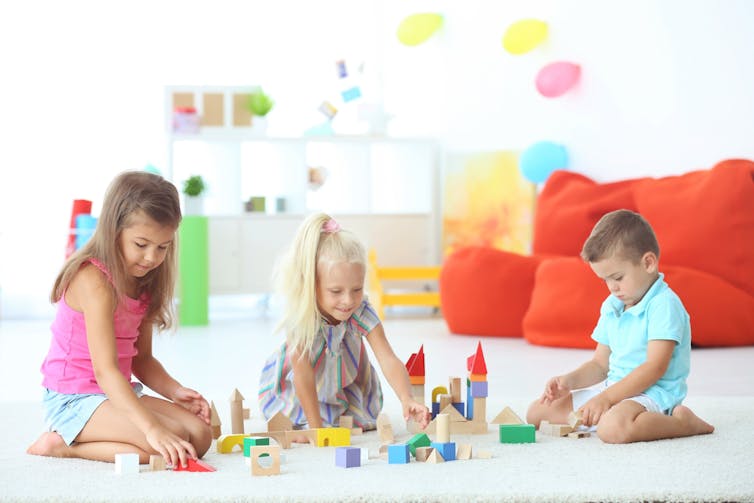


Kids learn to play and work together when using blocks.

Kids learn to play and work together when using blocks.
Shutterstock


Less well known is that blocks also foster spatial reasoning. Spatial reasoning is the ability to mentally manipulate objects or to think in a way that relates to space and the position, area, and size of things within it. We use spatial reasoning skills in everyday life when we read maps, pack the car for holidays, assemble flat pack furniture or cut cake into equal slices.

Spatial reasoning skills are linked to mathematics skills. Children who have good spatial skills tend to have better maths skills. Many people are unaware of the research, but early mathematics skills are a better predictor of later school success than either early reading or social-emotional skills. Block play helps children understand many mathematical concepts in number, measurement and geometry. During block play children count, measure, estimate, pattern, transform, and learn about symmetry.

Perhaps most surprising to readers will be the research that shows spatial reasoning skills are the best predictor of whether children will end up in a Science, Technology, Engineering and Mathematics (STEM) related career. Spatial skills are especially important in STEM related jobs where people are required, for example, to create or read X-ray and ultrasound imaging, engineering and architectural designs, or cross sections of heating and plumbing systems.
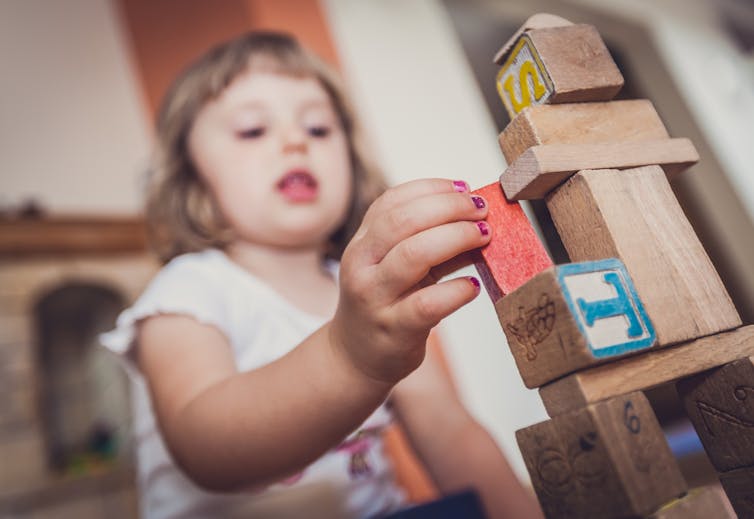


blocks are still the best toy you can buy your child.

Christmas lists usually suggest the latest and greatest technology, but blocks are still the best toy you can buy your child.
Shutterstock


Blocks also help develop spatial language


Block play also fosters spatial language. When children play with blocks they hear and produce more words related to spatial reasoning including things such as beneath, above, next to, behind, and so on.

One study showed block play elicited more spatial language than any other type of play. The other types of play included playing with puppets, playing house, shops, school, zoos, chefs and throwing a ball.

Other research that looked at spatial language showed the more spatial words children heard, the more spatial words they produced and the better they performed on spatial tasks. In this study, researchers looked at language relating to the spatial features and properties of objects such as the dimensions of objects (such as how big small, wide, tall), the forms of shapes (for example rectangle, circle, square) and other spatial properties (like bent, pointy, curved).

Different blocks for different ages and stages
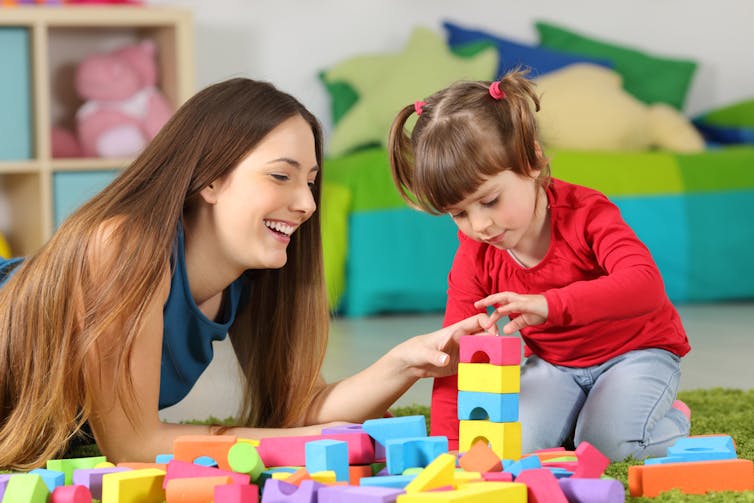


kids playing with blocks

The best way to get your kids playing with blocks is to play along with them.
Shutterstock


There are a wide variety of choices for blocks for children including MegaBloks for really young children, Duplo, wooden blocks or waffle blocks for preschoolers, and Eco bricks and Lego for older children.

These age guidelines are suggestions only. My ten and fourteen year old daughters will still play with the wooden blocks. Much of the reason blocks are such enduring toys is due to the fact they’re “loose parts”. That is, they can be moved, arranged, combined, taken apart, and put together in any number of ways. Frobel, the father of kindergarten, created ten gifts for children of which six were blocks.

The best way to engage children in block play is to play alongside them and show your interest and enthusiasm in block building. My friend has a ritual of playing half an hour every afternoon with Duplo with her three young boys aged five, three and one. She says it’s her favourite time of day.


Read more: Can toys really be ‘educational’? Well that depends on the parents


The ConversationSo, when those lists appear in your inbox or on social media, just remember the best toy of all is likely to be missing.

Kym Simoncini, Assistant Professor in Early Childhood and Primary Education, University of Canberra and Kevin Larkin, Senior Lecturer in Mathematics Education, Griffith University

This article was originally published on The Conversation. Read the original article.

Tuesday, December 27, 2016

Guest Post: Five ways Christmas affects your brain


by Kira Shaw, University of Sussex

Christmas is a time of year like no other; gifts are exchanged, little-spoken-to relatives are contacted, and appetising treats are consumed with great gusto. Christmas can be both a time of stress and a time of relaxation. But whether you love or hate Christmas it’s pretty difficult to avoid – and so your brain may be altered by the experience one way or another. Here are some of the main facets of the Christmas experience, and how they might affect your brain.

Christmas festive ornament
The festive spirit: The joy surrounding Christmas may influence some of the chemicals in your brain (dopamine and serotonin) which affect your happiness levels. Dopamine is known to be involved with reward-driven behaviour and pleasure seeking and serotonin is thought to increase our feelings of worth and belonging. So when people talk about “Christmas cheer” they may be on to something.

In fact, researchers at the University of Copenhagen conducted an imaging study to try and find the “centre” of the Christmas spirit in the human brain. Here, participants were shown Christmas-themed images and, in those participants who actively celebrated Christmas, there was increased brain activation in the sensory motor cortex, the premotor and primary motor cortex, and the parietal lobule. Previously these brain areas have been associated with spirituality, bodily senses and recognising facial emotions. While these results should be interpreted with some caution, it is interesting to note the physical effects that feeling festive can exert on your brain.

Stress: Not everyone finds Christmas an entirely joyful and festive time – many people find it very stressful. In fact, the burdens of navigating through a busy shopping centre to find the ideal gift for your other half, or of cooking the perfect turkey for a house full of hungry people, is enough to rattle even the calmest person. Stress can exert a physical response in your body, with the automatic release of adrenaline and cortisol. Further, cortisol has been shown to have a profound effect on the hippocampus, which may decrease your memory and ability to multitask.

Giving gifts: The giving and receiving of gifts is an age-old Christmas tradition and there’s no better feeling than seeing your loved one’s eyes light up when you’ve found the perfect gift for them. But why does giving make us feel so good? Generosity has been linked with the reward circuitry of our brain, causing the release of dopamine and endorphins. Researchers have described a “helpers’ high”, which is experienced after giving. The chemicals that cause this high can reduce stress and increase your desire to repeat these acts of kindness. So, while you may resent being out of pocket after buying your great aunt that pair of slippers, your brain at least ensures that you are compensated with a chemical reward.

Bonding with family and friends: The quintessential Christmas experience involves sitting around a table with your loved ones. In fact, it’s hard to even imagine the festive period without thinking of your family and friends. The bond between you and those special to you can result in the release of a hormone called oxytocin in the brain. Oxytocin – sometimes referred to as the “cuddle hormone” – drives maternal behaviour, trust, and social attachment. As such, this hormone may help towards explaining that warm, fuzzy feeling you get at Christmas when surrounded by those you love and trust.

Overindulging: Indulging in our favourite food and drinks is all part of the Christmas experience – but overeating can affect your brain. It has been shown to activate a pathway linking the hypothalamus in the brain to the immune system. This leads to an immune response and low-grade inflammation, which may explain why you can feel unwell after eating too much. Of course, this doesn’t do much harm to your body after one extravagant Christmas meal – but, when overeating becomes a long-term issue, this inflammation can become chronic, and contribute to Type 2 diabetes and heart disease.

But for now, don’t worry too much if you’ve got Christmas on the brain, you’ll soon be back to your usual self come January.

The Conversation

Kira Shaw, Postdoctoral Researcher in Neuroscience, University of Sussex

This article was originally published on The Conversation. Read the original article.

Friday, December 23, 2016

Why young children often prefer wrapping paper and boxes to actual presents

by Julie Brierley, University of Hull

We’ve all been there: you spend an unthinkable amount on a child’s toy – lulled by the promise that the interaction with the flashing lights and whooshing noises will excite, stimulate and educate our little people. Yet on the big day, we watch as our child’s interest in the toy quickly diminishes and the attraction of the discarded wrapping paper and packaging takes over.

We watch with confusion as our young children show us the real pleasures of Christmas – not their new shiny toy, but all that is destined for the recycling bin. And as they roll around on the floor in the wrapping paper and jump in and out of the boxes, we question our own sanity in spending ridiculous sums of money on a child who would have clearly preferred a cardboard box for Christmas.

But while our child’s preoccupation with screwed up wrapping paper and packaging may seem barmy to us adults, it is in fact just another way to play – and can help children to learn about themselves and the world around them.

The psychology of wrapping paper


At a very early age, children use play to drive their own learning. And when young children are allowed and actively encouraged to explore and follow their own interests, they develop understanding from their actions.

In recent years, neuroscientific studies have led to a greater appreciation of the importance of young children’s brain development. These studies have shown us that the first three years of a child’s life are a critical period for learning and development. This confirms a direct relationship between the quality of experiences young children gain and the growth and development of the brain.


‘Just look at this paper!’
Shutterstock


So, when children explore and experiment with objects such as boxes, paper and ribbons, they are using both their sensory and physical senses to extend their thinking.

“What is this and what can I do with it? Can I fit my hand inside? what else fits in?” – young children’s questioning minds are pivotal to their learning. And engagement in self-directed play helps to aid learning and supports the development of language as well as mathematical, scientific, creative, personal and social concepts.

The power of play


In today’s society, the power of play is frequently misunderstood and underestimated. Children these days have less time to “free play” given that so much of their playtime is structured or involves a parental onlooker.

But young children are physical beings, who gain sensory perceptions and feedback from the whole of their bodies – and these perceptions contribute to essential brain development. So seemingly meaningless actions such as twirling, jumping, rolling and messing around with objects can actually help children to learn about who they are and the world around them.

Through the sensory and physical exploration of the discarded boxes and Christmas wrapping paper, the foundations of learning and cognitive development are occurring. Children become sensitised and motivated to further their explorations, allowing more complex thoughts and understanding to develop.


Living the dream.
Shutterstock


So a young child who repeatedly fills and empties a box, climbs in and out, puts things in then tips them out, is not just making a mess. Instead they are exploring the “insideness” of the object – which helps them to understand concepts such as capacity, volume and space.

And with this in mind, rather than just filling the toy cupboard with a load of manufactured creations, it is important that young children are also able to make their own discoveries and to construct their own understanding, too.

So this Christmas, make sure your child has a chance to play with all the wrapping paper before it is neatly tidied up and disposed of. Because not only are you helping them to cultivate a desire to learn, you are also helping to develop their inquisitive resolve and creative expression.

You will also be allowing them the opportunity to strengthen the bits of their brain that are responsible for development – and this will help to ensure they have the foundations for future learning. And what could be a better gift than that?

The Conversation

Julie Brierley, Lecturer in Early Years & Education, University of Hull

This article was originally published on The Conversation. Read the original article.