Showing posts with label England. Show all posts

Thursday, November 22, 2018

Guest Post: Sweet potatoes, Donald Trump – and the Special Relationship


Rebecca Earle, University of Warwick

Two days after the US presidential election, The Independent reported that “Donald Trump has spoken with nine world leaders but has yet to call Theresa May, throwing her claim of a ‘special relationship’ into tatters.”

Eventually, the phone call was made. “Concerns over ‘special relationship’ allayed as Trump calls May,” read the headline in The Guardian a few days later. Time magazine reassured US readers that “Donald Trump and Britain’s Theresa May Affirm ‘Special Relationship’.”

It seems especially apt, as people in the US gather to celebrate Thanksgiving, to ponder the nature of the relationship between the two countries. After all, Thanksgiving forms part of an origin myth about how English settlers began the slow process of transforming themselves into Americans. The holiday commemorates the 1621 celebrations held at the Puritan settlement in Plymouth, which included, apparently, a large meal, some parading and a short religious service.

Scholars (and cartoonists) have deconstructed the holiday comprehensively, noting the invented nature of many of its core elements, its sporadic celebration before the 20th century, its erasure of European violence towards Native Americans and many other aspects. Overall, it’s clear that this holiday, like all national holidays, is an invented tradition based not only on collective remembering but also collective forgetting.

At the same time, while Thanksgiving masks a range of troubling and enduring aspects of US history, one feature merits some serious celebration: the sweet potato. Sweet potatoes in some form or another are now a structural element in the canonical Thanksgiving menu.

The authoritative New York Times cookery section recommends 14 different sweet potato side dishes, from classic maple-candied sweet potatoes to less traditional takes such as roasted sweet potatoes with horseradish butter. And that’s not even starting on sweet potato pies and puddings. This year, I plan to bake Paul Prudhomme’s sweet potato pecan pie. (After that, I will hibernate for an entire year while my digestive system processes the 4m calories it has ingested.)


A tart that is courage


The sweet potato is in fact part of a transatlantic food alliance that predates the original Thanksgiving feast. Sweet potatoes originated in the Americas, and formed a staple of the diets of Caribbean islanders. Columbus had never seen anything like them when he landed in the Bahamas in 1492. He compared them to African yams; others thought they tasted like turnips or chestnuts.

Once introduced into Europe, however, sweet potatoes quickly spread. By the late 16th century, they were grown on a commercial scale in the area around Malaga, Spain, and were considered “a good thing to eat” – in the words of one Spanish Jesuit.

But when did the sweet potato reach the British Isles? The English herbalist John Gerard included an illustration in his 1597 Herball. “Howsoever they bee dressed, they comfort, nourish, and strengthen the body”, he reported enthusiastically. Sweet potatoes quickly became popular in England, and many of the earliest recipes for “potatoes” may in fact refer to sweet potatoes. They were even grown at Hampton Court, for the delectation of Henry VIII, who reportedly learned to enjoy their honeyed delights from the ill-fated Catherine of Aragon.
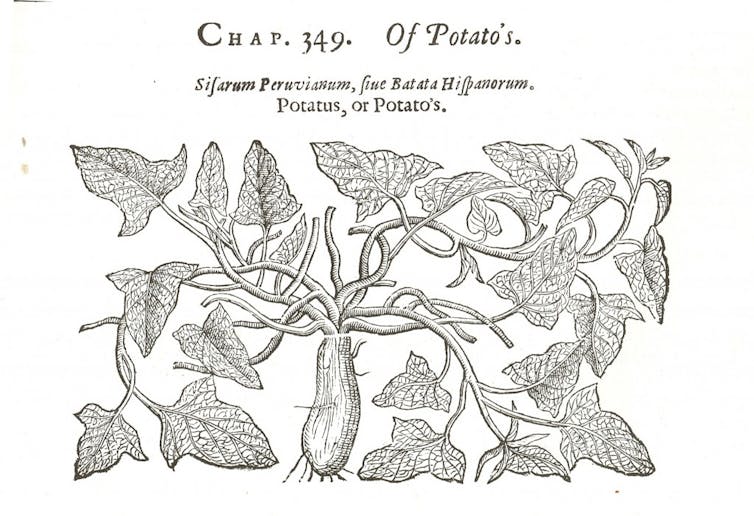


 Sweet potatoes: ‘they comfort, nourish, and strengthen the body’. John Gerard's 'Herball' (1596)

Sweet potatoes: ‘they comfort, nourish, and strengthen the body’.
John Gerard's 'Herball' (1596)


After their marriage disintegrated, Henry had to rely on home-grown sweet potatoes, rather than Spanish imports. Gardeners at Hampton Court have recently demonstrated that sweet potatoes grow perfectly well in our scarcely tropical climate. The first printed recipe containing sweet potato is probably the description of how to make “a tart that is a courage to a man or woman”, which appeared in the Good Huswife’s Jewell, a cookbook published in London in 1596.

Before NATO … the sweet potato


Ironically, while Henry VIII enjoyed sweet potatoes in Tudor England, pilgrims in 1621 New England almost certainly did not feast on maple-candied sweet potatoes, or any sweet potatoes at all. Early records of the settlement make no mention of them and they were not native to the chilly shores of the north Atlantic. The oldest documents in the US that refer to sweet potatoes are actually from England.

Washington’s Folger Library, which holds a major collection of Shakespeariana, has recently unearthed an early recipe for sweet potato pudding from … Warwickshire! The pudding calls for potatoes (sweet or ordinary), eggs, sugar and a good dose of sherry. So new world sweet potatoes have been criss-crossing the Atlantic since the 16th century, forming a special relationship of eaters and growers that long predates NATO.

But what about Donald Trump? Does he have anything to do with this long history? Not really, although the internet is replete with images of sweet potatoes that resemble the president-elect and critics have called him a “xenophobic sweet potato”. Will Trump tuck into a traditional sweet potato pie or candied sweet potatoes for his Thanksgiving dinner? I don’t know and I certainly don’t care. But the sweet potato, unlike Trump, is unquestionably one of the new world’s gifts to Britain – and the world.

A recipe for sweet potato tart from Charles Carter, The Complete Practical Cook (London, 1730).

POTATOE TORT.

TAKE a Pound and half Spanish Potatoes [sweet potatoes]; boil them and blanch them, and cut them in Slices, not thin; sheet a Dish with Puff-paste, lay some Citron in the Bottom, lay over your Potatoes, and season them with Ginger, Cinnamon, Nutmeg, and Sugar; then take the Marrow of two Bones, cut it into Pieces as big as Walnuts, roll it in Yolks of Eggs, and season it as the Potatoes; lay it on them, and between the Lumps of Marrow lay Citron and Dates slic’d, and Eringoe Roots [I’d use candied angelica], sprinkle over some Sack and Orange-flower Water; then draw up a Quart of Cream boil’d with the Yolks of ten Eggs, and pour all over, bake it, and stick over some Citron, and serve it.
The Conversation

Rebecca Earle, Professor of HIstory, University of Warwick

This article is republished from The Conversation under a Creative Commons license. Read the original article.

Sunday, June 04, 2017

Guest Post: Faggots, punks, and prostitutes: the evolving language of gay men


Peter Robinson, Swinburne University of Technology

Joe Jackson’s 1982 hit Real Men was the first time I had heard gays referred to as faggots. I was just out of the closet and in my first gay relationship in London. Jackson’s lyrics about how only our friends and other gays could call us faggots was encouraging, coming as it did from a straight man singing a song just before AIDS hit.


Faggot, often-considered a slur, has been reclaimed many times over by gay men, including in a new play by Declan Greene, The Homosexuals, or “Faggots”, currently showing at the Malthouse in Melbourne. The play looks at gay male relationships and their politics, and is apt as middle-class gay men and lesbians struggle with acceptance all over again in the face of their call for marriage equality.

Joe Jackson Real Men vinyl fags faggotsMy friends and I called ourselves fags because it was a way of turning the abuse on its head and laughing at the straight bullies.

And in merry-old-England there was abuse: one night when leaving gay club Heaven, a bunch of lads called us and our female friends “pooh jabbers”. It was graphic and offensive (“bum bandit” being a similar, anal-fixated term from about the same time) and it occurred to me how deeply, viscerally they hated us.

Language defines who you are. But words used by others to define gay people can say a great deal more about them than us.

From prostitutes to gays


Let’s begin with the most common term, “gay”, which baby-boomer homosexuals appropriated for their liberationist cause in the late 1960s and early 1970s. Its pedigree is longer and according to Edmund White originally applied to women and meant loose or immoral, as in a prostitute. And “gay-house” was the term for a brothel. “In the past one asked if a woman was "gay,” much as today one might ask if she “swings,”“ wrote White.

"Homosexual” (or “homosexualist”) has similar 19th-century origins and was originally coined in 1869 by a Hungarian doctor, Karoly Maria Benkert.

“Faggot” has had different meanings according to where and when it was used. In eighteenth-century London it was first a term for prostitute then for homosexual. In 1920s New York, it described an effeminate homosexual who sought social/sexual relations with “normal men”, according to George Chauncey while a “flaming faggot” was an extremely obvious, flamboyant gay man.

In 1970s Australia, the ubiquitous “poofter” covered all forms of deviancy including men who had sex with other men, poor-performing sportsmen, politicians and motorists. Meanwhile, as the documentary Deep Water revealed, the literal bashing and killing of poofters caught at it in public parklands was something of a pastime.

“Cat” from “catamite” is ancient Roman with connotations of effeminacy, prostitution, and the passive role in a sexual encounter. “Fruit” was, like faggot, according to US historian Randolph Trumbach, a term first used in the 18th century for a prostitute and then a sodomite. “Fairy” and “queer” had similar origins between the world wars.

Why the fixation on prostitution? As Trumbach explains, there is a “long tradition in English usage” of words that are used to designate a prostitute being appropriated one generation later to describe sodomites.

This tendency for the words for prostitute to be later used for homosexual dates from 18th-century England when they often shared common social spaces, argues gay historian Rictor Norton.

Much later, historians such as Chad Heap and George Chauncey found similar intermingling in the underground bars that operated in New York and Chicago during Prohibition in the US.

The words gays use for themselves


Because of the sardonic nature of gayness, all of the above would have to be included also in the vocabulary of gay men and queers.

As well, there are community-specific terms, such as “clone”. Historically-specific, it connotes the style of gay men mid-1970 to mid-1980s (moustache, short hair, faded, baggy Levis and pocket and/or neck handkerchief) as exemplified by the lead singer of the Bronski Beat at the time of their hit single, Smalltown Boy.


More arcane terms include “ganymede” (a young male) which was used by Oscar Wilde and his contemporaries and “Marianne” and “Molly” from the earlier 18th century, again connoting an effeminate (or passive) male.

“Nance” and “nancy boy” as well as “Nelly” and “nellies” were terms used by both gays and straights also connoting effeminacy or youthfulness. According to one of writer Keith Vacha’s interviewees, nellies were “common queens” by which he meant: “ones with bleached blonde hair and plucked eyebrows”.

And finally, perhaps to the consternation of some of today’s toughs, there is “punk,” which according to Rudolph Trumbach was once the slang term for both prostitute and sodomite.

Terms of abuse and endearment


Terms of abuse are a way of distinguishing those whom we choose to marginalise because we do not like the look of them or because we were there first. In other words, they are the “outsiders” of sociologist Norbert Elias’s important work from the mid-1960s.

Bronski Beat Smalltown Boy gay slang faggotHumans have been doing this from the outset. Gangs and groups, them and us, and in the case of sexual preference, there are the straights, the “normals”, if you like, and the others, the sexual outcasts.

The terms I’ve illustrated were used by the majority to exclude prostitutes and homosexuals from “polite” society. While these terms were used to mark their difference, this did not prevent males from that same polite society from using the good services of prostitutes and homosexuals when it suited them. And as they did so then, they still do so now.

What is also interesting is the way in which sexual outcasts could adopt terms of abuse used for them and turn them into terms of endearment for each other — as my friends and I did in the 1980s when we called ourselves fags. And so, self mockery becomes a form of defence against the strictures of the priests and preachers.

It was literally the priests and the preachers, and later doctors and lawyers, who sought to demarcate “useful” sexual activity from wasted sexual activity. According to historian Michel Foucault the monogamous heterosexual couple produced new workers; those erotic and sexual activities that detracted from or weakened it were identified, categorised, and punished by law.

That young, gay men are now starting to reclaim these words is significant. It could mean that they are becoming interested in finding out where they have came from, that is, what are the origins of the culture they inhabit?

Twenty-one years ago, AIDS, which was then the dominant concern for gay men and culture, ceased to be a death sentence and instead became a manageable disease. Young men who have grown up since then could feel that other aspects of gay life can now be explored with greater freedom.

If this is so, it would suggest a strengthening of gay culture and community because people can only start exploring their past, warts and all, when they feel safe.

The Homosexuals, or “Faggots” will be showing at Melbourne’s Malthouse Theatre until March 12.

Peter Robinson, Senior lecturer in History and Sociology, Swinburne University of Technology

This article was originally published on The Conversation. Read the original article.

Friday, June 02, 2017

Guest Post: A brief history of Polari: the curious after-life of the dead language for gay men


Paul Baker, Lancaster University

In early February, the Church of England College expressed regret that in an evening liturgy in Cambridge, God was referred to as the Duchess. The service had been advertised as a Polari evening prayer in anticipation of LGBT History Month, and was described as a liturgical experiment. So what was Polari and how did it end up in an evening prayer? The Conversation

Polari is a secret language, which has now largely fallen out of use, but was historically spoken by gay men and female impersonators. My research has tracked how it grew out of the world of entertainment, stretching back from West End theatres, through to 19th-century music halls and beyond that to travelling entertainers and market-stall holders.

It developed from an earlier form of language called Parlyaree which had roots in Italian and rudimentary forms of language used for communication by sailors around the Mediterranean. Also associated with travellers, buskers, beggars and prostitutes, it found its way into Britain, especially London and port cities, and gradually became used by gay men and female impersonators, especially during the first half of the 20th century.


Polari Bible gay language Britain

The Polari bible.
Joe Richardson, Author provided


Polari itself had Parlyaree as a base, but once in Britain was supplemented with a wealth of slang terminology from different sources, including Cockney Rhyming Slang, backslang (pronouncing a word as if it was spelt backwards), French, Yiddish and American airforce slang.

In a period when homosexuality was illegal and heavily stigmatised, it was useful as a means of conducting conversations in public spaces, which would have alerted others to your sexuality. Many of the words allowed speakers to gossip about mutual friends or to critique the appearance of people who were in the immediate vicinity.

Vada the naff strides on the omee ajax” meant look at the awful trousers on the man nearby. Inserting a Polari word – such as bona (good) or palone (woman) – into a sentence could act as a coded way of identifying other people who might be gay. The language itself, full of camp, irony, innuendo and sarcasm, also helped its speakers to form a resilient worldview in the face of arrest, blackmail and physical violence.

Polari speakers “christened” themselves with camp names like Scotch Flo or Diamond Lil, affording themselves alternative identities that reclaimed the representations of them as effeminate in positive ways.

Surplus to requirements


In the 1990s, I based my doctoral thesis around the study of Polari, examining its varied history and complicated etymology, the ways that it resembled a language, its social functions and the reasons for its eventual decline. I interviewed speakers of the language and analysed texts, including scripts of the 1960s comedy radio series Round the Horne, which had a regular sketch voiced by Kenneth Williams and Hugh Paddick, who played Polari-speaking actors.

The version of Polari that was used in Round the Horne was necessarily simplified and toned down for the British public, and by the 1960s, there was a feeling that Polari had already overstayed its welcome. Round the Horne spoiled the secret, rendering the language less attractive to its speakers. Meanwhile the decriminalisation of homosexuality in 1967 was round the corner, making it less necessary for a secret lingo in any case.


Some younger gay men were more interested in concepts like gay pride, gay liberation and coming out and viewed Polari as a naff byproduct of a more repressive time. In the 1970s, in an early gay magazine called Lunch, activists branded Polari as ghettoising and it gradually became surplus to requirements. When I carried out a survey of 800 gay men in the year 2000, about half the respondents had never heard of it.

Renewed interest


While few gay men today actively use Polari, in recent years it has gained a kind of latent respectability as an historic language – similar to the way Latin is seen by the Catholic faith. From a political standpoint, Polari is now recognised as historically important, an example of the perseverance of a reviled group of people who risked arrest and attack just for being true to who they were.

gay talk homosexual language slang In 2012 a group of Manchester-based artists used Polari to highlight the lack of LGBT inclusivity in education. They created an exam in LGBT studies, getting volunteers to sit it under strict exam conditions. The language portion of the exam was about Polari.

Another group of activists called the Sisters of Perpetual Indulgence created a Polari Bible, running a Polari wordlist through a computer program on an English version of the Bible. The Bible was bound in leather and displayed in a glass case at the John Rylands Library in Manchester. This was not to mock religion but to highlight how religious practices are filtered through different cultures and societies, and that despite not always being treated well by mainstream religions, there should still be space for gay people to engage with religion.

In 2012, I participated in a group effort to carry out the longest ever Polari Bible reading which took place in a Manchester Art gallery. In a nice touch of high camp we had to wear white gloves while touching the Bible, to ensure the oils from our fingers didn’t ruin the paper. We took turns reading lines such as: “And the rib, which the Duchess Gloria had lelled from homie, made she a palone, and brought her unto the homie.” Translation: “And the rib which God had taken from man was made into a woman and brought to the man.”

The Polari Evensong at Cambridge, carried out by trainee priests, however, took place in a more official context and provoked a range of conflicting opinion. Some people think it is hilarious, some are concerned about Church of England rules being broken and disrespect for religious tradition, while others think that God should be prayed to in any language and that the Evensong was perfectly valid. As someone who has spent 20 years documenting the rise and fall of Polari, I find it fascinating that even now, it is finding new ways to cause controversy. Never has a dead language had such an interesting afterlife.

Paul Baker, Professor of Linguistics and English Language, Lancaster University

This article was originally published on The Conversation. Read the original article.

Monday, December 26, 2016

Guest Post: Boxing Day's journey from Pepys to shopping petitions and parliament


by Nelson Blackley, Nottingham Trent University

British members of Parliament have been debating whether shops should remain open on Boxing Day. Some 30 or 40 years years ago, shops stayed closed for longer during the holiday season – and on Boxing Day family time was the focus and leftover turkey the star of the show. But in recent years Boxing Day has fired the starting gun for the January sales, created (yet another) key moment in the British retail calendar and forced retail staff into work.

This growing commercialisation has created a backlash. In 2015, a petition on the government’s website to ban shops from opening on Boxing Day gathered a modest 27,525 signatures, but 2016 has seen the campaign gather greater momentum. Two similar petitions have been active this year. The first, also on the government’s official website, calls for all retailers to close on Boxing Day, claiming: “Some things are needed over the festive period, retail isn’t one of them.” It has received more than 140,000 signatures, easily meeting the required level of support to warrant the parliamentary debate. A similar petition on the website change.org claims has gathered more than 230,000 signatures.

So what is the historical background to Boxing Day and why are we so attached to it? Is it possible that this recent groundswell of support could begin to loosen the grip of consumerism during the Christmas break?

Pepys show


The Oxford English Dictionary claims the earliest use of the term “Boxing Day” is from 1830s England. It was “the first weekday after Christmas Day, observed as a holiday on which post-men, errand-boys, and servants of various kinds expect to receive a Christmas box”. This relates to a seasonal British custom for tradespeople to collect boxes of money or presents after Christmas as thanks for good service throughout the year.

This is actually linked to an even older English tradition, mentioned by Samuel Pepys’ in a diary entry from December 19, 1663, when servants of the wealthy, who would have to wait on their masters on Christmas Day, were allowed the next day to visit their families. Employers would give each servant a box to take home containing gifts, bonuses and sometimes leftover food.


Stony-faced. A statue of Samuel Pepys in London.
chrisdorney/Shutterstock


The 2016 parliamentary debate about the modern nature of Boxing Day did not involve a vote and so there will be no immediate change in the law. However it was a chance for MPs to demonstrate whether it is an issue with much parliamentary support. In response to the petitions, the government has said:

We do not believe it is for central government to tell businesses how to run their shops or how best to serve their customers. Therefore we are not proposing to ban shops from opening on Boxing Day.

Even if there is general support in Parliament, I don’t believe the UK government will amend the current trading laws and so prevent large stores from opening on Boxing Day any time soon – for several reasons.

Ker-ching


First, and most importantly, the retail sector is a critical part of the UK economy – and in fragile economic times it would be a brave government indeed that took any action that might damage it. Sales in the sector were £339 billion in 2015 (generating 5% of the UK’s GDP) and, with almost 3m working in retail, it was the UK’s largest private-sector employer.

There is also an important international dimension. The UK’s in-store sales on Boxing Day are boosted by an influx of foreign shoppers.

The second key factor reflects the radical changes seen in consumer habits as a result of online shopping, a point also acknowledged by the government in its response to previous Boxing Day petitions:

Consumers are now used to the freedom to buy what they need at any time that suits them. The government believes that all businesses should be allowed flexibility to meet their customers’ needs and offer consumers choice about when and how they want to shop. This will help drive competition, productivity and the local economy, as well as helping create jobs

Unsurprisingly, this is a view echoed by the British Retail Consortium (BRC) the trade association whose members represent 70% of the turnover of the UK retail sector.

Sacred time


That leads onto a third factor behind the government’s decision making. According to the Guardian, shoppers last year were more willing than ever to interrupt Christmas Day itself for some online bargain hunting.

Online sales in the UK on Dec 25, 2015 were the highest ever, up 21% on 2014 according to web services group PCA Predict – whose founder Jamie Turner highlighted the “convenience of being able to browse online throughout the entire Christmas period to find deals and discounts”.

However, there is one thing that seems to remain sacred. Experian and online retail trade association IMRG reported a dip in online between 1pm and 4pm on Christmas Day as families enjoyed Christmas lunch together (and perhaps even watched the Queen’s speech), then rising again in the evening as people sat down to relax and watch television.

At the heart of this debate lies the fear of missing out. For the government, for retailers and their shareholders, and for millions of bargain-hunting consumers. According to the BRC, the UK retail market is the “most competitive in the world” and in that context it becomes almost unimaginable that any large retailers would now make a voluntary decision to close on Boxing Day and so lose sales and market share to rivals.

The British boom in online shopping – the UK has the highest level of penetration in the world – has also brought with it the “click-and-collect” phenomenon. In other words, both parts of the UK retail industry work hand-in-hand – there will be millions of UK consumers who want to order products online over the Christmas holiday period and collect from a store on Boxing Day. More, you have to conclude, than the 140,000 petition signatories who long for a Christmas free from the ringing of the nation’s cash registers (or the sound of clicking on the pay now button).

The Conversation

Nelson Blackley, Research Associate - National Retail Research Knowledge Exchange Centre, Nottingham Business School, Nottingham Trent University

This article was originally published on The Conversation. Read the original article.

Saturday, December 24, 2016

Guest Post: How did we come to celebrate Christmas?


by Bronwen Neil, Australian Catholic University

Christmas is literally “the mass for Christ”, the day on which Christians celebrate the birth of Jesus.

Pope Leo - Christmas
Pope Leo I
The western date for Jesus’ birth is quite arbitrary. It was chosen by Pope Leo I, bishop of Rome (440-461), to coincide with the Festival of the Saturnalia, when Romans worshipped Saturn, the sun god. This was the day of the solar equinox, the shortest day of the year in the northern hemisphere, which officially marked the halfway point of winter.

Leo thought it would distract his Roman congregation from sun worship by celebrating the feast of Christ’s birth on the same day. He described Jesus as the “new light”; an image of salvation, but timely in that the days began to lengthen from 25 December onwards.

The date of the feast varies within Christian denominations. Western Christians celebrate the Nativity on a fixed date, 25 December. Some Eastern Orthodox Christians celebrate it on 6 January together with Epiphany, the revelation of the infant Jesus to three wise men. The Greek and Russian Orthodox celebrate Christmas on 7 January and Epiphany on 19 January.

Where did Christmas traditions originate?


It is true to say that the western Christmas began as a Christianized pagan feast. The Christmas tree is also a pagan symbol of fertility.

In northern countries, when the nights are long and cold, the feast of Christmas traditionally gave Christian people something to look forward to: rich food (reindeer if you are in Sweden, pork and lamb if you are in Greece), lots of candles, Catholic Mass at midnight or Protestant services on Christmas morning. Fir trees were brought inside and lit with candles as a symbol of the hope that spring would return with new crops and plentiful food.


Fir trees were brought inside to symbolise the return of spring, new crops, and plentiful food. It’s also a pagan symbol of fertility.
Ievgenii Meyer/www.shutterstock.com


The early church also celebrated Christ’s Resurrection in spring, the season of new life, since it coincided with the Jewish Passover feast on 14 Nisan, a date that depended on when the first full moon occurred in March or April. Many of our Easter symbols, like the bunny and the egg, are ancient fertility symbols. No one knows how chocolate got dragged in!

It is also an interesting coincidence that the Jewish Festival of Lights, Hanukkah, falls in November or December each year, and is celebrated with the lighting of the candelabra (menorah), traditional foods, games and gifts.

Where did Santa Claus come from?


The Santa Claus myth (spoiler alert: don’t read any further if you are under 10!) came from the legend of Saint Nicholas. Nicholas was a bishop in the city of Myra (in modern Turkey), who wanted to help poor young women get husbands. He left bags of money of the doorsteps of their family homes in secret, an anonymous gift to the poor to be used as a dowry.

A 1950s Coca-Cola advertisement

For this he became known as the patron saint of virgins and children. Over time, his generosity was remembered by people giving gifts to children in secret on the feast of St Nicholas, celebrated on December 6 (in western Christian countries) and 19 December (in the eastern churches). His name in English became Clause, after the Dutch Sinterklaas. Dutch children and others in western Europe leave food out in a shoe or a clog for Nicholas’ horse on the eve of 6 December, and receive presents on the day of the feast.

Our modern image of Santa Claus as a rotund gentleman of a certain age dressed in a red-and-white suit and matching hat comes from an incredibly successful marketing campaign by Coca-Cola in the 1930s. Since then, suburban Santas always dress in the image created by the Coke brand.

But this image comes from an earlier depiction of Father Christmas who had nothing to do with the American Santa Claus until the 1850s.

Until the Victorian era, when childhood was recognised as a separate stage of life, and the Christmas feast came to centre around children, Father Christmas, or Lord Christmas as he was also known, was the personification of a mid-winter feast of merrymaking for adults – and he brought no presents. He was useful as a symbol for Catholic-sympathising writers in the early 17th century who wanted to defend Christmas from attacks by the Puritans, radical Protestants who intended to ban the feast.

(For a Jewish perspective on the Wars of Religion, see Stephen Feldman’s book, Please Don’t Wish Me a Merry Christmas: A Critical History of the Separation of Church and State (1997).)

Tuck Postcard, Photo Oilette Series, 1919.
From the 1850s onwards, the English Father Christmas was depicted as a bearded old man wearing a long red robe trimmed with white fur and a pointed red hat, who brought gifts to good children. This image can be seen on English postcards from the early 20th century.

Christmas in the modern era

A lot of the significance of the original feast is lost when we in the southern hemisphere celebrate it in the middle of summer. A family barbecue at the beach cannot really capture the atmosphere of a cold and dark mid-winter.

This seems to be the main reason for the emergence of the alternative “Christmas in July”. Today we give presents to adults as well as kids on the eve or day of 25 December, and usually not anonymously. It would be interesting to see what would change if none of our gifts had name tags attached – Secret Santa at the office is based on the same concept.

Our gifts are also reminiscent of the tributes that the three Magi – who symbolise, according to tradition, the non-Jewish peoples – gave to the infant Jesus.

Incidentally, according to two of the four Gospels, Jesus was born in Bethlehem, but given the lack of corroborating evidence for a census there that year, it is now thought that Jesus was more likely born in Galilee, where he grew up. Bethlehem was significant for the Gospel writers as being the birthplace of King David 1,000 years earlier, and a royal city for the Jews.

The Magi gave Jesus gold, frankincense and myrrh, when they understood that the baby they were looking at was both human and the son of God. That mystery at least remains intact.

The Conversation

Bronwen Neil, Associate professor, Australian Catholic University

This article was originally published on The Conversation. Read the original article.

Friday, December 23, 2016

Why young children often prefer wrapping paper and boxes to actual presents

by Julie Brierley, University of Hull

We’ve all been there: you spend an unthinkable amount on a child’s toy – lulled by the promise that the interaction with the flashing lights and whooshing noises will excite, stimulate and educate our little people. Yet on the big day, we watch as our child’s interest in the toy quickly diminishes and the attraction of the discarded wrapping paper and packaging takes over.

We watch with confusion as our young children show us the real pleasures of Christmas – not their new shiny toy, but all that is destined for the recycling bin. And as they roll around on the floor in the wrapping paper and jump in and out of the boxes, we question our own sanity in spending ridiculous sums of money on a child who would have clearly preferred a cardboard box for Christmas.

But while our child’s preoccupation with screwed up wrapping paper and packaging may seem barmy to us adults, it is in fact just another way to play – and can help children to learn about themselves and the world around them.

The psychology of wrapping paper


At a very early age, children use play to drive their own learning. And when young children are allowed and actively encouraged to explore and follow their own interests, they develop understanding from their actions.

In recent years, neuroscientific studies have led to a greater appreciation of the importance of young children’s brain development. These studies have shown us that the first three years of a child’s life are a critical period for learning and development. This confirms a direct relationship between the quality of experiences young children gain and the growth and development of the brain.


‘Just look at this paper!’
Shutterstock


So, when children explore and experiment with objects such as boxes, paper and ribbons, they are using both their sensory and physical senses to extend their thinking.

“What is this and what can I do with it? Can I fit my hand inside? what else fits in?” – young children’s questioning minds are pivotal to their learning. And engagement in self-directed play helps to aid learning and supports the development of language as well as mathematical, scientific, creative, personal and social concepts.

The power of play


In today’s society, the power of play is frequently misunderstood and underestimated. Children these days have less time to “free play” given that so much of their playtime is structured or involves a parental onlooker.

But young children are physical beings, who gain sensory perceptions and feedback from the whole of their bodies – and these perceptions contribute to essential brain development. So seemingly meaningless actions such as twirling, jumping, rolling and messing around with objects can actually help children to learn about who they are and the world around them.

Through the sensory and physical exploration of the discarded boxes and Christmas wrapping paper, the foundations of learning and cognitive development are occurring. Children become sensitised and motivated to further their explorations, allowing more complex thoughts and understanding to develop.


Living the dream.
Shutterstock


So a young child who repeatedly fills and empties a box, climbs in and out, puts things in then tips them out, is not just making a mess. Instead they are exploring the “insideness” of the object – which helps them to understand concepts such as capacity, volume and space.

And with this in mind, rather than just filling the toy cupboard with a load of manufactured creations, it is important that young children are also able to make their own discoveries and to construct their own understanding, too.

So this Christmas, make sure your child has a chance to play with all the wrapping paper before it is neatly tidied up and disposed of. Because not only are you helping them to cultivate a desire to learn, you are also helping to develop their inquisitive resolve and creative expression.

You will also be allowing them the opportunity to strengthen the bits of their brain that are responsible for development – and this will help to ensure they have the foundations for future learning. And what could be a better gift than that?

The Conversation

Julie Brierley, Lecturer in Early Years & Education, University of Hull

This article was originally published on The Conversation. Read the original article.

Guest Post: What would you have eaten for Christmas in medieval times?


by Iona McCleery, University of Leeds

With Christmas almost upon us, there will be plenty of frenzied present shopping and meal planning. Haven’t made that Christmas cake yet? Fear not. If you were preparing the festive meal 600 years ago you’d have far more on your plate.

The picture below is a calendar page from a Book of Hours, a type of prayer book popular among pious rich people in the Middle Ages. Apart from the costumes they are wearing, the people at the bottom of the page seem much like us – keeping warm and enjoying their food and drink.

The 12th Day of Christmas
It may surprise you to learn that this particular calendar month is January. The feast day celebrated by the couple is Epiphany on January 6, picked out in red (Epyphania). Our Christmases, hectic though they may be, are actually a doddle compared to the traditions of old. Medieval people celebrated all 12 days of Christmas, from December 25 through to Epiphany – the day the three kings turned up with gifts for the newborn Jesus – although they did not usually feast every day. Some households had their big feast on Christmas Day. For others it was the first of January or the 6th, depending on local custom.

Wealthy or poor


There’s not much detail as to what the couple ate at their winter feast. The artist was more interested in depicting the strawberries and flowers in the margins than in putting food on the table. This is typical of medieval manuscript art. Even elaborate descriptions of royal feasts say little about food. We know even less about what the poor ate, although lords probably feasted their tenants at least once over Christmas.

We do know that preparations for winter would have begun in the late autumn. Humans and animals both ate the same basic foodstuff: grain. Poorer people did not have enough grain for animals over winter so most pigs and cattle were fattened up on acorns and slaughtered. Calendars commemorate this strategic act for the months of November and December as in the images below, paired with the relevant signs of the zodiac (Sagittarius and Capricorn).


Fattening in November and slaughtering in December.
Courtesy of the Brotherton Library, University of Leeds


Of course, the wealthy could continue to keep their animals alive, so they had fresh meat all winter. It’s not true that they used spices to liven up rotten meat: cloves, nutmeg, cinnamon and pepper were imported from India or Indonesia, so if you could afford them you could afford good meat. The rich could also afford sugar – candied fruit, sugared almonds and sweets have always been popular Christmas treats.

The poor would have eaten sausage and bacon instead, salted fish if they could get it, stored or dried apples, peas and beans, perhaps a bit of honey, and would only have had the added flavours of onion, leeks and garlic. Even salt was expensive. The hungriest time was actually not the months that we associate with winter cold, but the months of April and May. It was then that stores had run out and there would be little growing yet in the garden. Nor was there much dairy as hens naturally lay less in winter and cows don’t produce milk until after they have their spring calves.

Yuletide feasting


The best way to find out what the wealthy ate is to turn to their financial accounts and cookery books. Cookery books such as the Forme of Cury, written for the household of King Richard II (1377-1399), provide some tasty recipes. For a recent project we made recipes from this text and others for the public to try at festivals and markets around Yorkshire. In Castleford Market in December 2012 we prepared seasonal tastes such as gingerbread, mutton stew (mounchelet) and apple pudding (pommesmoile).


An opulent Christmas feast.
Courtesy of the Brotherton Library, University of Leeds


But it was nigh on impossible to prepare the main dishes that the rich had at their feasts. Turkey originally came from the Americas so was not found on English tables until the late 16th century. It probably replaced a showier but much less tasty bird: the peacock. The price of these birds meant that most people had to be content with another large expensive bird, the goose, which was a traditional Christmas main course until relatively recently. Also closely associated with Christmas was the wild boar – a boar’s head was often brought into the hall to accompanying carols. But it wasn’t always intended for eating.

And then elaborate displays of prepared meat, sugar or wax in the form of fantasy animals, angels and castles were often part of the entertainment, sometimes even moving mechanically or exploding.

So count yourself lucky as somebody who won’t go hungry this winter. You may have left the pudding quite late but you can leave the peacock and pommesmoile for next year.

The Conversation

Iona McCleery, Lecturer in Medieval History, University of Leeds

This article was originally published on The Conversation. Read the original article.

Thursday, December 22, 2016

Guest Post: A short history of three very famous Christmas carols


by Peter Roennfeldt, Griffith University

Singing and Christmas seem to go naturally together, like plum pudding and custard. Even those who would not normally attend a choir concert or church service throughout the year might happily participate in a civic Carols by Candlelight or a Midnight Mass. In these settings, the carols come thick and fast, and everyone joins in, almost involuntarily. But what is the origin of the choral music which adorns these settings?

The tradition of carol singing dates from the Middle Ages, and was not restricted to the Christmas season. There were carols for Easter, for New Year, and sometimes even for political events such as the Battle of Agincourt.

The poetic form was simple: a succession of stanzas with different texts, interspersed with a recurring refrain. In more recent times, the term “carol” has come to mean any song associated with Christmas.

Medieval carols from England and elsewhere have survived, though much transformed.
Good Christian Men, Rejoice dates from the 14th century, though only its text has been reliably attributed, to the Dominican friar Heinrich Seuse (Suso). The melody is known in Latin as In dulci jubilo (in sweet joy), and has been frequently used as the basis of extended instrumental or vocal compositions.


This song found its way into English through the 1853 publication Carols for Christmastide by J.M. Neale. This and other volumes of carols contributed materially to the Victorian era’s wholesale adoption of seasonal trimmings, along with royally sanctioned Christmas trees and greeting cards.

During the centuries between the first iteration of a carol tradition and the Dickensian revival of the Christmas spirit in the mid-1800s, there was comparatively little in the way of English composition of new works in this genre. A few pieces that are more appropriately termed Christmas hymns were, however, produced during the 18th century.

One of these is Adeste fideles or O Come, All Ye Faithful. Its authorship is disputed, but the most likely source is the 1751 volume Cantus diversi, published by John Francis Wade. Like most other Christmas carols, its text has clear Christian references.


Interestingly, it is also thought to contain covert Jacobite symbolism, with the phrases “all ye faithful” and “to Bethlehem” referring respectively to the supporters of Bonnie Prince Charlie and England itself. Wade fled to France after the failure of the 1745 Jacobite uprising, but his hymn soon came into regular use, particularly amongst English Catholics.

An indication of its wider adoption is the inclusion of O Come, All Ye Faithful within the Service of Nine Lessons and Carols, a familiar modern day tradition inaugurated at Cornwall’s Truro Cathedral in 1880. In the age of mass media, this most renowned Christmas ceremony, as practised in King’s College Cambridge has become universally familiar, firstly on radio and then television. Choirs around the world also perform their own Lessons and Carols programs every December, and most often conclude with this piece.

The most famous Christmas carol of all time is undoubtedly Silent Night, Holy Night. The original words for Stille Nacht, heilige Nacht were written by Joseph Mohr in 1816 and the melody two years later by Franz Xaver Gruber, when both were living in villages near Salzburg.

The German version was published soon afterward, and the familiar English translation in 1859, since when it has become known in nearly 150 languages. Due to its universality, Silent Night was in 2011 designated by UNESCO as an intangible item of cultural heritage.

With its stereotypical overlay of European winter costumes and snow-covered fir trees, the translation of Christmas traditions around the world is problematic. In Australia, there have been several attempts to develop parallel traditions of carols that eschew northern hemisphere references, in favour of local culture.

The best known are those composed by W.G. James, former federal controller of music for the ABC, to texts by John Wheeler. Outback images of drovers, summer heat, red dust and red-gold moon, dancing brolgas, mulga plains, Christmas bush, gully creeks and grazing sheep recur throughout these songs.


They were published in several sets, commencing in 1948. Despite several recordings by major ensembles, their familiarity and popularity has fluctuated greatly. However, two of James’ carols recently made it into a “top 10” list of Aussie Christmas songs by the Australian Times, whose target audience is expats living in the UK.

The tradition of singing Christmas carols is embedded in the season, even though the contexts where they are performed may differ widely from that where the words and music originated. We happily ignore the obvious disconnect between the imagery of some familiar carols and our hot Australian summers, and there is something reassuring about hearing and singing them once again, with feeling, every Christmastime.

The Conversation

Peter Roennfeldt, Professor of Music, Griffith University

This article was originally published on The Conversation. Read the original article.