Showing posts with label Santa Claus. Show all posts

Saturday, December 23, 2017

Guest Post: Could lies about Santa be good for your child?

Kristen Dunfield, Concordia University

Christmas is a magical time of year, especially for children. Unfortunately, between elaborate Elf on the Shelf staging and fending off questions about Santa, parents are often left wondering how much of the magic depends on them.

Specifically, many parents worry about whether they should encourage their children’s belief in the physical reality of Santa, about the potential impact of lying to them and what to do when their children realize they’ve been duped.

Rest assured, parents, it’s not all up to you. In fact, the best approach involves supporting your kids while they figure it out on their own. They will, and it won’t be as bad as you expect.

As a developmental scientist, I spend most of my time researching children’s trust. I’m interested in how trust develops and what happens when it’s broken. During the holiday season, I spend a lot of time thinking about Santa.
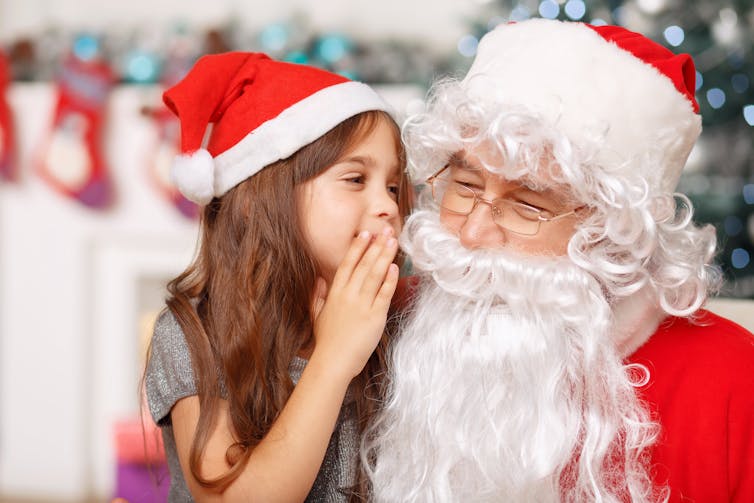


Santa Claus and child on lap

Developmental psychology suggests that fantastical beliefs in children are associated with positive developmental outcomes. And parents need not worry, children will bust the Santa myth themselves, when the time is right.
(Shutterstock)


As a proud auntie of three children under the age of four, my Santa musings have taken on a new significance. But, unlike many parents, I see the development of a belief in the physical reality of Santa, and the eventual myth-busting, as impressive achievements to be celebrated, not feared!

Research in the field of developmental psychology suggests that such fantastical beliefs are not actually harmful, but are associated with a number of positive developmental outcomes — from exercising the “counterfactual reasoning skills” needed for human innovation to boosting emotional development.

When kids question the magic


The vast majority of children will at some point believe in Santa. While many children learn these beliefs at home, the cultural support for Santa is so strong that children in households that don’t actively endorse the myth still sometimes believe.

Yet, despite Santa’s impressive marketing strategy, most children will abandon their belief by the age of eight. Though many parents fear this transition, it’s an inevitable part of growing up.


Santa is a mix of mundane and magical qualities. He is a jolly man dressed in red with a snowy beard. He also flies with the help of reindeer, visits all the world’s children in a single night and knows if you’ve been naughty or nice.

With age, a child’s thinking develops to the point where they start to notice Santa does magical things that physical objects can’t. This newfound knowledge is evident in the types of questions children are asking.

Younger children are often interested in general details about Santa, like: “Where does Santa live?” Older children are more likely to hone in on Santa’s extraordinary abilities: “How does Santa get around the whole world in a single night?”

Should you bust the myth?


Recognizing these challenging questions for what they are — cognitive development in action — may free some parents from the burden of belief.

If your goal is to extend your child’s belief in the physical reality of Santa, you can respond to the questions with plausible explanations or evidence. This is where NORAD, the online tracker that shows Santa’s progress around the globe on Christmas Eve, can come in handy.


If instead you want to let your child take the lead, you can simply direct the question back to them, allowing your child to come up with explanations for themselves: “I don’t know, how do you think the sleigh flies?”

Finally, if you think it’s time to usher your child into the common adult understanding of Santa as a beloved fantasy figure, you can provide different, disconfirming evidence and explanations.

My Santa myth was busted shortly after the discovery of Santa’s gift tags in my mother’s robe pocket. Regardless of which strategy you choose, it is inevitable that eventually the evidence against Santa will become overwhelming and the belief will become unsustainable.

Lies with good intentions


If you choose to extend your child’s belief in Santa, and your child realizes you have deceived them, how will they respond?



boy in Santa hat

If Santa’s elves make handmade toys, how does he deliver electronics? And what does this do to the magic of Christmas for children from poorer families?
(Shutterstock)


As it turns out, probably pretty well. In a study examining children’s reaction to discovering the truth about Santa, parents generally took the transition much harder than their children, who actually felt quite positive about the discovery.

And why wouldn’t they? Santa is one of countless things children learn through the testimony of others. Because we rely on others for so much of what we know, humans are surprisingly well-equipped for the task. They evaluate both the source and content of the information they have received in light of their existing knowledge and their memory of past interactions with the source.

This means that, when compared to all of the reliable information that parents share with their children over their lives, it is highly unlikely a single lie will cause irreparable damage.

Children are also discovering the truth about Santa at around the same time they are starting to understand that some lies, like Santa lies, are told with good intentions.

Why Santa is for small gifts


Believing in impossible beings such as Santa is a special kind of magic available only to children.

Research suggests that fantastical beliefs are associated with a number of positive developmental outcomes. So, if your child is still a believer, feel free to protect that belief.

As your child ages, especially if there are younger siblings in the house, there are creative ways to keep the Santa experience positive, even after their belief in the physical reality of Santa has been abandoned.

Finally, always remember, as children are figuring out how the world really works, that they are going to look to the people and things around them for evidence.

The ConversationIt might be a good idea to give modest gifts from Santa and save the big ones for parents, because no matter what your family income, every child deserves to feel loved by Santa on Christmas morning.

Kristen Dunfield, Assistant Professor of Psychology, Concordia University

This article was originally published on The Conversation. Read the original article.

Guest Post: Your child probably knows the truth about Santa


by Kate Ellis-Davies, Nottingham Trent University

Most parents lie to their children. It’s usually done to get the children to behave the way the parents want. One study found that well over 80% of American parents and more than 90% of Chinese parents admitting to this kind of “instrumental” lying. Lying about the existence of Father Christmas often falls into this category, used as a tool to teach pro-social behaviour (helping and sharing) through the promise of presents if the children are good.

Santa Claus Rick Sincere 1960s
Of course, there can be other reasons for carrying on the Santa myth that are more to do with children’s immediate happiness. These could include extending the naivety of childhood and raising the excitement of the holiday season. But given what we know about children’s ability to figure out the truth, it seems likely that slightly older kids may well be playing along with their parents’ fantasy in order to reap the benefits of the promised rewards.

When studies have questioned whether lying to children about Father Christmas does them any harm, the theory seems to be that the dishonesty undermines parents’ image as trustworthy and reliable sources of information. But there’s no real evidence of any lasting damage.

Research with children who no longer believe has shown that they tend to stop believing in Santa around seven years of age. When interviewed about their feelings about being lied to – and how they felt about Santa now – the children generally tended to report positive happy emotions around the topic. Parents, on the other hand, were left saddened by their child’s loss of Santa belief.

Children tend to come to the end of their belief of Santa either through their own tenacious questioning of the logic and practicality of the myth, or by older, more seasoned siblings and peers bursting the bubble. This is particularly the case for today’s tech-savvy kids, who have the internet to answer every question and give them extra space for conversations away from the protective guidance of adults keen to keep the myth alive.

Yet while children often come to the realisation that Santa is not what they had been lead to believe on their own, they also tend to act along with the fiasco and continue to play along with 58% of children in one study playing the role of Santa-believer. This goes counter to the under-sevens’ tendency to correct the mistakes adults make, in speech for example, and to trust more reliable adults.

So what’s in it for the kids in maintaining the lie? Well the commonly written letter to Santa may give us some clues. Rather than reading this note assuming that this child believes in Santa, if we cynically consider that he or she no longer believed in Santa but is playing along – then the child is playing along like a pro.

We can see children’s willingness to play along with pretence and fantasy well beyond the seasonal myths into a more general eagerness to suspend reality for the enjoyment of play, something long associated with their development. The act of playing along may also support children as they test out out their knowledge and theories of the real world.

Logical to pretend


Santa Claus truthWithin the letter to Santa, children often recognise the premise that they should have been good to warrant the requested presents, demonstrating they have followed the behavioural compliance set out by their parents. They put in a good mix of optimistic present requests, but with a placating note for those that might be overreaching and some humbler suggestions with a higher likelihood of approval. Plus there may be a nod to their doting grandparents for the affection it can be assumed they appreciate.

Really, the traditional letter represents a child’s well-constructed communication to people they know are lying in the hope they will reward the pro-social behaviour and willingness to play along. So, while researchers have reported that younger Santa cynics may have well-developed abilities in logic and reasoning, this doesn’t necessarily mean they won’t play along with the myth for a little longer. Doing so may be enjoyable in itself, have some present-shaped benefits, and be a positive family experience.

There is also little evidence that childhood myths challenge otherwise trusted and secure parent-child relationships. Instead, when children realise that their parents were engaged in a protracted deception, the children appear to be less saddened than their parents.

The Conversation

Kate Ellis-Davies, Senior Lecturer, Division of Psychology, Nottingham Trent University

This article was originally published on The Conversation. Read the original article.

Sunday, December 25, 2016

Guest Post: Why children believe (or not) that Santa Claus exists


by Jacqueline D. Woolley, University of Texas at Austin

The holiday season is upon us, and so are its attendant myths, most prominent of which is the Santa Claus story. This is the time that many children are told about a man who lives forever, resides at the North Pole, knows what every child in the world desires, drives a sleigh pulled by flying reindeer and enters one’s house through a chimney, which most children don’t even have.

Given the many absurdities and contradictions in this story, it’s surprising that even young children would believe it. Yet research from my lab shows that 83 percent of five-year-olds think that Santa Claus is real.

Why?

An evolutionary advantage?


At the root of this paradox is a very basic question regarding the nature of the young child as an inherently credulous being – that is, believing everything he or she is told – versus a rational one.

The noted author and ethologist Richard Dawkins, in a 1995 essay, proposed that children are inherently credulous, and prone to believing in just about anything. He even suggested that it was an evolutionary advantage for children to believe.

He illustrated that quite convincingly with an example of a young child living near an alligator-infested swamp. His point was that the child who is skeptical, and prone to critically evaluating his parents’ advice not to go swimming in that swamp, has much less chance of surviving than does the child who unthinkingly heeds his parents’ advice.

This view of young children who believe easily is shared by many, including 18th-century philosopher Thomas Reid, and developmental psychologists, who argue that children are strongly biased to trust what people tell them.

Not very different from adults?


Yet research from my lab shows that children actually are rational, thoughtful consumers of information. In fact, they use many of the same tools as adults to decide what to believe.

So, what are some of the tools that adults use to decide what to believe, and what evidence is there that children possess them?

I’ll focus on three: One is attention to the context in which new information is embedded. A second is the tendency to measure new information against one’s existing knowledge base. And the third is the ability to evaluate the expertise of other people.

Let’s look first at context.

Imagine reading an article about a new species of fish – let’s call them “surnits.” Then imagine you’re reading this article in two very different contexts – one in which your doctor is late and you’re in the waiting room reading the article in a copy of National Geographic, the official magazine of a scientific society.

In another context, you encounter a report of this discovery while waiting in line at the grocery store and perusing the National Enquirer, an American supermarket tabloid. My guess is that the context surrounding your introduction to this new information would guide your judgment about the reality status of this new fish.

We essentially did this with children. We told them about animals they’d never heard of, like surnits. Some children heard about them in a fantastical context, in which they were told that dragons or ghosts collect them. Other children learned about surnits in a scientific context, in which they were told that doctors or scientists use them.

Children as young as four were more likely to claim that surnits really existed when they heard about them in the scientific context versus in the fantastical context.

How children use knowledge and expertise


One of the primary ways we, as adults, learn about new things is by hearing about them from others. Imagine hearing about a new kind of fish from a marine biologist versus from your next-door neighbor who often regales you with reports of his alien abductions. Your evaluation of the expertise and trustworthiness of these sources presumably will guide your beliefs about the true existence of this fish.

In another research project, we presented young children with novel animals that were either possible (e.g., a fish that lives in the ocean), impossible (e.g., a fish that lives on the moon) or improbable (e.g., a fish as big as a car). Then we gave them the choice to figure out on their own whether the entity really existed or to ask someone. They also heard reports from either a zookeeper (an expert) or a chef (a nonexpert).

We found that children believed in the possible entities and rejected the impossible ones. Children made these decisions by comparing the new information to their existing knowledge. For the improbable animals – ones that could possibly exist but were rare or odd – children were significantly more likely to believe in them when the zookeeper claimed they were real than when the chef did.

In other words, children use expertise, just as adults do.

It’s the adults


If children are so smart, why do they believe in Santa?

The reason is simple: Parents and others go to great lengths to support the Santa myth. In a recent study we found that 84 percent of parents reported taking their child to visit more than two Santa impersonators during the Christmas season.

The Elf on the Shelf, originally a children’s picture book about elves who inform Santa about children’s behavior around Christmastime, is now a multi-million-dollar franchise. And the United States Postal Service now promotes a “Letters from Santa” program in which it provides personal replies to children’s letters to Santa.

Why do we feel compelled to go to such great lengths? Why does Uncle Jack insist on climbing onto the roof on Christmas Eve to stomp around and shake jingle bells?

The answer is simply this: Children are not unthinkingly credulous and do not believe everything we tell them. So, we adults must overwhelm them with evidence – the bells on the roof, the live Santas at the mall, the half-eaten carrot on Christmas morning.

How children evaluate


Given this effort, it essentially would be irrational for children not to believe. In believing in Santa Claus, children, in fact, exercise their scientific thinking skills.

First, they evaluate sources of information. As ongoing research in my lab indicates, they’re more likely to believe an adult than a child about what’s real.

Second, they use evidence (e.g., the empty glass of milk and half-eaten cookies on Christmas morning) to come to a conclusion about existence. Other research from my lab shows that children use similar evidence to guide their beliefs about a fantastical being, the Candy Witch, who visits children on Halloween night and leaves new toys in exchange for candy.

Third, research shows that, as children’s understanding becomes more sophisticated, they tend to engage more with the absurdities in the Santa Claus myth, like how a fat man can fit through a small chimney, or how animals could possibly fly.

Wondering what to tell your child?


Some parents wonder whether they are harming their children by engaging in the Santa myth. Philosophers and bloggers alike have mounted arguments against perpetuating the “Santa-lie,” some even claiming that it could lead to permanent distrust of parents and other authorities.

So, what should parents do?

There is no evidence that belief, and eventual disbelief in Santa, affects parental trust in any significant way. Furthermore, not only do children have the tools to ferret out the truth; but engaging with the Santa story may give them a chance to exercise these abilities.

So, if you think it would be fun for you and your family to invite Santa Claus into your home at Christmas time, you should do so. Your children will be fine. And they might even learn something.

The Conversation

Jacqueline D. Woolley, Professor and Department of Psychology Chair, University of Texas at Austin

This article was originally published on The Conversation. Read the original article.

Saturday, December 24, 2016

Guest Post: 5 Laws That Could Send Santa to Federal Prison

by David Rosenthal

While most people know Jolly Old Saint Nick as a friendly figure, he too is not immune from the perils of administrative overreach and overcriminalization.

To get you in the Christmas spirit, here is a list of some of the potential crimes and violations of federal law Saint Nick as he prepares to take flight for 2016.

1. The Reindeer Act

Santa Claus Rick Sincere 1960s
Many have tried finding Santa’s workshop—without success—but children have long mailed letters to the Santa Claus House located at 101 St. Nicholas Drive in North Pole, Alaska. This office location is the first source of trouble for Father Christmas. Under the Reindeer Act, signed into law by President Franklin D. Roosevelt in 1937, only Alaska Natives are allowed to own reindeer in Alaska.

While Santa has been operating out of the North Pole for many years, only Eskimos, Indians, and Aleuts inhabiting Alaska at the time the United States purchased the land from Russia are considered natives under the act, and Saint Nicholas is from the Greek village Patara in modern-day Turkey. Luckily for Santa, he might be able to avoid the $5,000 fine for violating this provision of the Code of Federal Regulations, but only if he applies for and is granted a special use permit to possess reindeers as a non-native.

2. The Lacey Act
Even if Santa gets around the Reindeer Act, he may face civil and criminal penalties under the Lacey Act if his purchase, sale, possession, or use of reindeer—or any other flora or fauna— violates any state or federal law or the law of any foreign nation, no matter what language or code that foreign law is written in.

Just as some unwitting Americans have been convicted of offenses such as the “importation of Caribbean spiny lobsters from Honduras” in violation of Honduran packaging laws, Santa could be committing a crime each time he crosses borders to deliver flora or fauna.

3. Flying Without a License
Despite Santa’s many years of experience, there is no Mr. Claus listed in the Federal Aviation Administration’s pilot certificates database. If Santa is piloting his sleigh without an airman’s certificate, he is in violation of 49 U.S.C. § 46317.

Any pilot who operates an aircraft without a proper license is guilty of a federal crime punishable by three years in prison (the sleigh would almost certainly be deemed an aircraft under 49 U.S.C. § 40102(a)(6)). And that is only for Santa’s role as a pilot. If his sleigh is not deemed airworthy, Santa will be in violation of 14 C.F.R. § 91.7 and subject to additional civil penalties by the FAA.

If Santa’s sleigh is approved, he then must post “within” the “aircraft” a copy of the registration, airworthiness certificate, and other official documents, to be displayed “at the cabin or cockpit entrance so that it is legible to passengers or crew,” per 14 C.F.R. § 91.203(b); the sleigh’s baggage compartment must be installed subject to Subsection C with a copy of FAA Form 337 authorizing such installation maintained on board the sleigh; and all fuel venting and exhaust emissions must meet additional requirements.

Hopefully Santa has a good compliance team.

4. False Statements
Any white lie that falls within the jurisdiction of the U.S. government could be a federal crime. As Heritage scholars have written elsewhere, there is one general federal statute for false statements that “should be broad enough to reach any fib or whopper that the federal government could have a good reason to prosecute.”

But there are dozens more specific criminal statutes that punish false statements regarding such minutiae as fluid milk products. If Santa parks his sleigh on federal land and encounters a park ranger while coming down the chimney, he’d better not tell a fib about what he’s up to or he could end up in big trouble. (He would also be violating another federal law if he parks his sleigh in a way that inconveniences another person on federal land, but I digress.)

Supreme Court Justice Ruth Bader Ginsburg once observed that, under federal false statement statutes, “the prospect remains that an overzealous prosecutor or investigator—aware that a person has committed some suspicious acts, but unable to make a criminal case—will create a crime by surprising the suspect, asking about those acts, and receiving a false denial.”

Here, once Santa gets off the ground, his real legal trouble is only just beginning. A government agent need only ask Santa if he committed burglary, trespass, or larceny, or ask him, “Are you really Santa Claus?” In that case, Santa really would need a Miracle on 34th Street to stay out of the slammer for lying.

5. IRS Tax Gift
Even if Santa evades capture during his Christmas Eve flight, he then must deal with Uncle Sam upon his return to the North Pole. Under IRS gift tax rules, the giver of gifts above a certain threshold is taxed at a rate up to 40 percent of the value of the gift. While individuals are allowed to make gifts up to $14,000 per recipient without encountering any tax consequences—most toy trucks and dolls would probably fit under this exemption—gifts above the limit must be reported on IRS Form 709.

As such, each time Santa drops off a shiny new BMW for mom or dad, he will be on the hook for an even bigger tax bill on April 15. Willful failure to file a gift tax return can land Santa in prison for up to one year under 26 U.S.C. § 7203. Let no good deed go unpunished.

The List Goes On
While those are just a few examples of how Santa may be held criminally and civilly liable for violating U.S. law, there are several other ways in which he operates in legal gray areas.

For instance, how does Santa compensate all of his elves who are working around the clock to finish making toys before the big day? If they are not receiving proper overtime pay in a safe work environment, Santa will be in violation of numerous provisions of the Fair Labor Standards Act. Finally, given the size of his operation, Santa must be complying with the Affordable Care Act’s employer mandate.

If Santa cannot even stay in line with every single government rule and regulation, how is the average American supposed to keep up? Attorney Harvey Silverglate argues that the average American unwittingly commits three felonies a day due to vague laws and governmental overreach.

The American people—and Mr. Claus—deserve better. Heritage scholars have identified a comprehensive strategy to combat the problem of overcriminalization, which threatens liberty by using the criminal law and penalties to attempt to solve every problem in society and compel compliance with regulatory schemes.

Merry Christmas to all, and to all a good night.

Reprinted from The Daily Signal.


David Rosenthal
is a visiting legal fellow in the Edwin Meese III Center for Legal and Judicial Studies at The Heritage Foundation.


This work is licensed under a Creative Commons Attribution 4.0 International License.
This article was originally published on FEE.org. Read the original article.


Guest Post: How did we come to celebrate Christmas?


by Bronwen Neil, Australian Catholic University

Christmas is literally “the mass for Christ”, the day on which Christians celebrate the birth of Jesus.

Pope Leo - Christmas
Pope Leo I
The western date for Jesus’ birth is quite arbitrary. It was chosen by Pope Leo I, bishop of Rome (440-461), to coincide with the Festival of the Saturnalia, when Romans worshipped Saturn, the sun god. This was the day of the solar equinox, the shortest day of the year in the northern hemisphere, which officially marked the halfway point of winter.

Leo thought it would distract his Roman congregation from sun worship by celebrating the feast of Christ’s birth on the same day. He described Jesus as the “new light”; an image of salvation, but timely in that the days began to lengthen from 25 December onwards.

The date of the feast varies within Christian denominations. Western Christians celebrate the Nativity on a fixed date, 25 December. Some Eastern Orthodox Christians celebrate it on 6 January together with Epiphany, the revelation of the infant Jesus to three wise men. The Greek and Russian Orthodox celebrate Christmas on 7 January and Epiphany on 19 January.

Where did Christmas traditions originate?


It is true to say that the western Christmas began as a Christianized pagan feast. The Christmas tree is also a pagan symbol of fertility.

In northern countries, when the nights are long and cold, the feast of Christmas traditionally gave Christian people something to look forward to: rich food (reindeer if you are in Sweden, pork and lamb if you are in Greece), lots of candles, Catholic Mass at midnight or Protestant services on Christmas morning. Fir trees were brought inside and lit with candles as a symbol of the hope that spring would return with new crops and plentiful food.


Fir trees were brought inside to symbolise the return of spring, new crops, and plentiful food. It’s also a pagan symbol of fertility.
Ievgenii Meyer/www.shutterstock.com


The early church also celebrated Christ’s Resurrection in spring, the season of new life, since it coincided with the Jewish Passover feast on 14 Nisan, a date that depended on when the first full moon occurred in March or April. Many of our Easter symbols, like the bunny and the egg, are ancient fertility symbols. No one knows how chocolate got dragged in!

It is also an interesting coincidence that the Jewish Festival of Lights, Hanukkah, falls in November or December each year, and is celebrated with the lighting of the candelabra (menorah), traditional foods, games and gifts.

Where did Santa Claus come from?


The Santa Claus myth (spoiler alert: don’t read any further if you are under 10!) came from the legend of Saint Nicholas. Nicholas was a bishop in the city of Myra (in modern Turkey), who wanted to help poor young women get husbands. He left bags of money of the doorsteps of their family homes in secret, an anonymous gift to the poor to be used as a dowry.

A 1950s Coca-Cola advertisement

For this he became known as the patron saint of virgins and children. Over time, his generosity was remembered by people giving gifts to children in secret on the feast of St Nicholas, celebrated on December 6 (in western Christian countries) and 19 December (in the eastern churches). His name in English became Clause, after the Dutch Sinterklaas. Dutch children and others in western Europe leave food out in a shoe or a clog for Nicholas’ horse on the eve of 6 December, and receive presents on the day of the feast.

Our modern image of Santa Claus as a rotund gentleman of a certain age dressed in a red-and-white suit and matching hat comes from an incredibly successful marketing campaign by Coca-Cola in the 1930s. Since then, suburban Santas always dress in the image created by the Coke brand.

But this image comes from an earlier depiction of Father Christmas who had nothing to do with the American Santa Claus until the 1850s.

Until the Victorian era, when childhood was recognised as a separate stage of life, and the Christmas feast came to centre around children, Father Christmas, or Lord Christmas as he was also known, was the personification of a mid-winter feast of merrymaking for adults – and he brought no presents. He was useful as a symbol for Catholic-sympathising writers in the early 17th century who wanted to defend Christmas from attacks by the Puritans, radical Protestants who intended to ban the feast.

(For a Jewish perspective on the Wars of Religion, see Stephen Feldman’s book, Please Don’t Wish Me a Merry Christmas: A Critical History of the Separation of Church and State (1997).)

Tuck Postcard, Photo Oilette Series, 1919.
From the 1850s onwards, the English Father Christmas was depicted as a bearded old man wearing a long red robe trimmed with white fur and a pointed red hat, who brought gifts to good children. This image can be seen on English postcards from the early 20th century.

Christmas in the modern era

A lot of the significance of the original feast is lost when we in the southern hemisphere celebrate it in the middle of summer. A family barbecue at the beach cannot really capture the atmosphere of a cold and dark mid-winter.

This seems to be the main reason for the emergence of the alternative “Christmas in July”. Today we give presents to adults as well as kids on the eve or day of 25 December, and usually not anonymously. It would be interesting to see what would change if none of our gifts had name tags attached – Secret Santa at the office is based on the same concept.

Our gifts are also reminiscent of the tributes that the three Magi – who symbolise, according to tradition, the non-Jewish peoples – gave to the infant Jesus.

Incidentally, according to two of the four Gospels, Jesus was born in Bethlehem, but given the lack of corroborating evidence for a census there that year, it is now thought that Jesus was more likely born in Galilee, where he grew up. Bethlehem was significant for the Gospel writers as being the birthplace of King David 1,000 years earlier, and a royal city for the Jews.

The Magi gave Jesus gold, frankincense and myrrh, when they understood that the baby they were looking at was both human and the son of God. That mystery at least remains intact.

The Conversation

Bronwen Neil, Associate professor, Australian Catholic University

This article was originally published on The Conversation. Read the original article.

Monday, December 19, 2016

Guest Post: How the Soviets Stole Christmas


by Michael de Sapio

When totalitarian regimes (particularly those of the Left) come to power, one of the first things they typically do is destroy hallowed cultural symbols, the better to remake society from the ground up. The Soviet campaign to replace the symbols of Christmas is an interesting cultural chapter in the history of what Ronald Reagan famously called the “Evil Empire.” It is discussed here.

All symbols deemed religious and/or "bourgeois" were eradicated and replaced with new, secular versions.

Following the Russian Revolution, the new atheist government began an anti-religious campaign. All symbols deemed religious and/or “bourgeois” were eradicated and replaced with new, secular versions. Thus Christmas (which in the Russian Orthodox calendar occurs on January 7) was abolished in favor of New Year's, and several traditional Christmas customs and characters received new identities. St. Nicholas/Santa Claus gave way to Ded Moroz or “Old Man Frost” (a popular figure originating in pagan times), and the new “nativity scene” featured him and his granddaughter the Snow Maiden in place of Joseph and Mary, sometimes with the “New Year Boy” added in place of Jesus. Christmas cards often featured Ded Moroz riding alongside a Soviet cosmonaut in a spacecraft emblazoned with a hammer and sickle.

Such images seem laughable now, but the impulse to destroy tradition is part and parcel of radical social movements throughout history. Think of the French Revolutionaries, who replaced the Christian calendar with a naturalist one, and even renamed the months and the days of the week so as to avoid any possible reference to Christianity.

And the Soviets weren't the only ones to have a problem with Christmas. The Puritans of seventeenth-century Boston were vehemently against it too. A “Publick Notice” from the period survives proclaiming the following:
The Observation of Christmas having been deemed a Sacrilege, the exchanging of Gifts and Greetings, Dressing in Fine Clothing, Feasting and similar Satanical Practices are hereby FORBIDDEN with the Offender liable to a fine of five shillings.

The one group hated Christmas because it was religious, and the other hated it because it was irreligious. History and human nature are full of paradoxes.

As for the Soviets, they eventually softened their stance. In 1935, the Communist Party official Pavel Postyshev wrote an editorial in Pravda mocking the extreme anti-Christmas faction. He declared that Christmas customs ought to be brought back for the enjoyment and benefit of children. (Needless to say, the goal vis à vis the children was always to make them obedient servants of the State.) After the fall of the Soviet Union in 1991, Christmas became popular again.

All of which goes to show that while you can fight against tradition, you can't utterly destroy it. It may go underground, it may lie dormant, but once restrictions are lifted it will spring forth to new life. And any regime which tries to replace the familiar world with a synthetic one is fundamentally at war with the human spirit.

This first appeared at Intellectual Takeout.


Michael de Sapio
writes at Intellectual Takeout.


This work is licensed under a Creative Commons Attribution 4.0 International License. This article was originally published on FEE.org. Read the original article.


Friday, December 24, 2004

OK, Perhaps the Anti-Christmas Attitude Has Gone Too Far

From my friend Chuck Muth's daily e-newsletter, Chuck Muth's News and Views, comes this story:

SEPARATION OF BRAIN & PRINCIPAL

From SeaCoastOnline.com: “A parent of a Hampton Academy Junior High School (Hampton, NH) student says the principal of the school told his son to leave the school’s holiday dance on Friday night because the boy was dressed in a Santa Claus costume, which was politically incorrect. . . . Principal Fred Muscara said he told the boy he couldn’t get into the dance because he was wearing the costume. ‘It was a holiday party,’ said Muscara. ‘It was not a Christmas party. There is a separation of church and state. We have a lot of students that go to Hampton Academy Junior High that have different religions. We have to be sensitive to that.’"

Hmmm. This appears to be a public school. Who’d a thunk it?

Chuck's report seems to be true. You can read the original newspaper article at "Boy in a Santa suit asked to quit dance" (Hampton Union Local News). The article features a photograph of the young man in a totally inoffensive Santa suit.

Chuck also posted the telephone number and email address of Principal Muscara, but I won't be responsible for any annoying phone calls to Hampton Academy Junior High. (If you're really interested, check out Chuck Muth's News and Views.)